ASSISTED REPRODUCTIVE
TECHNOLOGY
PRESENTED BY:
AKUMBOM EURICE NSHITI (BSN, MPH, PhD Cand.)
1
Outline
Introduction
Definitions
In vitro fertilization
Other methods of assisted reproduction
Ethical issues
2
Introduction
• Infertility has traditionally been an area of medicine in which
physicians had limited means to help their patients.
• Infertility is the inability of a sexually active, non-contracepting couple
to achieve pregnancy in one year.
• The landscape of this field changed dramatically with the
announcement of the birth of Louise Brown in 1978 through in vitro
fertilization (IVF).
• However, the explosion of this technology has introduced a myriad of
new social, ethical, and legal challenges.
3
Definition
Assisted reproductive technology (ART): all treatments or procedures that
involve the in vitro handling of both human oocytes and sperm or of
embryos for the purpose of establishing a pregnancy. (Centre for Disease
Control).
ART involves a number of different procedures to help address fertility
problems and increase the likelihood of pregnancy
These include:
 In vitro fertilization (IVF)
 Gamete intrafallopian transfer (GIFT)
 Zygote intrafallopian transfer (ZIFT)
 Intracytoplasmic sperm injection (ICSI)
 Surrogacy
4
In vitro fertilization
Definition: IVF is the uniting of egg and sperm in vitro (in the lab).
Subsequently the embryos are transferred into the uterus through the
cervix and pregnancy is allowed to begin.
Who need IVF?
Couple has infertility problem.
 Men with low sperm count, abnormal sperm, no mature sperm,
antibody against sperms etc.
 Women with oviduct obstruction, endometriosis, endocrine imbalance,
reproductive organ infection, antibody against partner’s sperms etc.
5
In vitro fertilization
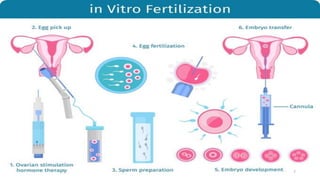
Steps
 Collection of oocytes
 Collection of sperms
 IVF of the oocytes
 Implantation of resulting zygote into the uterus
6
7
In vitro fertilization
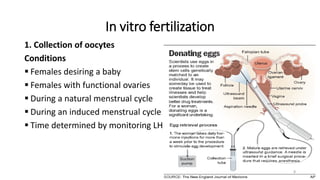
1. Collection of oocytes
Conditions
 Females desiring a baby
 Females with functional ovaries
 During a natural menstrual cycle
 During an induced menstrual cycle
 Time determined by monitoring LH
8
In vitro fertilization
Procedure:
Recovery of oocytes can be done most conveniently by a laparoscopic
instrument that allows the visualization of ovary through a monitor,
aspiration (suction) of the follicular fluid containing the oocytes and the
necessary surgical manipulation of ovary using sensors, laparoscopic
scissors and an aspirating apparatus inserted into the abdomen of the
female via a suitable tube.
9
In vitro fertilization
2. Collection of sperm
 Abstain from sexual intercourse or masturbation for 2 – 5 days
 Sperm cells can be collected by masturbation, condomistic intercourse,
coitus interruption, surgical aspiration etc.
 Collected about 60-90 minutes prior to fertilization, liquefied (Liquefaction
is the breakdown of the gel portion of the seminal plasma) and
centrifuged (Centrifugation is utilized when processing semen for freezing
or to remove seminal plasma that has been contaminated with urine
during semen collection).
 Resuspended in culture medium, and incubated for 30-60 mins at 37⁰ C.
 The most active sperms are located in the surface of the medium.
10
In vitro fertilization
Terminologies of sperm analysis
 Oligospermia – sperm concentration <15 million/ml.
 Azoospermia – no spermatozoa in semen.
 Polyzoospermia – ++ high sperm concentration, >200M/m
 Aspermia – no semen volume
 Pyospermia – leukocytes present in semen, >1M/ml
 Hematospermia – red blood cell present in semen
 Necrozoospermia – “dead” sperm
11
In vitro fertilization
Indicators for donor sperm IVF
 Azoospermia with testicular failure
 Hereditary disease in men
 Severe untreatable isoimmunisation in wife
 Single women, lesbian couples etc.
 Vasectomy
 Husband impotent
12
In vitro fertilization
3. IVF of the oocytes
Fertilization is started by adding 10,00050,000 motile sperms to about 100
µl to 1 ml culture medium in which the oocytes is being incubated.
The oocytes is examined after 12-13 hourrs for detection of;
 Number of pronuclei and polar bodies
 Granulation of the oocytes and
 Shape of the oocytes
A normally fertilized oocyte (actually a zygote now) contains two pronuclei
and two polar bodies. Any zygote other than this and having abnormalities
and granulation of any kind are rejected.
13
In vitro fertilization
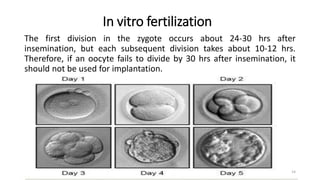
The first division in the zygote occurs about 24-30 hrs after
insemination, but each subsequent division takes about 10-12 hrs.
Therefore, if an oocyte fails to divide by 30 hrs after insemination, it
should not be used for implantation.
14
In vitro fertilization
Day 0 Egg retrieval, Sperm collection, and preparation
Insemination in vitro
Day 1: Check eggs for fertilization (the presence of two pronuclei or
PN's)
Day 2: Embryos at the 4-cell or more stage of development
Day 3: Embryos at the 8-cell or more stage of development
Day 4: Embryos at the compacted morula (16-32 cell) stage
Day 5: Embryos at the blastocyst stage of development
15
In vitro fertilization
4. Embryo transfer
A blastocyst transfer is an embryo transfer which involves transferring
one or more embryos that are at a very advanced stage of
development, the so-called blastocyst stage. This is usually done on the
fifth day after follicular aspiration.
It is at the blastocyst stage of development (five days after fertilisation)
that an embryo would normally move out of the fallopian tube and into
the uterus. Once in the uterus, the blastocyst starts to attach to the
uterine lining in a process known as implantation.
16
In vitro fertilization
• The advantage of attempting to grow embryos to the blastocyst stage
is that they should have a greater chance of implantation because
the phase of embryo development matches the uterine environment.
As a result, fewer embryos can be replaced, which will minimise the
risk of a multiple pregnancy.
• The disadvantage is that fewer embryos will “survive” or grow to
this phase (probably about 30%-50% of them).
17
In vitro fertilization
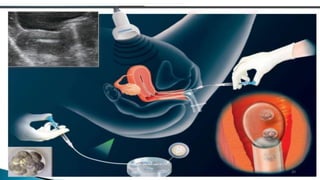
Embryo transfer technique
The patient is orally administered with Valium before embryo
transfer.
The patient is placed in lithotomy (knee chest) position.
A sterile bivalve speculum is inserted to visualize the cervix.
The cervical canal and uterine cavity are aligned.
The embryo is drawn into a Teflon catheter in tissue culture
medium. Teflon is used due to its low adhesiveness
The catheter is inserted into the uterine cavity just short of the
fundus. 18
In vitro fertilization
Embryo transfer technique
The embryo is gently inserted in culture medium and the catheter
and cannula are gently withdrawn.
Catheter is examined under the microscope to ensure that the
embryo has been expelled.
The babies produced using these approaches are called test tube
babies.
The first test tube baby was born on July 25, 1978 and was named
Louise Joy Brown.
The Nobel Prize of Medicine for the year 2010 was awarded to
Robert G. Edwards for this outstanding invention 19
20
In vitro fertilization
IVF success rate
 IVF success rates are the percentage of all IVF procedures
which result in a favourable outcome, which implies
Pregnancy rate (Number of confirmed pregnancies) or Live
birth rate (Number of live births).
Due to advancement in reproductive technology, the IVF
success rates are substantially better today than they were
just a few years ago.
21
In vitro fertilization
Factors affecting success rate
• Maternal age
• Duration of infertility or sub-fertility
• FSH
• Number of oocytes
• Tobacco smoking
• High body mass index
• Alcohol/caffeine intake
Assignment: Briefly explain how these factors can affect IVF success
rate
22
Other Methods of Assisted Reproduction
A. Pre-implantation genetic screening or diagnosis (PGS or PGD):
Preimplantation genetic screening (PGS) or preimplantation genetic
diagnosis (PGD) has been suggested to be able to be used in IVF to
select an embryo that appears to have the greatest chances for
successful pregnancy.
B. Embryo splitting: It can be used for twinning to increase the
number of available embryos.
C. Intra cytoplasmic sperm injection It is an in vitro fertilization
procedure in which a single sperm is injected directly into an egg.
23
Other Methods of Assisted Reproduction
D. Assisted zona hatching: is a procedure in which a small hole is
made in the zona pellucida, using a micromanipulation, thereby
facilitating for zona hatching to occur. Zona hatching is where
the blastocyst gets rid of the surrounding zona pellucida to be
able to implant in the uterus.
E. Gamete intrafallopian transfer (GIFT): eggs are removed from
the woman, and placed in one of the fallopian tubes, along with
the man's sperm. This allows fertilization to take place inside
the woman's body. Therefore, this variation is actually an in
vivo fertilization, and not an in vitro fertilization. 24
Other Methods of Assisted Reproduction
F. Zygote intrafallopian transfer (ZIFT): Egg cells are removed
from a woman's ovaries, and in vitro fertilized. The resulting
zygote is placed into the fallopian tube by the use of
laparoscopy.
25
Ethical issues
Laboratory mix-ups (misidentified gametes, transfer of wrong
embryos) have occurred, leading to legal action against the
IVF provider and complex paternity suits.
An example is the case of a woman in California who received
the embryo of another couple and was notified of this mistake
after the birth of her son. This has led to many authorities and
individual clinics implementing procedures to minimise the
risk of such mix-ups.
26
Ethical issues
The Catholic Church opposes all kinds of in vitro fertilisation
because, as with contraception, it separates the procreative
purpose of the marriage act from its unitive purpose, i.e. to
produce a new life.
Pre-implantation screening: A deaf British couple have
petitioned to create a deaf baby using IVF. Medical ethicists
are against this form of Pre-implantation genetic screening or
diagnosis
27
Ethical issues
Use of donor eggs/sperms
Parentage: Who are the parents? Are they the ones whose genetic
material (sperm and egg) combine to form the child or the people who
raise the child?
Disclosure: Should children know that one or both of his or her
(rearing) parents did not provide the egg or sperm which brought them
into being?
Should children have access to the donor(s) (genetic parents)?
Should genetic parents have visitation rights?
28
Ethical issues
Embryo cryopreservation (the process of preserving an embryo at sub-
zero temperatures, generally at an embryogenesis stage)
Left over embryos are cryopreserved, owners don’t get to use them after
all. Four possible fates for these embryos exist
• Thawing and discarding
• Donating to research
• Indefinite storage
• Donating the embryos to another couple for the purposes of uterine
transfer
In the event of divorce who gets custody of the embryo?
29
Ethical issues
Surrogacy and Gestational carriers
Surrogacy is defined as a woman who agrees to carry a
pregnancy using her own oocytes but the sperm of another
couple and relinquish the child to this couple upon delivery.
A gestational carrier, by contrast, involves a couple who
undergoes IVF with their genetic gametes and then places the
resultant embryo in another woman’s uterus, the gestational
carrier, who will carry the pregnancy and relinquish the child
to this couple upon deliver
30
Ethical issues
Surrogacy and Gestational carriers
 Significant medical and emotional risks from carrying a pregnancy and
undergoing a delivery
 Child selling enterprise -Some also are concerned that the use of
surrogates and gestational carriers is a form of “child selling” or the
“sale of parental rights”
 Parental rights- Possibility of five parents. Genetic father, genetic
mother, Rearing father, Rearing mother, gestational mother.
 Exploitation and commoditization of children.
 Citizenship of the offspring(international surrogacy)
31
THANKS FOR LISTENING
32

Assisted reproductive technology pdf

  • 1.
    ASSISTED REPRODUCTIVE TECHNOLOGY PRESENTED BY: AKUMBOMEURICE NSHITI (BSN, MPH, PhD Cand.) 1
  • 2.
    Outline Introduction Definitions In vitro fertilization Othermethods of assisted reproduction Ethical issues 2
  • 3.
    Introduction • Infertility hastraditionally been an area of medicine in which physicians had limited means to help their patients. • Infertility is the inability of a sexually active, non-contracepting couple to achieve pregnancy in one year. • The landscape of this field changed dramatically with the announcement of the birth of Louise Brown in 1978 through in vitro fertilization (IVF). • However, the explosion of this technology has introduced a myriad of new social, ethical, and legal challenges. 3
  • 4.
    Definition Assisted reproductive technology(ART): all treatments or procedures that involve the in vitro handling of both human oocytes and sperm or of embryos for the purpose of establishing a pregnancy. (Centre for Disease Control). ART involves a number of different procedures to help address fertility problems and increase the likelihood of pregnancy These include:  In vitro fertilization (IVF)  Gamete intrafallopian transfer (GIFT)  Zygote intrafallopian transfer (ZIFT)  Intracytoplasmic sperm injection (ICSI)  Surrogacy 4
  • 5.
    In vitro fertilization Definition:IVF is the uniting of egg and sperm in vitro (in the lab). Subsequently the embryos are transferred into the uterus through the cervix and pregnancy is allowed to begin. Who need IVF? Couple has infertility problem.  Men with low sperm count, abnormal sperm, no mature sperm, antibody against sperms etc.  Women with oviduct obstruction, endometriosis, endocrine imbalance, reproductive organ infection, antibody against partner’s sperms etc. 5
  • 6.
    In vitro fertilization Steps Collection of oocytes  Collection of sperms  IVF of the oocytes  Implantation of resulting zygote into the uterus 6
  • 7.
  • 8.
    In vitro fertilization 1.Collection of oocytes Conditions  Females desiring a baby  Females with functional ovaries  During a natural menstrual cycle  During an induced menstrual cycle  Time determined by monitoring LH 8
  • 9.
    In vitro fertilization Procedure: Recoveryof oocytes can be done most conveniently by a laparoscopic instrument that allows the visualization of ovary through a monitor, aspiration (suction) of the follicular fluid containing the oocytes and the necessary surgical manipulation of ovary using sensors, laparoscopic scissors and an aspirating apparatus inserted into the abdomen of the female via a suitable tube. 9
  • 10.
    In vitro fertilization 2.Collection of sperm  Abstain from sexual intercourse or masturbation for 2 – 5 days  Sperm cells can be collected by masturbation, condomistic intercourse, coitus interruption, surgical aspiration etc.  Collected about 60-90 minutes prior to fertilization, liquefied (Liquefaction is the breakdown of the gel portion of the seminal plasma) and centrifuged (Centrifugation is utilized when processing semen for freezing or to remove seminal plasma that has been contaminated with urine during semen collection).  Resuspended in culture medium, and incubated for 30-60 mins at 37⁰ C.  The most active sperms are located in the surface of the medium. 10
  • 11.
    In vitro fertilization Terminologiesof sperm analysis  Oligospermia – sperm concentration <15 million/ml.  Azoospermia – no spermatozoa in semen.  Polyzoospermia – ++ high sperm concentration, >200M/m  Aspermia – no semen volume  Pyospermia – leukocytes present in semen, >1M/ml  Hematospermia – red blood cell present in semen  Necrozoospermia – “dead” sperm 11
  • 12.
    In vitro fertilization Indicatorsfor donor sperm IVF  Azoospermia with testicular failure  Hereditary disease in men  Severe untreatable isoimmunisation in wife  Single women, lesbian couples etc.  Vasectomy  Husband impotent 12
  • 13.
    In vitro fertilization 3.IVF of the oocytes Fertilization is started by adding 10,00050,000 motile sperms to about 100 µl to 1 ml culture medium in which the oocytes is being incubated. The oocytes is examined after 12-13 hourrs for detection of;  Number of pronuclei and polar bodies  Granulation of the oocytes and  Shape of the oocytes A normally fertilized oocyte (actually a zygote now) contains two pronuclei and two polar bodies. Any zygote other than this and having abnormalities and granulation of any kind are rejected. 13
  • 14.
    In vitro fertilization Thefirst division in the zygote occurs about 24-30 hrs after insemination, but each subsequent division takes about 10-12 hrs. Therefore, if an oocyte fails to divide by 30 hrs after insemination, it should not be used for implantation. 14
  • 15.
    In vitro fertilization Day0 Egg retrieval, Sperm collection, and preparation Insemination in vitro Day 1: Check eggs for fertilization (the presence of two pronuclei or PN's) Day 2: Embryos at the 4-cell or more stage of development Day 3: Embryos at the 8-cell or more stage of development Day 4: Embryos at the compacted morula (16-32 cell) stage Day 5: Embryos at the blastocyst stage of development 15
  • 16.
    In vitro fertilization 4.Embryo transfer A blastocyst transfer is an embryo transfer which involves transferring one or more embryos that are at a very advanced stage of development, the so-called blastocyst stage. This is usually done on the fifth day after follicular aspiration. It is at the blastocyst stage of development (five days after fertilisation) that an embryo would normally move out of the fallopian tube and into the uterus. Once in the uterus, the blastocyst starts to attach to the uterine lining in a process known as implantation. 16
  • 17.
    In vitro fertilization •The advantage of attempting to grow embryos to the blastocyst stage is that they should have a greater chance of implantation because the phase of embryo development matches the uterine environment. As a result, fewer embryos can be replaced, which will minimise the risk of a multiple pregnancy. • The disadvantage is that fewer embryos will “survive” or grow to this phase (probably about 30%-50% of them). 17
  • 18.
    In vitro fertilization Embryotransfer technique The patient is orally administered with Valium before embryo transfer. The patient is placed in lithotomy (knee chest) position. A sterile bivalve speculum is inserted to visualize the cervix. The cervical canal and uterine cavity are aligned. The embryo is drawn into a Teflon catheter in tissue culture medium. Teflon is used due to its low adhesiveness The catheter is inserted into the uterine cavity just short of the fundus. 18
  • 19.
    In vitro fertilization Embryotransfer technique The embryo is gently inserted in culture medium and the catheter and cannula are gently withdrawn. Catheter is examined under the microscope to ensure that the embryo has been expelled. The babies produced using these approaches are called test tube babies. The first test tube baby was born on July 25, 1978 and was named Louise Joy Brown. The Nobel Prize of Medicine for the year 2010 was awarded to Robert G. Edwards for this outstanding invention 19
  • 20.
  • 21.
    In vitro fertilization IVFsuccess rate  IVF success rates are the percentage of all IVF procedures which result in a favourable outcome, which implies Pregnancy rate (Number of confirmed pregnancies) or Live birth rate (Number of live births). Due to advancement in reproductive technology, the IVF success rates are substantially better today than they were just a few years ago. 21
  • 22.
    In vitro fertilization Factorsaffecting success rate • Maternal age • Duration of infertility or sub-fertility • FSH • Number of oocytes • Tobacco smoking • High body mass index • Alcohol/caffeine intake Assignment: Briefly explain how these factors can affect IVF success rate 22
  • 23.
    Other Methods ofAssisted Reproduction A. Pre-implantation genetic screening or diagnosis (PGS or PGD): Preimplantation genetic screening (PGS) or preimplantation genetic diagnosis (PGD) has been suggested to be able to be used in IVF to select an embryo that appears to have the greatest chances for successful pregnancy. B. Embryo splitting: It can be used for twinning to increase the number of available embryos. C. Intra cytoplasmic sperm injection It is an in vitro fertilization procedure in which a single sperm is injected directly into an egg. 23
  • 24.
    Other Methods ofAssisted Reproduction D. Assisted zona hatching: is a procedure in which a small hole is made in the zona pellucida, using a micromanipulation, thereby facilitating for zona hatching to occur. Zona hatching is where the blastocyst gets rid of the surrounding zona pellucida to be able to implant in the uterus. E. Gamete intrafallopian transfer (GIFT): eggs are removed from the woman, and placed in one of the fallopian tubes, along with the man's sperm. This allows fertilization to take place inside the woman's body. Therefore, this variation is actually an in vivo fertilization, and not an in vitro fertilization. 24
  • 25.
    Other Methods ofAssisted Reproduction F. Zygote intrafallopian transfer (ZIFT): Egg cells are removed from a woman's ovaries, and in vitro fertilized. The resulting zygote is placed into the fallopian tube by the use of laparoscopy. 25
  • 26.
    Ethical issues Laboratory mix-ups(misidentified gametes, transfer of wrong embryos) have occurred, leading to legal action against the IVF provider and complex paternity suits. An example is the case of a woman in California who received the embryo of another couple and was notified of this mistake after the birth of her son. This has led to many authorities and individual clinics implementing procedures to minimise the risk of such mix-ups. 26
  • 27.
    Ethical issues The CatholicChurch opposes all kinds of in vitro fertilisation because, as with contraception, it separates the procreative purpose of the marriage act from its unitive purpose, i.e. to produce a new life. Pre-implantation screening: A deaf British couple have petitioned to create a deaf baby using IVF. Medical ethicists are against this form of Pre-implantation genetic screening or diagnosis 27
  • 28.
    Ethical issues Use ofdonor eggs/sperms Parentage: Who are the parents? Are they the ones whose genetic material (sperm and egg) combine to form the child or the people who raise the child? Disclosure: Should children know that one or both of his or her (rearing) parents did not provide the egg or sperm which brought them into being? Should children have access to the donor(s) (genetic parents)? Should genetic parents have visitation rights? 28
  • 29.
    Ethical issues Embryo cryopreservation(the process of preserving an embryo at sub- zero temperatures, generally at an embryogenesis stage) Left over embryos are cryopreserved, owners don’t get to use them after all. Four possible fates for these embryos exist • Thawing and discarding • Donating to research • Indefinite storage • Donating the embryos to another couple for the purposes of uterine transfer In the event of divorce who gets custody of the embryo? 29
  • 30.
    Ethical issues Surrogacy andGestational carriers Surrogacy is defined as a woman who agrees to carry a pregnancy using her own oocytes but the sperm of another couple and relinquish the child to this couple upon delivery. A gestational carrier, by contrast, involves a couple who undergoes IVF with their genetic gametes and then places the resultant embryo in another woman’s uterus, the gestational carrier, who will carry the pregnancy and relinquish the child to this couple upon deliver 30
  • 31.
    Ethical issues Surrogacy andGestational carriers  Significant medical and emotional risks from carrying a pregnancy and undergoing a delivery  Child selling enterprise -Some also are concerned that the use of surrogates and gestational carriers is a form of “child selling” or the “sale of parental rights”  Parental rights- Possibility of five parents. Genetic father, genetic mother, Rearing father, Rearing mother, gestational mother.  Exploitation and commoditization of children.  Citizenship of the offspring(international surrogacy) 31
  • 32.