IN VITRO FERTILIZATION
What Is in Vitro Fertilization
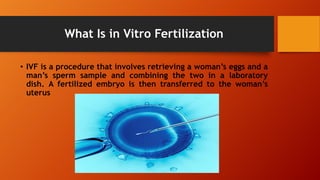
• IVF is a procedure that involves retrieving a woman’s eggs and a
man’s sperm sample and combining the two in a laboratory
dish. A fertilized embryo is then transferred to the woman’s
uterus
History of in Vitro Fertilization
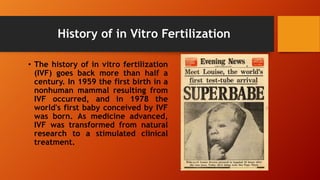
• The history of in vitro fertilization
(IVF) goes back more than half a
century. In 1959 the first birth in a
nonhuman mammal resulting from
IVF occurred, and in 1978 the
world's first baby conceived by IVF
was born. As medicine advanced,
IVF was transformed from natural
research to a stimulated clinical
treatment.
Methods of in Vitro Fertilization
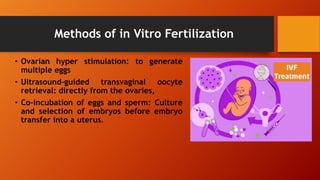
• Ovarian hyper stimulation: to generate
multiple eggs
• Ultrasound-guided transvaginal oocyte
retrieval: directly from the ovaries,
• Co-incubation of eggs and sperm: Culture
and selection of embryos before embryo
transfer into a uterus.
The Ethics of in Vitro Fertilization
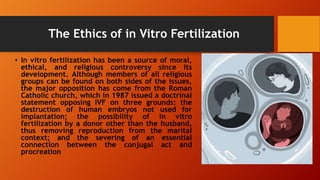
• In vitro fertilization has been a source of moral,
ethical, and religious controversy since its
development. Although members of all religious
groups can be found on both sides of the issues,
the major opposition has come from the Roman
Catholic church, which in 1987 issued a doctrinal
statement opposing IVF on three grounds: the
destruction of human embryos not used for
implantation; the possibility of in vitro
fertilization by a donor other than the husband,
thus removing reproduction from the marital
context; and the severing of an essential
connection between the conjugal act and
procreation
Legal status of in Vitro Fertilization
• The legal status of in vitro fertilization varies from country to
country, because this treatment is tied directly with the
different moral, religious and ethical considerations of each
culture.
How Does in Vitro Fertilization Work?
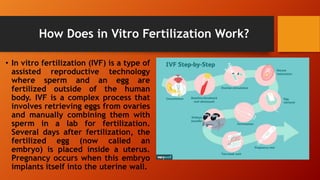
• In vitro fertilization (IVF) is a type of
assisted reproductive technology
where sperm and an egg are
fertilized outside of the human
body. IVF is a complex process that
involves retrieving eggs from ovaries
and manually combining them with
sperm in a lab for fertilization.
Several days after fertilization, the
fertilized egg (now called an
embryo) is placed inside a uterus.
Pregnancy occurs when this embryo
implants itself into the uterine wall.
Why is IVF performed
• People choose IVF for many reasons, including infertility issues or when
one partner has an existing health condition. Some people will try IVF after
other fertility methods have failed or if they’re at an advanced maternal
age. IVF is also a reproductive option for same-sex couples or people who
wish to have a baby without a partner.
IVF is an option if you or your partner has:
• Blocked or damaged fallopian tubes.
• Endometriosis.
• Low sperm count or other sperm impairments.
• Polycystic ovary syndrome (PCOS) or other ovarian conditions.
• Uterine fibroids.
• Problems with your uterus.
• Risk of passing on a genetic disease or disorder.
• Unexplained infertility.
• Are using an egg donor or a gestational surrogate.
Risks
There are several risks associated with IVF treatment:
• Multiple births: A pregnancy with multiple babies carries
a higher risk of premature labor.
• Premature delivery: You may have a slightly higher risk
of your baby being born early or at a lower birth weight.
• Miscarriage: The rate of miscarriage is about the same as
pregnancies from natural conception.
• Ectopic pregnancy: This is a condition where your
fertilized egg implants outside of your uterus.
• Complications during egg retrieval: Bleeding, infection
and damage to your bladder, bowel or reproductive
organs during the egg retrieval process.
• Ovarian hyperstimulation syndrome (OHSS): A rare
condition that causes abdominal pain, nausea, vomiting,
diarrhea, rapid weight gain, bloating, shortness of breath
and inability to urinate.
Treatment
IVF can be broken down into the following steps:
• Birth control pills or estrogen
• Ovarian stimulation
• Egg retrieval
• Fertilization
• Embryo development
• Embryo transfer
• Pregnancy
Recovery and Outlook
• The age of the patient is one of the
strongest factors in the success of IVF. the
chance of becoming pregnant through IVF is
much higher if the patient is under 35 years
old, and lower if they are over 40 years old.
The live birth rate also varies and is strongly
associated with age. For example, the live
birth rate when the birthing parent is under
35 and using their own eggs is around 46%,
while the birth rate of a 38-year-old using
their own eggs is about 22%.
Conclusion
• We can say that in modern medicine
procedures are often created with the
aim of resolving underlying conditions
that are making the life of a patient
more difficult; the act of conceiving a
child is not always easy, the causes of
these difficulties can vary from person to
person, but, with the aim of solving
these problems, medical science has
given rise to many fertility treatments,
of which the treatment known as in vitro
fertilization (IVF) is the most successful
currently available
IN VITRO FERTILIZATION PRESENTATION.pptx

IN VITRO FERTILIZATION PRESENTATION.pptx

  • 1.
  • 2.
    What Is inVitro Fertilization • IVF is a procedure that involves retrieving a woman’s eggs and a man’s sperm sample and combining the two in a laboratory dish. A fertilized embryo is then transferred to the woman’s uterus
  • 3.
    History of inVitro Fertilization • The history of in vitro fertilization (IVF) goes back more than half a century. In 1959 the first birth in a nonhuman mammal resulting from IVF occurred, and in 1978 the world's first baby conceived by IVF was born. As medicine advanced, IVF was transformed from natural research to a stimulated clinical treatment.
  • 4.
    Methods of inVitro Fertilization • Ovarian hyper stimulation: to generate multiple eggs • Ultrasound-guided transvaginal oocyte retrieval: directly from the ovaries, • Co-incubation of eggs and sperm: Culture and selection of embryos before embryo transfer into a uterus.
  • 5.
    The Ethics ofin Vitro Fertilization • In vitro fertilization has been a source of moral, ethical, and religious controversy since its development. Although members of all religious groups can be found on both sides of the issues, the major opposition has come from the Roman Catholic church, which in 1987 issued a doctrinal statement opposing IVF on three grounds: the destruction of human embryos not used for implantation; the possibility of in vitro fertilization by a donor other than the husband, thus removing reproduction from the marital context; and the severing of an essential connection between the conjugal act and procreation
  • 6.
    Legal status ofin Vitro Fertilization • The legal status of in vitro fertilization varies from country to country, because this treatment is tied directly with the different moral, religious and ethical considerations of each culture.
  • 7.
    How Does inVitro Fertilization Work? • In vitro fertilization (IVF) is a type of assisted reproductive technology where sperm and an egg are fertilized outside of the human body. IVF is a complex process that involves retrieving eggs from ovaries and manually combining them with sperm in a lab for fertilization. Several days after fertilization, the fertilized egg (now called an embryo) is placed inside a uterus. Pregnancy occurs when this embryo implants itself into the uterine wall.
  • 8.
    Why is IVFperformed • People choose IVF for many reasons, including infertility issues or when one partner has an existing health condition. Some people will try IVF after other fertility methods have failed or if they’re at an advanced maternal age. IVF is also a reproductive option for same-sex couples or people who wish to have a baby without a partner. IVF is an option if you or your partner has: • Blocked or damaged fallopian tubes. • Endometriosis. • Low sperm count or other sperm impairments. • Polycystic ovary syndrome (PCOS) or other ovarian conditions. • Uterine fibroids. • Problems with your uterus. • Risk of passing on a genetic disease or disorder. • Unexplained infertility. • Are using an egg donor or a gestational surrogate.
  • 9.
    Risks There are severalrisks associated with IVF treatment: • Multiple births: A pregnancy with multiple babies carries a higher risk of premature labor. • Premature delivery: You may have a slightly higher risk of your baby being born early or at a lower birth weight. • Miscarriage: The rate of miscarriage is about the same as pregnancies from natural conception. • Ectopic pregnancy: This is a condition where your fertilized egg implants outside of your uterus. • Complications during egg retrieval: Bleeding, infection and damage to your bladder, bowel or reproductive organs during the egg retrieval process. • Ovarian hyperstimulation syndrome (OHSS): A rare condition that causes abdominal pain, nausea, vomiting, diarrhea, rapid weight gain, bloating, shortness of breath and inability to urinate.
  • 10.
    Treatment IVF can bebroken down into the following steps: • Birth control pills or estrogen • Ovarian stimulation • Egg retrieval • Fertilization • Embryo development • Embryo transfer • Pregnancy
  • 11.
    Recovery and Outlook •The age of the patient is one of the strongest factors in the success of IVF. the chance of becoming pregnant through IVF is much higher if the patient is under 35 years old, and lower if they are over 40 years old. The live birth rate also varies and is strongly associated with age. For example, the live birth rate when the birthing parent is under 35 and using their own eggs is around 46%, while the birth rate of a 38-year-old using their own eggs is about 22%.
  • 12.
    Conclusion • We cansay that in modern medicine procedures are often created with the aim of resolving underlying conditions that are making the life of a patient more difficult; the act of conceiving a child is not always easy, the causes of these difficulties can vary from person to person, but, with the aim of solving these problems, medical science has given rise to many fertility treatments, of which the treatment known as in vitro fertilization (IVF) is the most successful currently available