IMS-PSTN
Interworking Flow
IP Multimedia Subsystem Series
IMS-PSTN Interworking Elements
P-CSCF
I-CSCF
S-CSCFHSS
UE
ASService
Session
Control
Access
MRFC
MRFP
MGCF
MGW
PSTN
BGCF
PSTN Originating
P-CSCF
UE
S-CSCF
AS
(11) Invite
(10) Invite
(8) Invite
(9) 200 OK
MGW
I-CSCF
HSS
MGCF
(4) Invite(7) Invite
(6)
(5)
PSTN
(3)
(2)
(1) IAM
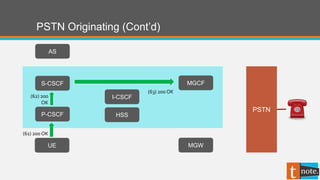
PSTN Originating (Cont’d)
P-CSCF
UE
S-CSCF
AS
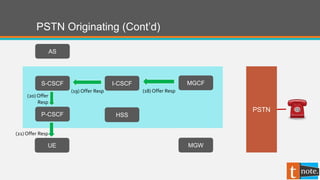
(12) Offer Resp
(13) Offer
Resp
MGW
I-CSCF
HSS
MGCF
(15) Offer Resp(14) Offer Resp
PSTN
(17)
(16)
PSTN Originating (Cont’d)
P-CSCF
UE
S-CSCF
AS
(21) Offer Resp
(20) Offer
Resp
MGW
I-CSCF
HSS
MGCF
(18) Offer Resp(19) Offer Resp
PSTN
PSTN Originating (Cont’d)
P-CSCF
UE
S-CSCF
AS
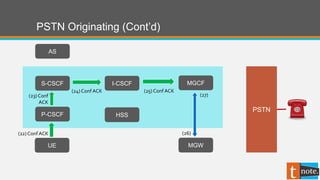
(22) Conf ACK
(23) Conf
ACK
MGW
I-CSCF
HSS
MGCF
(25) Conf ACK(24) Conf ACK
PSTN
(27)
(26)
PSTN Originating (Cont’d)
P-CSCF
UE
S-CSCF
AS
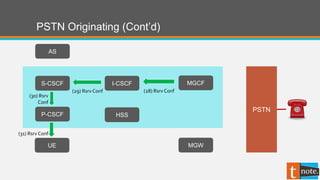
(31) Rsrv Conf
(30) Rsrv
Conf
MGW
I-CSCF
HSS
MGCF
(28) Rsrv Conf(29) Rsrv Conf
PSTN
PSTN Originating (Cont’d)
P-CSCF
UE
S-CSCF
AS
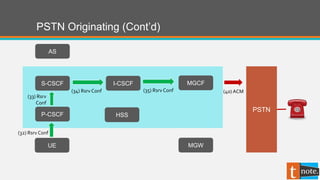
(32) Rsrv Conf
MGW
I-CSCF
HSS
MGCF
PSTN
(40) ACM
(33) Rsrv
Conf
(34) Rsrv Conf (35) Rsrv Conf
PSTN Originating (Cont’d)
P-CSCF
UE
S-CSCF
AS
(37) 180
Ringing
MGW
I-CSCF
HSS
MGCF
(39) 180 Ringing(38) 180 Ringing
PSTN
(40) ACM
(36) 180 Ringing
PSTN Originating (Cont’d)
P-CSCF
UE
S-CSCF
AS
(41) 200 OK
MGW
I-CSCF
HSS
MGCF
(44) 200 OK(43) 200 OK
PSTN
(45) ANM
(42) 200
OK
(47)
(46)
PSTN Originating (Cont’d)
P-CSCF
UE
S-CSCF
AS
(51)ACK
(50) ACK
MGW
I-CSCF
HSS
MGCF
(48) ACK(49) ACK
PSTN
Media Media
PSTN Originating (Cont’d)
P-CSCF
UE
S-CSCF
AS
(60) BYE
(59) BYE
MGW
I-CSCF
HSS
MGCF
(53) BYE
PSTN
(52) REL
(54) RLC
(57) BYE
(58) 200 OK
(56)
(55)
PSTN Originating (Cont’d)
P-CSCF
UE
S-CSCF
AS
(61) 200 OK
(62) 200
OK
MGW
I-CSCF
HSS
MGCF
(63) 200 OK
PSTN
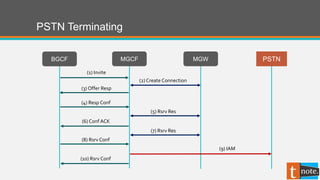
PSTN Terminating
MGWMGCF
(1) Invite
PSTN
(3) Offer Resp
(4) Resp Conf
(6) Conf ACK
(8) Rsrv Conf
(2) Create Connection
(5) Rsrv Res
(7) Rsrv Res
(9) IAM
(10) Rsrv Conf
BGCF
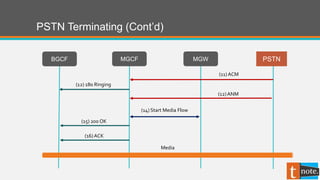
PSTN Terminating (Cont’d)
(11)ACM
(12) 180 Ringing
(12)ANM
(14) Start Media Flow
(15) 200 OK
(16)ACK
Media
MGWMGCF PSTNBGCF
thank you

IMS-PSTN Interworking Flow

Editor's Notes

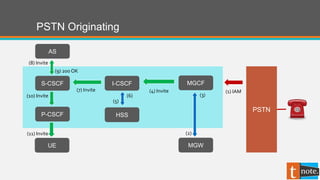
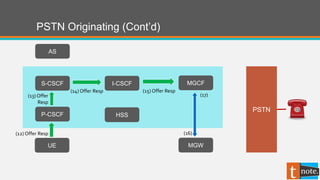
  • #5 15. The media stream capabilities of the destination are returned along the signalling path, per the S-S procedures; 16-17. MGCF initiates a H.248 command to modify the connection parameters and instruct the MGW to reserve the resources needed for the session.
  • #7 25. Terminating end point responds to the Response Confirmation. If Optional SDP is contained in the Response Confirmation, the Confirmation Acknowledge will also contain an SDP response; 26-27. MGW reserves the resources needed for the session.
  • #8 28. When the resource reservation is completed, MGCF sends the successful Resource Reservation message to the terminating endpoint, per the S-S procedures.
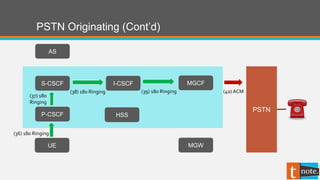
  • #9 32-35. Terminating end point responds to the successful media resource reservation; 36-39. The destination endpoint may optionally perform alerting. If so, it signals this to the originating party by a provisional response indicating Ringing. This message is sent to MGCF per the S-S procedure; 40. If alerting is being performed, the MGCF forwards an ACM message to PSTN.
  • #10 32-35. Terminating end point responds to the successful media resource reservation; 36-39. The destination endpoint may optionally perform alerting. If so, it signals this to the originating party by a provisional response indicating Ringing. This message is sent to MGCF per the S-S procedure; 40. If alerting is being performed, the MGCF forwards an ACM message to PSTN.
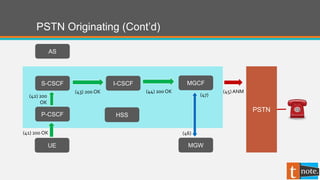
  • #11 41-44. When the destination party answers, the terminating and S-S procedures result in a SIP 200-OK final response being sent to MGCF; 45. MGCF forwards an ANM message to the PSTN. 46-47. MGCF initiates a H.248 command to alter the connection at MGW to make it bi-directional.
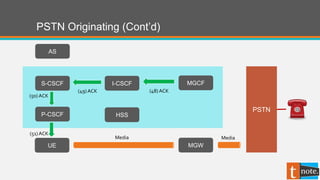
  • #12 48-51. MGCF acknowledges the SIP final response with a SIP ACK message.
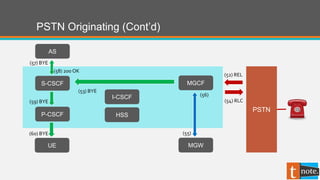
  • #13 52. PSTN party hangs up, which generates an ISUP REL message to the MGCF; 53. The MGCF sends a Hangup (Bye message in SIP) to the S‑CSCF to notify the terminal that the far end party has disconnected; 54. The MGCF notes the reception of the REL and acknowledges it with an RLC. This is consistent with the ISUP protocol; 55. The MGCF requests the MGW to release the vocoder and ISUP trunk using the H.248/MEGACO Transaction Request (subtract). This also results in disconnecting the two parties in the H.248 context. The IP network resources that were reserved for the message receive path to the PSTN for this session are now released. This is initiated from the MGW. If RSVP was used to allocated resources, then the appropriate release messages for that protocol would be invoked here; 56. The MGW sends an acknowledgement to the MGCF upon completion of above step; 57-58. The S‑CSCF invokes whatever service logic procedures are appropriate for this ending session; 59. The S‑CSCF forwards the Hangup to the P‑CSCF. The P‑CSCF/PCRF removes the authorization for resources that had previously been issued for this endpoint for this session. This step also results in a release indication to the IP‑CAN to confirm that the IP bearers associated with the UE#2 session have been deleted; 60. The P‑CSCF forwards the Hangup to the UE.
  • #14 61. The terminal responds with an acknowledgement, the SIP OK message (number 200), which is sent back to the P‑CSCF. The IP network resources that had been reserved for the message receive path to the endpoint for this session are released, taking into account the bearer establishment mode used for the IP‑CAN session. 62. The SIP OK message is sent to the S‑CSCF. 63. The S‑CSCF forwards the message to the MGCF.
  • #15 The MGCF in the IM CN subsystem is a SIP endpoint that initiates and receives requests on behalf of the PSTN and Media Gateway (MGW).Other nodes consider the signalling as if it came from a BGCF (S‑CSCF). Procedures: MGCF receives an INVITE request, containing an initial SDP, through one of the origination procedures and via one of the inter-serving procedures; MGCF initiates a H.248 interaction to pick an outgoing channel and determine media capabilities of the MGW; MGCF determines the subset of the media flows proposed by the originating endpoint that it supports, and responds with an Offer Response message back to the originator. This response is sent via the S-S procedure; The originating endpoint sends a Response Confirmation. The Response Confirmation may also contain SDP. This may be the same SDP as in the Offer Response sent in Step 3 or a subset. The originating UE is free to continue to offer new media on this operation or on subsequent exchanges using the Update method; MGCF initiates a H.248 interaction to modify the connection established in step #2 and instruct MGW to reserve the resources necessary for the media streams; MGCF responds to the offered media towards the originating party; GW reserved the resources necessary for the media streams; When the originating endpoint has completed its resource reservation, it sends the successful Resource Reservation message to MGCF, via the S-S procedures; MGCF sends an IAM message to the PSTN; MGCF sends response to the successful resource reservation towards originating end.
  • #16 The PSTN establishes the path to the destination. It may optionally alert the destination user before completing the session. If so, it responds with an ACM message; If the PSTN is alerting the destination user, MGCF indicates this to the originating party by a provisional response indicating Ringing. This message is sent via the S-S procedures; When the destination party answers, the PSTN sends an ANM message to MGCF; MGCF initiates a H.248 interaction to make the connection in the MGW bi-directional; MGCF sends a SIP 200-OK final response along the signalling path back to the session originator; The Originating party acknowledges the final response with a SIP ACK message.