Take a sip of SIP
Paul Sarstiuc, Romeo Vidrascu, Marius Trestioreanu
Bucharest
18 April 2016
2
SIP – Session Initiation Protocol
 Content
– VoIP
– SIP History
– SIP Architecture
– Addressing SIP
– SIP Messages
– SIP Flow
– WireShark and SIP Filters
– SIP Flow – WireShark
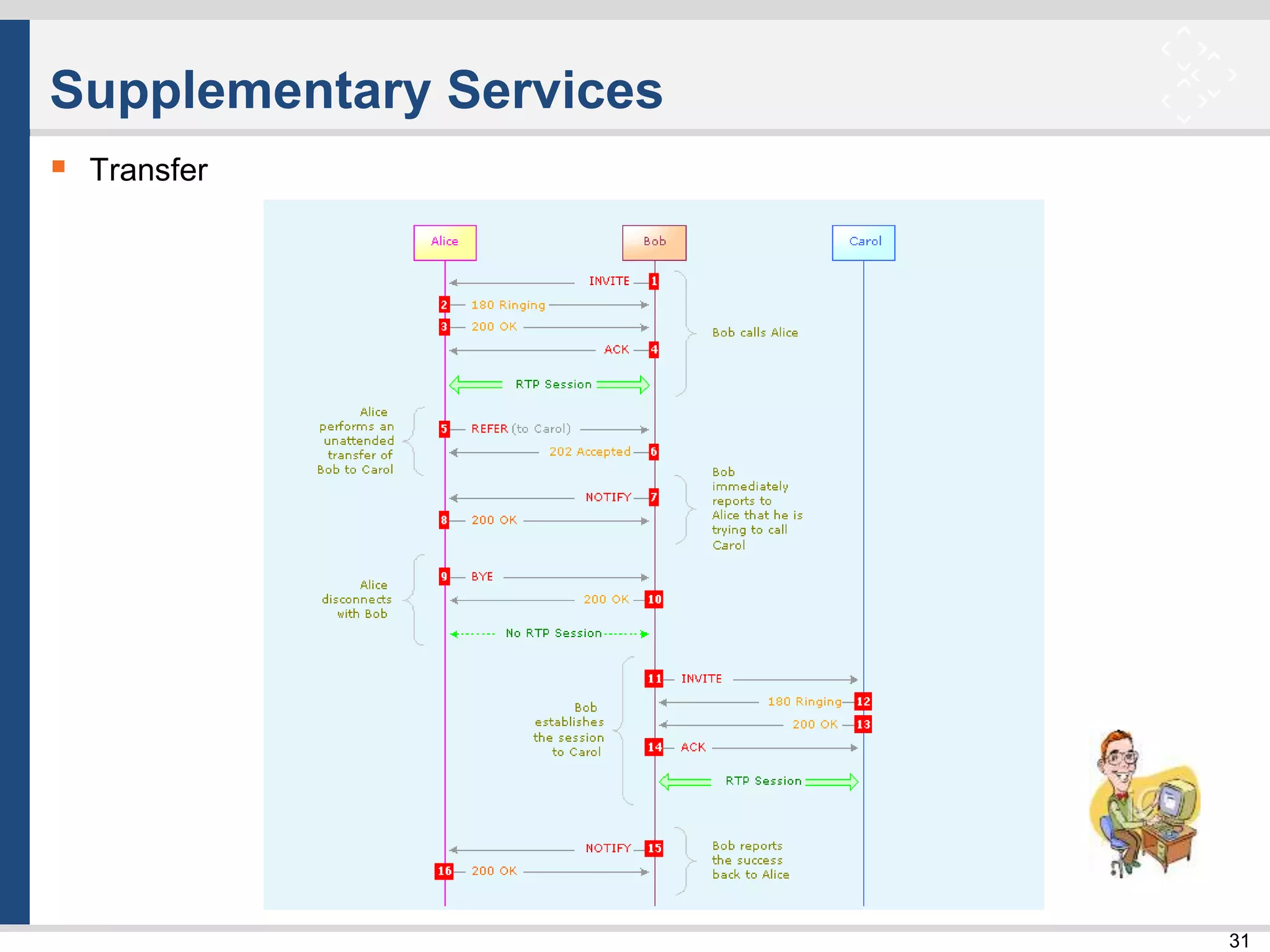
– Supplementary Services
– SDP - WireShark
3
VoIP stereotypes
 VoIP means free calls
 SIP is a collection of protocols
 SIP is better than H323
 SIP is a voice signaling protocol
4
VoIP
 VoIP
– VoIP: Voice over Internet Protocol
 IP Telephony
 Internet Telephony
 Voice over Broadband (VoBB)
 Broadband Telephony
 Broadband Phone
– Alternative to PSTN
– Single infrastructure for Data, Voice and Video
– More demand for video conferences is easily satisfied with VoIP
– Cost savings on long distance calls
– Easier connectivity: customers are to be reached at multiple points
under the same “telephone number”
– Communication Services
 Voice/Video
 Fax
 Voice/Messaging Application
5
VoIP
 VoIP Protocols
– SIP – Session Initiation Protocol
– H.323
– IMS – IP Multimedia Subsystem
– MGCP – Media Gateway Control Protocol
– RTP – Real-time Transport Protocol
– RTCP – Real-time Transport Control Protocol
– SDP – Session Description Protocol
– Skype Protocol (proprietary)
– TCP – Transmission Control Protocol
– UDP – User Datagram Protocol
– TLS – Transport Layer Security
6
SIP OSI
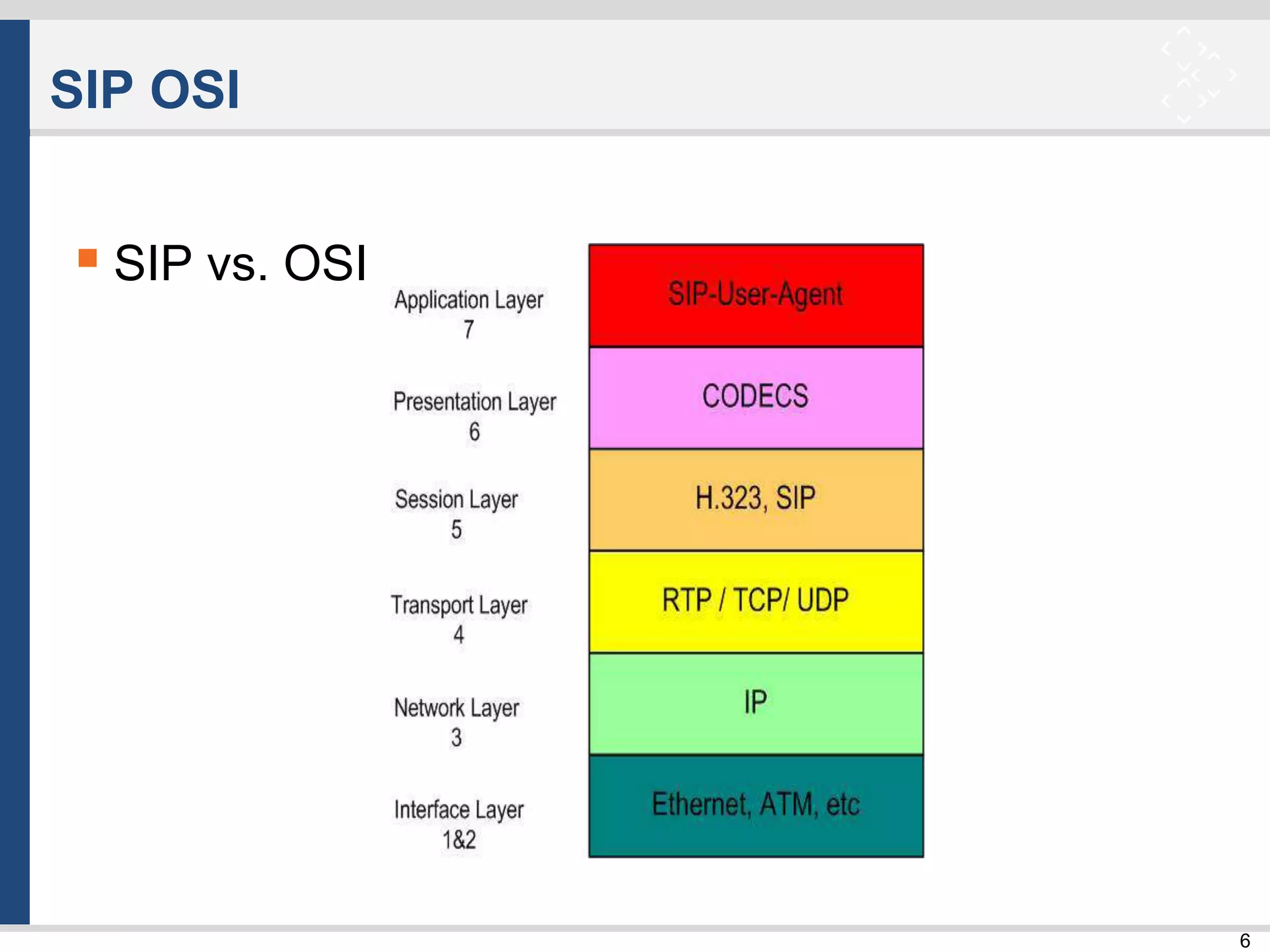
 SIP vs. OSI
7
History
 SIP History
– Feb. 22, 1996 draft-ietf-mmusic-scip-00; IDMS paper
– Feb. 22, 1996 draft-ietf-mmusic-sip-00
– Dec. 2, 1996 draft-ietf-mmusic-sip-01
– March 27, 1997 draft-ietf-mmusic-sip-02
– July 31, 1997 draft-ietf-mmusic-sip-03
– November 11, 1997 draft-ietf-mmusic-sip-04
– May 14, 1998 draft-ietf-mmusic-sip-05
– June 17, 1998 draft-ietf-mmusic-sip-06
– July 16, 1998 draft-ietf-mmusic-sip-07
– August 7, 1998 draft-ietf-mmusic-sip-08
– September 18, 1998 draft-ietf-mmusic-sip-09
– September 28, 1998 Last call
– November 12, 1998 draft-ietf-mmusic-sip-10
– December 15, 1998 draft-ietf-mmusic-sip-11
– January 15, 1999 draft-ietf-mmusic-sip-12
– February 2, 1999 Approved
– March 17, 1999 RFC 2543
– July 3, 2002 RFC 3261 (SIP: Session Initiation Protocol), RFC 3262 (Reliability of Provisional Responses
in Session Initiation Protocol (SIP)), RFC 3263 (Session Initiation Protocol (SIP): Locating SIP Servers), RFC
3264 (An Offer/Answer Model with Session Description Protocol (SDP)), RFC 3265 (Session Initiation Protocol
(SIP)-Specific Event Notification), RFC 3266 (Support for IPv6 in Session Description Protocol (SDP))
published
8
SIP Architecture
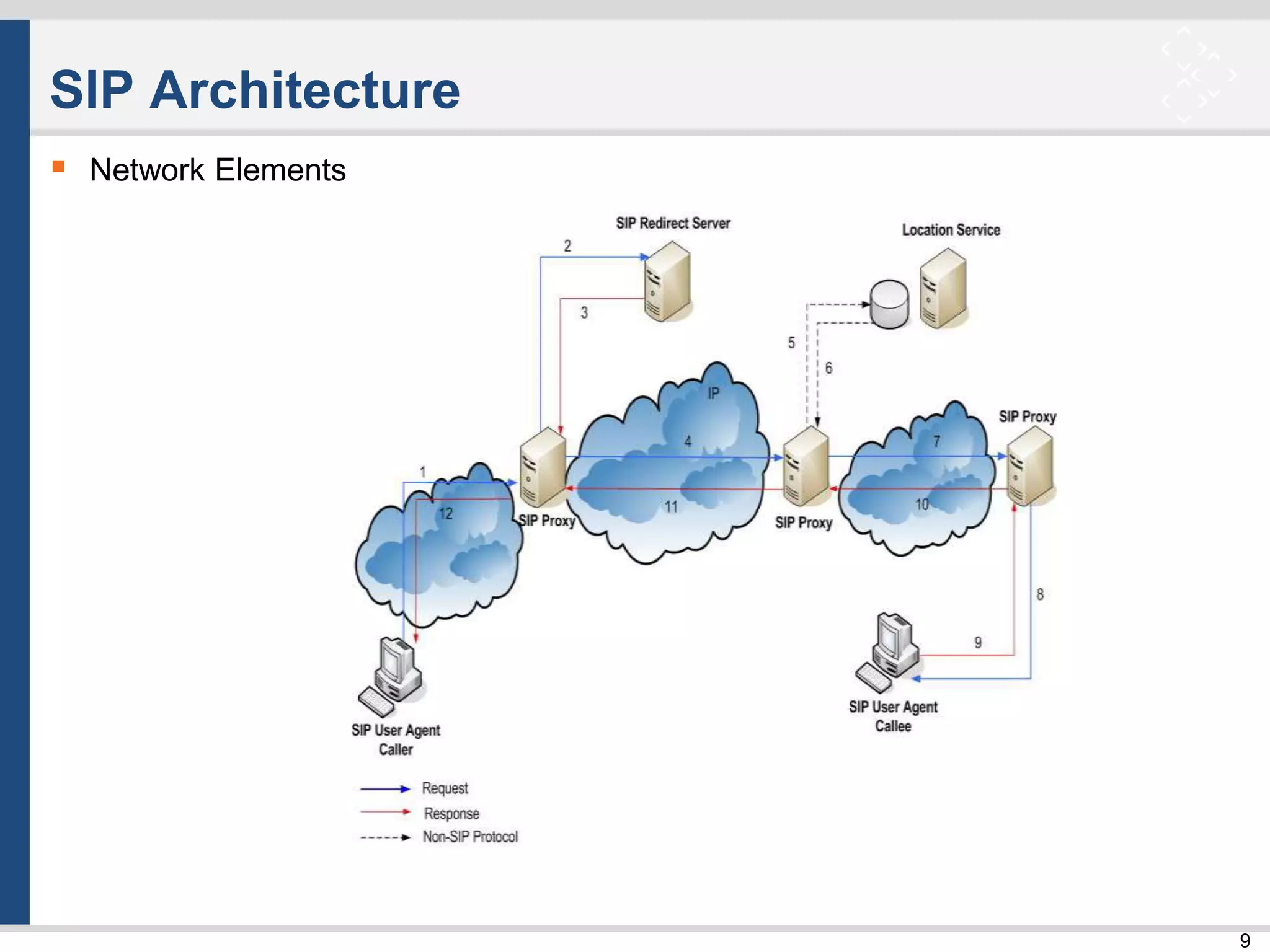
 Network Elements:
– UA – User Agent
 UAC – User Agent Client [request]
 UAS – User Agent Server [response]
– Server Elements [RFC 3261]
 Proxy Server [phone – proxy – proxy – phone]
 Registrar [REGISTER]
 Redirect Server [3XX]
– Other Network Elements
 SBC – Session Border Controller
 Gateway
9
SIP Architecture
 Network Elements
10
SIP addressing
 URI – Uniform Resource Identifier
 sip:username:password@host:port
 E.g.: sip:John@sipgatedomain.org
 Secure transmission
– sips:… instead of sip:…
– TLS – Transport Layer Security
11
SIP Messages
 SIP Requests:
– REGISTER
– INVITE
– ACK
– CANCEL
– BYE
– OPTIONS
– SUBSCRIBE
– REFER
– NOTIFY
 SIP Responses:
– Provisional (1xx)
– Success (2xx)
– Redirection (3xx)
– Client Error (4xx)
– Server Error (5xx)
– Global Failure (6xx)
12
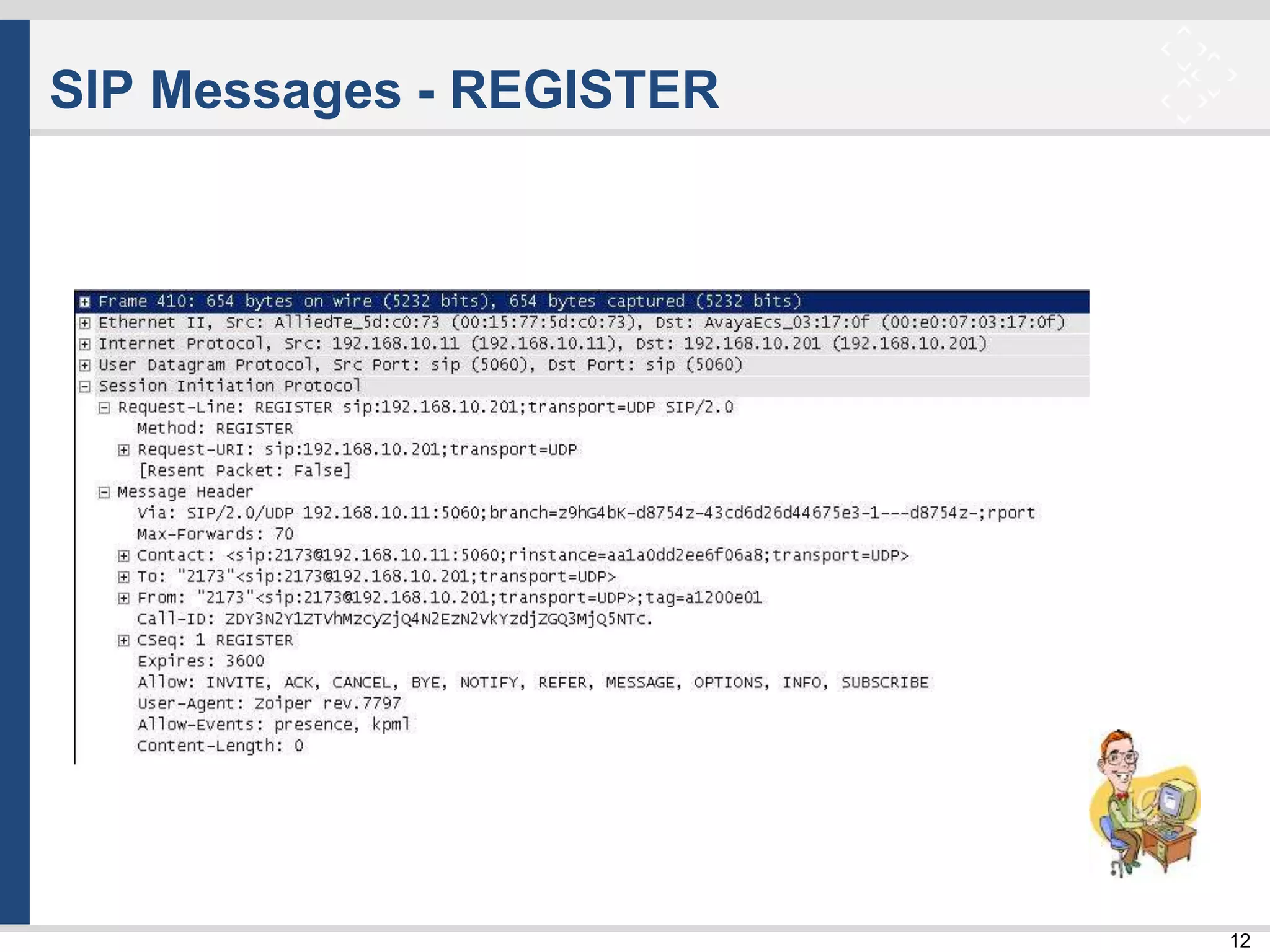
SIP Messages - REGISTER
13
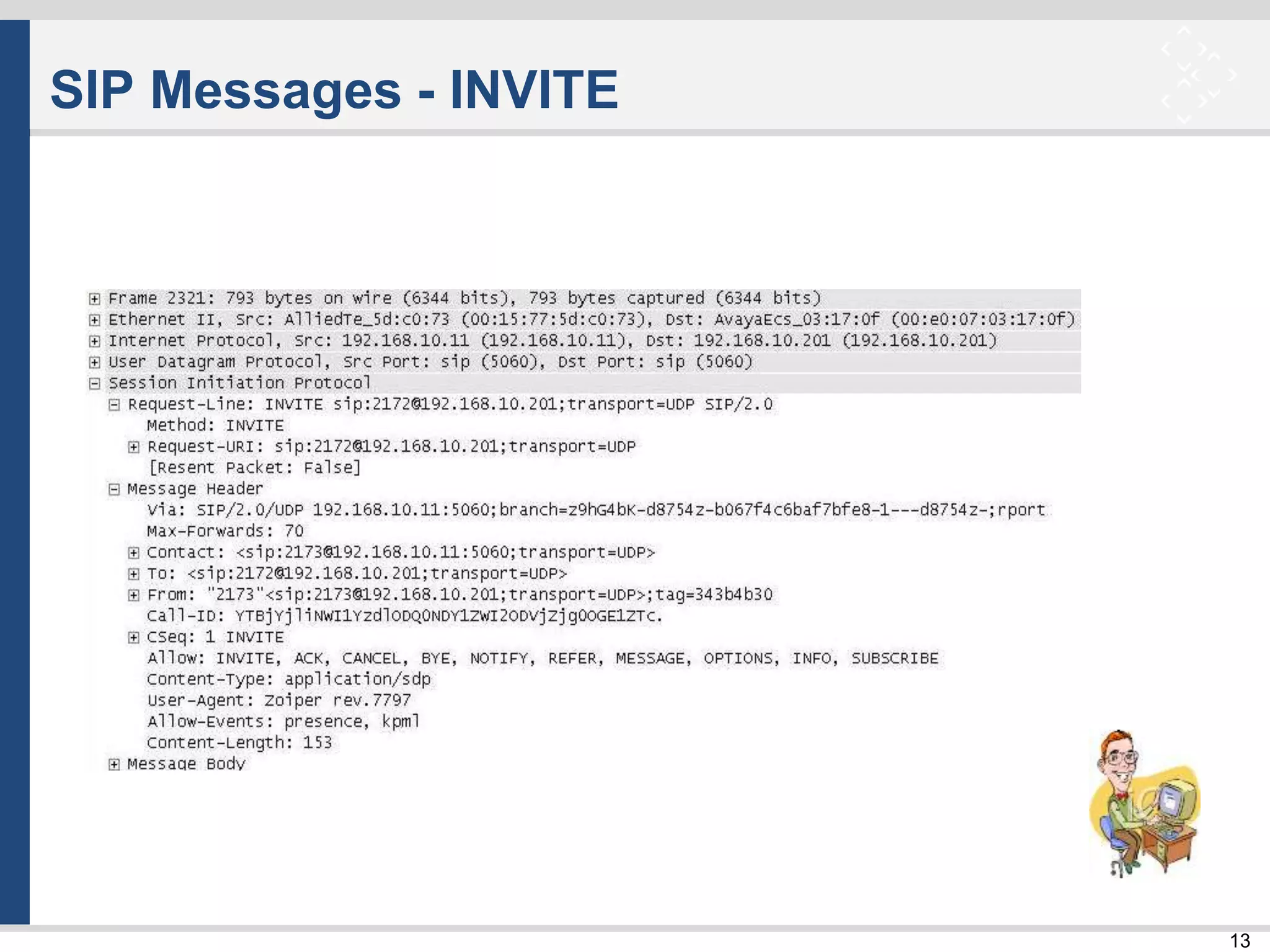
SIP Messages - INVITE
14
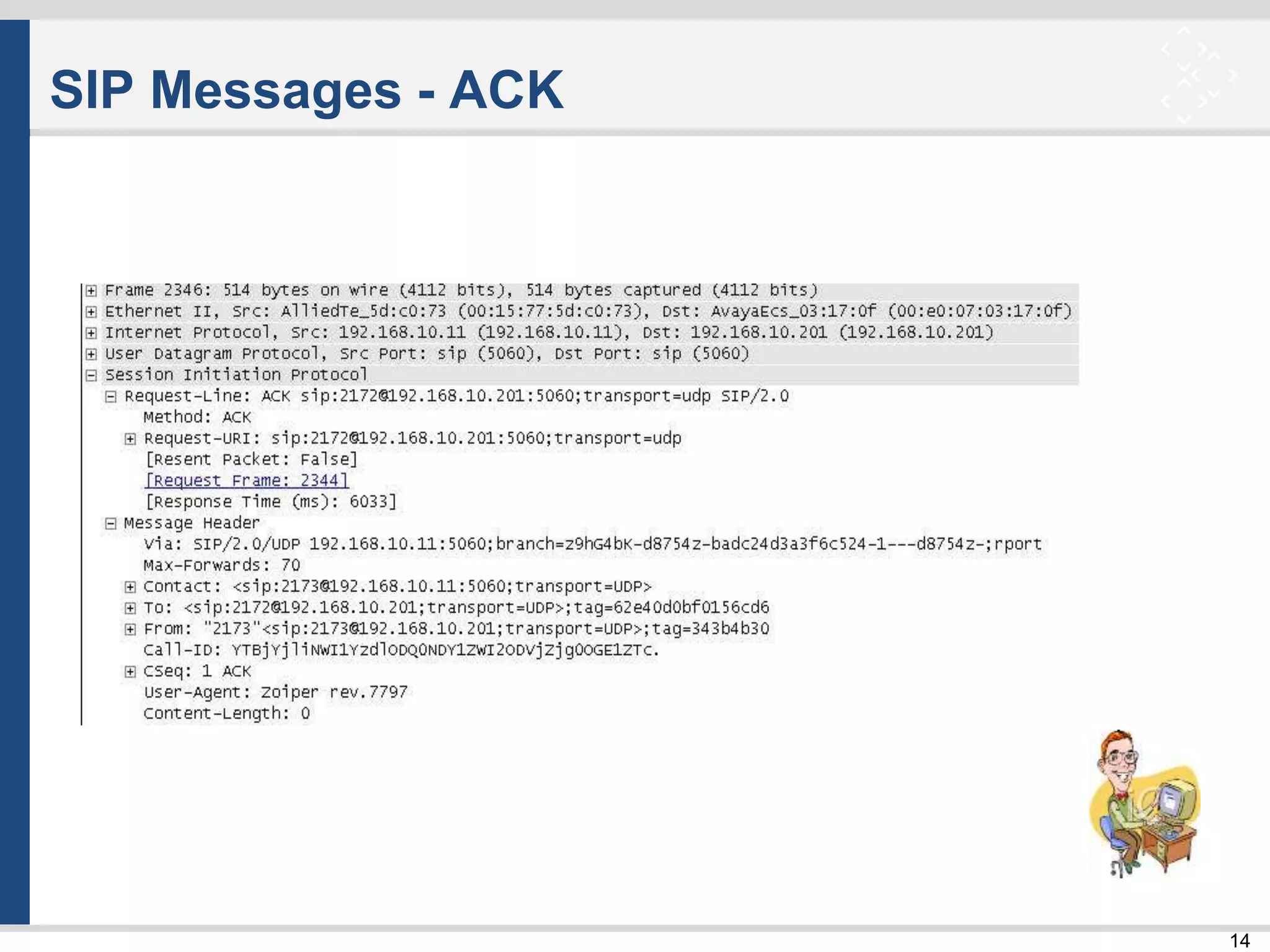
SIP Messages - ACK
15
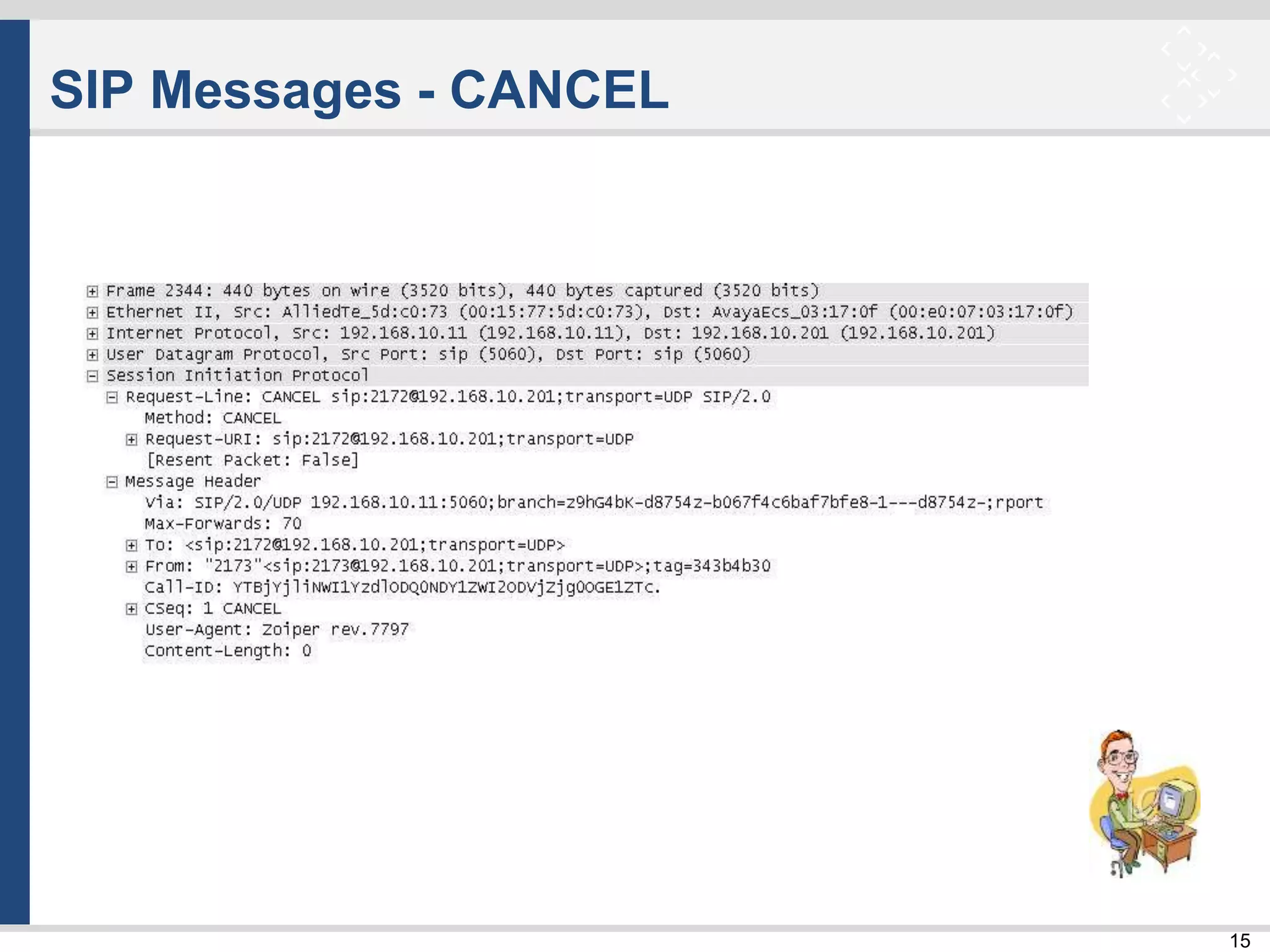
SIP Messages - CANCEL
16
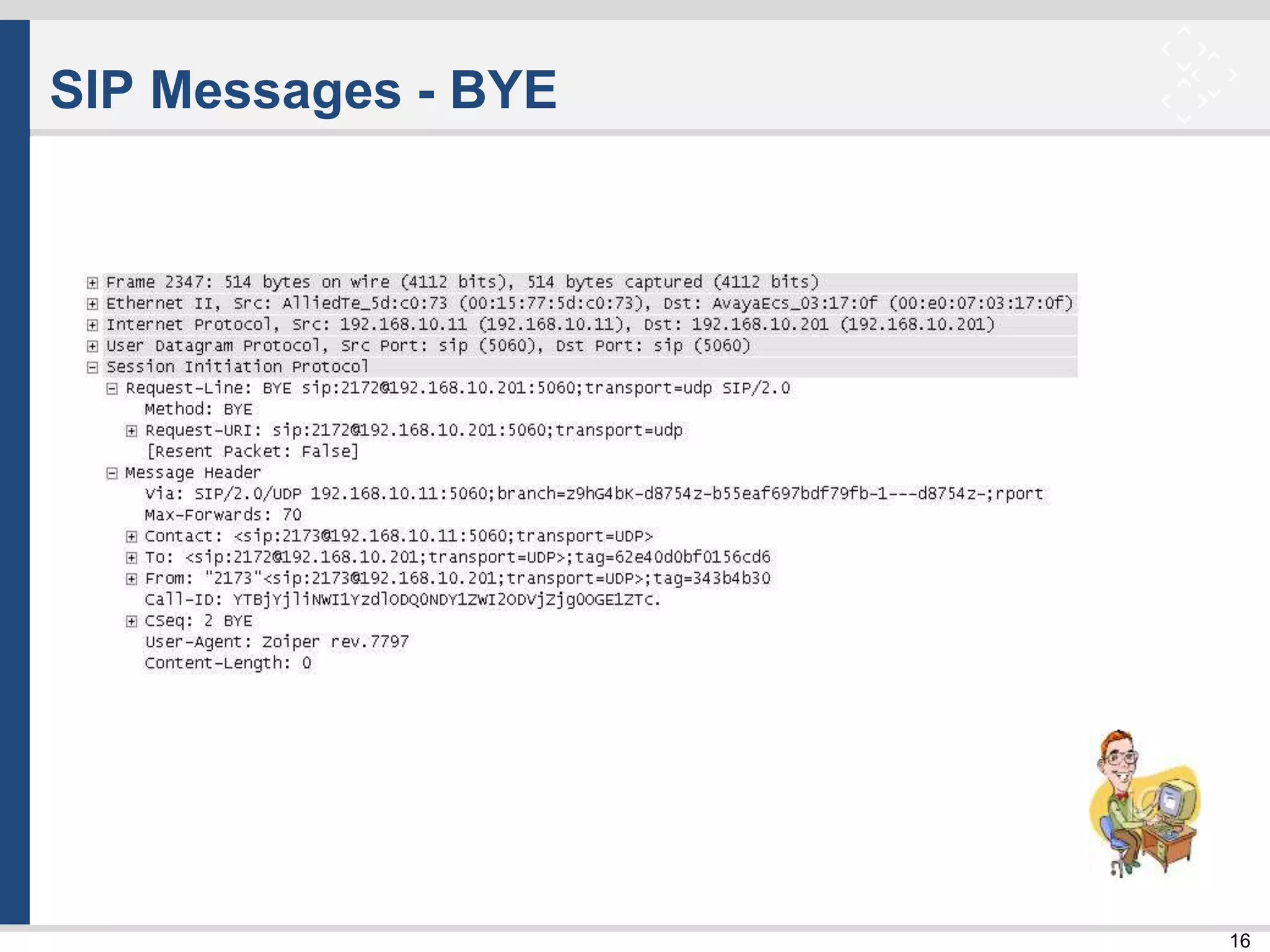
SIP Messages - BYE
17
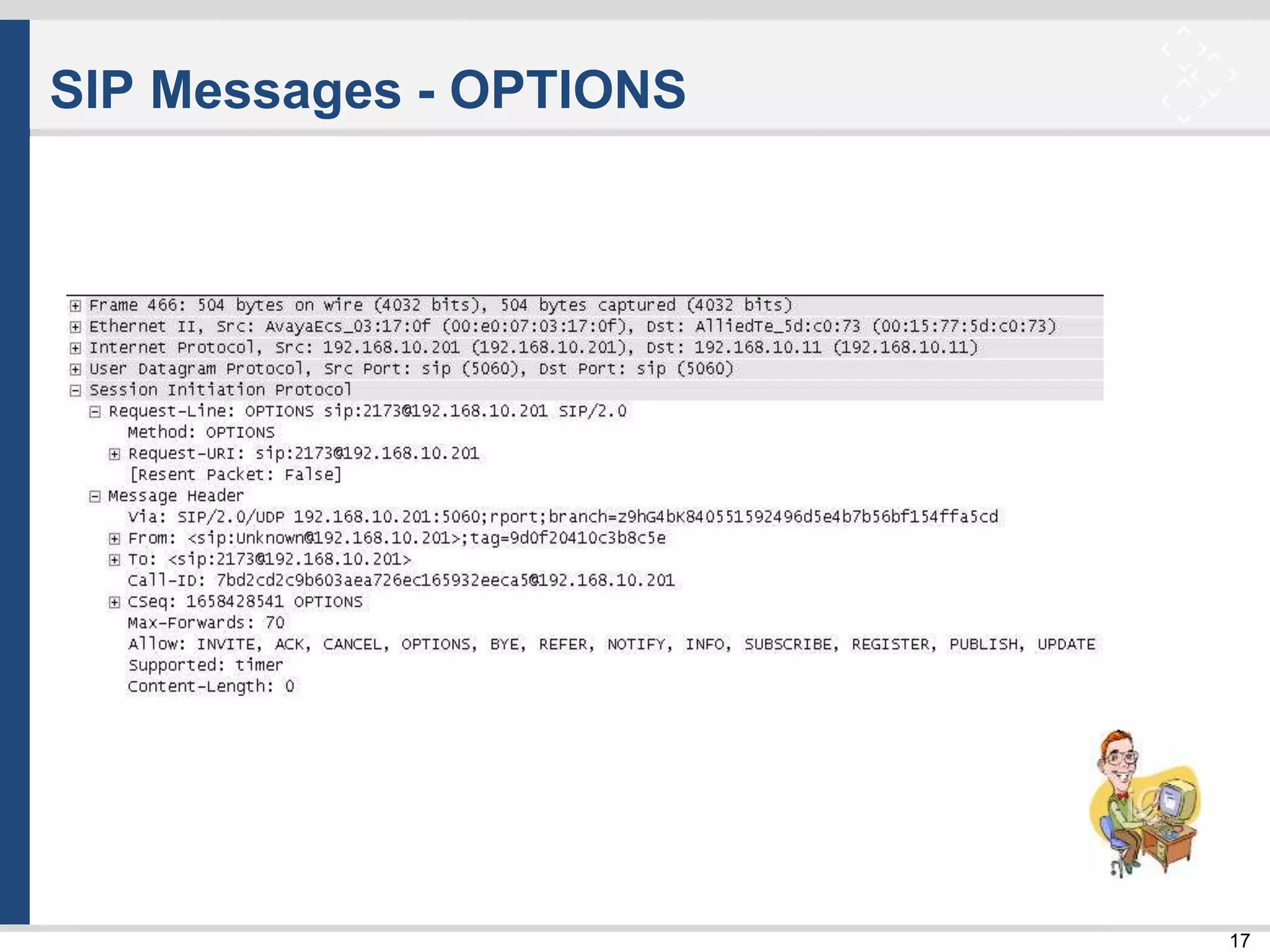
SIP Messages - OPTIONS
18
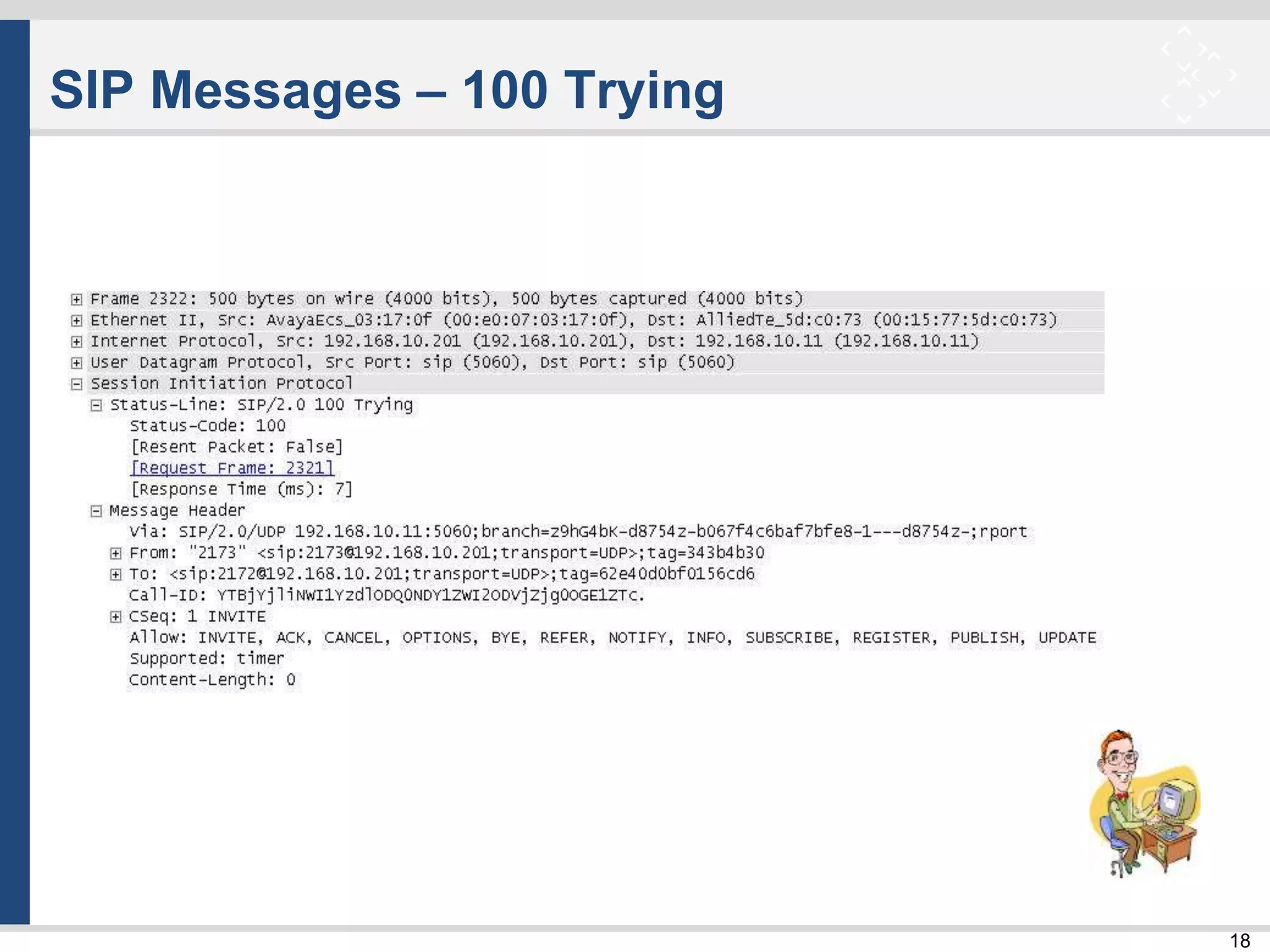
SIP Messages – 100 Trying
19
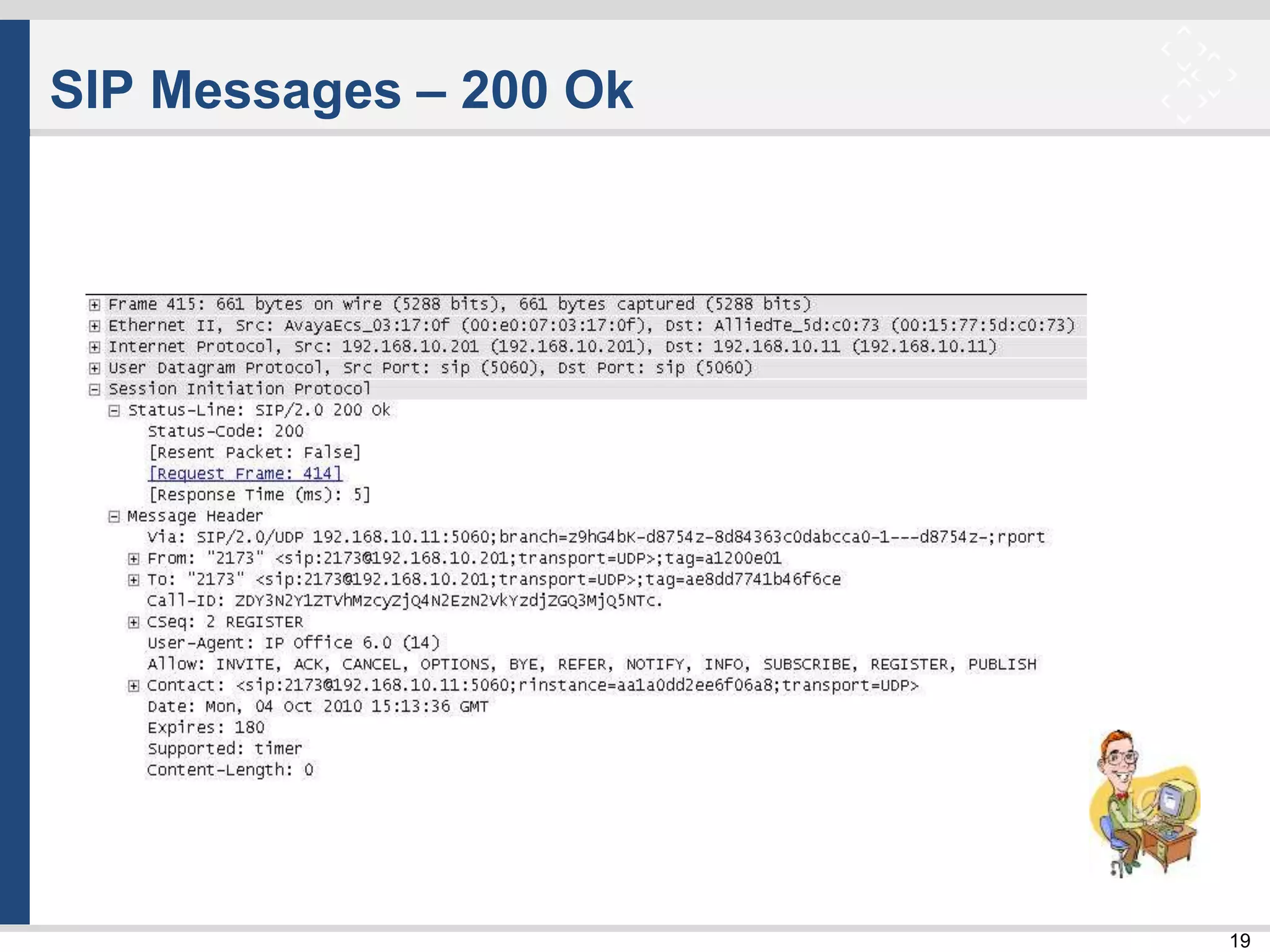
SIP Messages – 200 Ok
20
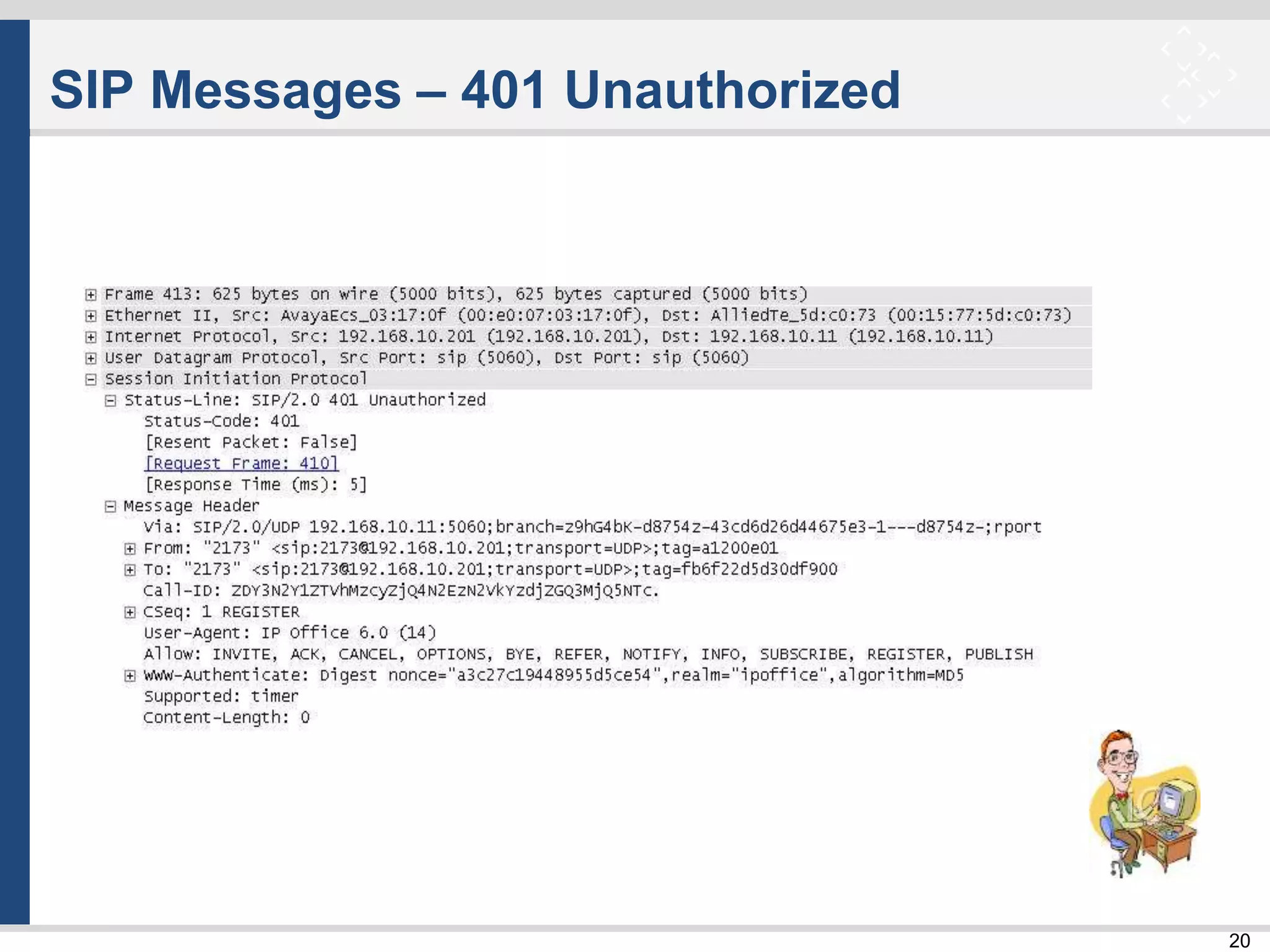
SIP Messages – 401 Unauthorized
21
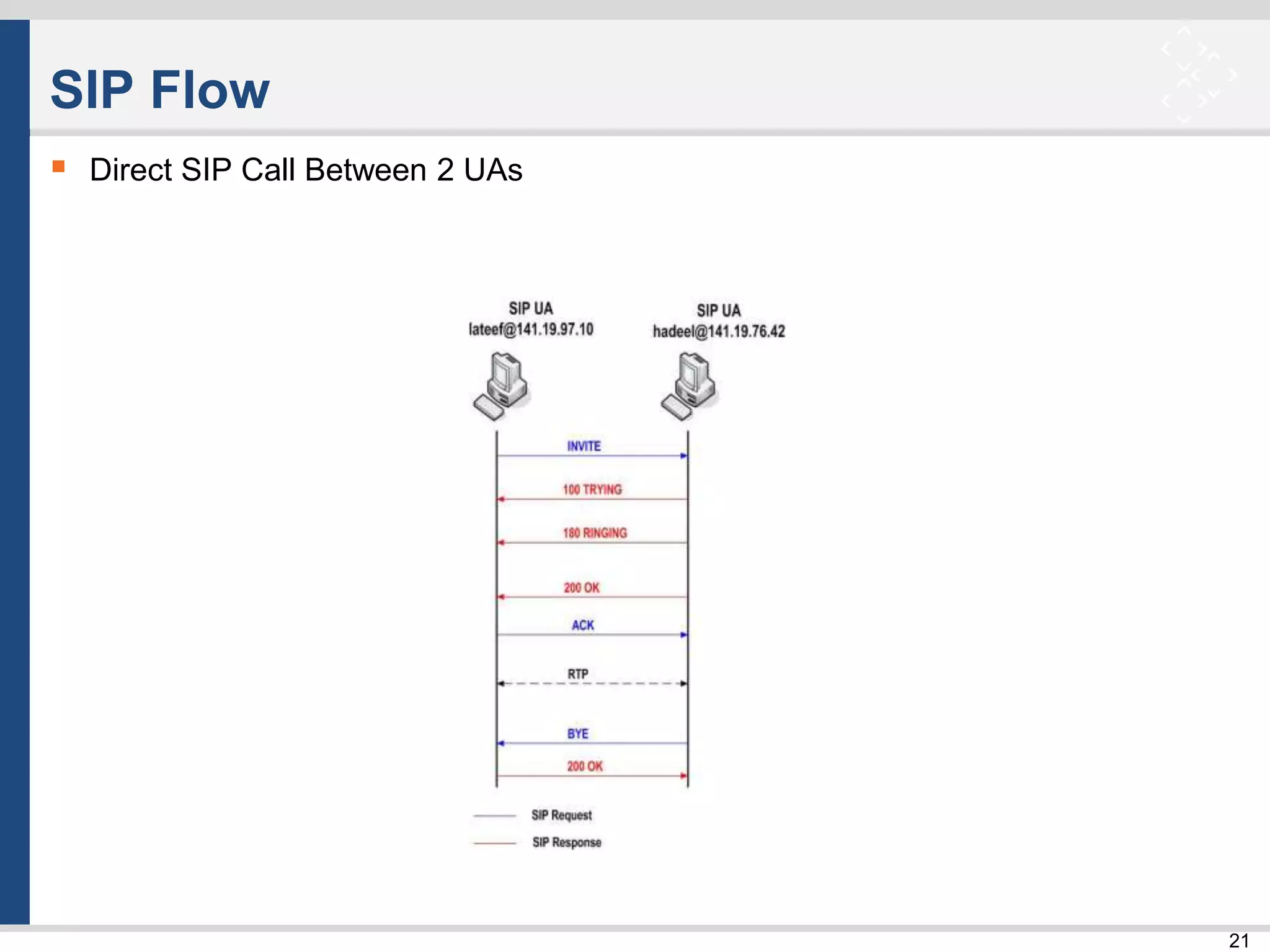
SIP Flow
 Direct SIP Call Between 2 UAs
22
SIP Flow
 Call via Proxy
23
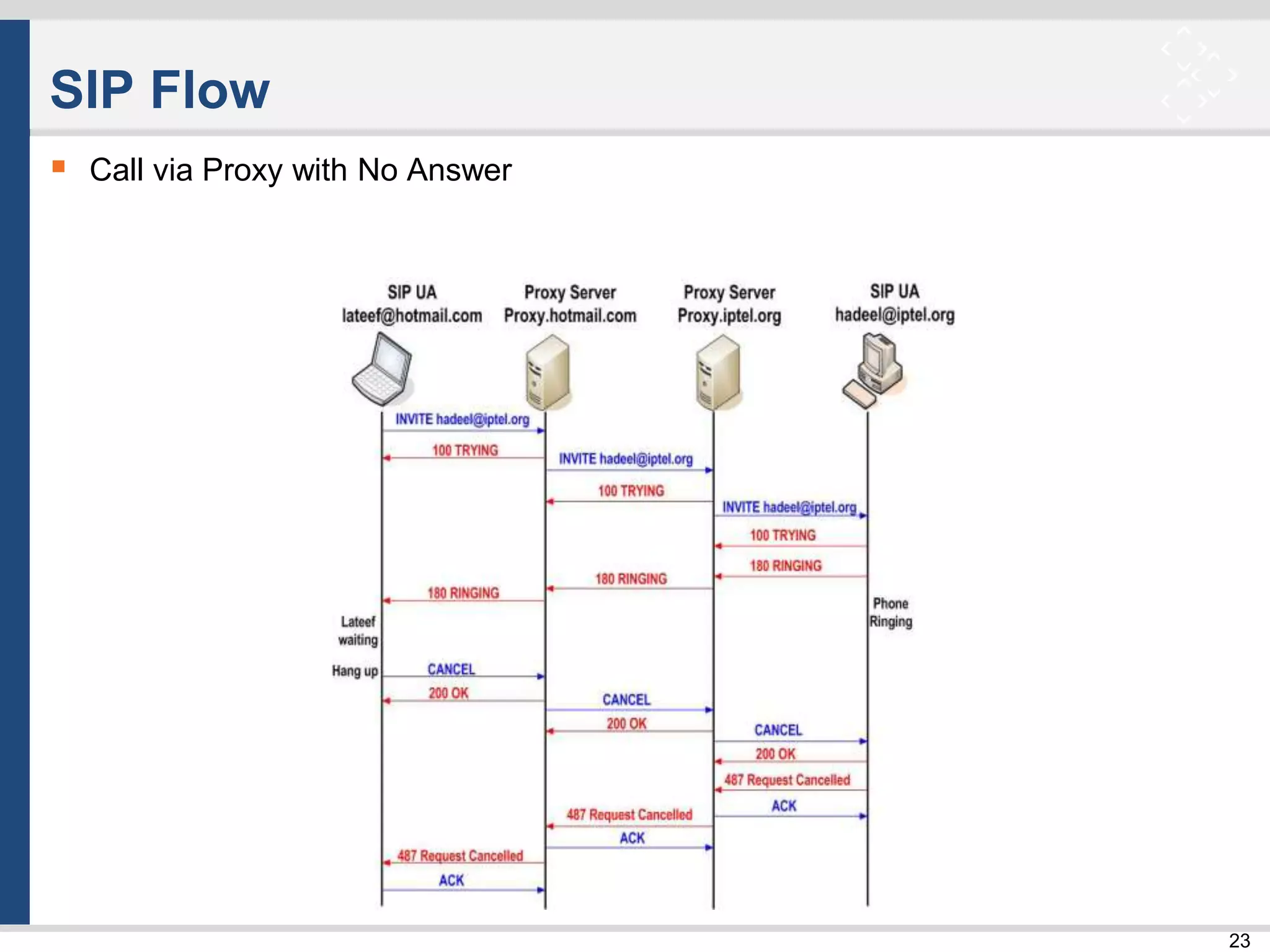
SIP Flow
 Call via Proxy with No Answer
24
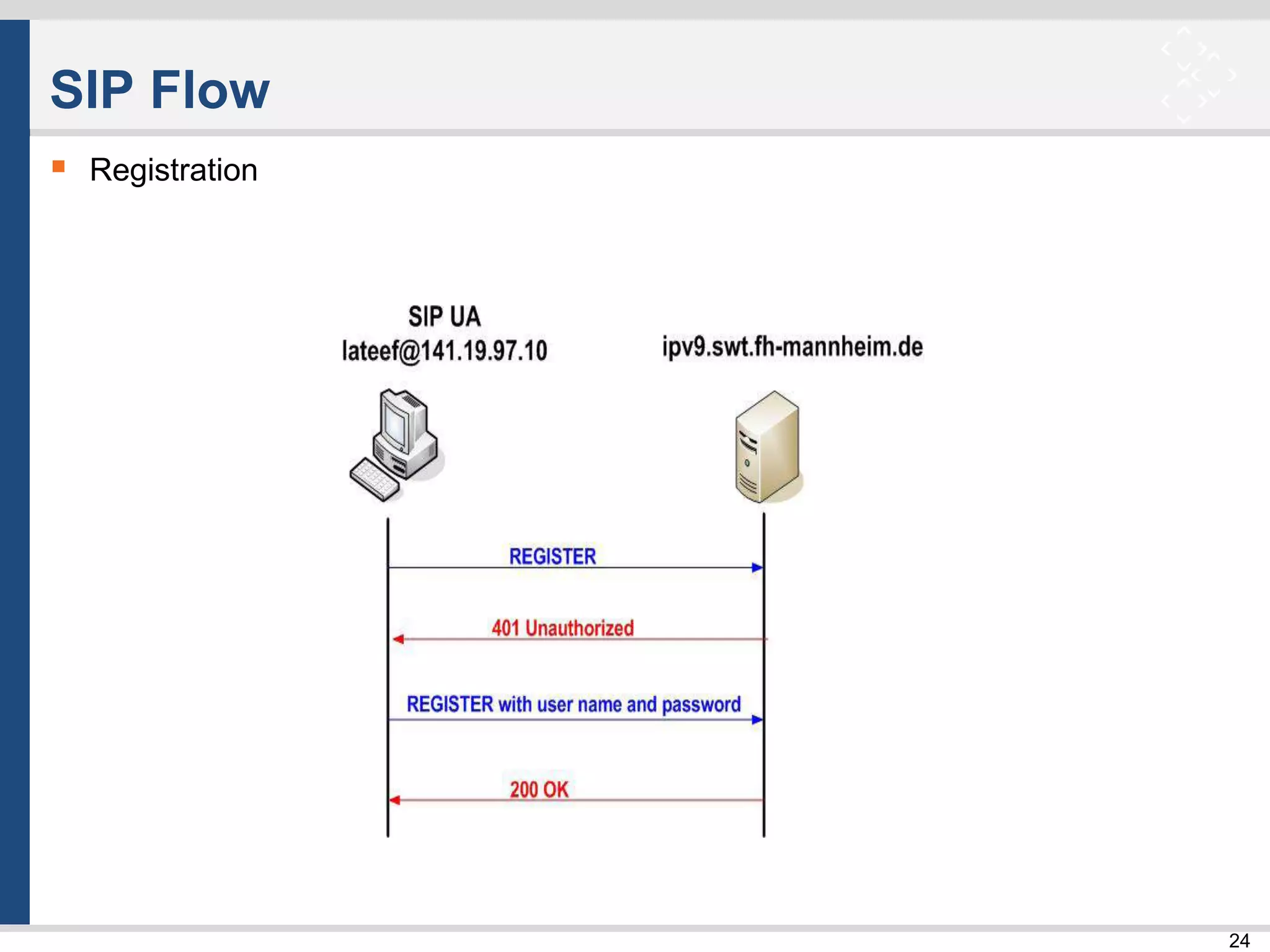
SIP Flow
 Registration
25
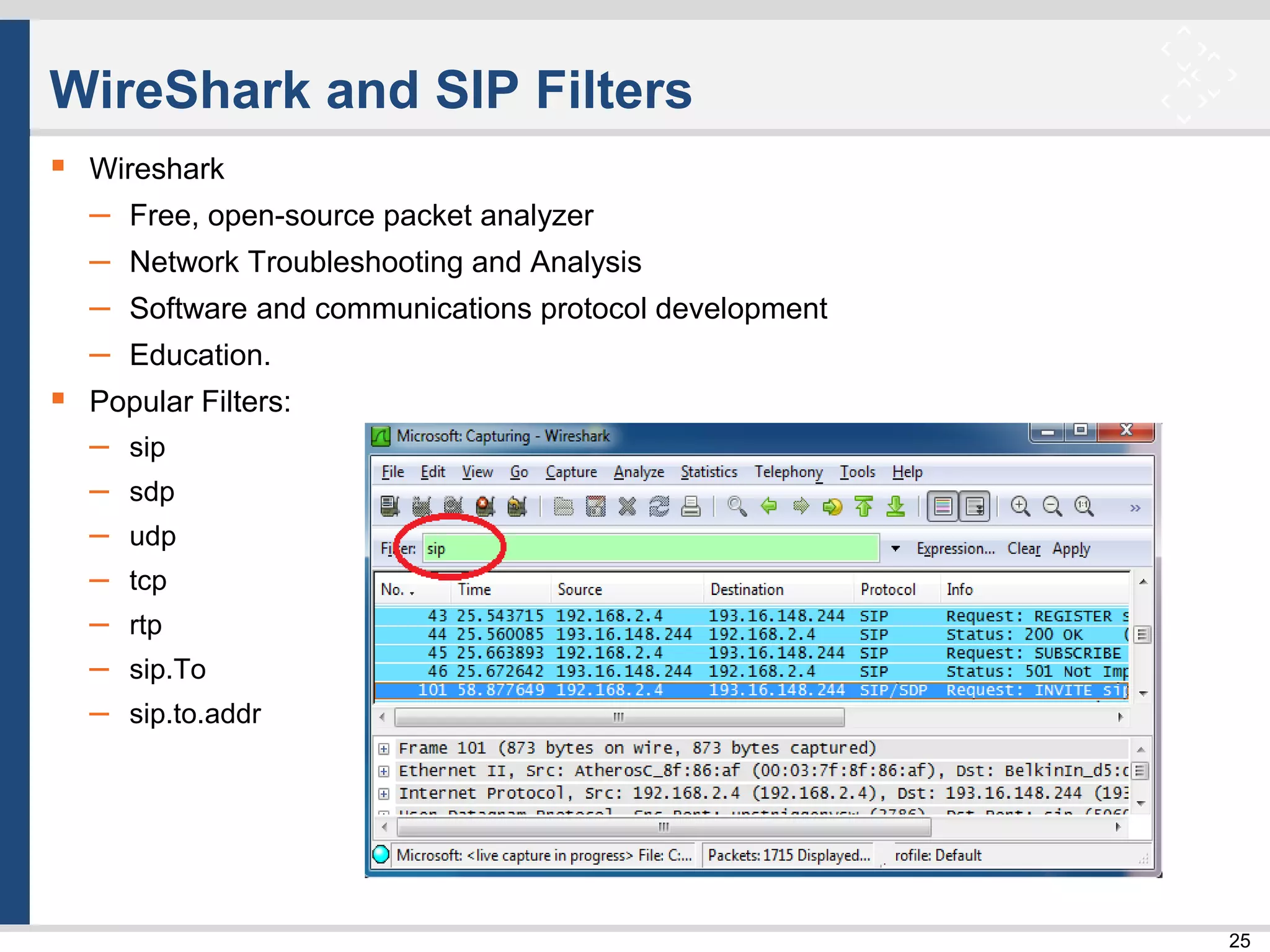
WireShark and SIP Filters
 Wireshark
– Free, open-source packet analyzer
– Network Troubleshooting and Analysis
– Software and communications protocol development
– Education.
 Popular Filters:
– sip
– sdp
– udp
– tcp
– rtp
– sip.To
– sip.to.addr
26
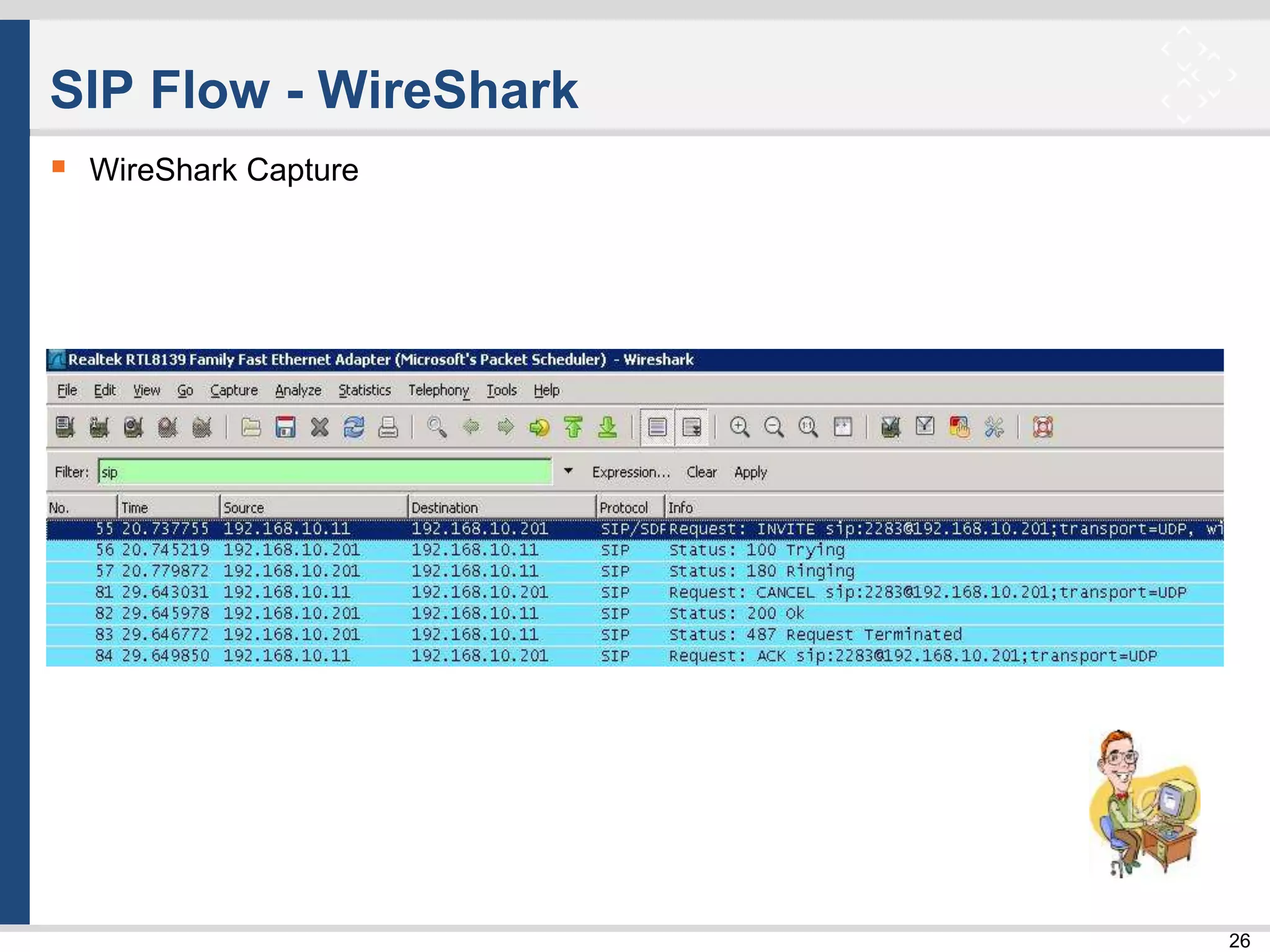
SIP Flow - WireShark
 WireShark Capture
27
SIP Flow - WireShark
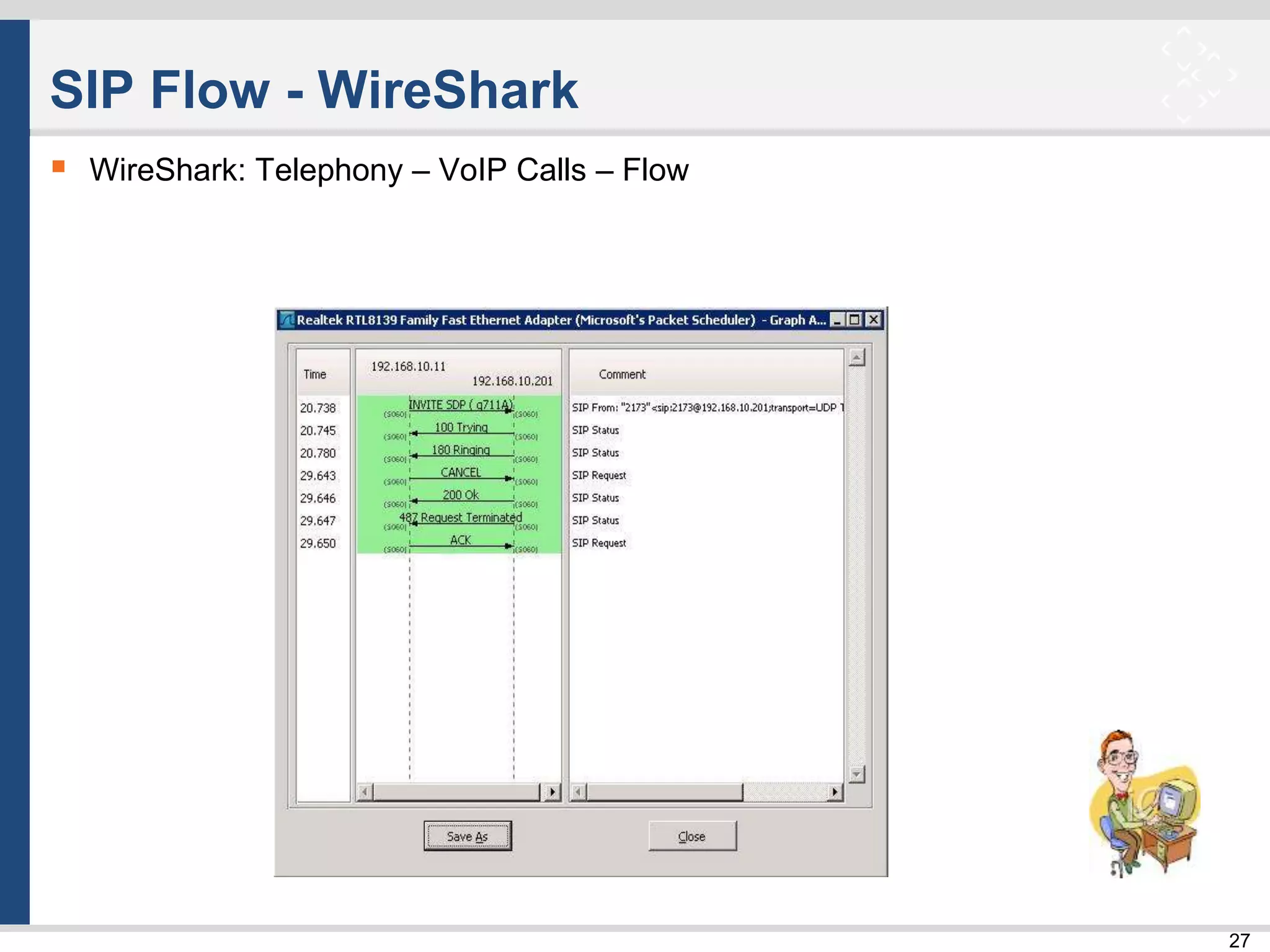
 WireShark: Telephony – VoIP Calls – Flow
28
Supplementary Services
– Call Hold
– Call Transfer
– Call Conference
– Call Forwarding
 on busy
 no answer
 unconditional
29
Supplementary Services
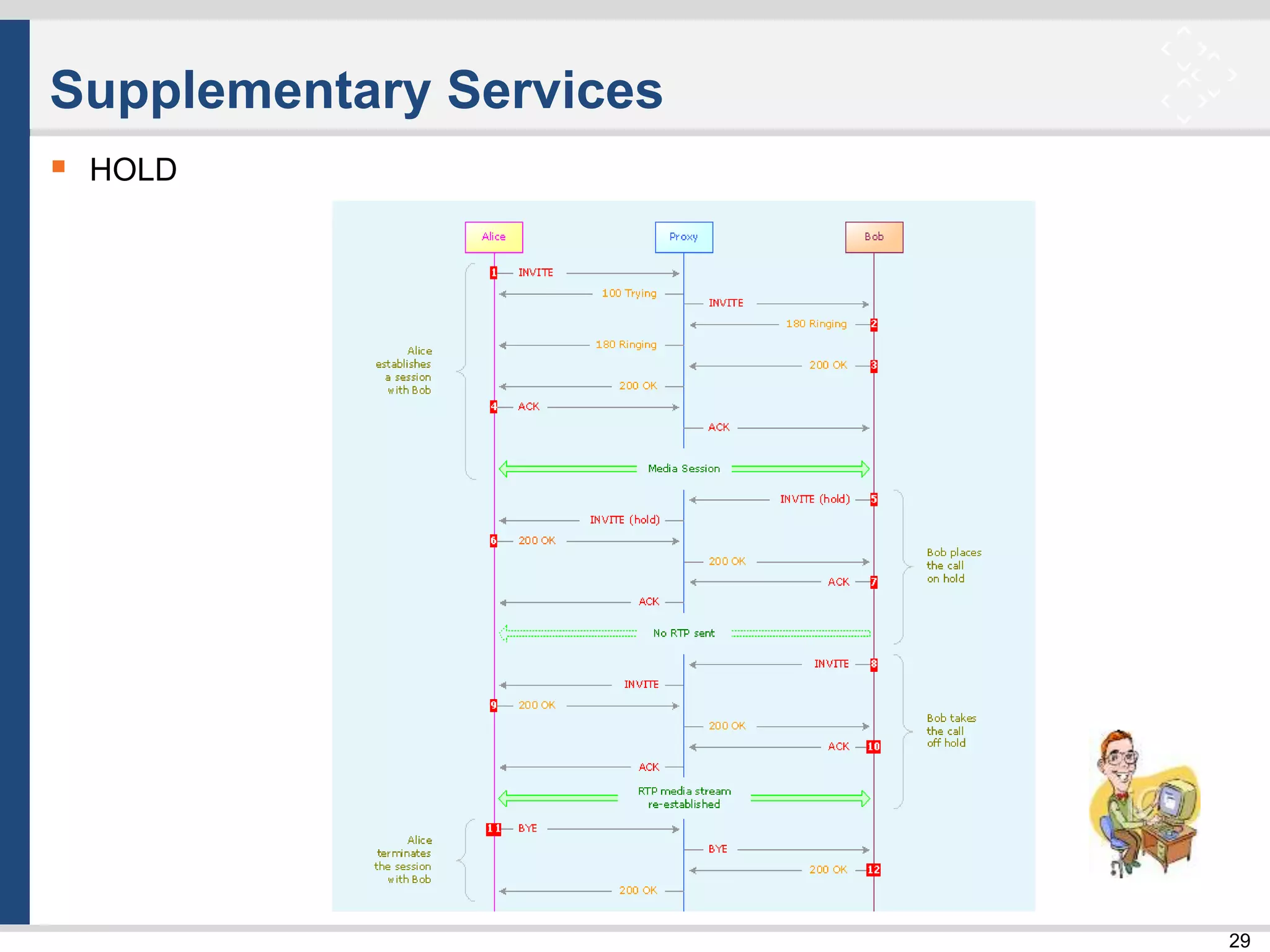
 HOLD
30
Supplementary Services
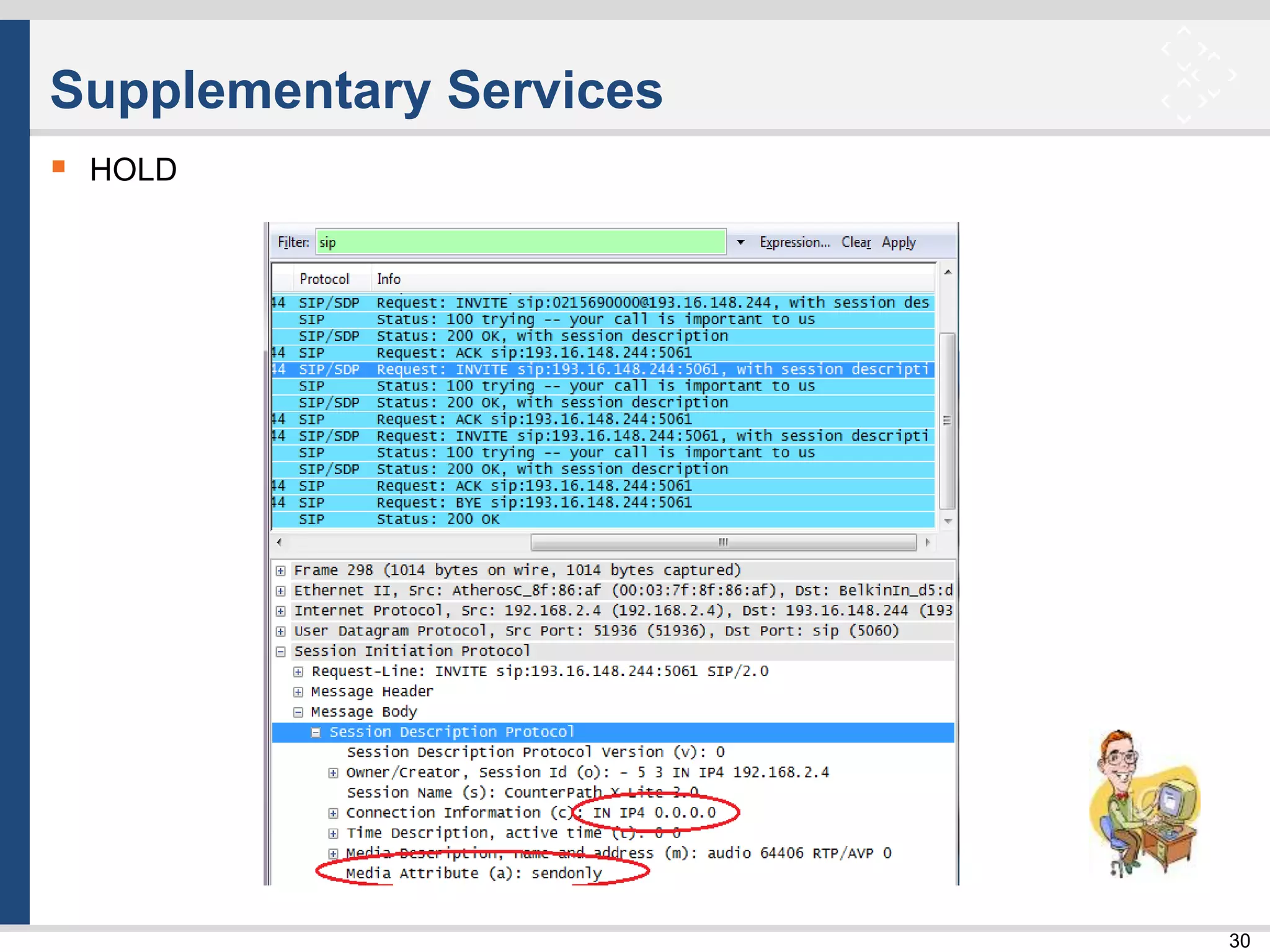
 HOLD
31
Supplementary Services
 Transfer
32
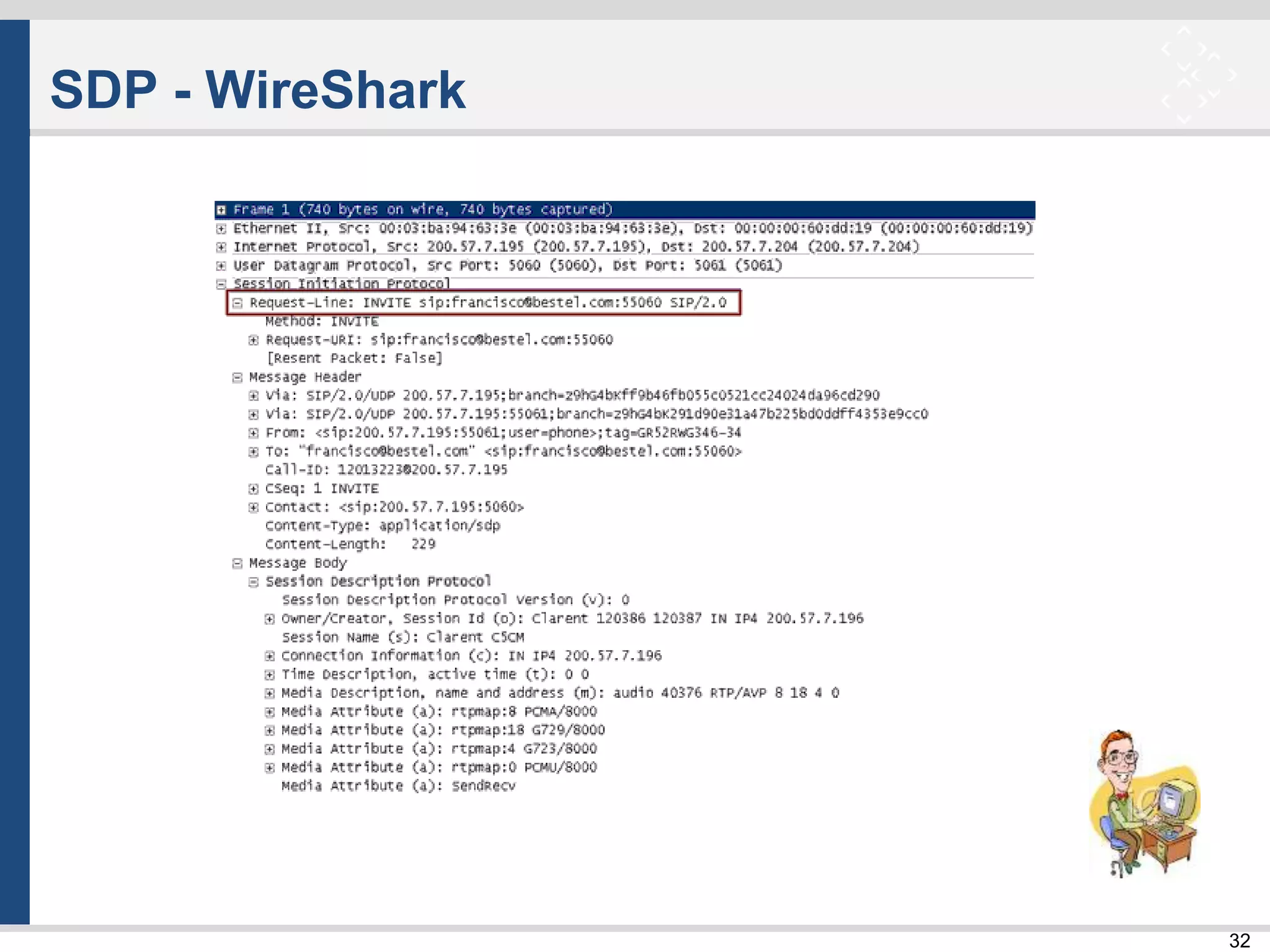
SDP - WireShark
33
SDP - WireShark
 Session Description Protocol Version - 0
 Owner / Creator of the session or Owner / Creator. Identification is made by:
– Owner username. User.
– Session ID. ID of the session. Random number as a unique identifier of the session.
– Session Version. Version.
– Network Type. Tipe network. Always IN.
– Address Type. It can be IP4 (IPv4) or IP 6 (IPv6).
– Address (IP). IP Address. (200.57.7.197)
– Session Name. Name of the session.
 Connection Information:
– C = Connection Type Network (IN)
– Connection Address Type: (IP4 or IPv6)
– Connection Address: (200.57.7.197)
 Time Description, active time. (t): 0 0, start stop time = 0. [unrestricted and permanent session].
 Media Description, name and address (m): audio 40376 RTP / AVP 4 0 8 18. Type of data being transported (audio or telephone session in this
case), UDP port used (40 376), protocol used (Real Time Transport Protocol RTP / AVP Audio Video Profiles). Codecs formats:
– 8 G.711 PCMA
– 18 G.729
– 4 G.723
– 0 G.711 PCMU
 Media Attribute (a). This is a list of format codes outlined above with data from Sample rate or sampling frequency, fieldname, etc.
 Media Attribute (a). SendRecv. So send / receive.
34
Q & A
Thank You !

Tlc 004 - take a sip of sip

  • 1.
    Take a sipof SIP Paul Sarstiuc, Romeo Vidrascu, Marius Trestioreanu Bucharest 18 April 2016
  • 2.
    2 SIP – SessionInitiation Protocol  Content – VoIP – SIP History – SIP Architecture – Addressing SIP – SIP Messages – SIP Flow – WireShark and SIP Filters – SIP Flow – WireShark – Supplementary Services – SDP - WireShark
  • 3.
    3 VoIP stereotypes  VoIPmeans free calls  SIP is a collection of protocols  SIP is better than H323  SIP is a voice signaling protocol
  • 4.
    4 VoIP  VoIP – VoIP:Voice over Internet Protocol  IP Telephony  Internet Telephony  Voice over Broadband (VoBB)  Broadband Telephony  Broadband Phone – Alternative to PSTN – Single infrastructure for Data, Voice and Video – More demand for video conferences is easily satisfied with VoIP – Cost savings on long distance calls – Easier connectivity: customers are to be reached at multiple points under the same “telephone number” – Communication Services  Voice/Video  Fax  Voice/Messaging Application
  • 5.
    5 VoIP  VoIP Protocols –SIP – Session Initiation Protocol – H.323 – IMS – IP Multimedia Subsystem – MGCP – Media Gateway Control Protocol – RTP – Real-time Transport Protocol – RTCP – Real-time Transport Control Protocol – SDP – Session Description Protocol – Skype Protocol (proprietary) – TCP – Transmission Control Protocol – UDP – User Datagram Protocol – TLS – Transport Layer Security
  • 6.
  • 7.
    7 History  SIP History –Feb. 22, 1996 draft-ietf-mmusic-scip-00; IDMS paper – Feb. 22, 1996 draft-ietf-mmusic-sip-00 – Dec. 2, 1996 draft-ietf-mmusic-sip-01 – March 27, 1997 draft-ietf-mmusic-sip-02 – July 31, 1997 draft-ietf-mmusic-sip-03 – November 11, 1997 draft-ietf-mmusic-sip-04 – May 14, 1998 draft-ietf-mmusic-sip-05 – June 17, 1998 draft-ietf-mmusic-sip-06 – July 16, 1998 draft-ietf-mmusic-sip-07 – August 7, 1998 draft-ietf-mmusic-sip-08 – September 18, 1998 draft-ietf-mmusic-sip-09 – September 28, 1998 Last call – November 12, 1998 draft-ietf-mmusic-sip-10 – December 15, 1998 draft-ietf-mmusic-sip-11 – January 15, 1999 draft-ietf-mmusic-sip-12 – February 2, 1999 Approved – March 17, 1999 RFC 2543 – July 3, 2002 RFC 3261 (SIP: Session Initiation Protocol), RFC 3262 (Reliability of Provisional Responses in Session Initiation Protocol (SIP)), RFC 3263 (Session Initiation Protocol (SIP): Locating SIP Servers), RFC 3264 (An Offer/Answer Model with Session Description Protocol (SDP)), RFC 3265 (Session Initiation Protocol (SIP)-Specific Event Notification), RFC 3266 (Support for IPv6 in Session Description Protocol (SDP)) published
  • 8.
    8 SIP Architecture  NetworkElements: – UA – User Agent  UAC – User Agent Client [request]  UAS – User Agent Server [response] – Server Elements [RFC 3261]  Proxy Server [phone – proxy – proxy – phone]  Registrar [REGISTER]  Redirect Server [3XX] – Other Network Elements  SBC – Session Border Controller  Gateway
  • 9.
  • 10.
    10 SIP addressing  URI– Uniform Resource Identifier  sip:username:password@host:port  E.g.: sip:John@sipgatedomain.org  Secure transmission – sips:… instead of sip:… – TLS – Transport Layer Security
  • 11.
    11 SIP Messages  SIPRequests: – REGISTER – INVITE – ACK – CANCEL – BYE – OPTIONS – SUBSCRIBE – REFER – NOTIFY  SIP Responses: – Provisional (1xx) – Success (2xx) – Redirection (3xx) – Client Error (4xx) – Server Error (5xx) – Global Failure (6xx)
  • 12.
  • 13.
  • 14.
  • 15.
  • 16.
  • 17.
  • 18.
  • 19.
  • 20.
    20 SIP Messages –401 Unauthorized
  • 21.
    21 SIP Flow  DirectSIP Call Between 2 UAs
  • 22.
  • 23.
    23 SIP Flow  Callvia Proxy with No Answer
  • 24.
  • 25.
    25 WireShark and SIPFilters  Wireshark – Free, open-source packet analyzer – Network Troubleshooting and Analysis – Software and communications protocol development – Education.  Popular Filters: – sip – sdp – udp – tcp – rtp – sip.To – sip.to.addr
  • 26.
    26 SIP Flow -WireShark  WireShark Capture
  • 27.
    27 SIP Flow -WireShark  WireShark: Telephony – VoIP Calls – Flow
  • 28.
    28 Supplementary Services – CallHold – Call Transfer – Call Conference – Call Forwarding  on busy  no answer  unconditional
  • 29.
  • 30.
  • 31.
  • 32.
  • 33.
    33 SDP - WireShark Session Description Protocol Version - 0  Owner / Creator of the session or Owner / Creator. Identification is made by: – Owner username. User. – Session ID. ID of the session. Random number as a unique identifier of the session. – Session Version. Version. – Network Type. Tipe network. Always IN. – Address Type. It can be IP4 (IPv4) or IP 6 (IPv6). – Address (IP). IP Address. (200.57.7.197) – Session Name. Name of the session.  Connection Information: – C = Connection Type Network (IN) – Connection Address Type: (IP4 or IPv6) – Connection Address: (200.57.7.197)  Time Description, active time. (t): 0 0, start stop time = 0. [unrestricted and permanent session].  Media Description, name and address (m): audio 40376 RTP / AVP 4 0 8 18. Type of data being transported (audio or telephone session in this case), UDP port used (40 376), protocol used (Real Time Transport Protocol RTP / AVP Audio Video Profiles). Codecs formats: – 8 G.711 PCMA – 18 G.729 – 4 G.723 – 0 G.711 PCMU  Media Attribute (a). This is a list of format codes outlined above with data from Sample rate or sampling frequency, fieldname, etc.  Media Attribute (a). SendRecv. So send / receive.
  • 34.