


IMPROVING YOUR EXPLANATION SKILLS
Mr. Jamlick Bosire
New Horizon Consultancy Services
P. O. Box 1675-80200, Malindi
ojamlick@yahoo.com
The ability to explain something clearly to a pupil is
very essential in a good teacher’s professional
practice.
The term “explaining” simply means to make plain.
One dictionary states:
• You explain something when you supply
information or details that make it clear or easy
to understand.
• When you tell people the reason for something
e.g. “I can explain why I came late.”
what is an explanation?
2Comm. skills/10thAPR2013/DADJU
Different situations
require different ways of
explaining. However, the
goal of explaining is to
give understanding to
others.
3Comm. skills/10thAPR2013/DADJU
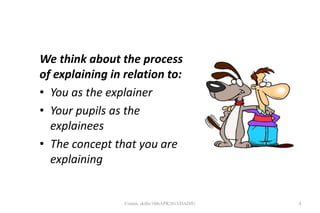
We think about the process
of explaining in relation to:
• You as the explainer
• Your pupils as the
explainees
• The concept that you are
explaining
4Comm. skills/10thAPR2013/DADJU
As you give explanations, you should
appreciate the impact of your explanations.
Your listeners may find your explanations:
• Complex
• Full of incorrect or difficult language
• Not clear.
5Comm. skills/10thAPR2013/DADJU
Ways of explaining
• The interpretative
• The descriptive
• The reasoning giving.
6Comm. skills/10thAPR2013/DADJU
1.The interpretative:
Here your explanation will help
pupils interpret what they know.
For example, you can explain what
the function is of the talons and
beaks of birds of prey.
7Comm. skills/10thAPR2013/DADJU
2. The descriptive:
A descriptive explanation usually describes
a process or structure. These
explanations will be to the question
“how”. An example is Mr. Maina is
describing the process of how to make a
sponge cake in a home science activity.
8Comm. skills/10thAPR2013/DADJU
3. The reason giving:
Sometimes you give explanations in
which you offer reasons or causes
of the occurrence of something.
Such explanations are answers to
the questions “why”. For example,
why some mammals hibernate in
winter, or why rain falls.
9Comm. skills/10thAPR2013/DADJU
You use any of the above ways of
explaining depending on the
subject aim in your lesson. Your
choice may also depend on the
age of your children.
10Comm. skills/10thAPR2013/DADJU
Chow you can bring your explanations to life.
1. Using analogies:
You might use analogies to make your explanations to
make your explanations clearer. When you use an
analogy, you talk of something which is like
something else. For example Mrs. Mugambi was
explaining what goose pimples are to her class. This
is what she told them: “Goose pimples are not like
the ordinary pimples you get after a mosquito bite.
Goose pimples come all over your body and are very
small. They look like small grains of millet that have
scattered on your body.” 11Comm. skills/10thAPR2013/DADJU
2. Using examples.
We also use examples to help us clarify
an explanation. . Examples can be from
both the teacher and pupils. You can use
examples when ideas are ambiguous, or
simply not understood. You should draw
examples from the pupils’ experience
and, at their level of understanding.
12Comm. skills/10thAPR2013/DADJU
3. Use of practical work:
You can use practical work to
complement an explanation. If you
were explaining to your pupils how to
set up a science experiment you
would either demonstrate it, or get
them to them to do it themselves.
13Comm. skills/10thAPR2013/DADJU
4. use of teaching/learning aids:
The use of teaching/learning aids,
like practical work, will help to
simplify what you are explaining.
They should be part and parcel of
your explanation. A teacher
teaching an agriculture lesson
where they are handling the topic
“Farm tools,” should have with
them the various farm tools. They
can then explain what the tools are
called, their uses, and so on. In this
way the teaching/learning aids will
support the explanation.
14Comm. skills/10thAPR2013/DADJU
Making your explanation clear.
As well as making your explanations
clear through questions, analogies and
examples, you should look into the
way you use language. Good
communication skills are very
important in explaining.
15Comm. skills/10thAPR2013/DADJU
For effective communication
you will need to make good
use of your voice.
16Comm. skills/10thAPR2013/DADJU
You should vary the tone of your voice to suit what you
are explaining. You should use humor where necessary.
Your voice should not be monotonous. The use of
gestures and facial expressions helps to complement
your voice.
You should also organize your explanations, if your
pupils are to understand the ideas you are explaining to
them. Your explanations should have logical sequence.
The use of link words and phrases will help you to
organize your explanations in a logical order. Examples
of link words are “ because, since, as, in order to, as a
result, therefore, by, if … then”.
17Comm. skills/10thAPR2013/DADJU
THANK YOU
Comm. skills/10thAPR2013/DADJU 18

Improving your explanation skills

  • 1.
    IMPROVING YOUR EXPLANATIONSKILLS Mr. Jamlick Bosire New Horizon Consultancy Services P. O. Box 1675-80200, Malindi ojamlick@yahoo.com
  • 2.
    The ability toexplain something clearly to a pupil is very essential in a good teacher’s professional practice. The term “explaining” simply means to make plain. One dictionary states: • You explain something when you supply information or details that make it clear or easy to understand. • When you tell people the reason for something e.g. “I can explain why I came late.” what is an explanation? 2Comm. skills/10thAPR2013/DADJU
  • 3.
    Different situations require differentways of explaining. However, the goal of explaining is to give understanding to others. 3Comm. skills/10thAPR2013/DADJU
  • 4.
    We think aboutthe process of explaining in relation to: • You as the explainer • Your pupils as the explainees • The concept that you are explaining 4Comm. skills/10thAPR2013/DADJU
  • 5.
    As you giveexplanations, you should appreciate the impact of your explanations. Your listeners may find your explanations: • Complex • Full of incorrect or difficult language • Not clear. 5Comm. skills/10thAPR2013/DADJU
  • 6.
    Ways of explaining •The interpretative • The descriptive • The reasoning giving. 6Comm. skills/10thAPR2013/DADJU
  • 7.
    1.The interpretative: Here yourexplanation will help pupils interpret what they know. For example, you can explain what the function is of the talons and beaks of birds of prey. 7Comm. skills/10thAPR2013/DADJU
  • 8.
    2. The descriptive: Adescriptive explanation usually describes a process or structure. These explanations will be to the question “how”. An example is Mr. Maina is describing the process of how to make a sponge cake in a home science activity. 8Comm. skills/10thAPR2013/DADJU
  • 9.
    3. The reasongiving: Sometimes you give explanations in which you offer reasons or causes of the occurrence of something. Such explanations are answers to the questions “why”. For example, why some mammals hibernate in winter, or why rain falls. 9Comm. skills/10thAPR2013/DADJU
  • 10.
    You use anyof the above ways of explaining depending on the subject aim in your lesson. Your choice may also depend on the age of your children. 10Comm. skills/10thAPR2013/DADJU
  • 11.
    Chow you canbring your explanations to life. 1. Using analogies: You might use analogies to make your explanations to make your explanations clearer. When you use an analogy, you talk of something which is like something else. For example Mrs. Mugambi was explaining what goose pimples are to her class. This is what she told them: “Goose pimples are not like the ordinary pimples you get after a mosquito bite. Goose pimples come all over your body and are very small. They look like small grains of millet that have scattered on your body.” 11Comm. skills/10thAPR2013/DADJU
  • 12.
    2. Using examples. Wealso use examples to help us clarify an explanation. . Examples can be from both the teacher and pupils. You can use examples when ideas are ambiguous, or simply not understood. You should draw examples from the pupils’ experience and, at their level of understanding. 12Comm. skills/10thAPR2013/DADJU
  • 13.
    3. Use ofpractical work: You can use practical work to complement an explanation. If you were explaining to your pupils how to set up a science experiment you would either demonstrate it, or get them to them to do it themselves. 13Comm. skills/10thAPR2013/DADJU
  • 14.
    4. use ofteaching/learning aids: The use of teaching/learning aids, like practical work, will help to simplify what you are explaining. They should be part and parcel of your explanation. A teacher teaching an agriculture lesson where they are handling the topic “Farm tools,” should have with them the various farm tools. They can then explain what the tools are called, their uses, and so on. In this way the teaching/learning aids will support the explanation. 14Comm. skills/10thAPR2013/DADJU
  • 15.
    Making your explanationclear. As well as making your explanations clear through questions, analogies and examples, you should look into the way you use language. Good communication skills are very important in explaining. 15Comm. skills/10thAPR2013/DADJU
  • 16.
    For effective communication youwill need to make good use of your voice. 16Comm. skills/10thAPR2013/DADJU
  • 17.
    You should varythe tone of your voice to suit what you are explaining. You should use humor where necessary. Your voice should not be monotonous. The use of gestures and facial expressions helps to complement your voice. You should also organize your explanations, if your pupils are to understand the ideas you are explaining to them. Your explanations should have logical sequence. The use of link words and phrases will help you to organize your explanations in a logical order. Examples of link words are “ because, since, as, in order to, as a result, therefore, by, if … then”. 17Comm. skills/10thAPR2013/DADJU
  • 18.

Editor's Notes