Activities for classroom talk
Jamlick Bosire
What makes a good classroom talk
activity?
A good talk activity is one which is purposeful.
What considerations do you think help
in planning a good classroom talk
activity?
Whenever you decide on a talk activity you
need to have some factors in mind. These
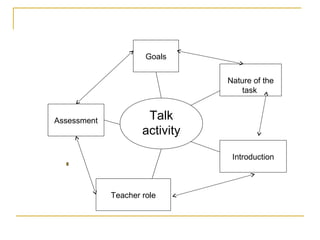
considerations are presented in diagrammatic
form below.
Talk
activity
Teacher role
Introduction
Goals
Assessment
Nature of the
task
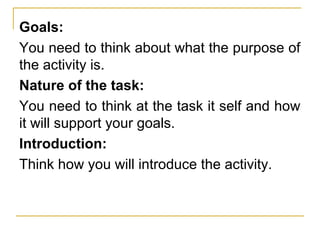
Goals:
You need to think about what the purpose of
the activity is.
Nature of the task:
You need to think at the task it self and how
it will support your goals.
Introduction:
Think how you will introduce the activity.
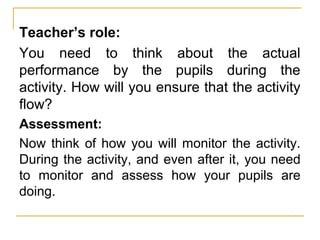
Teacher’s role:
You need to think about the actual
performance by the pupils during the
activity. How will you ensure that the activity
flow?
Assessment:
Now think of how you will monitor the activity.
During the activity, and even after it, you need
to monitor and assess how your pupils are
doing.
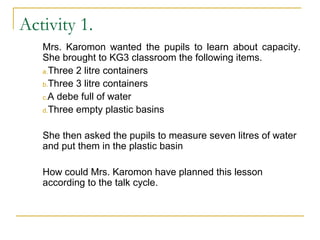
Mrs. Karomon wanted the pupils to learn about capacity.
She brought to KG3 classroom the following items.
a.Three 2 litre containers
b.Three 3 litre containers
c.A debe full of water
d.Three empty plastic basins
She then asked the pupils to measure seven litres of water
and put them in the plastic basin
How could Mrs. Karomon have planned this lesson
according to the talk cycle.
Activity 1.
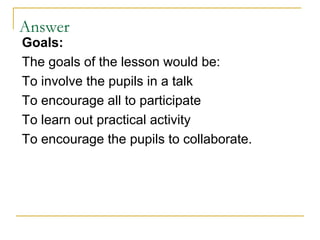
Answer
Goals:
The goals of the lesson would be:
To involve the pupils in a talk
To encourage all to participate
To learn out practical activity
To encourage the pupils to collaborate.
Nature of task:
The task was that the pupils work in groups and
find a way to measure the water.
Teacher’s role:
Mrs. Karomon planned that she would
•Ask the pupils to discuss the possible ways of
measuring the amount of water.
•Ask them to work in groups of six and actually
measure the water.
•Ask them to explain what they were doing
•Ask for feedback at the end of the lesson
Assessment:
Mrs. Karomon wanted to see if:
The pupils talked freely among themselves
They worked collaboratively
They enjoyed the activity
They had the appropriate vocabulary
N/B: the starting point is always the pupils’
interest.
Why do we need to increase interaction
and pupils engagement?
 Makes our pupils accountable
 pupils retain more with greater depth when they
interact with the content in meaningful ways
 Allows pupils the opportunity to explore content and
language on their own
 Provides opportunities for pupils to pupils interaction
to help pupils develop language skills
 Promotes an environment of academic risk taking
 Teaches pupils structure, responsibility, and
deadlines
How can you assess your classroom talk
activities?
1. Observation
As the children work ask yourself:
i.Are the children talking?
ii.Are there children who contribute?
iii.Do the children appear interested?
iv.What are they saying to each other?
Interaction in my classroom
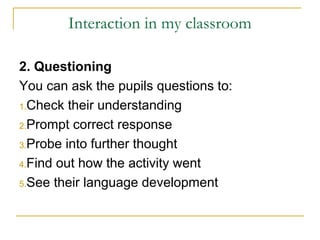
2. Questioning
You can ask the pupils questions to:
1.Check their understanding
2.Prompt correct response
3.Probe into further thought
4.Find out how the activity went
5.See their language development
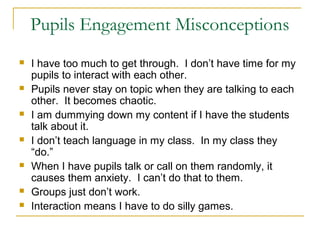
Pupils Engagement Misconceptions
 I have too much to get through. I don’t have time for my
pupils to interact with each other.
 Pupils never stay on topic when they are talking to each
other. It becomes chaotic.
 I am dummying down my content if I have the students
talk about it.
 I don’t teach language in my class. In my class they
“do.”
 When I have pupils talk or call on them randomly, it
causes them anxiety. I can’t do that to them.
 Groups just don’t work.
 Interaction means I have to do silly games.
End

Activities for classroom talk

  • 1.
    Activities for classroomtalk Jamlick Bosire
  • 2.
    What makes agood classroom talk activity? A good talk activity is one which is purposeful.
  • 3.
    What considerations doyou think help in planning a good classroom talk activity? Whenever you decide on a talk activity you need to have some factors in mind. These considerations are presented in diagrammatic form below.
  • 4.
  • 5.
    Goals: You need tothink about what the purpose of the activity is. Nature of the task: You need to think at the task it self and how it will support your goals. Introduction: Think how you will introduce the activity.
  • 6.
    Teacher’s role: You needto think about the actual performance by the pupils during the activity. How will you ensure that the activity flow? Assessment: Now think of how you will monitor the activity. During the activity, and even after it, you need to monitor and assess how your pupils are doing.
  • 7.
    Mrs. Karomon wantedthe pupils to learn about capacity. She brought to KG3 classroom the following items. a.Three 2 litre containers b.Three 3 litre containers c.A debe full of water d.Three empty plastic basins She then asked the pupils to measure seven litres of water and put them in the plastic basin How could Mrs. Karomon have planned this lesson according to the talk cycle. Activity 1.
  • 8.
    Answer Goals: The goals ofthe lesson would be: To involve the pupils in a talk To encourage all to participate To learn out practical activity To encourage the pupils to collaborate.
  • 9.
    Nature of task: Thetask was that the pupils work in groups and find a way to measure the water. Teacher’s role: Mrs. Karomon planned that she would •Ask the pupils to discuss the possible ways of measuring the amount of water. •Ask them to work in groups of six and actually measure the water. •Ask them to explain what they were doing •Ask for feedback at the end of the lesson
  • 10.
    Assessment: Mrs. Karomon wantedto see if: The pupils talked freely among themselves They worked collaboratively They enjoyed the activity They had the appropriate vocabulary N/B: the starting point is always the pupils’ interest.
  • 11.
    Why do weneed to increase interaction and pupils engagement?  Makes our pupils accountable  pupils retain more with greater depth when they interact with the content in meaningful ways  Allows pupils the opportunity to explore content and language on their own  Provides opportunities for pupils to pupils interaction to help pupils develop language skills  Promotes an environment of academic risk taking  Teaches pupils structure, responsibility, and deadlines
  • 12.
    How can youassess your classroom talk activities? 1. Observation As the children work ask yourself: i.Are the children talking? ii.Are there children who contribute? iii.Do the children appear interested? iv.What are they saying to each other?
  • 13.
    Interaction in myclassroom 2. Questioning You can ask the pupils questions to: 1.Check their understanding 2.Prompt correct response 3.Probe into further thought 4.Find out how the activity went 5.See their language development
  • 14.
    Pupils Engagement Misconceptions I have too much to get through. I don’t have time for my pupils to interact with each other.  Pupils never stay on topic when they are talking to each other. It becomes chaotic.  I am dummying down my content if I have the students talk about it.  I don’t teach language in my class. In my class they “do.”  When I have pupils talk or call on them randomly, it causes them anxiety. I can’t do that to them.  Groups just don’t work.  Interaction means I have to do silly games.
  • 15.