
Explanation
Skill
Mr.Amol Ubale
PVDT College Of Education For women.
what is an explanation?
 You explain something when you
supply information or details that make
it clear or easy to understand.
 The ability to explain something
clearly to a pupil is very essential in a
good teacher’s professional practice.
We think about the
process of explaining
in relation to:
 You as the explainer
 Your pupils as the
explainees
 The concept that you
are explaining
3
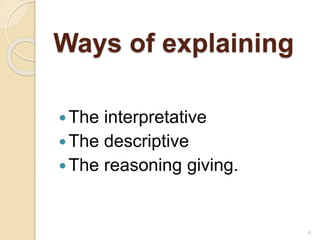
Ways of explaining
The interpretative
The descriptive
The reasoning giving.
4
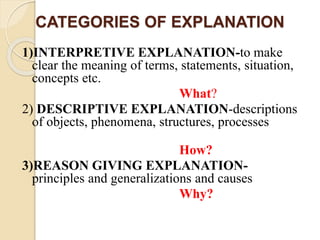
1)INTERPRETIVE EXPLANATION-to make
clear the meaning of terms, statements, situation,
concepts etc.
What?
2) DESCRIPTIVE EXPLANATION-descriptions
of objects, phenomena, structures, processes
How?
3)REASON GIVING EXPLANATION-
principles and generalizations and causes
Why?
CATEGORIES OF EXPLANATION
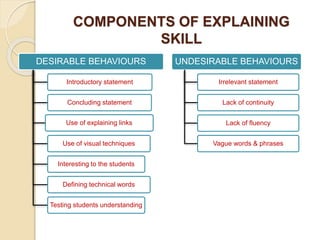
DESIRABLE BEHAVIOURS
Introductory statement
Concluding statement
Use of explaining links
Use of visual techniques
Interesting to the students
Defining technical words
Testing students understanding
UNDESIRABLE BEHAVIOURS
Irrelevant statement
Lack of continuity
Lack of fluency
Vague words & phrases
COMPONENTS OF EXPLAINING
SKILL
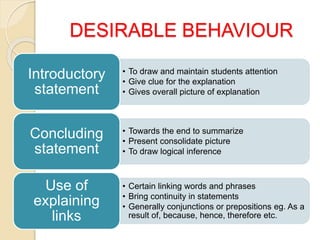
DESIRABLE BEHAVIOUR
• To draw and maintain students attention
• Give clue for the explanation
• Gives overall picture of explanation
Introductory
statement
• Towards the end to summarize
• Present consolidate picture
• To draw logical inference
Concluding
statement
• Certain linking words and phrases
• Bring continuity in statements
• Generally conjunctions or prepositions eg. As a
result of, because, hence, therefore etc.
Use of
explaining
links
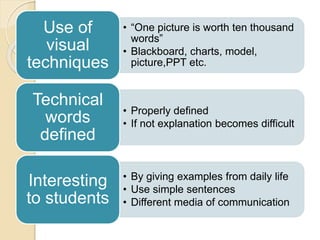
• “One picture is worth ten thousand
words”
• Blackboard, charts, model,
picture,PPT etc.
Use of
visual
techniques
• Properly defined
• If not explanation becomes difficult
Technical
words
defined
• By giving examples from daily life
• Use simple sentences
• Different media of communication
Interesting
to students
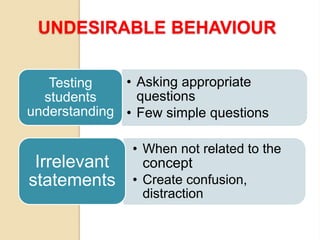
UNDESIRABLE BEHAVIOUR
• Asking appropriate
questions
• Few simple questions
Testing
students
understanding
• When not related to the
concept
• Create confusion,
distraction
Irrelevant
statements
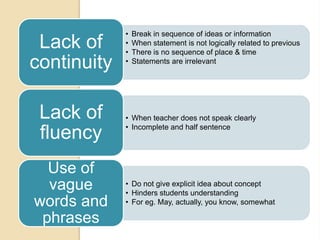
• Break in sequence of ideas or information
• When statement is not logically related to previous
• There is no sequence of place & time
• Statements are irrelevant
Lack of
continuity
• When teacher does not speak clearly
• Incomplete and half sentence
Lack of
fluency
• Do not give explicit idea about concept
• Hinders students understanding
• For eg. May, actually, you know, somewhat
Use of
vague
words and
phrases
Explanation skills by Amol Ubale

Explanation skills by Amol Ubale

  • 1.
  • 2.
    what is anexplanation?  You explain something when you supply information or details that make it clear or easy to understand.  The ability to explain something clearly to a pupil is very essential in a good teacher’s professional practice.
  • 3.
    We think aboutthe process of explaining in relation to:  You as the explainer  Your pupils as the explainees  The concept that you are explaining 3
  • 4.
    Ways of explaining Theinterpretative The descriptive The reasoning giving. 4
  • 5.
    1)INTERPRETIVE EXPLANATION-to make clearthe meaning of terms, statements, situation, concepts etc. What? 2) DESCRIPTIVE EXPLANATION-descriptions of objects, phenomena, structures, processes How? 3)REASON GIVING EXPLANATION- principles and generalizations and causes Why? CATEGORIES OF EXPLANATION
  • 6.
    DESIRABLE BEHAVIOURS Introductory statement Concludingstatement Use of explaining links Use of visual techniques Interesting to the students Defining technical words Testing students understanding UNDESIRABLE BEHAVIOURS Irrelevant statement Lack of continuity Lack of fluency Vague words & phrases COMPONENTS OF EXPLAINING SKILL
  • 7.
    DESIRABLE BEHAVIOUR • Todraw and maintain students attention • Give clue for the explanation • Gives overall picture of explanation Introductory statement • Towards the end to summarize • Present consolidate picture • To draw logical inference Concluding statement • Certain linking words and phrases • Bring continuity in statements • Generally conjunctions or prepositions eg. As a result of, because, hence, therefore etc. Use of explaining links
  • 8.
    • “One pictureis worth ten thousand words” • Blackboard, charts, model, picture,PPT etc. Use of visual techniques • Properly defined • If not explanation becomes difficult Technical words defined • By giving examples from daily life • Use simple sentences • Different media of communication Interesting to students
  • 9.
    UNDESIRABLE BEHAVIOUR • Askingappropriate questions • Few simple questions Testing students understanding • When not related to the concept • Create confusion, distraction Irrelevant statements
  • 10.
    • Break insequence of ideas or information • When statement is not logically related to previous • There is no sequence of place & time • Statements are irrelevant Lack of continuity • When teacher does not speak clearly • Incomplete and half sentence Lack of fluency • Do not give explicit idea about concept • Hinders students understanding • For eg. May, actually, you know, somewhat Use of vague words and phrases