E
quipment Downtime
isthebiggestsourceof
productivity loss for
most manufacturers.
If the equipment sets are not
able to produce as much as
what the customer wants on
a daily basis, this leads to a
cause of lost revenue. Badly
maintained equipment use
up much money on repairs.
Typically erratic equipment
performance is also the
cause of high inventory
build-up in the shop floor.
Manufacturers have no choice
but to run expensive overtime
production to catch up
with customer demand and
shipments. It is also the cause
of much confusion, debates
and misunderstanding
between different groups of
shop-floor crew.
Equipment improvement
is an urgent need for most
manufacturers. But to the
contrary most manufacturers
just don’t maintain their
equipment and many don’t
realise that they are not
1.	 Do you miss customer commits due to equipment
breakdown more than once a month?
2.	 You have not heard of or measure an important
equipment management metric called Overall
Equipment Effectiveness (OEE)?
3.	 You measure OEE, but it is less than 70%
4.	 Your bottlenecks keep shifting. Today it is this machine
and tomorrow it is another
5.	 You usually batch large production sizes of similar
product to reduce equipment changeover. Equipment
set up time is very long and unpredictable in length
and reliability.
6.	 Your equipment are causing Quality rejects and
rework
7.	 Your technicians and production crew have frequent
misunderstanding in the shop-floor on missing
production targets?
NO. QUESTIONS					 YES	 NO
maintainingthemeffectively.Thetypicalmodeespeciallyamongsmallmanufacturers
is what is called as Break-Down Maintenance. This is the attitude of “if it isn’t broken,
don’t fix it; if it is still running just keep running”. This popular attitude has led
many manufacturers to a dangerous situation where they are not in control of their
equipment. Take this seven points test:
•	 If you answered YES to more
than two of the above points:  
You do not manage your
equipment in a systematic
manner. Your machines need  
attention
•	 If you answered YES to more
than 4 of the above point:  
Your equipment are in danger
zone and in need of immediate
attention. Your equipment
may me making you bleed
money.
Here are some short term tips and
proposed long term strategies to
manageyourequipmenteffectively.
SHORT TERM TIPS
1.	 Start with the simple OEE
It is important for us to understand
which is the bottleneck capacity
equipment or set of equipment
first. A bottleneck equipment is
one where the total Daily Output
performance is below the daily
customer demand. Once known we
can use a key measurement called
Overall Equipment Effectiveness
(OEE) to study equipment
performance. OEE has a complex
formula using three Equipment
indicators called Availability Rate,
Performance Rate & Quality
Rate. The compound effect of
rate of these losses will show how
much your equipment is losing
in performance. Here we shall
introduce a simple method (called
Simple OEE) of estimating OEE
without having to use the complex
OEE formula. It will be a very good
estimate but will not show which
category contributes to the biggest
losses. Simple OEE is calculated as
follows:
•	 Determine how many parts
the equipment is supposed
to be producing in 24 hours
with the assumption that there is no downtime, no changeovers, the machine
was running at its optimum speed and created no rejects
•	 Simple OEE is the ratio of how many parts were actually produced to the
number determined above
•	 Example: An equipment is supposed to have produced 6500 pieces in 24
hours assuming it had no downtime, ran at optimum speed and there was
no rejects. However the equipment produced only 3,200 pieces in 24 hours.
Simple OEE is 3200/6500 which is only 49.2%
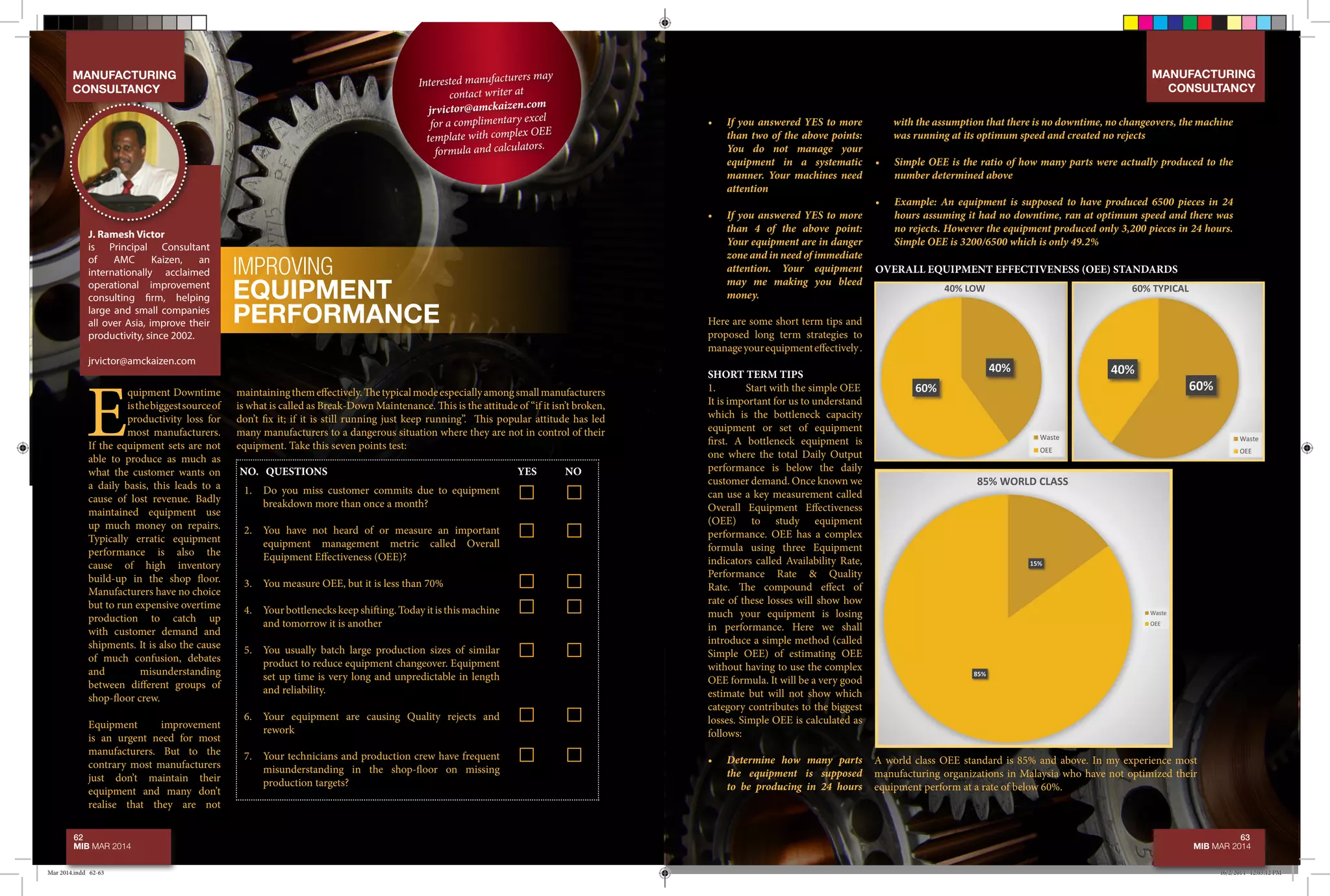
OVERALL EQUIPMENT EFFECTIVENESS (OEE) STANDARDS
A world class OEE standard is 85% and above. In my experience most
manufacturing organizations in Malaysia who have not optimized their
equipment perform at a rate of below 60%.
Interested manufacturers may
contact writer at
jrvictor@amckaizen.com
for a complimentary excel
template with complex OEE
formula and calculators.
62 63
MIB MAR 2014 MIB MAR 2014
MANUFACTURING
CONSULTANCY
MANUFACTURING
CONSULTANCY
J. Ramesh Victor
is Principal Consultant
of AMC Kaizen, an
internationally acclaimed
operational improvement
consulting firm, helping
large and small companies
all over Asia, improve their
productivity, since 2002.
jrvictor@amckaizen.com
IMPROVING
EQUIPMENT
PERFORMANCE
Mar 2014.indd 62-63 16/2/2014 12:03:12 PM
2. Use Bottleneck Management
techniques:
Bottlenecks that don’t perform
to standard needs to be
managed in a specific way.
Form a bottleneck management
team which will meet 3 times a
day for 20 minutes each at the
shop-floor. Create a large visual
board showing on key figures
such as output, downtime,
rework, no-material etc. The
team is to ensure that there
are no unnecessary losses on
the machine and when there is
a breakdown it is attended to
immediately. Make sure that
technicians know that repair
on bottleneck equipment is top
priority
3. Short Term Equipment
Restoration:
Make a short term equipment
restoration effort. This is where
a task force identifies worn
out parts (e.g., seals, gaskets,
bearings, belts etc.) that can
cause breakdowns as they reach
the end of their life. Check
that these parts are in good
condition and replace any worn
out parts. This task force also
makes a daily cleaning of the
equipment. While cleaning they
can spot leaks and further wear
and tear on machine
4. Create visibility and
accountability:
The supervisor of bottleneck
equipment need to track
hourly performances of the
machine. This is displayed on
the visual board placed beside
the machine. Hourly following
up with operators, technicians
and other relevant staff for
about two minutes in front of
this visual board creates great
awareness and urgency on
consistent performance
LONG TERM TIPS
All the short term things suggested
above costs almost nothing in terms
of money. It is merely a focussed
approach on exploiting equipment
performance. By just doing these
things I have seen manufacturers
producing up to 20% more output
from the same set of equipment.
However long term equipment
improvement strategies have to be
planned. Failing to do that will only
mean that the equipment don’t get
systematically improved in terms
of performance and quality. Some
proven long term equipment
improvement strategies are as
follows:
•	 Make an equipment
diagnostics using a complex OEE
formula and other equipment
losses studies
•	 Reduce Equipment
Changeover Time: Quick
Changeover Methodology is very
effective here. It is a method where
typically changeover time can be
systematically reduced by about
50%. I have witnessed several
Quick Changeover projects where
even large machine setups taking
as long as 3 hours being reduced to
about 30 minutes. Even high tech
complex semiconductor industry
machine setups have been reduced
from 2 hours to a mere 40 minutes.
•	 Consider Total Productive Maintenance
(TPM) initiative to address chronic and frequent
losses and Down Time at the machine. The
scope of TPM goes far beyond Down Time. It
includes a complete set of tools and processes for
eliminating waste and addressing all of the six
major equipment Losses. It aims at increasing
equipment OEE to world class standards. Its
three main aims are Zero Unplanned Downtime,
Zero Defects & Zero Accidents
•	 There is a big difference between working
reactively (repairing when they breakdown) and
working proactively (putting in long-term fixes).
Improve Maintenance efforts though proper
study of it. TPM concepts such as Preventive
Maintenance and Predictive Maintenance move
a set of machines from being in Break-Down
Maintenance mode to Zero Unplanned Down
time anywhere between six months to two years.
Skills on the long term proposed methodologies
may be acquired through Training and external
consulting from reliable service providers.
Reliable equipment leads to predictable delivery,
faster cycle time and cost reduction. Taking
equipment management lightly or ignoring it
is not an option in today’s highly challenging
manufacturing environment. I would urge all
manufacturers to take a closer look at one of your
most important investments-your machines. Are
these machines helping you make money? Or are
they causing loss of productivity and unnecessary
stress in the shop-floor. You may find the above
mentioned tips very useful because they are all
proven methods. I have seen it working again
and again in my 20 over years of experience in
manufacturing operational management.
“TPM…includes a complete set of tools and processes for eliminating
waste and addressing all of the six major equipment Losses. It aims at
increasing equipment OEE to world class standards”
64 65
MIB MAR 2014 MIB MAR 2014
GLOBAL INDIAN TRADERS ADDRESSES
GITA
LOG ON TO
www.indiantoday.net
gita@charu.com.my
PJ Office:
Suite 3A52, Level 3A, Block A2,
Leisure Commerce Square,
Jalan PJS 8/9,
46150 Petaling Jaya, Selangor
Tel/Fax: 03 7865 7320
E-directory GITA brings together Indian
businesses from all over the world and allows
them to showcase and promote their products
and services to millions of customers. Call us
now and list your company and acquire more
customers and profits.
GITA is my favourite
e-Directory
JB Office:
No. 6-01, Jalan Bestari 4/2,
Taman Nusa Bestari,
81300 Johor Bahru,
Johor
Tel / Fax : 07 3582320
MANUFACTURING
CONSULTANCY
Mar 2014.indd 64-65 16/2/2014 12:03:13 PM

IMPROVING EQUIPMENT PERFORMANCE

  • 1.
    E quipment Downtime isthebiggestsourceof productivity lossfor most manufacturers. If the equipment sets are not able to produce as much as what the customer wants on a daily basis, this leads to a cause of lost revenue. Badly maintained equipment use up much money on repairs. Typically erratic equipment performance is also the cause of high inventory build-up in the shop floor. Manufacturers have no choice but to run expensive overtime production to catch up with customer demand and shipments. It is also the cause of much confusion, debates and misunderstanding between different groups of shop-floor crew. Equipment improvement is an urgent need for most manufacturers. But to the contrary most manufacturers just don’t maintain their equipment and many don’t realise that they are not 1. Do you miss customer commits due to equipment breakdown more than once a month? 2. You have not heard of or measure an important equipment management metric called Overall Equipment Effectiveness (OEE)? 3. You measure OEE, but it is less than 70% 4. Your bottlenecks keep shifting. Today it is this machine and tomorrow it is another 5. You usually batch large production sizes of similar product to reduce equipment changeover. Equipment set up time is very long and unpredictable in length and reliability. 6. Your equipment are causing Quality rejects and rework 7. Your technicians and production crew have frequent misunderstanding in the shop-floor on missing production targets? NO. QUESTIONS YES NO maintainingthemeffectively.Thetypicalmodeespeciallyamongsmallmanufacturers is what is called as Break-Down Maintenance. This is the attitude of “if it isn’t broken, don’t fix it; if it is still running just keep running”. This popular attitude has led many manufacturers to a dangerous situation where they are not in control of their equipment. Take this seven points test: • If you answered YES to more than two of the above points: You do not manage your equipment in a systematic manner. Your machines need attention • If you answered YES to more than 4 of the above point: Your equipment are in danger zone and in need of immediate attention. Your equipment may me making you bleed money. Here are some short term tips and proposed long term strategies to manageyourequipmenteffectively. SHORT TERM TIPS 1. Start with the simple OEE It is important for us to understand which is the bottleneck capacity equipment or set of equipment first. A bottleneck equipment is one where the total Daily Output performance is below the daily customer demand. Once known we can use a key measurement called Overall Equipment Effectiveness (OEE) to study equipment performance. OEE has a complex formula using three Equipment indicators called Availability Rate, Performance Rate & Quality Rate. The compound effect of rate of these losses will show how much your equipment is losing in performance. Here we shall introduce a simple method (called Simple OEE) of estimating OEE without having to use the complex OEE formula. It will be a very good estimate but will not show which category contributes to the biggest losses. Simple OEE is calculated as follows: • Determine how many parts the equipment is supposed to be producing in 24 hours with the assumption that there is no downtime, no changeovers, the machine was running at its optimum speed and created no rejects • Simple OEE is the ratio of how many parts were actually produced to the number determined above • Example: An equipment is supposed to have produced 6500 pieces in 24 hours assuming it had no downtime, ran at optimum speed and there was no rejects. However the equipment produced only 3,200 pieces in 24 hours. Simple OEE is 3200/6500 which is only 49.2% OVERALL EQUIPMENT EFFECTIVENESS (OEE) STANDARDS A world class OEE standard is 85% and above. In my experience most manufacturing organizations in Malaysia who have not optimized their equipment perform at a rate of below 60%. Interested manufacturers may contact writer at jrvictor@amckaizen.com for a complimentary excel template with complex OEE formula and calculators. 62 63 MIB MAR 2014 MIB MAR 2014 MANUFACTURING CONSULTANCY MANUFACTURING CONSULTANCY J. Ramesh Victor is Principal Consultant of AMC Kaizen, an internationally acclaimed operational improvement consulting firm, helping large and small companies all over Asia, improve their productivity, since 2002. jrvictor@amckaizen.com IMPROVING EQUIPMENT PERFORMANCE Mar 2014.indd 62-63 16/2/2014 12:03:12 PM
  • 2.
    2. Use BottleneckManagement techniques: Bottlenecks that don’t perform to standard needs to be managed in a specific way. Form a bottleneck management team which will meet 3 times a day for 20 minutes each at the shop-floor. Create a large visual board showing on key figures such as output, downtime, rework, no-material etc. The team is to ensure that there are no unnecessary losses on the machine and when there is a breakdown it is attended to immediately. Make sure that technicians know that repair on bottleneck equipment is top priority 3. Short Term Equipment Restoration: Make a short term equipment restoration effort. This is where a task force identifies worn out parts (e.g., seals, gaskets, bearings, belts etc.) that can cause breakdowns as they reach the end of their life. Check that these parts are in good condition and replace any worn out parts. This task force also makes a daily cleaning of the equipment. While cleaning they can spot leaks and further wear and tear on machine 4. Create visibility and accountability: The supervisor of bottleneck equipment need to track hourly performances of the machine. This is displayed on the visual board placed beside the machine. Hourly following up with operators, technicians and other relevant staff for about two minutes in front of this visual board creates great awareness and urgency on consistent performance LONG TERM TIPS All the short term things suggested above costs almost nothing in terms of money. It is merely a focussed approach on exploiting equipment performance. By just doing these things I have seen manufacturers producing up to 20% more output from the same set of equipment. However long term equipment improvement strategies have to be planned. Failing to do that will only mean that the equipment don’t get systematically improved in terms of performance and quality. Some proven long term equipment improvement strategies are as follows: • Make an equipment diagnostics using a complex OEE formula and other equipment losses studies • Reduce Equipment Changeover Time: Quick Changeover Methodology is very effective here. It is a method where typically changeover time can be systematically reduced by about 50%. I have witnessed several Quick Changeover projects where even large machine setups taking as long as 3 hours being reduced to about 30 minutes. Even high tech complex semiconductor industry machine setups have been reduced from 2 hours to a mere 40 minutes. • Consider Total Productive Maintenance (TPM) initiative to address chronic and frequent losses and Down Time at the machine. The scope of TPM goes far beyond Down Time. It includes a complete set of tools and processes for eliminating waste and addressing all of the six major equipment Losses. It aims at increasing equipment OEE to world class standards. Its three main aims are Zero Unplanned Downtime, Zero Defects & Zero Accidents • There is a big difference between working reactively (repairing when they breakdown) and working proactively (putting in long-term fixes). Improve Maintenance efforts though proper study of it. TPM concepts such as Preventive Maintenance and Predictive Maintenance move a set of machines from being in Break-Down Maintenance mode to Zero Unplanned Down time anywhere between six months to two years. Skills on the long term proposed methodologies may be acquired through Training and external consulting from reliable service providers. Reliable equipment leads to predictable delivery, faster cycle time and cost reduction. Taking equipment management lightly or ignoring it is not an option in today’s highly challenging manufacturing environment. I would urge all manufacturers to take a closer look at one of your most important investments-your machines. Are these machines helping you make money? Or are they causing loss of productivity and unnecessary stress in the shop-floor. You may find the above mentioned tips very useful because they are all proven methods. I have seen it working again and again in my 20 over years of experience in manufacturing operational management. “TPM…includes a complete set of tools and processes for eliminating waste and addressing all of the six major equipment Losses. It aims at increasing equipment OEE to world class standards” 64 65 MIB MAR 2014 MIB MAR 2014 GLOBAL INDIAN TRADERS ADDRESSES GITA LOG ON TO www.indiantoday.net gita@charu.com.my PJ Office: Suite 3A52, Level 3A, Block A2, Leisure Commerce Square, Jalan PJS 8/9, 46150 Petaling Jaya, Selangor Tel/Fax: 03 7865 7320 E-directory GITA brings together Indian businesses from all over the world and allows them to showcase and promote their products and services to millions of customers. Call us now and list your company and acquire more customers and profits. GITA is my favourite e-Directory JB Office: No. 6-01, Jalan Bestari 4/2, Taman Nusa Bestari, 81300 Johor Bahru, Johor Tel / Fax : 07 3582320 MANUFACTURING CONSULTANCY Mar 2014.indd 64-65 16/2/2014 12:03:13 PM