INTRODUCTION
TO
TOTAL PRODUCTIVE
MAINTENANCE (TPM)
What is TPM?
Total Productive Maintenance (TPM) is a well-defined and time-tested
concept for maintaining plants and equipment. TPM can be considered as the
medical science of machines.
TPM was introduced to achieve the following objectives:
􀂃 Avoid waste in a quickly changing economic environment.
􀂃 Produce goods without reducing product quality.
􀂃 Reduce costs.
􀂃 Produce a low batch quantity at the earliest possible time.
􀂃 Send only non-defective parts to the customers.
TPM involves all Denso Associates. The major difference between TPM and
other concepts is that the Production Operators are directly involved in the
process of maintaining their equipment.
The old notion of "I operate the equipment, You Maintain it" is NOT followed.
History with TPM
Total Productive Maintenance is an innovative Japanese concept, the origin of which
can be traced back to the early 1950s when preventive maintenance was introduced
in Japan.
The concept of preventive maintenance originated in the USA. Preventive
maintenance is the concept of daily maintenance designed to maintain equipment in
good condition and prevent failure through the prevention of deterioration and
periodic inspections.
Nippondenso was the first company to introduce plant-wide preventive maintenance
in 1960.
Nippondenso operators used machines to produce products and the maintenance
group maintained the machines; however, with the introduction of more and more
factory automation, maintenance became a problem because more maintenance
personnel were required.
Management decided that the production operators could perform the routine
maintenance on their equipment (Autonomous Maintenance, one of the features of
TPM). The maintenance group could then focus on essential maintenance projects.
Thus, Nippondenso, which already practiced preventive maintenance, also added
Autonomous Maintenance performed by production operators. The maintenance
group began identifying modifications to improve overall equipment reliability. The
modifications were made or incorporated in new equipment. This led to Maintenance
Prevention.
Preventive maintenance along with Maintenance Prevention,Autonomous
Maintenance and Maintainability Improvement gave birth to Productive Maintenance.
The goal of productive maintenance was to maximize plant and equipment
effectiveness to achieve optimum life cycle cost of production equipment.
By then Nippondenso had made quality circles, involving the employees’
participation in implementing Productive Maintenance.
Based on these developments Nippondenso was awarded by the Japanese Institute of
Plant Engineers (JIPE) the distinguished plant prize for developing and implementing
TPM.
Nippondenso of the Toyota group became the first company to obtain the TPM
certification.
Denso Vision 2015
To meet our Goals, we must surpass customer expectations of quality, cost, and delivery,
which create a new level of value for everyone.
TPM Goals and Benefits
The goal of the TPM program is to markedly increase production while, at the same
time, increase associate morale and job satisfaction.
TPM brings maintenance into focus as a necessary and vitally important part of the
business. It is no longer regarded as a non-profit activity. Downtime for maintenance is
scheduled as a part of the manufacturing day and, in some cases, as an integral part of
the manufacturing process. The goal is to hold emergency and unscheduled
maintenance to a minimum.
The benefits of TPM are:
• A Safer Workplace
• Associate Empowerment
• An Easier Workload
• Increased Production
• Fewer Defects
• Fewer Breakdowns
• Fewer Short Stoppages (Chokotei)
• Decreased Costs
• Decreased Waste (Muda)
Equipment Efficiency
Equipment that does not operate well or is always breaking down causes more work
for everyone and can cause customer dissatisfaction. If equipment breaks down during
production, many other processes can be affected. Refer to the figure.
Production equipment not being able to produce products with normal equipment
performance is due to 6 major losses:
• Startup Loss
• Setup/Adjustment Loss
• Cycle Time Loss
• Chokotei Loss
• Breakdown Loss
• Defect Loss
If the equipment operates without breakdowns and is consistently working well,
everyone’s work is easier, the company is more profitable, and working conditions
are improved.
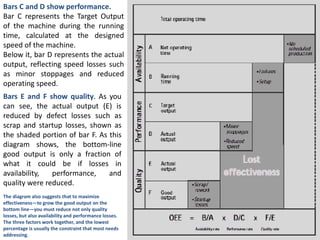
The inverted stair step diagram on the following page shows graphically how the
losses in availability, performance, and quality work together to reduce the overall
effectiveness of a machine.
The top bar, total operating time, shows the total time a machine is available to make
a product. This is usually considered to be 480 minutes per 8-hour shift.
Bars A and B show availability.
Bar A represents the net operating time, which is the time available for production
after subtracting planned downtime (no scheduled production) such as a holiday, no
orders, or no personnel.
Bar B shows the actual running time after subtracting downtime losses such as
equipment failures and setup and adjustments.
Bars C and D show performance.
Bar C represents the Target Output
of the machine during the running
time, calculated at the designed
speed of the machine.
Below it, bar D represents the actual
output, reflecting speed losses such
as minor stoppages and reduced
operating speed.
Bars E and F show quality. As you
can see, the actual output (E) is
reduced by defect losses such as
scrap and startup losses, shown as
the shaded portion of bar F. As this
diagram shows, the bottom-line
good output is only a fraction of
what it could be if losses in
availability, performance, and
quality were reduced.
The diagram also suggests that to maximize
effectiveness—to grow the good output on the
bottom line—you must reduce not only quality
losses, but also availability and performance losses.
The three factors work together, and the lowest
percentage is usually the constraint that most needs
addressing.
Maintenance
Maintenance is defined as “activities that retain machine performance”.
The number, frequency, and severity of equipment breakdowns can be decreased with
proper maintenance. Maintenance includes servicing current conditions and taking
action to prevent future problems.
Types of Maintenance
The major categories of Maintenance include:
• Breakdown Maintenance
• Preventive Maintenance
• Predictive Maintenance
• Corrective Maintenance
• Maintenance Prevention
Breakdown Maintenance (BM) is when we wait for equipment to fail and then repair it. For
example, some electronic equipment is simply replaced when it fails.
Equipment breakdown is classified according to the duration of the stop. Refer to the diagram.
Preventive Maintenance is periodic maintenance that retains the condition of equipment
and prevents failure through the prevention of deterioration, periodic inspection, and
equipment condition diagnosis. PM includes daily cleaning, inspection, lubrication and
tightening.
Autonomous Maintenance is daily preventive maintenance (cleaning, inspection,
lubrication and re-tightening) performed by the equipment operator.
Preventive Maintenance is further divided into Periodic Maintenance and Predictive
Maintenance. Periodic Maintenance is time-based, which involves periodically inspecting,
servicing, and cleaning equipment and replacing parts to prevent problems. Predictive
Maintenance is condition-based, which involves predicting the service life of important
parts based upon inspection or diagnosis, to use the parts to the limit of their service life.
Corrective Maintenance improves equipment and its components so that preventive
maintenance can be performed reliably. Equipment with a design weakness is redesigned
with corrective maintenance to improve reliability or maintainability.
Maintenance Prevention deals with improving the design of new equipment. Current
machine data (information leading to failure prevention, easier maintenance, prevention of
defects, safety,and ease of manufacturing) are studied and designs are incorporated in new
equipment.
Pillars of TPM
Pillars of TPM
5S
5S – The Foundation of TPM
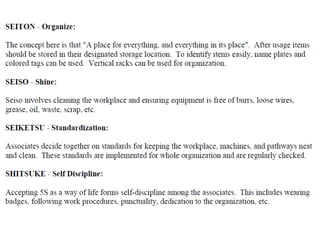
TPM starts with 5S. Problems cannot be clearly seen when the work place is
unorganized. Cleaning and organizing the workplace helps the team to uncover
problems. Making problems visible is the first step of improvement.
Supervisor
Supervisor
EARLY MANAGEMENT & MAINTENANCE PREVENTION
TPM is a Lean tool for
Quality and Productivity
TPM
IMPLEMENTATION
TPM as a Lean Initiative
• Competitive costs require
– Spending control
– Defect control
– Downtime reduction
• TPM = Total Productive Maintenance
– Proactive (with all employees involved)
– Preventive
– Predictive
– Planned
Why Change?
• ACTIONS:
– Reduce defectives / scrap
– Reduction of lost production time
– Lowest possible cost by reducing waste
Lean System
5S
Visual
Factory
T P M
Standardized
Work
Leadership by Example & Commitment
In-Station Process Control
Lean Measures
Employee Involvement & Mutual Respect
Pull system / flow production
Peak Performance
Variation reduction / Six Sigma
Continuous Waste Reduction
Rapid Changeover / Customer-driven lot size
7 Wastes
• Transportation
• Excess production
• Added processes
• Motion
• Waiting
• Inventory
• Non-conformance (defectives)
Causes of Waste
• Excess Manning
– Poor layout and material presentation
– Rework and extra processes
– Inconsistent / inefficient work methods
• Excess Downtime
– Tooling condition
– Unreliable equipment
– Long changeovers
– Incapable process
• Defectives - Rework or Replace
– Incapable processes or process not compatible with
customer expectations or design spec (design for mfg)
– Tooling condition
– Operator methods and errors
Effective TPM Eliminates 5 Losses
1. Equipment breakdowns
2. Defects, scrap, and rework
3. Safety Issues
4. Mini stoppages
5. Reduced speed
1
2
3
4
5
6
7
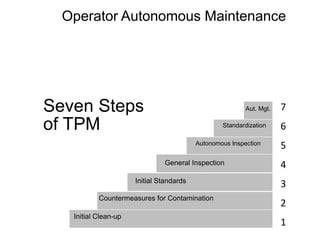
Operator Autonomous Maintenance
Countermeasures for Contamination
Initial Standards
General Inspection
Autonomous Inspection
Standardization
Aut. Mgt.
Seven Steps
of TPM
7
6
5
4
3
2
1
Initial Clean-up
TPM is Planned, Predictive, & Preventive
1. Starts with 5S / Visual Factory
2. Builds a comprehensive downtime data base
by cause, frequency, and duration
3. Predicts and prevents downtime by PM
system
4. Expands role of Operator as first point of
early warning and prevention
5. Professional Maintenance
5S Workplace
Sort (organize)
Shine (clean)
Set in order (make orderly and neat)
Standardize (visual place for everything)
Sustain (maintain the system)
A safe, clean, orderly workplace is
fundamental to quality, efficiency, and teams
TPM starts with 5S
• You can’t see problems clearly when the
workplace is in disarray
• Cleaning and organizing the workplace
helps the team to uncover problems
• Making problems visible is the first step of
improvement
• Clean machines and workplace create pride
& Safety
Downtime Visual Controls
• Visual or audio alerts
– Abnormality obvious at a glance (e.g. stoppage, reject,
control fault)
– Alerting Maint and team leaders
– Provide real time “scoreboard” for employees
• Machine down light visible.
• Production status board (e.g. actual counts vs. goal)
• Scrap counts and downtime minutes
• Located in clear view in shop (not in control room)
• Simple, self regulating, & employee managed
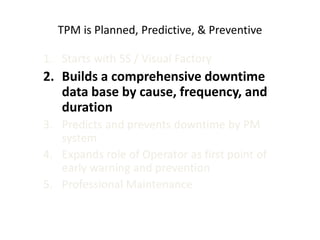
TPM is Planned, Predictive, & Preventive
1. Starts with 5S / Visual Factory
2. Builds a comprehensive downtime
data base by cause, frequency, and
duration
3. Predicts and prevents downtime by PM
system
4. Expands role of Operator as first point of
early warning and prevention
5. Professional Maintenance
Downtime Database
• Categorize at a minimum by Equip, Tooling, C/O, Other
• Segmented bar graph for E-T-O lost time
• Subcategories for Equip (e.g.)
– Hydraulic / pneumatic
– Mechanical / lubrication
– Electrical / controls
– Shot-end components
• Subcategories for Tooling (e.g.)
– Slides
– Cores
– Inserts
– Ejector pins
• Subcategories for Other (e.g.)
– Operator error
– Materials
TPM is Planned, Predictive, & Preventive
1. Starts with 5S / Visual Factory
2. Builds a comprehensive downtime data base
by cause, frequency, and duration
3. Predicts and prevents downtime by
PM system
4. Expands role of Operator as first point of
early warning and prevention
5. Professional Maintenance
Predictive Maintenance Tools
• Rate/hr vs. target or historical normal output (B/W)
• Database
– maintenance history
– statistical probability (frequency & duration)
• Physical prediction of impending failure
– Sound (bearing)
– Temperature (cooling water)
– Flash (core pins)
– Shot monitoring system
– SPC on part geometry
– Hydraulic pressure (ejector pins)
– Spindle loads (amps)
– Fluids / Lubrication analysis (milipore)
– Vibration Signature Analysis
Preventive Maintenance System
• History of downtime by major machine & tool
– Downtime measurement & tracking
– Mean Time Between Failures
– Average downtime
– Pareto of causes at component level (eg L/S or temp sensor)
– Cost to maintain
• Develop PM cards based on frequency of failure and magnitude of average lost
time (start small & grow)
– Limit & prox switches
– Shot tip / sleeve
– Critical frame and cylinder mounting bolts
– Expendable tools
– Valves, hoses, packing, seals
• PM’s have instruction, schedule/frequency & sign-off
– PM’s / repairs done in window of opportunity when machine is down
– Cycle count or date based execution of PM’s (eg cutter change)
– PM status visual (work completed / not completed)
TPM is Planned, Predictive, & Preventive
1. Starts with 5S / Visual Factory
2. Builds a comprehensive downtime data base by
cause, frequency, and duration
3. Predicts and prevents downtime by PM system
4. Expands role of Operator as first point of
early warning and prevention
• One point lessons for operator awareness
• Creates OMP (Operator - Maintenance
Partnership)
• Operator performs checks, problem solving, and
improvements
5. Professional Maintenance
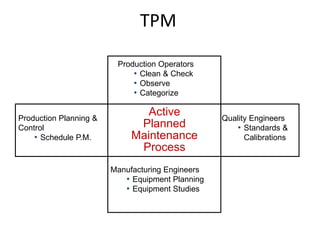
TPM
Production Operators
• Clean & Check
• Observe
• Categorize
Manufacturing Engineers
• Equipment Planning
• Equipment Studies
Production Planning &
Control
• Schedule P.M.
Quality Engineers
• Standards &
Calibrations
Active
Planned
Maintenance
Process
OMP - Operator Maintenance Partnership
• Operator training in TPM
• Operator basic equip inspection &
tooling checks
• Operator basic cleaning
• Operator lubrication check
• One point lessons (capture
knowledge)
• TPM Board & TPM Tags (proactive
operator involvement)
TPM
TPM Tag System
• Problem communication tool to and from
maintenance, tool room, and production
– Identify abnormal machine conditions
• Record problem discovered by operator
• Record problem found during scheduled PM
– Status tracking system of requested repairs
– TPM visual management tool (hang tags)
– Repair history for future problem solving
• TPM Tag used for recording problem & fix
– Blue Tag-Operator or Maint responsible to repair
– Red Tag- Safety-related request (priority)
TPM is Proactive, Predictive, Preventive &
Planned
1. Starts with 5S / Visual Factory
2. Builds a comprehensive downtime data base
by cause, frequency, and duration
3. Predicts and prevents downtime by PM
system
4. Expands role of Operator as first point of
early warning and prevention
5. Professional Maintenance
Professional Maintenance
• Equip Safety
• Skill building
• Cross-training
• Area Maintenance
• Maint Mgmt System
• Down alarms
• Planned PM
1
2
3
4
5
6
7
Operator Autonomous Maintenance
Countermeasures for Contamination
Prepare Temporary Standards
General Inspection
Autonomous Inspection
Standardization
Aut. Mgt.
7 Steps
7
6
5
4
3
2
1
Initial Clean-up
OIL
T P M
TPM
5S
TPM I
Step 1
Step 2
Step 3
TPM II
Step 4
Step 5
Step 6
Step 7
Initial Focus
prerequisite for TPM I
tpm main.pptx
tpm main.pptx
tpm main.pptx
tpm main.pptx
tpm main.pptx
tpm main.pptx

tpm main.pptx

  • 1.
  • 2.
    What is TPM? TotalProductive Maintenance (TPM) is a well-defined and time-tested concept for maintaining plants and equipment. TPM can be considered as the medical science of machines. TPM was introduced to achieve the following objectives: 􀂃 Avoid waste in a quickly changing economic environment. 􀂃 Produce goods without reducing product quality. 􀂃 Reduce costs. 􀂃 Produce a low batch quantity at the earliest possible time. 􀂃 Send only non-defective parts to the customers. TPM involves all Denso Associates. The major difference between TPM and other concepts is that the Production Operators are directly involved in the process of maintaining their equipment. The old notion of "I operate the equipment, You Maintain it" is NOT followed.
  • 3.
    History with TPM TotalProductive Maintenance is an innovative Japanese concept, the origin of which can be traced back to the early 1950s when preventive maintenance was introduced in Japan. The concept of preventive maintenance originated in the USA. Preventive maintenance is the concept of daily maintenance designed to maintain equipment in good condition and prevent failure through the prevention of deterioration and periodic inspections. Nippondenso was the first company to introduce plant-wide preventive maintenance in 1960. Nippondenso operators used machines to produce products and the maintenance group maintained the machines; however, with the introduction of more and more factory automation, maintenance became a problem because more maintenance personnel were required. Management decided that the production operators could perform the routine maintenance on their equipment (Autonomous Maintenance, one of the features of TPM). The maintenance group could then focus on essential maintenance projects.
  • 4.
    Thus, Nippondenso, whichalready practiced preventive maintenance, also added Autonomous Maintenance performed by production operators. The maintenance group began identifying modifications to improve overall equipment reliability. The modifications were made or incorporated in new equipment. This led to Maintenance Prevention. Preventive maintenance along with Maintenance Prevention,Autonomous Maintenance and Maintainability Improvement gave birth to Productive Maintenance. The goal of productive maintenance was to maximize plant and equipment effectiveness to achieve optimum life cycle cost of production equipment. By then Nippondenso had made quality circles, involving the employees’ participation in implementing Productive Maintenance. Based on these developments Nippondenso was awarded by the Japanese Institute of Plant Engineers (JIPE) the distinguished plant prize for developing and implementing TPM. Nippondenso of the Toyota group became the first company to obtain the TPM certification. Denso Vision 2015 To meet our Goals, we must surpass customer expectations of quality, cost, and delivery, which create a new level of value for everyone.
  • 5.
    TPM Goals andBenefits The goal of the TPM program is to markedly increase production while, at the same time, increase associate morale and job satisfaction. TPM brings maintenance into focus as a necessary and vitally important part of the business. It is no longer regarded as a non-profit activity. Downtime for maintenance is scheduled as a part of the manufacturing day and, in some cases, as an integral part of the manufacturing process. The goal is to hold emergency and unscheduled maintenance to a minimum. The benefits of TPM are: • A Safer Workplace • Associate Empowerment • An Easier Workload • Increased Production • Fewer Defects • Fewer Breakdowns • Fewer Short Stoppages (Chokotei) • Decreased Costs • Decreased Waste (Muda)
  • 6.
    Equipment Efficiency Equipment thatdoes not operate well or is always breaking down causes more work for everyone and can cause customer dissatisfaction. If equipment breaks down during production, many other processes can be affected. Refer to the figure. Production equipment not being able to produce products with normal equipment performance is due to 6 major losses: • Startup Loss • Setup/Adjustment Loss • Cycle Time Loss • Chokotei Loss • Breakdown Loss • Defect Loss
  • 7.
    If the equipmentoperates without breakdowns and is consistently working well, everyone’s work is easier, the company is more profitable, and working conditions are improved. The inverted stair step diagram on the following page shows graphically how the losses in availability, performance, and quality work together to reduce the overall effectiveness of a machine. The top bar, total operating time, shows the total time a machine is available to make a product. This is usually considered to be 480 minutes per 8-hour shift. Bars A and B show availability. Bar A represents the net operating time, which is the time available for production after subtracting planned downtime (no scheduled production) such as a holiday, no orders, or no personnel. Bar B shows the actual running time after subtracting downtime losses such as equipment failures and setup and adjustments.
  • 8.
    Bars C andD show performance. Bar C represents the Target Output of the machine during the running time, calculated at the designed speed of the machine. Below it, bar D represents the actual output, reflecting speed losses such as minor stoppages and reduced operating speed. Bars E and F show quality. As you can see, the actual output (E) is reduced by defect losses such as scrap and startup losses, shown as the shaded portion of bar F. As this diagram shows, the bottom-line good output is only a fraction of what it could be if losses in availability, performance, and quality were reduced. The diagram also suggests that to maximize effectiveness—to grow the good output on the bottom line—you must reduce not only quality losses, but also availability and performance losses. The three factors work together, and the lowest percentage is usually the constraint that most needs addressing.
  • 9.
    Maintenance Maintenance is definedas “activities that retain machine performance”. The number, frequency, and severity of equipment breakdowns can be decreased with proper maintenance. Maintenance includes servicing current conditions and taking action to prevent future problems. Types of Maintenance The major categories of Maintenance include: • Breakdown Maintenance • Preventive Maintenance • Predictive Maintenance • Corrective Maintenance • Maintenance Prevention Breakdown Maintenance (BM) is when we wait for equipment to fail and then repair it. For example, some electronic equipment is simply replaced when it fails. Equipment breakdown is classified according to the duration of the stop. Refer to the diagram.
  • 10.
    Preventive Maintenance isperiodic maintenance that retains the condition of equipment and prevents failure through the prevention of deterioration, periodic inspection, and equipment condition diagnosis. PM includes daily cleaning, inspection, lubrication and tightening. Autonomous Maintenance is daily preventive maintenance (cleaning, inspection, lubrication and re-tightening) performed by the equipment operator. Preventive Maintenance is further divided into Periodic Maintenance and Predictive Maintenance. Periodic Maintenance is time-based, which involves periodically inspecting, servicing, and cleaning equipment and replacing parts to prevent problems. Predictive Maintenance is condition-based, which involves predicting the service life of important parts based upon inspection or diagnosis, to use the parts to the limit of their service life. Corrective Maintenance improves equipment and its components so that preventive maintenance can be performed reliably. Equipment with a design weakness is redesigned with corrective maintenance to improve reliability or maintainability. Maintenance Prevention deals with improving the design of new equipment. Current machine data (information leading to failure prevention, easier maintenance, prevention of defects, safety,and ease of manufacturing) are studied and designs are incorporated in new equipment.
  • 11.
  • 12.
  • 13.
    5S – TheFoundation of TPM TPM starts with 5S. Problems cannot be clearly seen when the work place is unorganized. Cleaning and organizing the workplace helps the team to uncover problems. Making problems visible is the first step of improvement.
  • 17.
  • 31.
    EARLY MANAGEMENT &MAINTENANCE PREVENTION
  • 34.
    TPM is aLean tool for Quality and Productivity TPM IMPLEMENTATION
  • 35.
    TPM as aLean Initiative • Competitive costs require – Spending control – Defect control – Downtime reduction • TPM = Total Productive Maintenance – Proactive (with all employees involved) – Preventive – Predictive – Planned
  • 36.
    Why Change? • ACTIONS: –Reduce defectives / scrap – Reduction of lost production time – Lowest possible cost by reducing waste
  • 37.
    Lean System 5S Visual Factory T PM Standardized Work Leadership by Example & Commitment In-Station Process Control Lean Measures Employee Involvement & Mutual Respect Pull system / flow production Peak Performance Variation reduction / Six Sigma Continuous Waste Reduction Rapid Changeover / Customer-driven lot size
  • 38.
    7 Wastes • Transportation •Excess production • Added processes • Motion • Waiting • Inventory • Non-conformance (defectives)
  • 39.
    Causes of Waste •Excess Manning – Poor layout and material presentation – Rework and extra processes – Inconsistent / inefficient work methods • Excess Downtime – Tooling condition – Unreliable equipment – Long changeovers – Incapable process • Defectives - Rework or Replace – Incapable processes or process not compatible with customer expectations or design spec (design for mfg) – Tooling condition – Operator methods and errors
  • 40.
    Effective TPM Eliminates5 Losses 1. Equipment breakdowns 2. Defects, scrap, and rework 3. Safety Issues 4. Mini stoppages 5. Reduced speed
  • 41.
    1 2 3 4 5 6 7 Operator Autonomous Maintenance Countermeasuresfor Contamination Initial Standards General Inspection Autonomous Inspection Standardization Aut. Mgt. Seven Steps of TPM 7 6 5 4 3 2 1 Initial Clean-up
  • 42.
    TPM is Planned,Predictive, & Preventive 1. Starts with 5S / Visual Factory 2. Builds a comprehensive downtime data base by cause, frequency, and duration 3. Predicts and prevents downtime by PM system 4. Expands role of Operator as first point of early warning and prevention 5. Professional Maintenance
  • 43.
    5S Workplace Sort (organize) Shine(clean) Set in order (make orderly and neat) Standardize (visual place for everything) Sustain (maintain the system) A safe, clean, orderly workplace is fundamental to quality, efficiency, and teams
  • 44.
    TPM starts with5S • You can’t see problems clearly when the workplace is in disarray • Cleaning and organizing the workplace helps the team to uncover problems • Making problems visible is the first step of improvement • Clean machines and workplace create pride & Safety
  • 45.
    Downtime Visual Controls •Visual or audio alerts – Abnormality obvious at a glance (e.g. stoppage, reject, control fault) – Alerting Maint and team leaders – Provide real time “scoreboard” for employees • Machine down light visible. • Production status board (e.g. actual counts vs. goal) • Scrap counts and downtime minutes • Located in clear view in shop (not in control room) • Simple, self regulating, & employee managed
  • 46.
    TPM is Planned,Predictive, & Preventive 1. Starts with 5S / Visual Factory 2. Builds a comprehensive downtime data base by cause, frequency, and duration 3. Predicts and prevents downtime by PM system 4. Expands role of Operator as first point of early warning and prevention 5. Professional Maintenance
  • 47.
    Downtime Database • Categorizeat a minimum by Equip, Tooling, C/O, Other • Segmented bar graph for E-T-O lost time • Subcategories for Equip (e.g.) – Hydraulic / pneumatic – Mechanical / lubrication – Electrical / controls – Shot-end components • Subcategories for Tooling (e.g.) – Slides – Cores – Inserts – Ejector pins • Subcategories for Other (e.g.) – Operator error – Materials
  • 48.
    TPM is Planned,Predictive, & Preventive 1. Starts with 5S / Visual Factory 2. Builds a comprehensive downtime data base by cause, frequency, and duration 3. Predicts and prevents downtime by PM system 4. Expands role of Operator as first point of early warning and prevention 5. Professional Maintenance
  • 49.
    Predictive Maintenance Tools •Rate/hr vs. target or historical normal output (B/W) • Database – maintenance history – statistical probability (frequency & duration) • Physical prediction of impending failure – Sound (bearing) – Temperature (cooling water) – Flash (core pins) – Shot monitoring system – SPC on part geometry – Hydraulic pressure (ejector pins) – Spindle loads (amps) – Fluids / Lubrication analysis (milipore) – Vibration Signature Analysis
  • 50.
    Preventive Maintenance System •History of downtime by major machine & tool – Downtime measurement & tracking – Mean Time Between Failures – Average downtime – Pareto of causes at component level (eg L/S or temp sensor) – Cost to maintain • Develop PM cards based on frequency of failure and magnitude of average lost time (start small & grow) – Limit & prox switches – Shot tip / sleeve – Critical frame and cylinder mounting bolts – Expendable tools – Valves, hoses, packing, seals • PM’s have instruction, schedule/frequency & sign-off – PM’s / repairs done in window of opportunity when machine is down – Cycle count or date based execution of PM’s (eg cutter change) – PM status visual (work completed / not completed)
  • 51.
    TPM is Planned,Predictive, & Preventive 1. Starts with 5S / Visual Factory 2. Builds a comprehensive downtime data base by cause, frequency, and duration 3. Predicts and prevents downtime by PM system 4. Expands role of Operator as first point of early warning and prevention • One point lessons for operator awareness • Creates OMP (Operator - Maintenance Partnership) • Operator performs checks, problem solving, and improvements 5. Professional Maintenance
  • 52.
    TPM Production Operators • Clean& Check • Observe • Categorize Manufacturing Engineers • Equipment Planning • Equipment Studies Production Planning & Control • Schedule P.M. Quality Engineers • Standards & Calibrations Active Planned Maintenance Process
  • 53.
    OMP - OperatorMaintenance Partnership • Operator training in TPM • Operator basic equip inspection & tooling checks • Operator basic cleaning • Operator lubrication check • One point lessons (capture knowledge) • TPM Board & TPM Tags (proactive operator involvement) TPM
  • 54.
    TPM Tag System •Problem communication tool to and from maintenance, tool room, and production – Identify abnormal machine conditions • Record problem discovered by operator • Record problem found during scheduled PM – Status tracking system of requested repairs – TPM visual management tool (hang tags) – Repair history for future problem solving • TPM Tag used for recording problem & fix – Blue Tag-Operator or Maint responsible to repair – Red Tag- Safety-related request (priority)
  • 55.
    TPM is Proactive,Predictive, Preventive & Planned 1. Starts with 5S / Visual Factory 2. Builds a comprehensive downtime data base by cause, frequency, and duration 3. Predicts and prevents downtime by PM system 4. Expands role of Operator as first point of early warning and prevention 5. Professional Maintenance
  • 56.
    Professional Maintenance • EquipSafety • Skill building • Cross-training • Area Maintenance • Maint Mgmt System • Down alarms • Planned PM
  • 57.
    1 2 3 4 5 6 7 Operator Autonomous Maintenance Countermeasuresfor Contamination Prepare Temporary Standards General Inspection Autonomous Inspection Standardization Aut. Mgt. 7 Steps 7 6 5 4 3 2 1 Initial Clean-up OIL T P M
  • 58.
    TPM 5S TPM I Step 1 Step2 Step 3 TPM II Step 4 Step 5 Step 6 Step 7 Initial Focus prerequisite for TPM I

Editor's Notes

  • #42 These are the 7 steps for Operator Autonomous Maintenance: 1. Initial clean-up 2. Countermeasures for Hard-to-Access & Source of Contamination 3. Prepare Temporary Standards 4. General Inspection 5. Autonomous Inspection 6. Standardization 7. Autonomous Management
  • #53 All of these activities must work together to fully achieve a successful planned maintenance program. Everyone must understand their roles and responsibilities and execute as a team. Planned maintenance can no longer be the sole responsibility of the maintenance department.
  • #58 These are the 7 steps for Operator Autonomous Maintenance: 1. Initial clean-up 2. Countermeasures for Hard-to-Access & Source of Contamination 3. Prepare Temporary Standards 4. General Inspection 5. Autonomous Inspection 6. Standardization 7. Autonomous Management