Download the fullversion and explore a variety of ebooks
or textbooks at https://ebookultra.com
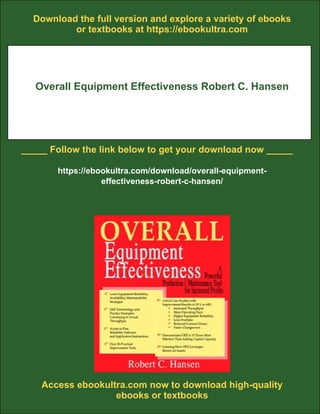
Overall Equipment Effectiveness Robert C. Hansen
_____ Follow the link below to get your download now _____
https://ebookultra.com/download/overall-equipment-
effectiveness-robert-c-hansen/
Access ebookultra.com now to download high-quality
ebooks or textbooks
2.
We have selectedsome products that you may be interested in
Click the link to download now or visit ebookultra.com
for more options!.
Small Antenna Handbook 1st Edition Robert C. Hansen
https://ebookultra.com/download/small-antenna-handbook-1st-edition-
robert-c-hansen/
Prevention Effectiveness A Guide to Decision Analysis and
Economic Evaluation 2nd Edition Anne C. Haddix
https://ebookultra.com/download/prevention-effectiveness-a-guide-to-
decision-analysis-and-economic-evaluation-2nd-edition-anne-c-haddix/
Cost Management Accounting and Control 5th Edition Don
R.(Don R. Hansen) Hansen
https://ebookultra.com/download/cost-management-accounting-and-
control-5th-edition-don-r-don-r-hansen-hansen/
Photographic Possibilities The Expressive Use of Equipment
Ideas Materials and Processes 3 ed 3rd Edition Hirsch
Robert
https://ebookultra.com/download/photographic-possibilities-the-
expressive-use-of-equipment-ideas-materials-and-processes-3-ed-3rd-
edition-hirsch-robert/
3.
Equipment Management Keyto Equipment Reliability and
productivity in mining 2nd ed Edition Tomlingson
https://ebookultra.com/download/equipment-management-key-to-equipment-
reliability-and-productivity-in-mining-2nd-ed-edition-tomlingson/
Environmental Regime Effectiveness Edward L. Miles
https://ebookultra.com/download/environmental-regime-effectiveness-
edward-l-miles/
Roman Military Equipment from the Punic Wars to the Fall
of Rome Second Edition J. C. Coulston
https://ebookultra.com/download/roman-military-equipment-from-the-
punic-wars-to-the-fall-of-rome-second-edition-j-c-coulston/
Brother Robert growing up with Robert Johnson 1st Edition
Annye C. Anderson
https://ebookultra.com/download/brother-robert-growing-up-with-robert-
johnson-1st-edition-annye-c-anderson/
Cost Effectiveness Analysis in Health Peter Muennig
https://ebookultra.com/download/cost-effectiveness-analysis-in-health-
peter-muennig/
5.
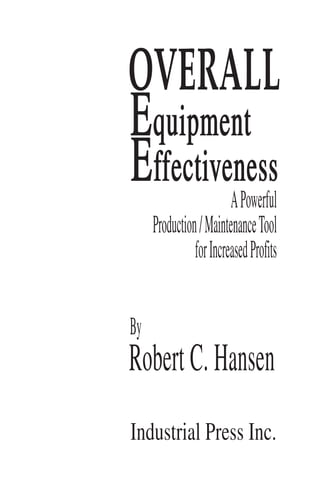
Overall Equipment EffectivenessRobert C. Hansen
Digital Instant Download
Author(s): Robert C. Hansen
ISBN(s): 9780831131388, 0831131381
Edition: Kindle
File Details: PDF, 6.29 MB
Year: 2001
Language: english
F O RE W O R D
O
verall Equipment Effectiveness (OEE) began to be rec-
ognized as a fundamental method for measuring plant
performance in the late 1980s and early 1990s. It was a
period that saw the emergence of serious big company maintenance
benchmarking, the introduction of Total Productive Maintenance (TPM)
in America, and the founding of the Society for Maintenance &
Reliability Professionals.
At first, OEE was closely bound to TPM and often was seen as a
vague defining measurement for winning the TPM Prize. Then, as more
practitioners were exposed to OEE in TPM-related articles and seminars,
it was viewed as a standalone tool for measuring true performance by
merging performance indicators for availability, efficiency, and quality.
OEE came to be further valued as a change agent for bringing
maintenance, operations, and engineering together to address the higher-
level issues of plant performance. Now, it is accepted by management
consultants as a primary performance metric.
Recognizing OEE as an effective productivity management met-
ric is one thing, using it effectively is another, as many practitioners have
found out. The OEE learning curve can be steep. Bob Hansen has been
there, climbed over the obstacles, and survived to develop a practical
how-to approach to using OEE which he lays out in Overall Equipment
Effectiveness: A Powerful Production/Maintenance Tool for Increased
Profits.
I’ve known Bob for a number of years as a maintenance and reli-
ability practitioner, seminar leader, and author of magazine articles. I’ve
found his analysis of OEE and related productivity processes insightful
and practical, as have members of the maintenance and reliability com-
munity. Now, he has put everything together to build this comprehensive
reference.
Not only does he cover OEE, but he presents related productivi-
ty and reliability tools in a format for quick application. He provides prac-
tical tips on what to do and how to do it. As such, the book becomes a
must-have desk reference for maintenance managers, production fore-
men, reliability engineers, manufacturing executives, and plant leader-
ship teams.
Robert C. Baldwin, CMRP
Editor, Maintenance Technology Magazine
Barrington, IL
9.
P R EF A C E
Overall Equipment Effectiveness: A Powerful Production and
Maintenance Tool for Increased Profits brings together both the
social and technical aspects of successful manufacturing and pro-
cessing. I would have paid many times over to have such a book at the start of my man-
ufacturing career. The book is a practitioner’s primer; it demonstrates how to apply and
improve overall equipment effectiveness at your factory or processing plant.
Picture yourself facing a majestic mountain that represents performance
excellence at its peak. Every factory or processing plant represents a mountain and no
two are exactly the same. In fact, each changes whenever its products, processes, mate-
rials, or people change. Achieving excellence is a continuous climb.
You have many decisions: where to start climbing the mountain, what to take
with you, how to use your resources, and which tools to use to measure your progress.
A wise person would first engage those who have made the climb before and learn
from them what worked and what didn’t work. This book lays out guidelines and
strategies for a successful climb. It is not the only way to success; however, it can
reveal new trails that help shorten the journey.
Every department and area where I have worked has demonstrated some level
of progress over its years of operation. When significant jumps in productivity were
made, I thought about the vast amount of income that could have been realized had the
practices and procedures that identify and leverage the "hidden factory" been imple-
mented years earlier.
I hope that plant and corporate managers accountable for production opera-
tions not only learn the concepts and theories but also take the responsibility to per-
sonally champion OEE. If you are not supporting reliability, then you are supporting
failures.
The concept of true OEE is the most important aspect of this book. This book
is worth its weight in platinum if all it does is help you discover your plant’s true posi-
tion relative to its current performance. This potential is determined by taking the actu-
al quantity of good product transferred out and dividing it by the total amount that
could be made in all the hours of scheduled production. This amount is what could be
made without any losses due to quality, speed rate, equipment downtime, changeovers,
start-ups, shutdowns, or lack of materials and supplies. If your plant is in the envious
position of selling everything it can make, then your hidden factory is the difference
between what good product was transferred out in the past twelve months and what
could be made in 8760 hours of perfect production.
Parts of this book focus on collecting data, generating information, prioritiz-
ing, and selecting ways to significantly improve the bottom line. A major goal is to
show how to identify the improvements a project should yield in financial terms, then
to actually generate those results.
I have outlined a methodology that links OEE and equipment reliability
improvements to bottom line increased income for operations. This methodology is a
v
10.
powerful tool thatshould assist every engineer, foreman, department head, and man-
ager in selecting the right projects and then communicating the benefits in financial
terms.
A portion of this book provides tools and techniques for examining the inher-
ent reliability of existing or proposed equipment systems and design for reliability
methodology. These include reliability block diagrams and computer simulations of
modeled systems. The book refers to software that can be freely downloaded from the
Internet. The examples demonstrate practical applications that investigate possible
improvements. The software program can perform the vast majority of that provided
by highly-priced commercial simulation software.
Another useful tool is Reliability Quantification Testing (RQT). This general
tool for existing and new equipment fabrications helps quantify the actual reliability
performance. It should become a mandatory tool used for accepting or commissioning
equipment systems critical to your manufacturing processes. To build in reliability of
proposed designs, reliability specifications and the level of testing before acceptance
must become a part of the original purchase order. RQT establishes the test hours and
failure frequency parameters, then generates a point estimate of actual Mean Time
Between Failures for the tested system.
In addition to OEE, this book champions the theory of constraints manage-
ment, quick changeovers, production–production capability balance, conditioned-
based maintenance, and a maintenance strategy of short frequent linestops. Any one of
these tools or techniques might leverage additional productivity out of the hidden fac-
tory at many plants worldwide and could be financially important to your company’s
overall business.
Several aspects of the human side of manufacturing are addressed in this
book. Years of observing maintenance people doing extensive shutdown work provid-
ed insights about human energy levels and attention to details. These observations form
the basis for shutdown planning guidelines. In addition, a system of ranking and com-
pensating workers doing nonrepetitive work is provided as well as recommendations
about the hiring process. One of the most important purposes of this book is to help
plants avoid the pain of unplanned downsizing that results from not being as produc-
tive as they could be. Over the long term, plants can not downsize themselves to suc-
cess without fundamental changes in current methodologies.
At the very least, this book is intended to motivate readers to start now on
their journey up the mountain toward performance excellence. I would be delighted to
receive comments and stories about the active use and application of this book's con-
cepts in your work area.
Getting people to accept change and do things differently can be very impos-
ing even if you know it is the right direction to go. Change often requires a leap of faith.
Understanding this book will reduce the leap of faith to a single step. Climbing to high-
er levels on the mountain begins with a single step. Start Now!
Bob Hansen
PO Box 272427
Fort Collins, CO. 80527, USA
Rch4oee@AOL.com
vi
11.
A C KN O W L E D G E M E N T S
I
give my sincere thanks to the many hundreds of people that helped me
as teachers, mentors, associates, supporters, champions, team mem-
bers, workmates, contributors, and friends in the manifestation of this
book. A few of you are listed below.
Cindy Carelli, the person who urged me to write a book.
Mary, my wife and best friend, who supported and encouraged me
through the entire project.
The people at Industrial Press, especially John Carleo and Janet Romano,
as well as a big thanks to Robert Weinstein, my freelance editor.
All the authors of the suggested reading materials in Appendix 1 and 8.
And, in no particular order, the people who educated me or worked direct-
ly on aspects of this book.
Gary Bien, Ron Moore, Brad Peterson, Bob Crosby, Jerry Haggerty, Bob
Baldwin, Joe Peterson, Al Weber, Jack Regan, Bob Mears, Gary Kirkpatrick, Dave
Troness, Rudy Hessling, Ron Kaufman, Eric Adsit, Ron Hartman, Dave Olson,
Ron Harmer, Steve VandeSande, Bob Price, Bob Dinges, Darl Brunner, Tom
Brooks, Ed Fleischman, Bob Cushman, Ray Secor, Karen Gleason, Rick Gilkey,
Dean Heine, Dennis Norton, Bob Izard, Chris Hiatt, Ken Nicolai, Rich Cox, Mike
Lenahan, Ray Seela, Gordy Edwards, Ted Huckabee, Heinz Buschang, Jim Cole,
Chris Schmachtenberger, Joe Tunner, Dave Kiick, Dick Vogel, Rick Ellerby, Ray
Traugott, Rick Niles, Rob Gray, Tom Barakat, Nick Yobbagy, Tom Pray, Sally
Seilbach, Al Ashbaugh, Tony Fedor, Walt Brink, Bruce Williams, Rick Merlino,
Bob Moran, Ron Cappalongo, Ralph Hedding, Dave Army, Jim Harris, Ian
Hedding, Walt Edwards, Harry Roberts, Chris Guerin, Carol Cox, Gary Gotham,
Mike Moll, Jeff Hartzel, Ray Richard, Derek Ransom, Dennis Lock, Pete Kufeke,
Stuart Parish, Ian Wood, Roy Kennedy, Nelson Tanaka, Garry Punch, Thom
Winkler, Randy Cooper, Roger Maddocks, Marco Vittuzo, Edgard Lopes, Carl
Talbott, Veronica Reou, Ron Chatterton, Tom Larkin, Troy Thompson, Carol
Vesier, Ed Armstrong, Ray Larson, Chuck Lindeken, Jerry Thoutt, Dan Lock,
Delbert Stolley, Rick Schleusener, Dale Conant, Jay Edwards, Paul Frank, Tom
Redding, Ray Cozzens Mike Haas, Ken Dillman, Ray Glaback, Derold Davis, Gil
Elleoby and many others.
Again, thank you all very much!
vii
12.
viii
T A BL E O F
C O N T E N T S
Foreword iii
Preface v
Acknowledgements vii
1. Understanding the Power of Overall Equipment
Effectiveness (OEE) 1
1.1 Factories: Effective Producers of Good Goods 2
1.2 Factory Dynamics 3
1.3 Balancing the Business 4
Decide II: A Simulation Experience 5
1.4 Leadership for Teams 8
1.5 Moving the Community to Improved Performance 10
A Case Study Using OEE Metrics
1.6 Total Effectiveness Equipment Performance (TEEP) 17
1.7 The Bottom Line: Good Goods at Lowest Cost—Now! 20
2. Learning the Basics of OEE Metrics 25
2.1 Definitions of OEE Categories 25
2.2 Data Collection Review 28
2.3 Practice Production Report 32
2.4 Summarization Example 33
2.5 OEE Formulas and Results 36
Method 1 OEE Using Nakajima Formulas 40
Method 2 OEE Using Event Time Records 41
Method 3 OEE Based On Good Units Transferred 41
2.6 Reconciliation and Loss Analysis 42
3. The Financial Aspects of OEE 47
3.1 Factory Example: Base Case 48
3.2 Case B: Same Output, Improved OEE 52
3.3 Case C: Full Factory, Improved OEE 54
3.4 Case D: OEE Impact on Return On Assets (ROA) 56
3.5 Case E: Higher OEE with the Same Sales, ROA 60
3.6 Case F: Higher OEE, Selling Everything Produced, ROA 62
13.
4. The PeopleFactor 67
4.1 The Most Important Resource: Actively Learning, 68
Motivated People
4.2 Group Centering Exercise 71
The Metronome Exercise
4.3 Skills, Interaction, Action 76
4.4 Observation and Education 79
4.5 Work Group Experiences 83
4.6 An Example of Expectations: Master Mechanics 88
4.7 An Example of Expectations: Technicians 91
4.8 Interviewing and Hiring 94
4.9 Ranking and Compensating 99
5. Priority and Decision Tools 105
5.1 The Value Fulcrum 105
5.2 Developing a Troubleshooting Guideline Decision Tree 109
6. Win-Win Maintenance/Equipment Shutdown Strategies 113
6.1 Steps to Improve TEEP: A Case Study 114
Identify 118
Exploit 120
Subordinate 126
Elevate 127
Go back 127
6.2 Shutdown Strategy Checklist 130
7. Reliability 101 137
7.1 Reliability101 Introduction 137
7.2 Reliability Nomenclature 143
7.3 Beginning Reliability with What You Have 156
7.4 Matching Maintenance Strategy to Equipment Function 160
7.5 Developing Best Practices 164
7.6 Building Reliability into Equipment Design 166
8. Reliability Availability Maintainability/System Performance
Analysis, (RAM/SPA) 173
8.1 RAM/SPA 174
8.2 Improving the ‘Horse’ you Already Have / Starting 175
Reliability
8.3 Quick Changeovers: Single-Minute Exchange of Dies 178
ix
14.
8.4 Theory OfConstraints 180
8.5 Data collection and Information sharing 183
8.6 Pareto Analysis 190
8.7 Project Management and Asset Life Cycle 192
8.8 Speed ups 198
8.9 Cycle time improvements 201
8.10 Benchmarking 204
9. A General Tool for Acceptance Testing 215
9.1 Reliability Quantification Testing 215
9.2 Implementation Stories 219
Case 1. Barrel Dumper Project 219
Case 2. Computer System Upgrade 220
Case 3. Material Handling Wheels 222
Case 4. Automatic Core Loading 222
10. Success or Failure 225
10.1 The Success Riddle 225
10.2 Why Factories Fail 230
Impending Failure Study 231
APPENDIX 237
1. Recommended Reading 237
2. RAPTOR 238
3. Redundancy Equations 240
4. Generic Failure Rates 244
5. Mechanical Failure Modes 253
6. Failure Mode Effects and Criticality Analysis 259
7. Constructing Pareto Charts 264
8. Preserving Failure Data 271
INDEX 275
x
15.
C H AP T E R 1
UNDERSTANDING THE
POWER OF OVERALL
EQUIPMENT EFFECTIVENESS
(OEE)
T
his book is the culmination of the many years of experi-
ence I have inside a large Fortune 100 company. It is
offered as a "how to improve" guide for many of the issues
that exist in manufacturing work centers (factories or refineries) of all
sizes and types. We will look at the key parameters for the success of
manufacturing communities, then link those parameters to the financial
business metrics that are vital to your company’s success. We will also
look at the practical application of theories that are commonly spoken,
but seldom accepted on the factory shop floor.
Aspects of this book are appropriate for everyone involved in or
supporting a manufacturing process. The book provides all work centers
with techniques and measures for greater throughput that requires little or
no capital spending. Over the years, I have been successful in five differ-
ent types of manufacturing processes. Based on that experience, I offer
recommendations regarding what does and does not work to improve pro-
ductivity and reliability-maintainability in both the short term and the
1
16.
long term. Ihope you will use this book proactively to drive improve-
ments in your area.
1.1 Factories: Effective Producers of Good Goods
Every factory* attempts to be an effective, low-cost producer.
This effort is required in today’s challenging environment when cus-
tomers demand quality product at the best value. Few factories attain and
maintain high level productivity and low costs. Many of these use a dis-
ciplined approach to identify the best improvements to make. They use
teams to eliminate the root problems that otherwise keep the factory from
driving toward continuously higher levels of effectiveness. In short, they
have found the power of OEE: Overall Equipment Effectiveness.1
By
recognizing the ‘hidden factory’ within, they have made improvements
that contribute directly to the bottom line.
World-class manufacturing areas share two common characteris-
tics. They are data driven and they are led by synergistic multi-function
leadership teams. Accurately measuring and driving key success parame-
ters contributes to higher productivity for both the area and the plant. A
method called Overall Equipment Effectiveness, or OEE, can help you
better understand how well a manufacturing area is performing, and iden-
tify what is limiting higher effectiveness.
Manufacturing systems are composed of equipment and machin-
ery that combine to transform materials and sub-assemblies into products
that are either parts for the next step of manufacturing or finished goods.
A significant amount of capital is often invested to design, build, and
implement a system so that product can be made uniformly at a high rate
with minimal waste. The factory should effectively deliver the product at
less cost than would be needed to produce it individually. Every business
plan should include projections about the effectiveness of the proposed
system and how well it will contribute to the bottom line. The company
should also be aware of the degree to which it is at risk if the expected
effectiveness is not attained and sustained.
Continuous and discrete processes of transforming materials and
parts into products can be complex and unique; the system is often quite
technical and elaborate. In many instances, a standard product is manu-
factured in many different formats and variations. The system, therefore,
splinters into multiple processes, yet they use shared resources. Some of
the cases in this book come from the author's personal experience in a set-
CHAPTER 1
2
*The word ‘factory’ can be replaced by ‘refinery’ throughout this book.
17.
ting where overthirty process setups were used to produce variations of
seventy different products from four different product families. The cap-
ital investment was well over $100 million. Thus, the operating cost to
product was significant; the effectiveness of the operation had a major
influence on the company's bottom line.
Nearly every industry has multiple manufacturers, each compet-
ing for its share of the market. Even a company with the best product may
not stay in business if its expense for getting the product to the customer
is excessive. Fierce competition usually exists. Companies with the most
effective factories will have the staying power to be the long-term sur-
vivors, assuming that the need for the product is continuous. This "stay-
ing power" provides a significant advantage over time. For example, in
the paper clip industry, one of three U.S. manufacturers has equipment
over 50 years old, still producing high quality clips2
. Sound investments
over half a century ago, and on-going maintenance, has provided a long-
term business advantage to the company.
In short, factories are at the core of any manufacturing company.
Staying in business requires building and maintaining effective factories.
1.2 Factory Dynamics
At any given factory, a vast number of events occur simultane-
ously every workday. The tasks of producing goods and maintaining
equipment usually hold the central focus. However, take a moment to
think about all the activities that go on and how and when they impact the
manufacturing process.
Decisions made in purchasing today set in motion a timeline for
each item ordered and used. How well a piece of equipment is repaired
today will influence some future runtime. In the spare parts warehouse, if
a bearing is accidentally dropped on the floor today, and re-shelved for
later use, the piece of equipment that eventually uses it may have a short-
ened life. Approval or rejection of various projects can affect overall
operations for years to come. Hiring and training decisions by human
resources set the stage for subsequent events.
In short, all the pieces of a factory interlock. One event eventual-
ly affects all. Left on their own, all these elements can create a chaotic,
reactive environment full of surprises, a home for "Murphy," the demon
that brings bad luck. Actually, with all that can potentially go wrong in a
factory, it is amazing that factories do as well as they do.
And yet, what makes the difference between world-class manu-
CHAPTER 1
3
18.
facturers and therest of the pack? World-class organizations have
evolved from a factory of individuals to a factory of coordinated teams
working together with a common purpose. All areas have win-win rela-
tionships with their interdependent areas. They make certain that deci-
sions are made correctly the first time. They balance production and pro-
duction capability appropriately. They are in control of "the big picture;"
they have engaged everyone’s support in working toward a high level of
excellence and sustaining that position. The bottom line: they know
where they are and where they are going.
World-class companies do not create their environment
overnight. They may need three to five years to achieve most of their
gains. They then start a long journey of continuous improvement. Much
of the work is educating all employees about doing their business with
others in mind. People may still work independently, but they also under-
stand their relationship with the whole. All employees understand the
objectives and strategies of the company. I would rank ‘can do’ people as
the most important element of the factory.
At one plant where I worked, every department had submitted its
minimum operating budget for the following year. Our corporate head-
quarters did not accept our proposed budget. We were challenged with a
goal of reducing our plant costs by an additional $12 million from the
submitted budget. We held many meetings to develop a plan that could
produce the results or, as an alternative, plan for inevitable downsizing.
Our management team for the plant did not see how we could possibly
meet the challenge. We were prepared for the worst.
Finally, one manager suggested that we turn the problem over to
the plant community, offering a reward or gain-sharing plan if the plant
were to meet or exceed the budget challenge. This strategy was approved
and communicated to all the workers. Almost immediately, everyone in
every area of the plant began to do all the little things that contributed to
our beating the goal. The result was an outstanding performance for the
year, surpassing the once-impossible goal by a significant amount.
Everyone was amazed at how powerful this dedicated and engaged com-
munity was in making the right things happen, once a common cause was
accepted.
1.3 Balancing the Business
The last section considered the big picture within the factory, the
interdependence of areas and people within a plant. Similarly, the factory
CHAPTER 1
4
19.
is one componentwithin the overall business. It is not enough for you to
understand the dynamics within your factory. You must also develop an
appreciation for the importance of productivity throughout all parts of the
company.
Many different components are needed to make a business suc-
cessful. The dynamics of these components are often even more dramat-
ic than the dynamics within the factory. In smaller companies, managers
must often juggle many different facets of their business at once. Not only
do they oversee factory operations, they are also concerned with sales and
marketing, accounting and finance, and human resources for the compa-
ny. Because large organizations are often organized functionally, man-
agers often focus only on their aspect of the business. Yet within that area
of focus, they are also often concerned with other areas. In all cases, you
should understand how your area of responsibility fits into the larger pic-
ture.
You can develop skills and a sense of understanding about man-
aging the overall business in many ways. Traditional academic courses in
business, whether at undergraduate, graduate, or vocational schools, are a
common approach. At some companies, you may be given a series of
three-to-six month assignments that take you from one functional area to
another. These assignments help you develop an overall understanding
for the company. I encourage you to proactively seek various positions in
different departments and areas your factory or different factories. Do this
with the intent to learn new processes and perspectives each time too gain
experience and skills. Cooperative diversity is a strength in factory teams.
Sometimes a faster way of getting exposure to a company's com-
plex dynamics is to participate in a simulation. Many business simula-
tions are available. Sometimes you attend a seminar away from the com-
pany. These seminars may involve groups of employees from your com-
pany or employees from many different companies. In other cases, the
person running the simulation may set up an in-house program.
Decide II: A Simulation Experience
A few years ago, I participated in a helpful simulation exercise
run over four days. The seminar, Decide II, was developed by Dr. Thomas
Pray, Professor of Decision Science at Rochester Institute of Technology,
Rochester, NY. The seminar consisted of several simulation exercises,
alternating with short lectures and workshop activities. The class provid-
ed an excellent framework for cross-functional thinking and team build-
CHAPTER 1
5
20.
ing with severalof my company associates. Among the results was a bet-
ter understanding of many business reports and marketing approaches.
Within the simulation, a class of up to two dozen participants is
divided into three- or four-person teams. Each team forms a company and
starts with the same information and resources. All the companies make
an imaginary common product and compete for the same general market.
Teams must set company objectives, implement strategies, and compete
against each other.
Teams select their own strategies. For example, one team may
decide that its company will produce high volume/low price and pursue a
large share of the market. Another team may decide to develop specialty
items at high prices, securing a profitable market niche. The teams devel-
op strategies for how their companies will manufacture and sell their
products.
Decide II uses a menu-driven Visual Basic decision-support soft-
ware package. Teams enter their decisions into the Decide II software.
Each team then receives immediate feedback on profits, cash flow, qual-
ity, and other measures of the effectiveness of their decisions. This feed-
back is based not only on the decisions made by the team itself, but also
on the other teams' decisions.
Over the course of the simulation, teams enter a series of eight
sets of decisions, with ongoing results provided each time. Thus, the sec-
ond set of decisions is based on the results and new market environment
from the first set of decisions. The team's overall score is provided by the
stock price, which varies relative to each company's overall health.
According to Decide II, your company is rewarded for "creating eco-
nomic value by implementing a solid and 'balanced' business plan that
generates free cash (i.e. cash from operations), economic profit, and
earnings from operations."3
As part of the Decide II simulation, each team must make deci-
sions covering the full range of functions, including:
❑ Marketing: Price, Promotion, R&D-Process, R&D-Product,
Service, Customer surveys.
❑ Operations: Production, Labor Scheduled/Overtime,
Maintenance, Material Purchases
❑ Finances: Capital Investment, Dividends, Securities, Market
Research
❑ Human Resources: Headcount Plans, Training Budgets, Pay &
Compensation, Employee Surveys
CHAPTER 1
6
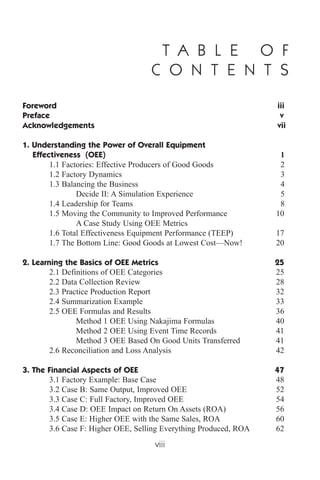
SÄNGER UND PREDIGER.
ANONYMEVOLKSTHÜMLICHE LIEDER.
[Scherer D. 196, 202, E. 188, 194.]
Herausgegeben in Minnesangs Frühling, Nr. 1. und in den Carmina
Burana.
1.
Dû bist mîn, ich bin dîn:
des solt dû gewis sîn.
dû bist beslozzen
in mînem herzen:
verlorn ist daz slüzzelîn:
dû muost immer drinne sîn.
2.
Swaz hie gât umbe,
daz sint allez megede:
die wellent âne man
allen disen sumer gân. 10
23.
3.
Tougen minne diuist guot,
si kan geben hôhen muot.
der sol man sich vlîzen.
swer mit triwen der niht phliget,
dem sol man daz verwîzen.
Geheime Liebe die ist gut,
Sie verleiht wohl frohen Muth.
Um die soll man sich mühen.
Wer in Treuen sie nicht hegt,
Dem wird das nie verziehen.
4.
‘Sô wê dir, sumerwunne!
daz vogelsanc ist geswunden:
als ist der linden ir loup.
jârlanc mir truobent ouch
mîniu wol stênden ougen. 10
mîn trût, du solt gelouben
dich anderre wîbe:
wan, helt, die solt du mîden.
dô du mich êrst sæhe,
dô dûhte ich dich zewâre
sô rehte minneclîch getân:
des man ich dich, lieber man.’
24.
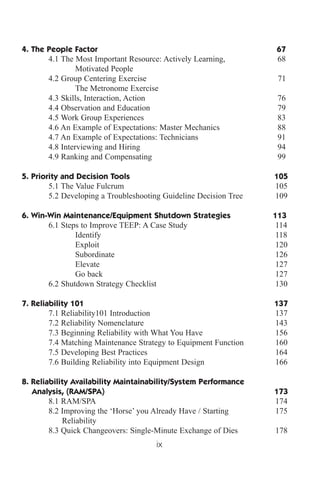
DER UNGENANNTE SPIELMANN.
[SchererD. 198, 225, E. 191, 217.]
Seine Gedichte sind in den Handschriften unter dem Namen ‘Spervogel’
überliefert und unter diesem in Minnesangs Frühling, Nr. 6
herausgegeben.
25.
Dô der guoteWernhart
an dise werlt geborn wart,
do begonde er teilen al sîn guot.
do gewan er Rüedegêres muot,
der saz ze Bechelære
und pflac der marke manegen tac:
der wart von sîner frümekeit sô mære.
Wie sich der rîche betraget!
sô dem nôthaften waget
dur daz lant der stegereif.
daz ich ze bûwe niht engreif,
dô mir begonde entspringen 10
von alrêrste mîn bart!
des muoz ich nû mit arbeiten ringen.
Weistu wie der igel sprach?
‘vil guot ist eigen gemach.’
zimber ein hûs, Kerlinc.
dar inne schaffe dîniu dinc.
die hêrren sint erarget.
swer dâ heime niht enhât,
wie maneger guoter dinge der darbet!
Mich hungerte harte. 20
Ich steic in einen garten.
dâ was obez innen:
des mohte ich niht gewinnen.
daz kom von unheile.
dicke weget ich den ast:
mir wart des obezes nie niht ze teile.
Ein wolf sîne sünde flôch,
in ein klôster er sich zôch,
er wolde geistlîchen leben.
dô hiez man in der schâfe pflegen:
26.
dô e ade sc â e p ege
sît wart er unstæte.
dô beiz er schâf unde swîn:
er jach daz ez des pfaffen rüde tæte.
Ein man sol haben êre,
und sol iedoch der sêle
under wîlen wesen guot, 10
daz in dehein sîn übermuot
verleite niht ze verre;
swenn er urlobes ger,
daz ez im an dem wege niht enwerre.
Wurze des waldes
und erze des goldes
und elliu apgründe
diu sint dir, hêrre, künde:
diu stênt in dîner hende.
allez himeleschez her 20
dazn möht dich niht volloben an ein ende.
27.
Als der guteWernhart
Zu dieser Welt gebracht ward,
Da theilt er allsogleich sein Gut.
Es überkam ihn Rüdgers Muth,
Der, zu Bechlarn gesessen,
Die Mark verwaltet manchen Tag:
Drum ward ihm Ruhms ein volles Mass gemessen.
Behaglich sich der Reiche labt,
Dieweil der Dürftige trabt
Mit losem Bügel durch das Land!
Was griff nicht nach dem Pflug die Hand,
Da mir begann zu sprossen 10
In erster Jugend mein Bart!
Daraus ist heute Mühsal mir geflossen.
Weisst du, wie der Igel sprach?
‘Ich lob’ mir eigenes Gemach.’
Kerling, zimmre dir ein Haus
Mit Vorrath rüst’ es sorglich aus.
Die Grossen wollen sparen.
Wer nichts im eignen Hause hat,
Wie viel Entbehrung, Noth muss der erfahren!
Von Hunger schier gemartert 20
Stieg ich in einen Garten.
Da war Obst drin gehangen:
Das konnt ich nicht erlangen.
Da zeigte sich mein Unheil.
Häufig schüttelt’ ich den Ast:
Doch ward mir von den Früchten nichts zu Theil.
Ein Wolf thät in ein Kloster ziehn,
Um seiner Sünde zu entfliehn;
Er wollt ein geistlich Leben führen
Da hiess man ihn die Schafe hüten:
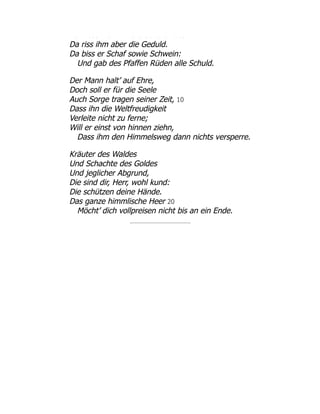
28.
a ess ad e Sc a e üte
Da riss ihm aber die Geduld.
Da biss er Schaf sowie Schwein:
Und gab des Pfaffen Rüden alle Schuld.
Der Mann halt’ auf Ehre,
Doch soll er für die Seele
Auch Sorge tragen seiner Zeit, 10
Dass ihn die Weltfreudigkeit
Verleite nicht zu ferne;
Will er einst von hinnen ziehn,
Dass ihm den Himmelsweg dann nichts versperre.
Kräuter des Waldes
Und Schachte des Goldes
Und jeglicher Abgrund,
Die sind dir, Herr, wohl kund:
Die schützen deine Hände.
Das ganze himmlische Heer 20
Möcht’ dich vollpreisen nicht bis an ein Ende.
29.
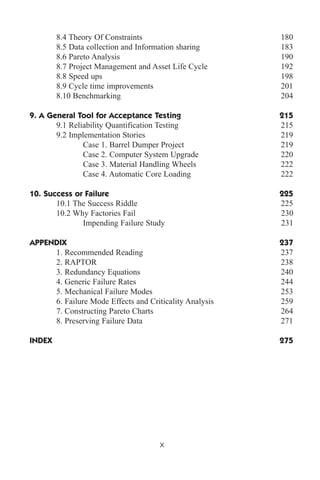
IN KÜRENBERGS WEISE.
[SchererD. 202, E. 195.]
Eine Strophenform, die von einem österreichischen Ritter Kürenberg
erfunden ist und so beliebt war, dass auch die Nibelungendichter sie
benutzten. Herausgegeben in Minnesangs Frühling, Nr. 2.
30.
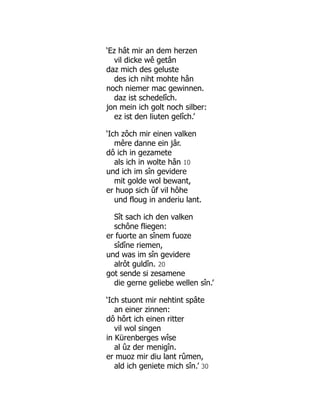
‘Ez hât miran dem herzen
vil dicke wê getân
daz mich des geluste
des ich niht mohte hân
noch niemer mac gewinnen.
daz ist schedelîch.
jon mein ich golt noch silber:
ez ist den liuten gelîch.’
‘Ich zôch mir einen valken
mêre danne ein jâr.
dô ich in gezamete
als ich in wolte hân 10
und ich im sîn gevidere
mit golde wol bewant,
er huop sich ûf vil hôhe
und floug in anderiu lant.
Sît sach ich den valken
schône fliegen:
er fuorte an sînem fuoze
sîdîne riemen,
und was im sîn gevidere
alrôt guldîn. 20
got sende si zesamene
die gerne geliebe wellen sîn.’
‘Ich stuont mir nehtint spâte
an einer zinnen:
dô hôrt ich einen ritter
vil wol singen
in Kürenberges wîse
al ûz der menigîn.
er muoz mir diu lant rûmen,
ald ich geniete mich sîn.’ 30
31.
Nu brinc mirher vil balde
mîn ros, mîn îsengwant.
wan ich muoz einer frouwen
rûmen diu lant.
diu wil mich des betwingen
daz ich ir holt sî.
si muoz der mîner minne
iemer darbende sîn.
32.
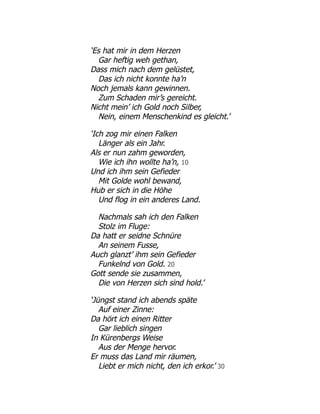
‘Es hat mirin dem Herzen
Gar heftig weh gethan,
Dass mich nach dem gelüstet,
Das ich nicht konnte ha’n
Noch jemals kann gewinnen.
Zum Schaden mir’s gereicht.
Nicht mein’ ich Gold noch Silber,
Nein, einem Menschenkind es gleicht.’
‘Ich zog mir einen Falken
Länger als ein Jahr.
Als er nun zahm geworden,
Wie ich ihn wollte ha’n, 10
Und ich ihm sein Gefieder
Mit Golde wohl bewand,
Hub er sich in die Höhe
Und flog in ein anderes Land.
Nachmals sah ich den Falken
Stolz im Fluge:
Da hatt er seidne Schnüre
An seinem Fusse,
Auch glanzt’ ihm sein Gefieder
Funkelnd von Gold. 20
Gott sende sie zusammen,
Die von Herzen sich sind hold.’
‘Jüngst stand ich abends späte
Auf einer Zinne:
Da hört ich einen Ritter
Gar lieblich singen
In Kürenbergs Weise
Aus der Menge hervor.
Er muss das Land mir räumen,
Liebt er mich nicht, den ich erkor.’ 30
33.
‘Nun bring meinRoss mir schleunig
Und mein Eisengewand,
Denn einer Frauen muss ich
räumen dieses Land.
Sie will mich dazu zwingen,
dass ich hold ihr sei:
Sie bleibet meiner Minne
doch immer ledig und frei.’
34.
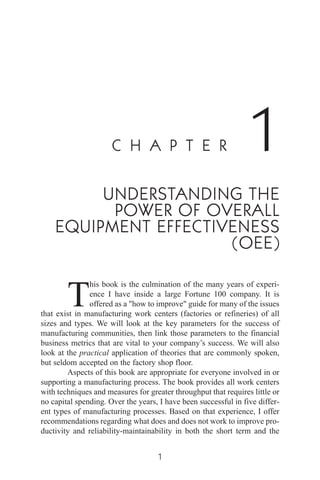
FRIEDRICH VON HAUSEN.
[SchererD. 154, E. 146.]
Aus einem ritterlichen Geschlecht, war mehrfach in Italien, nahm an
dem Kreuzzug Friedrich Barbarossas 1189 Theil und kam auf diesem um,
1190. Herausgegeben in Minnesangs Frühling, Nr. 8.
Mîn herze den gelouben hât,
solt ich od ieman bliben sîn,
durch liebe od durch der Minnen rât,
sô wære ich noch alumbe[166] den Rîn, 10
wan mir daz scheiden nâhe gât,
deich[167] tete von lieben friunden mîn.
swie ez doch dar umbe ergât,
got hêrre, ûf die genâde dîn
sô wil ich dir bevelhen die
die ich durch dînen willen lie[168].
Ich gunde[169] es guoten frowen niet
daz iemer mêre kœme der tac
daz si dâ heime heten liep[170]:
wan[171] ez wære ir êren slac[172]. 10
wie kunde in der gedienen iet,
der gotes verte alsô erschrac[173]?
dar zuo send ich in disiu liet,
und warnes[174] als ich beste mac.
sæn si mîn ougen niemer mê,
mir tæt iedoch ir laster[175] wê.
35.
REINMAR VON HAGENAU.
[SchererD. 155, E. 147.]
Reinmar von Hagenau, zum Unterschied von Reinmar von Zweter meist
Reinmar der Alte genannt. Ein Elsässer, lebte am Hofe Herzog Leopold VI
von Österreich, machte mit diesem den Kreuzzug 1190 mit und starb um
1207. Herausgegeben in Minnesangs Frühling, Nr. 20.
Ich alte ie von tage ze tage,
und bin doch hiure nihtes wîser danne vert.
und hete ein ander mîne klage,
dem riete ich sô daz ez der rede wære wert,
und gibe mir selben bœsen rât.
ich weiz vil wol waz mir den schaden gemachet hât.
daz ich si niht verhelen kunde swaz mir war.
des hân ich ir geseit sô vil
daz si es niht mêre hœren wil:
nû swîge ich unde nîge dar. 10
Ich wânde ie, ez wære ir spot,
die ich von minnen grôzer swære hôrte jehen.
desngilt ich sêre, semmir got,
sît ich die wârheit an mir selben hân ersehen.
mirst komen an daz herze mîn
ein wîp, sol ich der volle ein jâr unmære sîn,
und sol daz alse lange stân
daz si mîn niht nimet war,
sô muoz mîn fröide von ir gar
vil lîhte ân allen trôst zergân.
36.
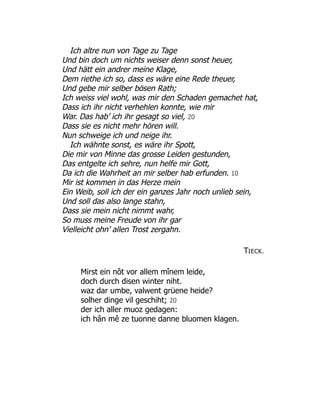
Ich altre nunvon Tage zu Tage
Und bin doch um nichts weiser denn sonst heuer,
Und hätt ein andrer meine Klage,
Dem riethe ich so, dass es wäre eine Rede theuer,
Und gebe mir selber bösen Rath;
Ich weiss viel wohl, was mir den Schaden gemachet hat,
Dass ich ihr nicht verhehlen konnte, wie mir
War. Das hab’ ich ihr gesagt so viel, 20
Dass sie es nicht mehr hören will.
Nun schweige ich und neige ihr.
Ich wähnte sonst, es wäre ihr Spott,
Die mir von Minne das grosse Leiden gestunden,
Das entgelte ich sehre, nun helfe mir Gott,
Da ich die Wahrheit an mir selber hab erfunden. 10
Mir ist kommen in das Herze mein
Ein Weib, soll ich der ein ganzes Jahr noch unlieb sein,
Und soll das also lange stahn,
Dass sie mein nicht nimmt wahr,
So muss meine Freude von ihr gar
Vielleicht ohn’ allen Trost zergahn.
TIECK.
Mirst ein nôt vor allem mînem leide,
doch durch disen winter niht.
waz dar umbe, valwent grüene heide?
solher dinge vil geschiht; 20
der ich aller muoz gedagen:
ich hân mê ze tuonne danne bluomen klagen.
37.
Mir ist einLeid vor allem meinem Leide;
Nicht dass der Sommer hat ein Ziel:
Nun was thut es, falbt die grüne Haide?
Solcher Dinge giebt es viel.
Darüber weiss ich nichts zu sagen.
Ich habe mehr zu thun als über Blumen klagen.
SIMROCK.
38.
HEINRICH VON MORUNGEN.
[SchererD. 148, E. 141.]
Ein Ritter aus Thüringen, dichtete Ende des 12. und Anfang des 13.
Jahrhunderts. Herausgegeben in Minnesangs Frühling, Nr. 18.
39.
Ich wæne niemanlebe der mînen kumber weine[176],
den ich eine[177] trage,
ez entuo diu guote, diech mit triuwen meine,
vernimt si mîne klage.
wê wie tuon ich sô, daz ich sô herzeclîche
bin an si verdâht[178], daz ich ein künicrîche
für ir minne niht ennemen wolde,
ob ich teilen unde welen solde?
Swer mir des verban[179], ob ich si minne tougen[180],
seht der sündet[181] sich. 10
swenn ich eine bin, si schînt mir vor den ougen.
sô bedunket mich
wie si gê dort her ze mir aldur[182] die mûren.
ir rede und ir trôst enlâzent mich niht trûren.
swenn si wil, sô füeret si mich hinnen
mit ir wîzen hant hôh über die zinnen.
Ich wæne, si ist ein Vênus hêre, diech dâ minne:
wan si kan sô vil.
si benimt mir beide fröide und al die sinne.
swenne sô si wil, 20
sô gêt si dort her zuo einem vensterlîne,
und siht mich an reht als der sunnen schîne:
swan ich si dan gerne wolde schouwen,
ach sô gêt si dort zuo andern frouwen.
Dô si mir alrêrst ein hôhgemüete[183] sande
in daz herze mîn,
des was bote ir güete, die ich wol erkande,
und ir liehter schîn
sach mich güetlîch ane mit ir spilnden[184] ougen:
lachen si began ûz rôtem munde tougen.
sâ zehant enzunte[185] sich mîn wunne,
daz mîn muot stuont hôhe sam[186] diu sunne.
Wê waz rede ich? jâ ist mîn geloube bœse
und ist wider got.
wan[187] bite ich in des daz er mich hinnen lœse?
ê î
40.
ez was êmîn spot. 10
ich tuon sam der swan, der singet swenne er stirbet.
waz ob mir mîn sanc daz lîhte noch erwirbet,
swâ man mînen kumber sagt ze mære[188],
daz man mir erbünne[189] mîner swære[190]?
41.
WALTHER VON DERVOGELWEIDE.
[Scherer D. 197, E. 189.]
Aus ritterlichem Geschlecht, aber arm; vermuthlich in Österreich
geboren. Lebte viel auf Reisen. Seine Jugend verbrachte er am
babenbergischen Hofe zu Wien, den er nach dem Tode seines Gönners
Herzog Friedrich 1198 verliess, aber später noch wiederholentlich
besuchte. Er unterhielt Beziehungen zu Philipp von Schwaben, Hermann
von Thüringen, Otto IV., Friedrich II. Von letzterem erhielt er ein Lehen. Er
starb nach 1227 zu Würzburg. Herausgegeben von Lachmann (Berlin
1827, fünfte Ausg. 1875); Wackernagel und Rieger (Giessen 1862);
Pfeiffer (Leipzig 1864, sechste Aufl. 1880); Wilmanns (Halle 1869, 1883);
Simrock (Bonn 1870); Paul (Halle 1882). Übersetzt von Simrock (Berlin
1833, sechste Aufl. Leipzig 1876); Koch; Weiske; Pannier.
1.
TANZLIED.
42.
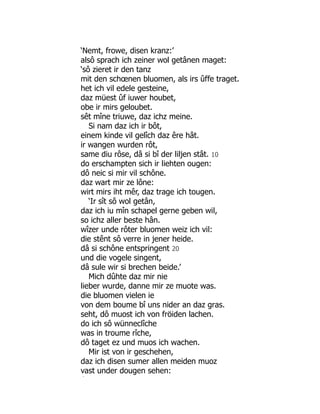
‘Nemt, frowe, disenkranz:’
alsô sprach ich zeiner wol getânen maget:
‘sô zieret ir den tanz
mit den schœnen bluomen, als irs ûffe traget.
het ich vil edele gesteine,
daz müest ûf iuwer houbet,
obe ir mirs geloubet.
sêt mîne triuwe, daz ichz meine.
Si nam daz ich ir bôt,
einem kinde vil gelîch daz êre hât.
ir wangen wurden rôt,
same diu rôse, dâ si bî der liljen stât. 10
do erschampten sich ir liehten ougen:
dô neic si mir vil schône.
daz wart mir ze lône:
wirt mirs iht mêr, daz trage ich tougen.
‘Ir sît sô wol getân,
daz ich iu mîn schapel gerne geben wil,
so ichz aller beste hân.
wîzer unde rôter bluomen weiz ich vil:
die stênt sô verre in jener heide.
dâ si schône entspringent 20
und die vogele singent,
dâ sule wir si brechen beide.’
Mich dûhte daz mir nie
lieber wurde, danne mir ze muote was.
die bluomen vielen ie
von dem boume bî uns nider an daz gras.
seht, dô muost ich von fröiden lachen.
do ich sô wünneclîche
was in troume rîche,
dô taget ez und muos ich wachen.
Mir ist von ir geschehen,
daz ich disen sumer allen meiden muoz
vast under dougen sehen:
î
43.
lîhte wirt mireniu: so ist mir sorgen buoz.
waz obe si gêt an disem tanze? 10
frowe, dur iuwer güete
rucket ûf die hüete.
owê gesæhe ichs under kranze!
44.
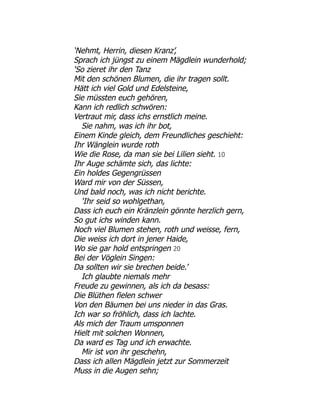
‘Nehmt, Herrin, diesenKranz’,
Sprach ich jüngst zu einem Mägdlein wunderhold;
‘So zieret ihr den Tanz
Mit den schönen Blumen, die ihr tragen sollt.
Hätt ich viel Gold und Edelsteine,
Sie müssten euch gehören,
Kann ich redlich schwören:
Vertraut mir, dass ichs ernstlich meine.
Sie nahm, was ich ihr bot,
Einem Kinde gleich, dem Freundliches geschieht:
Ihr Wänglein wurde roth
Wie die Rose, da man sie bei Lilien sieht. 10
Ihr Auge schämte sich, das lichte:
Ein holdes Gegengrüssen
Ward mir von der Süssen,
Und bald noch, was ich nicht berichte.
‘Ihr seid so wohlgethan,
Dass ich euch ein Kränzlein gönnte herzlich gern,
So gut ichs winden kann.
Noch viel Blumen stehen, roth und weisse, fern,
Die weiss ich dort in jener Haide,
Wo sie gar hold entspringen 20
Bei der Vöglein Singen:
Da sollten wir sie brechen beide.’
Ich glaubte niemals mehr
Freude zu gewinnen, als ich da besass:
Die Blüthen fielen schwer
Von den Bäumen bei uns nieder in das Gras.
Ich war so fröhlich, dass ich lachte.
Als mich der Traum umsponnen
Hielt mit solchen Wonnen,
Da ward es Tag und ich erwachte.
Mir ist von ihr geschehn,
Dass ich allen Mägdlein jetzt zur Sommerzeit
Muss in die Augen sehn;
45.
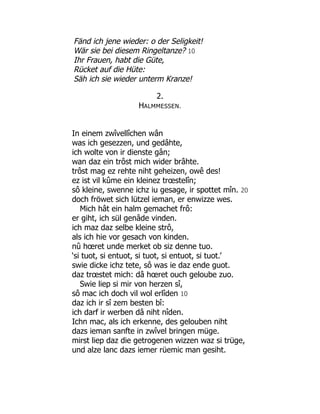
Fänd ich jenewieder: o der Seligkeit!
Wär sie bei diesem Ringeltanze? 10
Ihr Frauen, habt die Güte,
Rücket auf die Hüte:
Säh ich sie wieder unterm Kranze!
2.
HALMMESSEN.
In einem zwîvellîchen wân
was ich gesezzen, und gedâhte,
ich wolte von ir dienste gân;
wan daz ein trôst mich wider brâhte.
trôst mag ez rehte niht geheizen, owê des!
ez ist vil kûme ein kleinez trœstelîn;
sô kleine, swenne ichz iu gesage, ir spottet mîn. 20
doch fröwet sich lützel ieman, er enwizze wes.
Mich hât ein halm gemachet frô:
er giht, ich sül genâde vinden.
ich maz daz selbe kleine strô,
als ich hie vor gesach von kinden.
nû hœret unde merket ob siz denne tuo.
‘si tuot, si entuot, si tuot, si entuot, si tuot.’
swie dicke ichz tete, sô was ie daz ende guot.
daz trœstet mich: dâ hœret ouch geloube zuo.
Swie liep si mir von herzen sî,
sô mac ich doch vil wol erlîden 10
daz ich ir sî zem besten bî:
ich darf ir werben dâ niht nîden.
Ichn mac, als ich erkenne, des gelouben niht
dazs ieman sanfte in zwîvel bringen müge.
mirst liep daz die getrogenen wizzen waz si trüge,
und alze lanc dazs iemer rüemic man gesiht.
46.
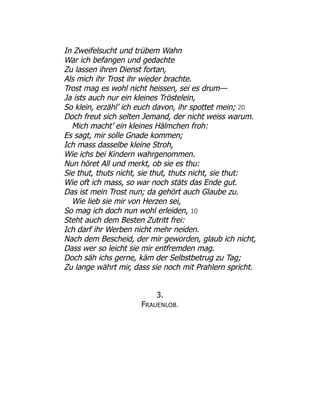
In Zweifelsucht undtrübem Wahn
War ich befangen und gedachte
Zu lassen ihren Dienst fortan,
Als mich ihr Trost ihr wieder brachte.
Trost mag es wohl nicht heissen, sei es drum—
Ja ists auch nur ein kleines Tröstelein,
So klein, erzähl’ ich euch davon, ihr spottet mein; 20
Doch freut sich selten Jemand, der nicht weiss warum.
Mich macht’ ein kleines Hälmchen froh:
Es sagt, mir solle Gnade kommen;
Ich mass dasselbe kleine Stroh,
Wie ichs bei Kindern wahrgenommen.
Nun höret All und merkt, ob sie es thu:
Sie thut, thuts nicht, sie thut, thuts nicht, sie thut:
Wie oft ich mass, so war noch stäts das Ende gut.
Das ist mein Trost nun; da gehört auch Glaube zu.
Wie lieb sie mir von Herzen sei,
So mag ich doch nun wohl erleiden, 10
Steht auch dem Besten Zutritt frei:
Ich darf ihr Werben nicht mehr neiden.
Nach dem Bescheid, der mir geworden, glaub ich nicht,
Dass wer so leicht sie mir entfremden mag.
Doch säh ichs gerne, käm der Selbstbetrug zu Tag;
Zu lange währt mir, dass sie noch mit Prahlern spricht.
3.
FRAUENLOB.
47.
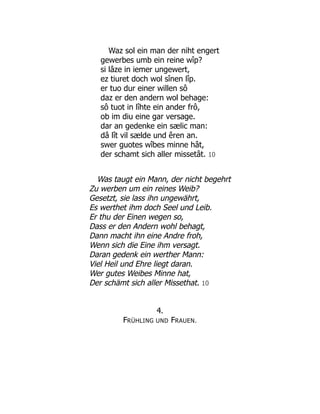
Waz sol einman der niht engert
gewerbes umb ein reine wîp?
si lâze in iemer ungewert,
ez tiuret doch wol sînen lîp.
er tuo dur einer willen sô
daz er den andern wol behage:
sô tuot in lîhte ein ander frô,
ob im diu eine gar versage.
dar an gedenke ein sælic man:
dâ lît vil sælde und êren an.
swer guotes wîbes minne hât,
der schamt sich aller missetât. 10
Was taugt ein Mann, der nicht begehrt
Zu werben um ein reines Weib?
Gesetzt, sie lass ihn ungewährt,
Es werthet ihm doch Seel und Leib.
Er thu der Einen wegen so,
Dass er den Andern wohl behagt,
Dann macht ihn eine Andre froh,
Wenn sich die Eine ihm versagt.
Daran gedenk ein werther Mann:
Viel Heil und Ehre liegt daran.
Wer gutes Weibes Minne hat,
Der schämt sich aller Missethat. 10
4.
FRÜHLING UND FRAUEN.
48.
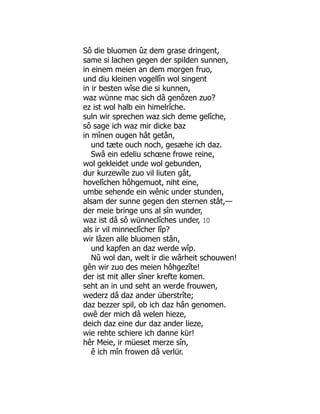
Sô die bluomenûz dem grase dringent,
same si lachen gegen der spilden sunnen,
in einem meien an dem morgen fruo,
und diu kleinen vogellîn wol singent
in ir besten wîse die si kunnen,
waz wünne mac sich dâ genôzen zuo?
ez ist wol halb ein himelrîche.
suln wir sprechen waz sich deme gelîche,
sô sage ich waz mir dicke baz
in mînen ougen hât getân,
und tæte ouch noch, gesæhe ich daz.
Swâ ein edeliu schœne frowe reine,
wol gekleidet unde wol gebunden,
dur kurzewîle zuo vil liuten gât,
hovelîchen hôhgemuot, niht eine,
umbe sehende ein wênic under stunden,
alsam der sunne gegen den sternen stât,—
der meie bringe uns al sîn wunder,
waz ist dâ sô wünneclîches under, 10
als ir vil minneclîcher lîp?
wir lâzen alle bluomen stân,
und kapfen an daz werde wîp.
Nû wol dan, welt ir die wârheit schouwen!
gên wir zuo des meien hôhgezîte!
der ist mit aller sîner krefte komen.
seht an in und seht an werde frouwen,
wederz dâ daz ander überstrîte;
daz bezzer spil, ob ich daz hân genomen.
owê der mich dâ welen hieze,
deich daz eine dur daz ander lieze,
wie rehte schiere ich danne kür!
hêr Meie, ir müeset merze sîn,
ê ich mîn frowen dâ verlür.
49.
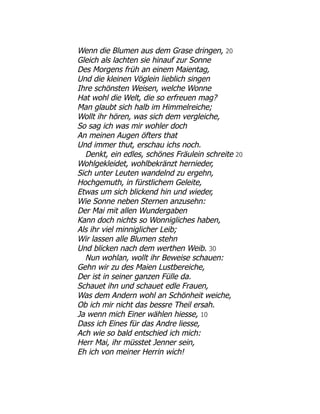
Wenn die Blumenaus dem Grase dringen, 20
Gleich als lachten sie hinauf zur Sonne
Des Morgens früh an einem Maientag,
Und die kleinen Vöglein lieblich singen
Ihre schönsten Weisen, welche Wonne
Hat wohl die Welt, die so erfreuen mag?
Man glaubt sich halb im Himmelreiche;
Wollt ihr hören, was sich dem vergleiche,
So sag ich was mir wohler doch
An meinen Augen öfters that
Und immer thut, erschau ichs noch.
Denkt, ein edles, schönes Fräulein schreite 20
Wohlgekleidet, wohlbekränzt hernieder,
Sich unter Leuten wandelnd zu ergehn,
Hochgemuth, in fürstlichem Geleite,
Etwas um sich blickend hin und wieder,
Wie Sonne neben Sternen anzusehn:
Der Mai mit allen Wundergaben
Kann doch nichts so Wonnigliches haben,
Als ihr viel minniglicher Leib;
Wir lassen alle Blumen stehn
Und blicken nach dem werthen Weib. 30
Nun wohlan, wollt ihr Beweise schauen:
Gehn wir zu des Maien Lustbereiche,
Der ist in seiner ganzen Fülle da.
Schauet ihn und schauet edle Frauen,
Was dem Andern wohl an Schönheit weiche,
Ob ich mir nicht das bessre Theil ersah.
Ja wenn mich Einer wählen hiesse, 10
Dass ich Eines für das Andre liesse,
Ach wie so bald entschied ich mich:
Herr Mai, ihr müsstet Jenner sein,
Eh ich von meiner Herrin wich!
50.
5.
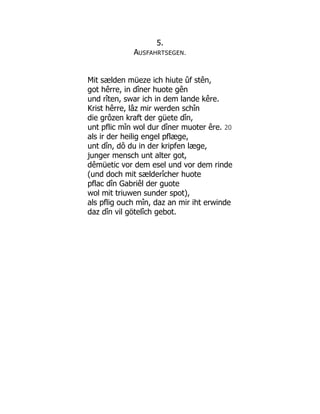
AUSFAHRTSEGEN.
Mit sælden müezeich hiute ûf stên,
got hêrre, in dîner huote gên
und rîten, swar ich in dem lande kêre.
Krist hêrre, lâz mir werden schîn
die grôzen kraft der güete dîn,
unt pflic mîn wol dur dîner muoter êre. 20
als ir der heilig engel pflæge,
unt dîn, dô du in der kripfen læge,
junger mensch unt alter got,
dêmüetic vor dem esel und vor dem rinde
(und doch mit sælderîcher huote
pflac dîn Gabriêl der guote
wol mit triuwen sunder spot),
als pflig ouch mîn, daz an mir iht erwinde
daz dîn vil götelîch gebot.
51.
Welcome to ourwebsite – the ideal destination for book lovers and
knowledge seekers. With a mission to inspire endlessly, we offer a
vast collection of books, ranging from classic literary works to
specialized publications, self-development books, and children's
literature. Each book is a new journey of discovery, expanding
knowledge and enriching the soul of the reade
Our website is not just a platform for buying books, but a bridge
connecting readers to the timeless values of culture and wisdom. With
an elegant, user-friendly interface and an intelligent search system,
we are committed to providing a quick and convenient shopping
experience. Additionally, our special promotions and home delivery
services ensure that you save time and fully enjoy the joy of reading.
Let us accompany you on the journey of exploring knowledge and
personal growth!
ebookultra.com




![SÄNGER UND PREDIGER.
ANONYME VOLKSTHÜMLICHE LIEDER.
[Scherer D. 196, 202, E. 188, 194.]
Herausgegeben in Minnesangs Frühling, Nr. 1. und in den Carmina
Burana.
1.
Dû bist mîn, ich bin dîn:
des solt dû gewis sîn.
dû bist beslozzen
in mînem herzen:
verlorn ist daz slüzzelîn:
dû muost immer drinne sîn.
2.
Swaz hie gât umbe,
daz sint allez megede:
die wellent âne man
allen disen sumer gân. 10](https://image.slidesharecdn.com/3477-250406001531-887baa57/85/Overall-Equipment-Effectiveness-Robert-C-Hansen-22-320.jpg)

![DER UNGENANNTE SPIELMANN.
[Scherer D. 198, 225, E. 191, 217.]
Seine Gedichte sind in den Handschriften unter dem Namen ‘Spervogel’
überliefert und unter diesem in Minnesangs Frühling, Nr. 6
herausgegeben.](https://image.slidesharecdn.com/3477-250406001531-887baa57/85/Overall-Equipment-Effectiveness-Robert-C-Hansen-24-320.jpg)
![IN KÜRENBERGS WEISE.
[Scherer D. 202, E. 195.]
Eine Strophenform, die von einem österreichischen Ritter Kürenberg
erfunden ist und so beliebt war, dass auch die Nibelungendichter sie
benutzten. Herausgegeben in Minnesangs Frühling, Nr. 2.](https://image.slidesharecdn.com/3477-250406001531-887baa57/85/Overall-Equipment-Effectiveness-Robert-C-Hansen-29-320.jpg)


![FRIEDRICH VON HAUSEN.
[Scherer D. 154, E. 146.]
Aus einem ritterlichen Geschlecht, war mehrfach in Italien, nahm an
dem Kreuzzug Friedrich Barbarossas 1189 Theil und kam auf diesem um,
1190. Herausgegeben in Minnesangs Frühling, Nr. 8.
Mîn herze den gelouben hât,
solt ich od ieman bliben sîn,
durch liebe od durch der Minnen rât,
sô wære ich noch alumbe[166] den Rîn, 10
wan mir daz scheiden nâhe gât,
deich[167] tete von lieben friunden mîn.
swie ez doch dar umbe ergât,
got hêrre, ûf die genâde dîn
sô wil ich dir bevelhen die
die ich durch dînen willen lie[168].
Ich gunde[169] es guoten frowen niet
daz iemer mêre kœme der tac
daz si dâ heime heten liep[170]:
wan[171] ez wære ir êren slac[172]. 10
wie kunde in der gedienen iet,
der gotes verte alsô erschrac[173]?
dar zuo send ich in disiu liet,
und warnes[174] als ich beste mac.
sæn si mîn ougen niemer mê,
mir tæt iedoch ir laster[175] wê.](https://image.slidesharecdn.com/3477-250406001531-887baa57/85/Overall-Equipment-Effectiveness-Robert-C-Hansen-34-320.jpg)
![REINMAR VON HAGENAU.
[Scherer D. 155, E. 147.]
Reinmar von Hagenau, zum Unterschied von Reinmar von Zweter meist
Reinmar der Alte genannt. Ein Elsässer, lebte am Hofe Herzog Leopold VI
von Österreich, machte mit diesem den Kreuzzug 1190 mit und starb um
1207. Herausgegeben in Minnesangs Frühling, Nr. 20.
Ich alte ie von tage ze tage,
und bin doch hiure nihtes wîser danne vert.
und hete ein ander mîne klage,
dem riete ich sô daz ez der rede wære wert,
und gibe mir selben bœsen rât.
ich weiz vil wol waz mir den schaden gemachet hât.
daz ich si niht verhelen kunde swaz mir war.
des hân ich ir geseit sô vil
daz si es niht mêre hœren wil:
nû swîge ich unde nîge dar. 10
Ich wânde ie, ez wære ir spot,
die ich von minnen grôzer swære hôrte jehen.
desngilt ich sêre, semmir got,
sît ich die wârheit an mir selben hân ersehen.
mirst komen an daz herze mîn
ein wîp, sol ich der volle ein jâr unmære sîn,
und sol daz alse lange stân
daz si mîn niht nimet war,
sô muoz mîn fröide von ir gar
vil lîhte ân allen trôst zergân.](https://image.slidesharecdn.com/3477-250406001531-887baa57/85/Overall-Equipment-Effectiveness-Robert-C-Hansen-35-320.jpg)

![HEINRICH VON MORUNGEN.
[Scherer D. 148, E. 141.]
Ein Ritter aus Thüringen, dichtete Ende des 12. und Anfang des 13.
Jahrhunderts. Herausgegeben in Minnesangs Frühling, Nr. 18.](https://image.slidesharecdn.com/3477-250406001531-887baa57/85/Overall-Equipment-Effectiveness-Robert-C-Hansen-38-320.jpg)
![Ich wæne nieman lebe der mînen kumber weine[176],
den ich eine[177] trage,
ez entuo diu guote, diech mit triuwen meine,
vernimt si mîne klage.
wê wie tuon ich sô, daz ich sô herzeclîche
bin an si verdâht[178], daz ich ein künicrîche
für ir minne niht ennemen wolde,
ob ich teilen unde welen solde?
Swer mir des verban[179], ob ich si minne tougen[180],
seht der sündet[181] sich. 10
swenn ich eine bin, si schînt mir vor den ougen.
sô bedunket mich
wie si gê dort her ze mir aldur[182] die mûren.
ir rede und ir trôst enlâzent mich niht trûren.
swenn si wil, sô füeret si mich hinnen
mit ir wîzen hant hôh über die zinnen.
Ich wæne, si ist ein Vênus hêre, diech dâ minne:
wan si kan sô vil.
si benimt mir beide fröide und al die sinne.
swenne sô si wil, 20
sô gêt si dort her zuo einem vensterlîne,
und siht mich an reht als der sunnen schîne:
swan ich si dan gerne wolde schouwen,
ach sô gêt si dort zuo andern frouwen.
Dô si mir alrêrst ein hôhgemüete[183] sande
in daz herze mîn,
des was bote ir güete, die ich wol erkande,
und ir liehter schîn
sach mich güetlîch ane mit ir spilnden[184] ougen:
lachen si began ûz rôtem munde tougen.
sâ zehant enzunte[185] sich mîn wunne,
daz mîn muot stuont hôhe sam[186] diu sunne.
Wê waz rede ich? jâ ist mîn geloube bœse
und ist wider got.
wan[187] bite ich in des daz er mich hinnen lœse?
ê î](https://image.slidesharecdn.com/3477-250406001531-887baa57/85/Overall-Equipment-Effectiveness-Robert-C-Hansen-39-320.jpg)
![ez was ê mîn spot. 10
ich tuon sam der swan, der singet swenne er stirbet.
waz ob mir mîn sanc daz lîhte noch erwirbet,
swâ man mînen kumber sagt ze mære[188],
daz man mir erbünne[189] mîner swære[190]?](https://image.slidesharecdn.com/3477-250406001531-887baa57/85/Overall-Equipment-Effectiveness-Robert-C-Hansen-40-320.jpg)
![WALTHER VON DER VOGELWEIDE.
[Scherer D. 197, E. 189.]
Aus ritterlichem Geschlecht, aber arm; vermuthlich in Österreich
geboren. Lebte viel auf Reisen. Seine Jugend verbrachte er am
babenbergischen Hofe zu Wien, den er nach dem Tode seines Gönners
Herzog Friedrich 1198 verliess, aber später noch wiederholentlich
besuchte. Er unterhielt Beziehungen zu Philipp von Schwaben, Hermann
von Thüringen, Otto IV., Friedrich II. Von letzterem erhielt er ein Lehen. Er
starb nach 1227 zu Würzburg. Herausgegeben von Lachmann (Berlin
1827, fünfte Ausg. 1875); Wackernagel und Rieger (Giessen 1862);
Pfeiffer (Leipzig 1864, sechste Aufl. 1880); Wilmanns (Halle 1869, 1883);
Simrock (Bonn 1870); Paul (Halle 1882). Übersetzt von Simrock (Berlin
1833, sechste Aufl. Leipzig 1876); Koch; Weiske; Pannier.
1.
TANZLIED.](https://image.slidesharecdn.com/3477-250406001531-887baa57/85/Overall-Equipment-Effectiveness-Robert-C-Hansen-41-320.jpg)