TPM the Effective
Maintenance
(23/30Apr2016)
For:
Kotak Malaysia (KOM) Sdn Bhd
11-12 Jln Usaha 4, Kawasan
Perindustrian, 75450,
Ayer Keroh, Melaka Darul Azim.
Presented by:
Timothy Wooi
ITS Management Sdn Bhd
2016/4/29 2
TPM the Effective Maintenance
TPM Implementation after (AM) & Maintenance
Workshop Activities
Review & extract Equipment PM to a ‘Do Dot’ Visual
Master Plan & Visual TPM Board.
Attacking 6 big losses of Equipment
(PdM) with Engineering Kaizen to maximize
Equipment Utilization
Quality, Engineering & Maintenance Kaizen
Improvement Action Projects & Action Plans
TPM the Effective Maintenance
Maintenance and Reliability is a core business strategy.
The key to a successful TPM implementation is Top
Management support.
To implement TPM
successfully, a 12 steps
approach is used.
This will lead you to the
road to:“ zero breakdowns”
and “zero defects’’
Course Overview
TPM the Effective Maintenance
To enable Participants understand TPM, after
that to Plan, Develop, Implement and oversee
the Maintenance program towards a Zero
downtime by;
Course Objective
TPM the Effective Maintenance
 executing Equipment Maintenance timely per
schedule and reduce Company’s resources
efficiently using ‘low cost or no cost’ techniques
as practiced in a Lean and World class
Environment.
2016/4/29 6
With TPM the focus of maintenance shifts from
that of repairing, or reacting to failures to that
of maintaining assets and preventing failures and
quality defects in the first place.
TPM the Effective Maintenance
The root word of maintenance is
Maintain,
more often than not maintenance is
looked at as the people that repair
our equipment when it breaks.
Maintenance Operations
TPM
Safety and Environmental
Training and Education
Autonomous
Maintenance
Autonomous
Maintenance
Workshops
Planned
Maintenance
Moving from
reactive to
proactive
maintenance
Attack Six
Big Losses
•Equipment failures
•Setup and Adjustment
•Idling and minor stoppages
•Reduced speed
•Defects and rework (quality)
•Start up losses (reduced yield)
New assets meet
production needs
and minimize Life
Cycle Costs (LCC)
Early Equipment
Design and
Start up
Management
TPM the Effective Maintenance
to Extend life span of Equipment and Tools
preventing damages caused by neglect and to cut
cost of new Equipment reinvestment.
TPM the Effective Maintenance
 to improve
Productivity and
Quality leading to
Increased Profit by
eliminating
unplanned
breakdowns and
costly downtime.
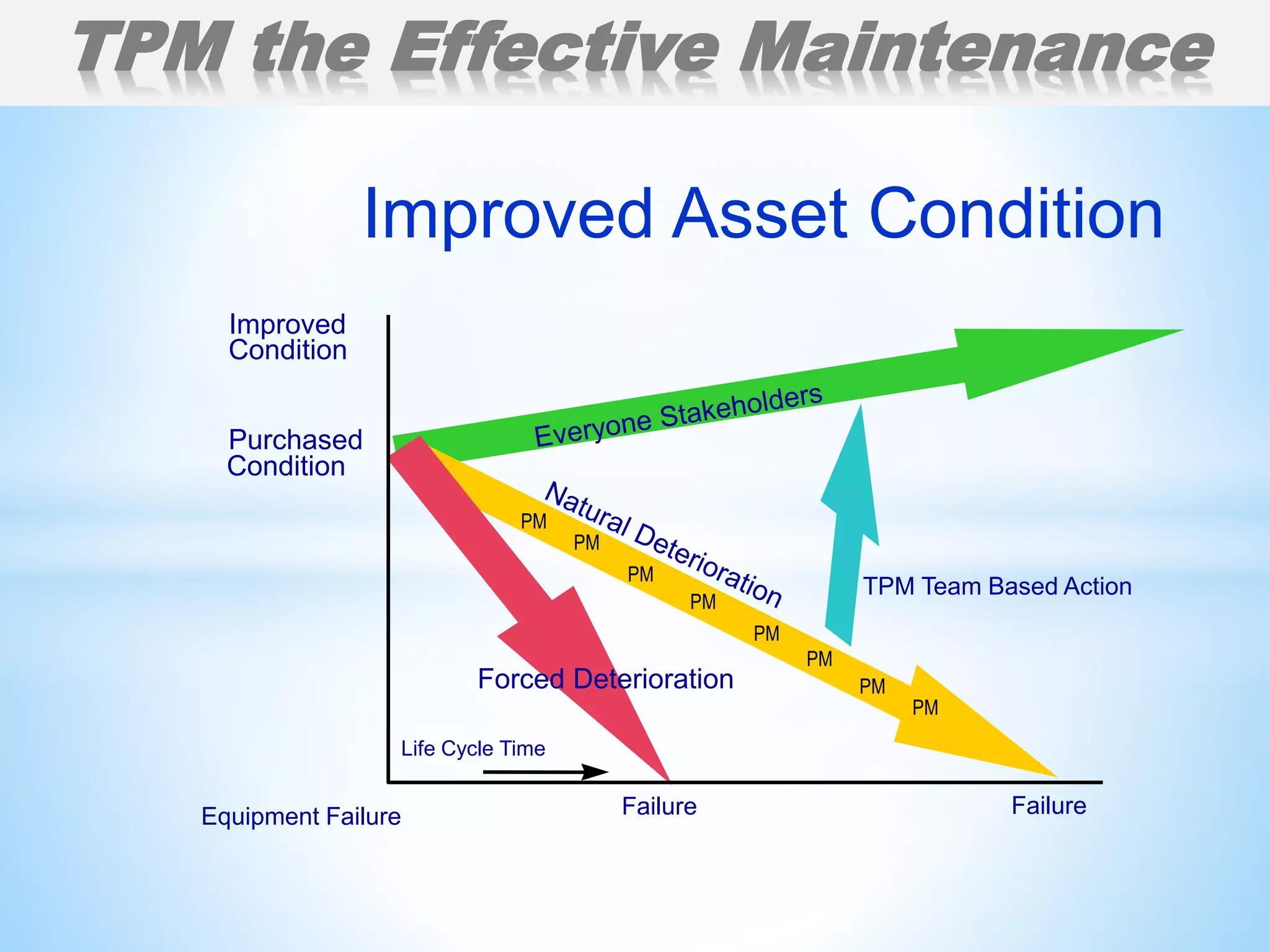
Failure
Purchased
Condition
Improved
Condition
Life Cycle Time
Failure
Improved Asset Condition
Forced
Deterioration
Equipment Failure
TPM Team
Based Action
2016/4/29 10
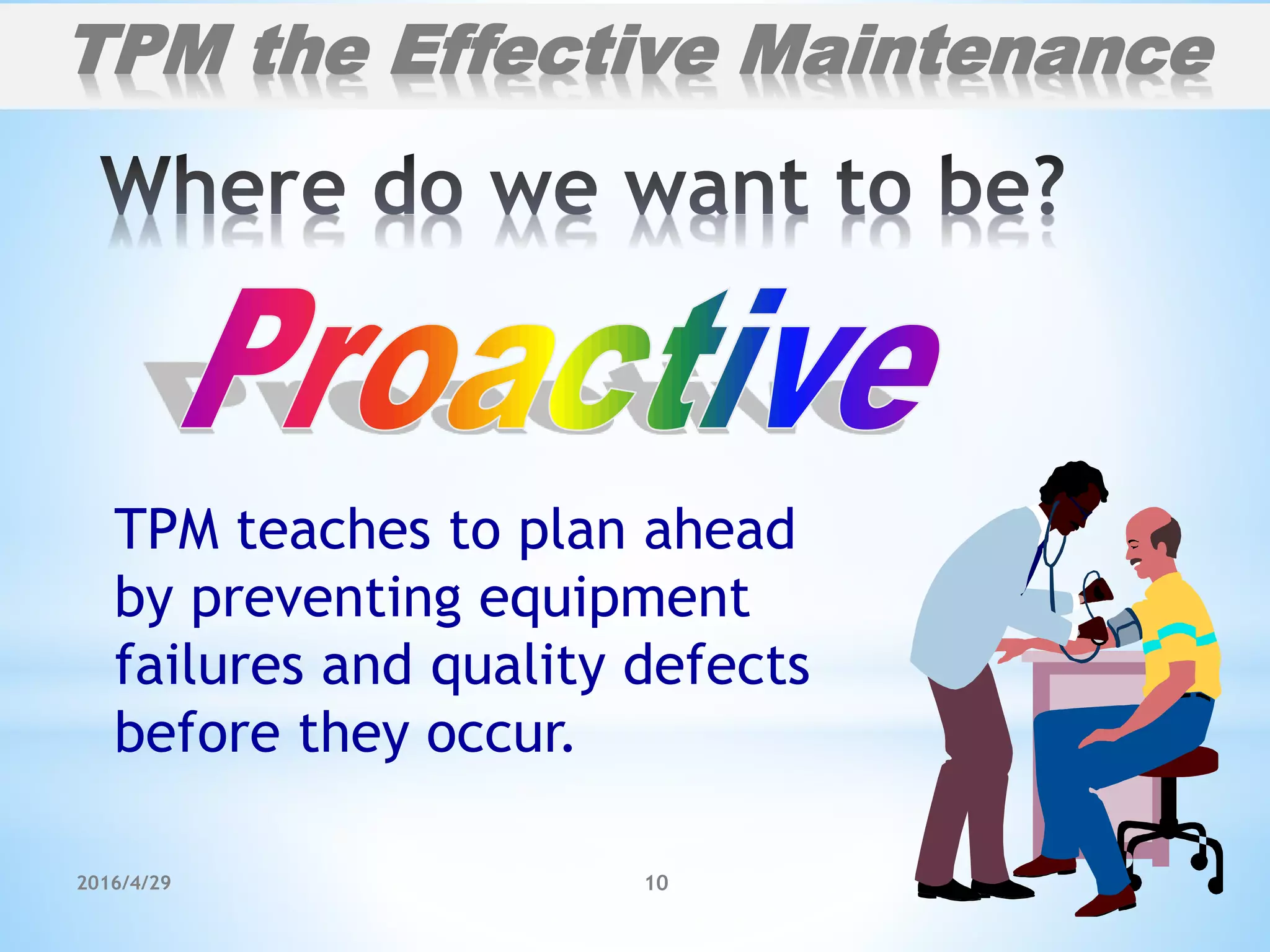
TPM teaches to plan ahead
by preventing equipment
failures and quality defects
before they occur.
TPM the Effective Maintenance
3P Maintenance TPM after AM
(Plan, Preventive & Predictive)
Step 9: Re access planned or preventive maintenance program.
Create a schedule for preventive maintenance on each piece of
equipment.
Step 10: Conduct training to improve operation and maintenance
skills. Maintenance department will take on the role of teachers and
guides to provide training, advice, and equipment information to the
teams.
Step 11: Develop an early equipment management program. Apply
preventive maintenance principles during the design process of
equipment.
Step 12: Continuous Improvement - As in any Lean initiative the
organization needs to develop a continuous improvement mindset.
The main TPM kick-off should take the form of a
formal presentation with all the employees
attending.
TPM Implementation after AM
5.5. TPM kick-off
This opportunity can be
used to gain the full
support of the employees
Invite external
customers, affiliated and
subcontracting companies
TPM the Effective Maintenance
*
Preparation
Kick-off
Implementation
Announcement to introduce TPM
Introductory education campaign for the workforce
TPM Promotion (special committees)
Establish basic TPM policies and goals
Preparation and Formulation of a master plan
Develop an equipment management program
Develop a planned maintenance program
Develop an autonomous maintenance program
Increase skills of production and maintenance personnel
Perfect TPM implementation and raise TPM levelsStabilization
Develop early equipment management program
Invite customers, affiliated companies and subcontractors
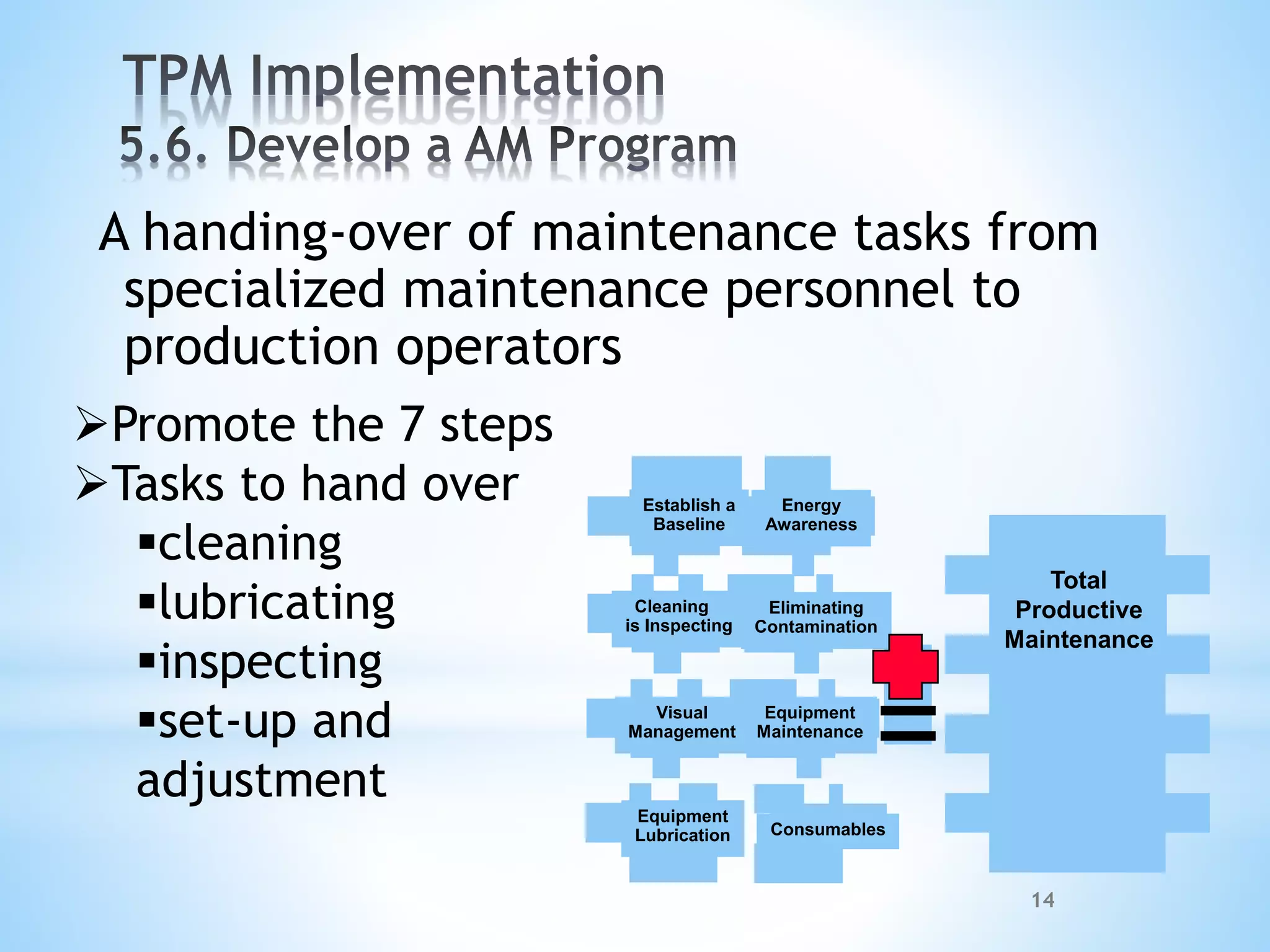
A handing-over of maintenance tasks from
specialized maintenance personnel to
production operators
Promote the 7 steps
Tasks to hand over
cleaning
lubricating
inspecting
set-up and
adjustment
14
=
Establish a
Baseline
Energy
Awareness
Cleaning
is Inspecting
Eliminating
Contamination
Visual
Management
Equipment
Maintenance
Equipment
Lubrication Consumables
Total
Productive
Maintenance
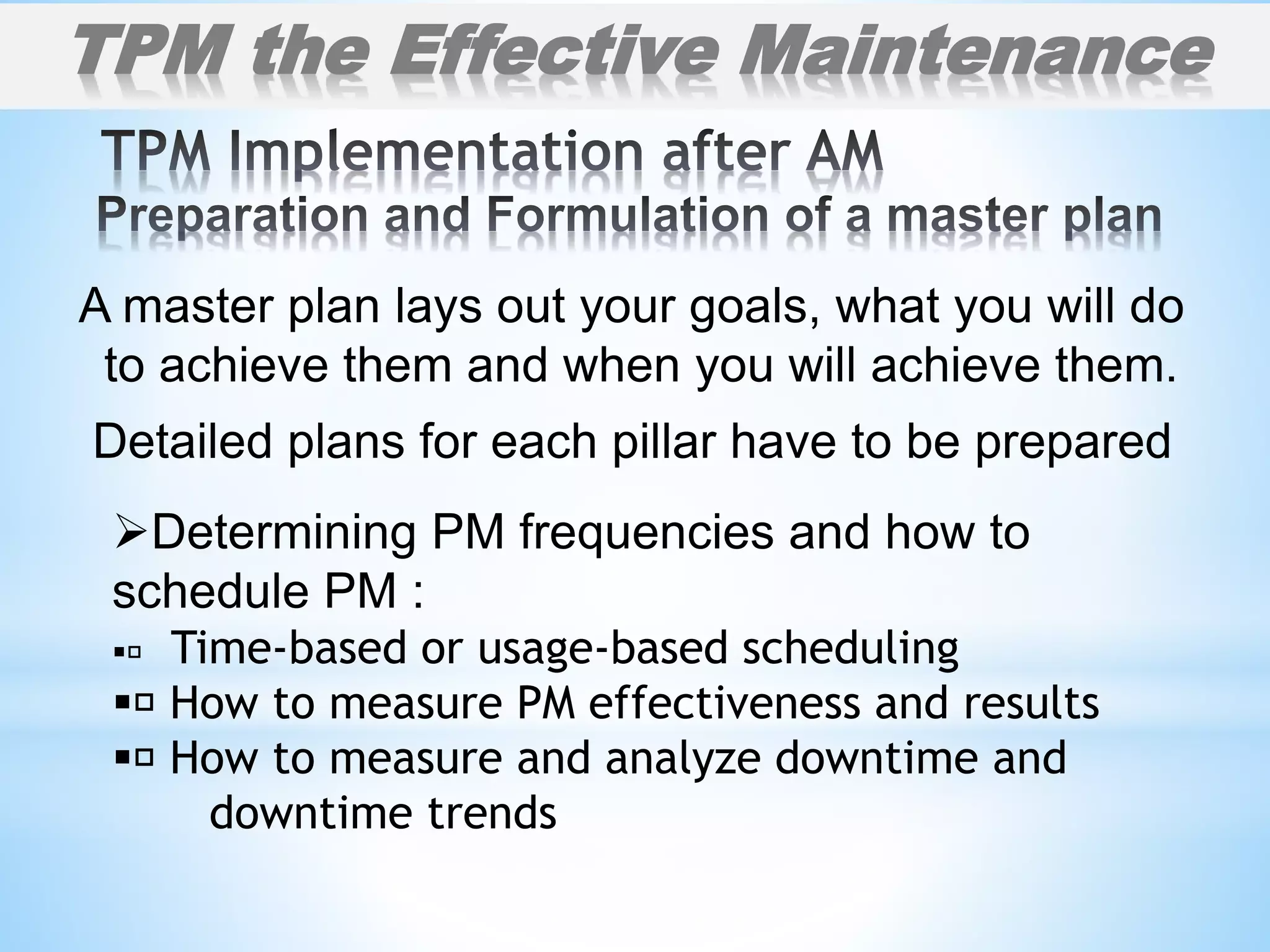
A master plan lays out your goals, what you will do
to achieve them and when you will achieve them.
Detailed plans for each pillar have to be prepared
TPM the Effective Maintenance
Determining PM frequencies and how to
schedule PM :
 Time-based or usage-based scheduling
 How to measure PM effectiveness and results
 How to measure and analyze downtime and
downtime trends
 How to Develop and Install a Good PM System
-Do Dot Visual Master Plan & TPM Board
 Maximizing Equipment Utilization
–Attacking the 6 Big loses
 Engineering TPM Kaizen
-Improvement Projects to address risk of breakdown
- 10 Steps to Improvement Action Plan
timothywooi2@gmail.com
TPM the Effective Maintenance
Workshop Activities
Form project teams
Select a base line (model equipment)
*identify equipment problems
*analyze equipment problems
*develop solutions and proposals for improvement
The tools of Total Quality Management and
Continuous Improvement are applied to the
management and improvement of equipment
TPM the Effective Maintenance
2016/4/2918
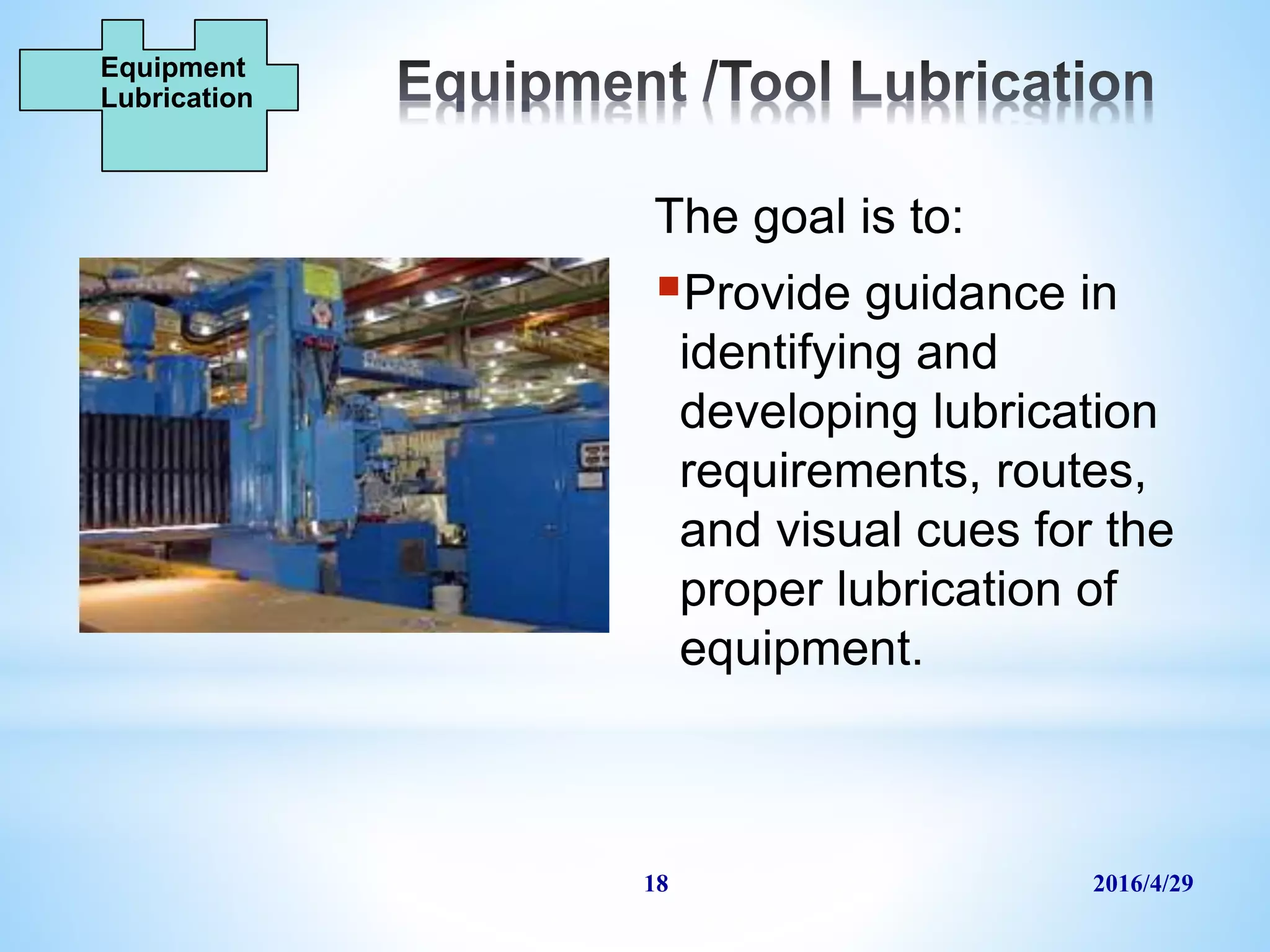
The goal is to:
Provide guidance in
identifying and
developing lubrication
requirements, routes,
and visual cues for the
proper lubrication of
equipment.
Equipment
Lubrication
19
70% of all mechanical equipment
failures are a result of improper
lubrication.
Too much lubricant is as bad as too little
S
S
S
S
S
Equipment Lubrication
S
S
S
S
S
TPM the Effective Maintenance
Set up plans and schedules to
carry out work on equipment
before it breaks down, in order to
extend the life of the equipment
Include Preventive and Predictive
Maintenance
Include management of spare
parts and tools
2016/4/2921
The goal is to:
Have a routine schedule of
activities for maintaining the
asset in a highly reliable
condition.
Pull together all the processes
and tasks developed in
previous modules relating to
maintenance of the equipment.
Ensure PMs are up to date. If
PMs are not available, they
should be created for this
equipment.
Equipment
Maintenance
Work with Reliability Team to
install condition-based
monitoring devices.
22
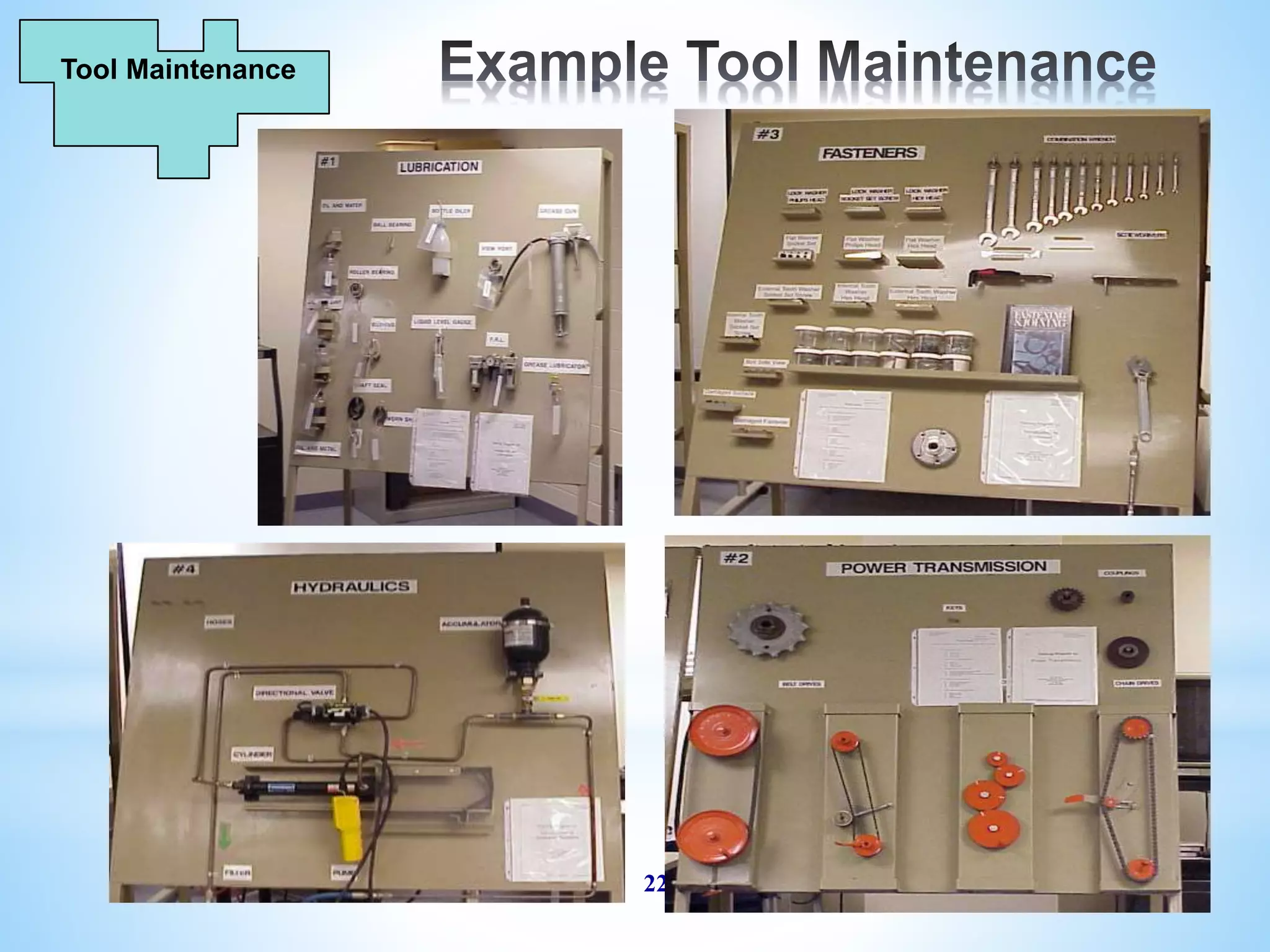
Tool Maintenance
Call for vibration check when
Hour Meter reads 250
Pull Bearing Packs and Inspect
when Hour meter reads 4000
Call for oil analysis when
Hour Meter reads 2000
216
93
1394
Spindle #1
Servos
Power On
Hrs
Hrs
Hrs
Example: Condition-based monitoring devices.
TPM the Effective Maintenance
2016/4/2924
The goal is to:
Develop a list of
consumable items needed
for the routine maintenance
of your equipment. Have a
Parts Change History record.
Establish minimum and
maximum quantities, identify
standard storage locations
at point of use, and apply
visual management.
Consumables
Components of a Well-organized P/PdM Program
 Equipment inventory/numbering system
 Critical Spare parts inventory/forecast
 Sequence of tasks (PM and PdM routes)
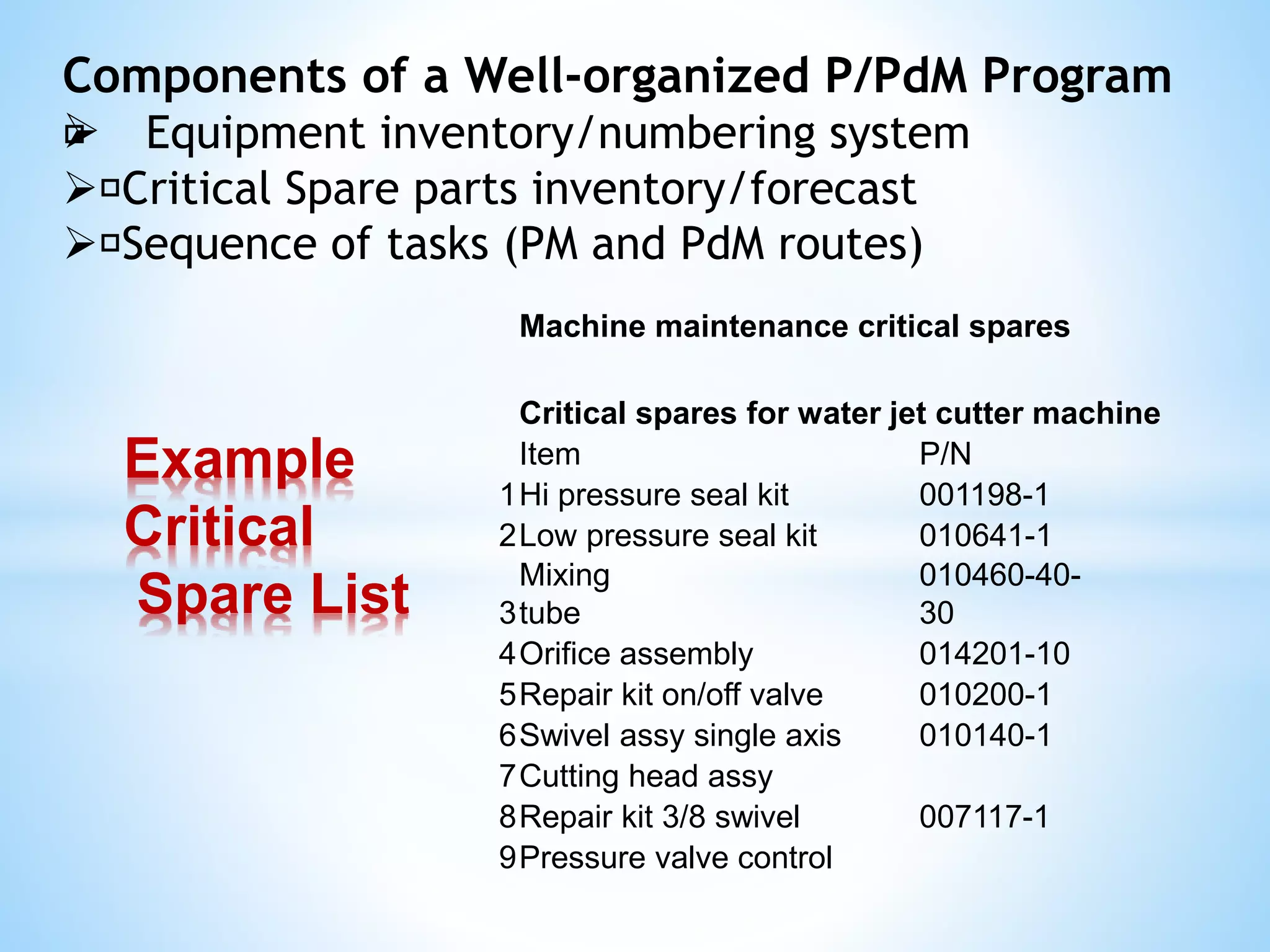
Machine maintenance critical spares
Critical spares for water jet cutter machine
Item P/N
1Hi pressure seal kit 001198-1
2Low pressure seal kit 010641-1
3
Mixing
tube
010460-40-
30
4Orifice assembly 014201-10
5Repair kit on/off valve 010200-1
6Swivel assy single axis 010140-1
7Cutting head assy
8Repair kit 3/8 swivel 007117-1
9Pressure valve control
Example
Critical
Spare List
Parts changed history for each machine/equipment
( source of data: finance department based on PO for period from Jan 02 to 29 Jun 04)
Equipment Name:
Asset No.:
Location:
Data of purchase:
Date Part change
Part no. Description RM/unit qty changed Total RM
Consumables
How to keep an effective and useful
equipment history
On existing machines:
Analyze historical records for
trends of types of failures
frequency of component failures
root causes of failures
Determine how to eliminate the problem and
reduce maintenance through an equipment
design change or by changing the process
TPM the Effective Maintenance
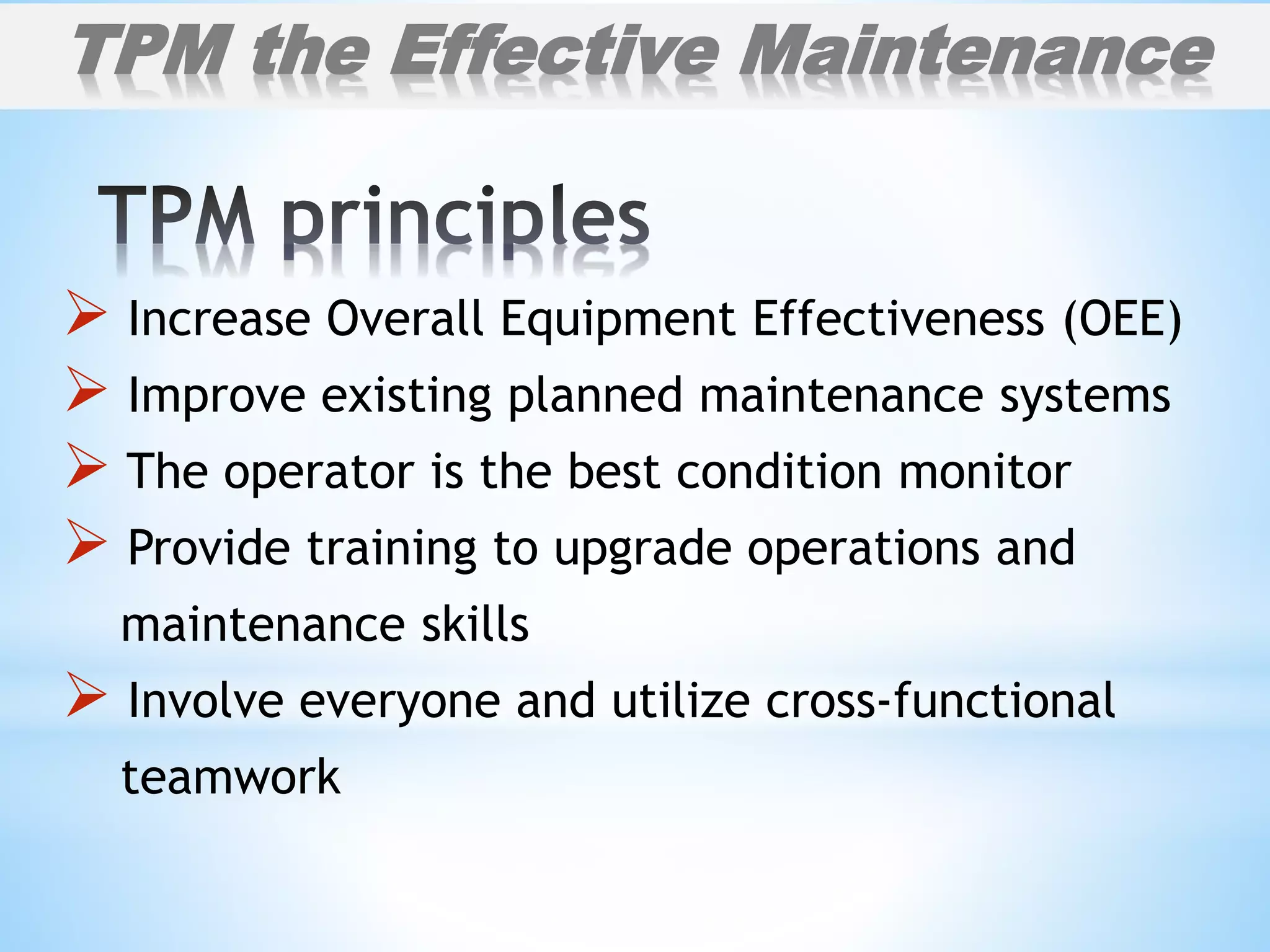
 Increase Overall Equipment Effectiveness (OEE)
 Improve existing planned maintenance systems
 The operator is the best condition monitor
 Provide training to upgrade operations and
maintenance skills
 Involve everyone and utilize cross-functional
teamwork
TPM the Effective Maintenance
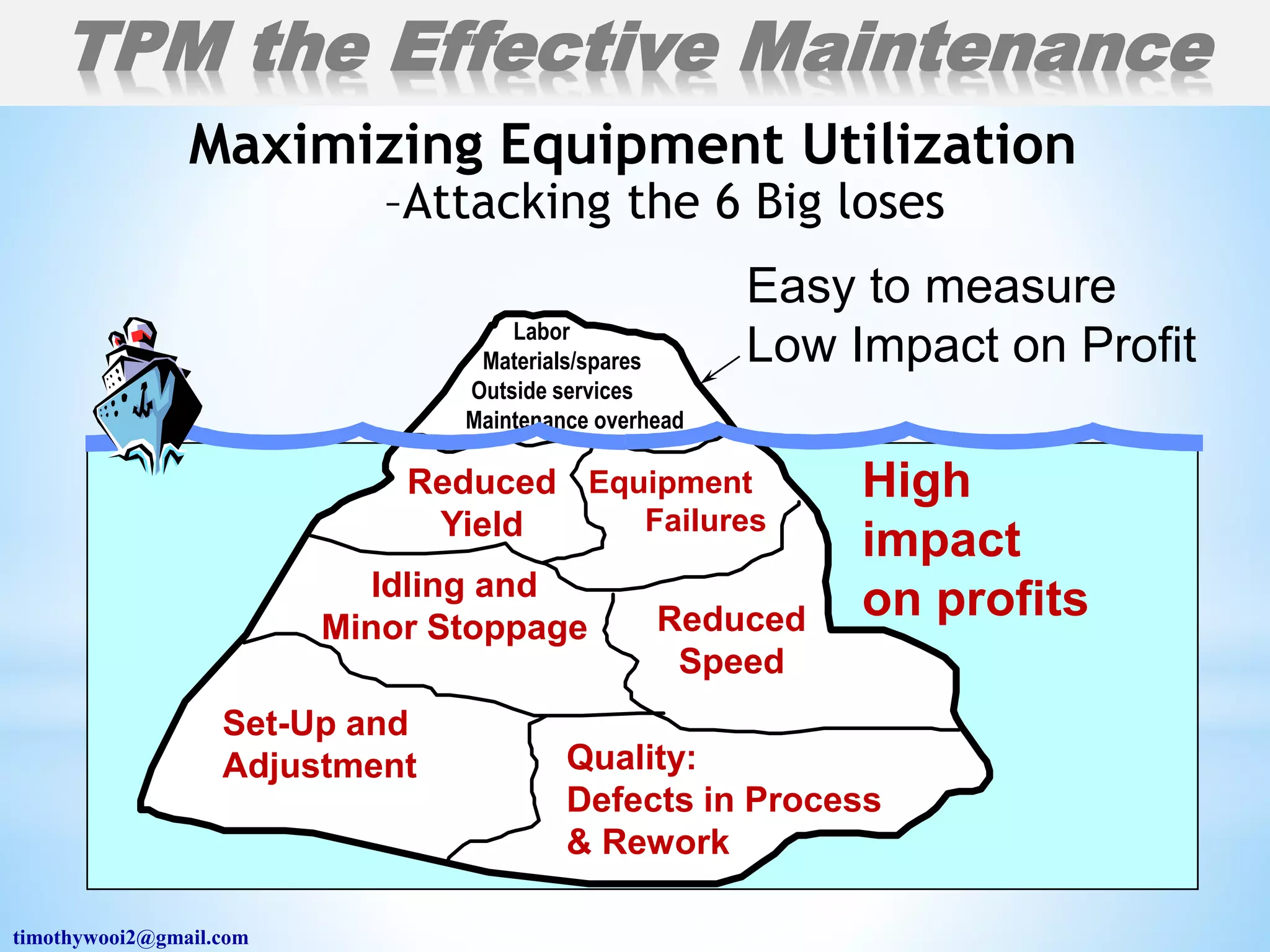
Maximizing Equipment Utilization
–Attacking the 6 Big loses
timothywooi2@gmail.com
TPM the Effective Maintenance
Set-Up and
Adjustment
Idling and
Minor Stoppage Reduced
Speed
Quality:
Defects in Process
& Rework
Reduced
Yield
Equipment
Failures
Easy to measure
Low Impact on Profit
High
impact
on profits
Labor
Materials/spares
Outside services
Maintenance overhead
4/29/2016 30
Failures
DefectsSetup and
Minor Stoppage
Reduced
Equipment Reduced
Yield
in ProcessAdjustment
Idling and
Speed
Availability Efficiency Quality
+ + +
Overall Equipment Effectiveness
X X
OEE is an internationally accepted measure of equipment
effectiveness during planned production.
It measures how effective equipment is at adding value
to the manufacturing process.
2016/4/29 31
Attacking the Six Big Losses for OEE
(Overall Equipment Effectiveness)
To achieve World class OEE
 Availability > 90%
 Efficiency > 95%
 Quality > 99%
 90 x 95 x 99 = 85% OEE
(Most companies find their OEE at 40 – 50%
before TPM)
World class OEE is 85%
TPM the Effective Maintenance
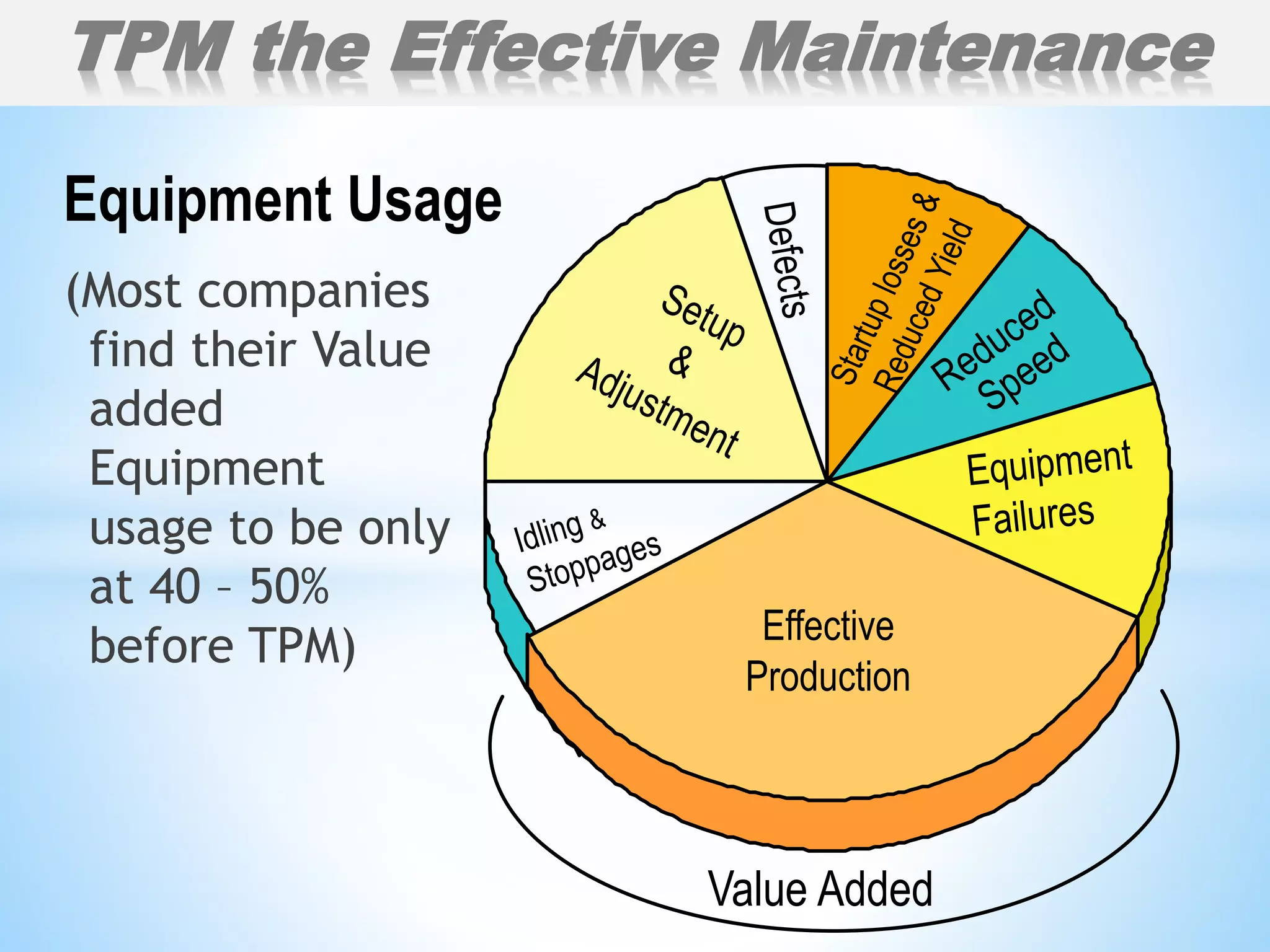
Equipment Usage
Effective
Production
Value Added
TPM the Effective Maintenance
(Most companies
find their Value
added
Equipment
usage to be only
at 40 – 50%
before TPM)
2016/4/29 33
Human
Neglect
Forced
Deterioration
Minor
Defects
Frustration
Losses
#1 Cause of
equipment failures
TPM the Effective Maintenance
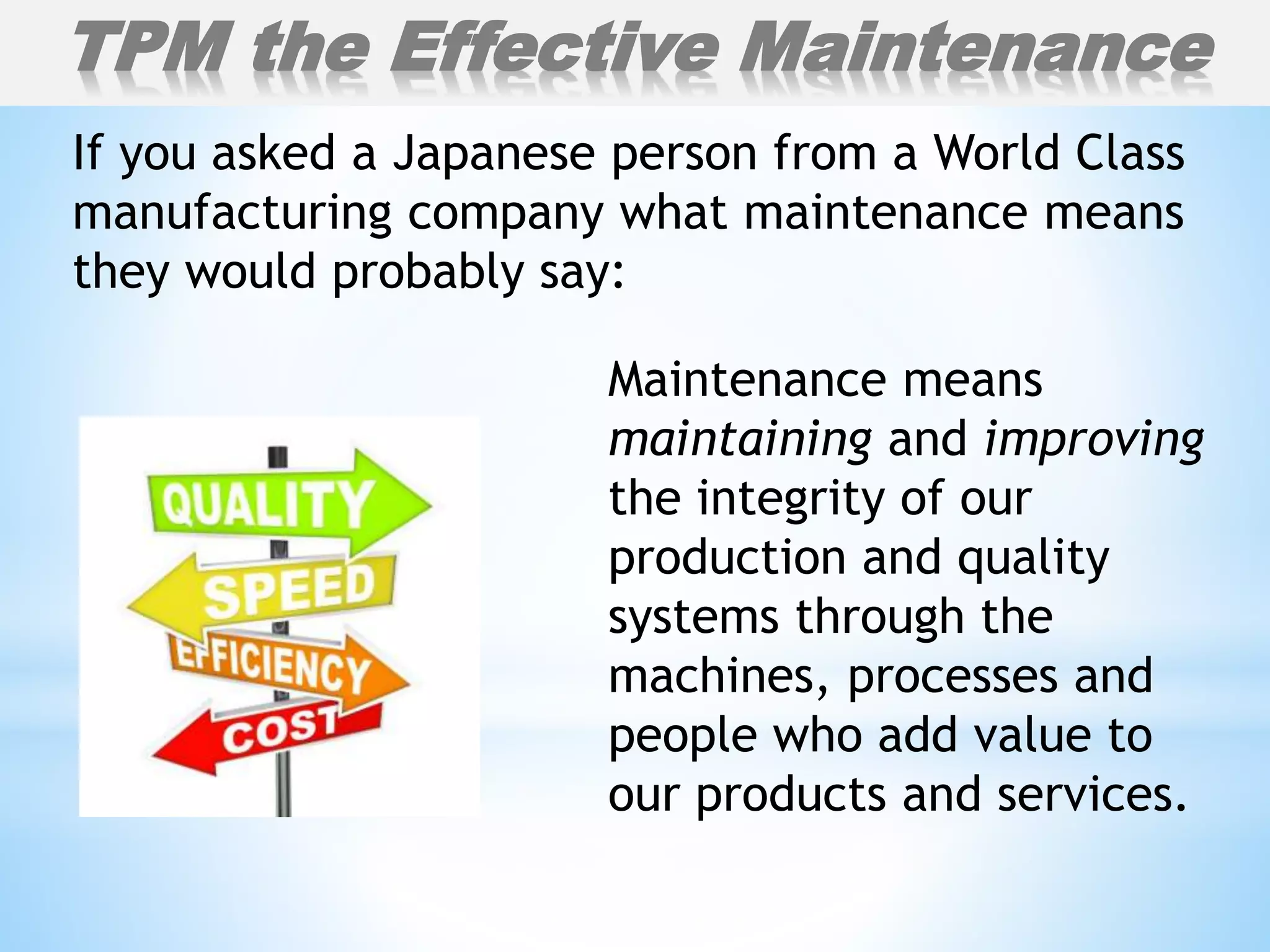
If you asked a Japanese person from a World Class
manufacturing company what maintenance means
they would probably say:
Maintenance means
maintaining and improving
the integrity of our
production and quality
systems through the
machines, processes and
people who add value to
our products and services.
TPM the Effective Maintenance
Failure
Purchased
Condition
Improved
Condition
Life Cycle Time
Failure
Improved Asset Condition
Forced Deterioration
Equipment Failure
TPM Team Based Action
PM
PM
PM
PM
PM
PM
PM
PM
TPM the Effective Maintenance
Workshop Activities
This Workshop is designed to equip Maintenance
Personal with knowledge of Maintenance TPM after
A M to:
 Focus on the Equipment Maintenance using ‘Do Dot’
Visual Master Plan Check sheet.
Ensure timely execution of (PM) with Production and
Management support
Execute (PdM) with Engineering support to ensure
Equipment are are always in a ‘ready to use’ condition
‘every time’ towards a ‘Zero Downtime’ as the Goal.
Overview
4/29/2016 371) Evaluate the current condition of the equipment
2) Improve the conditions to what they should be
3) Evaluate or prepare Preventive Maintenance inspection
standards
4) Implement Proactive maintenance to extend
service life
5) Improve Inspection and Maintenance
efficiency
6) Implement Quality
Maintenance
7) Implement CBM
2016/4/29 38
How to Implement Maintenance TPM -3P
(Plan, Preventive & Predictive)
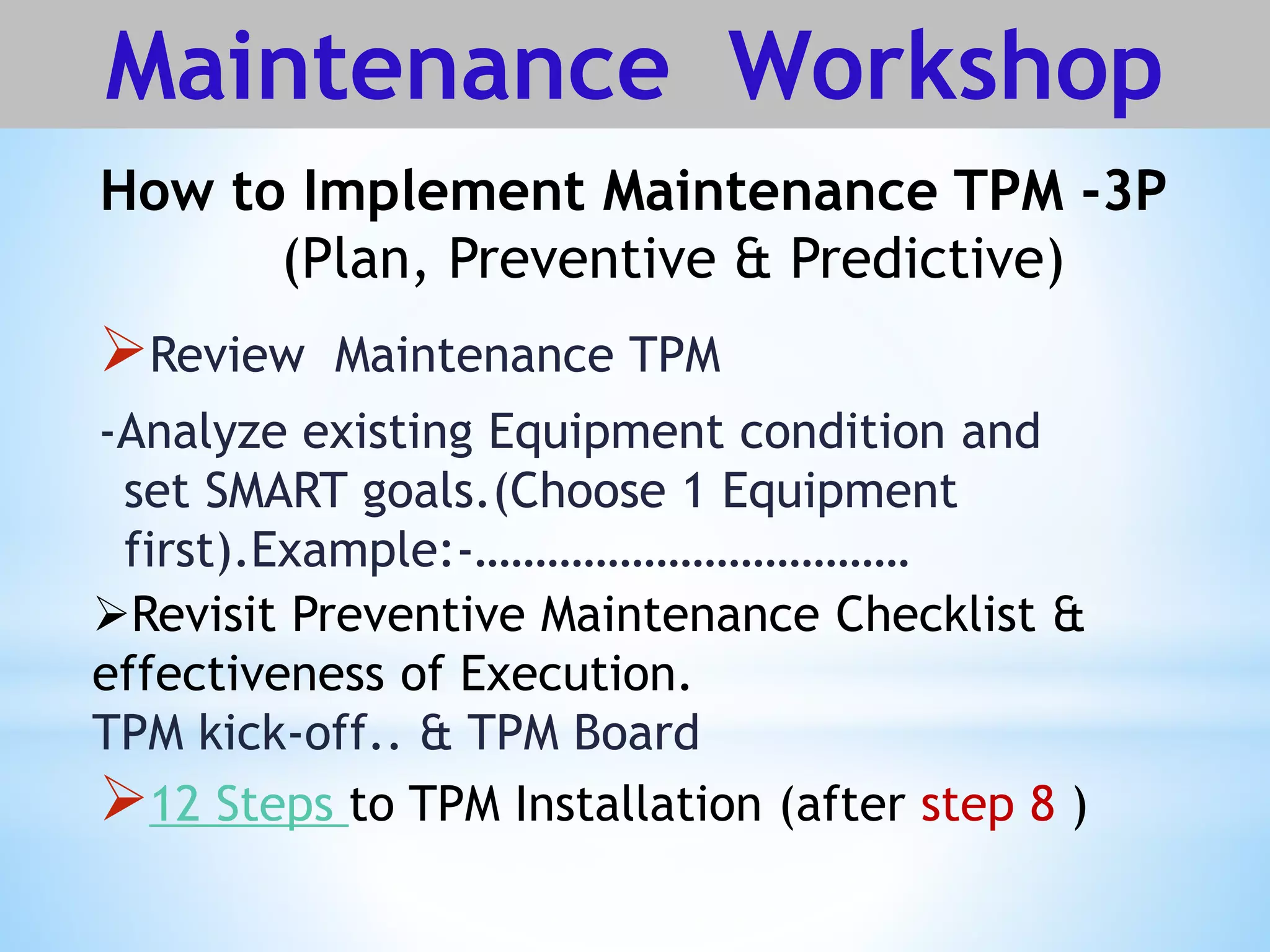
Maintenance Workshop
Review Maintenance TPM
-Analyze existing Equipment condition and
set SMART goals.(Choose 1 Equipment
first).Example:-………………………………
Revisit Preventive Maintenance Checklist &
effectiveness of Execution.
TPM kick-off.. & TPM Board
12 Steps to TPM Installation (after step 8 )
How to Develop and Install a Good PM System
timothywooi2@gmail.com
Maintenance Workshop
Do Dot Visual Master Plan
&
TPM Board
Do Dot Visual Master Plan sample
Maintenance Workshop
Critical Consumerable Spares Re-stocking Plan Date:31-May-06
( Source of data: Spare parts changed from Jan 04 to May 06 based on
Avialability vs Lead time)
Equipment Name: Gerber Kit cut
Asset No:
No Part Part Source & Unit Price
Lead
Time
Stock
Level
Name Number Contact NUmber (US$) (Days)
Curren
t Min Max
1Theta axis pulley CR2-033 1 2
2Theta motor A-CR2-194 1 2
3Linear bearing CR2-053 1 2
4Keypad CR2-044 1 2
5Galil mation control card DMC-1040 1 2
6Amplifier icon card A-CB2-110 1 2
7Y axis inter connect card CR2-041 1 2
8X Y axis motor A-CR2-193 1 2
Team D Suggested Layout of I nform ation Board
Suggested Layout of Information Board
• Board measures 36X48 mounted -- 40 to 48 inches from the floor
• Attach Consumables list to TPM cabinet door
• Lockout instructions & map to be located on main electrical cabinet (not on TPM Board)
Lube Critical
Cleaning
Route Map
Problem and
Component
Codes
MSS Equipment
Problem Log Sheet
(S.R. Record)
OEE Weekly
Summary Sheet
(if Available)
P.M. Schedule
List of persons
responsible for
updating each item on
this board
TPM Information Board
Machine OperatorMachine Name
Operators’ Name(s)
Instructions for
Lube & Critical
Cleaning
Any Single Point
Lesson place
behind these
instructions TPM Management
Walk-through
Checklist
Small Group
Activity
Improvement
Items (form)
Start-up/Shutdown
Process Map on Back
Team D Note:
Board construction wood
with cork facing or magnetic
Operator Sign-off
Sheet (daily)
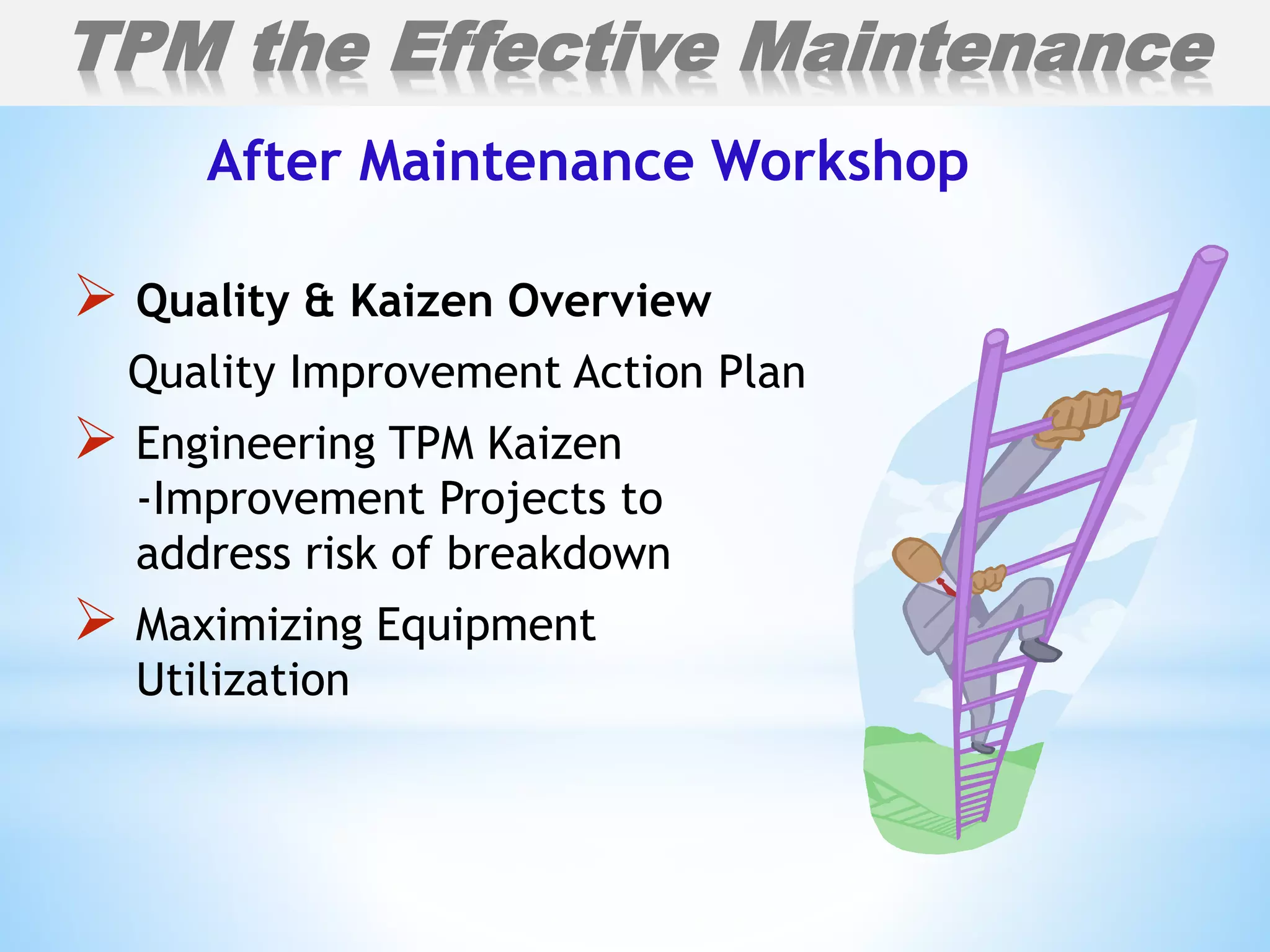
 Quality & Kaizen Overview
Quality Improvement Action Plan
 Engineering TPM Kaizen
-Improvement Projects to
address risk of breakdown
 Maximizing Equipment
Utilization
After Maintenance Workshop
TPM the Effective Maintenance
2016/4/29 44
Gradual, unending
improvement, doing
“little things” better
every day, setting and
achieving ever higher
standards
Engineering TPM (Kaizen)
TPM the Effective Maintenance
-Improvement Projects to address risk of breakdown
The Key to One Piece Flow, Just In
Time and Lean Manufacturing
IS
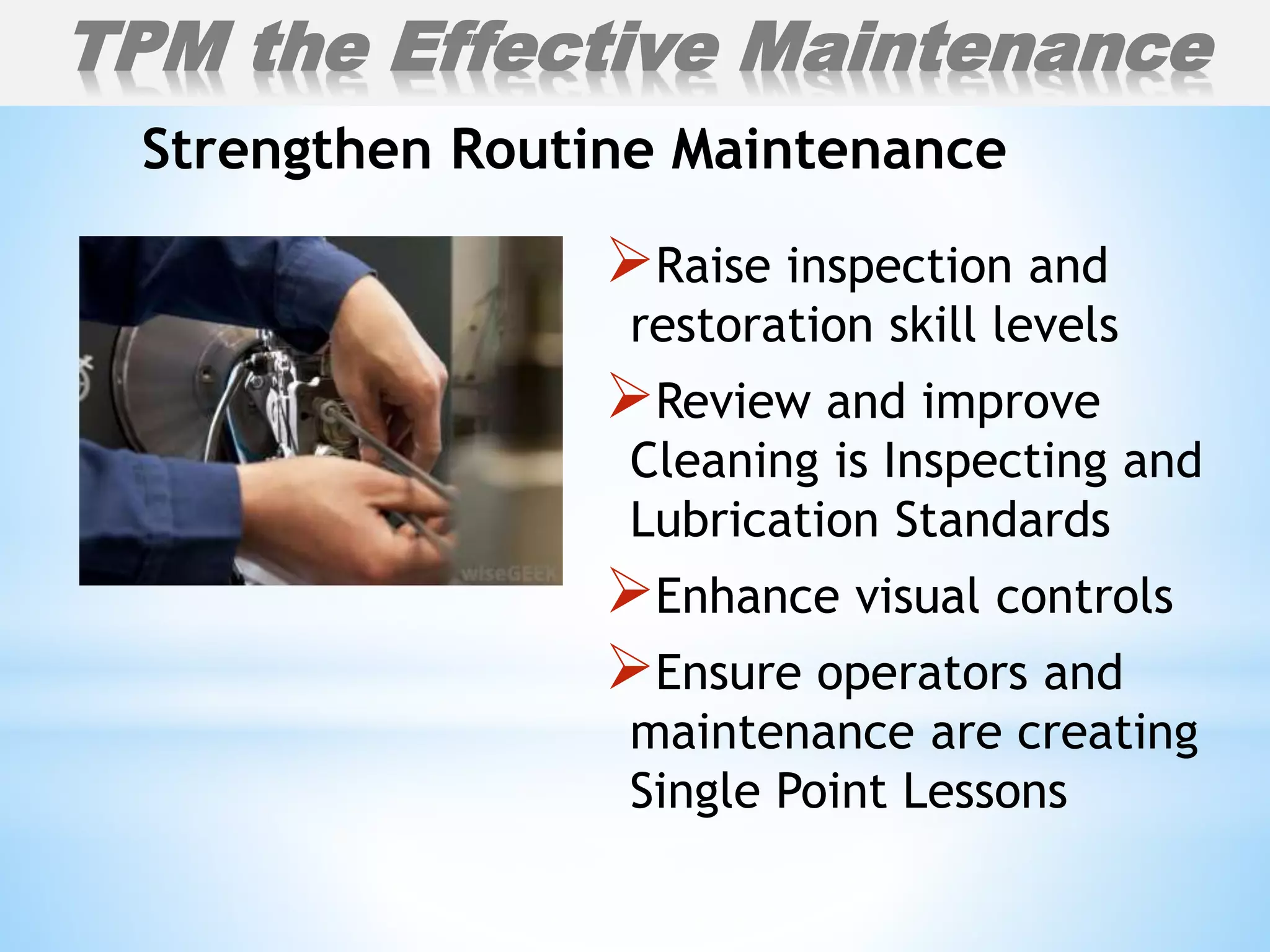
Raise inspection and
restoration skill levels
Review and improve
Cleaning is Inspecting and
Lubrication Standards
Enhance visual controls
Ensure operators and
maintenance are creating
Single Point Lessons
Strengthen Routine Maintenance
TPM the Effective Maintenance
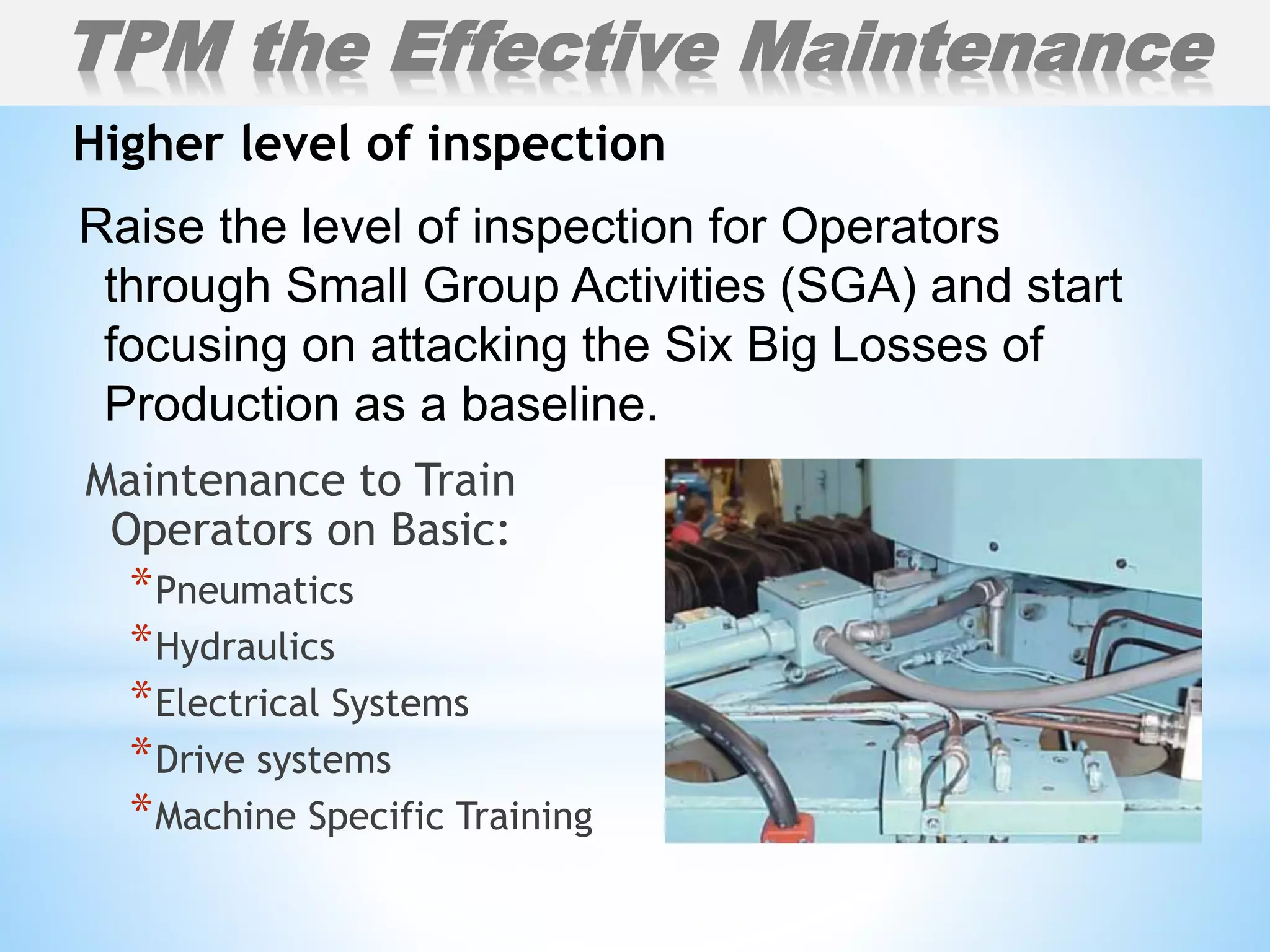
Raise the level of inspection for Operators
through Small Group Activities (SGA) and start
focusing on attacking the Six Big Losses of
Production as a baseline.
Higher level of inspection
TPM the Effective Maintenance
Maintenance to Train
Operators on Basic:
*Pneumatics
*Hydraulics
*Electrical Systems
*Drive systems
*Machine Specific Training
2016/4/29 48
Pneumatic systems
Hydraulic Systems
Electrical Systems
Drive Systems
Machine Specific Training
Skill Specific Training
Maintenance Training For Maintenance group should
then focus on Advanced:
*Why are we concerned about
equipment lubrication?
*Many moving parts are not
lubricated
*Many components are
over lubricated
*Lubricants already in
components are
contaminated
Failures
Components
Resources
Quality
28
50
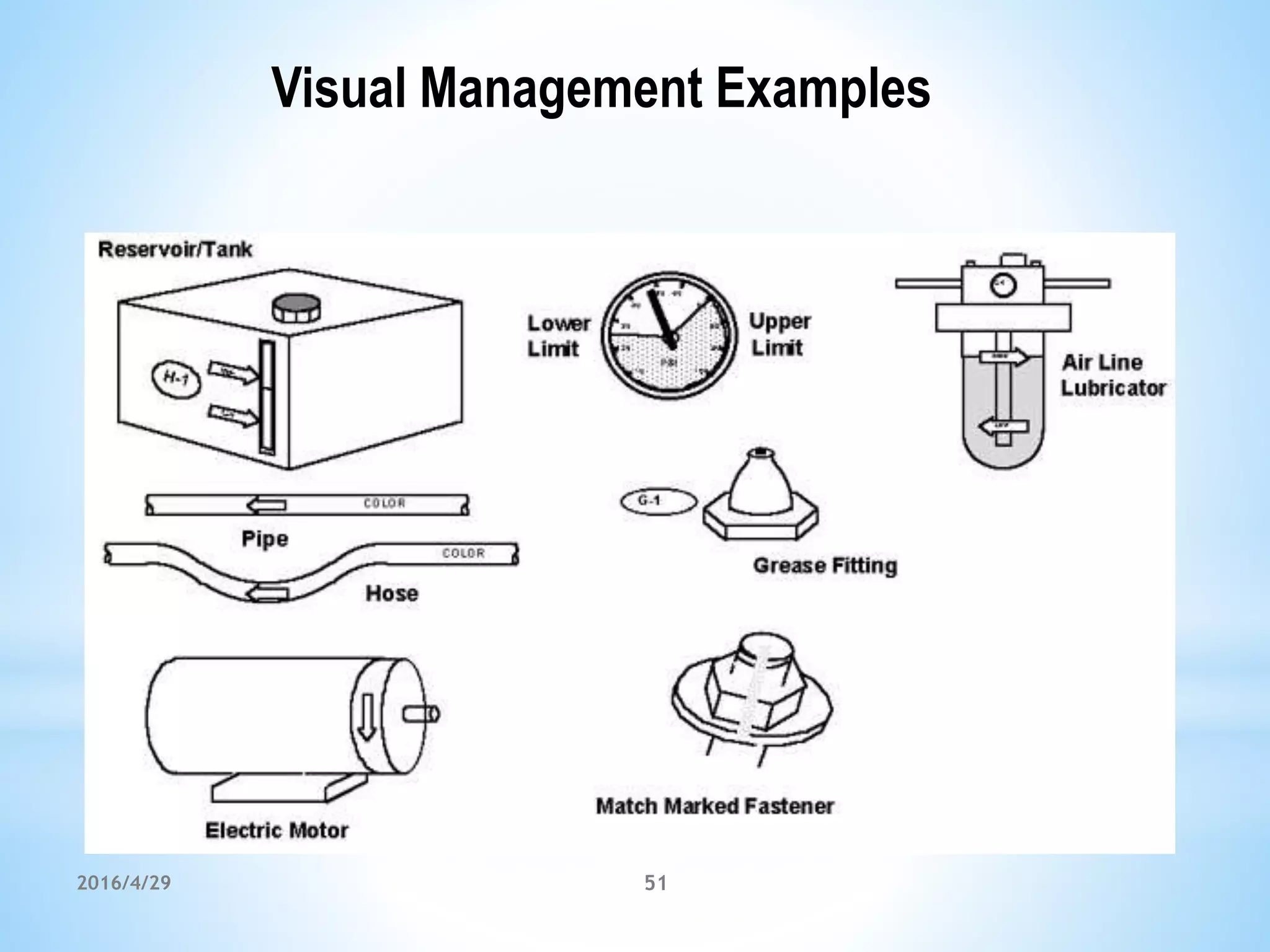
Lubrication (Yellow)
Air/Vacuum (Blue)
Hydraulic (White)
Water (Green)
Electrical (Red)
Lockout/Tag/Tryout (Orange and Black)
Inspection Checkpoints (White and Black)3
INSPECTION POINT
AIR PRESSURE
80-100 psi
#1
Main Air Supply
LOCKOUT
Work place Organization Standards ( Visual Management of
Equipment) - Color Coding
2016/4/29 51
Visual Management Examples
2016/4/29 52
*
Single Point Lessons let you quickly (ten minutes or
less) communicate key points on any subject either
verbally or visually.
You can augment your lesson with visual support if
appropriate. Suggested topics for lessons include, though not
limited to:
A specific maintenance procedure
An inspection task for Quality Control
A detail of a safety check
An office procedure, such as record keeping for AM
A well prepared Single Point Lesson stands alone, and can be
delivered by anyone who feels comfortable doing so,
whether or not they are a subject matter expert.
 Elements of PdM (mechanical
and electrical)
 Equipment condition
monitoring
 Predicting potential equipment
breakdowns or to avoid
expensive repairs
3P Maintenance TPM (Plan, Preventive &
Predictive Maintenance)
TPM the Effective Maintenance
Predictive Maintenance Techniques, Applications,
and Instrumentation covers;
 Starting with a PdM base line
(History of Failure)
 Retighten PM Schedule to
include PdM
 Combining PdM with PM for
greatest overall effect and
least cost Organizational
requirements
TPM the Effective Maintenance
Predictive Maintenance (PdM) Implementation
Getting Organized for PdM &Planning for PdM,
the preparatory steps;
Typical membership of
a team
*five to seven operators
*a maintenance person
*a technical expert
Tools
*Pareto
*Cause & effect
*Root cause
*Methods Analysis
TPM the Effective Maintenance
 Vibration analysis/monitoring
 Shock pulse method
 Spectrographic oil analysis
 Ferrographic particle analysis
 Thermography/temperature
measurement
 Non-destructive testing (NDT)
 Ultrasonic testing and more
Specific PdM Techniques and Applications
TPM the Effective Maintenance
A manager that does not spend 20%
of their time involved in TPM is only
offering lip service
Tokutaro Suzuki
Vice Chairman, Japanese
Institute of Plant Maintenance
TPM the Effective Maintenance
shop floor
attitude
TPM the Effective Maintenance
I run it,
you fix it
I fix it,
you run it
Total Productive Maintenance is Not,
TPM the Effective Maintenance
Autonomous Maintenance is Not
TPM the Effective Maintenance
For Choosing ITS Management Sdn Bhd
As Your Training Provider
If you have questions or require further assistance later, please email to
Itslc98.help@gmail.com
Email Subject: “Attn: Timothy Wooi”
Other inquiries, please email to
itslc98@gmail.com

TPM the effective maintenance (2)

  • 1.
    TPM the Effective Maintenance (23/30Apr2016) For: KotakMalaysia (KOM) Sdn Bhd 11-12 Jln Usaha 4, Kawasan Perindustrian, 75450, Ayer Keroh, Melaka Darul Azim. Presented by: Timothy Wooi ITS Management Sdn Bhd
  • 2.
    2016/4/29 2 TPM theEffective Maintenance
  • 3.
    TPM Implementation after(AM) & Maintenance Workshop Activities Review & extract Equipment PM to a ‘Do Dot’ Visual Master Plan & Visual TPM Board. Attacking 6 big losses of Equipment (PdM) with Engineering Kaizen to maximize Equipment Utilization Quality, Engineering & Maintenance Kaizen Improvement Action Projects & Action Plans TPM the Effective Maintenance
  • 4.
    Maintenance and Reliabilityis a core business strategy. The key to a successful TPM implementation is Top Management support. To implement TPM successfully, a 12 steps approach is used. This will lead you to the road to:“ zero breakdowns” and “zero defects’’ Course Overview TPM the Effective Maintenance
  • 5.
    To enable Participantsunderstand TPM, after that to Plan, Develop, Implement and oversee the Maintenance program towards a Zero downtime by; Course Objective TPM the Effective Maintenance  executing Equipment Maintenance timely per schedule and reduce Company’s resources efficiently using ‘low cost or no cost’ techniques as practiced in a Lean and World class Environment.
  • 6.
  • 7.
    With TPM thefocus of maintenance shifts from that of repairing, or reacting to failures to that of maintaining assets and preventing failures and quality defects in the first place. TPM the Effective Maintenance The root word of maintenance is Maintain, more often than not maintenance is looked at as the people that repair our equipment when it breaks.
  • 8.
    Maintenance Operations TPM Safety andEnvironmental Training and Education Autonomous Maintenance Autonomous Maintenance Workshops Planned Maintenance Moving from reactive to proactive maintenance Attack Six Big Losses •Equipment failures •Setup and Adjustment •Idling and minor stoppages •Reduced speed •Defects and rework (quality) •Start up losses (reduced yield) New assets meet production needs and minimize Life Cycle Costs (LCC) Early Equipment Design and Start up Management TPM the Effective Maintenance
  • 9.
    to Extend lifespan of Equipment and Tools preventing damages caused by neglect and to cut cost of new Equipment reinvestment. TPM the Effective Maintenance  to improve Productivity and Quality leading to Increased Profit by eliminating unplanned breakdowns and costly downtime. Failure Purchased Condition Improved Condition Life Cycle Time Failure Improved Asset Condition Forced Deterioration Equipment Failure TPM Team Based Action
  • 10.
    2016/4/29 10 TPM teachesto plan ahead by preventing equipment failures and quality defects before they occur. TPM the Effective Maintenance
  • 11.
    3P Maintenance TPMafter AM (Plan, Preventive & Predictive) Step 9: Re access planned or preventive maintenance program. Create a schedule for preventive maintenance on each piece of equipment. Step 10: Conduct training to improve operation and maintenance skills. Maintenance department will take on the role of teachers and guides to provide training, advice, and equipment information to the teams. Step 11: Develop an early equipment management program. Apply preventive maintenance principles during the design process of equipment. Step 12: Continuous Improvement - As in any Lean initiative the organization needs to develop a continuous improvement mindset.
  • 12.
    The main TPMkick-off should take the form of a formal presentation with all the employees attending. TPM Implementation after AM 5.5. TPM kick-off This opportunity can be used to gain the full support of the employees Invite external customers, affiliated and subcontracting companies TPM the Effective Maintenance
  • 13.
    * Preparation Kick-off Implementation Announcement to introduceTPM Introductory education campaign for the workforce TPM Promotion (special committees) Establish basic TPM policies and goals Preparation and Formulation of a master plan Develop an equipment management program Develop a planned maintenance program Develop an autonomous maintenance program Increase skills of production and maintenance personnel Perfect TPM implementation and raise TPM levelsStabilization Develop early equipment management program Invite customers, affiliated companies and subcontractors
  • 14.
    A handing-over ofmaintenance tasks from specialized maintenance personnel to production operators Promote the 7 steps Tasks to hand over cleaning lubricating inspecting set-up and adjustment 14 = Establish a Baseline Energy Awareness Cleaning is Inspecting Eliminating Contamination Visual Management Equipment Maintenance Equipment Lubrication Consumables Total Productive Maintenance
  • 15.
    A master planlays out your goals, what you will do to achieve them and when you will achieve them. Detailed plans for each pillar have to be prepared TPM the Effective Maintenance Determining PM frequencies and how to schedule PM :  Time-based or usage-based scheduling  How to measure PM effectiveness and results  How to measure and analyze downtime and downtime trends
  • 16.
     How toDevelop and Install a Good PM System -Do Dot Visual Master Plan & TPM Board  Maximizing Equipment Utilization –Attacking the 6 Big loses  Engineering TPM Kaizen -Improvement Projects to address risk of breakdown - 10 Steps to Improvement Action Plan timothywooi2@gmail.com TPM the Effective Maintenance Workshop Activities
  • 17.
    Form project teams Selecta base line (model equipment) *identify equipment problems *analyze equipment problems *develop solutions and proposals for improvement The tools of Total Quality Management and Continuous Improvement are applied to the management and improvement of equipment TPM the Effective Maintenance
  • 18.
    2016/4/2918 The goal isto: Provide guidance in identifying and developing lubrication requirements, routes, and visual cues for the proper lubrication of equipment. Equipment Lubrication
  • 19.
    19 70% of allmechanical equipment failures are a result of improper lubrication. Too much lubricant is as bad as too little S S S S S Equipment Lubrication S S S S S TPM the Effective Maintenance
  • 20.
    Set up plansand schedules to carry out work on equipment before it breaks down, in order to extend the life of the equipment Include Preventive and Predictive Maintenance Include management of spare parts and tools
  • 21.
    2016/4/2921 The goal isto: Have a routine schedule of activities for maintaining the asset in a highly reliable condition. Pull together all the processes and tasks developed in previous modules relating to maintenance of the equipment. Ensure PMs are up to date. If PMs are not available, they should be created for this equipment. Equipment Maintenance Work with Reliability Team to install condition-based monitoring devices.
  • 22.
  • 23.
    Call for vibrationcheck when Hour Meter reads 250 Pull Bearing Packs and Inspect when Hour meter reads 4000 Call for oil analysis when Hour Meter reads 2000 216 93 1394 Spindle #1 Servos Power On Hrs Hrs Hrs Example: Condition-based monitoring devices. TPM the Effective Maintenance
  • 24.
    2016/4/2924 The goal isto: Develop a list of consumable items needed for the routine maintenance of your equipment. Have a Parts Change History record. Establish minimum and maximum quantities, identify standard storage locations at point of use, and apply visual management. Consumables
  • 25.
    Components of aWell-organized P/PdM Program  Equipment inventory/numbering system  Critical Spare parts inventory/forecast  Sequence of tasks (PM and PdM routes) Machine maintenance critical spares Critical spares for water jet cutter machine Item P/N 1Hi pressure seal kit 001198-1 2Low pressure seal kit 010641-1 3 Mixing tube 010460-40- 30 4Orifice assembly 014201-10 5Repair kit on/off valve 010200-1 6Swivel assy single axis 010140-1 7Cutting head assy 8Repair kit 3/8 swivel 007117-1 9Pressure valve control Example Critical Spare List
  • 26.
    Parts changed historyfor each machine/equipment ( source of data: finance department based on PO for period from Jan 02 to 29 Jun 04) Equipment Name: Asset No.: Location: Data of purchase: Date Part change Part no. Description RM/unit qty changed Total RM Consumables How to keep an effective and useful equipment history
  • 27.
    On existing machines: Analyzehistorical records for trends of types of failures frequency of component failures root causes of failures Determine how to eliminate the problem and reduce maintenance through an equipment design change or by changing the process TPM the Effective Maintenance
  • 28.
     Increase OverallEquipment Effectiveness (OEE)  Improve existing planned maintenance systems  The operator is the best condition monitor  Provide training to upgrade operations and maintenance skills  Involve everyone and utilize cross-functional teamwork TPM the Effective Maintenance
  • 29.
    Maximizing Equipment Utilization –Attackingthe 6 Big loses timothywooi2@gmail.com TPM the Effective Maintenance Set-Up and Adjustment Idling and Minor Stoppage Reduced Speed Quality: Defects in Process & Rework Reduced Yield Equipment Failures Easy to measure Low Impact on Profit High impact on profits Labor Materials/spares Outside services Maintenance overhead
  • 30.
    4/29/2016 30 Failures DefectsSetup and MinorStoppage Reduced Equipment Reduced Yield in ProcessAdjustment Idling and Speed Availability Efficiency Quality + + + Overall Equipment Effectiveness X X OEE is an internationally accepted measure of equipment effectiveness during planned production. It measures how effective equipment is at adding value to the manufacturing process.
  • 31.
    2016/4/29 31 Attacking theSix Big Losses for OEE (Overall Equipment Effectiveness) To achieve World class OEE  Availability > 90%  Efficiency > 95%  Quality > 99%  90 x 95 x 99 = 85% OEE (Most companies find their OEE at 40 – 50% before TPM) World class OEE is 85% TPM the Effective Maintenance
  • 32.
    Equipment Usage Effective Production Value Added TPMthe Effective Maintenance (Most companies find their Value added Equipment usage to be only at 40 – 50% before TPM)
  • 33.
  • 34.
    If you askeda Japanese person from a World Class manufacturing company what maintenance means they would probably say: Maintenance means maintaining and improving the integrity of our production and quality systems through the machines, processes and people who add value to our products and services. TPM the Effective Maintenance
  • 35.
    Failure Purchased Condition Improved Condition Life Cycle Time Failure ImprovedAsset Condition Forced Deterioration Equipment Failure TPM Team Based Action PM PM PM PM PM PM PM PM TPM the Effective Maintenance
  • 36.
    Workshop Activities This Workshopis designed to equip Maintenance Personal with knowledge of Maintenance TPM after A M to:  Focus on the Equipment Maintenance using ‘Do Dot’ Visual Master Plan Check sheet. Ensure timely execution of (PM) with Production and Management support Execute (PdM) with Engineering support to ensure Equipment are are always in a ‘ready to use’ condition ‘every time’ towards a ‘Zero Downtime’ as the Goal. Overview
  • 37.
    4/29/2016 371) Evaluatethe current condition of the equipment 2) Improve the conditions to what they should be 3) Evaluate or prepare Preventive Maintenance inspection standards 4) Implement Proactive maintenance to extend service life 5) Improve Inspection and Maintenance efficiency 6) Implement Quality Maintenance 7) Implement CBM
  • 38.
  • 39.
    How to ImplementMaintenance TPM -3P (Plan, Preventive & Predictive) Maintenance Workshop Review Maintenance TPM -Analyze existing Equipment condition and set SMART goals.(Choose 1 Equipment first).Example:-……………………………… Revisit Preventive Maintenance Checklist & effectiveness of Execution. TPM kick-off.. & TPM Board 12 Steps to TPM Installation (after step 8 )
  • 40.
    How to Developand Install a Good PM System timothywooi2@gmail.com Maintenance Workshop Do Dot Visual Master Plan & TPM Board
  • 41.
    Do Dot VisualMaster Plan sample Maintenance Workshop Critical Consumerable Spares Re-stocking Plan Date:31-May-06 ( Source of data: Spare parts changed from Jan 04 to May 06 based on Avialability vs Lead time) Equipment Name: Gerber Kit cut Asset No: No Part Part Source & Unit Price Lead Time Stock Level Name Number Contact NUmber (US$) (Days) Curren t Min Max 1Theta axis pulley CR2-033 1 2 2Theta motor A-CR2-194 1 2 3Linear bearing CR2-053 1 2 4Keypad CR2-044 1 2 5Galil mation control card DMC-1040 1 2 6Amplifier icon card A-CB2-110 1 2 7Y axis inter connect card CR2-041 1 2 8X Y axis motor A-CR2-193 1 2
  • 42.
    Team D SuggestedLayout of I nform ation Board Suggested Layout of Information Board • Board measures 36X48 mounted -- 40 to 48 inches from the floor • Attach Consumables list to TPM cabinet door • Lockout instructions & map to be located on main electrical cabinet (not on TPM Board) Lube Critical Cleaning Route Map Problem and Component Codes MSS Equipment Problem Log Sheet (S.R. Record) OEE Weekly Summary Sheet (if Available) P.M. Schedule List of persons responsible for updating each item on this board TPM Information Board Machine OperatorMachine Name Operators’ Name(s) Instructions for Lube & Critical Cleaning Any Single Point Lesson place behind these instructions TPM Management Walk-through Checklist Small Group Activity Improvement Items (form) Start-up/Shutdown Process Map on Back Team D Note: Board construction wood with cork facing or magnetic Operator Sign-off Sheet (daily)
  • 43.
     Quality &Kaizen Overview Quality Improvement Action Plan  Engineering TPM Kaizen -Improvement Projects to address risk of breakdown  Maximizing Equipment Utilization After Maintenance Workshop TPM the Effective Maintenance
  • 44.
    2016/4/29 44 Gradual, unending improvement,doing “little things” better every day, setting and achieving ever higher standards Engineering TPM (Kaizen) TPM the Effective Maintenance -Improvement Projects to address risk of breakdown
  • 45.
    The Key toOne Piece Flow, Just In Time and Lean Manufacturing IS
  • 46.
    Raise inspection and restorationskill levels Review and improve Cleaning is Inspecting and Lubrication Standards Enhance visual controls Ensure operators and maintenance are creating Single Point Lessons Strengthen Routine Maintenance TPM the Effective Maintenance
  • 47.
    Raise the levelof inspection for Operators through Small Group Activities (SGA) and start focusing on attacking the Six Big Losses of Production as a baseline. Higher level of inspection TPM the Effective Maintenance Maintenance to Train Operators on Basic: *Pneumatics *Hydraulics *Electrical Systems *Drive systems *Machine Specific Training
  • 48.
    2016/4/29 48 Pneumatic systems HydraulicSystems Electrical Systems Drive Systems Machine Specific Training Skill Specific Training Maintenance Training For Maintenance group should then focus on Advanced:
  • 49.
    *Why are weconcerned about equipment lubrication? *Many moving parts are not lubricated *Many components are over lubricated *Lubricants already in components are contaminated Failures Components Resources Quality 28
  • 50.
    50 Lubrication (Yellow) Air/Vacuum (Blue) Hydraulic(White) Water (Green) Electrical (Red) Lockout/Tag/Tryout (Orange and Black) Inspection Checkpoints (White and Black)3 INSPECTION POINT AIR PRESSURE 80-100 psi #1 Main Air Supply LOCKOUT Work place Organization Standards ( Visual Management of Equipment) - Color Coding
  • 51.
  • 52.
    2016/4/29 52 * Single PointLessons let you quickly (ten minutes or less) communicate key points on any subject either verbally or visually. You can augment your lesson with visual support if appropriate. Suggested topics for lessons include, though not limited to: A specific maintenance procedure An inspection task for Quality Control A detail of a safety check An office procedure, such as record keeping for AM A well prepared Single Point Lesson stands alone, and can be delivered by anyone who feels comfortable doing so, whether or not they are a subject matter expert.
  • 53.
     Elements ofPdM (mechanical and electrical)  Equipment condition monitoring  Predicting potential equipment breakdowns or to avoid expensive repairs 3P Maintenance TPM (Plan, Preventive & Predictive Maintenance) TPM the Effective Maintenance Predictive Maintenance Techniques, Applications, and Instrumentation covers;
  • 54.
     Starting witha PdM base line (History of Failure)  Retighten PM Schedule to include PdM  Combining PdM with PM for greatest overall effect and least cost Organizational requirements TPM the Effective Maintenance Predictive Maintenance (PdM) Implementation Getting Organized for PdM &Planning for PdM, the preparatory steps;
  • 55.
    Typical membership of ateam *five to seven operators *a maintenance person *a technical expert Tools *Pareto *Cause & effect *Root cause *Methods Analysis TPM the Effective Maintenance
  • 56.
     Vibration analysis/monitoring Shock pulse method  Spectrographic oil analysis  Ferrographic particle analysis  Thermography/temperature measurement  Non-destructive testing (NDT)  Ultrasonic testing and more Specific PdM Techniques and Applications TPM the Effective Maintenance
  • 57.
    A manager thatdoes not spend 20% of their time involved in TPM is only offering lip service Tokutaro Suzuki Vice Chairman, Japanese Institute of Plant Maintenance TPM the Effective Maintenance
  • 58.
    shop floor attitude TPM theEffective Maintenance
  • 59.
    I run it, youfix it I fix it, you run it Total Productive Maintenance is Not, TPM the Effective Maintenance
  • 60.
    Autonomous Maintenance isNot TPM the Effective Maintenance
  • 61.
    For Choosing ITSManagement Sdn Bhd As Your Training Provider If you have questions or require further assistance later, please email to Itslc98.help@gmail.com Email Subject: “Attn: Timothy Wooi” Other inquiries, please email to itslc98@gmail.com