



Forensic Psychiatry
Dr Nikita Prabhakaran
Senior Resident
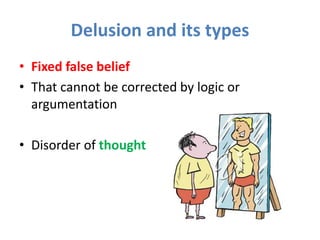
Delusion and its types
• Fixed false belief
• That cannot be corrected by logic or
argumentation
• Disorder of thought
Types
• 1. Delusion of persecution
• 2. Delusion of grandeur
• 3. Delusion of Infidelity (Othello syndrome)
• 4. Nihilistic delusion
• 5. Hypochondriacal delusion
• 6. Delusion of Influence
• 7. Delusion of reference
• 8. Delusion of influence
• 9. Delusion of reference
• 10. Religious delusion
• 11. Erotomania
• 12. Cotard delusion
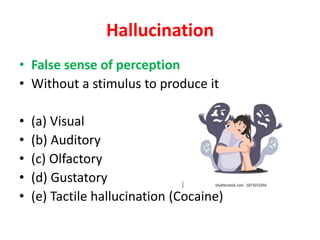
Hallucination
• False sense of perception
• Without a stimulus to produce it
• (a) Visual
• (b) Auditory
• (c) Olfactory
• (d) Gustatory
• (e) Tactile hallucination (Cocaine)
• (f) Psychomotor
• (g) Lilliputin
• (h) Hypnagogic hallucination
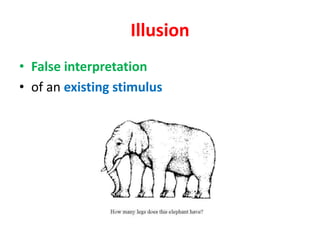
Illusion
• False interpretation
• of an existing stimulus
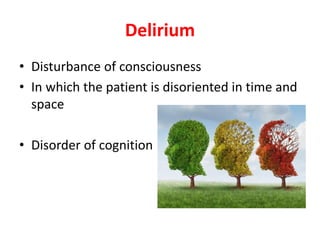
Delirium
• Disturbance of consciousness
• In which the patient is disoriented in time and
space
• Disorder of cognition
Occurs in:
• High fevers like typhoid, meningitis
• Poisoning – Datura poison
• Alcohol withdrawal (Delirium tremens)
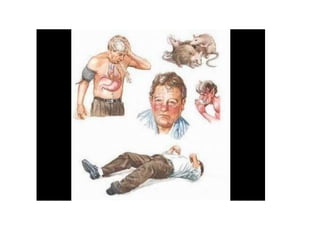
Delirium tremens
• Totally disoriented
• Fluctuations in consciousness
• Delusion++Hallucination+++Illusions++++
• Inappropriate, violent behaviour
• Carphologia ( picking at bed cloth)
• Precipitated by injury or alcohol withdrawal
• MLI: he is not responsible for his deeds
Impulse
• Irresistible desire to do something
• Without any provocation
• (a) Kleptomania  steal
• (b) Pyromania set fire
• (c) Dipsomania drink alcohol
• (d) Mutilomania to mutilate animals
• (e) Oniomania shopping
• (f) Trichotillomania pulling out hair
• (g) Nymphomaniasexual intercourse in
female
• (h) Satyriasis males
• (i) suicidal and homicidal impulse
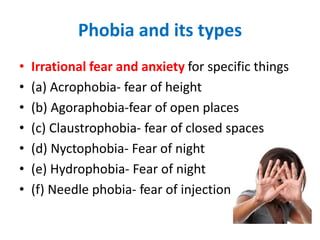
Phobia and its types
• Irrational fear and anxiety for specific things
• (a) Acrophobia- fear of height
• (b) Agoraphobia-fear of open places
• (c) Claustrophobia- fear of closed spaces
• (d) Nyctophobia- Fear of night
• (e) Hydrophobia- Fear of night
• (f) Needle phobia- fear of injection
• (g) Algophobia- Fear of pain
• (h) Hapnophobia- fear of touch
• (i) Xenophobia- fear of strangers
• (j) Zoophobia- fear of animals
• (k) Thanatophobia- fear of death
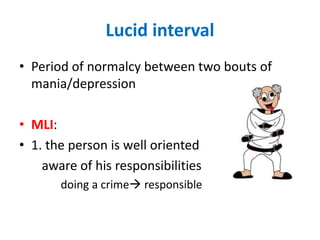
Lucid interval
• Period of normalcy between two bouts of
mania/depression
• MLI:
• 1. the person is well oriented
aware of his responsibilities
doing a crime responsible
• 2. He can execute a valid will during that
period
• 3. Advanced directive
• 4. difficult to prove
Differential diagnosis
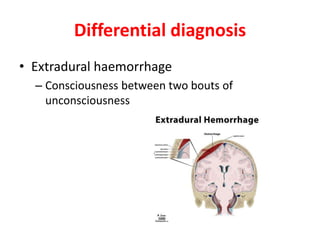
• Extradural haemorrhage
– Consciousness between two bouts of
unconsciousness
Neurosis
• Minor psychiatric illnesses
• Types:
1. Anxiety neurosis
2. Hysterical neurosis
3. Phobic neurosis
4. Obsessive compulsive neurosis
5. Depressive neurosis
Psychosis Neurosis
Contact with reality- lost Preserved
Interpersonal behaviour- disturbed preserved
Empathy- absent present
Insight- absent present
Organic causative factor- present absent
Delusions+ hallucinations+ illusions Usually physical or psychic symptoms
Dealing with routine- impaired preserved
Ex: schizophrenia, MDP, Dementia Anxiety, phobia
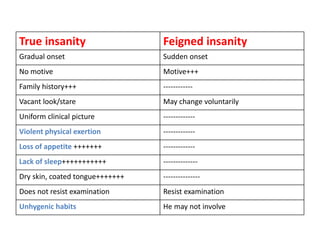
True insanity Feigned insanity
Gradual onset Sudden onset
No motive Motive+++
Family history+++ ------------
Vacant look/stare May change voluntarily
Uniform clinical picture -------------
Violent physical exertion -------------
Loss of appetite +++++++ -------------
Lack of sleep+++++++++++ --------------
Dry skin, coated tongue+++++++ ---------------
Does not resist examination Resist examination
Unhygenic habits He may not involve
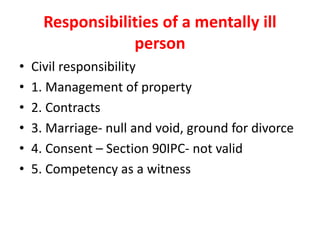
Responsibilities of a mentally ill
person
• Civil responsibility
• 1. Management of property
• 2. Contracts
• 3. Marriage- null and void, ground for divorce
• 4. Consent – Section 90IPC- not valid
• 5. Competency as a witness
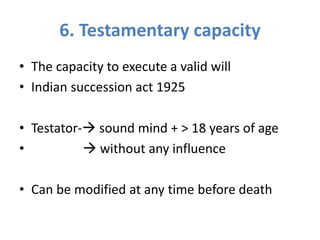
6. Testamentary capacity
• The capacity to execute a valid will
• Indian succession act 1925
• Testator- sound mind + > 18 years of age
•  without any influence
• Can be modified at any time before death
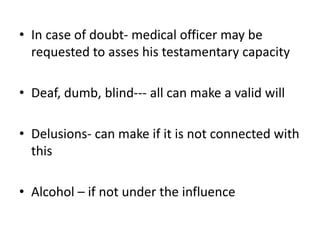
• In case of doubt- medical officer may be
requested to asses his testamentary capacity
• Deaf, dumb, blind--- all can make a valid will
• Delusions- can make if it is not connected with
this
• Alcohol – if not under the influence
• In lucid interval  can make a will
• If after writing a will he suicides????
• if there was no mental illness->>> +++
• Will in extremis– made by an old person ???
• Holographic will- valid
Criminal Responsibility
• Law presumes that all persons are of sound
mind
• If unsoundness is raised as a defence the
burden lies upon the accused
Section 84 IPC
• “ Nothing is an offence which is done by a
person who at the time of doing it, by the
reason of unsoundness of mind is incapable of
knowing the nature of the act, or that he is
doing wrong or contrary to law”
Comments
• 1. The person should be unsound during the
act
• 2. Due to unsoundness, he does not know the
nature and quality of the act
• 3. Even if he understand, he doesn’t know its
contrary here
• 4. The person doesn’t know whether it is right
or wrong
Legal test of insanity
• Defence has to prove all these four points
Limitations
• All persons with mental illness will not get this
benefit
• Certificate is not sufficient
• A legal test is needed
• All or none  stubborn law
• Borderline cases- no benefit
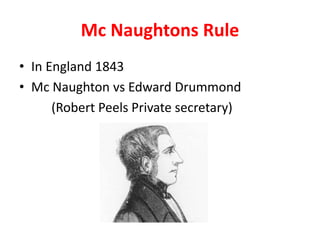
Mc Naughtons Rule
• In England 1843
• Mc Naughton vs Edward Drummond
(Robert Peels Private secretary)
• Rule states that
• “ in order to establish insanity as the defence
of a crime, it must be clearly proved that,
• at the time of committing the act,
• the accused was labouring under such a
defect of reason from disease of mind,
• So as not to know the nature and quality of
the act
• or what he was doing was wrong/ legally
punishable”
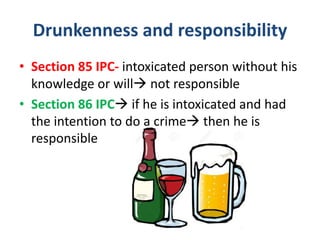
Drunkenness and responsibility
• Section 85 IPC- intoxicated person without his
knowledge or will not responsible
• Section 86 IPC if he is intoxicated and had
the intention to do a crime then he is
responsible
Automatism
• Conduct by a person who is not fully aware of
his actions
• Consciousness is impsared
• Purposeful behaviour without conscious
control
Causes
• (1) Epilepsy
• (2) Concussion or cerebral disease
• (3) Hypoglycemia
• (4) Somnambulism
• (5) Drug induced
Restraint of the mentally ill person
1. Independent admission and discharge
2. Supported admission
3. High supported admission
4. Emergency/immediate restraint
5. Wandering mentally ill person
6. A prisoner with mental illness
1. Independent admission and
discharge
• Patient has the capacity to make mental
healthcare decisions
• If he is not a minor he may request
• He can be admitted(2x psychiatrists)
• mental illness of severity requiring admission
• will be benefitted
• understands the nature of illness and treatment
• He can be discharged on request too after
assesment
• A minor, when a nominated representative of
the minor > 18 years gives a request
2. Supported admission
• When an independent admission patient has
requested for discharge,
But the psychiatrist feels:
• he doesn’t understand the consequences
• has harmed himself/ others
• cant take care of himself
2 psychiatrists can independently examine
can extend the admission (but not > 30 days)
3. High supported admission
If a person discharged has come again within 7 days
Or
a person needs to be detained > 30 days
Certified by 2 psychiatrists
Mental health establishment shall apply to the board
Board shall permit such admissions within 21 days
90days 120 days180 days
Make alternative based community based care
4. Emergency treatment
• Person causing
• (a) death/ irreversible harm to himself or
others
• (b) serious damage to his properties
• Can be transported to the nearest
establishment for treatment
• can be detained for 72 hours
Following treatment shall not be
performed
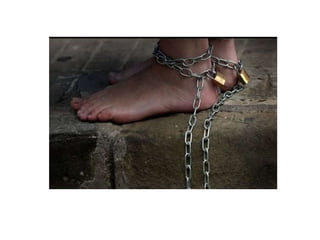
• Chained/ isolate- only if causing harm- inform
the board
• ECT cannot be given without muscle relaxants
• ECT prevented for minors
• ECT after approval from the board
• Sterilisation of men and women
• Psychosurgery only approved by board
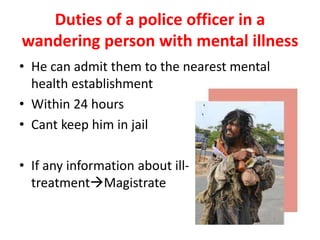
Duties of a police officer in a
wandering person with mental illness
• He can admit them to the nearest mental
health establishment
• Within 24 hours
• Cant keep him in jail
• If any information about ill-
treatmentMagistrate
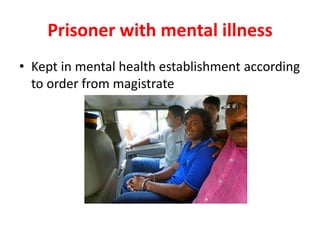
Prisoner with mental illness
• Kept in mental health establishment according
to order from magistrate
THANK YOU

Forensic Psychiatry.pptx

  • 2.
    Forensic Psychiatry Dr NikitaPrabhakaran Senior Resident
  • 3.
    Delusion and itstypes • Fixed false belief • That cannot be corrected by logic or argumentation • Disorder of thought
  • 4.
    Types • 1. Delusionof persecution • 2. Delusion of grandeur • 3. Delusion of Infidelity (Othello syndrome) • 4. Nihilistic delusion • 5. Hypochondriacal delusion • 6. Delusion of Influence • 7. Delusion of reference
  • 5.
    • 8. Delusionof influence • 9. Delusion of reference • 10. Religious delusion • 11. Erotomania • 12. Cotard delusion
  • 6.
    Hallucination • False senseof perception • Without a stimulus to produce it • (a) Visual • (b) Auditory • (c) Olfactory • (d) Gustatory • (e) Tactile hallucination (Cocaine)
  • 7.
    • (f) Psychomotor •(g) Lilliputin • (h) Hypnagogic hallucination
  • 8.
  • 9.
    Delirium • Disturbance ofconsciousness • In which the patient is disoriented in time and space • Disorder of cognition
  • 10.
    Occurs in: • Highfevers like typhoid, meningitis • Poisoning – Datura poison • Alcohol withdrawal (Delirium tremens)
  • 11.
    Delirium tremens • Totallydisoriented • Fluctuations in consciousness • Delusion++Hallucination+++Illusions++++ • Inappropriate, violent behaviour • Carphologia ( picking at bed cloth) • Precipitated by injury or alcohol withdrawal • MLI: he is not responsible for his deeds
  • 13.
    Impulse • Irresistible desireto do something • Without any provocation • (a) Kleptomania  steal • (b) Pyromania set fire • (c) Dipsomania drink alcohol • (d) Mutilomania to mutilate animals • (e) Oniomania shopping
  • 14.
    • (f) Trichotillomaniapulling out hair • (g) Nymphomaniasexual intercourse in female • (h) Satyriasis males • (i) suicidal and homicidal impulse
  • 15.
    Phobia and itstypes • Irrational fear and anxiety for specific things • (a) Acrophobia- fear of height • (b) Agoraphobia-fear of open places • (c) Claustrophobia- fear of closed spaces • (d) Nyctophobia- Fear of night • (e) Hydrophobia- Fear of night • (f) Needle phobia- fear of injection
  • 16.
    • (g) Algophobia-Fear of pain • (h) Hapnophobia- fear of touch • (i) Xenophobia- fear of strangers • (j) Zoophobia- fear of animals • (k) Thanatophobia- fear of death
  • 17.
    Lucid interval • Periodof normalcy between two bouts of mania/depression • MLI: • 1. the person is well oriented aware of his responsibilities doing a crime responsible
  • 18.
    • 2. Hecan execute a valid will during that period • 3. Advanced directive • 4. difficult to prove
  • 19.
    Differential diagnosis • Extraduralhaemorrhage – Consciousness between two bouts of unconsciousness
  • 20.
    Neurosis • Minor psychiatricillnesses • Types: 1. Anxiety neurosis 2. Hysterical neurosis 3. Phobic neurosis 4. Obsessive compulsive neurosis 5. Depressive neurosis
  • 21.
    Psychosis Neurosis Contact withreality- lost Preserved Interpersonal behaviour- disturbed preserved Empathy- absent present Insight- absent present Organic causative factor- present absent Delusions+ hallucinations+ illusions Usually physical or psychic symptoms Dealing with routine- impaired preserved Ex: schizophrenia, MDP, Dementia Anxiety, phobia
  • 22.
    True insanity Feignedinsanity Gradual onset Sudden onset No motive Motive+++ Family history+++ ------------ Vacant look/stare May change voluntarily Uniform clinical picture ------------- Violent physical exertion ------------- Loss of appetite +++++++ ------------- Lack of sleep+++++++++++ -------------- Dry skin, coated tongue+++++++ --------------- Does not resist examination Resist examination Unhygenic habits He may not involve
  • 23.
    Responsibilities of amentally ill person • Civil responsibility • 1. Management of property • 2. Contracts • 3. Marriage- null and void, ground for divorce • 4. Consent – Section 90IPC- not valid • 5. Competency as a witness
  • 24.
    6. Testamentary capacity •The capacity to execute a valid will • Indian succession act 1925 • Testator- sound mind + > 18 years of age •  without any influence • Can be modified at any time before death
  • 25.
    • In caseof doubt- medical officer may be requested to asses his testamentary capacity • Deaf, dumb, blind--- all can make a valid will • Delusions- can make if it is not connected with this • Alcohol – if not under the influence
  • 26.
    • In lucidinterval  can make a will • If after writing a will he suicides???? • if there was no mental illness->>> +++ • Will in extremis– made by an old person ??? • Holographic will- valid
  • 27.
    Criminal Responsibility • Lawpresumes that all persons are of sound mind • If unsoundness is raised as a defence the burden lies upon the accused
  • 28.
    Section 84 IPC •“ Nothing is an offence which is done by a person who at the time of doing it, by the reason of unsoundness of mind is incapable of knowing the nature of the act, or that he is doing wrong or contrary to law”
  • 29.
    Comments • 1. Theperson should be unsound during the act • 2. Due to unsoundness, he does not know the nature and quality of the act • 3. Even if he understand, he doesn’t know its contrary here • 4. The person doesn’t know whether it is right or wrong
  • 30.
    Legal test ofinsanity • Defence has to prove all these four points
  • 31.
    Limitations • All personswith mental illness will not get this benefit • Certificate is not sufficient • A legal test is needed • All or none  stubborn law • Borderline cases- no benefit
  • 32.
    Mc Naughtons Rule •In England 1843 • Mc Naughton vs Edward Drummond (Robert Peels Private secretary)
  • 33.
    • Rule statesthat • “ in order to establish insanity as the defence of a crime, it must be clearly proved that, • at the time of committing the act, • the accused was labouring under such a defect of reason from disease of mind, • So as not to know the nature and quality of the act • or what he was doing was wrong/ legally punishable”
  • 34.
    Drunkenness and responsibility •Section 85 IPC- intoxicated person without his knowledge or will not responsible • Section 86 IPC if he is intoxicated and had the intention to do a crime then he is responsible
  • 35.
    Automatism • Conduct bya person who is not fully aware of his actions • Consciousness is impsared • Purposeful behaviour without conscious control
  • 36.
    Causes • (1) Epilepsy •(2) Concussion or cerebral disease • (3) Hypoglycemia • (4) Somnambulism • (5) Drug induced
  • 38.
    Restraint of thementally ill person 1. Independent admission and discharge 2. Supported admission 3. High supported admission 4. Emergency/immediate restraint 5. Wandering mentally ill person 6. A prisoner with mental illness
  • 39.
    1. Independent admissionand discharge • Patient has the capacity to make mental healthcare decisions • If he is not a minor he may request • He can be admitted(2x psychiatrists) • mental illness of severity requiring admission • will be benefitted • understands the nature of illness and treatment
  • 40.
    • He canbe discharged on request too after assesment • A minor, when a nominated representative of the minor > 18 years gives a request
  • 41.
    2. Supported admission •When an independent admission patient has requested for discharge, But the psychiatrist feels: • he doesn’t understand the consequences • has harmed himself/ others • cant take care of himself 2 psychiatrists can independently examine can extend the admission (but not > 30 days)
  • 42.
    3. High supportedadmission If a person discharged has come again within 7 days Or a person needs to be detained > 30 days Certified by 2 psychiatrists Mental health establishment shall apply to the board Board shall permit such admissions within 21 days 90days 120 days180 days Make alternative based community based care
  • 43.
    4. Emergency treatment •Person causing • (a) death/ irreversible harm to himself or others • (b) serious damage to his properties • Can be transported to the nearest establishment for treatment • can be detained for 72 hours
  • 46.
    Following treatment shallnot be performed • Chained/ isolate- only if causing harm- inform the board • ECT cannot be given without muscle relaxants • ECT prevented for minors • ECT after approval from the board • Sterilisation of men and women • Psychosurgery only approved by board
  • 47.
    Duties of apolice officer in a wandering person with mental illness • He can admit them to the nearest mental health establishment • Within 24 hours • Cant keep him in jail • If any information about ill- treatmentMagistrate
  • 48.
    Prisoner with mentalillness • Kept in mental health establishment according to order from magistrate
  • 49.