EMBRYONIC DEVELOPMENT
(Forensic perspective)
Period of gestation
• According to RCOG  9months +7 days 280 days
• =10 lunar months
• Forensic texts : 10 months (10 lunar months)
• Each month of 4 weeks
• In all embryology texts divided as weeks
• Ref: Modi, Reddy, Ludwig, Scheff’s textbook of pediatric autopsy
Period of gestation Nomenclature
0-1 week Developing ovum
Upto 8 weeks Embryo
>8 weeks to delivery Foetus
Upto 1 month after delivery neonate
Upto 1 year after delivery infant
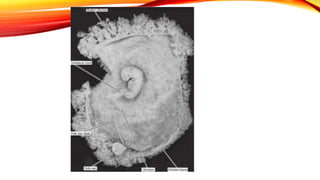
1ST MONTH/ 4 WEEKS
• I cm in length
• 2.5 g (2.75 g : Modi)
• grey coloured oval mass= pigeons egg
• umbilical vesicle ++
• attached to the chorion with a very short cord
• head – thick oval swelling, tail-slender
• limb buds nodules
• hardly detected when surrounded by blood clots
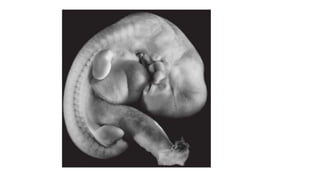
2ND MONTH/ 8 WEEKS
• 4 cm long (3 cm long- Modi)
• Weight 10g  hen’s egg
• Nose bud starts to form and is separated from mouth
• Umbilical vesicle disappears
• Sex is indistinct
• Cord is longer
• Placenta starts to form
• Anus – a dark spot
• Webbed hands and feet
• Ossification centres clavicle (4 to 5 weeks)
• maxilla (6 weeks) mandible ++
• Ribs, Ilium, Bodies of the vertebrae(Modi)
• upper segments of sacrum (Reddy)
P
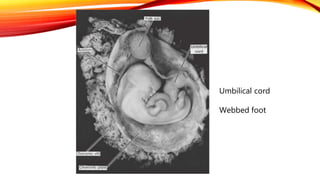
3RD MONTH/12 WEEKS
• 9 cm long (10 cm – Modi)
• 30gm weight
• Placenta is developed and takes over
• The cord is longer and spiral twist
• Formation of neck+
• Eyes are closed, pupillary memb++
• Mouth closed
• Nails are formed as memberanes
• Sex – rarely indistinguishable
• Heart divided into two chambers
• GIT-loops++
• Ossification centres in almost all bones
Umbilical cord
Webbed foot
4TH MONTH/ 16 WEEKS• 13 to 16 cm long
• Weight- 60 to120 g
• Fetus can be detected is the mother is X-rayed
• Skin is rosy and firmer
• Sex distinguishable
• Head=1/4 of length of the body
• Convolutions of brain+
• Eyes closed, PM+
• External ear stands out due to development of cartilages
• Breast buds seen as dots
• Ossicles of ear have been ossified
• Skull bones ossified sutures and fontanelles wide
• Gall bladder +
• Meconium + in the duodenum
• Umbilicus near the pubis
• Ossification centres –lower parts of sacrum
1/4th
Digits formed
Umbilical cord
Brain convolutions
Umbilicus down at pubis
5TH MONTH/20 WEEKS
• 25 cm length (15 to 25g–Modi)
• 240 to 320 g
• Vernix caseosa ++
• Light hair in the head
• Lanugo on the body
• Breast buds seen (Langman’s)
• Germs of the teeth begin to appear
• Position of umbilicus recedes upwards
• Ossification centres: Calcaneum+, os pubis+, ischium+
Middle segments of sacrum
• Meconium (yellowish green) at large intestine
6TH MONTH/24 WEEKS
• 30 cm length(22-30 cm length)
• 480-720g
• Wrinkled appearance
• Cinnabar red appearance
• Cerebral hemispheres cover the cerebellum
• Eyebrows, eyelashes+
• S/c fat starts to appear
• Eyes still closed, PM+
• Umbilicus further recedes
• Testicles –close to kidneys
• Dark meconium in the large intestine
• Sternum -4th division ossification+(Modi)
7TH MONTH/ 28 WEEKS• Length:35 cm
• CRL:23 cm
• Foot length: 8 cm
• Weight: 900 to 1200 g
• Thick nails( not reaching the tip)
• Eyelids partly open.PM-
• Skin is dusky red,
• Vernix Caseosa++
• Meconium-entire large intestine
• Testes- ext inguinal ring
• Caecum in RIF+
• Ossification centre in talus
• Period of viability
8TH MONTH/32 WEEKS
• Length 40 cm(35-42 cm)
• Weight: 1.5-2.5 kg
• Rosy skin covered with hair
• Not wrinkled
• s/c fat builds up
• Lanugo disappears from the face,
• Scalp hair thickens-1.5 cm length
• Nails have reached the tips
• Left testis descended
• Ossification-last centre of sacrum
• Modi  period of viability – 30 weeks(210 days)
• Placenta-500 gms
9TH MONTH/36 WEEKS
• 45 - 47 cm long
• 2.2-3 kg
• Meconium - at the end of LI
• Lanugo hair has complete disappeared
• Scrotum contains testicles
• Vernix caseosa at the flexures of joints
• Vulva is closed
• Scalp hair is dark-4 cm long
• Ossification centre - lower end of femur
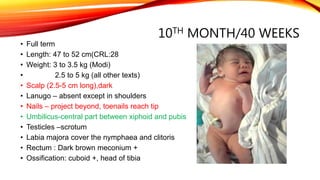
10TH MONTH/40 WEEKS
• Full term
• Length: 47 to 52 cm(CRL:28
• Weight: 3 to 3.5 kg (Modi)
• 2.5 to 5 kg (all other texts)
• Scalp (2.5-5 cm long),dark
• Lanugo – absent except in shoulders
• Nails – project beyond, toenails reach tip
• Umbilicus-central part between xiphoid and pubis
• Testicles –scrotum
• Labia majora cover the nymphaea and clitoris
• Rectum : Dark brown meconium +
• Ossification: cuboid +, head of tibia
Age (weeks) Developmental events
9 Closed or closing eyes, more rounded head,
and herniation of intestines in umbilical cord
10 Intestines in abdomen and early development
of fingernails
12 Differentiated external genitalia and welldefined
neck
14 Erect head, well-developed lower limb, and
early finger nail development
16 External ears standing out from the head
18 Vernix caseosa and early toe nail development
20 Lanugo hair
22 Wrinkled and red skin
24 Fingernails and lean body
26 Partially open eyes and eyelashes
28 Open eyes, hair, and slightly wrinkled skin
30 Toe nails and descending testes
32 Fingernails up to finger tips, and pink and
smooth skin
36 Plumb body, absence of lanugo hair, toe
nails
up to toe tips, flexed limbs, and a firm grasp
38 Prominent chest, protruding breasts, testes
in
the scrotum or inguinal canals, and fingernails
Ref: Vishram Singh, I B Singh
OSSIFICATION CENTRES
Ref : Practical textbook of Dr B Umadathen
Medicolegal code
6 m IU
7 m IU
9 m IU
60 Yrs
40 Yrs
STERNUM
5 m IU
4-5 m IU
6-7 m IU
I
II
III
IV
V 8m IU (14 Yr)
(20-25) Yr
SACRUM
(14-17 Yr)
TARSAL BONES
Calcaneum
5 m IU
Talus
7 m IU
Cuboid
9 m IU
9 m IU
Just after birth
Upper end of tibia
Lower end of femur
Descend of testis
During 3rd month Testis reaches iliac fossa
At the end of 6th month Reaches deep Inguinal ring
During 7th month Travels through inguinal canal
At 8th month Reaches at superficial inguinal ring
By end of 9th month Reaches scrotum
Ref: IB Singh, Vishram Singh
References
• Modi’s textbook of medical jurisprudence
• KSN Reddy textbook of forensic medicine
• Textbook of forensic medicine by Dr B Umadethen
• Medicolegal code
• Textbook of forensic medicine by Dr Anil Aggrawal
• Schaeff’s textbook of pediatric autopsy
• Clinical embryology- Langman’s
• Textbook of human embryology – Vishram Singh
• Textbook of human embryology- IB Singh
• Dutta’s textbook of obstetrics
• RCOG –Global summit 2016

Embryonic development

  • 1.
  • 2.
    Period of gestation •According to RCOG  9months +7 days 280 days • =10 lunar months • Forensic texts : 10 months (10 lunar months) • Each month of 4 weeks • In all embryology texts divided as weeks • Ref: Modi, Reddy, Ludwig, Scheff’s textbook of pediatric autopsy
  • 3.
    Period of gestationNomenclature 0-1 week Developing ovum Upto 8 weeks Embryo >8 weeks to delivery Foetus Upto 1 month after delivery neonate Upto 1 year after delivery infant
  • 4.
    1ST MONTH/ 4WEEKS • I cm in length • 2.5 g (2.75 g : Modi) • grey coloured oval mass= pigeons egg • umbilical vesicle ++ • attached to the chorion with a very short cord • head – thick oval swelling, tail-slender • limb buds nodules • hardly detected when surrounded by blood clots
  • 6.
    2ND MONTH/ 8WEEKS • 4 cm long (3 cm long- Modi) • Weight 10g  hen’s egg • Nose bud starts to form and is separated from mouth • Umbilical vesicle disappears • Sex is indistinct • Cord is longer • Placenta starts to form • Anus – a dark spot • Webbed hands and feet • Ossification centres clavicle (4 to 5 weeks) • maxilla (6 weeks) mandible ++ • Ribs, Ilium, Bodies of the vertebrae(Modi) • upper segments of sacrum (Reddy) P
  • 8.
    3RD MONTH/12 WEEKS •9 cm long (10 cm – Modi) • 30gm weight • Placenta is developed and takes over • The cord is longer and spiral twist • Formation of neck+ • Eyes are closed, pupillary memb++ • Mouth closed • Nails are formed as memberanes • Sex – rarely indistinguishable • Heart divided into two chambers • GIT-loops++ • Ossification centres in almost all bones
  • 9.
  • 10.
    4TH MONTH/ 16WEEKS• 13 to 16 cm long • Weight- 60 to120 g • Fetus can be detected is the mother is X-rayed • Skin is rosy and firmer • Sex distinguishable • Head=1/4 of length of the body • Convolutions of brain+ • Eyes closed, PM+ • External ear stands out due to development of cartilages • Breast buds seen as dots • Ossicles of ear have been ossified • Skull bones ossified sutures and fontanelles wide • Gall bladder + • Meconium + in the duodenum • Umbilicus near the pubis • Ossification centres –lower parts of sacrum 1/4th
  • 12.
  • 13.
  • 14.
    5TH MONTH/20 WEEKS •25 cm length (15 to 25g–Modi) • 240 to 320 g • Vernix caseosa ++ • Light hair in the head • Lanugo on the body • Breast buds seen (Langman’s) • Germs of the teeth begin to appear • Position of umbilicus recedes upwards • Ossification centres: Calcaneum+, os pubis+, ischium+ Middle segments of sacrum • Meconium (yellowish green) at large intestine
  • 17.
    6TH MONTH/24 WEEKS •30 cm length(22-30 cm length) • 480-720g • Wrinkled appearance • Cinnabar red appearance • Cerebral hemispheres cover the cerebellum • Eyebrows, eyelashes+ • S/c fat starts to appear • Eyes still closed, PM+ • Umbilicus further recedes • Testicles –close to kidneys • Dark meconium in the large intestine • Sternum -4th division ossification+(Modi)
  • 18.
    7TH MONTH/ 28WEEKS• Length:35 cm • CRL:23 cm • Foot length: 8 cm • Weight: 900 to 1200 g • Thick nails( not reaching the tip) • Eyelids partly open.PM- • Skin is dusky red, • Vernix Caseosa++ • Meconium-entire large intestine • Testes- ext inguinal ring • Caecum in RIF+ • Ossification centre in talus • Period of viability
  • 19.
    8TH MONTH/32 WEEKS •Length 40 cm(35-42 cm) • Weight: 1.5-2.5 kg • Rosy skin covered with hair • Not wrinkled • s/c fat builds up • Lanugo disappears from the face, • Scalp hair thickens-1.5 cm length • Nails have reached the tips • Left testis descended • Ossification-last centre of sacrum • Modi  period of viability – 30 weeks(210 days) • Placenta-500 gms
  • 20.
    9TH MONTH/36 WEEKS •45 - 47 cm long • 2.2-3 kg • Meconium - at the end of LI • Lanugo hair has complete disappeared • Scrotum contains testicles • Vernix caseosa at the flexures of joints • Vulva is closed • Scalp hair is dark-4 cm long • Ossification centre - lower end of femur
  • 21.
    10TH MONTH/40 WEEKS •Full term • Length: 47 to 52 cm(CRL:28 • Weight: 3 to 3.5 kg (Modi) • 2.5 to 5 kg (all other texts) • Scalp (2.5-5 cm long),dark • Lanugo – absent except in shoulders • Nails – project beyond, toenails reach tip • Umbilicus-central part between xiphoid and pubis • Testicles –scrotum • Labia majora cover the nymphaea and clitoris • Rectum : Dark brown meconium + • Ossification: cuboid +, head of tibia
  • 22.
    Age (weeks) Developmentalevents 9 Closed or closing eyes, more rounded head, and herniation of intestines in umbilical cord 10 Intestines in abdomen and early development of fingernails 12 Differentiated external genitalia and welldefined neck 14 Erect head, well-developed lower limb, and early finger nail development 16 External ears standing out from the head 18 Vernix caseosa and early toe nail development 20 Lanugo hair 22 Wrinkled and red skin 24 Fingernails and lean body 26 Partially open eyes and eyelashes 28 Open eyes, hair, and slightly wrinkled skin 30 Toe nails and descending testes 32 Fingernails up to finger tips, and pink and smooth skin 36 Plumb body, absence of lanugo hair, toe nails up to toe tips, flexed limbs, and a firm grasp 38 Prominent chest, protruding breasts, testes in the scrotum or inguinal canals, and fingernails Ref: Vishram Singh, I B Singh
  • 23.
    OSSIFICATION CENTRES Ref :Practical textbook of Dr B Umadathen Medicolegal code
  • 24.
    6 m IU 7m IU 9 m IU 60 Yrs 40 Yrs STERNUM 5 m IU
  • 25.
    4-5 m IU 6-7m IU I II III IV V 8m IU (14 Yr) (20-25) Yr SACRUM
  • 26.
    (14-17 Yr) TARSAL BONES Calcaneum 5m IU Talus 7 m IU Cuboid 9 m IU
  • 27.
    9 m IU Justafter birth Upper end of tibia Lower end of femur
  • 28.
    Descend of testis During3rd month Testis reaches iliac fossa At the end of 6th month Reaches deep Inguinal ring During 7th month Travels through inguinal canal At 8th month Reaches at superficial inguinal ring By end of 9th month Reaches scrotum Ref: IB Singh, Vishram Singh
  • 29.
    References • Modi’s textbookof medical jurisprudence • KSN Reddy textbook of forensic medicine • Textbook of forensic medicine by Dr B Umadethen • Medicolegal code • Textbook of forensic medicine by Dr Anil Aggrawal • Schaeff’s textbook of pediatric autopsy • Clinical embryology- Langman’s • Textbook of human embryology – Vishram Singh • Textbook of human embryology- IB Singh • Dutta’s textbook of obstetrics • RCOG –Global summit 2016