The document outlines the implementation of the reciprocity theorem, which states that the current from a voltage source at one point is equal to the current at the other point when positions are interchanged. It includes details on the objectives, theory, apparatus, procedure, calculations, and results of an experiment conducted to demonstrate the theorem using a circuit with resistors and a breadboard setup. The results showed a 4% error in the current measurements, confirming the theorem's validity under specified conditions.
CONTENTS OF THE
PRESENTATION
Objectives
introduction
Theory
Apparatus
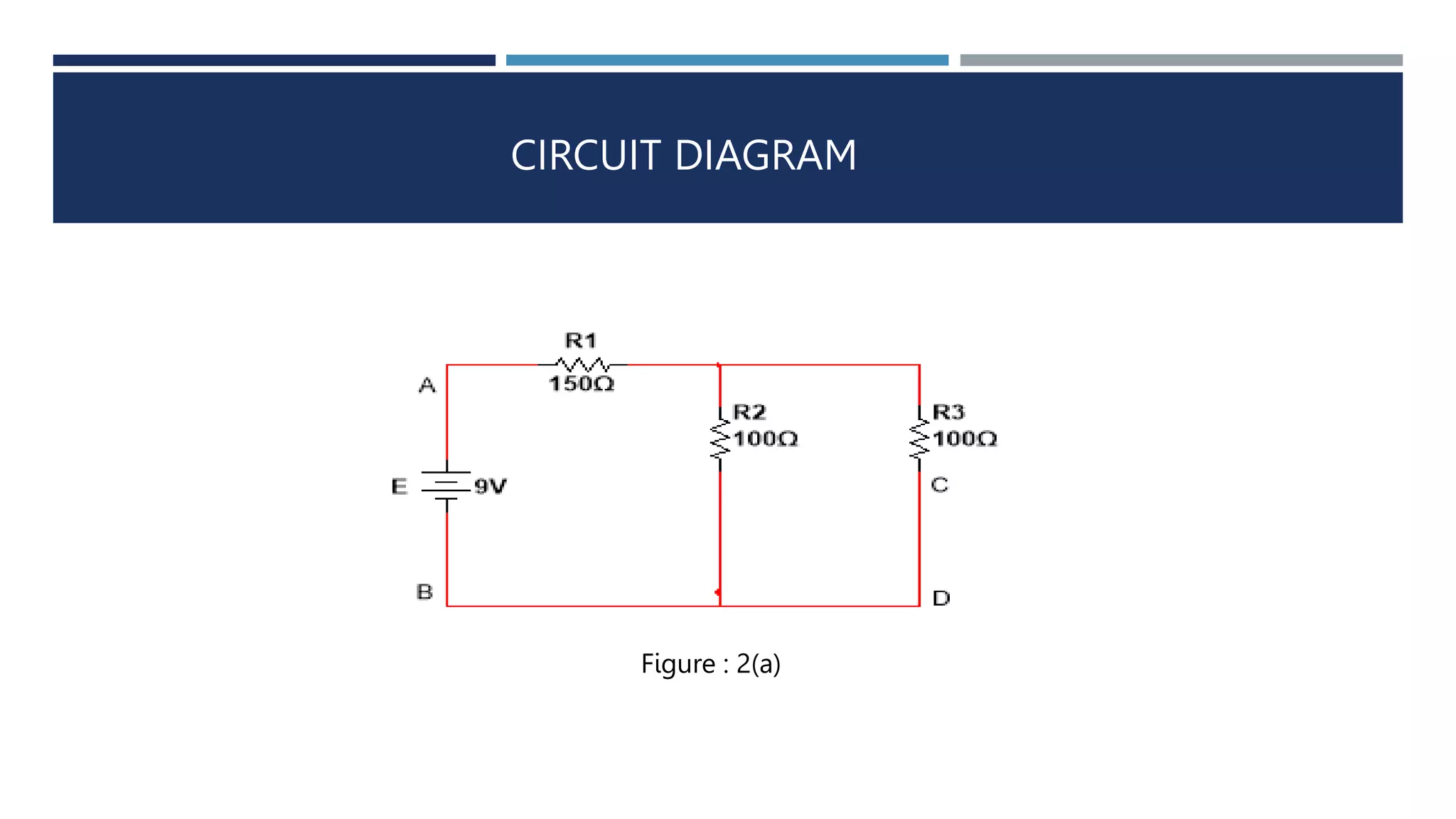
Circuit Diagram
Procedure
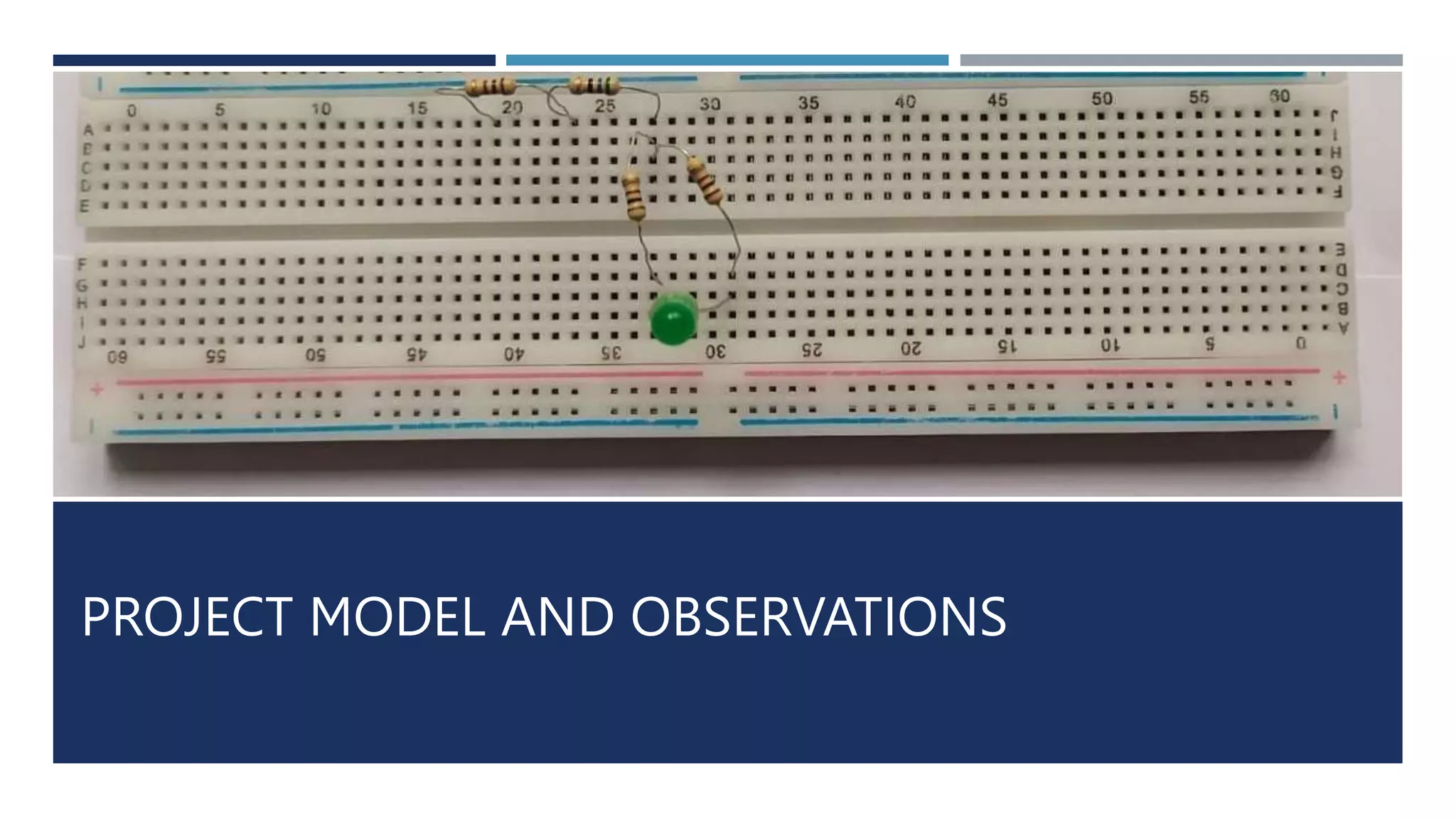
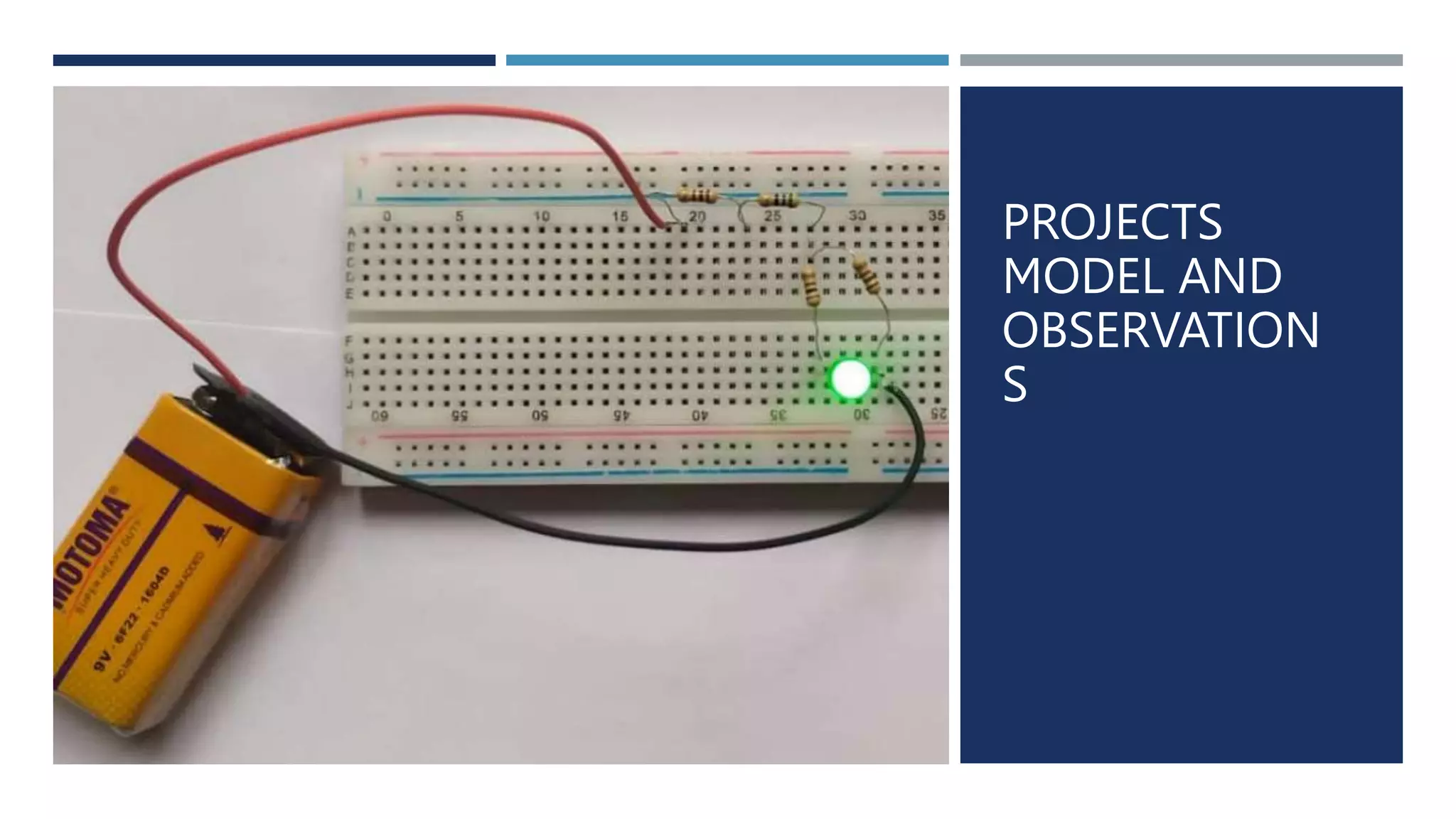
project model and
observations
Calculation
simulation
Result
3.
OBJECTIVES AND OUTCOMES
Understanding what Reciprocity Theorem
Understanding how Reciprocity Theorem work
Implementation of Reciprocity Theorem in a breadboard and simulation
Proving Reciprocity Theorem
4.
INTRODUCTION
The principle ofreciprocity in acoustic as well as electromagnetic (EM)
systems was first enunciated by Lord Rayleigh. Soon afterward, H. A. Lorentz and
J. R. Carson extended the concept and provided sound physical and mathematical arguments that
underlie the rigorous proof of the reciprocity theorem. Over the years, the theorem has been
embellished and extended to cover a broader range of possibilities, and to apply with fewer
constraints The basic concept and its proof based on Maxwell’s macroscopic equations
are discussed in standard textbooks on electromagnetism. For a recent review of
reciprocity in optics, the reader is referred to the comprehensive article by Potton.
5.
THEORY
The reciprocitytheorem states that the current at one point in a circuit due to a voltage at a second
point is the same as the current at the second point due to the same voltage at the first.
The limitation of this theorem is that it is applicable only to single-source networks and not in the multi-
source network.
The network where reciprocity theorem is applied should be linear and consist of resistors, inductors,
capacitors and coupled circuits.
The circuit should not have any time-varying elements.
6.
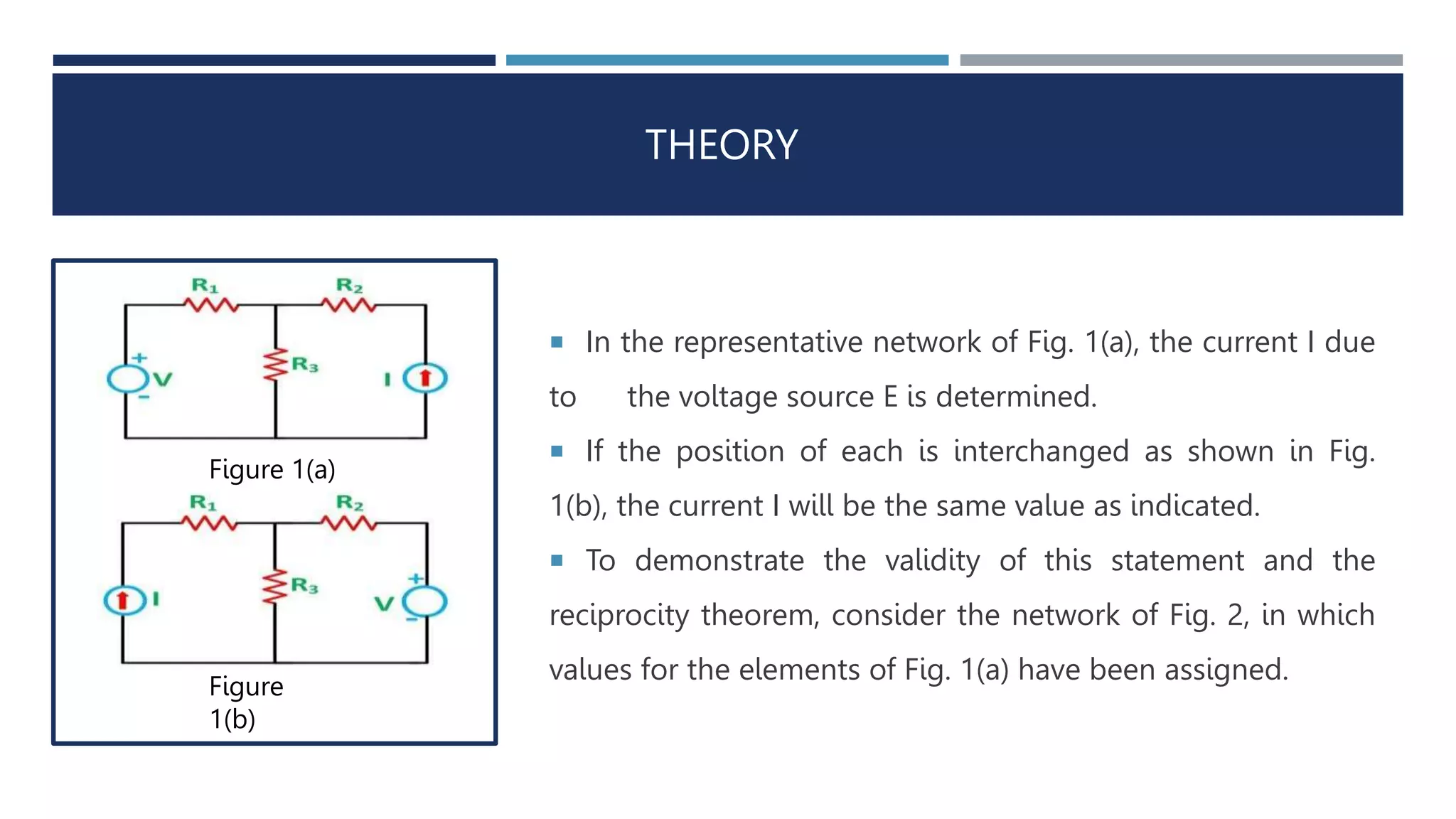
In therepresentative network of Fig. 1(a), the current I due
to the voltage source E is determined.
If the position of each is interchanged as shown in Fig.
1(b), the current I will be the same value as indicated.
To demonstrate the validity of this statement and the
reciprocity theorem, consider the network of Fig. 2, in which
values for the elements of Fig. 1(a) have been assigned.
THEORY
Figure 1(a)
Figure
1(b)
7.
APPARATUS
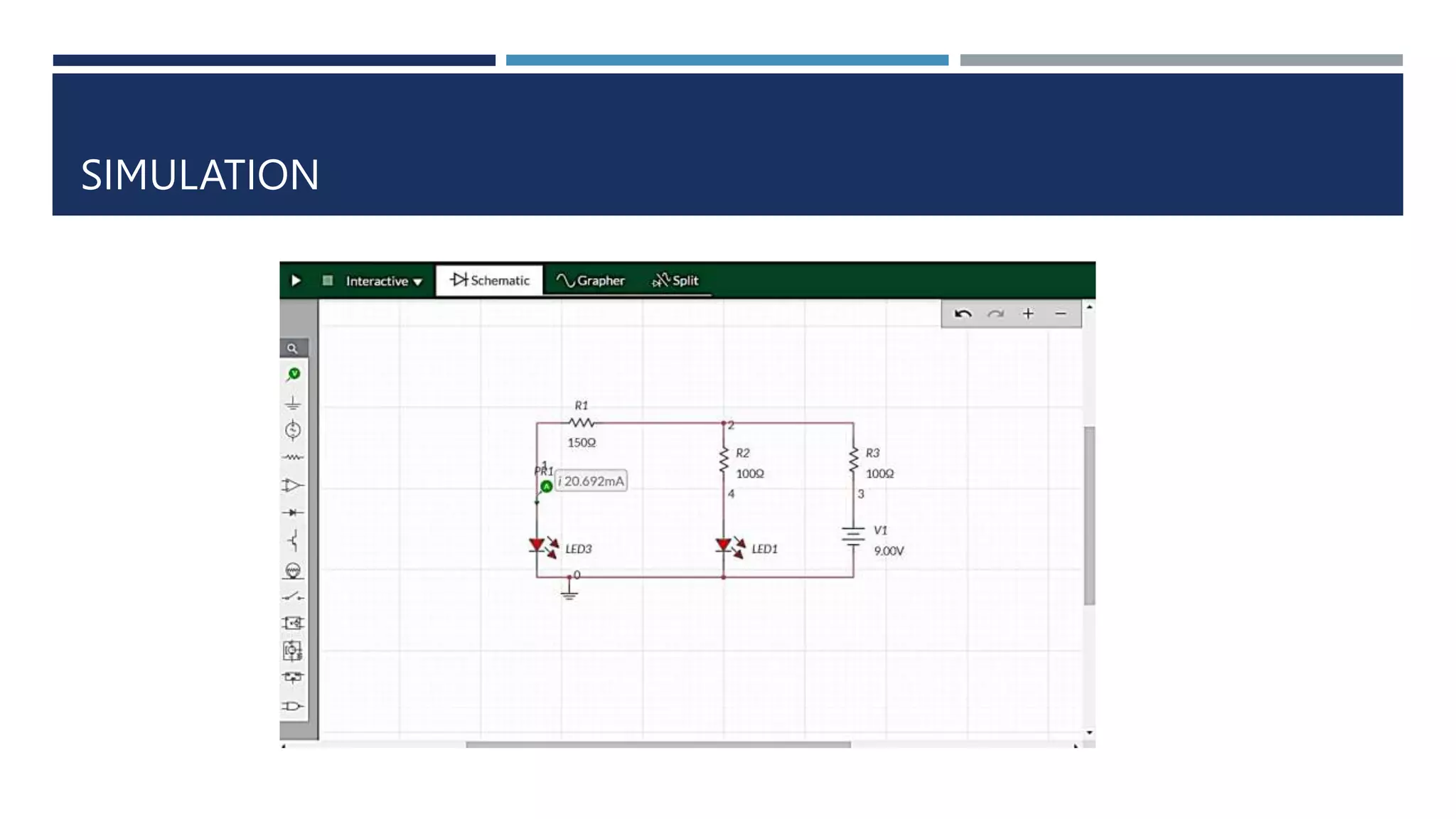
Resistor (150Ω, 100Ω , 100Ω )
Source ( 9 V )
Breadboard
LED Light ( 0.02 A )
Connecting Wire
PROCEDURE
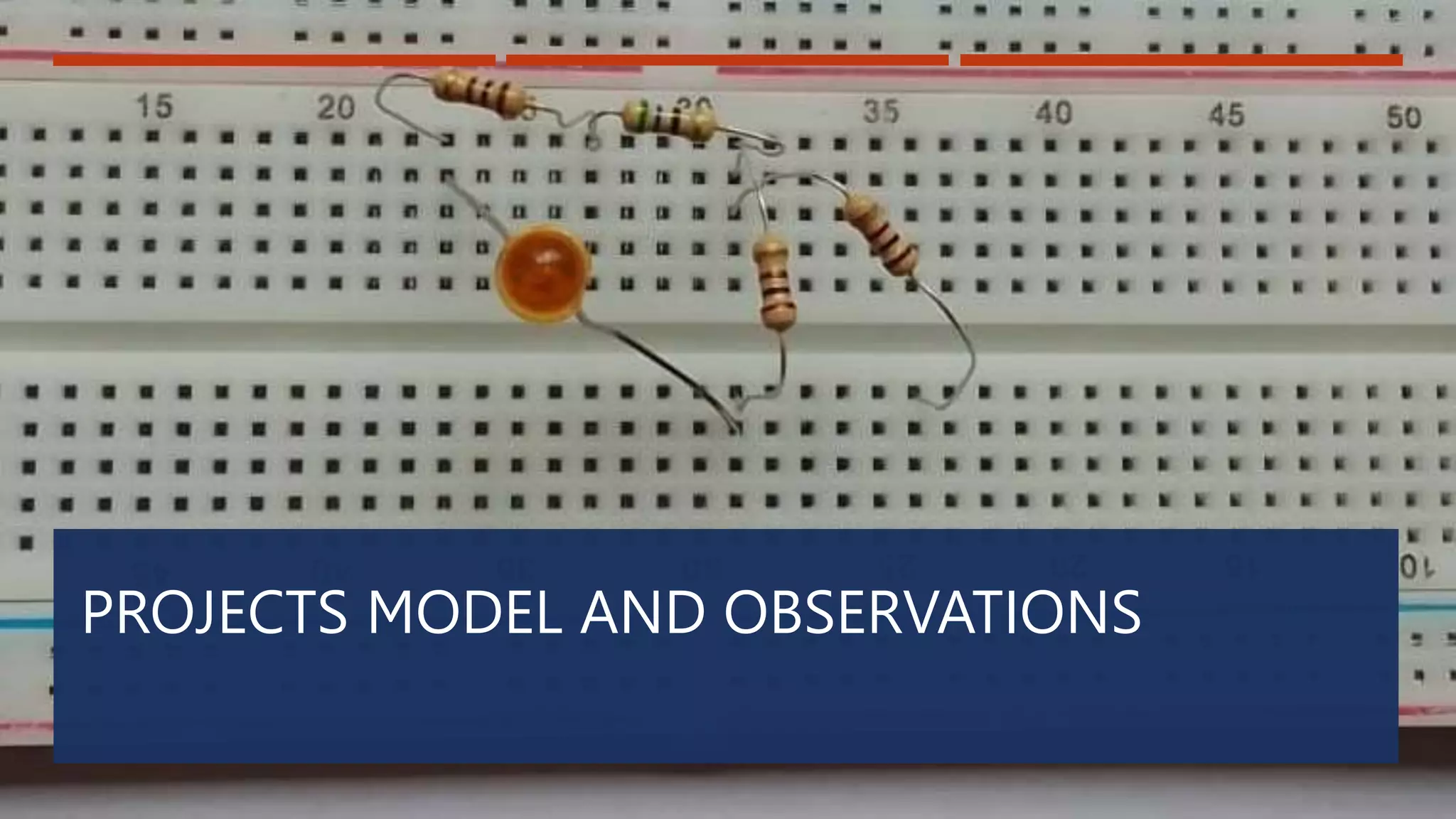
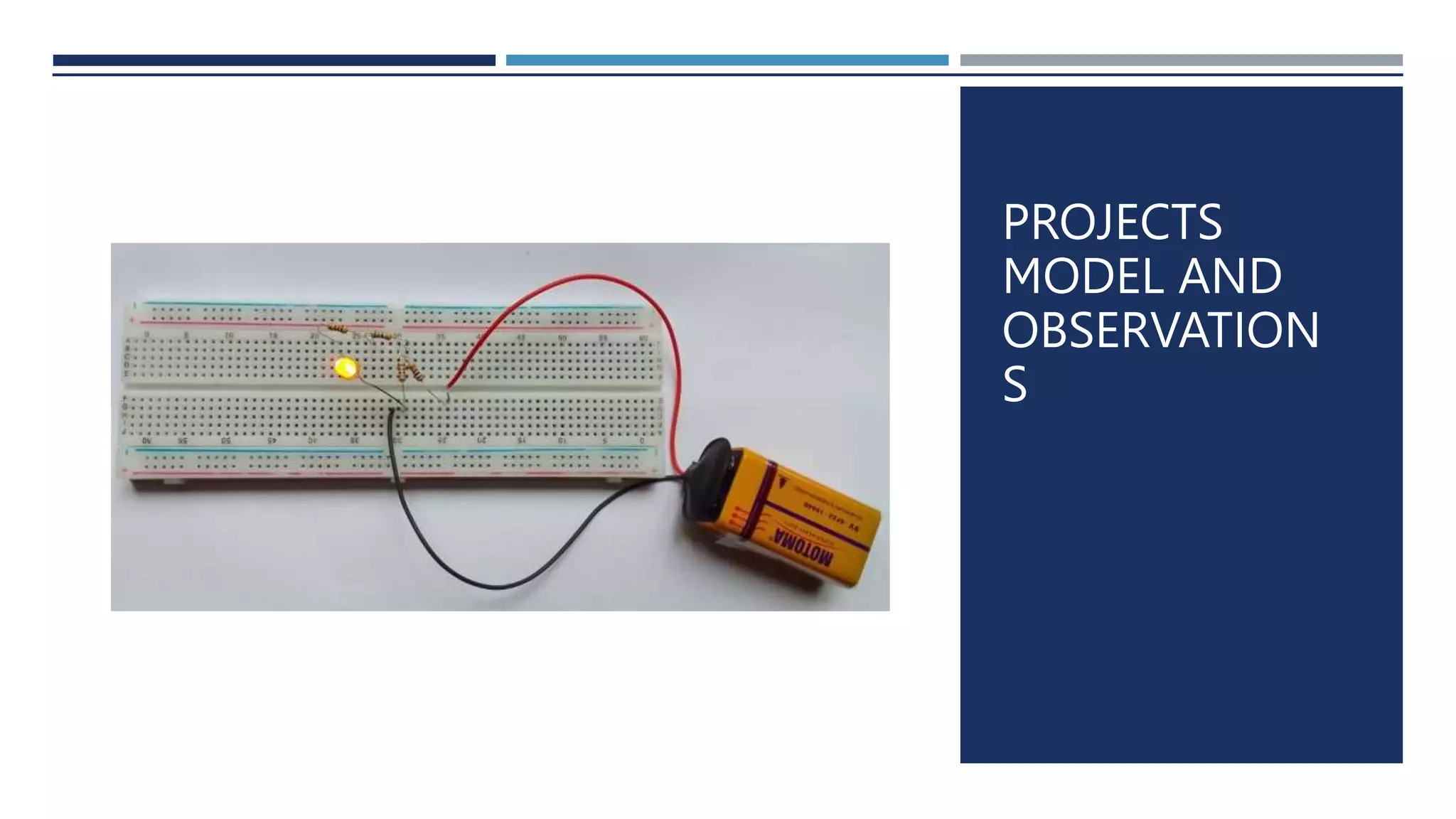
Constructed thecircuit as shown in Figure fig 2(a) in a
breadboard.
Then connected the LED light flowing from terminal C to
terminal D keeping the source E between terminal A & B.
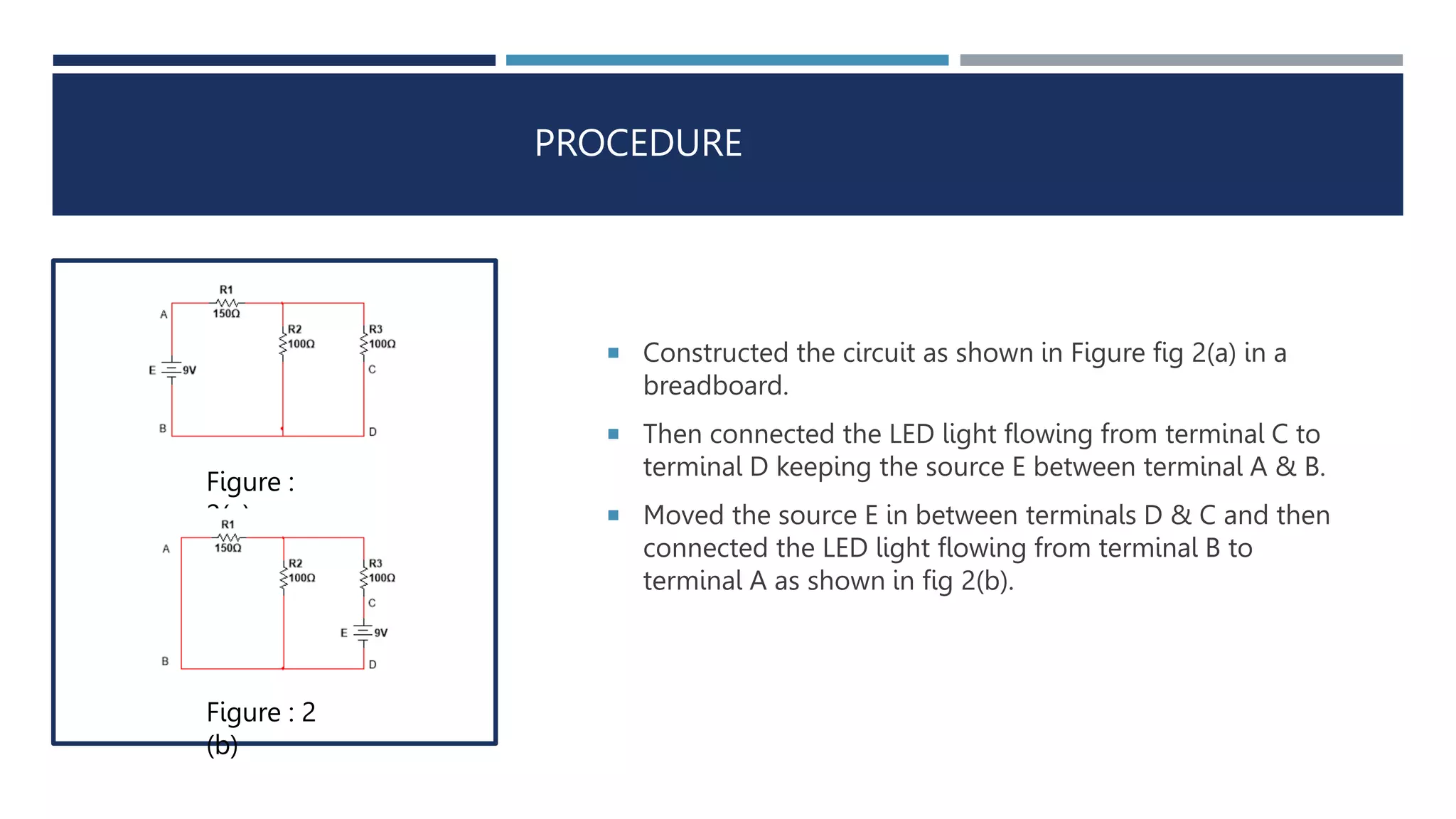
Moved the source E in between terminals D & C and then
connected the LED light flowing from terminal B to
terminal A as shown in fig 2(b).
Figure :
2(a)
Figure : 2
(b)
CALCULATION
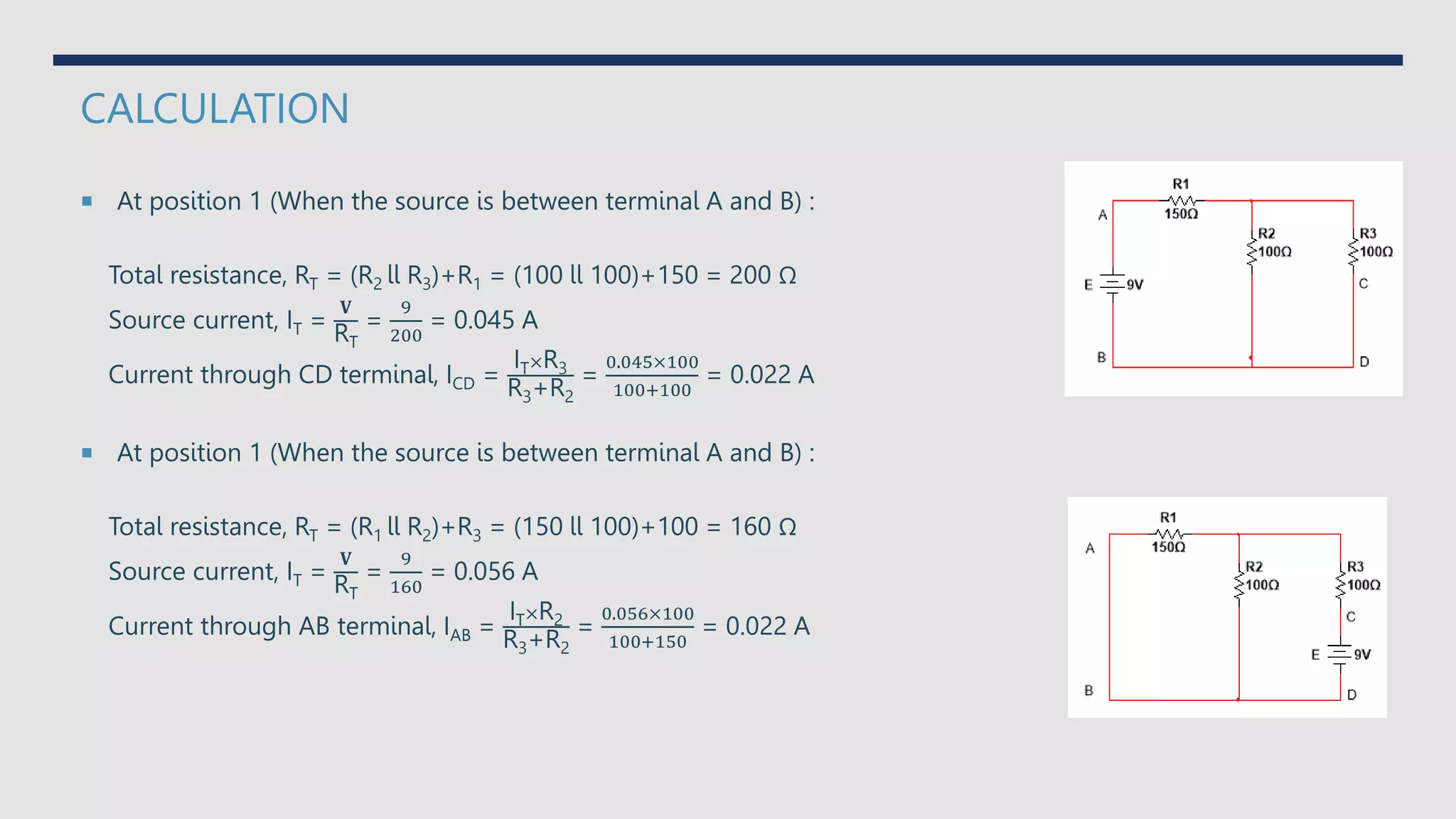
At position1 (When the source is between terminal A and B) :
Total resistance, RT = (R2 ll R3)+R1 = (100 ll 100)+150 = 200 Ω
Source current, IT =
𝐕
RT
=
9
200
= 0.045 A
Current through CD terminal, ICD =
IT×R3
R3+R2
=
0.045×100
100+100
= 0.022 A
At position 1 (When the source is between terminal A and B) :
Total resistance, RT = (R1 ll R2)+R3 = (150 ll 100)+100 = 160 Ω
Source current, IT =
𝐕
RT
=
9
160
= 0.056 A
Current through AB terminal, IAB =
IT×R2
R3+R2
=
0.056×100
100+150
= 0.022 A