Implementation I
1
Objectives
• Introduce basic implementation strategies
• Clipping
• Scan conversion
2
Overview
• At end of the geometric pipeline, vertices have been assembled into
primitives
• Must clip out primitives that are outside the view frustum
• Algorithms based on representing primitives by lists of vertices
• Must find which pixels can be affected by each primitive
• Fragment generation
• Rasterization or scan conversion
3
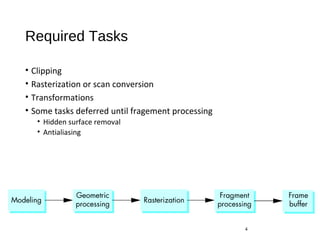
Required Tasks
• Clipping
• Rasterization or scan conversion
• Transformations
• Some tasks deferred until fragement processing
• Hidden surface removal
• Antialiasing
4
Rasterization Meta Algorithms
• Consider two approaches to rendering a scene with opaque objects
• For every pixel, determine which object that projects on the pixel is
closest to the viewer and compute the shade of this pixel
• Ray tracing paradigm
• For every object, determine which pixels it covers and shade these
pixels
• Pipeline approach
• Must keep track of depths
5
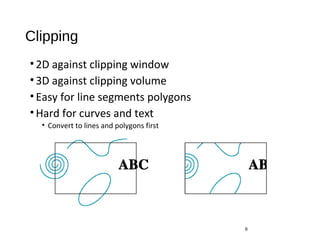
Clipping
•2D against clipping window
•3D against clipping volume
•Easy for line segments polygons
•Hard for curves and text
• Convert to lines and polygons first
6
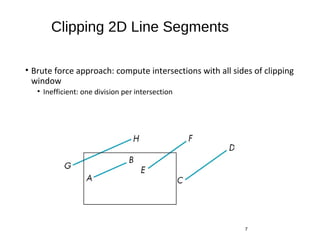
Clipping 2D Line Segments
• Brute force approach: compute intersections with all sides of clipping
window
• Inefficient: one division per intersection
7
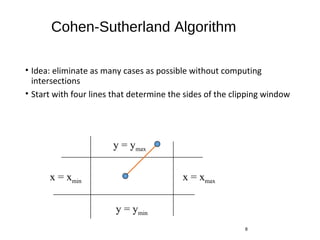
Cohen-Sutherland Algorithm
• Idea: eliminate as many cases as possible without computing
intersections
• Start with four lines that determine the sides of the clipping window
8
x = xmaxx = xmin
y = ymax
y = ymin
The Cases
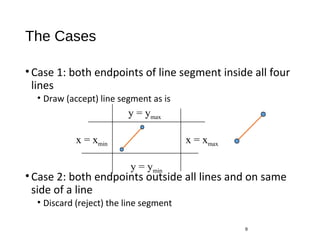
•Case 1: both endpoints of line segment inside all four
lines
• Draw (accept) line segment as is
•Case 2: both endpoints outside all lines and on same
side of a line
• Discard (reject) the line segment
9
x = xmaxx = xmin
y = ymax
y = ymin
The Cases
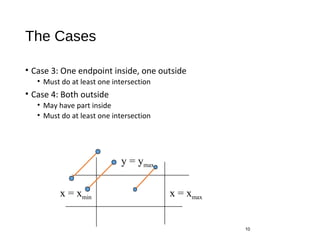
• Case 3: One endpoint inside, one outside
• Must do at least one intersection
• Case 4: Both outside
• May have part inside
• Must do at least one intersection
10
x = xmaxx = xmin
y = ymax
Defining Outcodes
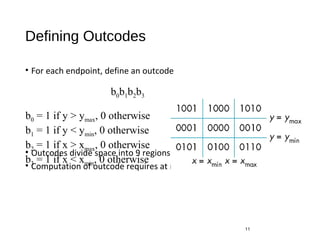
• For each endpoint, define an outcode
• Outcodes divide space into 9 regions
• Computation of outcode requires at most 4 subtractions
11
b0b1b2b3
b0 = 1 if y > ymax, 0 otherwise
b1 = 1 if y < ymin, 0 otherwise
b2 = 1 if x > xmax, 0 otherwise
b3 = 1 if x < xmin, 0 otherwise
Using Outcodes
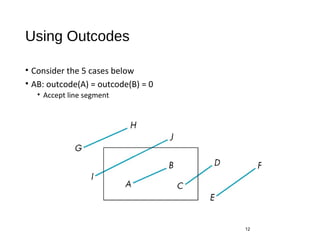
• Consider the 5 cases below
• AB: outcode(A) = outcode(B) = 0
• Accept line segment
12
Using Outcodes
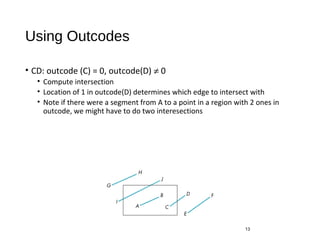
• CD: outcode (C) = 0, outcode(D) ≠ 0
• Compute intersection
• Location of 1 in outcode(D) determines which edge to intersect with
• Note if there were a segment from A to a point in a region with 2 ones in
outcode, we might have to do two interesections
13
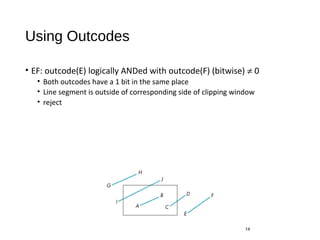
Using Outcodes
• EF: outcode(E) logically ANDed with outcode(F) (bitwise) ≠ 0
• Both outcodes have a 1 bit in the same place
• Line segment is outside of corresponding side of clipping window
• reject
14
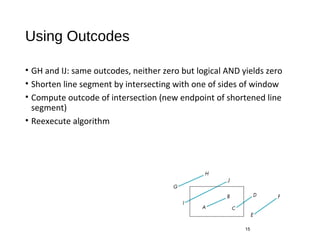
Using Outcodes
• GH and IJ: same outcodes, neither zero but logical AND yields zero
• Shorten line segment by intersecting with one of sides of window
• Compute outcode of intersection (new endpoint of shortened line
segment)
• Reexecute algorithm
15
Efficiency
• In many applications, the clipping window is small relative to the size
of the entire data base
• Most line segments are outside one or more side of the window and can be
eliminated based on their outcodes
• Inefficiency when code has to be reexecuted for line segments that
must be shortened in more than one step
16
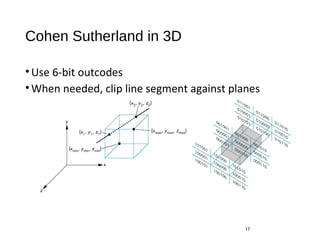
Cohen Sutherland in 3D
•Use 6-bit outcodes
•When needed, clip line segment against planes
17
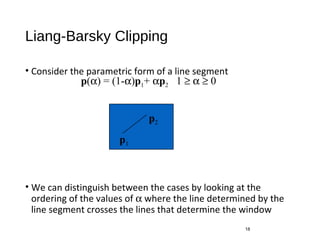
Liang-Barsky Clipping
• Consider the parametric form of a line segment
• We can distinguish between the cases by looking at the
ordering of the values of α where the line determined by the
line segment crosses the lines that determine the window
18
p(α) = (1-α)p1+ αp2 1 ≥ α ≥ 0
p1
p2
Liang-Barsky Clipping
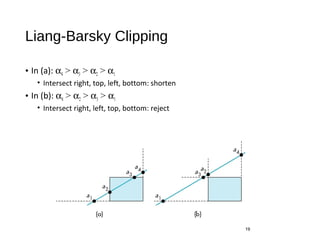
• In (a): α4 > α3 > α2 > α1
• Intersect right, top, left, bottom: shorten
• In (b): α4 > α2 > α3 > α1
• Intersect right, left, top, bottom: reject
19
Advantages
• Can accept/reject as easily as with Cohen-Sutherland
• Using values of α, we do not have to use algorithm recursively as
with C-S
• Extends to 3D
20
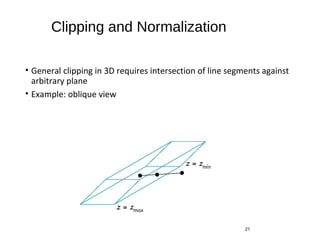
Clipping and Normalization
• General clipping in 3D requires intersection of line segments against
arbitrary plane
• Example: oblique view
21
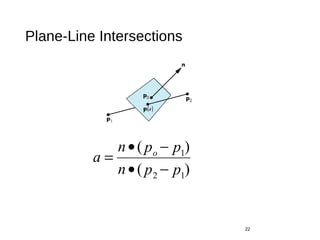
Plane-Line Intersections
22
)(
)(
12
1
ppn
ppn
a o
−•
−•
=
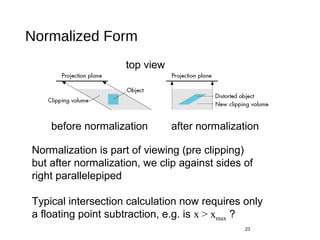
Normalized Form
23
before normalization after normalization
Normalization is part of viewing (pre clipping)
but after normalization, we clip against sides of
right parallelepiped
Typical intersection calculation now requires only
a floating point subtraction, e.g. is x > xmax ?
top view

Implementation

  • 1.
  • 2.
    Objectives • Introduce basicimplementation strategies • Clipping • Scan conversion 2
  • 3.
    Overview • At endof the geometric pipeline, vertices have been assembled into primitives • Must clip out primitives that are outside the view frustum • Algorithms based on representing primitives by lists of vertices • Must find which pixels can be affected by each primitive • Fragment generation • Rasterization or scan conversion 3
  • 4.
    Required Tasks • Clipping •Rasterization or scan conversion • Transformations • Some tasks deferred until fragement processing • Hidden surface removal • Antialiasing 4
  • 5.
    Rasterization Meta Algorithms •Consider two approaches to rendering a scene with opaque objects • For every pixel, determine which object that projects on the pixel is closest to the viewer and compute the shade of this pixel • Ray tracing paradigm • For every object, determine which pixels it covers and shade these pixels • Pipeline approach • Must keep track of depths 5
  • 6.
    Clipping •2D against clippingwindow •3D against clipping volume •Easy for line segments polygons •Hard for curves and text • Convert to lines and polygons first 6
  • 7.
    Clipping 2D LineSegments • Brute force approach: compute intersections with all sides of clipping window • Inefficient: one division per intersection 7
  • 8.
    Cohen-Sutherland Algorithm • Idea:eliminate as many cases as possible without computing intersections • Start with four lines that determine the sides of the clipping window 8 x = xmaxx = xmin y = ymax y = ymin
  • 9.
    The Cases •Case 1:both endpoints of line segment inside all four lines • Draw (accept) line segment as is •Case 2: both endpoints outside all lines and on same side of a line • Discard (reject) the line segment 9 x = xmaxx = xmin y = ymax y = ymin
  • 10.
    The Cases • Case3: One endpoint inside, one outside • Must do at least one intersection • Case 4: Both outside • May have part inside • Must do at least one intersection 10 x = xmaxx = xmin y = ymax
  • 11.
    Defining Outcodes • Foreach endpoint, define an outcode • Outcodes divide space into 9 regions • Computation of outcode requires at most 4 subtractions 11 b0b1b2b3 b0 = 1 if y > ymax, 0 otherwise b1 = 1 if y < ymin, 0 otherwise b2 = 1 if x > xmax, 0 otherwise b3 = 1 if x < xmin, 0 otherwise
  • 12.
    Using Outcodes • Considerthe 5 cases below • AB: outcode(A) = outcode(B) = 0 • Accept line segment 12
  • 13.
    Using Outcodes • CD:outcode (C) = 0, outcode(D) ≠ 0 • Compute intersection • Location of 1 in outcode(D) determines which edge to intersect with • Note if there were a segment from A to a point in a region with 2 ones in outcode, we might have to do two interesections 13
  • 14.
    Using Outcodes • EF:outcode(E) logically ANDed with outcode(F) (bitwise) ≠ 0 • Both outcodes have a 1 bit in the same place • Line segment is outside of corresponding side of clipping window • reject 14
  • 15.
    Using Outcodes • GHand IJ: same outcodes, neither zero but logical AND yields zero • Shorten line segment by intersecting with one of sides of window • Compute outcode of intersection (new endpoint of shortened line segment) • Reexecute algorithm 15
  • 16.
    Efficiency • In manyapplications, the clipping window is small relative to the size of the entire data base • Most line segments are outside one or more side of the window and can be eliminated based on their outcodes • Inefficiency when code has to be reexecuted for line segments that must be shortened in more than one step 16
  • 17.
    Cohen Sutherland in3D •Use 6-bit outcodes •When needed, clip line segment against planes 17
  • 18.
    Liang-Barsky Clipping • Considerthe parametric form of a line segment • We can distinguish between the cases by looking at the ordering of the values of α where the line determined by the line segment crosses the lines that determine the window 18 p(α) = (1-α)p1+ αp2 1 ≥ α ≥ 0 p1 p2
  • 19.
    Liang-Barsky Clipping • In(a): α4 > α3 > α2 > α1 • Intersect right, top, left, bottom: shorten • In (b): α4 > α2 > α3 > α1 • Intersect right, left, top, bottom: reject 19
  • 20.
    Advantages • Can accept/rejectas easily as with Cohen-Sutherland • Using values of α, we do not have to use algorithm recursively as with C-S • Extends to 3D 20
  • 21.
    Clipping and Normalization •General clipping in 3D requires intersection of line segments against arbitrary plane • Example: oblique view 21
  • 22.
  • 23.
    Normalized Form 23 before normalizationafter normalization Normalization is part of viewing (pre clipping) but after normalization, we clip against sides of right parallelepiped Typical intersection calculation now requires only a floating point subtraction, e.g. is x > xmax ? top view