SEMINAR ON
Radiation distribution and utilization by
plant communities.
Course:– Master seminar
Course no:- AGM-591
Presented by:
KHILESH KUMAR
SAHU
Department of Agrometeorology
College of Agriculture Raipur (Chhattisgarh)
Content
 Introduction
 Radiation distribution in plant community
Reflection, Transmission and Absorption of solar radiation
 Measurement of radiation distribution in plant community
 Factors affecting radiation distribution within plant community
 Spectral composition of radiation in a plant canopy
 Efficiency of solar radiation utilization
Conclusion
Solar radiation
 Solar radiation is the source of energy for all the physical process
in the atmosphere and physiological process in the plant.
 Crop production is the exploitation of solar radiation. Quality,
duration and intensity of solar radiation influence plant processes
and development to varying degrees in various plants.
Introduction
Radiation distribution in crop canopy
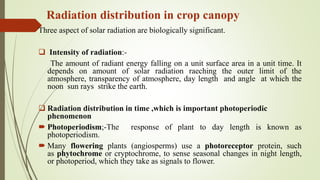
Three aspect of solar radiation are biologically significant.
 Intensity of radiation:-
The amount of radiant energy falling on a unit surface area in a unit time. It
depends on amount of solar radiation raeching the outer limit of the
atmosphere, transparency of atmosphere, day length and angle at which the
noon sun rays strike the earth.
 Radiation distribution in time ,which is important photoperiodic
phenomenon
 Photoperiodism;-The response of plant to day length is known as
photoperiodism.
 Many flowering plants (angiosperms) use a photoreceptor protein, such
as phytochrome or cryptochrome, to sense seasonal changes in night length,
or photoperiod, which they take as signals to flower.
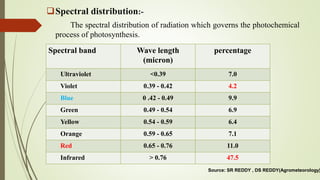
Spectral distribution:-
The spectral distribution of radiation which governs the photochemical
process of photosynthesis.
Spectral band Wave length
(micron)
percentage
Ultraviolet <0.39 7.0
Violet 0.39 - 0.42 4.2
Blue 0 .42 - 0.49 9.9
Green 0.49 - 0.54 6.9
Yellow 0.54 - 0.59 6.4
Orange 0.59 - 0.65 7.1
Red 0.65 - 0.76 11.0
Infrared > 0.76 47.5
Source: SR REDDY , DS REDDY(Agrometeorology)
Reflection, Transmission and Absorption of
radiation
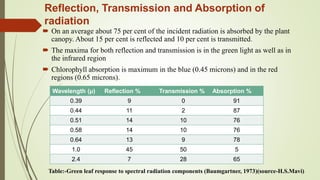
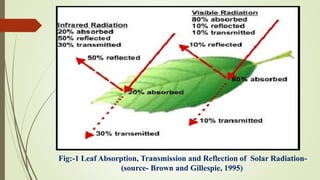
 On an average about 75 per cent of the incident radiation is absorbed by the plant
canopy. About 15 per cent is reflected and 10 per cent is transmitted.
 The maxima for both reflection and transmission is in the green light as well as in
the infrared region
 Chlorophyll absorption is maximum in the blue (0.45 microns) and in the red
regions (0.65 microns).
Wavelength (μ) Reflection % Transmission % Absorption %
0.39 9 0 91
0.44 11 2 87
0.51 14 10 76
0.58 14 10 76
0.64 13 9 78
1.0 45 50 5
2.4 7 28 65
Table:-Green leaf response to spectral radiation components (Baumgartner, 1973)(source-H.S.Mavi)
Fig:-1 Leaf Absorption, Transmission and Reflection of Solar Radiation-
(source- Brown and Gillespie, 1995)
Measurement of radiation distribution in a plant
Several investigation have been made to determine the radiation and light
profile in a plant canopy and several equation have been put forward to
determine the light at a particular height in a canopy .
 Beer’s law
 Monteith’s equation
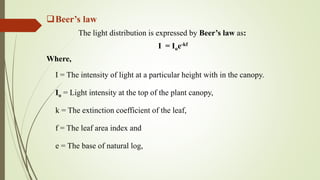
Beer’s law
The light distribution is expressed by Beer’s law as:
I = Ioe-kf
Where,
I = The intensity of light at a particular height with in the canopy.
Io = Light intensity at the top of the plant canopy,
k = The extinction coefficient of the leaf,
f = The leaf area index and
e = The base of natural log,
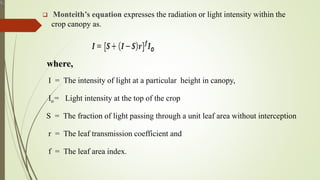
 Monteith’s equation expresses the radiation or light intensity within the
crop canopy as.
where,
I = The intensity of light at a particular height in canopy,
Io= Light intensity at the top of the crop
S = The fraction of light passing through a unit leaf area without interception
r = The leaf transmission coefficient and
f = The leaf area index.
,
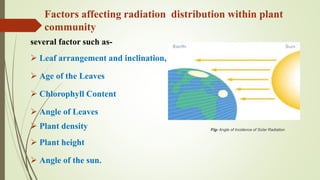
Factors affecting radiation distribution within plant
community
several factor such as-
 Leaf arrangement and inclination,
 Age of the Leaves
 Chlorophyll Content
 Angle of Leaves
 Plant density
 Plant height
 Angle of the sun.
Fig- Angle of Incidence of Solar Radiation
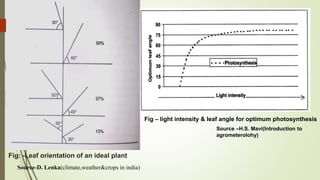
Fig: -Leaf orientation of an ideal plant
Fig – light intensity & leaf angle for optimum photosynthesis
Source –H.S. Mavi(Introduction to
agrometerolohy)
Source-D. Lenka(climate,weather&crops in india)
Spectral composition of radiation in a plant canopy
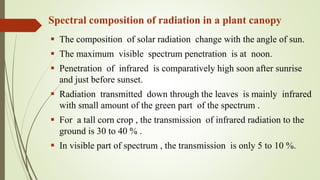
 The composition of solar radiation change with the angle of sun.
 The maximum visible spectrum penetration is at noon.
 Penetration of infrared is comparatively high soon after sunrise
and just before sunset.
 Radiation transmitted down through the leaves is mainly infrared
with small amount of the green part of the spectrum .
 For a tall corn crop , the transmission of infrared radiation to the
ground is 30 to 40 % .
 In visible part of spectrum , the transmission is only 5 to 10 %.
Efficiency of solar radiation utilization
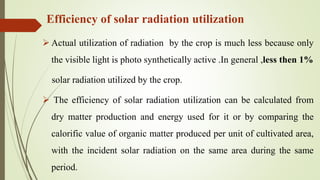
 Actual utilization of radiation by the crop is much less because only
the visible light is photo synthetically active .In general ,less then 1%
solar radiation utilized by the crop.
 The efficiency of solar radiation utilization can be calculated from
dry matter production and energy used for it or by comparing the
calorific value of organic matter produced per unit of cultivated area,
with the incident solar radiation on the same area during the same
period.
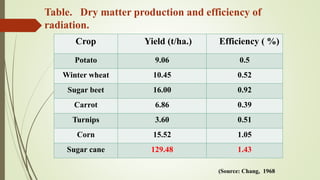
Table. Dry matter production and efficiency of
radiation.
Crop Yield (t/ha.) Efficiency ( %)
Potato 9.06 0.5
Winter wheat 10.45 0.52
Sugar beet 16.00 0.92
Carrot 6.86 0.39
Turnips 3.60 0.51
Corn 15.52 1.05
Sugar cane 129.48 1.43
(Source: Chang, 1968
Conclusion
 Solar radiations are required for the physiological function i.e. seed
germination, leaf expansion, flowering, fruiting and thermal conditions of
the plant.
 The determination of intensity and spectral distribution of radiation with in
crop canopies is an important problem in agro meteorology because of its
control on the photosynthetic process and on the microclimate of the plant
community.
 Interception of solar radiation by terrestrial system and its modification
determines weather and climate.
Radiation distribution and utilization by plant communities

Radiation distribution and utilization by plant communities

  • 1.
    SEMINAR ON Radiation distributionand utilization by plant communities. Course:– Master seminar Course no:- AGM-591 Presented by: KHILESH KUMAR SAHU Department of Agrometeorology College of Agriculture Raipur (Chhattisgarh)
  • 2.
    Content  Introduction  Radiationdistribution in plant community Reflection, Transmission and Absorption of solar radiation  Measurement of radiation distribution in plant community  Factors affecting radiation distribution within plant community  Spectral composition of radiation in a plant canopy  Efficiency of solar radiation utilization Conclusion
  • 3.
    Solar radiation  Solarradiation is the source of energy for all the physical process in the atmosphere and physiological process in the plant.  Crop production is the exploitation of solar radiation. Quality, duration and intensity of solar radiation influence plant processes and development to varying degrees in various plants. Introduction
  • 4.
    Radiation distribution incrop canopy Three aspect of solar radiation are biologically significant.  Intensity of radiation:- The amount of radiant energy falling on a unit surface area in a unit time. It depends on amount of solar radiation raeching the outer limit of the atmosphere, transparency of atmosphere, day length and angle at which the noon sun rays strike the earth.  Radiation distribution in time ,which is important photoperiodic phenomenon  Photoperiodism;-The response of plant to day length is known as photoperiodism.  Many flowering plants (angiosperms) use a photoreceptor protein, such as phytochrome or cryptochrome, to sense seasonal changes in night length, or photoperiod, which they take as signals to flower.
  • 5.
    Spectral distribution:- The spectraldistribution of radiation which governs the photochemical process of photosynthesis. Spectral band Wave length (micron) percentage Ultraviolet <0.39 7.0 Violet 0.39 - 0.42 4.2 Blue 0 .42 - 0.49 9.9 Green 0.49 - 0.54 6.9 Yellow 0.54 - 0.59 6.4 Orange 0.59 - 0.65 7.1 Red 0.65 - 0.76 11.0 Infrared > 0.76 47.5 Source: SR REDDY , DS REDDY(Agrometeorology)
  • 6.
    Reflection, Transmission andAbsorption of radiation  On an average about 75 per cent of the incident radiation is absorbed by the plant canopy. About 15 per cent is reflected and 10 per cent is transmitted.  The maxima for both reflection and transmission is in the green light as well as in the infrared region  Chlorophyll absorption is maximum in the blue (0.45 microns) and in the red regions (0.65 microns). Wavelength (μ) Reflection % Transmission % Absorption % 0.39 9 0 91 0.44 11 2 87 0.51 14 10 76 0.58 14 10 76 0.64 13 9 78 1.0 45 50 5 2.4 7 28 65 Table:-Green leaf response to spectral radiation components (Baumgartner, 1973)(source-H.S.Mavi)
  • 7.
    Fig:-1 Leaf Absorption,Transmission and Reflection of Solar Radiation- (source- Brown and Gillespie, 1995)
  • 8.
    Measurement of radiationdistribution in a plant Several investigation have been made to determine the radiation and light profile in a plant canopy and several equation have been put forward to determine the light at a particular height in a canopy .  Beer’s law  Monteith’s equation
  • 9.
    Beer’s law The lightdistribution is expressed by Beer’s law as: I = Ioe-kf Where, I = The intensity of light at a particular height with in the canopy. Io = Light intensity at the top of the plant canopy, k = The extinction coefficient of the leaf, f = The leaf area index and e = The base of natural log,
  • 10.
     Monteith’s equationexpresses the radiation or light intensity within the crop canopy as. where, I = The intensity of light at a particular height in canopy, Io= Light intensity at the top of the crop S = The fraction of light passing through a unit leaf area without interception r = The leaf transmission coefficient and f = The leaf area index. ,
  • 11.
    Factors affecting radiationdistribution within plant community several factor such as-  Leaf arrangement and inclination,  Age of the Leaves  Chlorophyll Content  Angle of Leaves  Plant density  Plant height  Angle of the sun. Fig- Angle of Incidence of Solar Radiation
  • 12.
    Fig: -Leaf orientationof an ideal plant Fig – light intensity & leaf angle for optimum photosynthesis Source –H.S. Mavi(Introduction to agrometerolohy) Source-D. Lenka(climate,weather&crops in india)
  • 13.
    Spectral composition ofradiation in a plant canopy  The composition of solar radiation change with the angle of sun.  The maximum visible spectrum penetration is at noon.  Penetration of infrared is comparatively high soon after sunrise and just before sunset.  Radiation transmitted down through the leaves is mainly infrared with small amount of the green part of the spectrum .  For a tall corn crop , the transmission of infrared radiation to the ground is 30 to 40 % .  In visible part of spectrum , the transmission is only 5 to 10 %.
  • 14.
    Efficiency of solarradiation utilization  Actual utilization of radiation by the crop is much less because only the visible light is photo synthetically active .In general ,less then 1% solar radiation utilized by the crop.  The efficiency of solar radiation utilization can be calculated from dry matter production and energy used for it or by comparing the calorific value of organic matter produced per unit of cultivated area, with the incident solar radiation on the same area during the same period.
  • 15.
    Table. Dry matterproduction and efficiency of radiation. Crop Yield (t/ha.) Efficiency ( %) Potato 9.06 0.5 Winter wheat 10.45 0.52 Sugar beet 16.00 0.92 Carrot 6.86 0.39 Turnips 3.60 0.51 Corn 15.52 1.05 Sugar cane 129.48 1.43 (Source: Chang, 1968
  • 16.
    Conclusion  Solar radiationsare required for the physiological function i.e. seed germination, leaf expansion, flowering, fruiting and thermal conditions of the plant.  The determination of intensity and spectral distribution of radiation with in crop canopies is an important problem in agro meteorology because of its control on the photosynthetic process and on the microclimate of the plant community.  Interception of solar radiation by terrestrial system and its modification determines weather and climate.