Abhishek Das 09ABT/15
Oxygenic photosynthesis is written as follows:
6CO2 + 12H2O + Light Energy → C6H12O6 + 6O2 + 6H2O
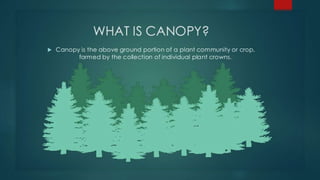
INTRODUCTION
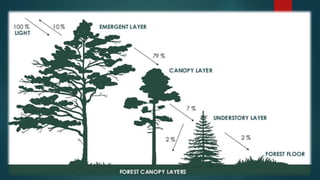
 A plant canopy consists of an assemblage of
plants with leaves that possess a particular spatial
distribution and assortment of angle orientations (de Wit, 1965;
Monsi et al., 1973).
 How a collection of leaves intercepts sunlight and uses light
energy to assimilate CO2 is the basis of canopy
photosynthesis.
 The major factors affecting canopy photosynthesis, through
light interception, include the angular relationship between
leaves and Earth-sun geometry and the leaves' vertical and
horizontal positions.
FACTORS AFFECTING CANOPY PHOTOSYNTHESIS
a) Sunlight
b) Leaf architecture
c) Wind
d) Temperature
e) Vapor pressure deficit
f) Leaf nitrogen
g) Water relations
h) Season
►Leaf photosynthesis is a hyperbolic function of
sunlight.
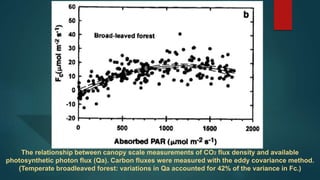
►Many micrometeorological studies shows that canopy
CO2 exchange rates (F) are a quasilinear function of absorbed
sunlight.
►This quasilinear response tends to be associated with closed, well-
watered crop canopies or with data averaged over the course of a day.
►Forests and sparse vegetation, on the other hand, experience a
markedly nonlinear response between Fc and absorbed sunlight
a) Sunlight
The relationship between canopy scale measurements of CO2 flux density and available
photosynthetic photon flux (Qa). Carbon fluxes were measured with the eddy covariance method.
(Temperate broadleaved forest: variations in Qa accounted for 42% of the variance in Fc.)
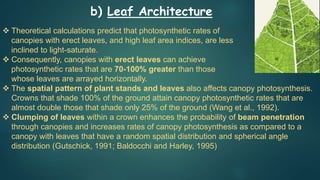
 Theoretical calculations predict that photosynthetic rates of
canopies with erect leaves, and high leaf area indices, are less
inclined to light-saturate.
 Consequently, canopies with erect leaves can achieve
photosynthetic rates that are 70-100% greater than those
whose leaves are arrayed horizontally.
 The spatial pattern of plant stands and leaves also affects canopy photosynthesis.
Crowns that shade 100% of the ground attain canopy photosynthetic rates that are
almost double those that shade only 25% of the ground (Wang et al., 1992).
 Clumping of leaves within a crown enhances the probability of beam penetration
through canopies and increases rates of canopy photosynthesis as compared to a
canopy with leaves that have a random spatial distribution and spherical angle
distribution (Gutschick, 1991; Baldocchi and Harley, 1995)
b) Leaf Architecture
 Studies report a positive correlation
between CO2 fluxes and wind speed,
whereas others indicate no significant
relationship between these two variables.
 Lemon (1960) and Uchijima (1976), for example, conclude that
photosynthesis is limited on sunny days when wind speeds
are low because a lack of turbulence limits the CO2 supply to
the crop (derived from the aerodynamic method.)
 The theoretical calculations (Baldocchi, 1993) suggest that
turbulent mixing supplies adequate amounts of CO2 to a crop
during the day.
c) Wind
d) Temperature
 The response of canopy CO2 exchange rates to temp. is
parabolic. The temp. optimum of canopy CO2 exchange rates
of many crops and forests growing in temperate continental climates, under full sunlight,
is on the order of 20-30ºC.
 The temperature optimum, however is very plastic, it can vary with species,
ecotype, site, and time of year (Stenberg et al., 1995).
 In general, leaf photosynthesis decreases markedly at leaf temperatures exceeding
37ºC This diminution occurs from a decrease in membrane stability.
 The zero crossing for canopy CO2 exchange occurs in the range between 30 & 35~
(Jeffers and Shibles, 1969; Baldocchi, 1997).
 Freezing reduces subsequent photosynthetic capacity appreciably.
 Low soil temperatures can also reduce photosynthesis through effects on water
balance and stomatal conductance (Stenberg et al., 1995).
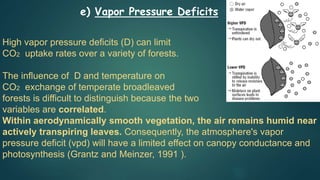
High vapor pressure deficits (D) can limit
CO2 uptake rates over a variety of forests.
The influence of D and temperature on
CO2 exchange of temperate broadleaved
forests is difficult to distinguish because the two
variables are correlated.
Within aerodynamically smooth vegetation, the air remains humid near
actively transpiring leaves. Consequently, the atmosphere's vapor
pressure deficit (vpd) will have a limited effect on canopy conductance and
photosynthesis (Grantz and Meinzer, 1991 ).
e) Vapor Pressure Deficits
In the past decade, many investigators have reported that photosynthetic
capacity varies with depth in a canopy (Field, 1991; Hollinger, 1996).
Chen et al., (1993) suggest that plants either distribute leaf nitrogen
optimally through the canopy or they coordinate the vertical distribution of N
to maintain a balance between Wc (rate of carboxylation) and Wj
(carboxylation rate when RuBP regeneration is limited by electron
transport).
In either case, the photosynthetic rates of plant stands that distribute leaf
nitrogen with depth exceed those of canopies that distribute N uniformly.
f) Leaf Nitrogen
g) Water Relations
Soil moisture deficits impact the magnitude and the diurnal course of
canopy-scale CO2 exchange rates (Biscoe et al., 1975).
When plants are exposed to cool and humid air and adequate soil moisture,
the diurnal pattern of canopy CO 2 exchange rates is single peaked
and the maximum occurs near midday.
For plants suffering from modest soil moisture deficits, peak rates of CO2 uptake occur in the morning.
Double-peaked patterns of daily photosynthesis tend to occur when the air is hot (Tair> 30º c and dry (vpd
> 3 kPa) or when leaf temperature exceeds the optimum for photosynthesis
These conditions cause midday stomatal closure, promote dark and photorespiration, and suppress
photosynthesis (Schulze, 1986).
Typically, reductions in canopy photosynthesis during periods of soil moisture deficit's are associated with
stomatal closure. However, it must be remembered that drought and high-temperature stress often co-
occur. Hence, enhanced respiration, during these periods, will also limit canopy CO2 uptake rates
(Baldocchi, 1997).
Photosynthetic rates of plant systems vary over
the course of the growing season as
photosynthetic capacity, the availability of solar
radiation & soil moisture, & air & soil temp. vary.
Leaf form (needle, broadleaf), leaf habit (evergreen, deciduous),
and latitude also affect the seasonal pattern of CO 2 exchange.
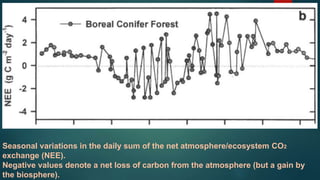
It shows that broadleaved forest canopies lose carbon when the
canopy is dormant.
During springtime leaf expansion the direction and magnitude of
carbon fluxes switch rapidly as forests change from losing 1-3 g C
m -2 d-1 ] to gaining 5-10 g C m -2 d-1.
h) Season
Seasonal variations in the daily sum of the net atmosphere/ecosystem CO2
exchange (NEE).
Negative values denote a net loss of carbon from the atmosphere (but a gain by
the biosphere).
Canopy Photosynthesis In The Future
o The most frequently mentioned factor is increasing atmospheric CO2
concentration. In C3 leaves, future elevated CO2 will stimulate photosynthesis
and at the same time inhibit photorespiration.
o A second important environmental change is the land-surface warming expected
to accompany further increases in atmospheric CO2. In the short term, warming
can alter several of the component processes of leaf and canopy
photosynthesis.
o Increasing atmospheric N deposition is a third environmental change that might
affect future photosynthesis.
o Changes in tropospheric pollutant levels may also affect future photosynthesis
in several ecosystems. For example, an increase in levels of the regional air
pollutant O3 might damage leaves and reduce canopy photosynthesis.
References
Baldocchi, D. D., and Harley, P. C. (1995). Scaling carbon dioxide and water vapor
exchange from leaf to canopy in a deciduous forest: model testing and
application. Plant Cell Environ. 18, 1157-1173.
Duncan, W. G., Loomis, R. S., Williams, W. A., and Hanau, R. (1967). A model for
simulating photosynthesis in plant communities. Hilgardia 38, 181-205.
Jarvis, E G.,James, G. B., and Landsberg,J.J. (1976). Coniferous forest. In
"Vegetation and the Atmosphere, Vol. 2" (J. L. Monteith, ed.), pp. 171-240.
Academic Press, London.
Kim, J., and Verma, S. B. (1991). Modeling canopy photosynthesis: scaling up
from a leaf to canopy in a temperate grassland ecosystem. Agric. For. Meteorol.
57, 187-208.
Raupach, M. R. (1988). Canopy transport processes. In "Flow and Transport in
the Natural Environment“ (W. L. Steffen and O. T. Denmead, eds.). Springer-
Verlag, Berlin.
CANOPY PHOTOSYNTHESIS  & FACTOR AFFECTING PHOTOSYNTHESIS

CANOPY PHOTOSYNTHESIS & FACTOR AFFECTING PHOTOSYNTHESIS

  • 1.
  • 3.
    Oxygenic photosynthesis iswritten as follows: 6CO2 + 12H2O + Light Energy → C6H12O6 + 6O2 + 6H2O
  • 4.
    INTRODUCTION  A plantcanopy consists of an assemblage of plants with leaves that possess a particular spatial distribution and assortment of angle orientations (de Wit, 1965; Monsi et al., 1973).  How a collection of leaves intercepts sunlight and uses light energy to assimilate CO2 is the basis of canopy photosynthesis.  The major factors affecting canopy photosynthesis, through light interception, include the angular relationship between leaves and Earth-sun geometry and the leaves' vertical and horizontal positions.
  • 5.
    FACTORS AFFECTING CANOPYPHOTOSYNTHESIS a) Sunlight b) Leaf architecture c) Wind d) Temperature e) Vapor pressure deficit f) Leaf nitrogen g) Water relations h) Season
  • 8.
    ►Leaf photosynthesis isa hyperbolic function of sunlight. ►Many micrometeorological studies shows that canopy CO2 exchange rates (F) are a quasilinear function of absorbed sunlight. ►This quasilinear response tends to be associated with closed, well- watered crop canopies or with data averaged over the course of a day. ►Forests and sparse vegetation, on the other hand, experience a markedly nonlinear response between Fc and absorbed sunlight a) Sunlight
  • 9.
    The relationship betweencanopy scale measurements of CO2 flux density and available photosynthetic photon flux (Qa). Carbon fluxes were measured with the eddy covariance method. (Temperate broadleaved forest: variations in Qa accounted for 42% of the variance in Fc.)
  • 10.
     Theoretical calculationspredict that photosynthetic rates of canopies with erect leaves, and high leaf area indices, are less inclined to light-saturate.  Consequently, canopies with erect leaves can achieve photosynthetic rates that are 70-100% greater than those whose leaves are arrayed horizontally.  The spatial pattern of plant stands and leaves also affects canopy photosynthesis. Crowns that shade 100% of the ground attain canopy photosynthetic rates that are almost double those that shade only 25% of the ground (Wang et al., 1992).  Clumping of leaves within a crown enhances the probability of beam penetration through canopies and increases rates of canopy photosynthesis as compared to a canopy with leaves that have a random spatial distribution and spherical angle distribution (Gutschick, 1991; Baldocchi and Harley, 1995) b) Leaf Architecture
  • 11.
     Studies reporta positive correlation between CO2 fluxes and wind speed, whereas others indicate no significant relationship between these two variables.  Lemon (1960) and Uchijima (1976), for example, conclude that photosynthesis is limited on sunny days when wind speeds are low because a lack of turbulence limits the CO2 supply to the crop (derived from the aerodynamic method.)  The theoretical calculations (Baldocchi, 1993) suggest that turbulent mixing supplies adequate amounts of CO2 to a crop during the day. c) Wind
  • 12.
    d) Temperature  Theresponse of canopy CO2 exchange rates to temp. is parabolic. The temp. optimum of canopy CO2 exchange rates of many crops and forests growing in temperate continental climates, under full sunlight, is on the order of 20-30ºC.  The temperature optimum, however is very plastic, it can vary with species, ecotype, site, and time of year (Stenberg et al., 1995).  In general, leaf photosynthesis decreases markedly at leaf temperatures exceeding 37ºC This diminution occurs from a decrease in membrane stability.  The zero crossing for canopy CO2 exchange occurs in the range between 30 & 35~ (Jeffers and Shibles, 1969; Baldocchi, 1997).  Freezing reduces subsequent photosynthetic capacity appreciably.  Low soil temperatures can also reduce photosynthesis through effects on water balance and stomatal conductance (Stenberg et al., 1995).
  • 13.
    High vapor pressuredeficits (D) can limit CO2 uptake rates over a variety of forests. The influence of D and temperature on CO2 exchange of temperate broadleaved forests is difficult to distinguish because the two variables are correlated. Within aerodynamically smooth vegetation, the air remains humid near actively transpiring leaves. Consequently, the atmosphere's vapor pressure deficit (vpd) will have a limited effect on canopy conductance and photosynthesis (Grantz and Meinzer, 1991 ). e) Vapor Pressure Deficits
  • 14.
    In the pastdecade, many investigators have reported that photosynthetic capacity varies with depth in a canopy (Field, 1991; Hollinger, 1996). Chen et al., (1993) suggest that plants either distribute leaf nitrogen optimally through the canopy or they coordinate the vertical distribution of N to maintain a balance between Wc (rate of carboxylation) and Wj (carboxylation rate when RuBP regeneration is limited by electron transport). In either case, the photosynthetic rates of plant stands that distribute leaf nitrogen with depth exceed those of canopies that distribute N uniformly. f) Leaf Nitrogen
  • 15.
    g) Water Relations Soilmoisture deficits impact the magnitude and the diurnal course of canopy-scale CO2 exchange rates (Biscoe et al., 1975). When plants are exposed to cool and humid air and adequate soil moisture, the diurnal pattern of canopy CO 2 exchange rates is single peaked and the maximum occurs near midday. For plants suffering from modest soil moisture deficits, peak rates of CO2 uptake occur in the morning. Double-peaked patterns of daily photosynthesis tend to occur when the air is hot (Tair> 30º c and dry (vpd > 3 kPa) or when leaf temperature exceeds the optimum for photosynthesis These conditions cause midday stomatal closure, promote dark and photorespiration, and suppress photosynthesis (Schulze, 1986). Typically, reductions in canopy photosynthesis during periods of soil moisture deficit's are associated with stomatal closure. However, it must be remembered that drought and high-temperature stress often co- occur. Hence, enhanced respiration, during these periods, will also limit canopy CO2 uptake rates (Baldocchi, 1997).
  • 16.
    Photosynthetic rates ofplant systems vary over the course of the growing season as photosynthetic capacity, the availability of solar radiation & soil moisture, & air & soil temp. vary. Leaf form (needle, broadleaf), leaf habit (evergreen, deciduous), and latitude also affect the seasonal pattern of CO 2 exchange. It shows that broadleaved forest canopies lose carbon when the canopy is dormant. During springtime leaf expansion the direction and magnitude of carbon fluxes switch rapidly as forests change from losing 1-3 g C m -2 d-1 ] to gaining 5-10 g C m -2 d-1. h) Season
  • 17.
    Seasonal variations inthe daily sum of the net atmosphere/ecosystem CO2 exchange (NEE). Negative values denote a net loss of carbon from the atmosphere (but a gain by the biosphere).
  • 18.
    Canopy Photosynthesis InThe Future o The most frequently mentioned factor is increasing atmospheric CO2 concentration. In C3 leaves, future elevated CO2 will stimulate photosynthesis and at the same time inhibit photorespiration. o A second important environmental change is the land-surface warming expected to accompany further increases in atmospheric CO2. In the short term, warming can alter several of the component processes of leaf and canopy photosynthesis. o Increasing atmospheric N deposition is a third environmental change that might affect future photosynthesis. o Changes in tropospheric pollutant levels may also affect future photosynthesis in several ecosystems. For example, an increase in levels of the regional air pollutant O3 might damage leaves and reduce canopy photosynthesis.
  • 19.
    References Baldocchi, D. D.,and Harley, P. C. (1995). Scaling carbon dioxide and water vapor exchange from leaf to canopy in a deciduous forest: model testing and application. Plant Cell Environ. 18, 1157-1173. Duncan, W. G., Loomis, R. S., Williams, W. A., and Hanau, R. (1967). A model for simulating photosynthesis in plant communities. Hilgardia 38, 181-205. Jarvis, E G.,James, G. B., and Landsberg,J.J. (1976). Coniferous forest. In "Vegetation and the Atmosphere, Vol. 2" (J. L. Monteith, ed.), pp. 171-240. Academic Press, London. Kim, J., and Verma, S. B. (1991). Modeling canopy photosynthesis: scaling up from a leaf to canopy in a temperate grassland ecosystem. Agric. For. Meteorol. 57, 187-208. Raupach, M. R. (1988). Canopy transport processes. In "Flow and Transport in the Natural Environment“ (W. L. Steffen and O. T. Denmead, eds.). Springer- Verlag, Berlin.