Unit II Seasons and System of farming
Dr. S. Marimuthu., Ph.D.
Asst. Professor (AGR)
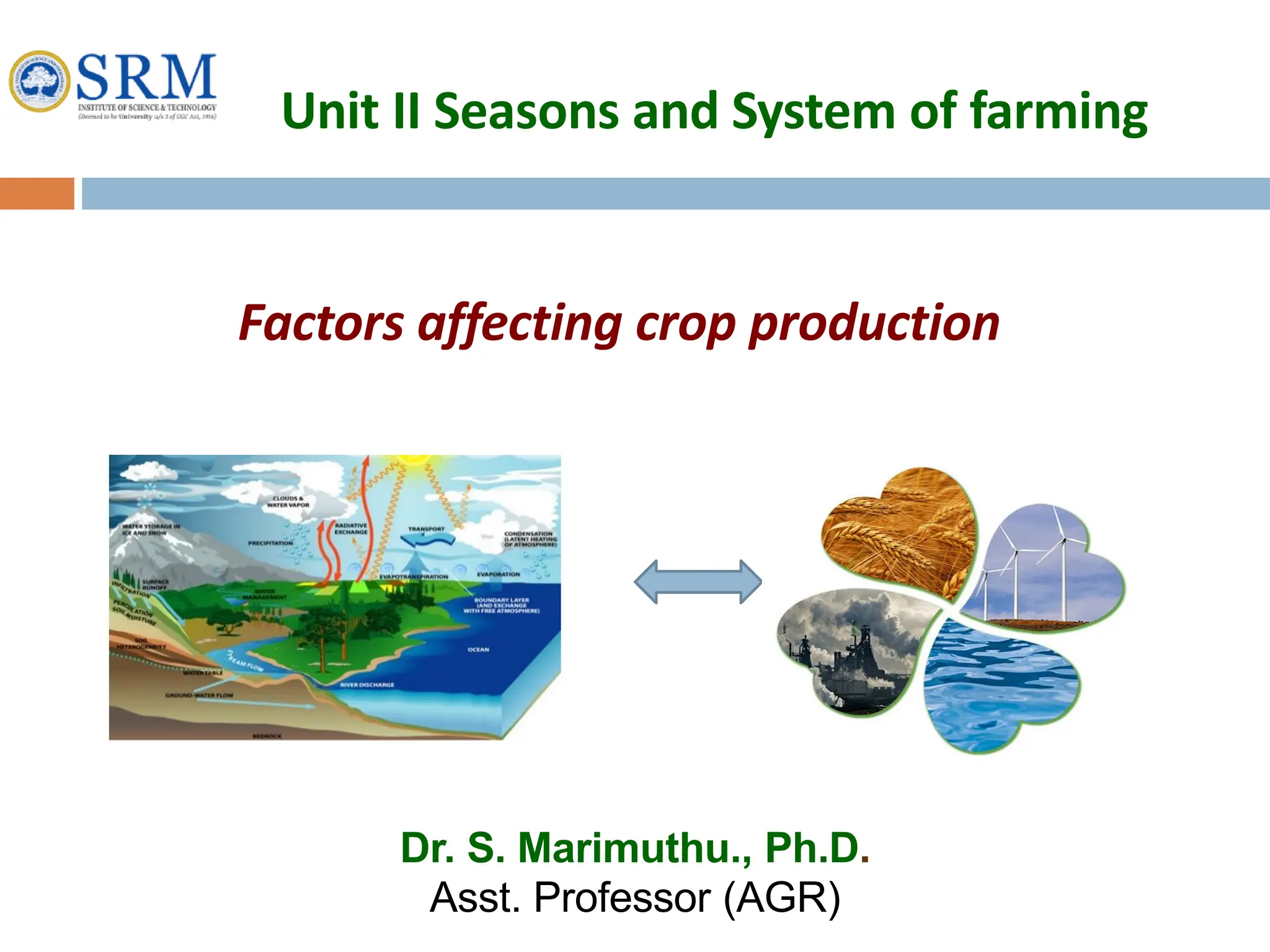
Factors affecting crop production
Factors
• A circumstance, fact, or influence that contributes to a result
Factors affecting crop production
Crop level Production system level
Y= G+E (G x E)
Where,
• Y= Yield
• G= Genotype
• E= Environment
• G x E= Interaction
Factors affecting crop production
• Internal Factors
• Climatic
• Edaphic (soil)
• Biotic
• Physiographic (Slope)
• Socioeconomic or
Anthropic (Man)
• External Factor
(Environmental)
• Genetic factors
Internal factors - Genetic factors
• High yielding ability
• Early maturity
• Resistance to lodging
• Drought, flood and salinity tolerance
• Tolerance to insect pests and diseases
• Chemical composition of grains (oil
content, protein content )
• Quality of grains (fineness, coarseness)
• Quality of straw (sweetness, juiciness)
Genetic
make up
External factors – Environmental factor
• Plant growth and development - To governed by
soil and climate
• Success or failure - Prevailing weather condition
• Modification of weather - Adjusting cropping
pattern
• More than 50 % yield variation
• Sound knowledge on climate and the biological
process of plant - Essential to a scientific farming
Climatic factors
• Precipitation
• Temperature
• Atmospheric humidity
• Solar radiation
• Wind velocity
• Atmospheric gases
Precipitation
• All water falls from atmosphere - Rainfall, Snow,
Hail, Fog and Dew
• Dew: condensation of water vapour present in
the air
• Rainfall - important factor influences vegetation
of a place
• Most crops receive water supply from rainwater
• Its amount and distribution, affects the choice
crops
Precipitation
• In desert areas grasses and shrubs are common where hot desert
climate exists
RF - Low & Uneven
distribution
Dry land
farming
Nutri – Ceraals
RF - Heavy &
Even distribution
Plains Western gates
Rice Tea, Coffee &
Rubber
Soil and
Vegetation
Precipitation
• Distribution of rainfall is more important than total rainfall
in drylands
Yield Amount of Rain fall
Low
yield Rain fall excess the optimum
Nutrient
Loss
Exceeds Infiltration rates, Run off
with Soil Erosion
Temperature
• It is intensity of heat energy
• 15 and 40o C for plant growth
• Temperature of a place - determined by
it’s distance from the equator (latitude),
altitude
• The minimum, optimum and maximum
temperature of individual’s plant -
Cardinal temperature
Crops Min. temp (oC) Opt. temp (oC) Max. temp (oC)
Rice 10 32 36-38
wheat 4.5 20 30-32
Maize 8-10 20 40-43
Sorghum 12-13 25 40
Tobacco 12-14 29 35
Pattern of biome distribution
• Large group of land ecosystems with similar climates and
organisms
Classification of crops based on temperature
Cool season crops
• Grown in cool weather period (Nov to Feb)
• Wheat, Barley, potato, Oats, sugarbeet etc.,
• Cardinal temp: Min:0-5;Opt:25-30; Max:30-
38oC
Warm season crops
• Grown in summer & monsoon (Mar- Sept)
• Rice, Sorghum, Maize, Sugarcane, Bajra,
Groundnut
• Cardinal temp: Min:15-20; opt:30-38; Max:45-
50
Classification of vegetation based on temperature
Class Region
Temp
conditions
Vegetation
Common
crops
Megatherms
Equatorial/
tropical
High temp
throu’ year
Tropical rain
Cassava,
rubber, rice
Mesotherms
Tropical/
subtropical
High temp with
low temp
winter
Tropical
deciduous
forests
Maize,
sorghum, etc
Microtherms Temperate Low temp
Mixed
coniferous
Wheat, oats
potato
Hekistotherms
Artic/
alpine
Very low temp Alpine Pines, spruce
• Eurythermic plants – Wide range of temperature - Freezing to 55°C
• Stenothermic plants – Narrow range of temperature - Aquatic
Influence of temperature on growth
• Biochemical reactions: At opt temp range the
biochemical reaction increases with increase in
temp.
• Rate of reaction may double for every 10 oC
increase - Quotient10 (Q10))
• Uptake of CO2: The opt temp for net CO2 uptake
is 24oC for wheat and Barley
Influence of temperature on growth
• Enzyme activity: Temp increases the activity of
enzymes
• Rate of photosynthesis: Low temp reduced the
rate of PS - Eg. Maize (10oC for 10 days, the rate
of PS reduced by 33%)
• Influence on growth regulators: At opt temp
the activity of auxin, gibberellins and cytokinin
(growth promoters) are high and the activity of
abscisic acid is low (growth retardant)
High temperature on growth of plants
• Nutrient uptake is reduced (Absorption of
calcium is reduced at 28oC in maize)
• Affects shoot growth in temp. crops (wheat)
• Abortion of pollen or loss of viability of pollen
• High temp. with high RH favours plant diseases
Lace bug
Mealy bug
Rot diseases
High Temperature
• Most of the Plants killed at 50-
60°C – Thermal death point
• Sun clad: Temperature
fluctuation - Death of tissue in
bark - high day temperature and
low night temp.
• Stem griddle: Scorching of
shoots of young seedling near
ground surface - summer cotton
High temp stress
Heat injury
• Very high temperature often
stops growth
• The plant faces incipient
starvation due to high
respiration rate.
• The plant stunted and if the
condition continuous the plant
will die
High Temperature
• Dehydration of protoplasm & Cell
protein precipitate
• Evaporation and Respiration will
be more
• Enzymes are affected
• Maturity advances
• Absorption and translocation of
nutrient affected
High temperature on growth of plants
Low temp stress
• Affect - survival, cell division and elongation, PS, water transport,
vegetative and reproductive growth
• C4 plants under 10 oC,
the activity of pyruvate
dikinase is reduced - less
PS
• Entry of water into the
plant is restricted (low
permeability of cells)
Low temp stress
• Temperate crops - Vegetative
(low temp) and high temp at
maturity (wheat, veg -10,
reproductive 18 and grain
develop 20oC)
• Tropical crops high temp during
early stage and low temp at
maturity (Rice veg 31, flowering
30 and ripening 20oC)
Low temp stress
Chilling injury
• Plants growing in hot
climate if exposed to low
temp for sometime, are
found to be killed or injured
severely.
• Eg: Chlorotic bands on
leaves of sugarcane and
maize, exposed to 4oC for
60 hours
Low temp stress
Freezing injury
• Plants exposed to low temperature,
water in intercellular spaces frozen into
ice crystals (Temperate region) further
low temp - increase size of ice crystals -
Distortion of cell (Death of cell)
Low temp stress
• Suffocation: During winter ice/snow -
crop suffers for want of oxygen - Ice
in contact with roots inhibits diffusion
of CO2 restricting root respiration
• Heaving Injury: Plants caused by
lifting upward of the plant along with
soil from it’s normal position in
temperate regions where snowfall is
common
Atmospheric Humidity
• Humidity - Water is present in the
atmosphere in the form of
invisible water vapour
• Relative humidity - Ratio between
the amount of moisture present in
the air to the saturation capacity
of the air at a particular
temperature
• RH - 100% it means that the entire
space is filled with water
Atmospheric Humidity
• Very low and very high relative
humidity is not suitable for crop
production
• RH - 40 – 60% is suitable for most
of the crops
• RH - 80% and above, high chance
for the outbreak of pest and
disease, e.g., Brown plant hopper
(BPH) in rice multiplies enormously
Atmospheric Humidity
• Influenced by temperature and
pressure of a particular place
• ET of crop plants increases with
temperature but decreases with
high RH affecting quantity of
Irrigation water
• Moist air favours the growth of
fungi and bacteria - affect crop
growth
• Blight disease of potato and tea
spread fast during moist weather
Solar radiation
• Primary source of heat energy for earth and its
atmosphere
• 99% of the energy to biosphere from the sun
• one per cent is from
• Stars,
• Lightning discharge,
• Sun’s radiation reflected from the moon,
• Re-radiation from the earth etc.
Solar radiation
• Solar energy provides light energy required for
photosynthesis and many other functions like
seed germination, leaf expansion, growth of
stem and shoot, flowering, fruiting and
thermal conditions for physiological functions
of the plant
Solar constant
• Solar energy received on a unit area at
the outer most boundary of the earth
spherical per unit time
• 1.88 g cal. cm-2 min-1 in June
• 2.02 g cal. cm-2 min-1 in January
• Average value is 1.94 g cal. cm-2 min-1
• 35% by UV and visible segment & 65%
by infrared segment
Reflectivity – Albedo
• Ratio of radiant energy
reflected to the total
incident radiation
• The percentage
expression is albedo
• Measured by
albedometer
• The earth albedo value
is approximately 35%
Is the reflectivity of a surface
Thermal effect of radiation
• >70 % of solar radiation
absorbed by plants is
converted into heat
• This heat energy is utilized
for transpiration and for
convective heat exchange
with surroundings
Photosynthetic effect of radiation
• A portion of solar radiation upto 28 % of energy is used in photosynthesis
• Light is indispensable for the synthesis of the most important pigment of
the plant –Chlorophyll
• Chlorophyll - absorbing radiant energy and converting it into potential
chemical energy of carbohydrates
• Regulate opening and closing of stomata
• Light affects the plants through it’s
• Intensity
• Quality
• Duration
Effect of light intensity
Low light intensity
• Causes stomatal closure
• CO2 entry restricted –
photosynthesis reduced
• Low plant growth, short
internodes and spikelet
sterility
High light intensity
• Respiration rate increase
• More water loss or transpiration
• Cell content will be oxidized at
very high light intensity called
Photo oxidation (or) Solarisation
• Leaf surface will decrease but
thickness increase
Duration of light
• Important for selection of crop variety
• Photoperiodism (Required relative length of the day & night,
especially for floral initiation)
• Short-day plants: Flower initiation required <10 hrs
• E.g. Rice, Jowar, Maize, green gram, black gram etc.
• Long day’s plants: Flower initiation >10 hrs E.g. Wheat, Barley,
Sugarbeet and Potato
• Day neutral plants: Photoperiod does not have much influence for
phase change for these plants. E.g. Cotton, sunflower, Buck wheat
Quality of light
VIBGYOR - is the Photosynthetic Active Radiation (PAR) – 400 to 750 nm
• V - Violet - 390 - 430 nm
• I - Indigo - 430 - 470 nm
• B - Blue - 470 - 500 nm
• G - Green - 500 - 560 nm
• Y - Yellow - 560 - 600 nm
• O - Orange - 600 - 650 nm
• R - Red - 650 - 750 nm
Quality of light
• Colours used for photosynthesis is violet-blue
and orange red regions
• Red light - most favourable for plant growth
• Shorter wavelength of UV rays, X rays and
Gamma rays and infrared rays - detrimental
crop growth
• UV and shorter wavelengths are scattered and
infrared and longer wavelengths are absorbed
by moisture of the atmosphere
• “Diffused light or sky light”
Wind Velocity
• Wind is to carry moisture and heat (also
supplies fresh CO2 for the PS)
• Mild wind is essential for crop production
(4 – 6 km/hour)
• High wind - mechanical damage of the crops
(i.e.) it removes leaves and twigs
• ET also increases with increase in wind speed
(frequent irrigation)
• Availability of CO2 and flow of nutrients are less
and Soil erosion. It also helps pollination
Wind Velocity
• Velocity of wind at a place depends on
geographical situation, topography, altitude and
distance from sea shore
Mechanical damage
• Lodging of crop and trees due to violent winds
• In bare soil, wind cause severe soil erosion
Physiological effects
• Higher wind speed leads to more ET loss
• Hot dry winds - damage at flowering time
• Internal water balance of plants is affected
Benefits - Wind Velocity
• Wind is also responsible for rainfall - In India
monsoon type of winds are mainly due to wind
movements
• Wind helps in pollination of flowers
• Hot dry winds reduce the incidence of yellow rust of
wheat
• Moderate wind have a beneficial effect on
photosynthesis
• Net Assimilation Rate and Relative Growth rate (RGR)
are increased with increase in wind speed from 2.5 to
7.0 m/s in barley and rice
Provisions to reduce the ill effect of wind
Wind break
• Structure to reduce the
wind speed
• Hedge, Tree along the
border rows
• Any other – structure to
reduce heat or cold
waves some extent
Provisions to reduce the ill effect of wind
Shelter belt
• Block or multiple rows of trees
with or without shrubs
• Several rows – 3 to 9
• Protection against heat and
cold waves and wind speed –
velocity reduces to 10 times of
the tree height at wind ward
side 30 times at leeward sides
Atmospheric gases on plant growth
• CO2 – is important for Photosynthesis, CO2 taken by the plants by
diffusion process from leaves through stomata
• CO2 is returned to atmosphere during decomposition of organic
materials & farm wastes
Atmospheric gases on plant growth
• O2: is important for respiration of
both plants and animals
• Nitrogen: one of the important major
plant nutrient, Atmospheric N is fixed
in the soil by lightning, rainfall and N
fixing microbes in pulses crops
• Certain gases like SO2, CO, CH4, HF
released to atmosphere are toxic to
plants
Edaphic factors
• Soil moisture
• Soil air
• Soil temperature
• Soil mineral matter
• Soil organic matter
• Soil organisms
• Soil reaction
• The factors which relate to structure
and composition of soil
• Physical, Chemical and Biological
Soil moisture
• The moisture is held within the soil
(attractive forces)
• Available soil moisture range between
saturation point and wilting point
Soil air
• Absolutely essential for the
absorption of water by roots
• O2 - respiration of roots and
microorganisms
• Breaking down the insoluble
mineral into soluble salts
• Decomposing organic matter
Soil temperature
• Influences the rate of absorption of
water and solutes (20°C and 30°C),
• Germination of seeds and rate of
growth of the underground
portions of the plants
Soil mineral matter
• Derived - weathering of the rooks
and minerals
• Plant nutrients (Si, Ca, Mg, Fe, K, Na
and Al)
• Minor (B, Mo, Zn, Cu, Co, I & Fe)
Soil organic matter
• Influence on the soil properties and
growth of crops
• Derived from dead and decaying or
added into the soils (Plants and
animal)
Soil organism
• Break down the organic matter
Flora Macro flora Roots of higher plants
Micro flora Bacteria, Actinomycetes,
Fungi, Algae
Fauna Macro fauna Earthworms, Burrowing
vertebrates
(moles, gophers, rats, etc.)
Micro fauna Protozoa, Nematodes,
Mites, Insects
Soil reaction
• Describes the degree of acidity or
alkalinity - terms of concentration
of H/OH ions
• Neutral soils - best for growth of
most crops
Biotic factors - plants
Competitive and complimentary nature
among field crops
• Competition between plants (nutrients,
moisture & sunlight)
• Cereals & legumes - mixed cropping -
mutual benefit -better yield
Competition between weed and crop
• Weeds reduce crop yields ( compete with
resources)
Plants as Parasites
• Dependent on its host (striga, orabanche,
cuscuta &loranthus)
Symbiosis
• Mutual relationship with each other &
with the environment
• Legumes and rhizobia–nodule forming
Biotic factors - animals
• Soil animals or Soil fauna include
protozoa, nematode, rotifers, snails
and insects
• Harmful organisms - Insects and
nematodes - damage crops –
storage grains (20% )
• Beneficial organisms - pollinated by
insects (Bees, wasps, Moths,
butterfly & beetles), Burrowing of
earthworm (aeration & drainage of
the soil)
• Small animals - rabbits, squirrels and
field rats - excessive damage to crops
• Large animals - Domestic animals and
wild animals- damage to crop plants
Physiographic factors
• Geological Strata
• Its not for parent material utilized -
nature of crops grown in these soils
• Topography - nature of the surface of earth
• Altitude of the place – increase temp
• Steepness of slope - run off
• Exposure of the slope to light and wind -
weak intensity of light and strong dry winds
• Direction of the mountain chains -
Distribution of the rainfall during monsoon -
type of crops in dry farming
Anthropic (socio economic) factors
• Man / women produce
changes in plant environment
and are responsible for
scientific crop and soil
management,
• Breeding varieties for
increased yield, and
• Introduction of exotic plants
Thanks a lot

Factors affecting Crop growth and Production.

  • 1.
    Unit II Seasonsand System of farming Dr. S. Marimuthu., Ph.D. Asst. Professor (AGR) Factors affecting crop production
  • 2.
    Factors • A circumstance,fact, or influence that contributes to a result
  • 3.
    Factors affecting cropproduction Crop level Production system level Y= G+E (G x E) Where, • Y= Yield • G= Genotype • E= Environment • G x E= Interaction
  • 4.
    Factors affecting cropproduction • Internal Factors • Climatic • Edaphic (soil) • Biotic • Physiographic (Slope) • Socioeconomic or Anthropic (Man) • External Factor (Environmental) • Genetic factors
  • 5.
    Internal factors -Genetic factors • High yielding ability • Early maturity • Resistance to lodging • Drought, flood and salinity tolerance • Tolerance to insect pests and diseases • Chemical composition of grains (oil content, protein content ) • Quality of grains (fineness, coarseness) • Quality of straw (sweetness, juiciness) Genetic make up
  • 6.
    External factors –Environmental factor • Plant growth and development - To governed by soil and climate • Success or failure - Prevailing weather condition • Modification of weather - Adjusting cropping pattern • More than 50 % yield variation • Sound knowledge on climate and the biological process of plant - Essential to a scientific farming
  • 7.
    Climatic factors • Precipitation •Temperature • Atmospheric humidity • Solar radiation • Wind velocity • Atmospheric gases
  • 8.
    Precipitation • All waterfalls from atmosphere - Rainfall, Snow, Hail, Fog and Dew • Dew: condensation of water vapour present in the air • Rainfall - important factor influences vegetation of a place • Most crops receive water supply from rainwater • Its amount and distribution, affects the choice crops
  • 9.
    Precipitation • In desertareas grasses and shrubs are common where hot desert climate exists RF - Low & Uneven distribution Dry land farming Nutri – Ceraals RF - Heavy & Even distribution Plains Western gates Rice Tea, Coffee & Rubber Soil and Vegetation
  • 10.
    Precipitation • Distribution ofrainfall is more important than total rainfall in drylands Yield Amount of Rain fall Low yield Rain fall excess the optimum Nutrient Loss Exceeds Infiltration rates, Run off with Soil Erosion
  • 11.
    Temperature • It isintensity of heat energy • 15 and 40o C for plant growth • Temperature of a place - determined by it’s distance from the equator (latitude), altitude • The minimum, optimum and maximum temperature of individual’s plant - Cardinal temperature
  • 12.
    Cardinal temperature Crops Min.temp (oC) Opt. temp (oC) Max. temp (oC) Rice 10 32 36-38 wheat 4.5 20 30-32 Maize 8-10 20 40-43 Sorghum 12-13 25 40 Tobacco 12-14 29 35
  • 13.
    Pattern of biomedistribution • Large group of land ecosystems with similar climates and organisms
  • 14.
    Classification of cropsbased on temperature Cool season crops • Grown in cool weather period (Nov to Feb) • Wheat, Barley, potato, Oats, sugarbeet etc., • Cardinal temp: Min:0-5;Opt:25-30; Max:30- 38oC Warm season crops • Grown in summer & monsoon (Mar- Sept) • Rice, Sorghum, Maize, Sugarcane, Bajra, Groundnut • Cardinal temp: Min:15-20; opt:30-38; Max:45- 50
  • 15.
    Classification of vegetationbased on temperature Class Region Temp conditions Vegetation Common crops Megatherms Equatorial/ tropical High temp throu’ year Tropical rain Cassava, rubber, rice Mesotherms Tropical/ subtropical High temp with low temp winter Tropical deciduous forests Maize, sorghum, etc Microtherms Temperate Low temp Mixed coniferous Wheat, oats potato Hekistotherms Artic/ alpine Very low temp Alpine Pines, spruce • Eurythermic plants – Wide range of temperature - Freezing to 55°C • Stenothermic plants – Narrow range of temperature - Aquatic
  • 16.
    Influence of temperatureon growth • Biochemical reactions: At opt temp range the biochemical reaction increases with increase in temp. • Rate of reaction may double for every 10 oC increase - Quotient10 (Q10)) • Uptake of CO2: The opt temp for net CO2 uptake is 24oC for wheat and Barley
  • 17.
    Influence of temperatureon growth • Enzyme activity: Temp increases the activity of enzymes • Rate of photosynthesis: Low temp reduced the rate of PS - Eg. Maize (10oC for 10 days, the rate of PS reduced by 33%) • Influence on growth regulators: At opt temp the activity of auxin, gibberellins and cytokinin (growth promoters) are high and the activity of abscisic acid is low (growth retardant)
  • 18.
    High temperature ongrowth of plants • Nutrient uptake is reduced (Absorption of calcium is reduced at 28oC in maize) • Affects shoot growth in temp. crops (wheat) • Abortion of pollen or loss of viability of pollen • High temp. with high RH favours plant diseases Lace bug Mealy bug Rot diseases
  • 19.
    High Temperature • Mostof the Plants killed at 50- 60°C – Thermal death point • Sun clad: Temperature fluctuation - Death of tissue in bark - high day temperature and low night temp. • Stem griddle: Scorching of shoots of young seedling near ground surface - summer cotton
  • 20.
    High temp stress Heatinjury • Very high temperature often stops growth • The plant faces incipient starvation due to high respiration rate. • The plant stunted and if the condition continuous the plant will die
  • 21.
    High Temperature • Dehydrationof protoplasm & Cell protein precipitate • Evaporation and Respiration will be more • Enzymes are affected • Maturity advances • Absorption and translocation of nutrient affected
  • 22.
    High temperature ongrowth of plants
  • 23.
    Low temp stress •Affect - survival, cell division and elongation, PS, water transport, vegetative and reproductive growth • C4 plants under 10 oC, the activity of pyruvate dikinase is reduced - less PS • Entry of water into the plant is restricted (low permeability of cells)
  • 24.
    Low temp stress •Temperate crops - Vegetative (low temp) and high temp at maturity (wheat, veg -10, reproductive 18 and grain develop 20oC) • Tropical crops high temp during early stage and low temp at maturity (Rice veg 31, flowering 30 and ripening 20oC)
  • 25.
    Low temp stress Chillinginjury • Plants growing in hot climate if exposed to low temp for sometime, are found to be killed or injured severely. • Eg: Chlorotic bands on leaves of sugarcane and maize, exposed to 4oC for 60 hours
  • 26.
    Low temp stress Freezinginjury • Plants exposed to low temperature, water in intercellular spaces frozen into ice crystals (Temperate region) further low temp - increase size of ice crystals - Distortion of cell (Death of cell)
  • 27.
    Low temp stress •Suffocation: During winter ice/snow - crop suffers for want of oxygen - Ice in contact with roots inhibits diffusion of CO2 restricting root respiration • Heaving Injury: Plants caused by lifting upward of the plant along with soil from it’s normal position in temperate regions where snowfall is common
  • 28.
    Atmospheric Humidity • Humidity- Water is present in the atmosphere in the form of invisible water vapour • Relative humidity - Ratio between the amount of moisture present in the air to the saturation capacity of the air at a particular temperature • RH - 100% it means that the entire space is filled with water
  • 29.
    Atmospheric Humidity • Verylow and very high relative humidity is not suitable for crop production • RH - 40 – 60% is suitable for most of the crops • RH - 80% and above, high chance for the outbreak of pest and disease, e.g., Brown plant hopper (BPH) in rice multiplies enormously
  • 30.
    Atmospheric Humidity • Influencedby temperature and pressure of a particular place • ET of crop plants increases with temperature but decreases with high RH affecting quantity of Irrigation water • Moist air favours the growth of fungi and bacteria - affect crop growth • Blight disease of potato and tea spread fast during moist weather
  • 31.
    Solar radiation • Primarysource of heat energy for earth and its atmosphere • 99% of the energy to biosphere from the sun • one per cent is from • Stars, • Lightning discharge, • Sun’s radiation reflected from the moon, • Re-radiation from the earth etc.
  • 32.
    Solar radiation • Solarenergy provides light energy required for photosynthesis and many other functions like seed germination, leaf expansion, growth of stem and shoot, flowering, fruiting and thermal conditions for physiological functions of the plant
  • 33.
    Solar constant • Solarenergy received on a unit area at the outer most boundary of the earth spherical per unit time • 1.88 g cal. cm-2 min-1 in June • 2.02 g cal. cm-2 min-1 in January • Average value is 1.94 g cal. cm-2 min-1 • 35% by UV and visible segment & 65% by infrared segment
  • 34.
    Reflectivity – Albedo •Ratio of radiant energy reflected to the total incident radiation • The percentage expression is albedo • Measured by albedometer • The earth albedo value is approximately 35% Is the reflectivity of a surface
  • 35.
    Thermal effect ofradiation • >70 % of solar radiation absorbed by plants is converted into heat • This heat energy is utilized for transpiration and for convective heat exchange with surroundings
  • 36.
    Photosynthetic effect ofradiation • A portion of solar radiation upto 28 % of energy is used in photosynthesis • Light is indispensable for the synthesis of the most important pigment of the plant –Chlorophyll • Chlorophyll - absorbing radiant energy and converting it into potential chemical energy of carbohydrates • Regulate opening and closing of stomata • Light affects the plants through it’s • Intensity • Quality • Duration
  • 37.
    Effect of lightintensity Low light intensity • Causes stomatal closure • CO2 entry restricted – photosynthesis reduced • Low plant growth, short internodes and spikelet sterility High light intensity • Respiration rate increase • More water loss or transpiration • Cell content will be oxidized at very high light intensity called Photo oxidation (or) Solarisation • Leaf surface will decrease but thickness increase
  • 38.
    Duration of light •Important for selection of crop variety • Photoperiodism (Required relative length of the day & night, especially for floral initiation) • Short-day plants: Flower initiation required <10 hrs • E.g. Rice, Jowar, Maize, green gram, black gram etc. • Long day’s plants: Flower initiation >10 hrs E.g. Wheat, Barley, Sugarbeet and Potato • Day neutral plants: Photoperiod does not have much influence for phase change for these plants. E.g. Cotton, sunflower, Buck wheat
  • 39.
    Quality of light VIBGYOR- is the Photosynthetic Active Radiation (PAR) – 400 to 750 nm • V - Violet - 390 - 430 nm • I - Indigo - 430 - 470 nm • B - Blue - 470 - 500 nm • G - Green - 500 - 560 nm • Y - Yellow - 560 - 600 nm • O - Orange - 600 - 650 nm • R - Red - 650 - 750 nm
  • 40.
    Quality of light •Colours used for photosynthesis is violet-blue and orange red regions • Red light - most favourable for plant growth • Shorter wavelength of UV rays, X rays and Gamma rays and infrared rays - detrimental crop growth • UV and shorter wavelengths are scattered and infrared and longer wavelengths are absorbed by moisture of the atmosphere • “Diffused light or sky light”
  • 41.
    Wind Velocity • Windis to carry moisture and heat (also supplies fresh CO2 for the PS) • Mild wind is essential for crop production (4 – 6 km/hour) • High wind - mechanical damage of the crops (i.e.) it removes leaves and twigs • ET also increases with increase in wind speed (frequent irrigation) • Availability of CO2 and flow of nutrients are less and Soil erosion. It also helps pollination
  • 42.
    Wind Velocity • Velocityof wind at a place depends on geographical situation, topography, altitude and distance from sea shore Mechanical damage • Lodging of crop and trees due to violent winds • In bare soil, wind cause severe soil erosion Physiological effects • Higher wind speed leads to more ET loss • Hot dry winds - damage at flowering time • Internal water balance of plants is affected
  • 43.
    Benefits - WindVelocity • Wind is also responsible for rainfall - In India monsoon type of winds are mainly due to wind movements • Wind helps in pollination of flowers • Hot dry winds reduce the incidence of yellow rust of wheat • Moderate wind have a beneficial effect on photosynthesis • Net Assimilation Rate and Relative Growth rate (RGR) are increased with increase in wind speed from 2.5 to 7.0 m/s in barley and rice
  • 44.
    Provisions to reducethe ill effect of wind Wind break • Structure to reduce the wind speed • Hedge, Tree along the border rows • Any other – structure to reduce heat or cold waves some extent
  • 45.
    Provisions to reducethe ill effect of wind Shelter belt • Block or multiple rows of trees with or without shrubs • Several rows – 3 to 9 • Protection against heat and cold waves and wind speed – velocity reduces to 10 times of the tree height at wind ward side 30 times at leeward sides
  • 46.
    Atmospheric gases onplant growth • CO2 – is important for Photosynthesis, CO2 taken by the plants by diffusion process from leaves through stomata • CO2 is returned to atmosphere during decomposition of organic materials & farm wastes
  • 47.
    Atmospheric gases onplant growth • O2: is important for respiration of both plants and animals • Nitrogen: one of the important major plant nutrient, Atmospheric N is fixed in the soil by lightning, rainfall and N fixing microbes in pulses crops • Certain gases like SO2, CO, CH4, HF released to atmosphere are toxic to plants
  • 48.
    Edaphic factors • Soilmoisture • Soil air • Soil temperature • Soil mineral matter • Soil organic matter • Soil organisms • Soil reaction • The factors which relate to structure and composition of soil • Physical, Chemical and Biological
  • 49.
    Soil moisture • Themoisture is held within the soil (attractive forces) • Available soil moisture range between saturation point and wilting point Soil air • Absolutely essential for the absorption of water by roots • O2 - respiration of roots and microorganisms • Breaking down the insoluble mineral into soluble salts • Decomposing organic matter
  • 50.
    Soil temperature • Influencesthe rate of absorption of water and solutes (20°C and 30°C), • Germination of seeds and rate of growth of the underground portions of the plants Soil mineral matter • Derived - weathering of the rooks and minerals • Plant nutrients (Si, Ca, Mg, Fe, K, Na and Al) • Minor (B, Mo, Zn, Cu, Co, I & Fe)
  • 51.
    Soil organic matter •Influence on the soil properties and growth of crops • Derived from dead and decaying or added into the soils (Plants and animal) Soil organism • Break down the organic matter Flora Macro flora Roots of higher plants Micro flora Bacteria, Actinomycetes, Fungi, Algae Fauna Macro fauna Earthworms, Burrowing vertebrates (moles, gophers, rats, etc.) Micro fauna Protozoa, Nematodes, Mites, Insects
  • 52.
    Soil reaction • Describesthe degree of acidity or alkalinity - terms of concentration of H/OH ions • Neutral soils - best for growth of most crops
  • 53.
    Biotic factors -plants Competitive and complimentary nature among field crops • Competition between plants (nutrients, moisture & sunlight) • Cereals & legumes - mixed cropping - mutual benefit -better yield Competition between weed and crop • Weeds reduce crop yields ( compete with resources) Plants as Parasites • Dependent on its host (striga, orabanche, cuscuta &loranthus) Symbiosis • Mutual relationship with each other & with the environment • Legumes and rhizobia–nodule forming
  • 54.
    Biotic factors -animals • Soil animals or Soil fauna include protozoa, nematode, rotifers, snails and insects • Harmful organisms - Insects and nematodes - damage crops – storage grains (20% ) • Beneficial organisms - pollinated by insects (Bees, wasps, Moths, butterfly & beetles), Burrowing of earthworm (aeration & drainage of the soil) • Small animals - rabbits, squirrels and field rats - excessive damage to crops • Large animals - Domestic animals and wild animals- damage to crop plants
  • 55.
    Physiographic factors • GeologicalStrata • Its not for parent material utilized - nature of crops grown in these soils • Topography - nature of the surface of earth • Altitude of the place – increase temp • Steepness of slope - run off • Exposure of the slope to light and wind - weak intensity of light and strong dry winds • Direction of the mountain chains - Distribution of the rainfall during monsoon - type of crops in dry farming
  • 56.
    Anthropic (socio economic)factors • Man / women produce changes in plant environment and are responsible for scientific crop and soil management, • Breeding varieties for increased yield, and • Introduction of exotic plants
  • 57.