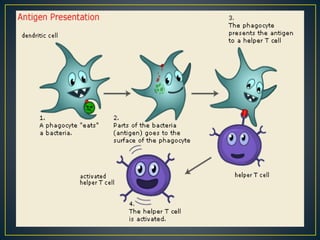
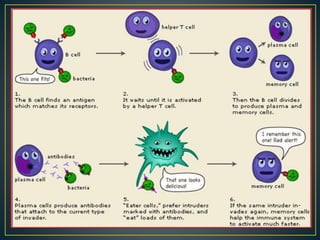
Dr. Saugat Chapagain
• The antigens and the antibodies combine specifically with
each other. This interaction between them is called Antigen-
Antibody reaction.
• It may be abbreviated as Ag –Ab reaction.
• These form the basis for humoral immunity or antibody
mediated immunity.
• These reactions form the basis for detection of infectious
disease causing agents and also some nonspecific Ag’s like
enzymes.
• When Ag – Ab reactions occur invitro, they are known as
serological reactions.
• The reactions between Ag and Ab occur in three stages.
• In first stage the reaction involves formation of Ag-Ab complex.
• The second stage leads to visible events like precipitation,
agglutination etc.
• Specificity of Antigen –Antibody Reaction.
• Immune complex.
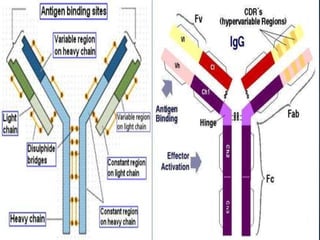
• Binding Site of Antigen –Antibody Reaction.
• Binding Force of Antigen –Antibody Reaction.
• Ag (epitope) Ab (paratope)
• Specificity refers to the ability of an individual antibody
combining site to react with only one antigenic
determinant or the ability of a population of antibody
molecules to react with only one antigen. (lock and key
phenomenon)
• For example, the antibody produced against lens antigen
will react only with lens-antigen. Similarly, the antibody
produced against kidney antigen will react with only
kidney- antigen. A standard lock can be opened by its
own key only as one antibody can react with its own
antigen.
• An immune complex is formed from the integral binding
of an antibody to a soluble antigen.
• The bound antigen acting as a specific epitope, bound to an
antibody is referred to as a singular immune complex.
• Mechanisms of antigen-antibody interaction leading to
inflammation. Antigen-antibody immune complex
formation results in complement activation, opsonization
of target cells, assembly of membrane attack complexes
and release of complement activators for chemotaxis.
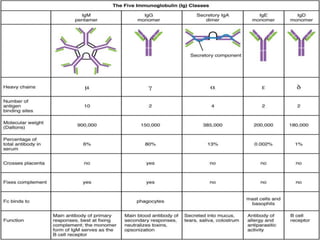
• Fc receptor mediated cell activation triggers cellular responses,
such as phagocytosis, antibody-dependent cellular cytotoxicity
(ADCC) and release of inflammatory mediators.
• In antigen - antibody reaction, the antibody attaches with
the antigen.
• The part of antigen which combines with antibody is
called Epitope.
• An epitope, also known as antigenic determinant, is the
part of an antigen that is recognized by the immune
system, specifically by antibodies, B cells, or T cells.
• The part of an antibody that recognizes the epitope is
called a paratope.
The binding between antigen and antibody in Ag – Ab reaction is due to
three factors namely:
• Closeness between antigen and antibody.
• Non – covalent bonds or Intermolecular forces .
• Affinity of antibody.
• Closeness between antigen and antibody: When antigen and
antibody are closely fit, the strength of binding is great. When they
are apart binding strength low.
• Non – Covalent Bonds: The bonds that hold the antigen to the
antibody combining site are all non-covalent in nature. These include
hydrogen bonds, electrostatic bonds, Van der Waals forces and
hydrophobic bonds.
• Affinity of antibody: Antibody affinity is the strength of the reaction
between a single antigenic determinant and a single combining site
on the antibody.
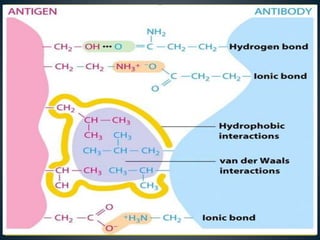
• The non – covalent interaction that form the basis of
antigen – antibody binding include hydrogen bond, ionic
bond, hydrophobic interaction and Van der Waals
interaction.
• A strong antigen – antibody interaction depends on a
very close fit between the antigen and antibody which
requires high degree of specificity.
• The properties of antigen and antibody can be
explained with the help of three points. They are:
• Antibody Affinity.
•Antibody Avidity
• Cross reaction.
• Interactions between antigen and antibody involve non-
covalent binding of an antigenic determinant (epitope) to
the variable region (complementarity determining region,
CDR) of both the heavy and light immunoglobulin chains.
These interactions are analogous to those observed in
enzyme-substrate interactions and they can be defined
similarly.
• It is the strength of the bond after the formation
of Ag-Ab complexes.
• It is used to denote the overall capacity of
antibodies to combine with the multivalent
antigen.
•A multivalent Ag has many types of antigenic
determinants.
• When injected into the blood, each antigenic
determinant stimulates the production of a
particular antibody.
An antiserum raised against an Ag, can also react with a similar Ag
of another type. This is called cross reaction and the Ag which
produces the cross reaction is called Cross reactive Ag. But the
strength of Ab raised against its own Ag is strong.
The bonds involved in cross reactions are weak.
• Example: The serum raised against albumin of hen’s egg
can cross react with albumin obtained from duck’s egg.
The antiserum raised against human insulin will react
with the insulin of Pig, Sheep, whale etc. The antiserum
raised against Pneumococcal polysaccharides will react
with E.coli, blood group A and collagen Ag’s.
• Precipitation Reaction.
• Agglutination Reaction.
• Complement Fixation.
• ELISA– Enzyme Linked ImmunoSorbentAssay.
• Immunofluorescence.
• Radio Immuno Assay (RIA)
When a soluble Ag combines with its Ab in the presence of
an electrolyte (NaCl) at a particular temperature and pH, it
forms an insoluble precipitate of Ag-Ab complex.
The Ab causing precipitation is called Precipitin and the
reaction is called as precipitation reaction.
Precipitation occurs in two media:
• Liquid.
• Gel.
• Diagnosis of disease by demonstration of antibodies
(RPR)
• Identification of pathogen and classification of micro
organisms.
• Titration of Antibody
• To compare two unknown antigens.
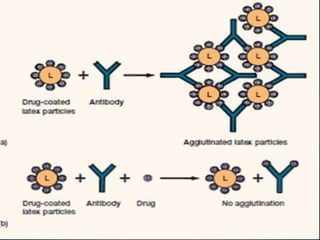
When a particular Ag is mixed with its Ab’s in the presence
of electrolytes at a suitable temperature and pH, the
particles are clumped or agglutinated.
• The Ab of the serum causes the cellular Ag’s to form clumps
and these are calledAgglutinins.
• The particulate antigens that are aggregated are termed
Agglutinogens.
Types:
• Slide agglutination
• Tube agglutination
• Passive agglutination
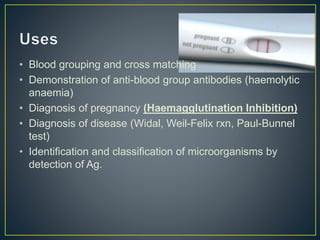
• Blood grouping and cross matching
• Demonstration of anti-blood group antibodies (haemolytic
anaemia)
• Diagnosis of pregnancy (Haemagglutination Inhibition)
• Diagnosis of disease (Widal, Weil-Felix rxn, Paul-Bunnel
test)
• Identification and classification of microorganisms by
detection of Ag.
Enzyme Linked ImmunoSorbent Assay
Types:
• Indirect
• Sandwich
• Competitive
Uses:
• Diagnosis of disease (esp. in viral and parasitic disease)
• Detection of antigen (in stool, serum)
• Detection of antibody titre in serum ( e.g. kala-azar)
• Fluorescence is the property of absorbing light rays of
one particular wavelength and emitting rays with a different
wave length.
• Fluorescent dyes show up brightly under UV light as they
convert into visible light.
• Commonly used dyes:
• Fluorescein
• Phycoerythrin
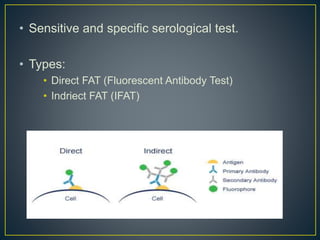
• Sensitive and specific serological test.
• Types:
• Direct FAT (Fluorescent Antibody Test)
• Indriect FAT (IFAT)
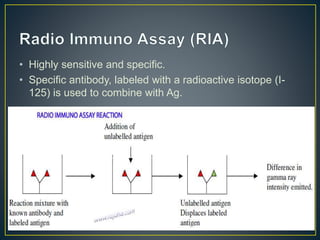
• Highly sensitive and specific.
• Specific antibody, labeled with a radioactive isotope (I-
125) is used to combine with Ag.
• Determination of blood groups for transfusion and cross
matching.
• Serological ascertainment of exposure to infectious
agents.
• Diagnosis of diseases by detecting antibody/ antigen.
• Diagnosis of Immune disorders.
• To detect the presence or absence of protein in serum.
• Identification of microorganisms.
• Diagnosis of pregnancy
• Detection of antibodies after vaccination
• Detection of HLA antigens e.g. for tissue transplantation.

2. antigen antibody reaction

  • 1.
  • 5.
    • The antigensand the antibodies combine specifically with each other. This interaction between them is called Antigen- Antibody reaction. • It may be abbreviated as Ag –Ab reaction. • These form the basis for humoral immunity or antibody mediated immunity. • These reactions form the basis for detection of infectious disease causing agents and also some nonspecific Ag’s like enzymes. • When Ag – Ab reactions occur invitro, they are known as serological reactions. • The reactions between Ag and Ab occur in three stages. • In first stage the reaction involves formation of Ag-Ab complex. • The second stage leads to visible events like precipitation, agglutination etc.
  • 6.
    • Specificity ofAntigen –Antibody Reaction. • Immune complex. • Binding Site of Antigen –Antibody Reaction. • Binding Force of Antigen –Antibody Reaction. • Ag (epitope) Ab (paratope)
  • 7.
    • Specificity refersto the ability of an individual antibody combining site to react with only one antigenic determinant or the ability of a population of antibody molecules to react with only one antigen. (lock and key phenomenon) • For example, the antibody produced against lens antigen will react only with lens-antigen. Similarly, the antibody produced against kidney antigen will react with only kidney- antigen. A standard lock can be opened by its own key only as one antibody can react with its own antigen.
  • 8.
    • An immunecomplex is formed from the integral binding of an antibody to a soluble antigen. • The bound antigen acting as a specific epitope, bound to an antibody is referred to as a singular immune complex. • Mechanisms of antigen-antibody interaction leading to inflammation. Antigen-antibody immune complex formation results in complement activation, opsonization of target cells, assembly of membrane attack complexes and release of complement activators for chemotaxis. • Fc receptor mediated cell activation triggers cellular responses, such as phagocytosis, antibody-dependent cellular cytotoxicity (ADCC) and release of inflammatory mediators.
  • 9.
    • In antigen- antibody reaction, the antibody attaches with the antigen. • The part of antigen which combines with antibody is called Epitope. • An epitope, also known as antigenic determinant, is the part of an antigen that is recognized by the immune system, specifically by antibodies, B cells, or T cells. • The part of an antibody that recognizes the epitope is called a paratope.
  • 11.
    The binding betweenantigen and antibody in Ag – Ab reaction is due to three factors namely: • Closeness between antigen and antibody. • Non – covalent bonds or Intermolecular forces . • Affinity of antibody. • Closeness between antigen and antibody: When antigen and antibody are closely fit, the strength of binding is great. When they are apart binding strength low. • Non – Covalent Bonds: The bonds that hold the antigen to the antibody combining site are all non-covalent in nature. These include hydrogen bonds, electrostatic bonds, Van der Waals forces and hydrophobic bonds. • Affinity of antibody: Antibody affinity is the strength of the reaction between a single antigenic determinant and a single combining site on the antibody.
  • 12.
    • The non– covalent interaction that form the basis of antigen – antibody binding include hydrogen bond, ionic bond, hydrophobic interaction and Van der Waals interaction. • A strong antigen – antibody interaction depends on a very close fit between the antigen and antibody which requires high degree of specificity.
  • 14.
    • The propertiesof antigen and antibody can be explained with the help of three points. They are: • Antibody Affinity. •Antibody Avidity • Cross reaction.
  • 15.
    • Interactions betweenantigen and antibody involve non- covalent binding of an antigenic determinant (epitope) to the variable region (complementarity determining region, CDR) of both the heavy and light immunoglobulin chains. These interactions are analogous to those observed in enzyme-substrate interactions and they can be defined similarly.
  • 16.
    • It isthe strength of the bond after the formation of Ag-Ab complexes. • It is used to denote the overall capacity of antibodies to combine with the multivalent antigen. •A multivalent Ag has many types of antigenic determinants. • When injected into the blood, each antigenic determinant stimulates the production of a particular antibody.
  • 17.
    An antiserum raisedagainst an Ag, can also react with a similar Ag of another type. This is called cross reaction and the Ag which produces the cross reaction is called Cross reactive Ag. But the strength of Ab raised against its own Ag is strong. The bonds involved in cross reactions are weak. • Example: The serum raised against albumin of hen’s egg can cross react with albumin obtained from duck’s egg. The antiserum raised against human insulin will react with the insulin of Pig, Sheep, whale etc. The antiserum raised against Pneumococcal polysaccharides will react with E.coli, blood group A and collagen Ag’s.
  • 18.
    • Precipitation Reaction. •Agglutination Reaction. • Complement Fixation. • ELISA– Enzyme Linked ImmunoSorbentAssay. • Immunofluorescence. • Radio Immuno Assay (RIA)
  • 19.
    When a solubleAg combines with its Ab in the presence of an electrolyte (NaCl) at a particular temperature and pH, it forms an insoluble precipitate of Ag-Ab complex. The Ab causing precipitation is called Precipitin and the reaction is called as precipitation reaction. Precipitation occurs in two media: • Liquid. • Gel.
  • 20.
    • Diagnosis ofdisease by demonstration of antibodies (RPR) • Identification of pathogen and classification of micro organisms. • Titration of Antibody • To compare two unknown antigens.
  • 21.
    When a particularAg is mixed with its Ab’s in the presence of electrolytes at a suitable temperature and pH, the particles are clumped or agglutinated. • The Ab of the serum causes the cellular Ag’s to form clumps and these are calledAgglutinins. • The particulate antigens that are aggregated are termed Agglutinogens. Types: • Slide agglutination • Tube agglutination • Passive agglutination
  • 23.
    • Blood groupingand cross matching • Demonstration of anti-blood group antibodies (haemolytic anaemia) • Diagnosis of pregnancy (Haemagglutination Inhibition) • Diagnosis of disease (Widal, Weil-Felix rxn, Paul-Bunnel test) • Identification and classification of microorganisms by detection of Ag.
  • 24.
    Enzyme Linked ImmunoSorbentAssay Types: • Indirect • Sandwich • Competitive Uses: • Diagnosis of disease (esp. in viral and parasitic disease) • Detection of antigen (in stool, serum) • Detection of antibody titre in serum ( e.g. kala-azar)
  • 25.
    • Fluorescence isthe property of absorbing light rays of one particular wavelength and emitting rays with a different wave length. • Fluorescent dyes show up brightly under UV light as they convert into visible light. • Commonly used dyes: • Fluorescein • Phycoerythrin
  • 26.
    • Sensitive andspecific serological test. • Types: • Direct FAT (Fluorescent Antibody Test) • Indriect FAT (IFAT)
  • 27.
    • Highly sensitiveand specific. • Specific antibody, labeled with a radioactive isotope (I- 125) is used to combine with Ag.
  • 28.
    • Determination ofblood groups for transfusion and cross matching. • Serological ascertainment of exposure to infectious agents. • Diagnosis of diseases by detecting antibody/ antigen. • Diagnosis of Immune disorders. • To detect the presence or absence of protein in serum. • Identification of microorganisms. • Diagnosis of pregnancy • Detection of antibodies after vaccination • Detection of HLA antigens e.g. for tissue transplantation.