© Innova Biosciences Ltd. All rights reserved 
Quality –Consistency –Expertise
© Innova Biosciences Ltd. All rights reserved 
Welcome to our 15th webinar 
ANTIBODY PURIFICATION: What you need to know to use antibodies effectively 
Dr Andy Lane
© Innova Biosciences Ltd. All rights reserved 
Dr Andy Lane 
•Sources of antibodies 
•Different methods of purifying antibodies 
•Why “purified antibodies” are not all the same 
•How to purify antibodies easily without specialist knowledge or equipment 
•Considerations for conjugating antibodies to enzymes, dyes and nanoparticles
© Innova Biosciences Ltd. All rights reserved 
Sources of antibodies 
•Animal serum –polyclonal antibodies 
•Ascites –monoclonal antibodies 
•Cell culture supernatant –monoclonal antibodies 
•Eggs –avian antibodies 
•Bacterial expression systems –recombinant antibodies 
Each of these sources has contains the specific antibody of interest amongst other proteins, lipids and other components.
© Innova Biosciences Ltd. All rights reserved 
Different methods of purifying antibodies 
•Fractionation by globulin precipitation 
•Ion exchange chromatography 
•Size exclusion chromatography 
•Protein A affinity chromatography 
•Protein G affinity chromatography 
•Protein L affinity chromatography 
•Antigen affinity chromatography
© Innova Biosciences Ltd. All rights reserved 
Globulin precipitation 
•First published in 1899 by James Atkinson in J. Exp. Med. –separating albumin from the anti-toxic components of a horse antiserum using magnesium sulphate. 
•Ammonium sulphate and sodium sulphate are more commonly used, taking advantage of the principle of “salting-out”. At the appropriate concentration these precipitate globulins, whilst many other proteins, including albumin, remain in solution. 
•Whilst this is a simple and gentle procedure, it only provides a partially pure preparation if starting from a complex mixture such as serum. 
•This step is often combined with further purification using one of the other methods discussed in this webinar.
© Innova Biosciences Ltd. All rights reserved 
Ion exchange chromatography 
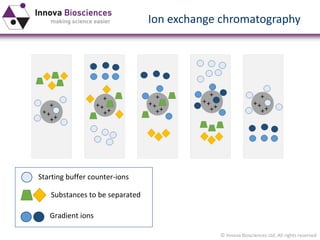
•Ion exchange chromatography (IEC) uses positively or negatively charged resins to bind proteins based on their net charges in a given buffer system (pH). 
•Typically, a complex mixture is added to the column in a certain set of buffer conditions (e.g. low salt), and the buffer conditions are then changed either step-wise or on a gradient basis. Different proteins are released from the column in differing conditions. 
•IEC is perhaps more often used to purify polyclonal antibodies than for monoclonals–note that each monoclonal is unique in terms of charge, and will therefore be released under a specific set of conditions –something that is useful for repeated purifications of the same antibody, but also means that optimisation is required for each antibody. 
•There are various IEC resins available, with perhaps the most widely used being DEAE-Sepharose.
© Innova Biosciences Ltd. All rights reserved 
Starting buffer counter-ions 
Substances to be separated 
Gradient ions 
Ion exchange chromatography
© Innova Biosciences Ltd. All rights reserved 
Size exclusion chromatography 
•Separation of complex mixtures on the basis of size or molecular shape can be achieved by size exclusion (SEC) or gel filtrationchromatography. 
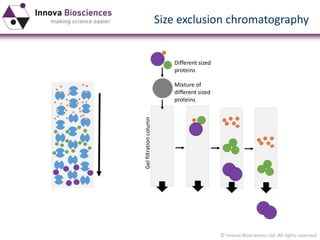
•The molecular sieving process takes place as a solute passes through a packed bed stationary phase. Separation depends on the different abilities of the various molecules to enter the pores of the bead-based stationary phase. 
•Large molecules, which cannot enter the pores, are excluded and pass through the column quickly. Smaller molecules that can enter the pores are retarded and move through the column more slowly. Very small molecules, such as salt, are able to fully permeate and elute last.
© Innova Biosciences Ltd. All rights reserved 
Size exclusion chromatography 
•SEC tends not to be used for primary purification of antibodies other than IgMs. However, it may be a valuable “polishing step” following purification by other methods. 
•Ranges of chromatography resins are available that separate proteins within different ranges of size (e.g. AcA22, AcA34, AcA44 from Ultrogel®, and S200, S300, S400 in the Sephadexrange) 
DE-SALTING COLUMNS 
•So called de-salting columns are used to undertake a buffer exchange, or to remove small size contaminants. This is simply a special case of SEC, with the most commonly used gel being SephadexG-25, often in pre-prepared PD10 columns.
© Innova Biosciences Ltd. All rights reserved 
Mixture of different sized proteins 
Different sized proteins 
Gel filtration column 
Size exclusion chromatography
© Innova Biosciences Ltd. All rights reserved 
Protein A/G/L chromatography 
•In their native form these proteins are expressed by bacteria as part of their defensemechanisms against the mammalian immune response. 
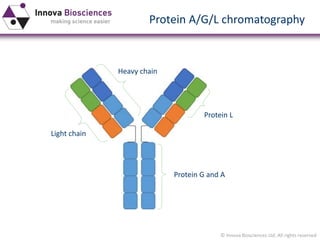
•All bind to mammalian immunoglobulins via constant regions –Protein A and G to the Fc region, and Protein L to the kappa light chain. 
•Recombinant versions are used immobilised to various matrices to purify IgG by a form of affinity chromatography.
© Innova Biosciences Ltd. All rights reserved 
Heavy chain 
Light chain 
Protein G and A 
Protein L 
Protein A/G/L chromatography
© Innova Biosciences Ltd. All rights reserved 
Protein A/G/L chromatography 
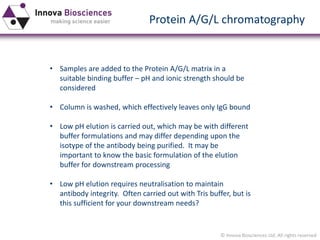
•Samples are added to the Protein A/G/L matrix in a suitable binding buffer –pH and ionic strength should be considered 
•Column is washed, which effectively leaves only IgG bound 
•Low pH elution is carried out, which may be with different buffer formulations and may differ depending upon the isotypeof the antibody being purified. It may be important to know the basic formulation of the elution buffer for downstream processing 
•Low pH elution requires neutralisation to maintain antibody integrity. Often carried out with Tris buffer, but is this sufficient for your downstream needs?
© Innova Biosciences Ltd. All rights reserved 
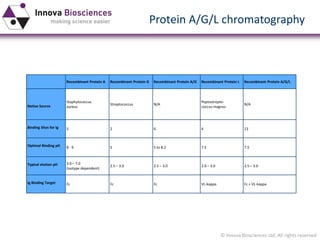
Recombinant ProteinA 
Recombinant ProteinG 
Recombinant ProteinA/G 
Recombinant ProteinL 
RecombinantProtein A/G/L 
Native Source 
Staphylococcusaureus 
Streptococcus 
N/A 
Peptostrepto- coccusmagnus 
N/A 
Binding Sites for Ig 
5 
2 
6 
4 
13 
Optimal Binding pH 
8-9 
5 
5 to 8.2 
7.5 
7.5 
Typical elution pH 
3.0 –7.0 
(isotypedependent) 
2.5 –3.0 
2.5 –3.0 
2.0 –3.0 
2.5–3.0 
Ig Binding Target 
Fc 
Fc 
Fc 
VL-kappa 
Fc + VL-kappa 
Protein A/G/L chromatography
© Innova Biosciences Ltd. All rights reserved 
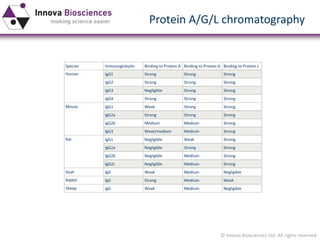
Species 
Immunoglobulin 
Binding to Protein A 
Binding to Protein G 
Binding to Protein L 
Human 
IgG1 
Strong 
Strong 
Strong 
IgG2 
Strong 
Strong 
Strong 
IgG3 
Negligible 
Strong 
Strong 
IgG4 
Strong 
Strong 
Strong 
Mouse 
lgG1 
Weak 
Strong 
Strong 
lgG2a 
Strong 
Strong 
Strong 
lgG2b 
Medium 
Medium 
Strong 
lgG3 
Weak/medium 
Medium 
Strong 
Rat 
lgG1 
Negligible 
Weak 
Strong 
lgG2a 
Negligible 
Strong 
Strong 
lgG2b 
Negligible 
Medium 
Strong 
lgG2c 
Negligible 
Medium 
Strong 
Goat 
lgG 
Weak 
Medium 
Negligible 
Rabbit 
lgG 
Strong 
Medium 
Weak 
Sheep 
lgG 
Weak 
Medium 
Negligible 
Protein A/G/L chromatography
© Innova Biosciences Ltd. All rights reserved 
Antigen affinity chromatography 
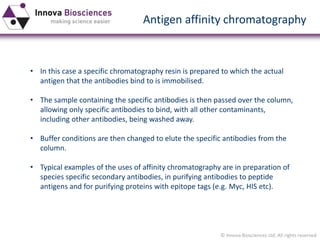
•In this case a specific chromatography resin is prepared to which the actual antigen that the antibodies bind to is immobilised. 
•The sample containing the specific antibodies is then passed over the column, allowing only specific antibodies to bind, with all other contaminants, including other antibodies, being washed away. 
•Buffer conditions are then changed to elute the specific antibodies from the column. 
•Typical examples of the uses of affinity chromatography are in preparation of species specific secondary antibodies, in purifying antibodies to peptide antigens and for purifying proteins with epitope tags (e.g. Myc, HIS etc).
© Innova Biosciences Ltd. All rights reserved 
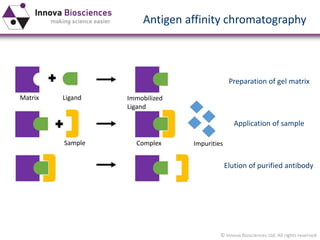
Matrix 
Ligand 
Immobilized Ligand 
Sample 
Complex 
Impurities 
Antigen affinity chromatography 
Preparation of gel matrix 
Application of sample 
Elution of purified antibody
© Innova Biosciences Ltd. All rights reserved 
Why “purified antibodies” are not all the same 
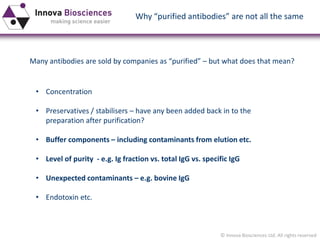
•Concentration 
•Preservatives / stabilisers –have any been added back in to the preparation after purification? 
•Buffer components –including contaminants from elution etc. 
•Level of purity -e.g. Ig fraction vs. total IgG vs. specific IgG 
•Unexpected contaminants –e.g. bovine IgG 
•Endotoxin etc. 
Many antibodies are sold by companies as “purified” –but what does that mean?
© Innova Biosciences Ltd. All rights reserved 
Your final buffer…….. 
•The final buffer that your antibody is in may have a significant effect on what you can use your antibody for. For instance, the presence of glycine in a buffer can inhibit conjugation reactions, or sodium azide may kill live cells. Some buffers may be suitable for conjugating to proteins, but not to nanoparticles. 
•If you undertake a dialysis step post-purification to transfer an antibody into a particular buffer, you need to be sure that the dialysis has been effective. 
•e.g. To remove (i.e. to 1nM level) 100mM glycine from 10ml of antibody you need to dialyse against 1 million litres of PBS. Alternatively, changing the dialysis 4 times will achieve the same effect with only 4 litres of PBS. 
•However, a single dialysis into 1 litre leaves glycine present at 1mM. 
Why “purified antibodies” are not all the same
© Innova Biosciences Ltd. All rights reserved 
Total IgG vs. specific IgG 
•The serum produced when any polyclonal antibody is raised will contain only approximately 10% of antibodies that are specific to the antigen of interest 
•Therefore if you purify all of the IgG present, only 10% of that IgG will be specific for the antigen. 
•Only antigen affinity chromatography effectively provides IgG that is 100% specific for antigen –Protein A/G/L chromatography provides total IgG, albeit apparently 100% pure when analysed by SDS-PAGE. 
•These differences lead to significant differences in activity –a working dilution of an antigen affinity purified antibody is likely to be 10-fold higher than that of a Protein A/G purified antibody. 
Why “purified antibodies” are not all the same
© Innova Biosciences Ltd. All rights reserved 
Unexpected contaminants –e.g. bovine IgG 
•By definition, your purified monoclonal antibody must be 100% pure. Is that right? 
•Be aware that if your cell culture media contains foetal/newbornbovine serum there may be significant levels of bovine IgG present –which may co-purify with your monoclonal antibody when using media such as Protein A or G. 
•Avoid these either by using a mouse IgG specific purification system or converting all of your hybridomaculture to serum free media. 
•If you use ascites you avoid bovine IgG, but you will have normal mouse IgG present which also co-purifies. 
Why “purified antibodies” are not all the same
© Innova Biosciences Ltd. All rights reserved 
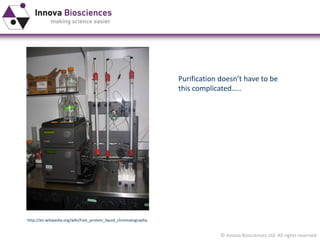
http://en.wikipedia.org/wiki/Fast_protein_liquid_chromatography 
Purification doesn’t have to be 
this complicated…..
© Innova Biosciences Ltd. All rights reserved 
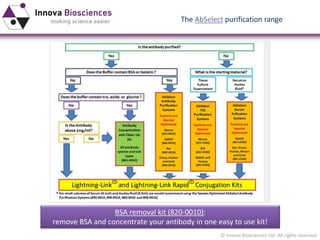
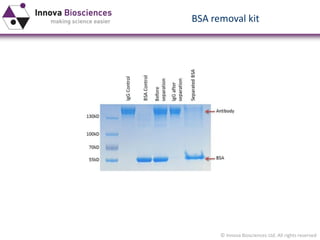
BSA removal kit (820-0010): 
remove BSA and concentrate your antibody in one easy to use kit! 
The AbSelectpurification range
© Innova Biosciences Ltd. All rights reserved 
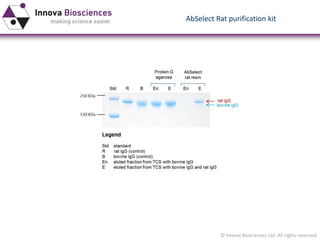
AbSelectRat purification kit
© Innova Biosciences Ltd. All rights reserved 
BSA removal kit
© Innova Biosciences Ltd. All rights reserved 
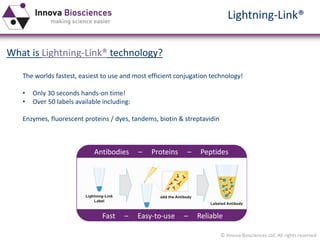
What is Lightning-Link®technology? 
The worlds fastest, easiest to use and most efficient conjugation technology! 
•Only 30 seconds hands-on time! 
•Over 50 labels available including: 
Enzymes, fluorescent proteins / dyes, tandems, biotin & streptavidin 
Lightning-Link® 
Antibodies –Proteins –Peptides 
Fast –Easy-to-use –Reliable
© Innova Biosciences Ltd. All rights reserved
© Innova Biosciences Ltd. All rights reserved 
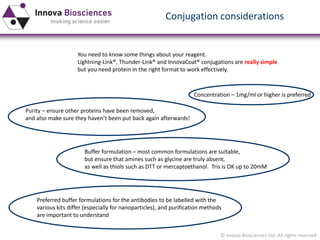
Conjugation considerations 
You need to know some things about your reagent. 
Lightning-Link®, Thunder-Link® and InnovaCoat® conjugations are really simple 
but you need protein in the right format to work effectively. 
Concentration –1mg/ml or higher is preferred 
Purity –ensure other proteins have been removed, 
and also make sure they haven’t been put back again afterwards! 
Buffer formulation –most common formulations are suitable, 
but ensure that amines such as glycine are truly absent, 
as well as thiolssuch as DTT or mercaptoethanol. Trisis OK up to 20mM 
Preferred buffer formulations for the antibodies to be labelled with the 
various kits differ (especially for nanoparticles), and purification methods 
are important to understand
© Innova Biosciences Ltd. All rights reserved 
AbSelect: 
AbPure:
© Innova Biosciences Ltd. All rights reserved 
Contact 
If you would like any more information, please contact us at 
info@innovabiosciences.com 
Please keep an eye out for our future webinars and other exciting news on our 
website and social media channels: 
www.innovabiosciences.com/innova/webinars.html 
YouTube: www.youtube.com/InnovaBiosciences
© Innova Biosciences Ltd. All rights reserved 
Innova Biosciences Ltd. Babraham Research Campus, 
Cambridge, UK, 
CB22 3AT 
www.innovabiosciences.com 
Lightning-Link® is a registered trademark of Innova BiosciencesDyLight® is a registered trademark of Thermo Fisher Scientific Inc. and its subsidiaries

Antibody purification – what you need to know to use antibodies effectively

  • 1.
    © Innova BiosciencesLtd. All rights reserved Quality –Consistency –Expertise
  • 2.
    © Innova BiosciencesLtd. All rights reserved Welcome to our 15th webinar ANTIBODY PURIFICATION: What you need to know to use antibodies effectively Dr Andy Lane
  • 3.
    © Innova BiosciencesLtd. All rights reserved Dr Andy Lane •Sources of antibodies •Different methods of purifying antibodies •Why “purified antibodies” are not all the same •How to purify antibodies easily without specialist knowledge or equipment •Considerations for conjugating antibodies to enzymes, dyes and nanoparticles
  • 4.
    © Innova BiosciencesLtd. All rights reserved Sources of antibodies •Animal serum –polyclonal antibodies •Ascites –monoclonal antibodies •Cell culture supernatant –monoclonal antibodies •Eggs –avian antibodies •Bacterial expression systems –recombinant antibodies Each of these sources has contains the specific antibody of interest amongst other proteins, lipids and other components.
  • 5.
    © Innova BiosciencesLtd. All rights reserved Different methods of purifying antibodies •Fractionation by globulin precipitation •Ion exchange chromatography •Size exclusion chromatography •Protein A affinity chromatography •Protein G affinity chromatography •Protein L affinity chromatography •Antigen affinity chromatography
  • 6.
    © Innova BiosciencesLtd. All rights reserved Globulin precipitation •First published in 1899 by James Atkinson in J. Exp. Med. –separating albumin from the anti-toxic components of a horse antiserum using magnesium sulphate. •Ammonium sulphate and sodium sulphate are more commonly used, taking advantage of the principle of “salting-out”. At the appropriate concentration these precipitate globulins, whilst many other proteins, including albumin, remain in solution. •Whilst this is a simple and gentle procedure, it only provides a partially pure preparation if starting from a complex mixture such as serum. •This step is often combined with further purification using one of the other methods discussed in this webinar.
  • 7.
    © Innova BiosciencesLtd. All rights reserved Ion exchange chromatography •Ion exchange chromatography (IEC) uses positively or negatively charged resins to bind proteins based on their net charges in a given buffer system (pH). •Typically, a complex mixture is added to the column in a certain set of buffer conditions (e.g. low salt), and the buffer conditions are then changed either step-wise or on a gradient basis. Different proteins are released from the column in differing conditions. •IEC is perhaps more often used to purify polyclonal antibodies than for monoclonals–note that each monoclonal is unique in terms of charge, and will therefore be released under a specific set of conditions –something that is useful for repeated purifications of the same antibody, but also means that optimisation is required for each antibody. •There are various IEC resins available, with perhaps the most widely used being DEAE-Sepharose.
  • 8.
    © Innova BiosciencesLtd. All rights reserved Starting buffer counter-ions Substances to be separated Gradient ions Ion exchange chromatography
  • 9.
    © Innova BiosciencesLtd. All rights reserved Size exclusion chromatography •Separation of complex mixtures on the basis of size or molecular shape can be achieved by size exclusion (SEC) or gel filtrationchromatography. •The molecular sieving process takes place as a solute passes through a packed bed stationary phase. Separation depends on the different abilities of the various molecules to enter the pores of the bead-based stationary phase. •Large molecules, which cannot enter the pores, are excluded and pass through the column quickly. Smaller molecules that can enter the pores are retarded and move through the column more slowly. Very small molecules, such as salt, are able to fully permeate and elute last.
  • 10.
    © Innova BiosciencesLtd. All rights reserved Size exclusion chromatography •SEC tends not to be used for primary purification of antibodies other than IgMs. However, it may be a valuable “polishing step” following purification by other methods. •Ranges of chromatography resins are available that separate proteins within different ranges of size (e.g. AcA22, AcA34, AcA44 from Ultrogel®, and S200, S300, S400 in the Sephadexrange) DE-SALTING COLUMNS •So called de-salting columns are used to undertake a buffer exchange, or to remove small size contaminants. This is simply a special case of SEC, with the most commonly used gel being SephadexG-25, often in pre-prepared PD10 columns.
  • 11.
    © Innova BiosciencesLtd. All rights reserved Mixture of different sized proteins Different sized proteins Gel filtration column Size exclusion chromatography
  • 12.
    © Innova BiosciencesLtd. All rights reserved Protein A/G/L chromatography •In their native form these proteins are expressed by bacteria as part of their defensemechanisms against the mammalian immune response. •All bind to mammalian immunoglobulins via constant regions –Protein A and G to the Fc region, and Protein L to the kappa light chain. •Recombinant versions are used immobilised to various matrices to purify IgG by a form of affinity chromatography.
  • 13.
    © Innova BiosciencesLtd. All rights reserved Heavy chain Light chain Protein G and A Protein L Protein A/G/L chromatography
  • 14.
    © Innova BiosciencesLtd. All rights reserved Protein A/G/L chromatography •Samples are added to the Protein A/G/L matrix in a suitable binding buffer –pH and ionic strength should be considered •Column is washed, which effectively leaves only IgG bound •Low pH elution is carried out, which may be with different buffer formulations and may differ depending upon the isotypeof the antibody being purified. It may be important to know the basic formulation of the elution buffer for downstream processing •Low pH elution requires neutralisation to maintain antibody integrity. Often carried out with Tris buffer, but is this sufficient for your downstream needs?
  • 15.
    © Innova BiosciencesLtd. All rights reserved Recombinant ProteinA Recombinant ProteinG Recombinant ProteinA/G Recombinant ProteinL RecombinantProtein A/G/L Native Source Staphylococcusaureus Streptococcus N/A Peptostrepto- coccusmagnus N/A Binding Sites for Ig 5 2 6 4 13 Optimal Binding pH 8-9 5 5 to 8.2 7.5 7.5 Typical elution pH 3.0 –7.0 (isotypedependent) 2.5 –3.0 2.5 –3.0 2.0 –3.0 2.5–3.0 Ig Binding Target Fc Fc Fc VL-kappa Fc + VL-kappa Protein A/G/L chromatography
  • 16.
    © Innova BiosciencesLtd. All rights reserved Species Immunoglobulin Binding to Protein A Binding to Protein G Binding to Protein L Human IgG1 Strong Strong Strong IgG2 Strong Strong Strong IgG3 Negligible Strong Strong IgG4 Strong Strong Strong Mouse lgG1 Weak Strong Strong lgG2a Strong Strong Strong lgG2b Medium Medium Strong lgG3 Weak/medium Medium Strong Rat lgG1 Negligible Weak Strong lgG2a Negligible Strong Strong lgG2b Negligible Medium Strong lgG2c Negligible Medium Strong Goat lgG Weak Medium Negligible Rabbit lgG Strong Medium Weak Sheep lgG Weak Medium Negligible Protein A/G/L chromatography
  • 17.
    © Innova BiosciencesLtd. All rights reserved Antigen affinity chromatography •In this case a specific chromatography resin is prepared to which the actual antigen that the antibodies bind to is immobilised. •The sample containing the specific antibodies is then passed over the column, allowing only specific antibodies to bind, with all other contaminants, including other antibodies, being washed away. •Buffer conditions are then changed to elute the specific antibodies from the column. •Typical examples of the uses of affinity chromatography are in preparation of species specific secondary antibodies, in purifying antibodies to peptide antigens and for purifying proteins with epitope tags (e.g. Myc, HIS etc).
  • 18.
    © Innova BiosciencesLtd. All rights reserved Matrix Ligand Immobilized Ligand Sample Complex Impurities Antigen affinity chromatography Preparation of gel matrix Application of sample Elution of purified antibody
  • 19.
    © Innova BiosciencesLtd. All rights reserved Why “purified antibodies” are not all the same •Concentration •Preservatives / stabilisers –have any been added back in to the preparation after purification? •Buffer components –including contaminants from elution etc. •Level of purity -e.g. Ig fraction vs. total IgG vs. specific IgG •Unexpected contaminants –e.g. bovine IgG •Endotoxin etc. Many antibodies are sold by companies as “purified” –but what does that mean?
  • 20.
    © Innova BiosciencesLtd. All rights reserved Your final buffer…….. •The final buffer that your antibody is in may have a significant effect on what you can use your antibody for. For instance, the presence of glycine in a buffer can inhibit conjugation reactions, or sodium azide may kill live cells. Some buffers may be suitable for conjugating to proteins, but not to nanoparticles. •If you undertake a dialysis step post-purification to transfer an antibody into a particular buffer, you need to be sure that the dialysis has been effective. •e.g. To remove (i.e. to 1nM level) 100mM glycine from 10ml of antibody you need to dialyse against 1 million litres of PBS. Alternatively, changing the dialysis 4 times will achieve the same effect with only 4 litres of PBS. •However, a single dialysis into 1 litre leaves glycine present at 1mM. Why “purified antibodies” are not all the same
  • 21.
    © Innova BiosciencesLtd. All rights reserved Total IgG vs. specific IgG •The serum produced when any polyclonal antibody is raised will contain only approximately 10% of antibodies that are specific to the antigen of interest •Therefore if you purify all of the IgG present, only 10% of that IgG will be specific for the antigen. •Only antigen affinity chromatography effectively provides IgG that is 100% specific for antigen –Protein A/G/L chromatography provides total IgG, albeit apparently 100% pure when analysed by SDS-PAGE. •These differences lead to significant differences in activity –a working dilution of an antigen affinity purified antibody is likely to be 10-fold higher than that of a Protein A/G purified antibody. Why “purified antibodies” are not all the same
  • 22.
    © Innova BiosciencesLtd. All rights reserved Unexpected contaminants –e.g. bovine IgG •By definition, your purified monoclonal antibody must be 100% pure. Is that right? •Be aware that if your cell culture media contains foetal/newbornbovine serum there may be significant levels of bovine IgG present –which may co-purify with your monoclonal antibody when using media such as Protein A or G. •Avoid these either by using a mouse IgG specific purification system or converting all of your hybridomaculture to serum free media. •If you use ascites you avoid bovine IgG, but you will have normal mouse IgG present which also co-purifies. Why “purified antibodies” are not all the same
  • 23.
    © Innova BiosciencesLtd. All rights reserved http://en.wikipedia.org/wiki/Fast_protein_liquid_chromatography Purification doesn’t have to be this complicated…..
  • 24.
    © Innova BiosciencesLtd. All rights reserved BSA removal kit (820-0010): remove BSA and concentrate your antibody in one easy to use kit! The AbSelectpurification range
  • 25.
    © Innova BiosciencesLtd. All rights reserved AbSelectRat purification kit
  • 26.
    © Innova BiosciencesLtd. All rights reserved BSA removal kit
  • 27.
    © Innova BiosciencesLtd. All rights reserved What is Lightning-Link®technology? The worlds fastest, easiest to use and most efficient conjugation technology! •Only 30 seconds hands-on time! •Over 50 labels available including: Enzymes, fluorescent proteins / dyes, tandems, biotin & streptavidin Lightning-Link® Antibodies –Proteins –Peptides Fast –Easy-to-use –Reliable
  • 28.
    © Innova BiosciencesLtd. All rights reserved
  • 29.
    © Innova BiosciencesLtd. All rights reserved Conjugation considerations You need to know some things about your reagent. Lightning-Link®, Thunder-Link® and InnovaCoat® conjugations are really simple but you need protein in the right format to work effectively. Concentration –1mg/ml or higher is preferred Purity –ensure other proteins have been removed, and also make sure they haven’t been put back again afterwards! Buffer formulation –most common formulations are suitable, but ensure that amines such as glycine are truly absent, as well as thiolssuch as DTT or mercaptoethanol. Trisis OK up to 20mM Preferred buffer formulations for the antibodies to be labelled with the various kits differ (especially for nanoparticles), and purification methods are important to understand
  • 30.
    © Innova BiosciencesLtd. All rights reserved AbSelect: AbPure:
  • 31.
    © Innova BiosciencesLtd. All rights reserved Contact If you would like any more information, please contact us at info@innovabiosciences.com Please keep an eye out for our future webinars and other exciting news on our website and social media channels: www.innovabiosciences.com/innova/webinars.html YouTube: www.youtube.com/InnovaBiosciences
  • 32.
    © Innova BiosciencesLtd. All rights reserved Innova Biosciences Ltd. Babraham Research Campus, Cambridge, UK, CB22 3AT www.innovabiosciences.com Lightning-Link® is a registered trademark of Innova BiosciencesDyLight® is a registered trademark of Thermo Fisher Scientific Inc. and its subsidiaries