Immunology
Nigarish Ehsan
PharmD, Mphil
Lecturer Gulab Devi institute of Pharmacy
Basic Concepts
Traditional concept
Immunity refers to protection against
infectious diseases.
Modern concept
Immunity is a function of which an individual
recognizes and excludes antigenic foreign
substances. It is normally beneficial, but
sometimes, it is injurious.
 immune system
 The cells and molecules responsible for
immunity constitute the immune system.
 immune response
 their collective and coordinated response to
foreign substances is called the immune
response.
 immune tissues.
 The immune system is organized into several
special tissues, which are collectively termed
lymphoid or immune tissues.
 Immunology
 It is the study of the components and function of
the immune system.
Immunity
 It is a natural or acquired resistance of the body
to a certain disease or pathogenic
microorganism. OR
 The ability to ward off disease caused by
microbes or their products and to protect
against environmental agents such as pollens,
drug, food and chemicals is called immunity.
Types of Immunity
 The main function of the immune system is to
prevent or limit infections by pathogenic
microorganisms, such as bacteria, viruses,
parasites, and fungi.
 The recognition of microorganisms and foreign
substances is the first event in immune responses
of a host.
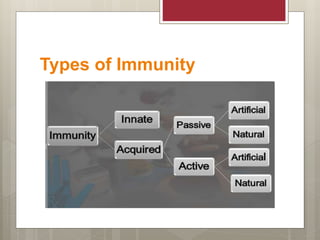
 The body’s defense mechanisms can be divided into:
 (a) innate (non specific / natural ) immunity and
 (b) acquired (specific/ adaptive) immunity.
Types of Immunity
INNATE IMMUNITY/ NON-
SPECIFIC IMMUNITY
Innate Immunity/ non-specific
Immunity
 It is the natural or non-specific resistance of
the body against infections by a number of
mechanical and chemical stimuli. It is called
as nonspecific because it exist in all humans
and present from the earliest time of life
(since birth). Lack of such type of resistance
is called as susceptibility
Components of Natural
Immunity
There are two components of natural or innate
immunity.
 First Line of Defense
 Second Line of Defense
 First Line of Defense
 This type of defense is provided by certain
mechanical and chemical barriers. These barriers
include :
 Dermis and Epidermis
 Mucous Membrane
 Hair
 Mucus
 Lacrimal Fluid
 Gastric acidity
 Saliva
 Urine
 Defecation
 Vomiting
 Vaginal Secretions
 Second Line of Defense
 Once the microorganisms succeed in passing
the first line of defense and enter the deeper
tissues, they are attacked by specific cells(such
as blood monocytes, neutrophils, and tissue
macrophages.) which may ingest or destroy
them. These cells are called as phagocytes
and form the second line of defense.
 This process is called phagocytosis
Features of Innate
Immunity
 Innate immunity shows the following features:
 It is due to the genetic and constitutional makeup of an
individual. Prior contact with microorganisms or their
products is not essential.
 It acts as the first line of defense of the host immune
system.
 The mechanisms involved in innate immunity are
present in place even before exposure to the foreign
agent.
 They are not specific to any infectious agent and do not
seem to improve response on repeated exposures.
 Phagocytic cells (e.g., macrophages and
neutrophils), barriers (e.g., skin and mucous
membrane), and a variety of antimicrobial
compounds synthesized by the host, all play
important roles in innate immunity.
Adaptive (Acquired) Immunity/
specific Immunity
Adaptive (Acquired) Immunity/
specific Immunity
It is an acquired resistance of the body against
infections. It involves the formation of antibodies
as a result of stimulation by foreign particles i.e.
antigens. They are specific and provide specific
resistance.
COMPONANTS OF Adaptive
(Acquired) Immunity
 The cells involved in the adaptive immune
responses are
 (a) lymphocytes, ( T- Lymphocytes , B
Lymphocytes )
 (b) antigen-presenting cells (APCs), and
 (c) effector cells that function to eliminate
antigens.
Features of adaptive immunity
 Adaptive immunity shows the following features:
 It is the resistance acquired by an individual during life.
 It occurs after exposure to an agent and is mediated by
antibodies as well as T lymphocytes.
 It has immunologic memory and a remarkable capability of
discriminating between self and non self antigens.
 Once an antigen has been recognized by the cells of acquired
immune system, the response to it is specific and can be
repeated. In most cases, the acquired immune response
improves with repeated exposure
 The immune response to the second
challenge occurs more quickly than the first, is
stronger, and is often more effective in
neutralizing and clearing the pathogen.
TYPES OF INNATE IMMUNITY
Acquired immunity is of two types.
 Active immunity
 Passive immunity
Active Immunity
It is produced by introducing antigenic substances i.e.
vaccines from outside to stimulate antibodies . it is of two
types:
Naturally Acquired Active Immunity
 It occurs when exposure to antigens is unintentional e.g. it
often follows a disease ;mumps.
Artificially Acquired Active Immunity
 It occurs when exposure to antigens is intentional. It is
often followed by immune response. Vaccines and
toxoids produce such type of response.
Passive Immunity
It is produced by injecting preformed antibodies from
external to the body e.g. immunoglobulins.
It is of two types.
Naturally Acquired Passive Immunity (Congenital
Immunity )
It develops when antibodies pass into the foetal circulation
from mother blood via placenta, unintentionally.
Artificially Acquired Passive Immunity
It develops from the intentional injection of antibody rich
serum into the circulation. Passive immunization is used
both for prophylaxis and therapeutic purposes.
 For prophylaxis …Immunoglobulins , Rabies Antiserum
 For therapeutic … Diptheria Antitoxin
 Antigen
 The word antigen is a shortened form of the
words “antibody generator”.
 Antibodies
 Antibodies are globulin proteins
(immunoglobulins) that are synthesized in
serum and tissue fluids, which react
specifically with the antigen that stimulated
their production.
Antibodies
 Antibodies are globulin proteins
(immunoglobulins) that are synthesized in
serum and tissue fluids, which react
specifically with the antigen that stimulated
their production.
Types of immunoglobulins
 There are five classes of immunoglobulins:
(GAMED)
 (i) immunoglobulin G (IgG),
 (ii) immunoglobulin M (IgM),
 (iii) immunoglobulin A (IgA),
 (iv) immunoglobulin E (IgE), and
 (v) immunoglobulin D (IgD).
Immunological Tolerance
 Immunological tolerance is a state of
unresponsiveness to a particular antigen to
which a person has been exposed earlier.
 The immune tolerance prevents the body to
provide immune response against the self-
antigen. Self Tolerance Failure leads to
autoimmune response
Antigen–Antibody
Reactions
 The interactions between antigens and
antibodies are known as antigen–antibody
reactions.
 The reactions are highly specific, and an
antigen reacts only with antibodies produced
by itself or with closely related antigens.
Clinical and Diagnostic
Applications of Antigen-
Antibody Reaction
 These reactions are essentially specific, they
have been used in many diagnostic tests for
the detection of either the antigen or the
antibody in vitro.
 The antigen and antibody reactions also form
the basis of immunity against microbial
diseases in vivo.
 Serological tests are widely used for detection
of antibodies or antigens for diagnosis of a
wide variety of infectious diseases.
 These serological tests are also used for
diagnosis of autoimmune diseases.
 They also help in typing of blood and tissues
before transplantation.
IMMUNE RESPONSE
 The immune system is developed in a host
primarily to protect the host from harmful effects of
pathogens and other foreign substances.
 The response can be
 antibody- mediated (humoral),
 cell-mediated (cellular), or both.
 An encounter with a microbial or viral agent
usually elicits a complex variety of responses.
 Humoral immunity acts mainly against
extracellular pathogens,
 Cell-mediated immunity (CMI) acts against
intracellular pathogens
HYPERSENSITIVITY
 “Hypersensitivity reaction denotes an immune
response resulting in exaggerated or inappropriate
reactions harmful to host.”
 “It is a harmful immune response in which tissue
damage is induced by exaggerated or inappropriate
immune responses in a sensitized individual on re-
exposure to the same antigen”
 Both the humoral and cell-mediated arms of the
immune response may participate in hypersensitivity
reactions.
Components of
Hypersensitivity
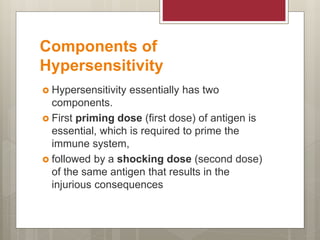
 Hypersensitivity essentially has two
components.
 First priming dose (first dose) of antigen is
essential, which is required to prime the
immune system,
 followed by a shocking dose (second dose)
of the same antigen that results in the
injurious consequences
TYPES OF
HYPERSENSITIVITY
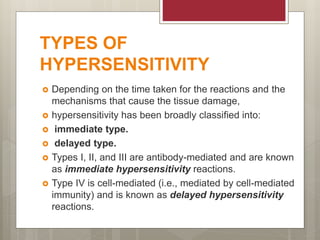
 Depending on the time taken for the reactions and the
mechanisms that cause the tissue damage,
 hypersensitivity has been broadly classified into:
 immediate type.
 delayed type.
 Types I, II, and III are antibody-mediated and are known
as immediate hypersensitivity reactions.
 Type IV is cell-mediated (i.e., mediated by cell-mediated
immunity) and is known as delayed hypersensitivity
reactions.
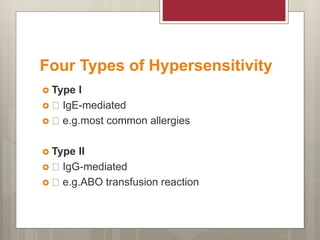
Four Types of Hypersensitivity
 Type I
 IgE-mediated
 e.g.most common allergies
 Type II
 IgG-mediated
 e.g.ABO transfusion reaction
 Type III
 Immune-complex mediated
 e.g. serum sickness
 Type IV
 T cell-mediated; delayed type
 e.g.tuberculin reaction
ALLERGY
 Type I hypersensitivity reaction is commonly called
allergic or immediate hypersensitivity reaction or
anaphylactic hypersensitivity.
 This reaction is always rapid, occurring within 15 to
30 minutes of exposure to an antigen, and always
involves IgE-mediated.
 IgE is responsible for sensitizing mast cells and
providing recognition of antigen for immediate
hypersensitivity reactions.
 Begin with a feeling of uneasiness, followed
by tingling sensations and dizziness.
 Rapidly develop severe symptoms such as,
generalized itching and hives , wheezing and
difficulty breathing, fainting, or a combination
of these and other allergy symptoms
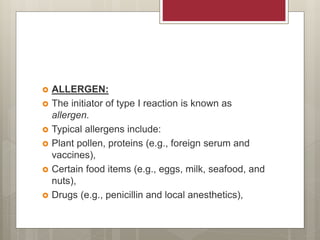
 ALLERGEN:
 The initiator of type I reaction is known as
allergen.
 Typical allergens include:
 Plant pollen, proteins (e.g., foreign serum and
vaccines),
 Certain food items (e.g., eggs, milk, seafood, and
nuts),
 Drugs (e.g., penicillin and local anesthetics),
 Insect products (venom from bees, wasps, and
ants),
 Dust mites, mould spores, and
 Animal hair and dander.
 Exposure may be ingested, inhalation, injection or
direct contact.
 Type I hypersensitivity reactions can be systemic
(e.g., systemic anaphylaxis) or localized to a
specific target tissue or organ (e.g., allergic rhinitis,
asthma).
DRUG ALLERGY
MECHANISM
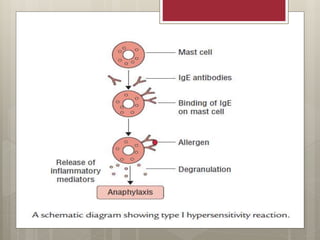
 On exposure to the antigen((drug/ allergen) ,
TH2 cells specific to the antigen are activated,
leading to the stimulation of B cells to produce
IgE antibody .
 The IgE then binds to Fc portion of mast cells
and basophils with high affinity.
 On reexposure to the antigen, the allergen
cross-links the bound IgE, followed by
activation of IgE and degranulation of
basophils and mast cells to release
pharmacologically active mediators within
minutes.
 Binding of IgE to the mast cells is also known
as sensitization, because IgE-coated mast
cells are ready to be activated on repeat
antigen encounter.
 Study and explain mechanism of typeII,
type III, Type IV
Immunization
 Immunization is defined as the procedure by
which the body is prepared to fight against a
specific disease. It is used to induce the
immune resistance of the body to a specific
disease.
 Immunization is of two types:
 1. Passive immunization (inject anibodies)
 2. Active immunization.(inject
antigen/vaccines)
Vaccine
 Vaccine is a substance that is introduced into the
body to prevent the disease produced by certain
pathogens.
 Vaccine consists of dead pathogens or live but
attenuated (artificially weakened) organisms.
 The vaccine induces immunity against the
pathogen, either by production of antibodies or by
activation of T lymphocytes.
 Edward Jenner produced first live vaccine.
 He produced the vaccine for smallpox from
cowpox virus.
 Nowadays, vaccines are used to prevent
many diseases like measles, mumps,
poliomyelitis, tuberculosis, smallpox, rubella,
yellow fever, rabies, typhoid, influenza,
hepatitis B, etc.
 Vaccination:
 The process of distributing and administrating vaccines
is referred to as Vaccination.
 Types of vaccine:
 1. Live-attenuated (weakened) vaccines
 2.Heterologous vaccines
 3. Killed-inactivated vaccines
 4. Sub-unit vaccines
 5.DNA Vaccine
 6.RECOMBINANT VECTOR VACCINES
 7.TOXOID VACCINES:
 1. Live-attenuated (weakened) vaccines
 These vaccines contain modifed strains of a
pathogen (bacteria or viruses) that have been
weakened but are able to multiply within the body
and remain antigenic enough to induce a strong
immune response.
 The varicella-zoster vaccine,
 Oral poliovirus (OPV) vaccine,
 yellow fever virus vaccine are some examples of
this type of vaccine.
 2.Heterologous vaccines
 Heterologous vaccines are a sub-group of live
attenuated vaccines produced from strains that
are pathogenic in animals but not in humans.
 It is a vaccine that confers protective immunity
against a pathogen that shares crossreacting
antigens with the microorganisms in the vaccine.
 example cowpox virus that protects against
smallpox in humans.
 3. Killed-inactivated vaccines:
 To produce this type of vaccines, bacteria or
viruses are killed or inactivated by a chemical
treatment or heat.
 This group includes for example the
inactivated poliovirus (IPV) vaccine, pertussis
vaccine, rabies vaccine, or hepatitis A virus
vaccine.
 4. Sub-unit vaccines
 Instead of the entire microbe, subunit vaccines include
only the antigens that best stimulate the immune
system.
 In some cases, these vaccines use epitopes—the very
specific parts of the antigen that antibodies or T cells
recognize and bind to.
 Because subunit vaccines contain only the essential
antigens and not all the other molecules that make up
the microbe, the chances of adverse reactions to the
vaccine are lower.
 5.DNA Vaccine
 When the genes for a microbe’s antigens are
introduced into the body, some cells will take up
that DNA.
 The DNA then instructs those cells to make the
antigen molecules. The cells secrete the antigens
and display them on their surfaces.
 In other words, the body’s own cells become
vaccine-making factories, creating the antigens
necessary to stimulate the immune system.
 6.RECOMBINANT VECTOR VACCINES
 Recombinant vector vaccines are
experimental vaccines similar to DNA
vaccines, but they use an attenuated virus or
bacterium to introduce microbial DNA to cells
of the body. “Vector” refers to the virus or
bacterium used as the carrier.
 7.TOXOID* VACCINES:
 These vaccines are used when a bacterial
toxin is the main cause of illness.
 When the immune system receives a vaccine
containing a harmless toxoid, it learns how to
fight off the natural toxin. The immune system
produces antibodies that block the toxin. E.g
Vaccines against diphtheria and tetanus.
Routes of Administration
 Deep subcutaneous or intramuscular route
(most vaccines)
 Oral route (oral BCG vaccine)
 Intradermal route (BCG vaccine)
 Scarification (small pox vaccine)
 Intranasal route (live attenuated influenza
vaccine)
Scheme of immunization
 Primary vaccination
 One dose vaccines (BCG, measles, mumps,
rubella, yellow fever)
 Multiple dose vaccines (polio, DPT, hepatitis
B)
 Booster vaccination
 To maintain immunity level after it
declinesafter some time has elapsed (DT,
MMR
 * Toxoids
 Toxoid is a substance which is normally toxic and
has been processed to destroy its toxicity but
retains its capacity to induce antibody production
by immune system.
 Toxoid consists of weakened components or
toxins secreted by the pathogens.
 Toxoids are used to develop immunity against
diseases like diphtheria, tetanus, cholera, etc.
THANK
YOU

Immunology.pptx

  • 1.
    Immunology Nigarish Ehsan PharmD, Mphil LecturerGulab Devi institute of Pharmacy
  • 2.
    Basic Concepts Traditional concept Immunityrefers to protection against infectious diseases. Modern concept Immunity is a function of which an individual recognizes and excludes antigenic foreign substances. It is normally beneficial, but sometimes, it is injurious.
  • 3.
     immune system The cells and molecules responsible for immunity constitute the immune system.  immune response  their collective and coordinated response to foreign substances is called the immune response.
  • 4.
     immune tissues. The immune system is organized into several special tissues, which are collectively termed lymphoid or immune tissues.  Immunology  It is the study of the components and function of the immune system.
  • 5.
    Immunity  It isa natural or acquired resistance of the body to a certain disease or pathogenic microorganism. OR  The ability to ward off disease caused by microbes or their products and to protect against environmental agents such as pollens, drug, food and chemicals is called immunity.
  • 6.
    Types of Immunity The main function of the immune system is to prevent or limit infections by pathogenic microorganisms, such as bacteria, viruses, parasites, and fungi.  The recognition of microorganisms and foreign substances is the first event in immune responses of a host.  The body’s defense mechanisms can be divided into:  (a) innate (non specific / natural ) immunity and  (b) acquired (specific/ adaptive) immunity.
  • 7.
  • 8.
  • 9.
    Innate Immunity/ non-specific Immunity It is the natural or non-specific resistance of the body against infections by a number of mechanical and chemical stimuli. It is called as nonspecific because it exist in all humans and present from the earliest time of life (since birth). Lack of such type of resistance is called as susceptibility
  • 10.
    Components of Natural Immunity Thereare two components of natural or innate immunity.  First Line of Defense  Second Line of Defense
  • 11.
     First Lineof Defense  This type of defense is provided by certain mechanical and chemical barriers. These barriers include :  Dermis and Epidermis  Mucous Membrane  Hair  Mucus  Lacrimal Fluid  Gastric acidity  Saliva  Urine  Defecation  Vomiting  Vaginal Secretions
  • 12.
     Second Lineof Defense  Once the microorganisms succeed in passing the first line of defense and enter the deeper tissues, they are attacked by specific cells(such as blood monocytes, neutrophils, and tissue macrophages.) which may ingest or destroy them. These cells are called as phagocytes and form the second line of defense.  This process is called phagocytosis
  • 13.
    Features of Innate Immunity Innate immunity shows the following features:  It is due to the genetic and constitutional makeup of an individual. Prior contact with microorganisms or their products is not essential.  It acts as the first line of defense of the host immune system.  The mechanisms involved in innate immunity are present in place even before exposure to the foreign agent.  They are not specific to any infectious agent and do not seem to improve response on repeated exposures.
  • 14.
     Phagocytic cells(e.g., macrophages and neutrophils), barriers (e.g., skin and mucous membrane), and a variety of antimicrobial compounds synthesized by the host, all play important roles in innate immunity.
  • 15.
  • 16.
    Adaptive (Acquired) Immunity/ specificImmunity It is an acquired resistance of the body against infections. It involves the formation of antibodies as a result of stimulation by foreign particles i.e. antigens. They are specific and provide specific resistance.
  • 17.
    COMPONANTS OF Adaptive (Acquired)Immunity  The cells involved in the adaptive immune responses are  (a) lymphocytes, ( T- Lymphocytes , B Lymphocytes )  (b) antigen-presenting cells (APCs), and  (c) effector cells that function to eliminate antigens.
  • 18.
    Features of adaptiveimmunity  Adaptive immunity shows the following features:  It is the resistance acquired by an individual during life.  It occurs after exposure to an agent and is mediated by antibodies as well as T lymphocytes.  It has immunologic memory and a remarkable capability of discriminating between self and non self antigens.  Once an antigen has been recognized by the cells of acquired immune system, the response to it is specific and can be repeated. In most cases, the acquired immune response improves with repeated exposure
  • 19.
     The immuneresponse to the second challenge occurs more quickly than the first, is stronger, and is often more effective in neutralizing and clearing the pathogen.
  • 20.
    TYPES OF INNATEIMMUNITY Acquired immunity is of two types.  Active immunity  Passive immunity
  • 21.
    Active Immunity It isproduced by introducing antigenic substances i.e. vaccines from outside to stimulate antibodies . it is of two types: Naturally Acquired Active Immunity  It occurs when exposure to antigens is unintentional e.g. it often follows a disease ;mumps. Artificially Acquired Active Immunity  It occurs when exposure to antigens is intentional. It is often followed by immune response. Vaccines and toxoids produce such type of response.
  • 22.
    Passive Immunity It isproduced by injecting preformed antibodies from external to the body e.g. immunoglobulins. It is of two types. Naturally Acquired Passive Immunity (Congenital Immunity ) It develops when antibodies pass into the foetal circulation from mother blood via placenta, unintentionally. Artificially Acquired Passive Immunity It develops from the intentional injection of antibody rich serum into the circulation. Passive immunization is used both for prophylaxis and therapeutic purposes.  For prophylaxis …Immunoglobulins , Rabies Antiserum  For therapeutic … Diptheria Antitoxin
  • 23.
     Antigen  Theword antigen is a shortened form of the words “antibody generator”.  Antibodies  Antibodies are globulin proteins (immunoglobulins) that are synthesized in serum and tissue fluids, which react specifically with the antigen that stimulated their production.
  • 24.
    Antibodies  Antibodies areglobulin proteins (immunoglobulins) that are synthesized in serum and tissue fluids, which react specifically with the antigen that stimulated their production.
  • 25.
    Types of immunoglobulins There are five classes of immunoglobulins: (GAMED)  (i) immunoglobulin G (IgG),  (ii) immunoglobulin M (IgM),  (iii) immunoglobulin A (IgA),  (iv) immunoglobulin E (IgE), and  (v) immunoglobulin D (IgD).
  • 26.
    Immunological Tolerance  Immunologicaltolerance is a state of unresponsiveness to a particular antigen to which a person has been exposed earlier.  The immune tolerance prevents the body to provide immune response against the self- antigen. Self Tolerance Failure leads to autoimmune response
  • 27.
    Antigen–Antibody Reactions  The interactionsbetween antigens and antibodies are known as antigen–antibody reactions.  The reactions are highly specific, and an antigen reacts only with antibodies produced by itself or with closely related antigens.
  • 28.
    Clinical and Diagnostic Applicationsof Antigen- Antibody Reaction  These reactions are essentially specific, they have been used in many diagnostic tests for the detection of either the antigen or the antibody in vitro.  The antigen and antibody reactions also form the basis of immunity against microbial diseases in vivo.
  • 29.
     Serological testsare widely used for detection of antibodies or antigens for diagnosis of a wide variety of infectious diseases.  These serological tests are also used for diagnosis of autoimmune diseases.  They also help in typing of blood and tissues before transplantation.
  • 30.
    IMMUNE RESPONSE  Theimmune system is developed in a host primarily to protect the host from harmful effects of pathogens and other foreign substances.  The response can be  antibody- mediated (humoral),  cell-mediated (cellular), or both.  An encounter with a microbial or viral agent usually elicits a complex variety of responses.
  • 31.
     Humoral immunityacts mainly against extracellular pathogens,  Cell-mediated immunity (CMI) acts against intracellular pathogens
  • 32.
    HYPERSENSITIVITY  “Hypersensitivity reactiondenotes an immune response resulting in exaggerated or inappropriate reactions harmful to host.”  “It is a harmful immune response in which tissue damage is induced by exaggerated or inappropriate immune responses in a sensitized individual on re- exposure to the same antigen”  Both the humoral and cell-mediated arms of the immune response may participate in hypersensitivity reactions.
  • 33.
    Components of Hypersensitivity  Hypersensitivityessentially has two components.  First priming dose (first dose) of antigen is essential, which is required to prime the immune system,  followed by a shocking dose (second dose) of the same antigen that results in the injurious consequences
  • 34.
    TYPES OF HYPERSENSITIVITY  Dependingon the time taken for the reactions and the mechanisms that cause the tissue damage,  hypersensitivity has been broadly classified into:  immediate type.  delayed type.  Types I, II, and III are antibody-mediated and are known as immediate hypersensitivity reactions.  Type IV is cell-mediated (i.e., mediated by cell-mediated immunity) and is known as delayed hypersensitivity reactions.
  • 35.
    Four Types ofHypersensitivity  Type I  IgE-mediated  e.g.most common allergies  Type II  IgG-mediated  e.g.ABO transfusion reaction
  • 36.
     Type III Immune-complex mediated  e.g. serum sickness  Type IV  T cell-mediated; delayed type  e.g.tuberculin reaction
  • 37.
    ALLERGY  Type Ihypersensitivity reaction is commonly called allergic or immediate hypersensitivity reaction or anaphylactic hypersensitivity.  This reaction is always rapid, occurring within 15 to 30 minutes of exposure to an antigen, and always involves IgE-mediated.  IgE is responsible for sensitizing mast cells and providing recognition of antigen for immediate hypersensitivity reactions.
  • 38.
     Begin witha feeling of uneasiness, followed by tingling sensations and dizziness.  Rapidly develop severe symptoms such as, generalized itching and hives , wheezing and difficulty breathing, fainting, or a combination of these and other allergy symptoms
  • 39.
     ALLERGEN:  Theinitiator of type I reaction is known as allergen.  Typical allergens include:  Plant pollen, proteins (e.g., foreign serum and vaccines),  Certain food items (e.g., eggs, milk, seafood, and nuts),  Drugs (e.g., penicillin and local anesthetics),
  • 40.
     Insect products(venom from bees, wasps, and ants),  Dust mites, mould spores, and  Animal hair and dander.  Exposure may be ingested, inhalation, injection or direct contact.  Type I hypersensitivity reactions can be systemic (e.g., systemic anaphylaxis) or localized to a specific target tissue or organ (e.g., allergic rhinitis, asthma).
  • 41.
    DRUG ALLERGY MECHANISM  Onexposure to the antigen((drug/ allergen) , TH2 cells specific to the antigen are activated, leading to the stimulation of B cells to produce IgE antibody .  The IgE then binds to Fc portion of mast cells and basophils with high affinity.
  • 42.
     On reexposureto the antigen, the allergen cross-links the bound IgE, followed by activation of IgE and degranulation of basophils and mast cells to release pharmacologically active mediators within minutes.  Binding of IgE to the mast cells is also known as sensitization, because IgE-coated mast cells are ready to be activated on repeat antigen encounter.
  • 44.
     Study andexplain mechanism of typeII, type III, Type IV
  • 45.
    Immunization  Immunization isdefined as the procedure by which the body is prepared to fight against a specific disease. It is used to induce the immune resistance of the body to a specific disease.  Immunization is of two types:  1. Passive immunization (inject anibodies)  2. Active immunization.(inject antigen/vaccines)
  • 46.
    Vaccine  Vaccine isa substance that is introduced into the body to prevent the disease produced by certain pathogens.  Vaccine consists of dead pathogens or live but attenuated (artificially weakened) organisms.  The vaccine induces immunity against the pathogen, either by production of antibodies or by activation of T lymphocytes.
  • 47.
     Edward Jennerproduced first live vaccine.  He produced the vaccine for smallpox from cowpox virus.  Nowadays, vaccines are used to prevent many diseases like measles, mumps, poliomyelitis, tuberculosis, smallpox, rubella, yellow fever, rabies, typhoid, influenza, hepatitis B, etc.
  • 48.
     Vaccination:  Theprocess of distributing and administrating vaccines is referred to as Vaccination.  Types of vaccine:  1. Live-attenuated (weakened) vaccines  2.Heterologous vaccines  3. Killed-inactivated vaccines  4. Sub-unit vaccines  5.DNA Vaccine  6.RECOMBINANT VECTOR VACCINES  7.TOXOID VACCINES:
  • 49.
     1. Live-attenuated(weakened) vaccines  These vaccines contain modifed strains of a pathogen (bacteria or viruses) that have been weakened but are able to multiply within the body and remain antigenic enough to induce a strong immune response.  The varicella-zoster vaccine,  Oral poliovirus (OPV) vaccine,  yellow fever virus vaccine are some examples of this type of vaccine.
  • 50.
     2.Heterologous vaccines Heterologous vaccines are a sub-group of live attenuated vaccines produced from strains that are pathogenic in animals but not in humans.  It is a vaccine that confers protective immunity against a pathogen that shares crossreacting antigens with the microorganisms in the vaccine.  example cowpox virus that protects against smallpox in humans.
  • 51.
     3. Killed-inactivatedvaccines:  To produce this type of vaccines, bacteria or viruses are killed or inactivated by a chemical treatment or heat.  This group includes for example the inactivated poliovirus (IPV) vaccine, pertussis vaccine, rabies vaccine, or hepatitis A virus vaccine.
  • 52.
     4. Sub-unitvaccines  Instead of the entire microbe, subunit vaccines include only the antigens that best stimulate the immune system.  In some cases, these vaccines use epitopes—the very specific parts of the antigen that antibodies or T cells recognize and bind to.  Because subunit vaccines contain only the essential antigens and not all the other molecules that make up the microbe, the chances of adverse reactions to the vaccine are lower.
  • 53.
     5.DNA Vaccine When the genes for a microbe’s antigens are introduced into the body, some cells will take up that DNA.  The DNA then instructs those cells to make the antigen molecules. The cells secrete the antigens and display them on their surfaces.  In other words, the body’s own cells become vaccine-making factories, creating the antigens necessary to stimulate the immune system.
  • 54.
     6.RECOMBINANT VECTORVACCINES  Recombinant vector vaccines are experimental vaccines similar to DNA vaccines, but they use an attenuated virus or bacterium to introduce microbial DNA to cells of the body. “Vector” refers to the virus or bacterium used as the carrier.
  • 55.
     7.TOXOID* VACCINES: These vaccines are used when a bacterial toxin is the main cause of illness.  When the immune system receives a vaccine containing a harmless toxoid, it learns how to fight off the natural toxin. The immune system produces antibodies that block the toxin. E.g Vaccines against diphtheria and tetanus.
  • 56.
    Routes of Administration Deep subcutaneous or intramuscular route (most vaccines)  Oral route (oral BCG vaccine)  Intradermal route (BCG vaccine)  Scarification (small pox vaccine)  Intranasal route (live attenuated influenza vaccine)
  • 57.
    Scheme of immunization Primary vaccination  One dose vaccines (BCG, measles, mumps, rubella, yellow fever)  Multiple dose vaccines (polio, DPT, hepatitis B)  Booster vaccination  To maintain immunity level after it declinesafter some time has elapsed (DT, MMR
  • 58.
     * Toxoids Toxoid is a substance which is normally toxic and has been processed to destroy its toxicity but retains its capacity to induce antibody production by immune system.  Toxoid consists of weakened components or toxins secreted by the pathogens.  Toxoids are used to develop immunity against diseases like diphtheria, tetanus, cholera, etc.
  • 59.