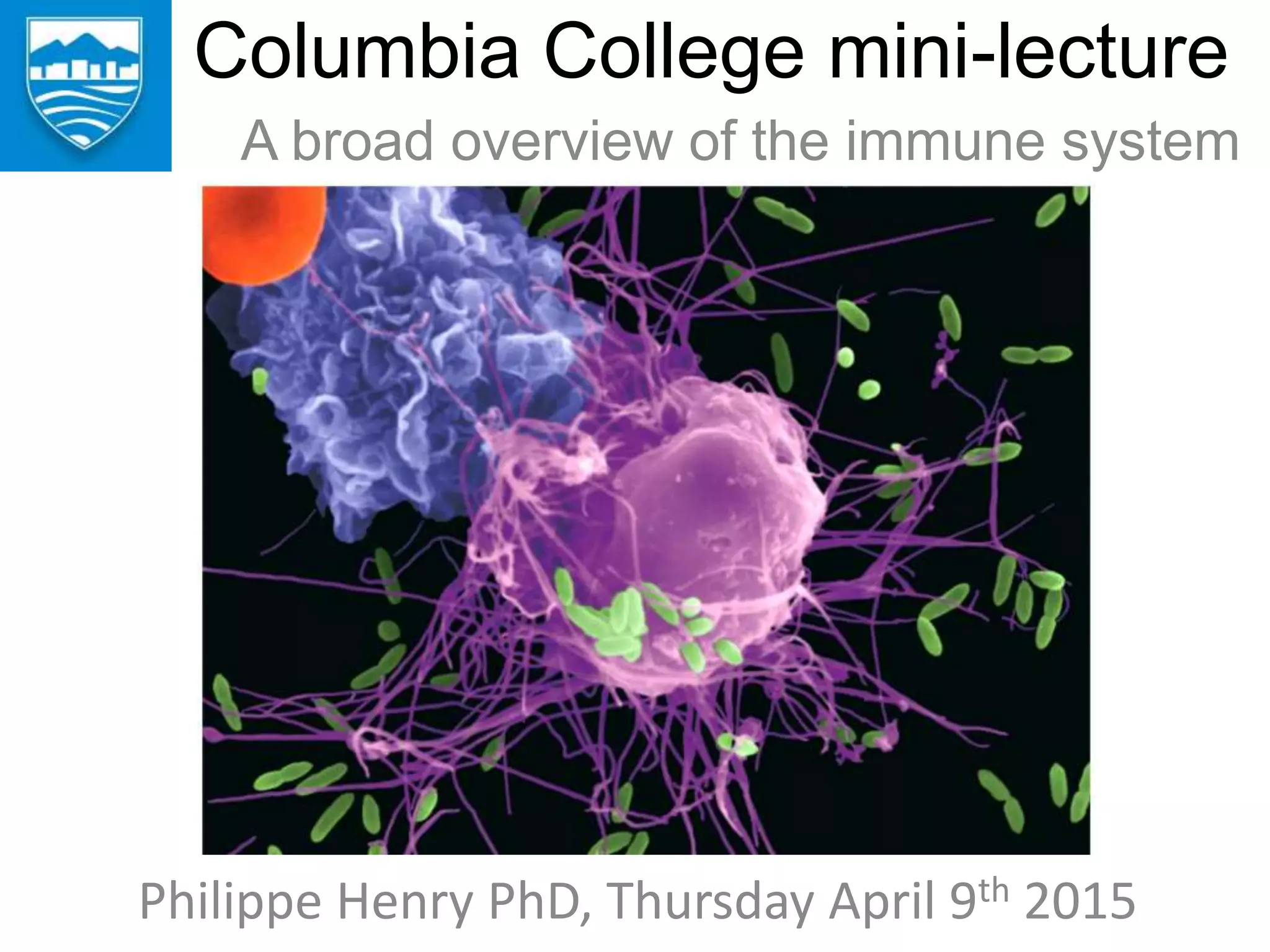

Columbia College mini-lecture
Philippe Henry PhD, Thursday April 9th 2015
A broad overview of the immune system
Based on chapters 1 & 2 of Kuby, Immunology (6th edition) 2007
Outline:
- background on
importance of the
immune system
- innate and
adaptive
response
- cells of the
immune system
(time permitting)
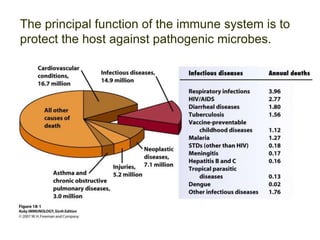
The principal function of the immune system is to
protect the host against pathogenic microbes.
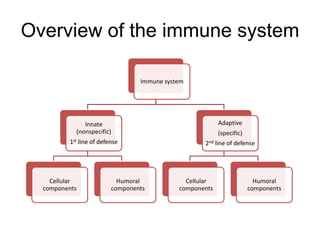
Overview of the immune system
Immune system
Innate
(nonspecific)
1st line of defense
Cellular
components
Humoral
components
Adaptive
(specific)
2nd line of defense
Cellular
components
Humoral
components
Innate immunity is present in all
multicellular plants and animals
but only vertebrates have
adaptive immunity.
Innate Immunity is
ubiquitous
6
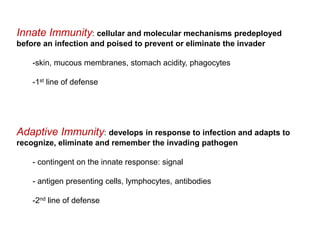
Innate Immunity: cellular and molecular mechanisms predeployed
before an infection and poised to prevent or eliminate the invader
-skin, mucous membranes, stomach acidity, phagocytes
-1st line of defense
Adaptive Immunity: develops in response to infection and adapts to
recognize, eliminate and remember the invading pathogen
- contingent on the innate response: signal
- antigen presenting cells, lymphocytes, antibodies
-2nd line of defense
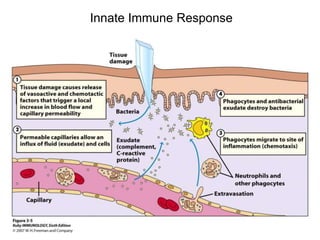
Innate Immune Response
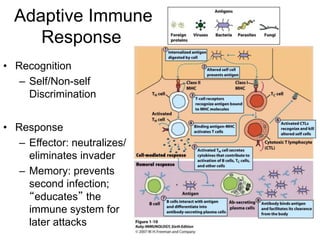
• Recognition
– Self/Non-self
Discrimination
• Response
– Effector: neutralizes/
eliminates invader
– Memory: prevents
second infection;
“educates” the
immune system for
later attacks
Adaptive Immune
Response
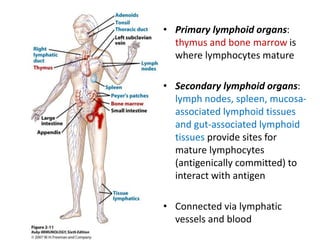
• Primary lymphoid organs:
thymus and bone marrow is
where lymphocytes mature
• Secondary lymphoid organs:
lymph nodes, spleen, mucosa-
associated lymphoid tissues
and gut-associated lymphoid
tissues provide sites for
mature lymphocytes
(antigenically committed) to
interact with antigen
• Connected via lymphatic
vessels and blood
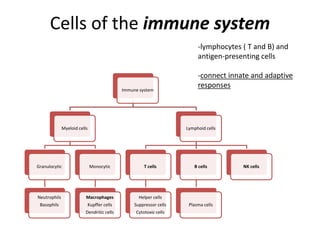
Cells of the immune system
Immune system
Myeloid cells
Granulocytic
Neutrophils
Basophils
Monocytic
Macrophages
Kupffer cells
Dendritic cells
Lymphoid cells
T cells
Helper cells
Suppressor cells
Cytotoxic cells
B cells
Plasma cells
NK cells
-lymphocytes ( T and B) and
antigen-presenting cells
-connect innate and adaptive
responses
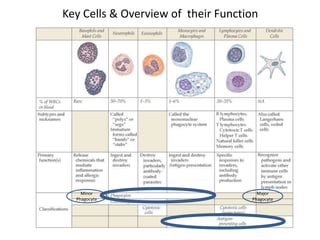
Key Cells & Overview of their Function
Major
Phagocyte
Minor
Phagocyte
Cells of the immune system: innate
• Phagocytes
– Monocytes/macrophages
– Dendritic cells
• Basophils and mast cells
• Platelets
• NK cells
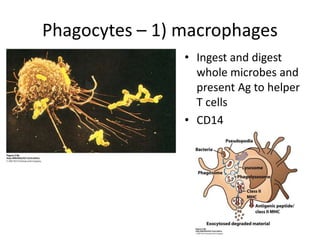
Phagocytes – 1) macrophages
• Ingest and digest
whole microbes and
present Ag to helper
T cells
• CD14
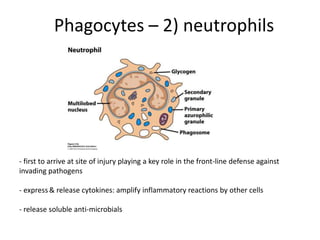
Phagocytes – 2) neutrophils
- first to arrive at site of injury playing a key role in the front-line defense against
invading pathogens
- express & release cytokines: amplify inflammatory reactions by other cells
- release soluble anti-microbials
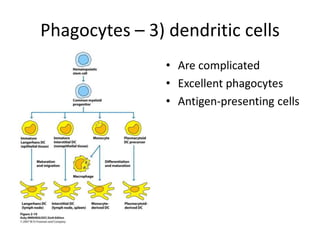
• Are complicated
• Excellent phagocytes
• Antigen-presenting cells
Phagocytes – 3) dendritic cells
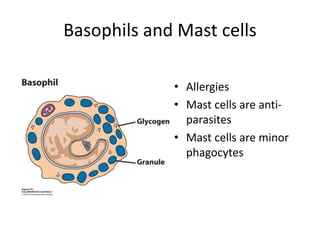
Basophils and Mast cells
• Allergies
• Mast cells are anti-
parasites
• Mast cells are minor
phagocytes
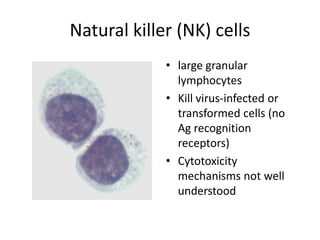
Natural killer (NK) cells
• large granular
lymphocytes
• Kill virus-infected or
transformed cells (no
Ag recognition
receptors)
• Cytotoxicity
mechanisms not well
understood
Cells of the immune system: APC
• Cells that link the innate and adaptive arms
– Antigen presenting cells (APCs)
• Heterogenous population with role in innate immunity
and activation of Th cells
– Examples
• Phagocytes like macrophages and dendritic cells
• B cells
Cells of the immune system: adaptive
• Lymphocytes
– B cells
• Plasma cells (Ab producing)
– T cells
• Cytotoxic (CTL)
• Helper (Th)
– Th1
– Th2
– Th17
– T-reg
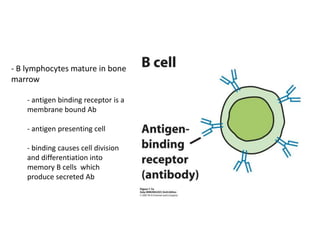
- B lymphocytes mature in bone
marrow
- antigen binding receptor is a
membrane bound Ab
- antigen presenting cell
- binding causes cell division
and differentiation into
memory B cells which
produce secreted Ab
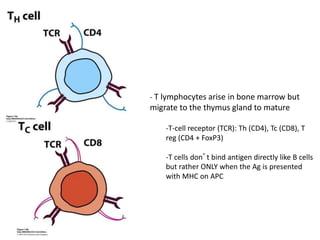
- T lymphocytes arise in bone marrow but
migrate to the thymus gland to mature
-T-cell receptor (TCR): Th (CD4), Tc (CD8), T
reg (CD4 + FoxP3)
-T cells don’t bind antigen directly like B cells
but rather ONLY when the Ag is presented
with MHC on APC
Thank you

Immune system mini lecture

  • 1.
    Columbia College mini-lecture PhilippeHenry PhD, Thursday April 9th 2015 A broad overview of the immune system
  • 2.
    Based on chapters1 & 2 of Kuby, Immunology (6th edition) 2007 Outline: - background on importance of the immune system - innate and adaptive response - cells of the immune system (time permitting)
  • 4.
    The principal functionof the immune system is to protect the host against pathogenic microbes.
  • 5.
    Overview of theimmune system Immune system Innate (nonspecific) 1st line of defense Cellular components Humoral components Adaptive (specific) 2nd line of defense Cellular components Humoral components
  • 6.
    Innate immunity ispresent in all multicellular plants and animals but only vertebrates have adaptive immunity. Innate Immunity is ubiquitous 6
  • 7.
    Innate Immunity: cellularand molecular mechanisms predeployed before an infection and poised to prevent or eliminate the invader -skin, mucous membranes, stomach acidity, phagocytes -1st line of defense Adaptive Immunity: develops in response to infection and adapts to recognize, eliminate and remember the invading pathogen - contingent on the innate response: signal - antigen presenting cells, lymphocytes, antibodies -2nd line of defense
  • 8.
  • 9.
    • Recognition – Self/Non-self Discrimination •Response – Effector: neutralizes/ eliminates invader – Memory: prevents second infection; “educates” the immune system for later attacks Adaptive Immune Response
  • 10.
    • Primary lymphoidorgans: thymus and bone marrow is where lymphocytes mature • Secondary lymphoid organs: lymph nodes, spleen, mucosa- associated lymphoid tissues and gut-associated lymphoid tissues provide sites for mature lymphocytes (antigenically committed) to interact with antigen • Connected via lymphatic vessels and blood
  • 11.
    Cells of theimmune system Immune system Myeloid cells Granulocytic Neutrophils Basophils Monocytic Macrophages Kupffer cells Dendritic cells Lymphoid cells T cells Helper cells Suppressor cells Cytotoxic cells B cells Plasma cells NK cells -lymphocytes ( T and B) and antigen-presenting cells -connect innate and adaptive responses
  • 12.
    Key Cells &Overview of their Function Major Phagocyte Minor Phagocyte
  • 13.
    Cells of theimmune system: innate • Phagocytes – Monocytes/macrophages – Dendritic cells • Basophils and mast cells • Platelets • NK cells
  • 14.
    Phagocytes – 1)macrophages • Ingest and digest whole microbes and present Ag to helper T cells • CD14
  • 15.
    Phagocytes – 2)neutrophils - first to arrive at site of injury playing a key role in the front-line defense against invading pathogens - express & release cytokines: amplify inflammatory reactions by other cells - release soluble anti-microbials
  • 16.
    • Are complicated •Excellent phagocytes • Antigen-presenting cells Phagocytes – 3) dendritic cells
  • 17.
    Basophils and Mastcells • Allergies • Mast cells are anti- parasites • Mast cells are minor phagocytes
  • 18.
    Natural killer (NK)cells • large granular lymphocytes • Kill virus-infected or transformed cells (no Ag recognition receptors) • Cytotoxicity mechanisms not well understood
  • 19.
    Cells of theimmune system: APC • Cells that link the innate and adaptive arms – Antigen presenting cells (APCs) • Heterogenous population with role in innate immunity and activation of Th cells – Examples • Phagocytes like macrophages and dendritic cells • B cells
  • 20.
    Cells of theimmune system: adaptive • Lymphocytes – B cells • Plasma cells (Ab producing) – T cells • Cytotoxic (CTL) • Helper (Th) – Th1 – Th2 – Th17 – T-reg
  • 21.
    - B lymphocytesmature in bone marrow - antigen binding receptor is a membrane bound Ab - antigen presenting cell - binding causes cell division and differentiation into memory B cells which produce secreted Ab
  • 22.
    - T lymphocytesarise in bone marrow but migrate to the thymus gland to mature -T-cell receptor (TCR): Th (CD4), Tc (CD8), T reg (CD4 + FoxP3) -T cells don’t bind antigen directly like B cells but rather ONLY when the Ag is presented with MHC on APC
  • 24.