Immunology Lecture 3rd
Cells of Immune System
BY
Dr. Humera Kausar
22th
Sep 2014
Cells of the Immune System
Leucocytes
Cells of the innate immune system:
• Phagocytes
– Monocytes/macrophages
– Neutrophils/PMNs/
• NK cells
• Basophils and mast cells
• Eosinophils
Phagocytic Cells Mononuclear
PROMONOCYTES
MONOCYTES
MACROPHAGES (Fixed or Free)
Brain ---------Microglial cells
Lungs ------------Alveolar cells
Liver ----------------- Kupffer cells
Connective tisues-----Histocytes
Kidney ---------------------Mesangial cells
Bones ------------------------ Osteoclasts
Skin ------------------------Langerhans cells
Macrophages
• Characteristic nucleus
• lysosomes
• CD14 membrane
marker protein
Macrophage
Macrophages
Activated by variety of stimuli in the course of an
immune response.
Activated macrophages are more effective then
resting ones in eliminating potential pathogen.
Activated macrophages secreted various cytotoxic
proteins that help to eliminate broad range of targets
including
o virus infected cells
o Tumor cells
o Intracellular bacteria
 Also act as antigen presenting cells
Macrophage as an antigen presenting cells
Granulocytes
Neutrophils
Polymorphonuclear (PMN) leukocyte.
 Has multilobed nucleus and granulated cytoplasm.
 Stains with both acidic and basic dyes.
 Constitute 50% to 70% of the circulating
leukocytes.
 After release in to the blood, circulates 7 –10 hours
before migrating in to the tissues.
 Life span is few days. (3 days)
Neutrophils (PMNs)
• CD66 membrane
marker protein
Geimsa stains
Neutrophil
Neutrophils
First cells to arrive at the site of inflammation.
 In response to many types of infections the bone
marrow releases increased number of circulating
neutrophils called leukocytosis.
Act as phagocytic cells.
GRANULOCYTES
Neutrophils GRANULOCYTES
Lytic enzymes and bactericidal substances in
neutrophils are contained within primary and
secondary granules.
 Larger denser primary granules are a type of
lysosome containing
peroxidase, lysozyme, various hydrolytic enzymes
 Smaller secondary granules contains,
collagenases, lactoferrin, lysozyme
 Both primary and secondary granules fuse with
phagosomes.
Neutrophil
Eosinophils
Stain with acid dye eosin red.
Has bilobed nucleus and granulated cytoplasm.
Constitute 1% to 3% of WBC population.
 Like neutrophils, motile phagocytic cells that can
migrate from blood into tissues.
 Phagocytic role of eosinophils are less significant
than that of neutrophils.
 Play a role in the defense against parasitic organisms
by secreting contents of eosinophilic granules, which
damage the parasite membrane.
GRANULOCYTES
Eosinophil
Basophils
 Basophil has a lobed nucleus and heavily granulated
cytoplasm.
 Stains with basic dye methylene blue.
 Non phagosytic granulocyte.
 Constitute <1% of circulating WBC.
 Function by releasing pharmacological active
substances from cytoplasmic granules.
 Play a major role in certain allergic responses.
GRANULOCYTES
Basophil
Mast Cells
 By hematopoiesis, released into the blood as
undifferentiated cells.
 Do not differentiate until they leave the blood and
enter the tissues, including
skin, connecting tissue of various organs,
mucosal epithelial tissues of respiratory, genitourinary
& digestive tracts
 Like circulating basophils, mast cells have large
numbers of cytoplasmic granules that contains
histamines and other pharmacological active substances.
 Play an important role in the development of allergies.
MEDIATORS RELEASED
Prostaglandin D2
Platelet Activating Factor
Tryptase
Heparin
Histamin
IL-4, IL-5, IL-6, IL-8
TNFɑ
CAUSING
Vasodilation,
increased vasopermeability,
contraction of smooth muscles,
bronchoconstriction,
increased eosinophil, neutrophil & monocyte
chemotaxis,
anticoagulation,
increased fibroblast proliferation,
platelet activation
Dendritic Cells
Activation of T cells and
initiate adaptive immunity
Found mainly in lymphoid
tissue
Function as antigen
presenting cells (APC)
Most potent stimulator of
T-cell response
Dendritic Cells
Dendritic Cells
DC covered with long membranous extensions
that resemble the dendrites of nerve cells.
 Display class I & class II MHC.
B and T lymphocytes are the mediators of
immunity, but their function is under the control
of dendritic cells.
 Dendritic cells in the periphery capture and
process antigens.
Dendritic Cells
 Express lymphocyte co-stimulatory molecules,
(B7, CD40)
 Migrate to lymphoid organs and secrete
cytokines to initiate immune responses.
 They not only activate lymphocytes, they also
tolerize T cells to antigens that are innate to the
body (self-antigens), thereby minimizing
autoimmune reactions.
Cells of the immune system:
APC
• Cells that link the innate and adaptive arms
– Antigen presenting cells (APCs)
• Heterogenous population with role in innate immunity
and activation of Th cells
• Rich in MHC class II molecules
– Examples
• Dendritic cells
• Macrophages
• B cells
• Others (Mast cells)
Cells of Adaptive Immune
System
T cells and B cells
Cells of the Adaptive Immune System:
• Lymphocytes (Lymphoid Cells)
– B cells
• Plasma cells (Ab producing)
• Memory cells
– T cells
• Cytotoxic (CTL)
• Helper (Th)
– Th1
– Th2
– Null cells (NK cells)
Lymphoid Cells
 Contributes 20-40% of body’s WBCs,
Naïve or unprimed cells are small, motile, non-
phagocytic cells.
 Can not be distinguished morphologically.
 Resting cells are in G0 phase of cell cycle.
 Small lymphocytes are 6 um in diameter.
 Cytoplasm barely covers the rim around
nucleus.
Lymphoid Cells
 Have,
o densely packed chromatin
o few mitochondria
o poorly developed endoplasmic reticulum
o Golgi apparatus
 Life span of effector cell is few days to few
weeks.
B-Lymphocytes
Derived its name from its site of maturation in the
Bursa of fabricius in birds and Bone marrow in humans
•Plasma cells (Ab producing)
•Memory cells
B-CELL RRECEPTORS
Membrane bond Ig molecules
i.e.,1.5 x 105
molecules/cell
CD 45 (Marker B220)
MHC II (Antigen Presenting
receptor)
CD35(Complement receptor)
CD21(Complement receptor)
CD32(Fc RII)ɤ
T-CELL RRECEPTORS
TCR
Thy 1 (1st
receptor remains
throughout life span of the cell)
CD4 (T- helper cell)
CD8 (T- cytotoxic cell)
Ratio of Th : Tc = 2:1
T- helper cell vs T cytotoxic cell)
Specificity of adaptive immune
response
• Resides with Ag
Receptor on T and B
cells
• TCR and BCR – both
specific for only ONE
antigenic determinant
• TCR is monovalent
• BCR is divalent
T cell
TCR Ag
B cell
BCR
Ag
Ag
Cytotoxic T cells (Tc) and Class I MHC proteins
The cell-cell interaction between
the infected cell and the Tc
cell is mediated by the
MHC/antigen complex and TCR
The Tc cell produces cytotoxic proteins
perforins—produce holes or pores in the
target cell and granzymes enter the
virus infected cell causing apoptosis or
programmed cell death
The cytotoxic proteins only affect those
cells to which the Tc cell has specifically
interacted
T helper cells and (TH) Class II MHC proteins
Specialized TH cell involved in
the inflammatory response
Cell-cell interaction mediated
by the TCR and the class II
MHC-antigen complex activates
The TH cell which produces
cytokines
TNF-alpha (tumor necrosis factor)
IFN-gamma (interferon)
GM-CSF (granulocyte-monocyte
colony stimulating factor)
These cytokines further stimulate
macrophages to increase phagocytic
activity and to in turn produce cytokines
that promote inflammation
NATURAL-KILLER CELLS
 Fails to express membrane molecules that
distinguished B and T cells.
 Fails to express antigen binding receptors.
 Constitute 5% - 10% of lymphocytes in human
peripheral blood.
 NK cells have ability to recognize tumor or
virus infected cells.
 NK cells express membrane receptor CD16 for
a specific region of antibody molecule (ADCC).
NATURAL-KILLER CELLS
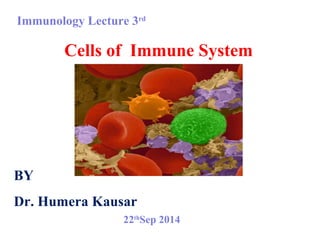
Human red blood cells
(red), activated platelets
(purple) and white blood
cells - monocyte (green)
and T lymphocyte
(orange).
Colorized-SEM
(scanning electron
micrograph)
Magnification:-1200x--
(Based on an image
size of 1 inch in the
narrow dimension)
Cells of the Immune System
 
‫پیدا‬ ‫سے‬ ‫مٹی‬ ‫تمہیں‬ ‫نے‬ ‫جس‬ ‫ہے‬ ‫وہی‬ ‫ا‬
‫اس‬ ‫اور‬ ‫دیا‬ ‫کر‬ ‫مقرر‬ ‫وقت‬ ‫ایک‬ ‫پھر‬ ‫کیا‬
‫بھی‬ ‫پھر‬ ‫تم‬ ‫ہے‬ ‫مقرر‬ ‫مدت‬ ‫ایک‬ ‫کےہاں‬
‫ہو‬ ‫کرتے‬ ‫شک‬)2(
‫عام‬َ ‫لن‬‫ٴ‬ ‫ا‬ ‫ة‬ُ ‫ر‬َ ‫و‬ۡ ‫س‬ُ

Immune cells 3rd lecture

  • 1.
    Immunology Lecture 3rd Cellsof Immune System BY Dr. Humera Kausar 22th Sep 2014
  • 2.
    Cells of theImmune System
  • 3.
    Cells of theImmune System Leucocytes
  • 4.
    Cells of theinnate immune system: • Phagocytes – Monocytes/macrophages – Neutrophils/PMNs/ • NK cells • Basophils and mast cells • Eosinophils
  • 5.
    Phagocytic Cells Mononuclear PROMONOCYTES MONOCYTES MACROPHAGES(Fixed or Free) Brain ---------Microglial cells Lungs ------------Alveolar cells Liver ----------------- Kupffer cells Connective tisues-----Histocytes Kidney ---------------------Mesangial cells Bones ------------------------ Osteoclasts Skin ------------------------Langerhans cells
  • 6.
    Macrophages • Characteristic nucleus •lysosomes • CD14 membrane marker protein Macrophage
  • 7.
    Macrophages Activated by varietyof stimuli in the course of an immune response. Activated macrophages are more effective then resting ones in eliminating potential pathogen. Activated macrophages secreted various cytotoxic proteins that help to eliminate broad range of targets including o virus infected cells o Tumor cells o Intracellular bacteria  Also act as antigen presenting cells
  • 8.
    Macrophage as anantigen presenting cells
  • 9.
    Granulocytes Neutrophils Polymorphonuclear (PMN) leukocyte. Has multilobed nucleus and granulated cytoplasm.  Stains with both acidic and basic dyes.  Constitute 50% to 70% of the circulating leukocytes.  After release in to the blood, circulates 7 –10 hours before migrating in to the tissues.  Life span is few days. (3 days)
  • 10.
    Neutrophils (PMNs) • CD66membrane marker protein Geimsa stains Neutrophil
  • 11.
    Neutrophils First cells toarrive at the site of inflammation.  In response to many types of infections the bone marrow releases increased number of circulating neutrophils called leukocytosis. Act as phagocytic cells. GRANULOCYTES
  • 12.
    Neutrophils GRANULOCYTES Lytic enzymesand bactericidal substances in neutrophils are contained within primary and secondary granules.  Larger denser primary granules are a type of lysosome containing peroxidase, lysozyme, various hydrolytic enzymes  Smaller secondary granules contains, collagenases, lactoferrin, lysozyme  Both primary and secondary granules fuse with phagosomes.
  • 13.
  • 14.
    Eosinophils Stain with aciddye eosin red. Has bilobed nucleus and granulated cytoplasm. Constitute 1% to 3% of WBC population.  Like neutrophils, motile phagocytic cells that can migrate from blood into tissues.  Phagocytic role of eosinophils are less significant than that of neutrophils.  Play a role in the defense against parasitic organisms by secreting contents of eosinophilic granules, which damage the parasite membrane. GRANULOCYTES
  • 15.
  • 16.
    Basophils  Basophil hasa lobed nucleus and heavily granulated cytoplasm.  Stains with basic dye methylene blue.  Non phagosytic granulocyte.  Constitute <1% of circulating WBC.  Function by releasing pharmacological active substances from cytoplasmic granules.  Play a major role in certain allergic responses. GRANULOCYTES
  • 17.
  • 18.
    Mast Cells  Byhematopoiesis, released into the blood as undifferentiated cells.  Do not differentiate until they leave the blood and enter the tissues, including skin, connecting tissue of various organs, mucosal epithelial tissues of respiratory, genitourinary & digestive tracts  Like circulating basophils, mast cells have large numbers of cytoplasmic granules that contains histamines and other pharmacological active substances.  Play an important role in the development of allergies.
  • 19.
    MEDIATORS RELEASED Prostaglandin D2 PlateletActivating Factor Tryptase Heparin Histamin IL-4, IL-5, IL-6, IL-8 TNFɑ
  • 20.
    CAUSING Vasodilation, increased vasopermeability, contraction ofsmooth muscles, bronchoconstriction, increased eosinophil, neutrophil & monocyte chemotaxis, anticoagulation, increased fibroblast proliferation, platelet activation
  • 21.
    Dendritic Cells Activation ofT cells and initiate adaptive immunity Found mainly in lymphoid tissue Function as antigen presenting cells (APC) Most potent stimulator of T-cell response
  • 22.
  • 23.
    Dendritic Cells DC coveredwith long membranous extensions that resemble the dendrites of nerve cells.  Display class I & class II MHC. B and T lymphocytes are the mediators of immunity, but their function is under the control of dendritic cells.  Dendritic cells in the periphery capture and process antigens.
  • 24.
    Dendritic Cells  Expresslymphocyte co-stimulatory molecules, (B7, CD40)  Migrate to lymphoid organs and secrete cytokines to initiate immune responses.  They not only activate lymphocytes, they also tolerize T cells to antigens that are innate to the body (self-antigens), thereby minimizing autoimmune reactions.
  • 25.
    Cells of theimmune system: APC • Cells that link the innate and adaptive arms – Antigen presenting cells (APCs) • Heterogenous population with role in innate immunity and activation of Th cells • Rich in MHC class II molecules – Examples • Dendritic cells • Macrophages • B cells • Others (Mast cells)
  • 26.
    Cells of AdaptiveImmune System T cells and B cells
  • 27.
    Cells of theAdaptive Immune System: • Lymphocytes (Lymphoid Cells) – B cells • Plasma cells (Ab producing) • Memory cells – T cells • Cytotoxic (CTL) • Helper (Th) – Th1 – Th2 – Null cells (NK cells)
  • 28.
    Lymphoid Cells  Contributes20-40% of body’s WBCs, Naïve or unprimed cells are small, motile, non- phagocytic cells.  Can not be distinguished morphologically.  Resting cells are in G0 phase of cell cycle.  Small lymphocytes are 6 um in diameter.  Cytoplasm barely covers the rim around nucleus.
  • 29.
    Lymphoid Cells  Have, odensely packed chromatin o few mitochondria o poorly developed endoplasmic reticulum o Golgi apparatus  Life span of effector cell is few days to few weeks.
  • 30.
    B-Lymphocytes Derived its namefrom its site of maturation in the Bursa of fabricius in birds and Bone marrow in humans •Plasma cells (Ab producing) •Memory cells
  • 31.
    B-CELL RRECEPTORS Membrane bondIg molecules i.e.,1.5 x 105 molecules/cell CD 45 (Marker B220) MHC II (Antigen Presenting receptor) CD35(Complement receptor) CD21(Complement receptor) CD32(Fc RII)ɤ
  • 32.
    T-CELL RRECEPTORS TCR Thy 1(1st receptor remains throughout life span of the cell) CD4 (T- helper cell) CD8 (T- cytotoxic cell) Ratio of Th : Tc = 2:1
  • 33.
    T- helper cellvs T cytotoxic cell)
  • 34.
    Specificity of adaptiveimmune response • Resides with Ag Receptor on T and B cells • TCR and BCR – both specific for only ONE antigenic determinant • TCR is monovalent • BCR is divalent T cell TCR Ag B cell BCR Ag Ag
  • 36.
    Cytotoxic T cells(Tc) and Class I MHC proteins The cell-cell interaction between the infected cell and the Tc cell is mediated by the MHC/antigen complex and TCR The Tc cell produces cytotoxic proteins perforins—produce holes or pores in the target cell and granzymes enter the virus infected cell causing apoptosis or programmed cell death The cytotoxic proteins only affect those cells to which the Tc cell has specifically interacted
  • 37.
    T helper cellsand (TH) Class II MHC proteins Specialized TH cell involved in the inflammatory response Cell-cell interaction mediated by the TCR and the class II MHC-antigen complex activates The TH cell which produces cytokines TNF-alpha (tumor necrosis factor) IFN-gamma (interferon) GM-CSF (granulocyte-monocyte colony stimulating factor) These cytokines further stimulate macrophages to increase phagocytic activity and to in turn produce cytokines that promote inflammation
  • 38.
    NATURAL-KILLER CELLS  Failsto express membrane molecules that distinguished B and T cells.  Fails to express antigen binding receptors.  Constitute 5% - 10% of lymphocytes in human peripheral blood.  NK cells have ability to recognize tumor or virus infected cells.  NK cells express membrane receptor CD16 for a specific region of antibody molecule (ADCC).
  • 39.
  • 40.
    Human red bloodcells (red), activated platelets (purple) and white blood cells - monocyte (green) and T lymphocyte (orange). Colorized-SEM (scanning electron micrograph) Magnification:-1200x-- (Based on an image size of 1 inch in the narrow dimension) Cells of the Immune System
  • 41.
      ‫پیدا‬ ‫سے‬ ‫مٹی‬‫تمہیں‬ ‫نے‬ ‫جس‬ ‫ہے‬ ‫وہی‬ ‫ا‬ ‫اس‬ ‫اور‬ ‫دیا‬ ‫کر‬ ‫مقرر‬ ‫وقت‬ ‫ایک‬ ‫پھر‬ ‫کیا‬ ‫بھی‬ ‫پھر‬ ‫تم‬ ‫ہے‬ ‫مقرر‬ ‫مدت‬ ‫ایک‬ ‫کےہاں‬ ‫ہو‬ ‫کرتے‬ ‫شک‬)2( ‫عام‬َ ‫لن‬‫ٴ‬ ‫ا‬ ‫ة‬ُ ‫ر‬َ ‫و‬ۡ ‫س‬ُ

Editor's Notes