Image Quality
What is an Image
 Is a mental or real resemblance of an objects
 Mental images are those generated as mental pictures
within our minds. These cannot be subjected to
objective studies
 Real images are those having physical appearances
such as photographic or radiographic images.These
can be subjected to scientific measurements and
objective study
Image Characteristics
 For images to give accurate representation on viewing,
the following characteristics have to be considered:
 Noise
 Contrast
 Sharpness
 Resolution
Noise
 Noise is often associated with sound but in simple
terms it is that which was not intended to be heard.
 Likewise in visible image, noise is that signal that was
not intended and will distort the intended signal.
 This happens always but the difference between the
intended and unintended parts determine the
visibility of the image.
 Thus the signal –to –noise ratio has to be high for
better visibility.
Radiographic Image Quality
 Assessment of radiographic image quality includes:
the visibility of recorded detail (photographic
properties) and sharpness of recorded detail
(geometric properties)
 The accuracy with which the radiographic image
represents the actual object is a factor of signal and
noise
Radiographic Image Quality
 Signal is the information required from the imaging
system (radiograph)- the minimum size of the object
that must be visible
 Noise is anything that may detract from that signal. In
film/screen system it could be graininess
 Other factors come into play when we are dealing with
digital imaging
 Image quality = Signal/Noise
Components of Radiographic image quality
 Quality of a radiographic image is its ability to produce
in a visible pattern the varying transmissions of X-rays
through the subject being radiographed.
 If the radiographer determines that the visibility of
recorded detail is adequate, the image is of diagnostic
radiographic quality. If not, it is unacceptable and
needs to be repeated.
Components of Radiographic image quality
 The radiographer, at this point must determine the
factors that should be adjusted to improve
visualization of recorded detail.
 Several elements are involved in this situation and are
classified as follows:
Photographic and Geometric properties
 To evaluate a radiograph, the radiographer will be
required to assess the image both for its visibility
of recorded detail (photographic properties) and
its sharpness of recorded detail (geometric
properties).
 Photographic properties or visibility is achieved by
proper balance of radiographic density and
radiographic contrast.
 Geometric properties are measured in terms of
sharpness which is influenced by recorded detail
and distortion.
Radiographic Density
 Density is the amount of overall blackness produced
on the image after processing
 A radiograph that is too light has insufficient density
to visualize anatomic structures.
 Conversely, when it is too dark, has excessive density
and anatomic parts cannot be visualized.
Radiographic Density
 Factors that directly affect density are identified as
controlling factors
 Factors that indirectly affect density are identified as
influencing factors
Density – controlling factors
 Exposure Intensity: Quantity of radiation
reaching the image receptor has a primary effect
on the amount of radiographic density produced.
 Product of milliamperage(mA) and exposure time
(mAs) has a direct proportional relationship with
the quantity of x-rays produced
 Because mAs is the product of milliamperage and
exposure time, increasing either increases density
Density – controlling factors
 When a radiograph is unacceptable and must be
repeated, the radiographer must decide how much
of a change in mAs is needed to correct the density
 Making a visible change in radiographic density
requires that the minimum amount of change in
mAs be approximately 30% (25% - 30% depending
on equipment)
 A radiograph repeated due to insufficient or
excessive density requires a change in mAs by a
factor of at least 2
Influencing factors
 Other factors that indirectly influence density are:
 Kilovoltage – alters the penetrating ability of the X-ray
photon . By having many photons with sufficient energy
to penetrate the part, quantity of radiation reaching the
image receptor is increased and so the density increases
 Although kVp has direct relationship with density, the
effect of kVp on density will not be equal throughout the
range of kilovoltage.
Influencing factors
 Raising the tube kilovoltage increases the intensity
ofradiation emitted from the tube and the radiation
that reaches the IR, leading to increased density.
 KVp also affects other aspects of the image and so is
not the primary factor to manipulate for changes in
radiographic density.
 15% rule states that changing the kilovoltage peak by
15% will have same effect on radiographic density as
doubling the mAs or reducing the mAs by 50%
Influencing factors
 Other influencing factors include;
 Distance
 SID (source – to- Image receptor Distance) – as it
increases, the density decreases as a result of Inverse
Square Law. Increasing SID requires that mAs be
increased to maintain density and vice versa
 OID (Object –to- image receptor Distance) – the more
the distance, the less the density because exit radiation
continues to diverge so less overall intensity of the
beam will reach the image receptor
Influencing factors
 Grid – Grid improves the quality of the radiograph
by absorbing scatter but it also absorbs some of the
transmitted radiation exiting the patient thus
reducing the intensity reaching the IR resulting in
reduced density.
 When grid is used compensation is done through
increasing either mAs
Influencing factors
 Collimation – restricts area covered by primary
beam thus reducing scatter radiation reaching the
IR. This will decrease radiographic density
 Anode heel effect – decrease in primary beam
intensity on the anode side of the tube due to
angling of the anode. This results in non uniform
density compared to the cathode side. Its more
evidenced when short SID and wide field area are
used
Influencing factors
 Reciprocity law – density produced will be equal for any
combination of milliamperage and exposure time as long as
the product of mAs is equal.
 It works only for direct exposure without intensifying
screens. At extreme exposure times (>10sec or<10ms),
screen light emission may not produce equivalent exposure
film (reciprocity failure)
Influencing factors
 Generator output – Three phase generators are more
efficient compared to single phase hence require lower
settings to produce image comparable to single phase.
 Generator my be inconsistent in output if not periodically
calibrated.
 Tube filtration –Excessive or insufficient filtration may
affect density. It should be checked regularly
 Compensating filters –use of compensating filters
requires an increase in mAs to maintain overall density
Influencing factors
 Film-screen speed- The greater the speed, the greater the
density for a given exposure technique. Increase in film-
screen speed requires decrease in mAs to maintain density
 Relative Speed of a screen – film system determines the
adjustment of mAs when changes occur.
 Film processing – Variability in temperature especially of
developer, chemistry of processing solutions or film
transport can affect density
Influencing factors
 Anatomical part – A thick part absorbs more
radiation requiring increase in mAs to get good
density
Contrast
 Contrast is the degree of difference between
adjacent densities.
 It is the photographic density difference between
two adjacent areas on the film
 The ability to distinguish between densities
enables differences in anatomic tissues to be
visualized.
 Contrast can be evaluated best when the
radiographic density is adequate to visualize
density differences
Contrast
 Radiographic contrast consists of:
 Subject contrast (radiation contrast) is a result of
absorption characteristics of anatomic tissue and level
of Kilovoltage used.
 It is responsible for the differing intensities of
emergent X-ray beam and therefore the exposure that
reaches the film
Contrast
 The radiographer is required to understand the
anatomic structure to be radiographed for him to
determine the factors required to achieve desired level
of radiographic contrast.
 The level of radiographic contrast desired in an image
is determined by the composition of the anatomic
tissue radiographed and the amount of information
needed to visualize the tissues to make an accurate
diagnosis
Contrast
Subject contrast is a factor of:
Different thicknesses of the same tissue
Different densities of the same tissue
Different atomic numbers of the tissues
Radiation quality (kVp, anode material,
etc)
Use of contrast agents
Contrast
 Film contrast
 Film contrast is a result of inherent properties
manufactured into the type of film, storage conitions,
how it is radiographed (direct or with intensifying
screens) and processing conditions
 It is the ability of the film to amplify subject contrast
 Film contrast is identified by the gradient of the film in
characteristic curve (D-min, speed index, Shoulder and
D-max)
Contrast
 Exposure latitude is the range of exposure that will give
acceptable density range. The wider the latitude, the
lower the contrast allowing differentiation of more
tissues.
 It depends on the type of film (inherent contrast),
 Inherent Contrast is the result of size and distribution of silver
halides in the emulsion layer of the film. This determines the
film’s response to exposure which we measure from the
characteristic curve. Inherent contrast is therefore a
contributing factor to film contrast.
Contrast
 Conditions of exposure
 Grid- by absorbing scatter from the patient, less
scatter reaches the IR reducing unwanted density (fog)
therefore increasing contrast
 Collimation – a smaller field size (more collimation)
irradiates less tissue reducing the amount of scatter
produced. Less scatter reaching the IR results in
greater radiographic contrast.
Contrast
 OID – The increase in distance between the object and
IR, creates an air gap preventing scatter from reaching
the IR. Reducing scatter means increased contrast
 Tube filtration –increasing filtration increases the
percentage of high penetrating x-rays. High
penetrating x-rays produces more scatter radiation
form the patient. Increased kV and increased scatter
results in reduced contrast.
Contrast
 Development conditions – When processor
temperature, chemistry or film transport vary, it can
affect the base plus fog thus affecting the contrast. Any
variation in density has an effect on the contrast.
Contrast
 Contrast can be assessed subjectively or
objectively
 Subjective contrast
 Is the observers’ opinion of the contrast he sees on a
film.
 Is a combination of all above plus viewing conditions,
performance of the eye, observers’ ability and his
opinion
Contrast
 Objective contrast can also be referred to as
Radiographic contrast which is the contrast of the
resultant image on a radiograph. This is the aspects
that can be measured
Factors of objective contrast are
summarized as
 Controlling factor
 Kilovoltage
 Influencing factors
 Grids
 Collimation
 Object-to-image receptor distance
 Anatomic part
 Contrast media
 Processing
Geometric Properties (sharpness)
 This is the sharpness of structural lines recorded in the
radiographic image
 A radiographic image cannot be an exact
reconstruction of the object, some information is often
lost
 It’s the duty of the technologist to minimize the
amount of information lost by accurately
manipulating the factors that cause the loss of
information.
Geometric Properties (sharpness)
 Recorded detail is the distinctness or sharpness of
lines that make up the recorded image
 It is a function of Sharpness and distortion
 Resolution measures sharpness
 Is the smallest size of an object or distance between
adjacent objects that must exist for the system to
record that object or objects as separate entities.
 Is measured in line pair per millimeter
 Poor resolution is also referred to as unsharpness
Resolution measurement
 This is done using a tool (grid) with radiopaque and
radiolucent lines running parallel
 On exposure, the radiopaque line will show as clear
space while the radiolucent line seen as black line
 The two form a line pair
 The spacing of one pair gives spatial resolution
measured in lp/mm
 From the image, the closest spacing detected gives the
resolution of the system
 This is the objective measurement
Resolution measurement
Line pair
radiolucent
radiopaque
Unsharpness
Unsharpness is as a result of Geometric, Image receptor
and motion factors :
Geometric unsharpness
 Focal spot size
 Normal radiographic foci range between 0.5 – 1.2mm
 Small focal spot sizes are usually 0.5 or 0.6mm
 Large focal spot sizes are 1.0 or 1.2mm
 As focal spot size increases, unsharpness increases and
recorded detail decreases
Unsharpness
 Distance
1. Source to Image receptor Distance (SID)
 As SID increases, the amount of unsharpness decreases
because most of the divergent ray become more
perpendicular to the object
 Decreasing unsharpness increases recorded detail
 Standardized SID are used to accommodate equipment
limitations
 Besides recorded detail SID also affects density and
magnification
Unsharpness
2. Object Image receptor Distance (OID)
 Optimal recorded detail is achieved when OID is Zero
 This is not realistic
 When exit beam leaves the object, it continues to
diverge
 Diverging exit beam records increased unsharpness in
the image. OID has greater effect on geometric
unsharpness than SID
Unsharpness
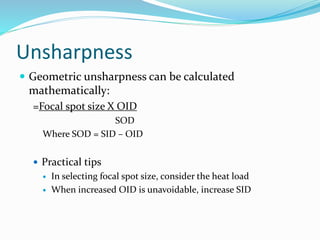
 Geometric unsharpness can be calculated
mathematically:
=Focal spot size X OID
SOD
Where SOD = SID – OID
 Practical tips
 In selecting focal spot size, consider the heat load
 When increased OID is unavoidable, increase SID
Image receptor unsharpness
 Intensifying screens increase unsharpness and
decrease recorded detail due to the fact that the actual
physical area exposed by a light photon on the film is
greater than the area exposed by an x-ray photon.
 Cross-over effect – when light from one intensifying
screen crosses over the film base to expose emulsion
on the opposite side, the area exposed will not be exact
as the first emulsion
 Screen speed – increase in screen speed , decreases
recorded details
Motion unsharpness
 Motion has the most detrimental effect on recorded
detail
 Patient motion known as blur is the worst
 Can be classified as voluntary or involuntary
 Equipment motion may involve tube, table or image
receptor.
 These are very unlikely unless purposely designed
Distortion
 This results from radiographic misrepresentation of
 Size (magnification) or
 Shape
 Size Distortion (Magnification)
 Increase in object’s image size compared to actual size
 Object- to- image receptor distance (OID) plays a
major role
 Source to image receptor distance (SID)is inversely
related to magnification
 Magnification factor is used to assess the extent of
magnification
Distortion
 MF = SID/SOD
 SOD = SID-OID
Shape Distortion
 Can appear as
 Elongation- image of objects appear longer than actual
 Foreshortening – image of objects appear shorter than
the true object
 These can be as a result of: misalignment of CR to the
part or image receptor
Digital Imaging
 Photographic Quality
 The relationship of exposure factors and their effect on
intensity holds true for digital imaging
 The relationship between mAs and density is not the
same for digital imaging because the computer is used
to create the image and electronic data can be adjusted
to correct errors in intensities reaching thee IR
 Correction of errors may adversely affect the quality of
the digital image
 The radiographers may routinely use more exposure
than required thus increases patient exposure
Digital Imaging
 Geometric properties
 Geometric factors that affect radiographic quality in
screen-film systems also affect the digital image.
 These include; Focal spot size, SID and OID resulting in
unsharpness , altering recorded detail
 Motion of patient or equipment also decreases recorded
detail
 All factors that determine distortion like SID and OID,
improper alignment of CR, anatomical part and image
Receptor distort the shape of the digital image
Components of Radiographic image quality
Processing
system
Recording
system
X-ray tube &
usage
Subject
characteristics
Developer
constitution
Film
characteristics
Focal spot size Attenuating
characteristics
Developer
replenishment
Intensifying
screen
characteristics
Tube rating Differential
attenuation by
different tissues
Fixer constitution Cassette
characteristics
Tube filtration Type & location of
organ
Fixer
replenishment
Film storage
conditions
Type of generator Movement of part
examined
Processing
temperatures
Kilovoltage Focus-object and
object-film
distances
Processor
characteristics
Milliamperage Correct exposure
Cont…
Exposure time Radiographers
assessment
Collimation &
centering
Scatter control
Focus Film
Distance

IMAGE QUALITY.pptx

  • 1.
  • 2.
    What is anImage  Is a mental or real resemblance of an objects  Mental images are those generated as mental pictures within our minds. These cannot be subjected to objective studies  Real images are those having physical appearances such as photographic or radiographic images.These can be subjected to scientific measurements and objective study
  • 3.
    Image Characteristics  Forimages to give accurate representation on viewing, the following characteristics have to be considered:  Noise  Contrast  Sharpness  Resolution
  • 4.
    Noise  Noise isoften associated with sound but in simple terms it is that which was not intended to be heard.  Likewise in visible image, noise is that signal that was not intended and will distort the intended signal.  This happens always but the difference between the intended and unintended parts determine the visibility of the image.  Thus the signal –to –noise ratio has to be high for better visibility.
  • 5.
    Radiographic Image Quality Assessment of radiographic image quality includes: the visibility of recorded detail (photographic properties) and sharpness of recorded detail (geometric properties)  The accuracy with which the radiographic image represents the actual object is a factor of signal and noise
  • 6.
    Radiographic Image Quality Signal is the information required from the imaging system (radiograph)- the minimum size of the object that must be visible  Noise is anything that may detract from that signal. In film/screen system it could be graininess  Other factors come into play when we are dealing with digital imaging  Image quality = Signal/Noise
  • 7.
    Components of Radiographicimage quality  Quality of a radiographic image is its ability to produce in a visible pattern the varying transmissions of X-rays through the subject being radiographed.  If the radiographer determines that the visibility of recorded detail is adequate, the image is of diagnostic radiographic quality. If not, it is unacceptable and needs to be repeated.
  • 8.
    Components of Radiographicimage quality  The radiographer, at this point must determine the factors that should be adjusted to improve visualization of recorded detail.  Several elements are involved in this situation and are classified as follows:
  • 9.
    Photographic and Geometricproperties  To evaluate a radiograph, the radiographer will be required to assess the image both for its visibility of recorded detail (photographic properties) and its sharpness of recorded detail (geometric properties).  Photographic properties or visibility is achieved by proper balance of radiographic density and radiographic contrast.  Geometric properties are measured in terms of sharpness which is influenced by recorded detail and distortion.
  • 10.
    Radiographic Density  Densityis the amount of overall blackness produced on the image after processing  A radiograph that is too light has insufficient density to visualize anatomic structures.  Conversely, when it is too dark, has excessive density and anatomic parts cannot be visualized.
  • 11.
    Radiographic Density  Factorsthat directly affect density are identified as controlling factors  Factors that indirectly affect density are identified as influencing factors
  • 12.
    Density – controllingfactors  Exposure Intensity: Quantity of radiation reaching the image receptor has a primary effect on the amount of radiographic density produced.  Product of milliamperage(mA) and exposure time (mAs) has a direct proportional relationship with the quantity of x-rays produced  Because mAs is the product of milliamperage and exposure time, increasing either increases density
  • 13.
    Density – controllingfactors  When a radiograph is unacceptable and must be repeated, the radiographer must decide how much of a change in mAs is needed to correct the density  Making a visible change in radiographic density requires that the minimum amount of change in mAs be approximately 30% (25% - 30% depending on equipment)  A radiograph repeated due to insufficient or excessive density requires a change in mAs by a factor of at least 2
  • 14.
    Influencing factors  Otherfactors that indirectly influence density are:  Kilovoltage – alters the penetrating ability of the X-ray photon . By having many photons with sufficient energy to penetrate the part, quantity of radiation reaching the image receptor is increased and so the density increases  Although kVp has direct relationship with density, the effect of kVp on density will not be equal throughout the range of kilovoltage.
  • 15.
    Influencing factors  Raisingthe tube kilovoltage increases the intensity ofradiation emitted from the tube and the radiation that reaches the IR, leading to increased density.  KVp also affects other aspects of the image and so is not the primary factor to manipulate for changes in radiographic density.  15% rule states that changing the kilovoltage peak by 15% will have same effect on radiographic density as doubling the mAs or reducing the mAs by 50%
  • 16.
    Influencing factors  Otherinfluencing factors include;  Distance  SID (source – to- Image receptor Distance) – as it increases, the density decreases as a result of Inverse Square Law. Increasing SID requires that mAs be increased to maintain density and vice versa  OID (Object –to- image receptor Distance) – the more the distance, the less the density because exit radiation continues to diverge so less overall intensity of the beam will reach the image receptor
  • 17.
    Influencing factors  Grid– Grid improves the quality of the radiograph by absorbing scatter but it also absorbs some of the transmitted radiation exiting the patient thus reducing the intensity reaching the IR resulting in reduced density.  When grid is used compensation is done through increasing either mAs
  • 18.
    Influencing factors  Collimation– restricts area covered by primary beam thus reducing scatter radiation reaching the IR. This will decrease radiographic density  Anode heel effect – decrease in primary beam intensity on the anode side of the tube due to angling of the anode. This results in non uniform density compared to the cathode side. Its more evidenced when short SID and wide field area are used
  • 19.
    Influencing factors  Reciprocitylaw – density produced will be equal for any combination of milliamperage and exposure time as long as the product of mAs is equal.  It works only for direct exposure without intensifying screens. At extreme exposure times (>10sec or<10ms), screen light emission may not produce equivalent exposure film (reciprocity failure)
  • 20.
    Influencing factors  Generatoroutput – Three phase generators are more efficient compared to single phase hence require lower settings to produce image comparable to single phase.  Generator my be inconsistent in output if not periodically calibrated.  Tube filtration –Excessive or insufficient filtration may affect density. It should be checked regularly  Compensating filters –use of compensating filters requires an increase in mAs to maintain overall density
  • 21.
    Influencing factors  Film-screenspeed- The greater the speed, the greater the density for a given exposure technique. Increase in film- screen speed requires decrease in mAs to maintain density  Relative Speed of a screen – film system determines the adjustment of mAs when changes occur.  Film processing – Variability in temperature especially of developer, chemistry of processing solutions or film transport can affect density
  • 22.
    Influencing factors  Anatomicalpart – A thick part absorbs more radiation requiring increase in mAs to get good density
  • 23.
    Contrast  Contrast isthe degree of difference between adjacent densities.  It is the photographic density difference between two adjacent areas on the film  The ability to distinguish between densities enables differences in anatomic tissues to be visualized.  Contrast can be evaluated best when the radiographic density is adequate to visualize density differences
  • 24.
    Contrast  Radiographic contrastconsists of:  Subject contrast (radiation contrast) is a result of absorption characteristics of anatomic tissue and level of Kilovoltage used.  It is responsible for the differing intensities of emergent X-ray beam and therefore the exposure that reaches the film
  • 25.
    Contrast  The radiographeris required to understand the anatomic structure to be radiographed for him to determine the factors required to achieve desired level of radiographic contrast.  The level of radiographic contrast desired in an image is determined by the composition of the anatomic tissue radiographed and the amount of information needed to visualize the tissues to make an accurate diagnosis
  • 26.
    Contrast Subject contrast isa factor of: Different thicknesses of the same tissue Different densities of the same tissue Different atomic numbers of the tissues Radiation quality (kVp, anode material, etc) Use of contrast agents
  • 27.
    Contrast  Film contrast Film contrast is a result of inherent properties manufactured into the type of film, storage conitions, how it is radiographed (direct or with intensifying screens) and processing conditions  It is the ability of the film to amplify subject contrast  Film contrast is identified by the gradient of the film in characteristic curve (D-min, speed index, Shoulder and D-max)
  • 28.
    Contrast  Exposure latitudeis the range of exposure that will give acceptable density range. The wider the latitude, the lower the contrast allowing differentiation of more tissues.  It depends on the type of film (inherent contrast),  Inherent Contrast is the result of size and distribution of silver halides in the emulsion layer of the film. This determines the film’s response to exposure which we measure from the characteristic curve. Inherent contrast is therefore a contributing factor to film contrast.
  • 29.
    Contrast  Conditions ofexposure  Grid- by absorbing scatter from the patient, less scatter reaches the IR reducing unwanted density (fog) therefore increasing contrast  Collimation – a smaller field size (more collimation) irradiates less tissue reducing the amount of scatter produced. Less scatter reaching the IR results in greater radiographic contrast.
  • 30.
    Contrast  OID –The increase in distance between the object and IR, creates an air gap preventing scatter from reaching the IR. Reducing scatter means increased contrast  Tube filtration –increasing filtration increases the percentage of high penetrating x-rays. High penetrating x-rays produces more scatter radiation form the patient. Increased kV and increased scatter results in reduced contrast.
  • 31.
    Contrast  Development conditions– When processor temperature, chemistry or film transport vary, it can affect the base plus fog thus affecting the contrast. Any variation in density has an effect on the contrast.
  • 32.
    Contrast  Contrast canbe assessed subjectively or objectively  Subjective contrast  Is the observers’ opinion of the contrast he sees on a film.  Is a combination of all above plus viewing conditions, performance of the eye, observers’ ability and his opinion
  • 33.
    Contrast  Objective contrastcan also be referred to as Radiographic contrast which is the contrast of the resultant image on a radiograph. This is the aspects that can be measured
  • 34.
    Factors of objectivecontrast are summarized as  Controlling factor  Kilovoltage  Influencing factors  Grids  Collimation  Object-to-image receptor distance  Anatomic part  Contrast media  Processing
  • 35.
    Geometric Properties (sharpness) This is the sharpness of structural lines recorded in the radiographic image  A radiographic image cannot be an exact reconstruction of the object, some information is often lost  It’s the duty of the technologist to minimize the amount of information lost by accurately manipulating the factors that cause the loss of information.
  • 36.
    Geometric Properties (sharpness) Recorded detail is the distinctness or sharpness of lines that make up the recorded image  It is a function of Sharpness and distortion  Resolution measures sharpness  Is the smallest size of an object or distance between adjacent objects that must exist for the system to record that object or objects as separate entities.  Is measured in line pair per millimeter  Poor resolution is also referred to as unsharpness
  • 37.
    Resolution measurement  Thisis done using a tool (grid) with radiopaque and radiolucent lines running parallel  On exposure, the radiopaque line will show as clear space while the radiolucent line seen as black line  The two form a line pair  The spacing of one pair gives spatial resolution measured in lp/mm  From the image, the closest spacing detected gives the resolution of the system  This is the objective measurement
  • 38.
  • 39.
    Unsharpness Unsharpness is asa result of Geometric, Image receptor and motion factors : Geometric unsharpness  Focal spot size  Normal radiographic foci range between 0.5 – 1.2mm  Small focal spot sizes are usually 0.5 or 0.6mm  Large focal spot sizes are 1.0 or 1.2mm  As focal spot size increases, unsharpness increases and recorded detail decreases
  • 40.
    Unsharpness  Distance 1. Sourceto Image receptor Distance (SID)  As SID increases, the amount of unsharpness decreases because most of the divergent ray become more perpendicular to the object  Decreasing unsharpness increases recorded detail  Standardized SID are used to accommodate equipment limitations  Besides recorded detail SID also affects density and magnification
  • 41.
    Unsharpness 2. Object Imagereceptor Distance (OID)  Optimal recorded detail is achieved when OID is Zero  This is not realistic  When exit beam leaves the object, it continues to diverge  Diverging exit beam records increased unsharpness in the image. OID has greater effect on geometric unsharpness than SID
  • 42.
    Unsharpness  Geometric unsharpnesscan be calculated mathematically: =Focal spot size X OID SOD Where SOD = SID – OID  Practical tips  In selecting focal spot size, consider the heat load  When increased OID is unavoidable, increase SID
  • 43.
    Image receptor unsharpness Intensifying screens increase unsharpness and decrease recorded detail due to the fact that the actual physical area exposed by a light photon on the film is greater than the area exposed by an x-ray photon.  Cross-over effect – when light from one intensifying screen crosses over the film base to expose emulsion on the opposite side, the area exposed will not be exact as the first emulsion  Screen speed – increase in screen speed , decreases recorded details
  • 44.
    Motion unsharpness  Motionhas the most detrimental effect on recorded detail  Patient motion known as blur is the worst  Can be classified as voluntary or involuntary  Equipment motion may involve tube, table or image receptor.  These are very unlikely unless purposely designed
  • 45.
    Distortion  This resultsfrom radiographic misrepresentation of  Size (magnification) or  Shape  Size Distortion (Magnification)  Increase in object’s image size compared to actual size  Object- to- image receptor distance (OID) plays a major role  Source to image receptor distance (SID)is inversely related to magnification  Magnification factor is used to assess the extent of magnification
  • 46.
    Distortion  MF =SID/SOD  SOD = SID-OID
  • 47.
    Shape Distortion  Canappear as  Elongation- image of objects appear longer than actual  Foreshortening – image of objects appear shorter than the true object  These can be as a result of: misalignment of CR to the part or image receptor
  • 48.
    Digital Imaging  PhotographicQuality  The relationship of exposure factors and their effect on intensity holds true for digital imaging  The relationship between mAs and density is not the same for digital imaging because the computer is used to create the image and electronic data can be adjusted to correct errors in intensities reaching thee IR  Correction of errors may adversely affect the quality of the digital image  The radiographers may routinely use more exposure than required thus increases patient exposure
  • 49.
    Digital Imaging  Geometricproperties  Geometric factors that affect radiographic quality in screen-film systems also affect the digital image.  These include; Focal spot size, SID and OID resulting in unsharpness , altering recorded detail  Motion of patient or equipment also decreases recorded detail  All factors that determine distortion like SID and OID, improper alignment of CR, anatomical part and image Receptor distort the shape of the digital image
  • 50.
    Components of Radiographicimage quality Processing system Recording system X-ray tube & usage Subject characteristics Developer constitution Film characteristics Focal spot size Attenuating characteristics Developer replenishment Intensifying screen characteristics Tube rating Differential attenuation by different tissues Fixer constitution Cassette characteristics Tube filtration Type & location of organ Fixer replenishment Film storage conditions Type of generator Movement of part examined Processing temperatures Kilovoltage Focus-object and object-film distances Processor characteristics Milliamperage Correct exposure
  • 51.
    Cont… Exposure time Radiographers assessment Collimation& centering Scatter control Focus Film Distance