Preparation and Examination of the
Gastrointestinal Tract
Chapter 9
Happy
Thanksgiving
Classificationof Contrast Media
• Barium Sulfate
• Water-soluble iodinated
• Oily iodine
• gases
Scheduling and Sequencing
• Proper scheduling of GI exams requires COMMUNICATION (between
doctors and nurses, nurses and the department, etc.)
• Considerations must be made as to all the procedures that are going
to be performed on the patient so that the correct sequence can be
followed
Guide to Sequencing Order for Diagnostic Studies
• All exams not requiring contrast media and any lab studies for iodine
uptake
• Exams of the urinary tract (IVP)
• Radiographic exams of the biliary system (gallbladder)
• Lower GI series (BE)
• Upper GI series
Ensuring Compliance with Preps
• Nurses are responsible for inpatient preps
• Radiographer is usually responsible for explaining preps to
outpatients or those scheduling outpatient procedures
• Scout films are taken to evaluate patient prep
Preparationfor Examination
• Most common reason for prep is for cleansing purposes
• Cleansing of the bowel usually requires several steps: diet,
cathartics, suppositories or enemas. May utilize several or all of
these methods.
Diet
• Patients may be placed on a low-residue diet for several days prior to
the exam
• Liquid intake is encouraged or forced
• For 24 hours before exam, patient may be restricted to clear liquids
(water, broths, gelatin, tea)
• Fasting may be employed (NPO 8-12 hours)
Cathartics
•Laxative preparations that aid in cleansing the bowel
•Fluid intake increases the effectiveness of cathartics
•Bisacodyl or Dulcolax tablets or magnesium citrate
(carbonated beverage) are common cathartics
•Heavy doses of cathartics may cause painful bowel
spasms; patients may have persistant diarrhea.
•Patients should always be told what to expect from
their bowel preparation
tories
• Rectal suppository is a semi-solid nugget of medication that is inserted
into the rectum to stimulate peristaltic action in the colon to cause
evacuation of the distal portion of lower bowel
• Suppository should remain for at least 30 minutes before evacuation
Cleansing Enema
• Procedure to dislodge and flush out any fecal contents
• This is usually carried out at the patient’s home or by their nurse (if they
are an inpatient)
• Occasionally, this duty may be assigned to the radiographer
• Items needed: enema bag with tubing, disposable rectal catheter, iv
pole
• Mix a soapsuds enema of 1000 ml of tap water and 30 ml of castile soap
(don’t use any other kind as it may be an irritant to the bowel)
• Run the liquid through the tubing to eliminate air, lubricate the tip,
explain the procedure, place patient in Sim’s position, hand enema bag
approx. 18 in above the table (too high can cause to rapid a flow), insert
tip
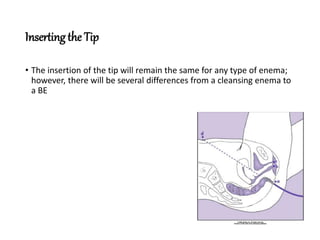
Inserting the Tip
• The insertion of the tip will remain the same for any type of enema;
however, there will be several differences from a cleansing enema to
a BE
BariumSulfate
•Inert, organic salt, packaged in many forms, may be
given oral or rectal, forms a colloidal suspension.
•No flavor (unless flavored for drinking), but hard to
swallow because of it’s chalky consistency; easier to
drink really cold and with a straw (keeps it from
coating the mouth)
•Although a warm solution of barium for lower GI
studies would seem more comforting, cold barium
is less likely to cause bowel spasms
•The proper viscosity or thickness is important in GI
exams- much variation from doc to doc
bout Barium
•Being an inert compound, it does not react chemically
with the body to any appreciable extent- allergies are
almost never a problem and few side effects occur
•Barium is hygroscopic (has a tendency to absorb
water); this nature can cause a barium impaction- to
decrease the risk, patients should be instructed to
drink lots and lots of fluids and a laxative may be
recommended.
•Always check with patients about latex allergies; a few
cases of allergy to the enema tip have been reported
Iodinated Media
•Used when barium is contraindicated or if abdominal
surgery is likely in the immediate future
•Also used when there is a high risk of impaction and
occasionally for neonatal studies
•More expensive than barium, produce less contrast,
can cause dehydration and are hazardous if aspirated
•Radiologist will guide you as far as what media to use
Air
• Negative contrast
• Can be produced from crystals or room air
Glucagon
• drug used to treat hypoglycemia
• Causes relaxation of smooth muscles in the GI tract
• Slows peristalsis
• Prevents cramping
• Can be administered IM or IV
Routine BE
•Scout film to ensure cleansing has occurred
•Prepare a bag of 1200-1500 ml (compared to about
1000 ml in a cleansing enema)
•Enema bag is suspended at a height of 24-30 inches
(compared to 18 in for cleansing enema) This is due
to the viscosity of the barium; requires greater
hydrostatic pressure to maintain a proper flow rate
•Larger rectal catheter is used than in a cleansing
enema; has a cuff to inflate a balloon to help hold in
place
BE Considerations
• Patients with unusual conditions may require special care when undergoing a BE
• Enlarged Colon like congenital megacolon or Hirschsprung’s Disease: distal colon
where no peristalsis occurs- results in chronic constipation and extremely large
colon
• When colon is enlarged, more water absorption can occur, increasing the
chances of developing a barium impaction; If this condition is known ahead of
time, water soluble contrast may be used; if not, follow up care is necessary to
insure the patient avoid an impaction
• Colon enlargement can also cause hypervolemia or fluid overload; the colon
absorbs so much water that it changes the concentration of fluid in the blood.
This can lead to CHF and in extreme cases lead to total physical collapse.
• If it is of concern, water absorption can be minimized by mixing barium with
normal saline
• Potential colon perforation: if this is suspected, do not use barium. Use a water
soluble contrast. If barium is extravasated into the peritoneal cavity, it can cause
a condition known as barium peritonitis.
• ostomies
UGI
•NPO 8 hours prior
•No smoking or gum chewing (increases gastric
secretion)
•Valsalva maneuver for hiatal hernia or reflux
•Pylorospasm: stomach does not empty into the
duodenum because of constriction of the sphincter
muscle between the stomach and duodenum;
patient will be asked to lie in the RAO position
which allows gravity to assist in the normal flow of
gastric contents
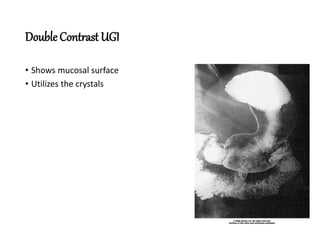
Double Contrast UGI
• Shows mucosal surface
• Utilizes the crystals
HypotonicDuodenography
• Used for the detection of lesions in the duodenum distal to the
duodenal bulb and also for the diagnosis of pancreatic disease
• This study is declining and being replaced by US, double contrast GI,
CT and ERCP

examination of GIT.ppt

  • 1.
    Preparation and Examinationof the Gastrointestinal Tract Chapter 9 Happy Thanksgiving
  • 2.
    Classificationof Contrast Media •Barium Sulfate • Water-soluble iodinated • Oily iodine • gases
  • 3.
    Scheduling and Sequencing •Proper scheduling of GI exams requires COMMUNICATION (between doctors and nurses, nurses and the department, etc.) • Considerations must be made as to all the procedures that are going to be performed on the patient so that the correct sequence can be followed
  • 4.
    Guide to SequencingOrder for Diagnostic Studies • All exams not requiring contrast media and any lab studies for iodine uptake • Exams of the urinary tract (IVP) • Radiographic exams of the biliary system (gallbladder) • Lower GI series (BE) • Upper GI series
  • 5.
    Ensuring Compliance withPreps • Nurses are responsible for inpatient preps • Radiographer is usually responsible for explaining preps to outpatients or those scheduling outpatient procedures • Scout films are taken to evaluate patient prep
  • 6.
    Preparationfor Examination • Mostcommon reason for prep is for cleansing purposes • Cleansing of the bowel usually requires several steps: diet, cathartics, suppositories or enemas. May utilize several or all of these methods.
  • 7.
    Diet • Patients maybe placed on a low-residue diet for several days prior to the exam • Liquid intake is encouraged or forced • For 24 hours before exam, patient may be restricted to clear liquids (water, broths, gelatin, tea) • Fasting may be employed (NPO 8-12 hours)
  • 8.
    Cathartics •Laxative preparations thataid in cleansing the bowel •Fluid intake increases the effectiveness of cathartics •Bisacodyl or Dulcolax tablets or magnesium citrate (carbonated beverage) are common cathartics •Heavy doses of cathartics may cause painful bowel spasms; patients may have persistant diarrhea. •Patients should always be told what to expect from their bowel preparation
  • 9.
    tories • Rectal suppositoryis a semi-solid nugget of medication that is inserted into the rectum to stimulate peristaltic action in the colon to cause evacuation of the distal portion of lower bowel • Suppository should remain for at least 30 minutes before evacuation
  • 10.
    Cleansing Enema • Procedureto dislodge and flush out any fecal contents • This is usually carried out at the patient’s home or by their nurse (if they are an inpatient) • Occasionally, this duty may be assigned to the radiographer • Items needed: enema bag with tubing, disposable rectal catheter, iv pole • Mix a soapsuds enema of 1000 ml of tap water and 30 ml of castile soap (don’t use any other kind as it may be an irritant to the bowel) • Run the liquid through the tubing to eliminate air, lubricate the tip, explain the procedure, place patient in Sim’s position, hand enema bag approx. 18 in above the table (too high can cause to rapid a flow), insert tip
  • 11.
    Inserting the Tip •The insertion of the tip will remain the same for any type of enema; however, there will be several differences from a cleansing enema to a BE
  • 12.
    BariumSulfate •Inert, organic salt,packaged in many forms, may be given oral or rectal, forms a colloidal suspension. •No flavor (unless flavored for drinking), but hard to swallow because of it’s chalky consistency; easier to drink really cold and with a straw (keeps it from coating the mouth) •Although a warm solution of barium for lower GI studies would seem more comforting, cold barium is less likely to cause bowel spasms •The proper viscosity or thickness is important in GI exams- much variation from doc to doc
  • 13.
    bout Barium •Being aninert compound, it does not react chemically with the body to any appreciable extent- allergies are almost never a problem and few side effects occur •Barium is hygroscopic (has a tendency to absorb water); this nature can cause a barium impaction- to decrease the risk, patients should be instructed to drink lots and lots of fluids and a laxative may be recommended. •Always check with patients about latex allergies; a few cases of allergy to the enema tip have been reported
  • 14.
    Iodinated Media •Used whenbarium is contraindicated or if abdominal surgery is likely in the immediate future •Also used when there is a high risk of impaction and occasionally for neonatal studies •More expensive than barium, produce less contrast, can cause dehydration and are hazardous if aspirated •Radiologist will guide you as far as what media to use
  • 15.
    Air • Negative contrast •Can be produced from crystals or room air
  • 16.
    Glucagon • drug usedto treat hypoglycemia • Causes relaxation of smooth muscles in the GI tract • Slows peristalsis • Prevents cramping • Can be administered IM or IV
  • 17.
    Routine BE •Scout filmto ensure cleansing has occurred •Prepare a bag of 1200-1500 ml (compared to about 1000 ml in a cleansing enema) •Enema bag is suspended at a height of 24-30 inches (compared to 18 in for cleansing enema) This is due to the viscosity of the barium; requires greater hydrostatic pressure to maintain a proper flow rate •Larger rectal catheter is used than in a cleansing enema; has a cuff to inflate a balloon to help hold in place
  • 18.
    BE Considerations • Patientswith unusual conditions may require special care when undergoing a BE • Enlarged Colon like congenital megacolon or Hirschsprung’s Disease: distal colon where no peristalsis occurs- results in chronic constipation and extremely large colon • When colon is enlarged, more water absorption can occur, increasing the chances of developing a barium impaction; If this condition is known ahead of time, water soluble contrast may be used; if not, follow up care is necessary to insure the patient avoid an impaction • Colon enlargement can also cause hypervolemia or fluid overload; the colon absorbs so much water that it changes the concentration of fluid in the blood. This can lead to CHF and in extreme cases lead to total physical collapse. • If it is of concern, water absorption can be minimized by mixing barium with normal saline • Potential colon perforation: if this is suspected, do not use barium. Use a water soluble contrast. If barium is extravasated into the peritoneal cavity, it can cause a condition known as barium peritonitis. • ostomies
  • 19.
    UGI •NPO 8 hoursprior •No smoking or gum chewing (increases gastric secretion) •Valsalva maneuver for hiatal hernia or reflux •Pylorospasm: stomach does not empty into the duodenum because of constriction of the sphincter muscle between the stomach and duodenum; patient will be asked to lie in the RAO position which allows gravity to assist in the normal flow of gastric contents
  • 20.
    Double Contrast UGI •Shows mucosal surface • Utilizes the crystals
  • 21.
    HypotonicDuodenography • Used forthe detection of lesions in the duodenum distal to the duodenal bulb and also for the diagnosis of pancreatic disease • This study is declining and being replaced by US, double contrast GI, CT and ERCP