KENYA INSTITUTE OF CURRICULUM DEVELOPMENT
A Skilled and Ethical Society
JUNIOR SCHOOL CURRICULUM DESIGN
AGRICULTURE AND NUTRITION
GRADE 7
ii
First published 2022
Revised 2024
All rights reserved. No part of this book may be reproduced, stored in a retrieval system or transcribed, in any form or by any
means, electronic, mechanical, photocopy, recording or otherwise, without the prior written permission of the publisher.
ISBN:
Published and printed by Kenya Institute of Curriculum Development
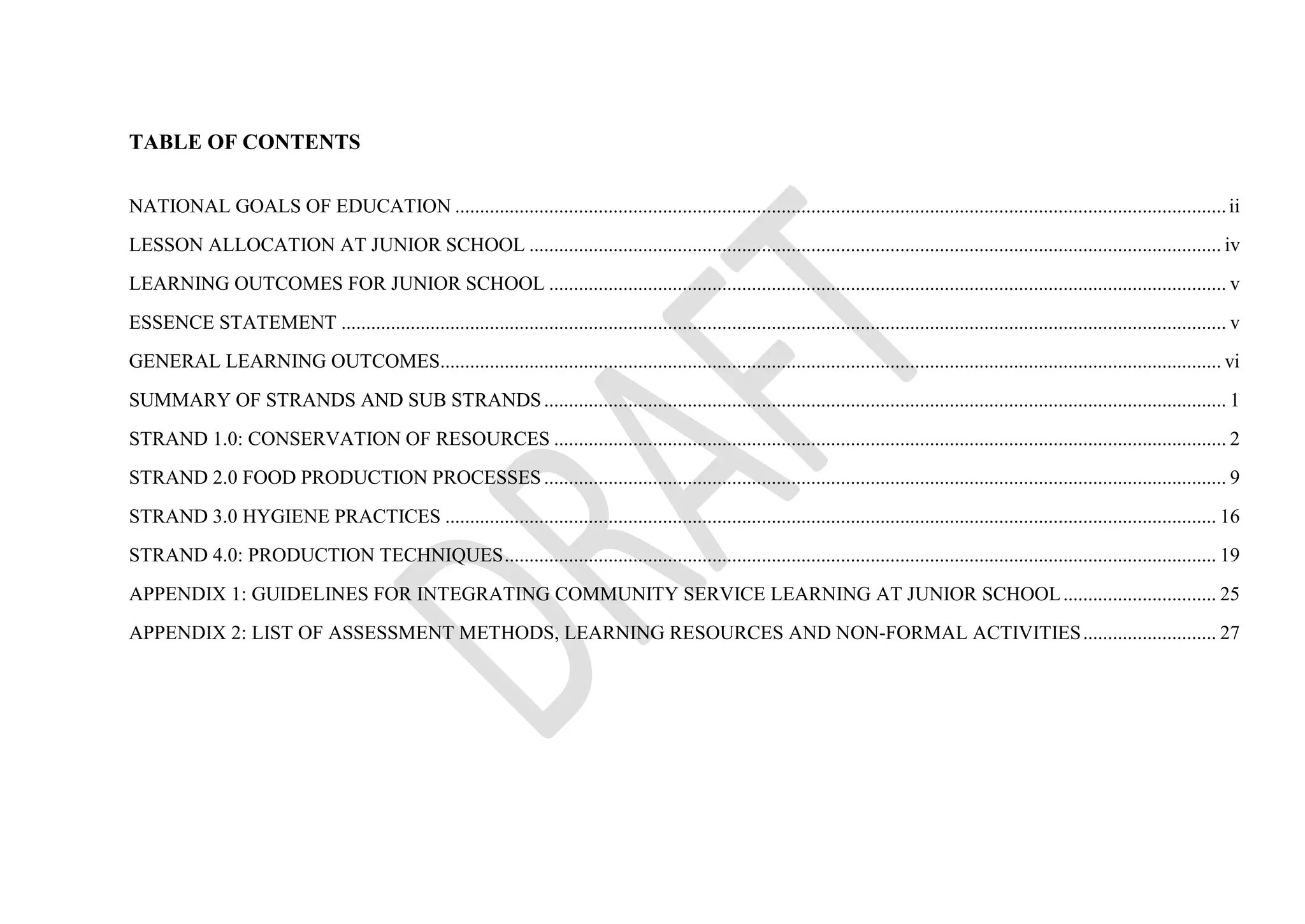
TABLE OF CONTENTS
NATIONAL GOALS OF EDUCATION ............................................................................................................................................................ii
LESSON ALLOCATION AT JUNIOR SCHOOL ............................................................................................................................................ iv
LEARNING OUTCOMES FOR JUNIOR SCHOOL ......................................................................................................................................... v
ESSENCE STATEMENT ................................................................................................................................................................................... v
GENERAL LEARNING OUTCOMES.............................................................................................................................................................. vi
SUMMARY OF STRANDS AND SUB STRANDS.......................................................................................................................................... 1
STRAND 1.0: CONSERVATION OF RESOURCES ........................................................................................................................................ 2
STRAND 2.0 FOOD PRODUCTION PROCESSES.......................................................................................................................................... 9
STRAND 3.0 HYGIENE PRACTICES ............................................................................................................................................................ 16
STRAND 4.0: PRODUCTION TECHNIQUES................................................................................................................................................ 19
APPENDIX 1: GUIDELINES FOR INTEGRATING COMMUNITY SERVICE LEARNING AT JUNIOR SCHOOL............................... 25
APPENDIX 2: LIST OF ASSESSMENT METHODS, LEARNING RESOURCES AND NON-FORMAL ACTIVITIES........................... 27
ii
NATIONAL GOALS OF EDUCATION
Education in Kenya should:
1. Foster nationalism and patriotism and promote national unity.
Kenya’s people belong to different communities, races and religions, but these differences need not divide them. They must be
able to live and interact as Kenyans. It is a paramount duty of education to help young people acquire this sense of nationhood
by removing conflicts and promoting positive attitudes of mutual respect which enable them to live together in harmony and
foster patriotism in order to make a positive contribution to the life of the nation.
2. Promote the social, economic, technological and industrial needs for national development.
Education should prepare the youth of the country to play an effective and productive role in the life of the nation.
a) Social Needs
Education in Kenya must prepare children for changes in attitudes and relationships which are necessary for the smooth
progress of a rapidly developing modern economy. There is bound to be a silent social revolution following the wake of
rapid modernisation. Education should assist our youth to adapt to this change.
b) Economic Needs
Education in Kenya should produce citizens with the skills, knowledge, expertise and personal qualities that are required
to support a growing economy. Kenya is building up a modern and independent economy which is in need of an adequate
and relevant domestic workforce.
c) Technological and Industrial Needs
Education in Kenya should provide learners with the necessary skills and attitudes for industrial development. Kenya
recognises the rapid industrial and technological changes taking place, especially in the developed world. We can only be
part of this development if our education system is deliberately focused on the knowledge, skills and attitudes that will
prepare our young people for these changing global trends.
iii
3. Promote individual development and self-fulfilment.
Education should provide opportunities for the fullest development of individual talents and personality. It should help
children to develop their potential interests and abilities. A vital aspect of individual development is the building of character.
4. Promote sound moral and religious values.
Education should provide for the development of knowledge, skills and attitudes that will enhance the acquisition of sound
moral values and help children to grow up into self-disciplined, self-reliant and integrated citizens.
5. Promote social equity and responsibility.
Education should promote social equality and foster a sense of social responsibility within an education system which
provides equal educational opportunities for all. It should give all children varied and challenging opportunities for collective
activities and corporate social service irrespective of gender, ability or geographical environment.
6. Promote respect for and development of Kenya’s rich and varied cultures.
Education should instil in the youth of Kenya an understanding of past and present cultures and their valid place in
contemporary society. Children should be able to blend the best of traditional values with the changing requirements that must
follow rapid development in order to build a stable and modern society.
7. Promote international consciousness and foster positive attitudes towards other nations.
Kenya is part of the international community. It is part of the complicated and interdependent network of peoples and nations.
Education should therefore lead the youth of the country to accept membership of this international community with all the
obligations and responsibilities, rights and benefits that this membership entails.
8. Promote positive attitudes towards good health and environmental protection.
Education should inculcate in young people the value of good health in order for them to avoid indulging in activities that will
lead to physical or mental ill health. It should foster positive attitudes towards environmental development and conservation. It
should lead the youth of Kenya to appreciate the need for a healthy environment.
iv
LESSON ALLOCATION AT JUNIOR SCHOOL
S/No Learning Area Number of Lessons
1. English 5
2. Kiswahili / Kenya Sign Language 4
3. Mathematics 5
4. Religious Education 4
5. Social Studies 4
6. Integrated Science 5
7. Pre-Technical Studies 4
8. Agriculture and Nutrition 4
9. Creative Arts and Sports 5
Total 40
* 1 lesson is set aside for the Pastoral/Religious Instruction Programme.
v
LEARNING OUTCOMES FOR JUNIOR SCHOOL
By end of Junior School, the learner should be able to:
1. Apply literacy, numeracy and logical thinking skills for appropriate self-expression.
2. Communicate effectively, verbally and non-verbally, in diverse contexts.
3. Demonstrate social skills, spiritual and moral values for peaceful co-existence.
4. Explore, manipulate, manage and conserve the environment effectively for learning and sustainable development.
5. Practise relevant hygiene, sanitation and nutrition skills to promote health.
6. Demonstrate ethical behaviour and exhibit good citizenship as a civic responsibility.
7. Appreciate the country's rich and diverse cultural heritage for harmonious co-existence.
8. Manage pertinent and contemporary issues in society effectively.
9. Apply digital literacy skills for communication and learning.
ESSENCE STATEMENT
Agriculture and nutrition is a learning area that anchors on the United Nation Sustainable development goals and the socio-
economic pillar of Kenya Vision 2030 to promote health, hygiene, food and nutrition security through education. It is an
integrated learning area comprising of agriculture and home science concepts introduced in the upper primary curriculum. The
learners will deepen the acquired knowledge, skills, attitudes and values in conservation of resources, food production, hygiene
and innovative production techniques. The curriculum will enrich learner’s competencies in conservation of resources, crop and
animal production, foods and nutrition, personal and environmental hygiene, basic clothing construction and laundry work.
Agriculture and nutrition curriculum will form a grounds for specialization in respective career pathways in senior school and
beyond.
vi
GENERAL LEARNING OUTCOMES
By end of Junior School, the learner should be able to:
1. Participate actively in agricultural and household activities in conservation of resources.
2. Use scarce resources through innovative practices to contribute towards food and nutrition security.
3. Engage in food production processes for self-sustainability, health and economic development.
4. Adopt personal and environmental hygiene practices for healthy living.
5. Apply appropriate production techniques, innovative technologies, digital and media resources to enhance sustainable
agricultural and household practices.
6. Appreciate agricultural and household skills as a worthy niche for hobby, career development, further education and
training.
1
SUMMARY OF STRANDS AND SUB STRANDS
Strands Sub strands
1.0 Conservation of Resources 1.1 Controlling soil pollution
1.2 Constructing water retention structures
1.3 Conserving food nutrients
1.4 Growing trees
2.0 Food Production Processes 2.1 Preparing planting site and establishing crop
2.2 Selected crop management practices
2.3 Preparing animal products: Eggs and honey
2.4 Cooking: Roasting and steaming
3.0 Hygiene Practices 3.1 Hygiene in rearing animals
3.2 Laundry: Loose coloured items
4.0 Production Techniques 4.1 Sewing Skills: Knitting
4.2 Constructing frames suspended garden
4.3 Adding value to crop produce
4.4 Making homemade soap
2
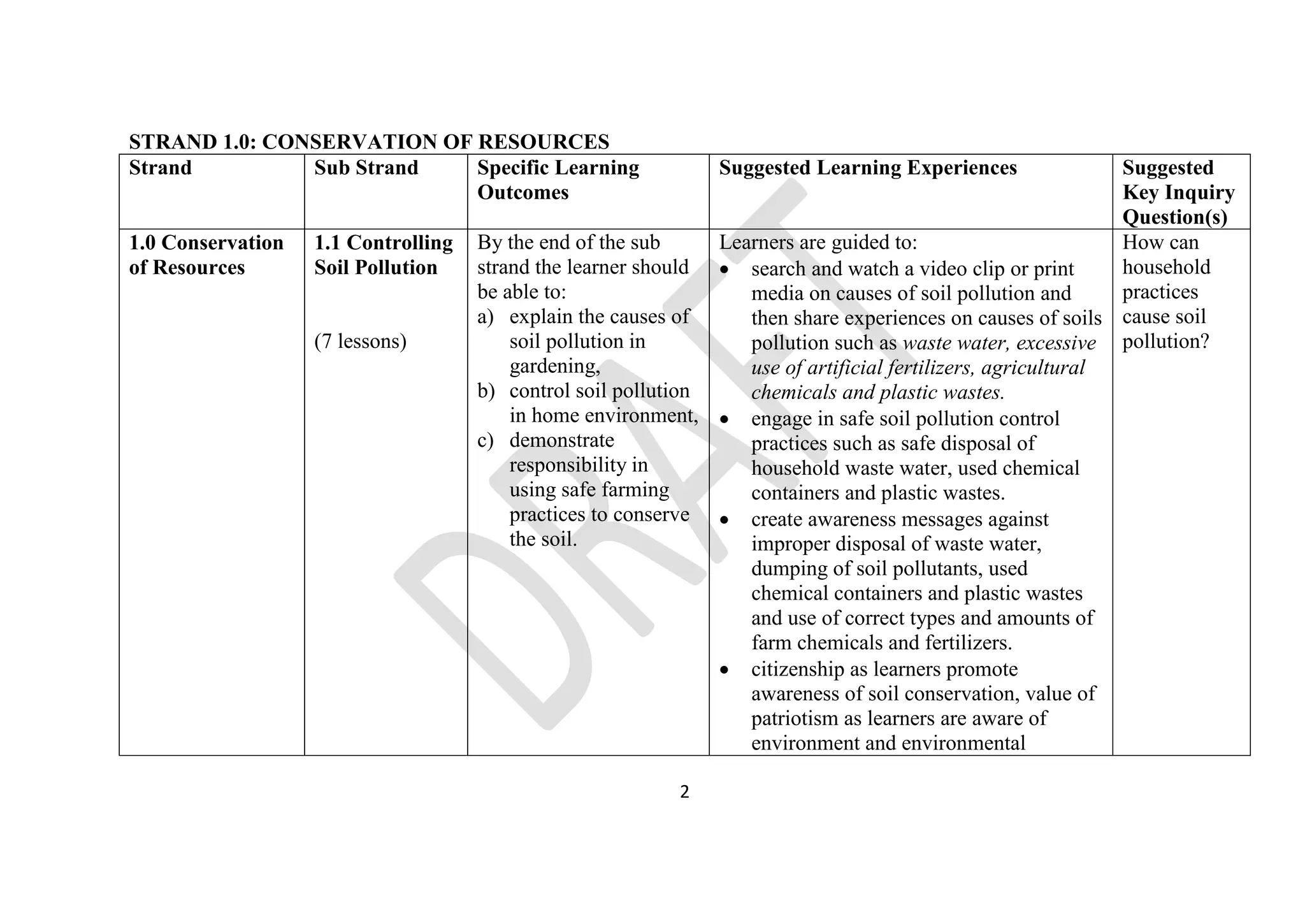
STRAND 1.0: CONSERVATION OF RESOURCES
Strand Sub Strand Specific Learning
Outcomes
Suggested Learning Experiences Suggested
Key Inquiry
Question(s)
1.0 Conservation
of Resources
1.1 Controlling
Soil Pollution
(7 lessons)
By the end of the sub
strand the learner should
be able to:
a) explain the causes of
soil pollution in
gardening,
b) control soil pollution
in home environment,
c) demonstrate
responsibility in
using safe farming
practices to conserve
the soil.
Learners are guided to:
 search and watch a video clip or print
media on causes of soil pollution and
then share experiences on causes of soils
pollution such as waste water, excessive
use of artificial fertilizers, agricultural
chemicals and plastic wastes.
 engage in safe soil pollution control
practices such as safe disposal of
household waste water, used chemical
containers and plastic wastes.
 create awareness messages against
improper disposal of waste water,
dumping of soil pollutants, used
chemical containers and plastic wastes
and use of correct types and amounts of
farm chemicals and fertilizers.
 citizenship as learners promote
awareness of soil conservation, value of
patriotism as learners are aware of
environment and environmental
How can
household
practices
cause soil
pollution?
3
protection as they create awareness
against soil pollution.
Core competencies:
Citizenship: civic skills as learners promote control of soil pollution to enhance soil conservation in the community.
Values:
Patriotism: awareness of own responsibility as the learners engage in activities that promote soil pollution control.
Pertinent and contemporary issues:
Environmental conservation as learners protect soil against pollution.
Link to other subjects:
Learners relate soil pollution to other forms of environmental pollution learnt in science and technology.
4
Strand Sub strand Specific learning
outcomes
Suggested learning experiences Suggested
Key inquiry
question(s)
1.0 Conservation
of Resources
1.2 Constructing
Water Retention
Structures
(8 lessons)
By the end of the sub
strand the learner
should be able to:
a) describe how
surface run-off can
be used in
gardening
b) construct water
retention structures
to conserve surface
runoff,
c) adopt utilization of
surface run-off in
gardening.
Learners are guided to:
 search for information and discuss
how surface run-off can be
conserved in structures such as
water retention ditches and water
retention pits for gardening.
 construct retention ditches or
retention pits for water conservation
and establish a crop of their choice
such as a banana sucker, sugarcane,
napier grass or arrowroot.
 problem solving skill as learners
solve the destructions caused by run-
off, value of unity when working in
groups to construct the retention
structure, environmental protection
and conservation while learners
conserve run-off.
1. How can
surface run-off
be conserved
for gardening
purposes?
2. How does
construction of
water retention
structures
conserve
water?
Core competencies: Critical thinking and problem solving: decision making skills as learners construct water retention structures
to control run-off.
Values: Unity: collaboration with others as learners engage in project activities to construct water retention structures.
5
Pertinent and contemporary issues: Environmental protection as learners construct water retention structures to harness run-off
and use it in gardening activities.
Link to other subjects: Learners relate construction of run-off control structures to destruction of environment by excess water
in socio-economic amenities as learnt in social studies.
6
Strand Sub Strand Specific Learning
Outcomes
Suggested Learning Experiences Suggested
Key Inquiry
Question(s)
1.0 Conservation
of Resources
1.3 Conserving
Food Nutrients
(9 lessons)
By the end of the sub
strand the learner
should be able to:
a) identify ways of
conserving
vitamins and
mineral salts in
vegetables
b) conserve vitamins
and mineral salts
in vegetables
c) adopt conservation
of vitamins and
mineral salts in
vegetables.
Learners are guided to:
 search for information and discuss on ways
of conserving vitamins and mineral salts in
vegetables such as washing, peeling,
cutting, cooking time, and covering.
 conserve vitamins and mineral salts in
vegetables during food handling,
preparation and cooking.
 adopt appropriate ways of handling,
preparing and cooking vegetables to
conserve vitamins and mineral salts.
 learning to learn as learners practice ways
of conserving nutrients, integrity as they
utilize resources prudently, health
promotion as they conserve the nutrients in
food production.
How do we
conserve
vitamins and
mineral salts
in vegetables?
Core competencies: Learning to learn: carrying out research and sharing information on ways of conserving nutrients.
Values: Integrity: prudent use of resources as learners conserve food nutrients.
Pertinent and contemporary issues: Health promotion as learners conserve nutrients in food production processes.
Link to other subjects: Learners relate conservation of food nutrients to healthy growth and development learnt in integrated
science.
7
Strand Sub strand Specific learning
outcomes
Suggested learning experiences Suggested
Key Inquiry
Question(s)
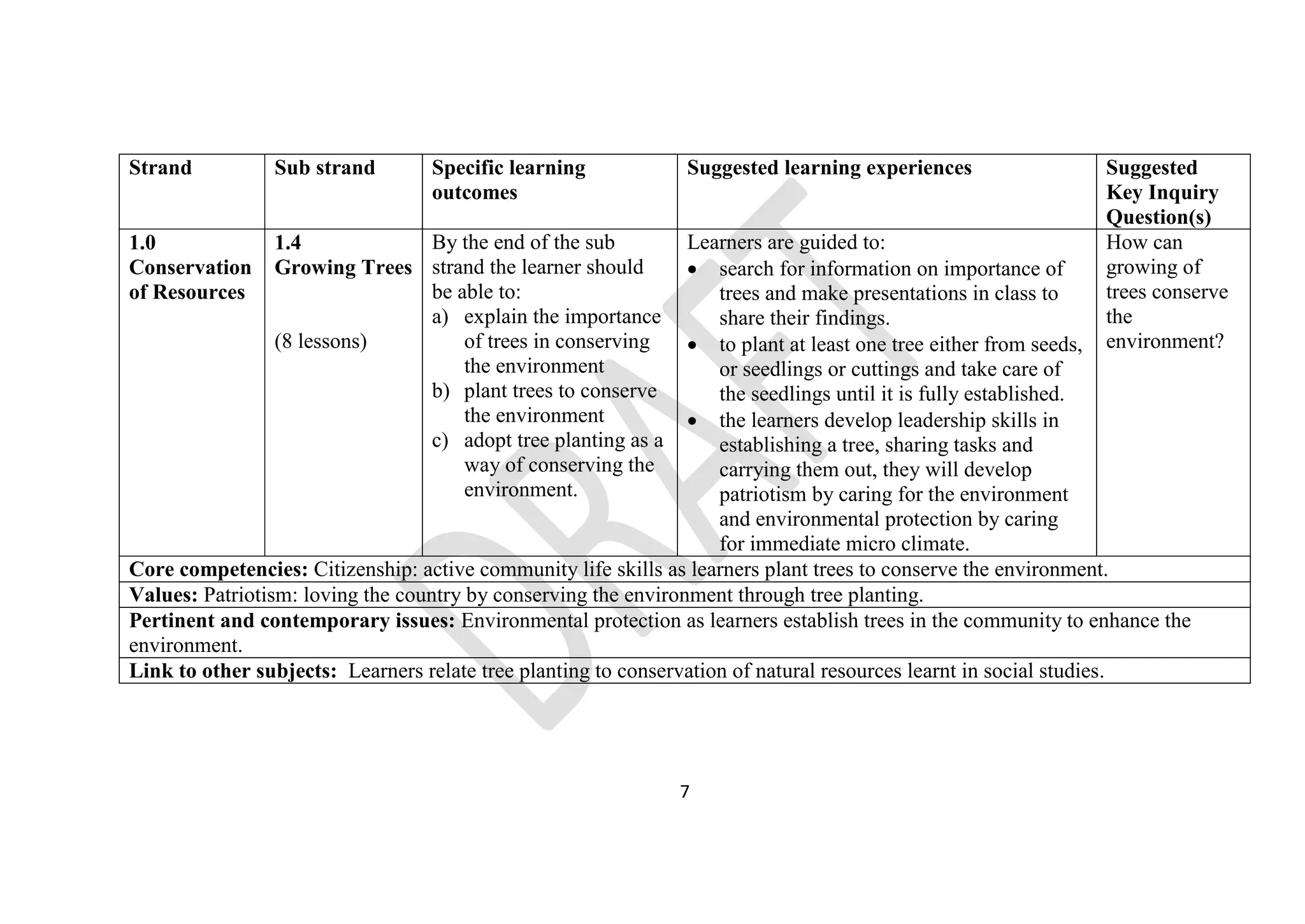
1.0
Conservation
of Resources
1.4
Growing Trees
(8 lessons)
By the end of the sub
strand the learner should
be able to:
a) explain the importance
of trees in conserving
the environment
b) plant trees to conserve
the environment
c) adopt tree planting as a
way of conserving the
environment.
Learners are guided to:
 search for information on importance of
trees and make presentations in class to
share their findings.
 to plant at least one tree either from seeds,
or seedlings or cuttings and take care of
the seedlings until it is fully established.
 the learners develop leadership skills in
establishing a tree, sharing tasks and
carrying them out, they will develop
patriotism by caring for the environment
and environmental protection by caring
for immediate micro climate.
How can
growing of
trees conserve
the
environment?
Core competencies: Citizenship: active community life skills as learners plant trees to conserve the environment.
Values: Patriotism: loving the country by conserving the environment through tree planting.
Pertinent and contemporary issues: Environmental protection as learners establish trees in the community to enhance the
environment.
Link to other subjects: Learners relate tree planting to conservation of natural resources learnt in social studies.
8
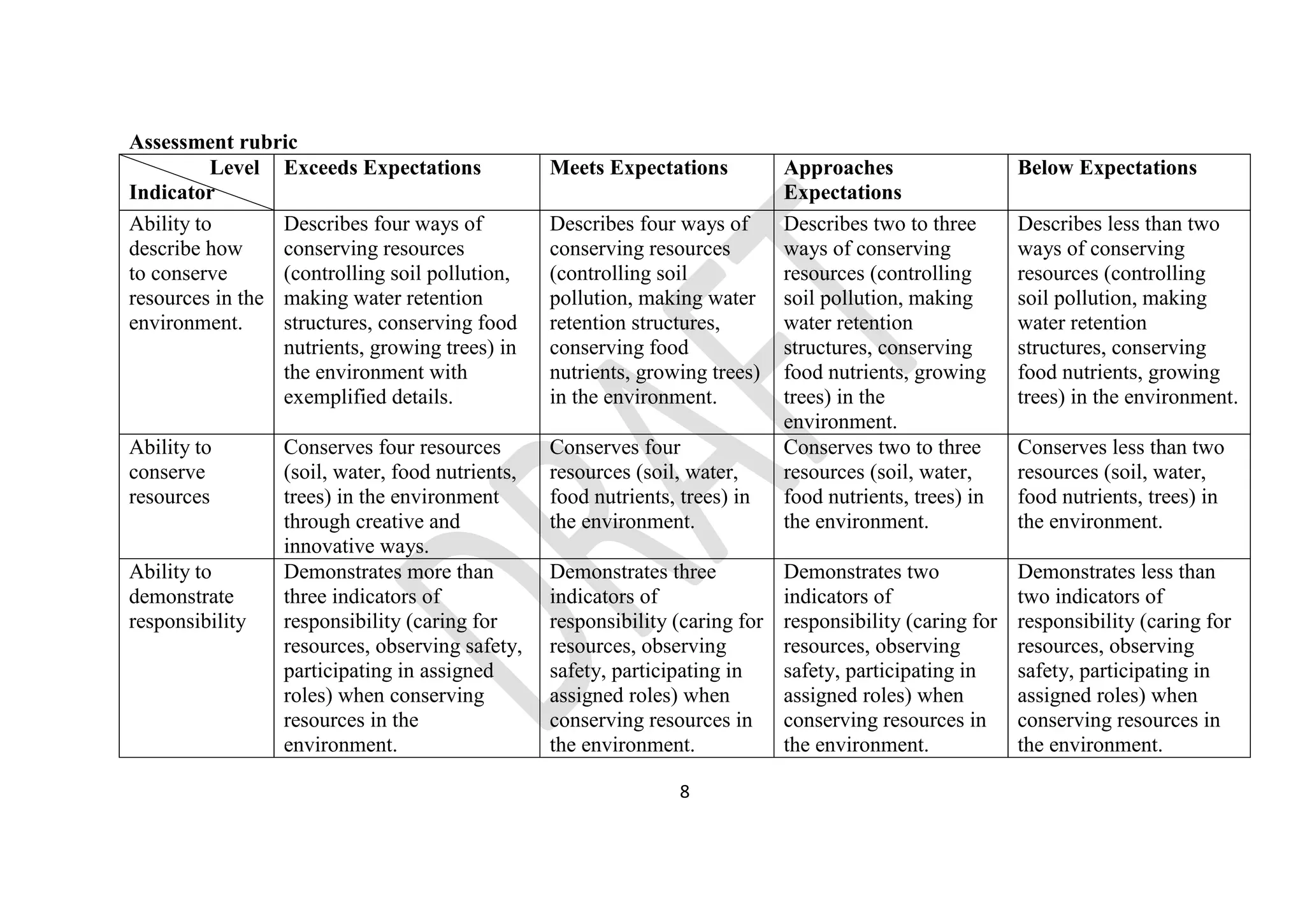
Assessment rubric
Level
Indicator
Exceeds Expectations Meets Expectations Approaches
Expectations
Below Expectations
Ability to
describe how
to conserve
resources in the
environment.
Describes four ways of
conserving resources
(controlling soil pollution,
making water retention
structures, conserving food
nutrients, growing trees) in
the environment with
exemplified details.
Describes four ways of
conserving resources
(controlling soil
pollution, making water
retention structures,
conserving food
nutrients, growing trees)
in the environment.
Describes two to three
ways of conserving
resources (controlling
soil pollution, making
water retention
structures, conserving
food nutrients, growing
trees) in the
environment.
Describes less than two
ways of conserving
resources (controlling
soil pollution, making
water retention
structures, conserving
food nutrients, growing
trees) in the environment.
Ability to
conserve
resources
Conserves four resources
(soil, water, food nutrients,
trees) in the environment
through creative and
innovative ways.
Conserves four
resources (soil, water,
food nutrients, trees) in
the environment.
Conserves two to three
resources (soil, water,
food nutrients, trees) in
the environment.
Conserves less than two
resources (soil, water,
food nutrients, trees) in
the environment.
Ability to
demonstrate
responsibility
Demonstrates more than
three indicators of
responsibility (caring for
resources, observing safety,
participating in assigned
roles) when conserving
resources in the
environment.
Demonstrates three
indicators of
responsibility (caring for
resources, observing
safety, participating in
assigned roles) when
conserving resources in
the environment.
Demonstrates two
indicators of
responsibility (caring for
resources, observing
safety, participating in
assigned roles) when
conserving resources in
the environment.
Demonstrates less than
two indicators of
responsibility (caring for
resources, observing
safety, participating in
assigned roles) when
conserving resources in
the environment.
9
STRAND 2.0 FOOD PRODUCTION PROCESSES
Strand Sub strand Specific Learning
Outcomes
Suggested Learning Experiences Suggested Key
Inquiry Question(s)
2.0 Food
Production
Processes
2.1
Preparing
Planting
Site and
Establishing
crop
(9 lessons)
By the end of the sub
strand the learner
should be able to:
a) determine
appropriate tilth
for selected
planting material,
b) prepare a suitable
tilth for
establishing
selected planting
material,
c) adopt appropriate
tilth in establishing
a selected planting
material.
Learners are guided to:
 observe provided planting materials and
suggest appropriate tilth for each material
(small sized seeds for fine tilth, medium sized
seeds for medium tilth and large planting
materials like tubers, suckers and cuttings for
coarse tilth).
 learners prepare suitable sites (fine tilth for
small seeds, medium tilth for medium sized
seeds, coarse tilth for large planting materials
like tubers, suckers and cuttings).
 learners establish a planting material of their
choice in the selected soil tilth.
 critical thinking (observation skills) as
learners compare planting material to
determine appropriate tilth, unity as learners
collaborate to prepare planting sites, safety as
learners use tools to prepare planting sites.
How does planting
material determine
planting site
preparation?
Core competencies:
Critical thinking and problem solving: observation skills as learnt relate size of planting materials to type of tilth.
Values:
Unity: collaboration with other learners in the preparation of sites and planting.
10
Pertinent and contemporary issues:
Safety of self and others as learners use tools and equipment to prepare planting sites.
Link to other subjects:
Learners relate planting site (tilth) and seed size to concept of germination learnt in Integrated Science.
11
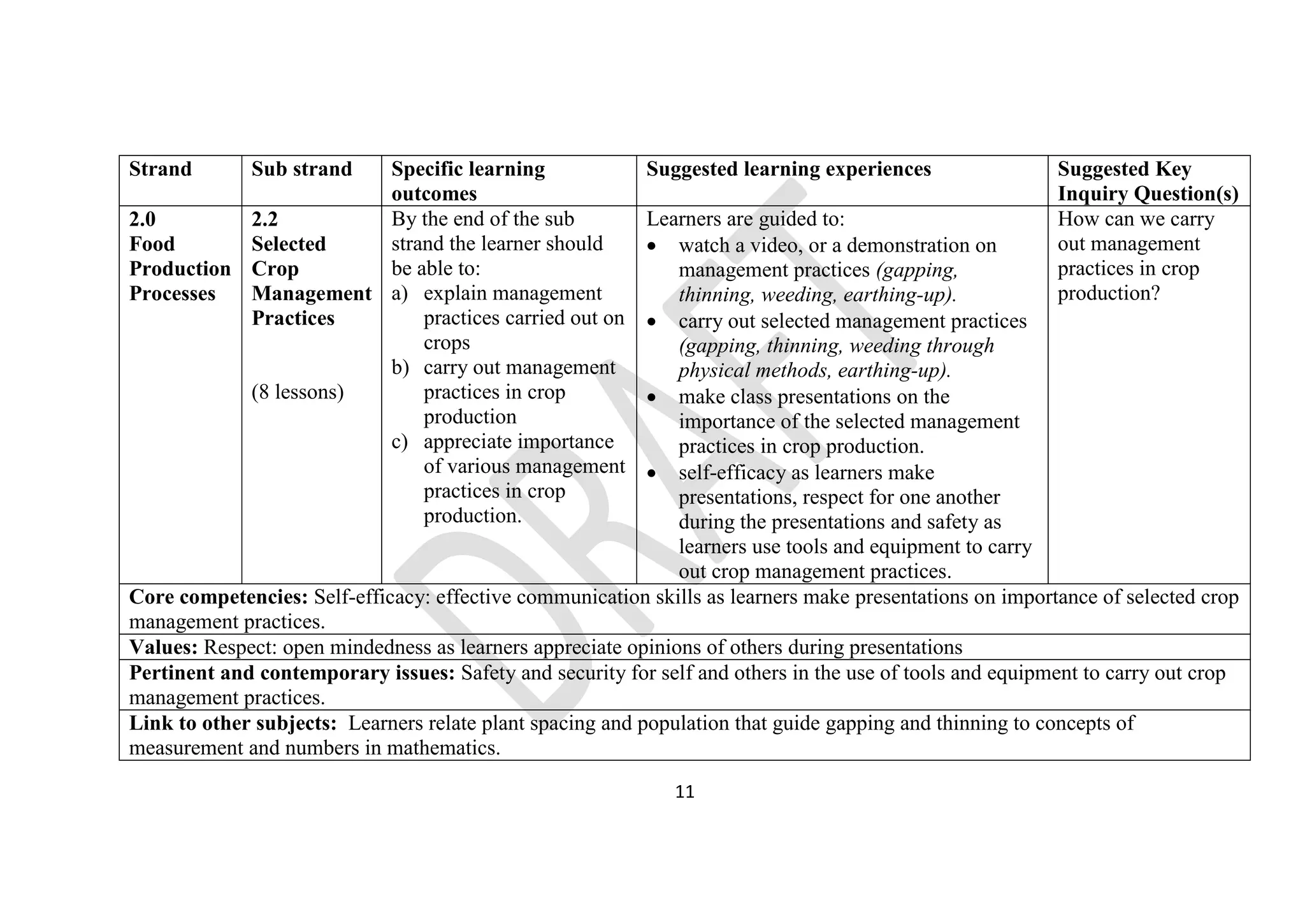
Strand Sub strand Specific learning
outcomes
Suggested learning experiences Suggested Key
Inquiry Question(s)
2.0
Food
Production
Processes
2.2
Selected
Crop
Management
Practices
(8 lessons)
By the end of the sub
strand the learner should
be able to:
a) explain management
practices carried out on
crops
b) carry out management
practices in crop
production
c) appreciate importance
of various management
practices in crop
production.
Learners are guided to:
 watch a video, or a demonstration on
management practices (gapping,
thinning, weeding, earthing-up).
 carry out selected management practices
(gapping, thinning, weeding through
physical methods, earthing-up).
 make class presentations on the
importance of the selected management
practices in crop production.
 self-efficacy as learners make
presentations, respect for one another
during the presentations and safety as
learners use tools and equipment to carry
out crop management practices.
How can we carry
out management
practices in crop
production?
Core competencies: Self-efficacy: effective communication skills as learners make presentations on importance of selected crop
management practices.
Values: Respect: open mindedness as learners appreciate opinions of others during presentations
Pertinent and contemporary issues: Safety and security for self and others in the use of tools and equipment to carry out crop
management practices.
Link to other subjects: Learners relate plant spacing and population that guide gapping and thinning to concepts of
measurement and numbers in mathematics.
12
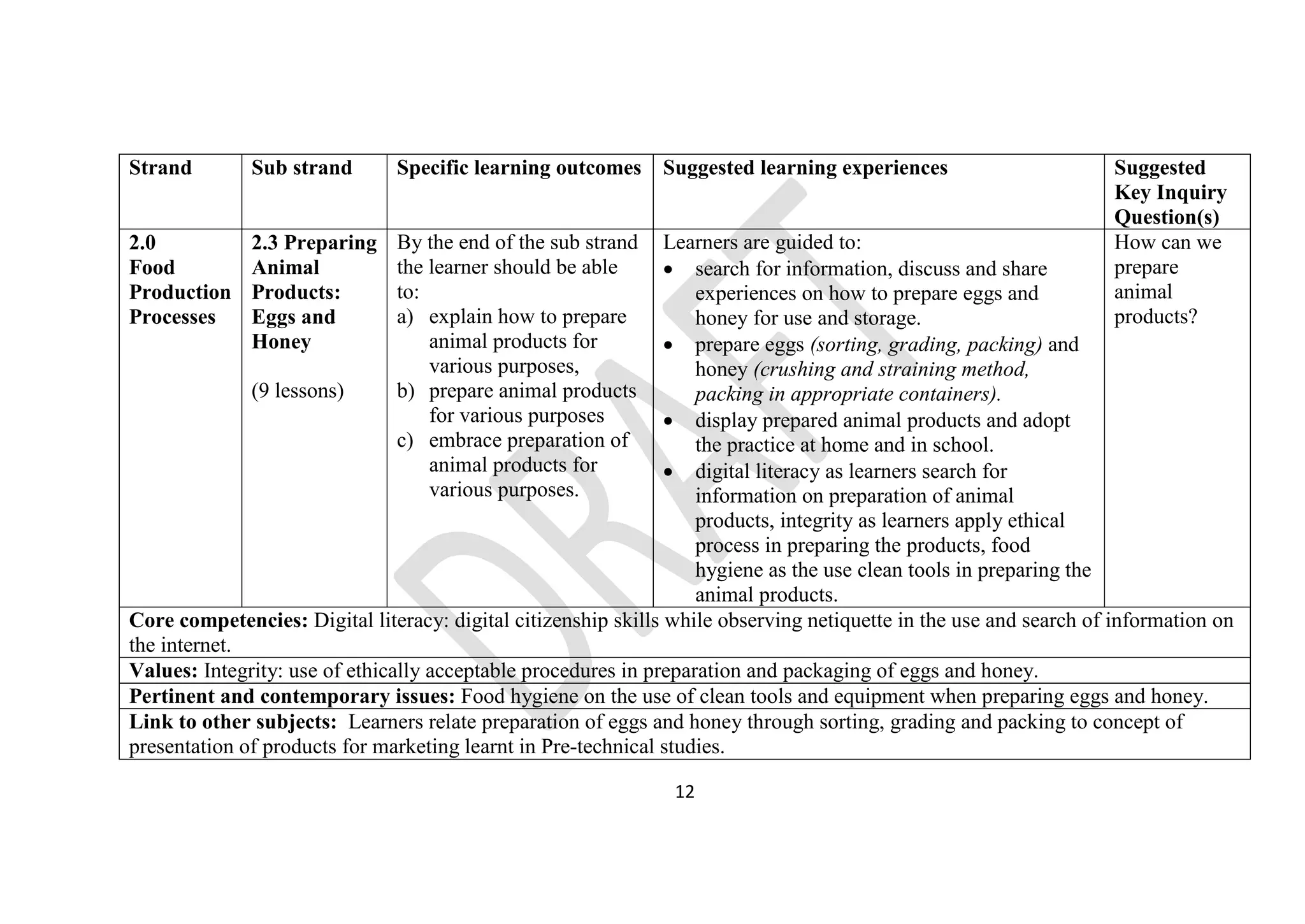
Strand Sub strand Specific learning outcomes Suggested learning experiences Suggested
Key Inquiry
Question(s)
2.0
Food
Production
Processes
2.3 Preparing
Animal
Products:
Eggs and
Honey
(9 lessons)
By the end of the sub strand
the learner should be able
to:
a) explain how to prepare
animal products for
various purposes,
b) prepare animal products
for various purposes
c) embrace preparation of
animal products for
various purposes.
Learners are guided to:
 search for information, discuss and share
experiences on how to prepare eggs and
honey for use and storage.
 prepare eggs (sorting, grading, packing) and
honey (crushing and straining method,
packing in appropriate containers).
 display prepared animal products and adopt
the practice at home and in school.
 digital literacy as learners search for
information on preparation of animal
products, integrity as learners apply ethical
process in preparing the products, food
hygiene as the use clean tools in preparing the
animal products.
How can we
prepare
animal
products?
Core competencies: Digital literacy: digital citizenship skills while observing netiquette in the use and search of information on
the internet.
Values: Integrity: use of ethically acceptable procedures in preparation and packaging of eggs and honey.
Pertinent and contemporary issues: Food hygiene on the use of clean tools and equipment when preparing eggs and honey.
Link to other subjects: Learners relate preparation of eggs and honey through sorting, grading and packing to concept of
presentation of products for marketing learnt in Pre-technical studies.
13
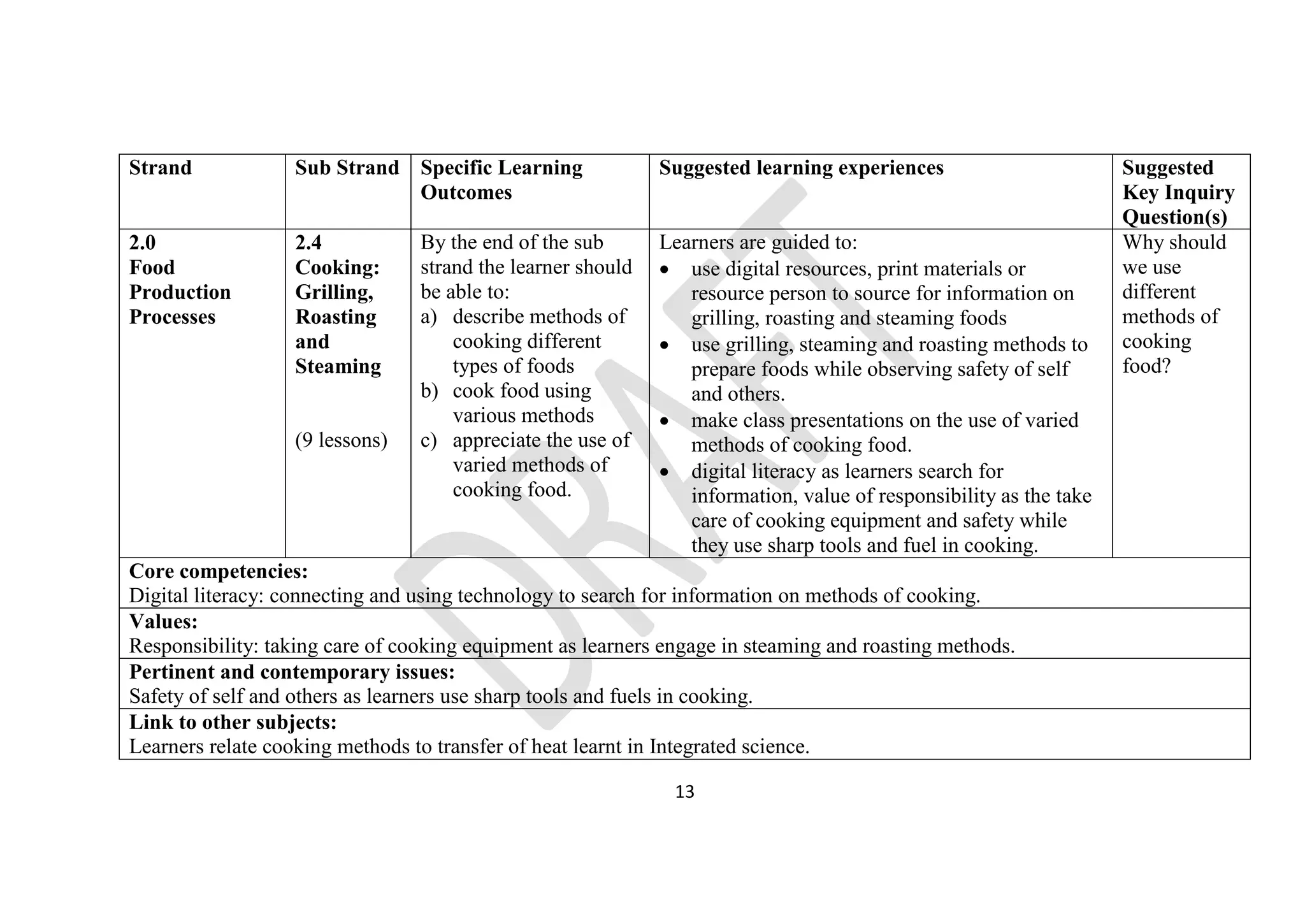
Strand Sub Strand Specific Learning
Outcomes
Suggested learning experiences Suggested
Key Inquiry
Question(s)
2.0
Food
Production
Processes
2.4
Cooking:
Grilling,
Roasting
and
Steaming
(9 lessons)
By the end of the sub
strand the learner should
be able to:
a) describe methods of
cooking different
types of foods
b) cook food using
various methods
c) appreciate the use of
varied methods of
cooking food.
Learners are guided to:
 use digital resources, print materials or
resource person to source for information on
grilling, roasting and steaming foods
 use grilling, steaming and roasting methods to
prepare foods while observing safety of self
and others.
 make class presentations on the use of varied
methods of cooking food.
 digital literacy as learners search for
information, value of responsibility as the take
care of cooking equipment and safety while
they use sharp tools and fuel in cooking.
Why should
we use
different
methods of
cooking
food?
Core competencies:
Digital literacy: connecting and using technology to search for information on methods of cooking.
Values:
Responsibility: taking care of cooking equipment as learners engage in steaming and roasting methods.
Pertinent and contemporary issues:
Safety of self and others as learners use sharp tools and fuels in cooking.
Link to other subjects:
Learners relate cooking methods to transfer of heat learnt in Integrated science.
14
Assessment Rubric
Level
Indicator
Exceeds Expectations Meets Expectations Approaches
Expectations
Below Expectations
Ability to describe
food production
processes
Describes four food production
processes (preparation of sites
and planting; selected
management practices;
preparing eggs and honey; and
cooking by grilling, roasting
and steaming) with elaborate
details.
Describes four food
production processes
(preparation of sites
and planting; selected
management
practices; preparing
eggs and honey; and
cooking by grilling,
roasting and
steaming).
Describes two to
three food production
processes
(preparation of sites
and planting; selected
management
practices; preparing
eggs and honey; and
cooking by grilling,
roasting and
steaming).
Describes less than
two food production
processes
(preparation of sites
and planting; selected
management
practices; preparing
eggs and honey; and
cooking by grilling,
roasting and
steaming).
Ability to carry out
various food
production processes
Carries out four food
production processes
(preparation of sites and
planting; selected management
practices; preparing eggs and
honey; and cooking by grilling,
roasting and steaming) with
innovative and creative
approaches.
Carries out four food
production processes
(preparation of sites
and planting; selected
management
practices; preparing
eggs and honey; and
cooking by grilling,
roasting and
Carries out two to
three food production
processes
(preparation of sites
and planting; selected
management
practices; preparing
eggs and honey; and
cooking by grilling,
Carries out less than
two food production
processes
(preparation of sites
and planting; selected
management
practices; preparing
eggs and honey; and
cooking by grilling,
15
steaming). roasting and
steaming).
roasting and
steaming).
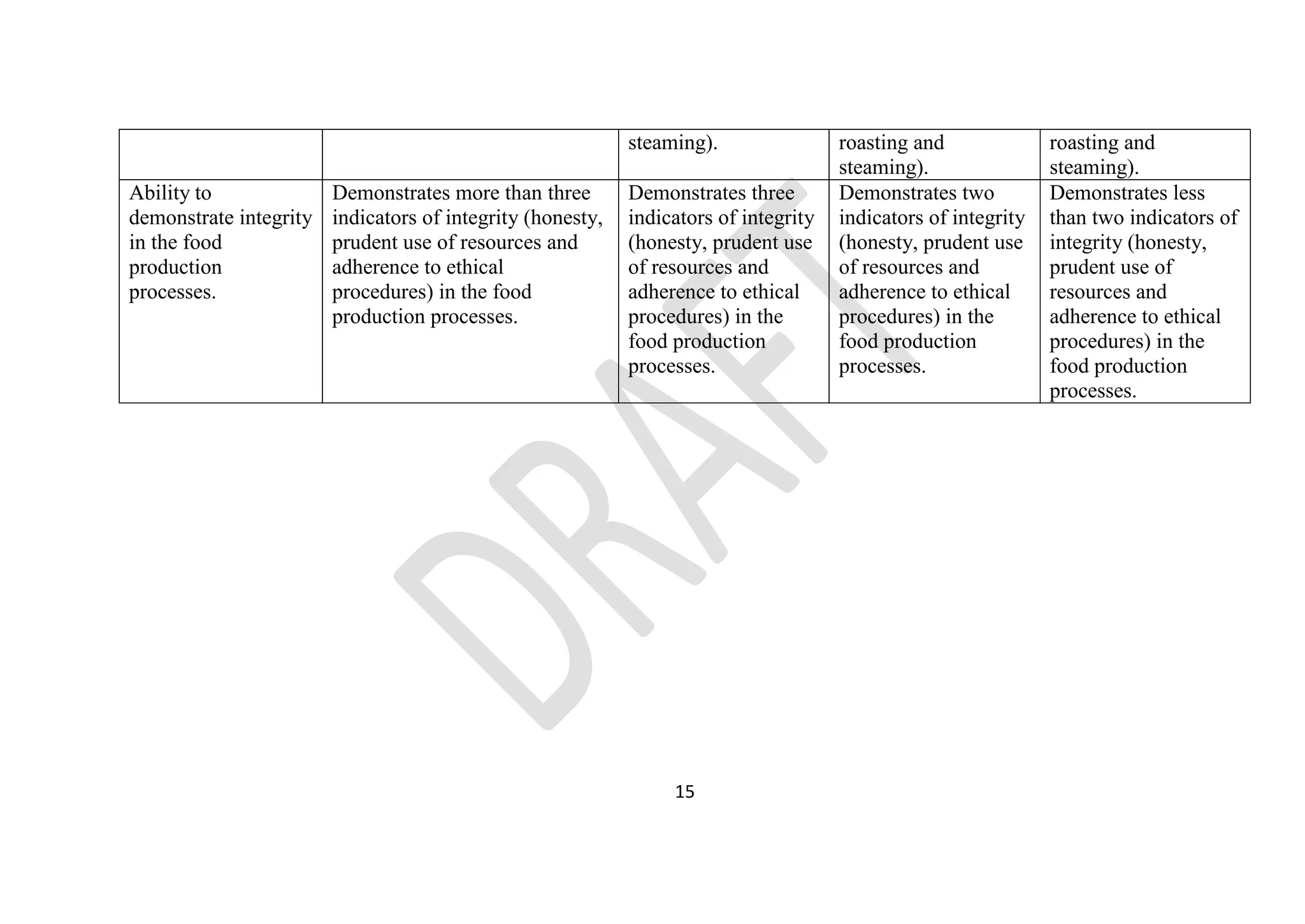
Ability to
demonstrate integrity
in the food
production
processes.
Demonstrates more than three
indicators of integrity (honesty,
prudent use of resources and
adherence to ethical
procedures) in the food
production processes.
Demonstrates three
indicators of integrity
(honesty, prudent use
of resources and
adherence to ethical
procedures) in the
food production
processes.
Demonstrates two
indicators of integrity
(honesty, prudent use
of resources and
adherence to ethical
procedures) in the
food production
processes.
Demonstrates less
than two indicators of
integrity (honesty,
prudent use of
resources and
adherence to ethical
procedures) in the
food production
processes.
16
STRAND 3.0 HYGIENE PRACTICES
Strand Sub Strand Specific Learning
Outcomes
Suggested Learning Experiences Suggested
Key Inquiry
Question(s)
3.0 Hygiene
Practices
3.1 Hygiene
in Rearing
Animals
(9 lessons)
By the end of the sub
strand the learner
should be able to:
a) describe hygiene
practices in rearing
domestic animals
b) carry out hygiene
practices in rearing
domestic animals
c) appreciate
importance of
hygiene practices
in rearing domestic
animals.
Learners are guided to:
 search for information on hygienic practices (clean
feeders and waterers, clean and well ventilated
housing, clean animal) in rearing domestic animals
such as pets.
 carry out appropriate hygiene practices in rearing
domestic animals such as cleaning feeders, waterers,
cleaning animal structures.
 make class presentation on the importance of
hygiene in rearing domestic animals.
 learning to learn while learners apply information to
maintain animal hygiene, responsibility while caring
for the animals by maintaining animal hygiene, and
animal welfare as learners embrace care of animals.
How can we
maintain
hygiene while
rearing
animals?
Core competencies: Learning to learn: sharing learnt knowledge as learners apply information to carry out hygiene in animal
rearing practices.
Values: Responsibility: engaging in assigned roles while carrying out hygiene practices in rearing domestic animals.
Pertinent and contemporary issues:
Animal welfare as learners observe hygiene practices in rearing domestic animals.
Link to other subjects: Learners relate hygiene practices in rearing domestic animals to concepts of animal production as an
economic activity learnt in social studies.
17
Strand Sub Strand Specific Learning
Outcomes
Suggested Learning Experiences Suggested
Key Inquiry
Question(s)
3.0 Hygiene
Practices
3.2 Laundry:
Loose
Coloured
Items
(8 lessons)
By the end of the sub
strand the learner should be
able to:
a) describe how to launder
a loose coloured article
for hygiene purpose
b) launder a loose
coloured article for
hygiene purposes
c) embrace laundering of
loose coloured article
for hygiene purposes.
Learners are guided to:
 watch a video clip or a demonstration on
how to launder a loose coloured (sorting,
washing by kneading and squeezing,
drying, finishing).
 launder a loose coloured item (sorting,
washing by kneading and squeezing,
drying, finishing).
 learning to learn as they launder loose
coloured articles, responsibility as they
undertake the assigned roles and health
promotion as they maintain hygiene.
How do you
launder a loose
coloured
articles for
hygienic
purposes?
Core competencies:
Learning to learn: reflection of own work as learners launder loose coloured articles for hygiene purposes.
Values:
Responsibility as learners undertake assigned roles to launder loose coloured articles.
Pertinent and contemporary issues:
Health promotion as learners maintain hygiene through laundering a loose coloured article.
Link to other subjects:
Learners relate laundering of loose coloured articles to concept of tie and dye technique of fixing colours learnt in creative art.
18
Suggested Assessment Rubric
Level
Indicator
Exceeds Expectations Meets Expectations Approaches
Expectations
Below Expectations
Ability to describe
hygiene practices at
household level.
Describes two hygiene
practices (in rearing
animals and laundering
loose coloured items) with
elaborate details.
Describes two
hygiene practices (in
rearing animals and
laundering loose
coloured items).
Describes one hygiene
practice (in rearing
animals or laundering
loose coloured items).
Describes hygiene
practices (in rearing
animals or laundering
loose coloured items)
with partial details.
Ability to carry out
hygiene practices at
household level.
Carries out two hygiene
practices (in rearing
animals and laundering
loose coloured items) at
household level with
innovative or notable
attention to details.
Carries out two
hygiene practices (in
rearing animals and
laundering loose
coloured items) at
household level.
Carries out one
hygiene practice (in
rearing animals or
laundering loose
coloured items) at
household level.
Carries out hygiene
practices (in rearing
animals and laundering
loose coloured items) at
household level with
some tasks that require
corrections.
Ability to exhibit
unity in practising
hygiene.
Exhibits more than three
indicators of unity (team
spirit, collaboration with
others and shares available
resources) in practising
hygiene.
Exhibits three
indicators of unity
(team spirit,
collaboration with
others and shares
available resources)
in practising
hygiene.
Exhibits two
indicators of unity
(team spirit,
collaboration with
others and shares
available resources) in
practising hygiene.
Exhibits less than two
indicators of unity (team
spirit, collaboration with
others and shares
available resources) in
practising hygiene.
19
STRAND 4.0: PRODUCTION TECHNIQUES
Strand Sub Strand Specific Learning
Outcomes
Suggested Learning Experiences Suggested
Key Inquiry
Question(s)
4.0
Production
Techniques
4.1 Sewing
Skills:
Knitting
(10 lessons)
By the end of the sub
strand the learner should be
able to:
a) describe knitting
stitches used in making
household articles
b) knit various articles for
household use
c) embrace knitted articles
for household use
Learners are guided to:
 use digital devices or real materials or print
media identify basic knitting stitches (purl and
knit).
 knit a simple household article such as tools
bag, scarf, gloves, mats or table wipers.
 creativity skills as they explore ideas of
knitting household articles, integrity as they
prudently utilise knitting materials and safety
as they use sharp tools for knitting.
How do you
knit an article
for household
use?
Core competencies:
Creativity and imagination: experimenting skills as learners knit a household article using basic knitting stitches.
Values:
Integrity: prudent use of materials and equipment in the knitting of household article.
Pertinent and contemporary issues:
Safety of self and others as learners use sharp knitting tools.
Link to other subjects:
Learners relate knitting to weaving technique learnt in creative arts.
20
Strand Sub Strand Specific Learning
Outcomes
Suggested Learning Experiences Suggested Key
Inquiry Question(s)
4.0
Production
Techniques
4.2
Constructing
Framed
Suspended
Garden
(10 lessons)
By the end of the sub
strand the learner
should be able to:
a) describe framed
suspended garden
for growing crops,
b) construct a framed
structure for
suspended garden,
c) embrace the use
of framed
suspended garden
for growing crops.
Learners are guided to:
 search for photos, videos and illustrations
on framed suspended gardens to describe
how they are constructed.
 innovate and construct framed suspended
gardens using locally available materials
such as wires, wooden planks, metal bars
and poles.
 establish a crop on the constructed framed
suspended garden.
 creativity skills as learners innovate framed
suspended gardens, unity as the learners
demonstrate teamwork as they construct
framed suspended gardens, and safety as the
learners use tools and equipment to
construct framed suspended gardens.
How are framed
suspended gardens
constructed?
Core competencies: Creativity and imagination: experimenting skills as learners innovate framed suspended gardens.
Values: Unity: team work as learners undertake the project for construction of framed suspended garden.
Pertinent and contemporary issues: Environmental awareness as learners utilize limited space when constructing framed
suspended gardens.
Link to other subjects: Learners relate designing, sketching and construction of framed suspended garden to skills in drawing,
designing and use of related tools learnt in Pre-technical studies.
21
Strand Sub strand Specific Learning
Outcomes
Suggested Learning Experiences Suggested
Key Inquiry
Question(s)
4.0 Production
Techniques
4.3 Adding
Value to
Crop
Produce
(8 lessons)
By the end of the
sub strand the
learner should be
able to:
a) explain ways of
adding value on
crop produce
b) add value to a
selected crop
produce
c) appreciate the
importance of
value addition
on crop
produce.
Learners are guided to:
 discuss ways of adding value to crop produce such
as potatoes, cassava, groundnuts, simsim, sweet
potatoes and pumpkin.
 process a provided sample of crop produce such as
potatoes, cassava, groundnuts, simsim, sweet
potatoes and pumpkin to add value using
appropriate methods like drying and frying.
 compare the processed crop produce to raw crop
produce in terms of monetary value and storage
life.
 problem solving skills as learners apply suitable
method of adding value to crop produce, integrity
as learners use ethically acceptable standards of
processing, food and nutrition security as they
process crop produce to solve food security issues.
Why do we
add value to
crop produce?
How can we
add value to
crop produce?
Core competencies: Critical thinking and problem solving: evaluation and decision making skills as learners carry out value
addition to a selected crop produce.
Values: Integrity: applying laid down procedures when learners ethically processes crop produce to add value.
Pertinent and contemporary issues: Food and nutrition security as learners process crop produce for value addition.
Link to other subjects: Learners relate value addition concept to commodity marketing learnt in Pre-technical studies.
22
Strand Sub Strand Specific Learning
Outcomes
Suggested Learning Experiences Suggested
Key Inquiry
Question(s)
4.0
Production
Techniques
4.4
Making
Homemade
Soap
(8 lessons)
By the end of the sub
strand the learner
should be able to:
a) identify the forms
of soap used at
household level
b) make homemade
soap using natural
ingredients
c) embrace
homemade soap
for household use.
Learners are guided to:
 brainstorm and share experiences on forms of soap
(liquid, cake/bar, paste, powder) used at household
level.
 use natural ingredients such as ashes, salt, water,
animal fats or plant oils to make soap.
 use the home made soap for cleaning purposes.
 problem solving in collecting and using natural
ingredients to make soap for cleaning, value of
responsibility in sharing tasks to accomplish soap
making process and financial literacy while learners
save costs by making soap using available resources.
How can we
make soap
using natural
ingredients?
Core competencies:
Critical thinking and problem solving: open-mindedness and creativity skills as learners make home-made soap using natural
ingredients.
Values:
Responsibility: engaging in assigned roles while making home-made soap.
Pertinent and contemporary issues:
Financial literacy as learners save on costs by using locally available resources to make home-made soap.
Link to other subjects:
Learners relate use of natural ingredients in making soap to concepts of recycling and reusing wastes learnt in Integrated science.
23
Suggested assessment rubric
Level
Indicator
Exceeds Expectations Meets Expectations Approaches
Expectations
Below Expectations
Ability to describe
production
techniques at
household level.
Describes four production
techniques (knitting,
constructing framed garden,
value addition on crop
produce, and making soap)
at household level with
illustrative details.
Describes four
production techniques
(knitting, constructing
framed garden, value
addition on crop
produce, and making
soap) at household
level.
Describes two to three
production techniques
(knitting, constructing
framed garden, value
addition on crop
produce, and making
soap) at household level.
Describes less than
two production
techniques (knitting,
constructing framed
garden, value addition
on crop produce, and
making soap) at
household level.
Ability to apply
production
techniques at
household level.
Applies four production
techniques (knitting,
constructing framed
suspended garden, value
addition on crop produce,
and making soap) at
household level with notable
creativity.
Applies four
production techniques
(knitting, constructing
framed suspended
garden, value
addition on crop
produce, and making
soap) at household
level.
Applies two to three
production techniques
(knitting, constructing
framed suspended
garden, value addition
on crop produce, and
making soap) at
household level.
Applies less than two
production techniques
(knitting, constructing
framed suspended
garden, value addition
on crop produce, and
making soap) at
household level.
Ability to portray
integrity in carrying
out production
techniques.
Portrays more than three
indicators of integrity
(prudent use of resources,
adheres to ethical
Portrays three
indicators of integrity
(prudent use of
resources, adheres to
Portrays two indicators
of integrity (prudent use
of resources, adheres to
ethical procedures,
Portrays less than two
indicators of integrity
(prudent use of
resources, adheres to
24
procedures, commitment to
duty) in carrying out
production tasks.
ethical procedures,
commitment to duty)
in carrying out
production tasks.
commitment to duty) in
carrying out production
tasks.
ethical procedures,
commitment to duty)
in carrying out
production tasks.
25
APPENDIX 1: GUIDELINES FOR INTEGRATING COMMUNITY SERVICE LEARNING AT JUNIOR SCHOOL
Introduction
Community Service Learning (CSL) is an experiential learning strategy that integrates classroom learning and community
service to enable learners reflect, experience and learn from the community. The CSL activity is hosted as a strand in Social
Studies. The Social Studies teacher will be expected to coordinate teachers from other learning areas to carry out the integrated
CSL class activity. Learners will be expected to apply knowledge, skills, attitudes and values from the different Learning Areas
to undertake the integrated CSL class activity. Learners will undertake one common integrated class CSL activity following a 6-
step milestone approach that is:
Milestone Description
Milestone 1 Problem Identification
Learners study their community to understand the challenges faced and their effects on community members.
Milestone 2 Designing a solution
Learners create an intervention to address the challenge identified.
Milestone 3 Planning for the Project
Learners share roles, create a list of activities to be undertaken, mobilise resources needed to create their
intervention and set timelines for execution
Milestone 4 Implementation
The learners execute the project and keep evidence of work done.
26
Milestone 5 Showcasing /Exhibition and Report Writing
Exhibitions involve showcasing learners’ project items to the community and reflecting on the feedback
Learners write a report detailing their project activities and learnings from feedback
Milestone 6 Reflection
Learners review all project work to learn from the challenges faced.
They link project work with academic concepts, noting how the concepts enabled them to do their project
as well as how the project helped to deepen learning of the academic concepts.
Assessment of CSL integrated Activity
Assessment for the integrated CSL activity will be conducted formatively. The assessment will consider both the process and
end product. This entails assessing each of the milestone stages of the integrated CSL class activity. It will focus on 3
components namely: skills from various learning areas applied in carrying out the activity, core competencies developed and
values nurtured.
27
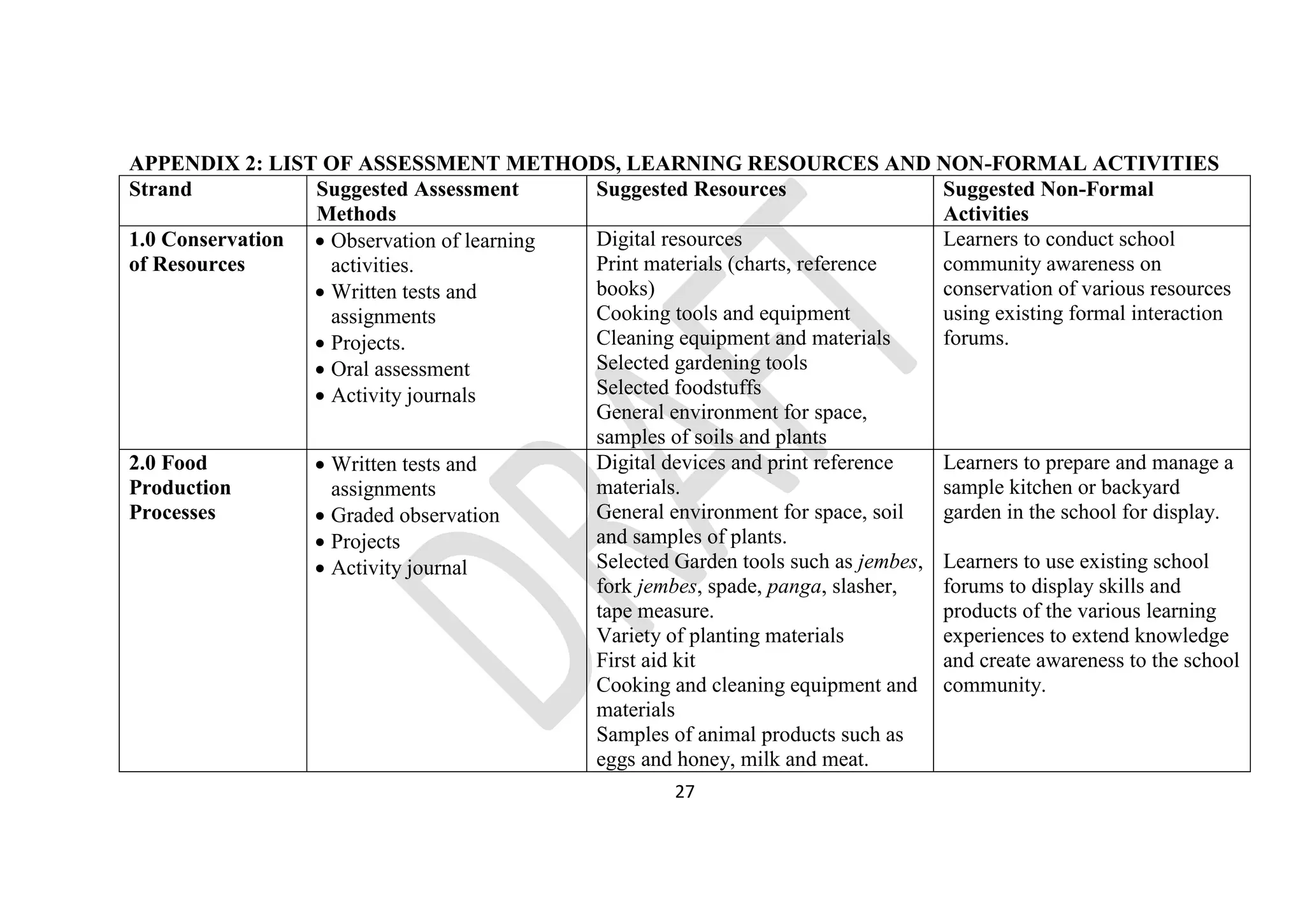
APPENDIX 2: LIST OF ASSESSMENT METHODS, LEARNING RESOURCES AND NON-FORMAL ACTIVITIES
Strand Suggested Assessment
Methods
Suggested Resources Suggested Non-Formal
Activities
1.0 Conservation
of Resources
 Observation of learning
activities.
 Written tests and
assignments
 Projects.
 Oral assessment
 Activity journals
Digital resources
Print materials (charts, reference
books)
Cooking tools and equipment
Cleaning equipment and materials
Selected gardening tools
Selected foodstuffs
General environment for space,
samples of soils and plants
Learners to conduct school
community awareness on
conservation of various resources
using existing formal interaction
forums.
2.0 Food
Production
Processes
 Written tests and
assignments
 Graded observation
 Projects
 Activity journal
Digital devices and print reference
materials.
General environment for space, soil
and samples of plants.
Selected Garden tools such as jembes,
fork jembes, spade, panga, slasher,
tape measure.
Variety of planting materials
First aid kit
Cooking and cleaning equipment and
materials
Samples of animal products such as
eggs and honey, milk and meat.
Learners to prepare and manage a
sample kitchen or backyard
garden in the school for display.
Learners to use existing school
forums to display skills and
products of the various learning
experiences to extend knowledge
and create awareness to the school
community.
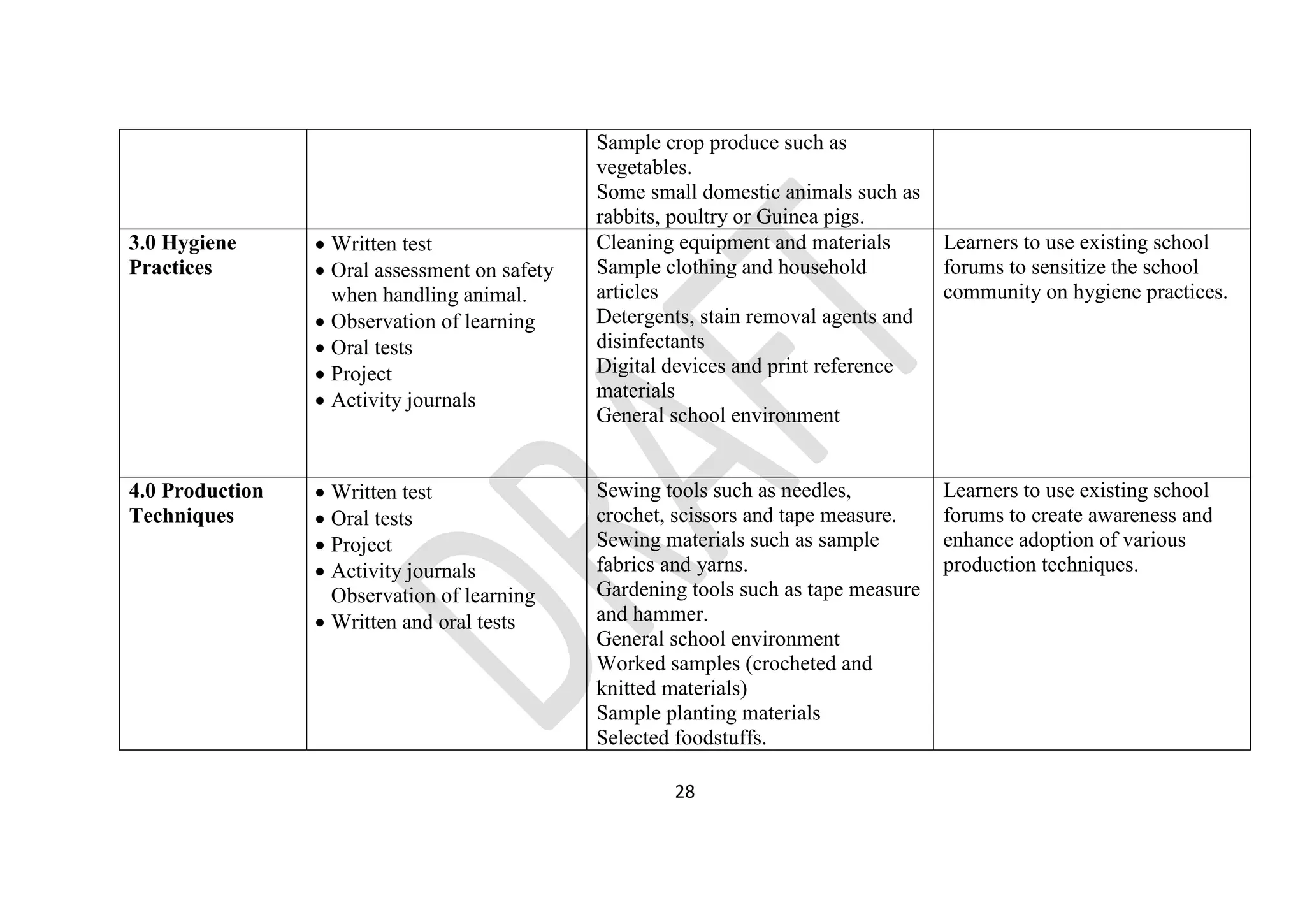
28
Sample crop produce such as
vegetables.
Some small domestic animals such as
rabbits, poultry or Guinea pigs.
3.0 Hygiene
Practices
 Written test
 Oral assessment on safety
when handling animal.
 Observation of learning
 Oral tests
 Project
 Activity journals
Cleaning equipment and materials
Sample clothing and household
articles
Detergents, stain removal agents and
disinfectants
Digital devices and print reference
materials
General school environment
Learners to use existing school
forums to sensitize the school
community on hygiene practices.
4.0 Production
Techniques
 Written test
 Oral tests
 Project
 Activity journals
Observation of learning
 Written and oral tests
Sewing tools such as needles,
crochet, scissors and tape measure.
Sewing materials such as sample
fabrics and yarns.
Gardening tools such as tape measure
and hammer.
General school environment
Worked samples (crocheted and
knitted materials)
Sample planting materials
Selected foodstuffs.
Learners to use existing school
forums to create awareness and
enhance adoption of various
production techniques.
29

GRADE.7.AGRICULTURE.NUTRITION.pdf for students

  • 1.
    KENYA INSTITUTE OFCURRICULUM DEVELOPMENT A Skilled and Ethical Society JUNIOR SCHOOL CURRICULUM DESIGN AGRICULTURE AND NUTRITION GRADE 7
  • 2.
    ii First published 2022 Revised2024 All rights reserved. No part of this book may be reproduced, stored in a retrieval system or transcribed, in any form or by any means, electronic, mechanical, photocopy, recording or otherwise, without the prior written permission of the publisher. ISBN: Published and printed by Kenya Institute of Curriculum Development
  • 3.
    TABLE OF CONTENTS NATIONALGOALS OF EDUCATION ............................................................................................................................................................ii LESSON ALLOCATION AT JUNIOR SCHOOL ............................................................................................................................................ iv LEARNING OUTCOMES FOR JUNIOR SCHOOL ......................................................................................................................................... v ESSENCE STATEMENT ................................................................................................................................................................................... v GENERAL LEARNING OUTCOMES.............................................................................................................................................................. vi SUMMARY OF STRANDS AND SUB STRANDS.......................................................................................................................................... 1 STRAND 1.0: CONSERVATION OF RESOURCES ........................................................................................................................................ 2 STRAND 2.0 FOOD PRODUCTION PROCESSES.......................................................................................................................................... 9 STRAND 3.0 HYGIENE PRACTICES ............................................................................................................................................................ 16 STRAND 4.0: PRODUCTION TECHNIQUES................................................................................................................................................ 19 APPENDIX 1: GUIDELINES FOR INTEGRATING COMMUNITY SERVICE LEARNING AT JUNIOR SCHOOL............................... 25 APPENDIX 2: LIST OF ASSESSMENT METHODS, LEARNING RESOURCES AND NON-FORMAL ACTIVITIES........................... 27
  • 4.
    ii NATIONAL GOALS OFEDUCATION Education in Kenya should: 1. Foster nationalism and patriotism and promote national unity. Kenya’s people belong to different communities, races and religions, but these differences need not divide them. They must be able to live and interact as Kenyans. It is a paramount duty of education to help young people acquire this sense of nationhood by removing conflicts and promoting positive attitudes of mutual respect which enable them to live together in harmony and foster patriotism in order to make a positive contribution to the life of the nation. 2. Promote the social, economic, technological and industrial needs for national development. Education should prepare the youth of the country to play an effective and productive role in the life of the nation. a) Social Needs Education in Kenya must prepare children for changes in attitudes and relationships which are necessary for the smooth progress of a rapidly developing modern economy. There is bound to be a silent social revolution following the wake of rapid modernisation. Education should assist our youth to adapt to this change. b) Economic Needs Education in Kenya should produce citizens with the skills, knowledge, expertise and personal qualities that are required to support a growing economy. Kenya is building up a modern and independent economy which is in need of an adequate and relevant domestic workforce. c) Technological and Industrial Needs Education in Kenya should provide learners with the necessary skills and attitudes for industrial development. Kenya recognises the rapid industrial and technological changes taking place, especially in the developed world. We can only be part of this development if our education system is deliberately focused on the knowledge, skills and attitudes that will prepare our young people for these changing global trends.
  • 5.
    iii 3. Promote individualdevelopment and self-fulfilment. Education should provide opportunities for the fullest development of individual talents and personality. It should help children to develop their potential interests and abilities. A vital aspect of individual development is the building of character. 4. Promote sound moral and religious values. Education should provide for the development of knowledge, skills and attitudes that will enhance the acquisition of sound moral values and help children to grow up into self-disciplined, self-reliant and integrated citizens. 5. Promote social equity and responsibility. Education should promote social equality and foster a sense of social responsibility within an education system which provides equal educational opportunities for all. It should give all children varied and challenging opportunities for collective activities and corporate social service irrespective of gender, ability or geographical environment. 6. Promote respect for and development of Kenya’s rich and varied cultures. Education should instil in the youth of Kenya an understanding of past and present cultures and their valid place in contemporary society. Children should be able to blend the best of traditional values with the changing requirements that must follow rapid development in order to build a stable and modern society. 7. Promote international consciousness and foster positive attitudes towards other nations. Kenya is part of the international community. It is part of the complicated and interdependent network of peoples and nations. Education should therefore lead the youth of the country to accept membership of this international community with all the obligations and responsibilities, rights and benefits that this membership entails. 8. Promote positive attitudes towards good health and environmental protection. Education should inculcate in young people the value of good health in order for them to avoid indulging in activities that will lead to physical or mental ill health. It should foster positive attitudes towards environmental development and conservation. It should lead the youth of Kenya to appreciate the need for a healthy environment.
  • 6.
    iv LESSON ALLOCATION ATJUNIOR SCHOOL S/No Learning Area Number of Lessons 1. English 5 2. Kiswahili / Kenya Sign Language 4 3. Mathematics 5 4. Religious Education 4 5. Social Studies 4 6. Integrated Science 5 7. Pre-Technical Studies 4 8. Agriculture and Nutrition 4 9. Creative Arts and Sports 5 Total 40 * 1 lesson is set aside for the Pastoral/Religious Instruction Programme.
  • 7.
    v LEARNING OUTCOMES FORJUNIOR SCHOOL By end of Junior School, the learner should be able to: 1. Apply literacy, numeracy and logical thinking skills for appropriate self-expression. 2. Communicate effectively, verbally and non-verbally, in diverse contexts. 3. Demonstrate social skills, spiritual and moral values for peaceful co-existence. 4. Explore, manipulate, manage and conserve the environment effectively for learning and sustainable development. 5. Practise relevant hygiene, sanitation and nutrition skills to promote health. 6. Demonstrate ethical behaviour and exhibit good citizenship as a civic responsibility. 7. Appreciate the country's rich and diverse cultural heritage for harmonious co-existence. 8. Manage pertinent and contemporary issues in society effectively. 9. Apply digital literacy skills for communication and learning. ESSENCE STATEMENT Agriculture and nutrition is a learning area that anchors on the United Nation Sustainable development goals and the socio- economic pillar of Kenya Vision 2030 to promote health, hygiene, food and nutrition security through education. It is an integrated learning area comprising of agriculture and home science concepts introduced in the upper primary curriculum. The learners will deepen the acquired knowledge, skills, attitudes and values in conservation of resources, food production, hygiene and innovative production techniques. The curriculum will enrich learner’s competencies in conservation of resources, crop and animal production, foods and nutrition, personal and environmental hygiene, basic clothing construction and laundry work. Agriculture and nutrition curriculum will form a grounds for specialization in respective career pathways in senior school and beyond.
  • 8.
    vi GENERAL LEARNING OUTCOMES Byend of Junior School, the learner should be able to: 1. Participate actively in agricultural and household activities in conservation of resources. 2. Use scarce resources through innovative practices to contribute towards food and nutrition security. 3. Engage in food production processes for self-sustainability, health and economic development. 4. Adopt personal and environmental hygiene practices for healthy living. 5. Apply appropriate production techniques, innovative technologies, digital and media resources to enhance sustainable agricultural and household practices. 6. Appreciate agricultural and household skills as a worthy niche for hobby, career development, further education and training.
  • 9.
    1 SUMMARY OF STRANDSAND SUB STRANDS Strands Sub strands 1.0 Conservation of Resources 1.1 Controlling soil pollution 1.2 Constructing water retention structures 1.3 Conserving food nutrients 1.4 Growing trees 2.0 Food Production Processes 2.1 Preparing planting site and establishing crop 2.2 Selected crop management practices 2.3 Preparing animal products: Eggs and honey 2.4 Cooking: Roasting and steaming 3.0 Hygiene Practices 3.1 Hygiene in rearing animals 3.2 Laundry: Loose coloured items 4.0 Production Techniques 4.1 Sewing Skills: Knitting 4.2 Constructing frames suspended garden 4.3 Adding value to crop produce 4.4 Making homemade soap
  • 10.
    2 STRAND 1.0: CONSERVATIONOF RESOURCES Strand Sub Strand Specific Learning Outcomes Suggested Learning Experiences Suggested Key Inquiry Question(s) 1.0 Conservation of Resources 1.1 Controlling Soil Pollution (7 lessons) By the end of the sub strand the learner should be able to: a) explain the causes of soil pollution in gardening, b) control soil pollution in home environment, c) demonstrate responsibility in using safe farming practices to conserve the soil. Learners are guided to:  search and watch a video clip or print media on causes of soil pollution and then share experiences on causes of soils pollution such as waste water, excessive use of artificial fertilizers, agricultural chemicals and plastic wastes.  engage in safe soil pollution control practices such as safe disposal of household waste water, used chemical containers and plastic wastes.  create awareness messages against improper disposal of waste water, dumping of soil pollutants, used chemical containers and plastic wastes and use of correct types and amounts of farm chemicals and fertilizers.  citizenship as learners promote awareness of soil conservation, value of patriotism as learners are aware of environment and environmental How can household practices cause soil pollution?
  • 11.
    3 protection as theycreate awareness against soil pollution. Core competencies: Citizenship: civic skills as learners promote control of soil pollution to enhance soil conservation in the community. Values: Patriotism: awareness of own responsibility as the learners engage in activities that promote soil pollution control. Pertinent and contemporary issues: Environmental conservation as learners protect soil against pollution. Link to other subjects: Learners relate soil pollution to other forms of environmental pollution learnt in science and technology.
  • 12.
    4 Strand Sub strandSpecific learning outcomes Suggested learning experiences Suggested Key inquiry question(s) 1.0 Conservation of Resources 1.2 Constructing Water Retention Structures (8 lessons) By the end of the sub strand the learner should be able to: a) describe how surface run-off can be used in gardening b) construct water retention structures to conserve surface runoff, c) adopt utilization of surface run-off in gardening. Learners are guided to:  search for information and discuss how surface run-off can be conserved in structures such as water retention ditches and water retention pits for gardening.  construct retention ditches or retention pits for water conservation and establish a crop of their choice such as a banana sucker, sugarcane, napier grass or arrowroot.  problem solving skill as learners solve the destructions caused by run- off, value of unity when working in groups to construct the retention structure, environmental protection and conservation while learners conserve run-off. 1. How can surface run-off be conserved for gardening purposes? 2. How does construction of water retention structures conserve water? Core competencies: Critical thinking and problem solving: decision making skills as learners construct water retention structures to control run-off. Values: Unity: collaboration with others as learners engage in project activities to construct water retention structures.
  • 13.
    5 Pertinent and contemporaryissues: Environmental protection as learners construct water retention structures to harness run-off and use it in gardening activities. Link to other subjects: Learners relate construction of run-off control structures to destruction of environment by excess water in socio-economic amenities as learnt in social studies.
  • 14.
    6 Strand Sub StrandSpecific Learning Outcomes Suggested Learning Experiences Suggested Key Inquiry Question(s) 1.0 Conservation of Resources 1.3 Conserving Food Nutrients (9 lessons) By the end of the sub strand the learner should be able to: a) identify ways of conserving vitamins and mineral salts in vegetables b) conserve vitamins and mineral salts in vegetables c) adopt conservation of vitamins and mineral salts in vegetables. Learners are guided to:  search for information and discuss on ways of conserving vitamins and mineral salts in vegetables such as washing, peeling, cutting, cooking time, and covering.  conserve vitamins and mineral salts in vegetables during food handling, preparation and cooking.  adopt appropriate ways of handling, preparing and cooking vegetables to conserve vitamins and mineral salts.  learning to learn as learners practice ways of conserving nutrients, integrity as they utilize resources prudently, health promotion as they conserve the nutrients in food production. How do we conserve vitamins and mineral salts in vegetables? Core competencies: Learning to learn: carrying out research and sharing information on ways of conserving nutrients. Values: Integrity: prudent use of resources as learners conserve food nutrients. Pertinent and contemporary issues: Health promotion as learners conserve nutrients in food production processes. Link to other subjects: Learners relate conservation of food nutrients to healthy growth and development learnt in integrated science.
  • 15.
    7 Strand Sub strandSpecific learning outcomes Suggested learning experiences Suggested Key Inquiry Question(s) 1.0 Conservation of Resources 1.4 Growing Trees (8 lessons) By the end of the sub strand the learner should be able to: a) explain the importance of trees in conserving the environment b) plant trees to conserve the environment c) adopt tree planting as a way of conserving the environment. Learners are guided to:  search for information on importance of trees and make presentations in class to share their findings.  to plant at least one tree either from seeds, or seedlings or cuttings and take care of the seedlings until it is fully established.  the learners develop leadership skills in establishing a tree, sharing tasks and carrying them out, they will develop patriotism by caring for the environment and environmental protection by caring for immediate micro climate. How can growing of trees conserve the environment? Core competencies: Citizenship: active community life skills as learners plant trees to conserve the environment. Values: Patriotism: loving the country by conserving the environment through tree planting. Pertinent and contemporary issues: Environmental protection as learners establish trees in the community to enhance the environment. Link to other subjects: Learners relate tree planting to conservation of natural resources learnt in social studies.
  • 16.
    8 Assessment rubric Level Indicator Exceeds ExpectationsMeets Expectations Approaches Expectations Below Expectations Ability to describe how to conserve resources in the environment. Describes four ways of conserving resources (controlling soil pollution, making water retention structures, conserving food nutrients, growing trees) in the environment with exemplified details. Describes four ways of conserving resources (controlling soil pollution, making water retention structures, conserving food nutrients, growing trees) in the environment. Describes two to three ways of conserving resources (controlling soil pollution, making water retention structures, conserving food nutrients, growing trees) in the environment. Describes less than two ways of conserving resources (controlling soil pollution, making water retention structures, conserving food nutrients, growing trees) in the environment. Ability to conserve resources Conserves four resources (soil, water, food nutrients, trees) in the environment through creative and innovative ways. Conserves four resources (soil, water, food nutrients, trees) in the environment. Conserves two to three resources (soil, water, food nutrients, trees) in the environment. Conserves less than two resources (soil, water, food nutrients, trees) in the environment. Ability to demonstrate responsibility Demonstrates more than three indicators of responsibility (caring for resources, observing safety, participating in assigned roles) when conserving resources in the environment. Demonstrates three indicators of responsibility (caring for resources, observing safety, participating in assigned roles) when conserving resources in the environment. Demonstrates two indicators of responsibility (caring for resources, observing safety, participating in assigned roles) when conserving resources in the environment. Demonstrates less than two indicators of responsibility (caring for resources, observing safety, participating in assigned roles) when conserving resources in the environment.
  • 17.
    9 STRAND 2.0 FOODPRODUCTION PROCESSES Strand Sub strand Specific Learning Outcomes Suggested Learning Experiences Suggested Key Inquiry Question(s) 2.0 Food Production Processes 2.1 Preparing Planting Site and Establishing crop (9 lessons) By the end of the sub strand the learner should be able to: a) determine appropriate tilth for selected planting material, b) prepare a suitable tilth for establishing selected planting material, c) adopt appropriate tilth in establishing a selected planting material. Learners are guided to:  observe provided planting materials and suggest appropriate tilth for each material (small sized seeds for fine tilth, medium sized seeds for medium tilth and large planting materials like tubers, suckers and cuttings for coarse tilth).  learners prepare suitable sites (fine tilth for small seeds, medium tilth for medium sized seeds, coarse tilth for large planting materials like tubers, suckers and cuttings).  learners establish a planting material of their choice in the selected soil tilth.  critical thinking (observation skills) as learners compare planting material to determine appropriate tilth, unity as learners collaborate to prepare planting sites, safety as learners use tools to prepare planting sites. How does planting material determine planting site preparation? Core competencies: Critical thinking and problem solving: observation skills as learnt relate size of planting materials to type of tilth. Values: Unity: collaboration with other learners in the preparation of sites and planting.
  • 18.
    10 Pertinent and contemporaryissues: Safety of self and others as learners use tools and equipment to prepare planting sites. Link to other subjects: Learners relate planting site (tilth) and seed size to concept of germination learnt in Integrated Science.
  • 19.
    11 Strand Sub strandSpecific learning outcomes Suggested learning experiences Suggested Key Inquiry Question(s) 2.0 Food Production Processes 2.2 Selected Crop Management Practices (8 lessons) By the end of the sub strand the learner should be able to: a) explain management practices carried out on crops b) carry out management practices in crop production c) appreciate importance of various management practices in crop production. Learners are guided to:  watch a video, or a demonstration on management practices (gapping, thinning, weeding, earthing-up).  carry out selected management practices (gapping, thinning, weeding through physical methods, earthing-up).  make class presentations on the importance of the selected management practices in crop production.  self-efficacy as learners make presentations, respect for one another during the presentations and safety as learners use tools and equipment to carry out crop management practices. How can we carry out management practices in crop production? Core competencies: Self-efficacy: effective communication skills as learners make presentations on importance of selected crop management practices. Values: Respect: open mindedness as learners appreciate opinions of others during presentations Pertinent and contemporary issues: Safety and security for self and others in the use of tools and equipment to carry out crop management practices. Link to other subjects: Learners relate plant spacing and population that guide gapping and thinning to concepts of measurement and numbers in mathematics.
  • 20.
    12 Strand Sub strandSpecific learning outcomes Suggested learning experiences Suggested Key Inquiry Question(s) 2.0 Food Production Processes 2.3 Preparing Animal Products: Eggs and Honey (9 lessons) By the end of the sub strand the learner should be able to: a) explain how to prepare animal products for various purposes, b) prepare animal products for various purposes c) embrace preparation of animal products for various purposes. Learners are guided to:  search for information, discuss and share experiences on how to prepare eggs and honey for use and storage.  prepare eggs (sorting, grading, packing) and honey (crushing and straining method, packing in appropriate containers).  display prepared animal products and adopt the practice at home and in school.  digital literacy as learners search for information on preparation of animal products, integrity as learners apply ethical process in preparing the products, food hygiene as the use clean tools in preparing the animal products. How can we prepare animal products? Core competencies: Digital literacy: digital citizenship skills while observing netiquette in the use and search of information on the internet. Values: Integrity: use of ethically acceptable procedures in preparation and packaging of eggs and honey. Pertinent and contemporary issues: Food hygiene on the use of clean tools and equipment when preparing eggs and honey. Link to other subjects: Learners relate preparation of eggs and honey through sorting, grading and packing to concept of presentation of products for marketing learnt in Pre-technical studies.
  • 21.
    13 Strand Sub StrandSpecific Learning Outcomes Suggested learning experiences Suggested Key Inquiry Question(s) 2.0 Food Production Processes 2.4 Cooking: Grilling, Roasting and Steaming (9 lessons) By the end of the sub strand the learner should be able to: a) describe methods of cooking different types of foods b) cook food using various methods c) appreciate the use of varied methods of cooking food. Learners are guided to:  use digital resources, print materials or resource person to source for information on grilling, roasting and steaming foods  use grilling, steaming and roasting methods to prepare foods while observing safety of self and others.  make class presentations on the use of varied methods of cooking food.  digital literacy as learners search for information, value of responsibility as the take care of cooking equipment and safety while they use sharp tools and fuel in cooking. Why should we use different methods of cooking food? Core competencies: Digital literacy: connecting and using technology to search for information on methods of cooking. Values: Responsibility: taking care of cooking equipment as learners engage in steaming and roasting methods. Pertinent and contemporary issues: Safety of self and others as learners use sharp tools and fuels in cooking. Link to other subjects: Learners relate cooking methods to transfer of heat learnt in Integrated science.
  • 22.
    14 Assessment Rubric Level Indicator Exceeds ExpectationsMeets Expectations Approaches Expectations Below Expectations Ability to describe food production processes Describes four food production processes (preparation of sites and planting; selected management practices; preparing eggs and honey; and cooking by grilling, roasting and steaming) with elaborate details. Describes four food production processes (preparation of sites and planting; selected management practices; preparing eggs and honey; and cooking by grilling, roasting and steaming). Describes two to three food production processes (preparation of sites and planting; selected management practices; preparing eggs and honey; and cooking by grilling, roasting and steaming). Describes less than two food production processes (preparation of sites and planting; selected management practices; preparing eggs and honey; and cooking by grilling, roasting and steaming). Ability to carry out various food production processes Carries out four food production processes (preparation of sites and planting; selected management practices; preparing eggs and honey; and cooking by grilling, roasting and steaming) with innovative and creative approaches. Carries out four food production processes (preparation of sites and planting; selected management practices; preparing eggs and honey; and cooking by grilling, roasting and Carries out two to three food production processes (preparation of sites and planting; selected management practices; preparing eggs and honey; and cooking by grilling, Carries out less than two food production processes (preparation of sites and planting; selected management practices; preparing eggs and honey; and cooking by grilling,
  • 23.
    15 steaming). roasting and steaming). roastingand steaming). Ability to demonstrate integrity in the food production processes. Demonstrates more than three indicators of integrity (honesty, prudent use of resources and adherence to ethical procedures) in the food production processes. Demonstrates three indicators of integrity (honesty, prudent use of resources and adherence to ethical procedures) in the food production processes. Demonstrates two indicators of integrity (honesty, prudent use of resources and adherence to ethical procedures) in the food production processes. Demonstrates less than two indicators of integrity (honesty, prudent use of resources and adherence to ethical procedures) in the food production processes.
  • 24.
    16 STRAND 3.0 HYGIENEPRACTICES Strand Sub Strand Specific Learning Outcomes Suggested Learning Experiences Suggested Key Inquiry Question(s) 3.0 Hygiene Practices 3.1 Hygiene in Rearing Animals (9 lessons) By the end of the sub strand the learner should be able to: a) describe hygiene practices in rearing domestic animals b) carry out hygiene practices in rearing domestic animals c) appreciate importance of hygiene practices in rearing domestic animals. Learners are guided to:  search for information on hygienic practices (clean feeders and waterers, clean and well ventilated housing, clean animal) in rearing domestic animals such as pets.  carry out appropriate hygiene practices in rearing domestic animals such as cleaning feeders, waterers, cleaning animal structures.  make class presentation on the importance of hygiene in rearing domestic animals.  learning to learn while learners apply information to maintain animal hygiene, responsibility while caring for the animals by maintaining animal hygiene, and animal welfare as learners embrace care of animals. How can we maintain hygiene while rearing animals? Core competencies: Learning to learn: sharing learnt knowledge as learners apply information to carry out hygiene in animal rearing practices. Values: Responsibility: engaging in assigned roles while carrying out hygiene practices in rearing domestic animals. Pertinent and contemporary issues: Animal welfare as learners observe hygiene practices in rearing domestic animals. Link to other subjects: Learners relate hygiene practices in rearing domestic animals to concepts of animal production as an economic activity learnt in social studies.
  • 25.
    17 Strand Sub StrandSpecific Learning Outcomes Suggested Learning Experiences Suggested Key Inquiry Question(s) 3.0 Hygiene Practices 3.2 Laundry: Loose Coloured Items (8 lessons) By the end of the sub strand the learner should be able to: a) describe how to launder a loose coloured article for hygiene purpose b) launder a loose coloured article for hygiene purposes c) embrace laundering of loose coloured article for hygiene purposes. Learners are guided to:  watch a video clip or a demonstration on how to launder a loose coloured (sorting, washing by kneading and squeezing, drying, finishing).  launder a loose coloured item (sorting, washing by kneading and squeezing, drying, finishing).  learning to learn as they launder loose coloured articles, responsibility as they undertake the assigned roles and health promotion as they maintain hygiene. How do you launder a loose coloured articles for hygienic purposes? Core competencies: Learning to learn: reflection of own work as learners launder loose coloured articles for hygiene purposes. Values: Responsibility as learners undertake assigned roles to launder loose coloured articles. Pertinent and contemporary issues: Health promotion as learners maintain hygiene through laundering a loose coloured article. Link to other subjects: Learners relate laundering of loose coloured articles to concept of tie and dye technique of fixing colours learnt in creative art.
  • 26.
    18 Suggested Assessment Rubric Level Indicator ExceedsExpectations Meets Expectations Approaches Expectations Below Expectations Ability to describe hygiene practices at household level. Describes two hygiene practices (in rearing animals and laundering loose coloured items) with elaborate details. Describes two hygiene practices (in rearing animals and laundering loose coloured items). Describes one hygiene practice (in rearing animals or laundering loose coloured items). Describes hygiene practices (in rearing animals or laundering loose coloured items) with partial details. Ability to carry out hygiene practices at household level. Carries out two hygiene practices (in rearing animals and laundering loose coloured items) at household level with innovative or notable attention to details. Carries out two hygiene practices (in rearing animals and laundering loose coloured items) at household level. Carries out one hygiene practice (in rearing animals or laundering loose coloured items) at household level. Carries out hygiene practices (in rearing animals and laundering loose coloured items) at household level with some tasks that require corrections. Ability to exhibit unity in practising hygiene. Exhibits more than three indicators of unity (team spirit, collaboration with others and shares available resources) in practising hygiene. Exhibits three indicators of unity (team spirit, collaboration with others and shares available resources) in practising hygiene. Exhibits two indicators of unity (team spirit, collaboration with others and shares available resources) in practising hygiene. Exhibits less than two indicators of unity (team spirit, collaboration with others and shares available resources) in practising hygiene.
  • 27.
    19 STRAND 4.0: PRODUCTIONTECHNIQUES Strand Sub Strand Specific Learning Outcomes Suggested Learning Experiences Suggested Key Inquiry Question(s) 4.0 Production Techniques 4.1 Sewing Skills: Knitting (10 lessons) By the end of the sub strand the learner should be able to: a) describe knitting stitches used in making household articles b) knit various articles for household use c) embrace knitted articles for household use Learners are guided to:  use digital devices or real materials or print media identify basic knitting stitches (purl and knit).  knit a simple household article such as tools bag, scarf, gloves, mats or table wipers.  creativity skills as they explore ideas of knitting household articles, integrity as they prudently utilise knitting materials and safety as they use sharp tools for knitting. How do you knit an article for household use? Core competencies: Creativity and imagination: experimenting skills as learners knit a household article using basic knitting stitches. Values: Integrity: prudent use of materials and equipment in the knitting of household article. Pertinent and contemporary issues: Safety of self and others as learners use sharp knitting tools. Link to other subjects: Learners relate knitting to weaving technique learnt in creative arts.
  • 28.
    20 Strand Sub StrandSpecific Learning Outcomes Suggested Learning Experiences Suggested Key Inquiry Question(s) 4.0 Production Techniques 4.2 Constructing Framed Suspended Garden (10 lessons) By the end of the sub strand the learner should be able to: a) describe framed suspended garden for growing crops, b) construct a framed structure for suspended garden, c) embrace the use of framed suspended garden for growing crops. Learners are guided to:  search for photos, videos and illustrations on framed suspended gardens to describe how they are constructed.  innovate and construct framed suspended gardens using locally available materials such as wires, wooden planks, metal bars and poles.  establish a crop on the constructed framed suspended garden.  creativity skills as learners innovate framed suspended gardens, unity as the learners demonstrate teamwork as they construct framed suspended gardens, and safety as the learners use tools and equipment to construct framed suspended gardens. How are framed suspended gardens constructed? Core competencies: Creativity and imagination: experimenting skills as learners innovate framed suspended gardens. Values: Unity: team work as learners undertake the project for construction of framed suspended garden. Pertinent and contemporary issues: Environmental awareness as learners utilize limited space when constructing framed suspended gardens. Link to other subjects: Learners relate designing, sketching and construction of framed suspended garden to skills in drawing, designing and use of related tools learnt in Pre-technical studies.
  • 29.
    21 Strand Sub strandSpecific Learning Outcomes Suggested Learning Experiences Suggested Key Inquiry Question(s) 4.0 Production Techniques 4.3 Adding Value to Crop Produce (8 lessons) By the end of the sub strand the learner should be able to: a) explain ways of adding value on crop produce b) add value to a selected crop produce c) appreciate the importance of value addition on crop produce. Learners are guided to:  discuss ways of adding value to crop produce such as potatoes, cassava, groundnuts, simsim, sweet potatoes and pumpkin.  process a provided sample of crop produce such as potatoes, cassava, groundnuts, simsim, sweet potatoes and pumpkin to add value using appropriate methods like drying and frying.  compare the processed crop produce to raw crop produce in terms of monetary value and storage life.  problem solving skills as learners apply suitable method of adding value to crop produce, integrity as learners use ethically acceptable standards of processing, food and nutrition security as they process crop produce to solve food security issues. Why do we add value to crop produce? How can we add value to crop produce? Core competencies: Critical thinking and problem solving: evaluation and decision making skills as learners carry out value addition to a selected crop produce. Values: Integrity: applying laid down procedures when learners ethically processes crop produce to add value. Pertinent and contemporary issues: Food and nutrition security as learners process crop produce for value addition. Link to other subjects: Learners relate value addition concept to commodity marketing learnt in Pre-technical studies.
  • 30.
    22 Strand Sub StrandSpecific Learning Outcomes Suggested Learning Experiences Suggested Key Inquiry Question(s) 4.0 Production Techniques 4.4 Making Homemade Soap (8 lessons) By the end of the sub strand the learner should be able to: a) identify the forms of soap used at household level b) make homemade soap using natural ingredients c) embrace homemade soap for household use. Learners are guided to:  brainstorm and share experiences on forms of soap (liquid, cake/bar, paste, powder) used at household level.  use natural ingredients such as ashes, salt, water, animal fats or plant oils to make soap.  use the home made soap for cleaning purposes.  problem solving in collecting and using natural ingredients to make soap for cleaning, value of responsibility in sharing tasks to accomplish soap making process and financial literacy while learners save costs by making soap using available resources. How can we make soap using natural ingredients? Core competencies: Critical thinking and problem solving: open-mindedness and creativity skills as learners make home-made soap using natural ingredients. Values: Responsibility: engaging in assigned roles while making home-made soap. Pertinent and contemporary issues: Financial literacy as learners save on costs by using locally available resources to make home-made soap. Link to other subjects: Learners relate use of natural ingredients in making soap to concepts of recycling and reusing wastes learnt in Integrated science.
  • 31.
    23 Suggested assessment rubric Level Indicator ExceedsExpectations Meets Expectations Approaches Expectations Below Expectations Ability to describe production techniques at household level. Describes four production techniques (knitting, constructing framed garden, value addition on crop produce, and making soap) at household level with illustrative details. Describes four production techniques (knitting, constructing framed garden, value addition on crop produce, and making soap) at household level. Describes two to three production techniques (knitting, constructing framed garden, value addition on crop produce, and making soap) at household level. Describes less than two production techniques (knitting, constructing framed garden, value addition on crop produce, and making soap) at household level. Ability to apply production techniques at household level. Applies four production techniques (knitting, constructing framed suspended garden, value addition on crop produce, and making soap) at household level with notable creativity. Applies four production techniques (knitting, constructing framed suspended garden, value addition on crop produce, and making soap) at household level. Applies two to three production techniques (knitting, constructing framed suspended garden, value addition on crop produce, and making soap) at household level. Applies less than two production techniques (knitting, constructing framed suspended garden, value addition on crop produce, and making soap) at household level. Ability to portray integrity in carrying out production techniques. Portrays more than three indicators of integrity (prudent use of resources, adheres to ethical Portrays three indicators of integrity (prudent use of resources, adheres to Portrays two indicators of integrity (prudent use of resources, adheres to ethical procedures, Portrays less than two indicators of integrity (prudent use of resources, adheres to
  • 32.
    24 procedures, commitment to duty)in carrying out production tasks. ethical procedures, commitment to duty) in carrying out production tasks. commitment to duty) in carrying out production tasks. ethical procedures, commitment to duty) in carrying out production tasks.
  • 33.
    25 APPENDIX 1: GUIDELINESFOR INTEGRATING COMMUNITY SERVICE LEARNING AT JUNIOR SCHOOL Introduction Community Service Learning (CSL) is an experiential learning strategy that integrates classroom learning and community service to enable learners reflect, experience and learn from the community. The CSL activity is hosted as a strand in Social Studies. The Social Studies teacher will be expected to coordinate teachers from other learning areas to carry out the integrated CSL class activity. Learners will be expected to apply knowledge, skills, attitudes and values from the different Learning Areas to undertake the integrated CSL class activity. Learners will undertake one common integrated class CSL activity following a 6- step milestone approach that is: Milestone Description Milestone 1 Problem Identification Learners study their community to understand the challenges faced and their effects on community members. Milestone 2 Designing a solution Learners create an intervention to address the challenge identified. Milestone 3 Planning for the Project Learners share roles, create a list of activities to be undertaken, mobilise resources needed to create their intervention and set timelines for execution Milestone 4 Implementation The learners execute the project and keep evidence of work done.
  • 34.
    26 Milestone 5 Showcasing/Exhibition and Report Writing Exhibitions involve showcasing learners’ project items to the community and reflecting on the feedback Learners write a report detailing their project activities and learnings from feedback Milestone 6 Reflection Learners review all project work to learn from the challenges faced. They link project work with academic concepts, noting how the concepts enabled them to do their project as well as how the project helped to deepen learning of the academic concepts. Assessment of CSL integrated Activity Assessment for the integrated CSL activity will be conducted formatively. The assessment will consider both the process and end product. This entails assessing each of the milestone stages of the integrated CSL class activity. It will focus on 3 components namely: skills from various learning areas applied in carrying out the activity, core competencies developed and values nurtured.
  • 35.
    27 APPENDIX 2: LISTOF ASSESSMENT METHODS, LEARNING RESOURCES AND NON-FORMAL ACTIVITIES Strand Suggested Assessment Methods Suggested Resources Suggested Non-Formal Activities 1.0 Conservation of Resources  Observation of learning activities.  Written tests and assignments  Projects.  Oral assessment  Activity journals Digital resources Print materials (charts, reference books) Cooking tools and equipment Cleaning equipment and materials Selected gardening tools Selected foodstuffs General environment for space, samples of soils and plants Learners to conduct school community awareness on conservation of various resources using existing formal interaction forums. 2.0 Food Production Processes  Written tests and assignments  Graded observation  Projects  Activity journal Digital devices and print reference materials. General environment for space, soil and samples of plants. Selected Garden tools such as jembes, fork jembes, spade, panga, slasher, tape measure. Variety of planting materials First aid kit Cooking and cleaning equipment and materials Samples of animal products such as eggs and honey, milk and meat. Learners to prepare and manage a sample kitchen or backyard garden in the school for display. Learners to use existing school forums to display skills and products of the various learning experiences to extend knowledge and create awareness to the school community.
  • 36.
    28 Sample crop producesuch as vegetables. Some small domestic animals such as rabbits, poultry or Guinea pigs. 3.0 Hygiene Practices  Written test  Oral assessment on safety when handling animal.  Observation of learning  Oral tests  Project  Activity journals Cleaning equipment and materials Sample clothing and household articles Detergents, stain removal agents and disinfectants Digital devices and print reference materials General school environment Learners to use existing school forums to sensitize the school community on hygiene practices. 4.0 Production Techniques  Written test  Oral tests  Project  Activity journals Observation of learning  Written and oral tests Sewing tools such as needles, crochet, scissors and tape measure. Sewing materials such as sample fabrics and yarns. Gardening tools such as tape measure and hammer. General school environment Worked samples (crocheted and knitted materials) Sample planting materials Selected foodstuffs. Learners to use existing school forums to create awareness and enhance adoption of various production techniques.
  • 37.