Ear mcq’s
Shraddha joshi
Shalakya tantra
Itra
jamnagar
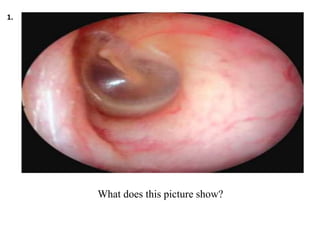
What does this picture show?
1.
 This is an endoscopic view of a normal ear canal and left tympanic membrane (TM)
(left because the handle of malleus is always directed posteriorly).
 The ear canal has the characteristic anterior prominence and is free from earwax.
This is due to the outward bound epithelial migration that starts from the umbo that
radiates out right through the ear canal.
 Thus, a normal ear is self-cleansing and there is no need to use cotton bud.
 The TM is pearly translucent in appearance with the handle of malleus positioned
approximately 45° to the horizon and the posterior malleolar ligament visible.
 The cone of light is at the anterior inferior quadrant (around 8 o’clock in the left ear
and 4 o’clock in the right ear) as this is the segment of TM that is 90° to the ear
canal and thus reflects the light of the otoscope or endoscope.
 This position of the cone of light is distorted if the TM is abnormal or retracted.
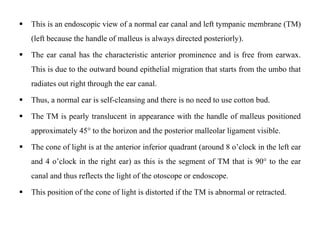
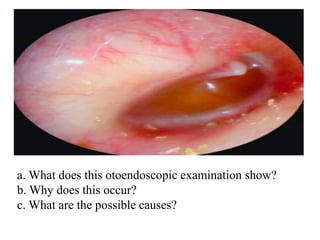
a. What does this otoendoscopic examination show?
b. Why does this occur?
c. What are the possible causes?
 The normal translucent color of the TM is not present; instead it looks yellowish due to the
accumulation of fluid in the middle ear space.
 The TM is retracted (handle of malleus is more acute than usual 45°) and the Prussak’s space
is retracted (a potential space just above the lateral process of the malleus).
 This is consistent with middle ear effusion (MEE) or serous otitis media.
 The middle ear space is an air-filled cavity that extends posteriorly to the mastoid antrum via
the aditus and is connected to the nasopharynx via the Eustachian tube (ET). The ET functions
to equalize pressure in the middle ear space and the atmospheric pressure outside.
 Malfunctions occur most commonly due to mechanical obstruction, which causes a gradual
negative pressure development in the middle ear that is eventually filled with fluid.
 The causes of MEE include ET dysfunction (abnormal ET or muscular movements of ET, e.g.
cleft palate, craniofacial abnormalities, mechanical obstruction, e.g. adenoids, tumors [e.g.
nasopharyngeal carcinoma (CA), very common cancer in Southeast Asia], allergic rhinitis,
and rhinosinusitis, etc.
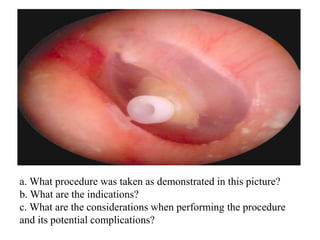
a. What procedure was taken as demonstrated in this picture?
b. What are the indications?
c. What are the considerations when performing the procedure
and its potential complications?
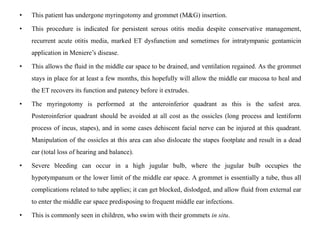
• This patient has undergone myringotomy and grommet (M&G) insertion.
• This procedure is indicated for persistent serous otitis media despite conservative management,
recurrent acute otitis media, marked ET dysfunction and sometimes for intratympanic gentamicin
application in Meniere’s disease.
• This allows the fluid in the middle ear space to be drained, and ventilation regained. As the grommet
stays in place for at least a few months, this hopefully will allow the middle ear mucosa to heal and
the ET recovers its function and patency before it extrudes.
• The myringotomy is performed at the anteroinferior quadrant as this is the safest area.
Posteroinferior quadrant should be avoided at all cost as the ossicles (long process and lentiform
process of incus, stapes), and in some cases dehiscent facial nerve can be injured at this quadrant.
Manipulation of the ossicles at this area can also dislocate the stapes footplate and result in a dead
ear (total loss of hearing and balance).
• Severe bleeding can occur in a high jugular bulb, where the jugular bulb occupies the
hypotympanum or the lower limit of the middle ear space. A grommet is essentially a tube, thus all
complications related to tube applies; it can get blocked, dislodged, and allow fluid from external ear
to enter the middle ear space predisposing to frequent middle ear infections.
• This is commonly seen in children, who swim with their grommets in situ.
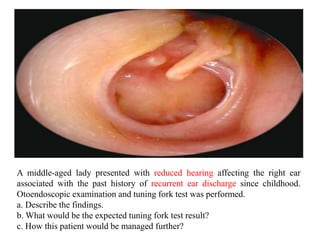
A middle-aged lady presented with reduced hearing affecting the right ear
associated with the past history of recurrent ear discharge since childhood.
Otoendoscopic examination and tuning fork test was performed.
a. Describe the findings.
b. What would be the expected tuning fork test result?
c. How this patient would be managed further?
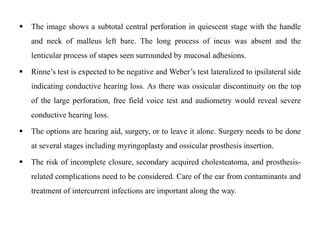
 The image shows a subtotal central perforation in quiescent stage with the handle
and neck of malleus left bare. The long process of incus was absent and the
lenticular process of stapes seen surrounded by mucosal adhesions.
 Rinne’s test is expected to be negative and Weber’s test lateralized to ipsilateral side
indicating conductive hearing loss. As there was ossicular discontinuity on the top
of the large perforation, free field voice test and audiometry would reveal severe
conductive hearing loss.
 The options are hearing aid, surgery, or to leave it alone. Surgery needs to be done
at several stages including myringoplasty and ossicular prosthesis insertion.
 The risk of incomplete closure, secondary acquired cholesteatoma, and prosthesis-
related complications need to be considered. Care of the ear from contaminants and
treatment of intercurrent infections are important along the way.
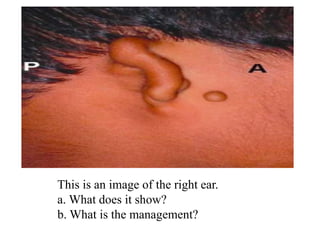
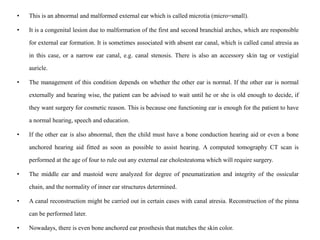
This is an image of the right ear.
a. What does it show?
b. What is the management?
• This is an abnormal and malformed external ear which is called microtia (micro=small).
• It is a congenital lesion due to malformation of the first and second branchial arches, which are responsible
for external ear formation. It is sometimes associated with absent ear canal, which is called canal atresia as
in this case, or a narrow ear canal, e.g. canal stenosis. There is also an accessory skin tag or vestigial
auricle.
• The management of this condition depends on whether the other ear is normal. If the other ear is normal
externally and hearing wise, the patient can be advised to wait until he or she is old enough to decide, if
they want surgery for cosmetic reason. This is because one functioning ear is enough for the patient to have
a normal hearing, speech and education.
• If the other ear is also abnormal, then the child must have a bone conduction hearing aid or even a bone
anchored hearing aid fitted as soon as possible to assist hearing. A computed tomography CT scan is
performed at the age of four to rule out any external ear cholesteatoma which will require surgery.
• The middle ear and mastoid were analyzed for degree of pneumatization and integrity of the ossicular
chain, and the normality of inner ear structures determined.
• A canal reconstruction might be carried out in certain cases with canal atresia. Reconstruction of the pinna
can be performed later.
• Nowadays, there is even bone anchored ear prosthesis that matches the skin color.
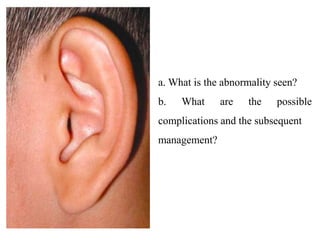
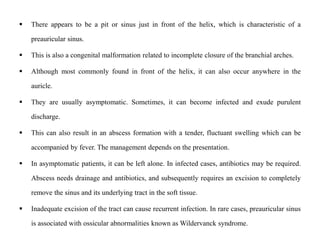
a. What is the abnormality seen?
b. What are the possible
complications and the subsequent
management?
 There appears to be a pit or sinus just in front of the helix, which is characteristic of a
preauricular sinus.
 This is also a congenital malformation related to incomplete closure of the branchial arches.
 Although most commonly found in front of the helix, it can also occur anywhere in the
auricle.
 They are usually asymptomatic. Sometimes, it can become infected and exude purulent
discharge.
 This can also result in an abscess formation with a tender, fluctuant swelling which can be
accompanied by fever. The management depends on the presentation.
 In asymptomatic patients, it can be left alone. In infected cases, antibiotics may be required.
Abscess needs drainage and antibiotics, and subsequently requires an excision to completely
remove the sinus and its underlying tract in the soft tissue.
 Inadequate excision of the tract can cause recurrent infection. In rare cases, preauricular sinus
is associated with ossicular abnormalities known as Wildervanck syndrome.
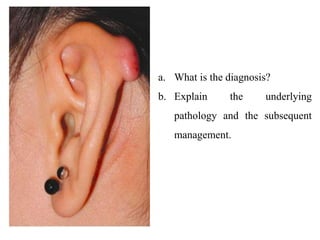
a. What is the diagnosis?
b. Explain the underlying
pathology and the subsequent
management.
• The picture shows a keloid of the pinna. It can occur in
anyone, although more commonly in darker skin people.
• It usually occurs after an injury or any trauma. The
fundamental underlying pathology is an exaggerated healing
response which causes fibrosis out of the boundaries of the
actual injury. These swellings are firm and nontender.
• Small lesions can be managed by multiple frequent injections
of steroids into the swellings while the larger ones will require
surgical excision, pressure bandage and subsequent steroid
injections (as justified).
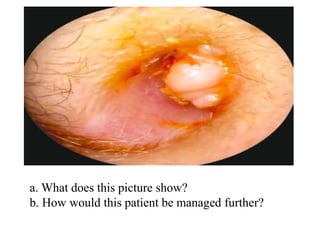
a. What does this picture show?
b. How would this patient be managed further?
• There appears to be a swelling at the external ear canal in the bony segment
(the medial aspect of the external ear).
• This is most likely to be an exostosis. It is due to the bony outgrowth
believed to be caused by swimming in cold water. This can be confirmed
by palpating the swelling which will be bony hard in consistency.
• The differential diagnosis includes tumors of the skin appendages, e.g.
seboma, etc.
• In asymptomatic patients, it can be left alone. Surgical management will be
required in patients with obstructive symptoms, or in whom where there is
a difficulty to clean the ears with resulting earwax cumulation and
impaction.
• The exostosis can be drilled off but there may be a risk of facial nerve
palsy.
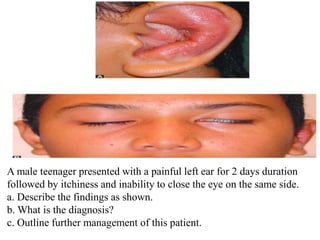
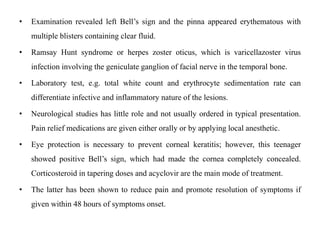
A male teenager presented with a painful left ear for 2 days duration
followed by itchiness and inability to close the eye on the same side.
a. Describe the findings as shown.
b. What is the diagnosis?
c. Outline further management of this patient.
• Examination revealed left Bell’s sign and the pinna appeared erythematous with
multiple blisters containing clear fluid.
• Ramsay Hunt syndrome or herpes zoster oticus, which is varicellazoster virus
infection involving the geniculate ganglion of facial nerve in the temporal bone.
• Laboratory test, e.g. total white count and erythrocyte sedimentation rate can
differentiate infective and inflammatory nature of the lesions.
• Neurological studies has little role and not usually ordered in typical presentation.
Pain relief medications are given either orally or by applying local anesthetic.
• Eye protection is necessary to prevent corneal keratitis; however, this teenager
showed positive Bell’s sign, which had made the cornea completely concealed.
Corticosteroid in tapering doses and acyclovir are the main mode of treatment.
• The latter has been shown to reduce pain and promote resolution of symptoms if
given within 48 hours of symptoms onset.
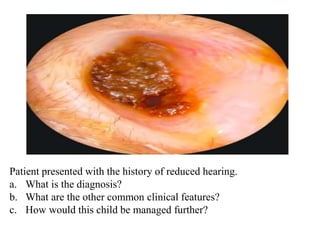
Patient presented with the history of reduced hearing.
a. What is the diagnosis?
b. What are the other common clinical features?
c. How would this child be managed further?
 The otoscopic view reveals wax almost totally occluding the ear canal.
 Usually, the complaint of hearing loss in patients with earwax occurs after swimming or digging the
ears. Swimming or entry of water into the ears causes the wax to expand and totally occlude the
external ear.
 This can be uncomfortable with a sense of ear obstruction, which a child will complain of pain and
not obstruction.
 In some patients, they have dizziness and cases of persistent coughs secondary to wax have also
been reported. This is due to the vagus nerve (Arnold’s nerve) irritation as the nerve supply the
innervation to both (tympanic membrane) and the larynx.
 In a child with impacted wax, removal either by syringing or direct vision (under microscope) can be
difficult due to the lack of cooperation as the procedure can be painful.
 It is better to instill wax softener, e.g. cerumol for few days to soften and dissolve the wax before the
procedure is undertaken.
 Syringing should not be performed if the TM is suspected to be perforated.
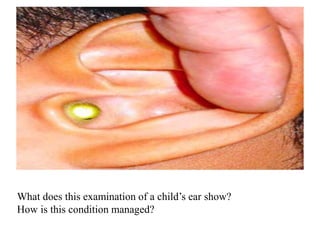
What does this examination of a child’s ear show?
How is this condition managed?
 There is a yellow round object at the opening of the ear canal most likely a foreign body. Foreign
body of the ear can be divided into organic and non-organic. Organic foreign body can lead to
infection and need to be removed quickly.
 Insects, if alive can be extremely painful and need to be killed with the use of any liquid.
 Non-organic foreign body can be asymptomatic and left unnoticed for some time.
 The management of ear foreign body is by removal.
 A round object would require a probe or a curved hook to be inserted behind it, while the flat foreign
bodies can be removed with the forceps.
 Syringing can be used although if not used in the right method can cause the foreign body to be
pushed further inside.
 Some cases of tightly impacted foreign body may require removal under general anesthesia. Injuries
to the TM or ossicles have been reported in overzealous or unskillful attempt at the removal of
impacted foreign bodies.
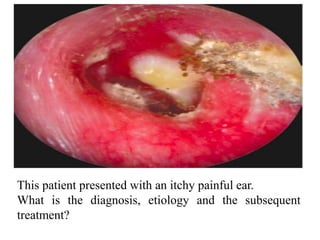
This patient presented with an itchy painful ear.
What is the diagnosis, etiology and the subsequent
treatment?
• This is a typical otoscopic view of otomycosis or fungal infection of the ear.
• The black spores seen in the picture indicate Aspergillus niger, while the white
plague is often candidiasis.
• Together they form a ‘wet newspaper’ appearance. Otomycosis is predominantly
seen in humid tropical countries like Malaysia.
• Frequent, recurrent otomycosis should be investigated for the possibility of diabetes
mellitus.
• The presentation can vary from itchiness and pain to a sensation of blockage.
• Management involves a thorough cleaning of the ear, typically under the
microscope with a meticulous attention to the inferior recess area.
• Antifungal ear drops, ointment, or powder can then be used topically for at least 6
weeks
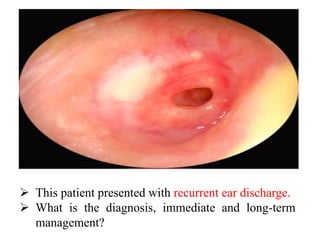
 This patient presented with recurrent ear discharge.
 What is the diagnosis, immediate and long-term
management?
 This otoscopic picture reveals a central perforation (around 30%) with purulent discharge noted around 9
o’clock and the inferior recess area.
 Thus, this indicates an active stage of chronic suppurative otitis media (CSOM). The term tubotympanic
(TT) indicates that the perforation is safe that it does not have cholesteatoma and the possible complications
that can arise from it. However, TT is often not used and other term that can be used to describe this
condition includes CSOM (safe), CSOM mucosal disease or just CSOM without cholesteatoma.
 In the presence of active discharge, a thorough ear toilet is performed followed by topical antibiotic drops
or even oral antibiotic if justified. The patient will be advised to keep his ear dry and subsequently, once it
remains dry for a period of at least 2–3 months, myringoplasty can be safely performed.
 Preoperative audiogram is taken for record keeping. If the ear continues to discharge despite antibiotics
(after culture and sensitivity), then cortical mastoidectomy needs to be considered. This is to clear the
infected mastoid air cells which would have served as a reservoir for the persistent infection.
 (Note: Small perforation can close by itself overtime provided the ear is dry and devoid of infection thus
not always need a repair).
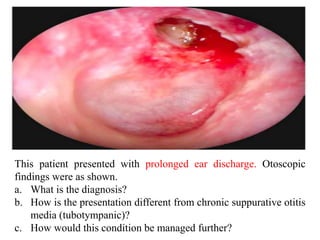
This patient presented with prolonged ear discharge. Otoscopic
findings were as shown.
a. What is the diagnosis?
b. How is the presentation different from chronic suppurative otitis
media (tubotympanic)?
c. How would this condition be managed further?
 There is an attic (area above the anterior and posterior malleolar ligament or pars flaccida and scutum)
pocket with white flaky debris characteristic of cholesteatoma. The pars tensa appears normal.
 The discharge in these patients tends to be persistent, scanty, and foul-smelling as compared to intermittent,
copious, mucopurulent, odorless discharge of CSOM (TT). Thus, the diagnosis is CSOM [atticoantral
(AA)].
 Atticoantral indicates that the perforation is unsafe; that it does have cholesteatoma and the possible
complications that can arise from it. However, AA is often not used and other terms that can be used to
describe this condition include CSOM (unsafe), CSOM epithelial disease or just CSOM with
cholesteatoma.
 The management of this condition is essential to prevent the possible complications if it is allowed to
expand; namely brain abscess, labyrinthitis, facial palsy, subperiosteal abscess and sigmoid sinus
thrombosis. In a small cavity and a medically unfit patient, regular cleaning will be adequate if all the
boundaries of the sac or cavity can be visualized and easily assessed with the help of a microscope.
 If this is not possible, mastoid exploration and exteriorization of cholesteatoma should be carried out.
 This can be divided into an atticotomy, modified radical mastoidectomy (MRM) or combined approach
mastoidectomy depending on the severity and intraoperative findings.
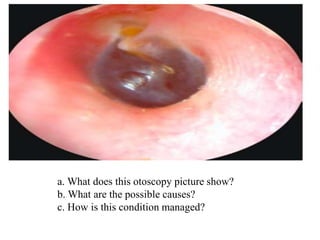
a. What does this otoscopy picture show?
b. What are the possible causes?
c. How is this condition managed?
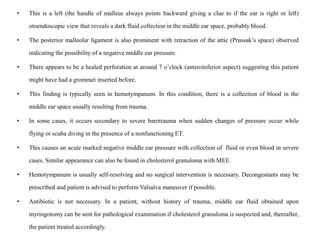
• This is a left (the handle of malleus always points backward giving a clue to if the ear is right or left)
otoendoscopic view that reveals a dark fluid collection in the middle ear space, probably blood.
• The posterior malleolar ligament is also prominent with retraction of the attic (Prussak’s space) observed
indicating the possibility of a negative middle ear pressure.
• There appears to be a healed perforation at around 7 o’clock (anteroinferior aspect) suggesting this patient
might have had a grommet inserted before.
• This finding is typically seen in hemotympanum. In this condition, there is a collection of blood in the
middle ear space usually resulting from trauma.
• In some cases, it occurs secondary to severe barotrauma when sudden changes of pressure occur while
flying or scuba diving in the presence of a nonfunctioning ET.
• This causes an acute marked negative middle ear pressure with collection of fluid or even blood in severe
cases. Similar appearance can also be found in cholesterol granuloma with MEE.
• Hemotympanum is usually self-resolving and no surgical intervention is necessary. Decongestants may be
prescribed and patient is advised to perform Valsalva maneuver if possible.
• Antibiotic is not necessary. In a patient, without history of trauma, middle ear fluid obtained upon
myringotomy can be sent for pathological examination if cholesterol granuloma is suspected and, thereafter,
the patient treated accordingly.
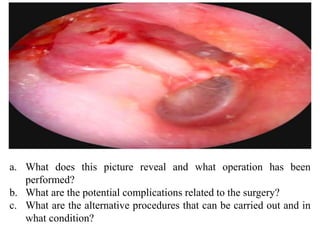
a. What does this picture reveal and what operation has been
performed?
b. What are the potential complications related to the surgery?
c. What are the alternative procedures that can be carried out and in
what condition?
• This picture reveals a post MRM cavity where mastoid, attic and the external ear were operated and joined together to form a single
chamber.
• It is usually performed to exteriorize the cholesteatoma to render the ‘unsafe’ ear into ‘safe ear’. The middle ear cavity is usually closed
off by laying the TM over the medial aspect of middle ear space since the scutum has been removed.
• This is important as an open middle ear cavity with its respiratory mucosa (goblets cells and other mucous secreting glands) will cause a
discharging mastoid cavity. In
• MRM, the facial ridge is lowered sufficiently to prevent ‘sump’ effect in the mastoid bowl.
• Complications of this surgery include injury to the dura [with or without cerebrospinal fluid (CSF) leak], labyrinth, facial nerve and
sigmoid sinus.
• There can also be a profound hearing loss that is believed due to the drills used during the surgery.
• Other procedures include atticotomy and combined approach tympanoplasty. In atticotomy, disease that is limited to the attic is removed
by removing the scutum and exteriorizing the attic pocket. This can be reconstructed with a cartilage grafting the same sitting if the
surgeon is confident that all the cholesteatoma has been removed or perform later in the second sitting. Combined approach
tympanoplasty or canal wall up procedure is usually performed in children, with well-pneumatized mastoid and in patients, who
complaint and understand that this is a two-stage procedure.
• This procedure prevents a mastoid cavity and its complications (discharging ear, regular ear toileting for life, vertigo and imbalance in
cold winds) and retains a normal external ear canal. It can be technically more challenging as a posterior tympanotomy (boundary: facial
nerve, chorda tympani and buttress) is performed together with the elevation of a tympanomeatal flap to remove the disease.
• As recurrence rate is high, a second look is vital.
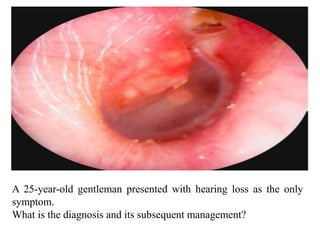
A 25-year-old gentleman presented with hearing loss as the only
symptom.
What is the diagnosis and its subsequent management?
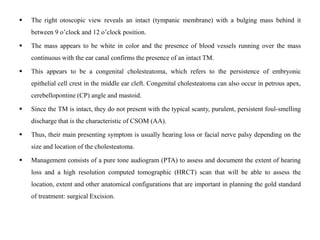
 The right otoscopic view reveals an intact (tympanic membrane) with a bulging mass behind it
between 9 o’clock and 12 o’clock position.
 The mass appears to be white in color and the presence of blood vessels running over the mass
continuous with the ear canal confirms the presence of an intact TM.
 This appears to be a congenital cholesteatoma, which refers to the persistence of embryonic
epithelial cell crest in the middle ear cleft. Congenital cholesteatoma can also occur in petrous apex,
cerebellopontine (CP) angle and mastoid.
 Since the TM is intact, they do not present with the typical scanty, purulent, persistent foul-smelling
discharge that is the characteristic of CSOM (AA).
 Thus, their main presenting symptom is usually hearing loss or facial nerve palsy depending on the
size and location of the cholesteatoma.
 Management consists of a pure tone audiogram (PTA) to assess and document the extent of hearing
loss and a high resolution computed tomographic (HRCT) scan that will be able to assess the
location, extent and other anatomical configurations that are important in planning the gold standard
of treatment: surgical Excision.
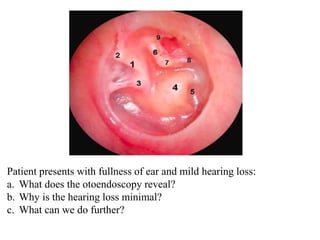
Patient presents with fullness of ear and mild hearing loss:
a. What does the otoendoscopy reveal?
b. Why is the hearing loss minimal?
c. What can we do further?
• This otoendoscopy view of the left ear reveals an adhesive otitis media.
• It usually occurs as a consequence of chronic ET dysfunction that leads to chronic persistent negative middle ear pressure. Eventually, the
TM will be sucked in and draped or even adherent to the medial aspect of the middle ear. The following structures can be identified:
• Handle of malleus
• Lateral process of malleus
• Umbo
• Promontory
• Round window niche
• Long process of incus
• Head of stapes
• Stapedius tendon.
• The hearing loss is minimal as the TM is draped and adherent to the stapes forming a natural type III tympanoplasty (natural
myringostapediopexy). The presence of an intact TM prevents a discharging ear.
• Management of this condition needs to address two main factors. The ET and the nasopharynx should be examined to rule out any
pathology and managed accordingly. As for the sensation of fullness, M&G can be attempted if there is enough room to insert one.
• With regards to the hearing loss, if it is significant and impairing the quality of life of the patient, a hearing aid would probably be the best
solution. Surgical exploration and attempts to reventilate the middle ear by elevating the TM is often unsuccessful with the reformation of
adhesions.
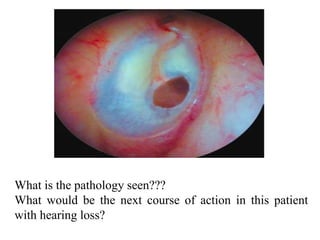
What is the pathology seen???
What would be the next course of action in this patient
with hearing loss?
• The otoendoscopy reveals an opaque TM with an anteroinferior area atrophic
(thinner) segment (estimated 20%), which indicates a healed perforation.
• The location of the atrophic segment suggests possibility of a previous grommet
insertion site or probably a central perforation complicating CSOM. The opaque
TM indicates thickening and scarring, and thus suggests frequent or longstanding
middle ear infection previously.
• Although the TM is intact, the atrophic segment would not be able to vibrate as
good as a normal TM and the energy transmitted to the ossicles would be reduced.
• Audiogram will show the severity of hearing loss. The management would be to
advise the use of hearing aid if the hearing loss is significant.
• There is no role of surgery in this condition.
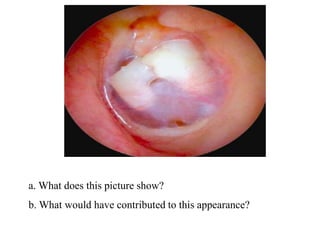
a. What does this picture show?
b. What would have contributed to this appearance?
• This is an endoscopic view of the left ear, where there appears to be
a white structure beneath the TM that appears to be thicker than an
abnormal TM.
• The attic region appears to be retracted and could possibly have
undergone surgery.
• Based on the appearance, there are two possibilities. The white
structure could be the cartilage that was used (or even two pieces of
cartilage) that is usually used to reconstruct the attic after an
atticotomy, or the other possibility is that of incus interposition in an
ossiculoplasty or tympanoplasty.
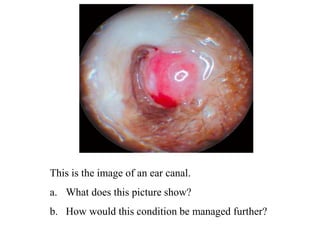
This is the image of an ear canal.
a. What does this picture show?
b. How would this condition be managed further?
 The endoscopic view reveals a red, fleshy mass with surrounding mucopus in the external ear
canal. This appears to be an aural polyp.
 It can occur due to infection, cholesteatoma, malignant otitis externa, or even malignancy.
 In this patient, ear swab was taken for culture and sensitivity,and thereafter, a thorough aural
toilet and examination under microscope was performed. It is important to probe all aroundthe
polyp to see where the stalk or where the polyp is coming from.
 If it is arising from middle ear, the probe will be able to go all around the polyp. A trial of
antibiotic can be given and subsequently polypectomy carried out using a snare.
 If it is arising from the posterosuperior aspect, then there is a strong possibility of
cholesteatoma and a mastoid exploration after CT scan would be required.
 Biopsy of the polyp is taken to rule out any malignancy.
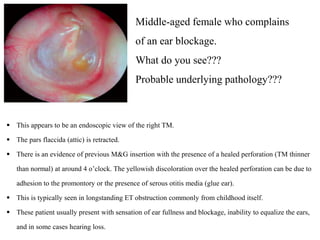
Middle-aged female who complains
of an ear blockage.
What do you see???
Probable underlying pathology???
 This appears to be an endoscopic view of the right TM.
 The pars flaccida (attic) is retracted.
 There is an evidence of previous M&G insertion with the presence of a healed perforation (TM thinner
than normal) at around 4 o’clock. The yellowish discoloration over the healed perforation can be due to
adhesion to the promontory or the presence of serous otitis media (glue ear).
 This is typically seen in longstanding ET obstruction commonly from childhood itself.
 These patient usually present with sensation of ear fullness and blockage, inability to equalize the ears,
and in some cases hearing loss.
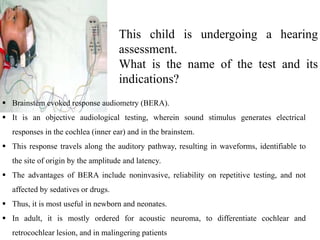
This child is undergoing a hearing
assessment.
What is the name of the test and its
indications?
 Brainstem evoked response audiometry (BERA).
 It is an objective audiological testing, wherein sound stimulus generates electrical
responses in the cochlea (inner ear) and in the brainstem.
 This response travels along the auditory pathway, resulting in waveforms, identifiable to
the site of origin by the amplitude and latency.
 The advantages of BERA include noninvasive, reliability on repetitive testing, and not
affected by sedatives or drugs.
 Thus, it is most useful in newborn and neonates.
 In adult, it is mostly ordered for acoustic neuroma, to differentiate cochlear and
retrocochlear lesion, and in malingering patients
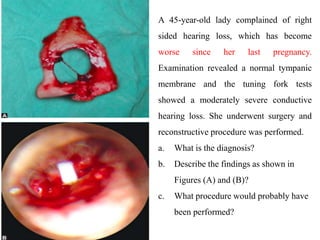
A 45-year-old lady complained of right
sided hearing loss, which has become
worse since her last pregnancy.
Examination revealed a normal tympanic
membrane and the tuning fork tests
showed a moderately severe conductive
hearing loss. She underwent surgery and
reconstructive procedure was performed.
a. What is the diagnosis?
b. Describe the findings as shown in
Figures (A) and (B)?
c. What procedure would probably have
been performed?
 Conductive hearing loss in the presence of normal TM suggests a middle ear pathology.
 These may range from tympanosclerosis, ossicular discontinuity, adhesion, or even ossicular
fusion.
 This patient is very likely to have otosclerosis, a condition whereby there is a new bone
formation at or about the stapes footplate thus impeding the transmission of sound to the oval
window.
 The lesion is more commonly found in females and hormonal changes during pregnancy would
have accelerated the disease process.
 Figure A shows a complete stapes structure, i.e. the footplate, anterior and posterior crus, and its
head.
 Figure B shows a whitish material encircling and anchored at the lower part of the long process
of incus.
 These figures gave a clue to stapedectomy with tympanoplasty performed.
 Ossicular reconstruction can be done with various commercialized materials, e.g. titanium
piston, or synthetic material such as plastipore (likely in this case since it is white in color). This
would restore the sound transmission to the round window enabling closure of air-bone gap.
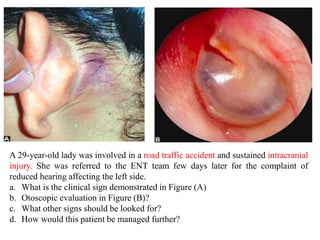
A 29-year-old lady was involved in a road traffic accident and sustained intracranial
injury. She was referred to the ENT team few days later for the complaint of
reduced hearing affecting the left side.
a. What is the clinical sign demonstrated in Figure (A)
b. Otoscopic evaluation in Figure (B)?
c. What other signs should be looked for?
d. How would this patient be managed further?
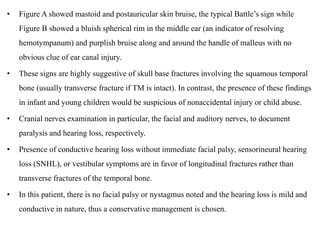
• Figure A showed mastoid and postauricular skin bruise, the typical Battle’s sign while
Figure B showed a bluish spherical rim in the middle ear (an indicator of resolving
hemotympanum) and purplish bruise along and around the handle of malleus with no
obvious clue of ear canal injury.
• These signs are highly suggestive of skull base fractures involving the squamous temporal
bone (usually transverse fracture if TM is intact). In contrast, the presence of these findings
in infant and young children would be suspicious of nonaccidental injury or child abuse.
• Cranial nerves examination in particular, the facial and auditory nerves, to document
paralysis and hearing loss, respectively.
• Presence of conductive hearing loss without immediate facial palsy, sensorineural hearing
loss (SNHL), or vestibular symptoms are in favor of longitudinal fractures rather than
transverse fractures of the temporal bone.
• In this patient, there is no facial palsy or nystagmus noted and the hearing loss is mild and
conductive in nature, thus a conservative management is chosen.
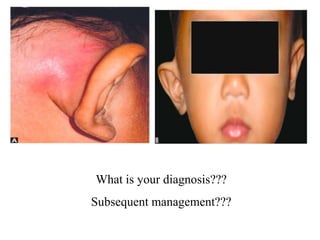
What is your diagnosis???
Subsequent management???
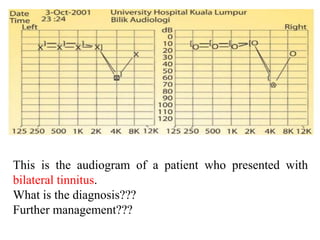
This is the audiogram of a patient who presented with
bilateral tinnitus.
What is the diagnosis???
Further management???
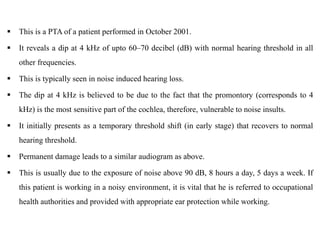
 This is a PTA of a patient performed in October 2001.
 It reveals a dip at 4 kHz of upto 60–70 decibel (dB) with normal hearing threshold in all
other frequencies.
 This is typically seen in noise induced hearing loss.
 The dip at 4 kHz is believed to be due to the fact that the promontory (corresponds to 4
kHz) is the most sensitive part of the cochlea, therefore, vulnerable to noise insults.
 It initially presents as a temporary threshold shift (in early stage) that recovers to normal
hearing threshold.
 Permanent damage leads to a similar audiogram as above.
 This is usually due to the exposure of noise above 90 dB, 8 hours a day, 5 days a week. If
this patient is working in a noisy environment, it is vital that he is referred to occupational
health authorities and provided with appropriate ear protection while working.
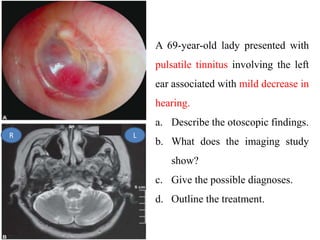
A 69-year-old lady presented with
pulsatile tinnitus involving the left
ear associated with mild decrease in
hearing.
a. Describe the otoscopic findings.
b. What does the imaging study
show?
c. Give the possible diagnoses.
d. Outline the treatment.
L
R
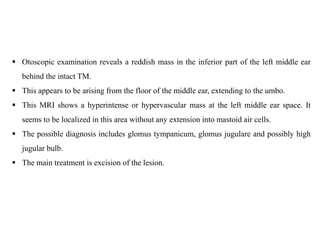
 Otoscopic examination reveals a reddish mass in the inferior part of the left middle ear
behind the intact TM.
 This appears to be arising from the floor of the middle ear, extending to the umbo.
 This MRI shows a hyperintense or hypervascular mass at the left middle ear space. It
seems to be localized in this area without any extension into mastoid air cells.
 The possible diagnosis includes glomus tympanicum, glomus jugulare and possibly high
jugular bulb.
 The main treatment is excision of the lesion.
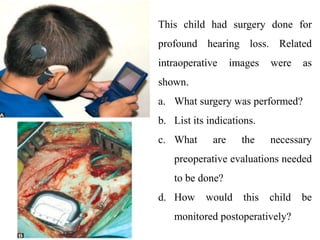
This child had surgery done for
profound hearing loss. Related
intraoperative images were as
shown.
a. What surgery was performed?
b. List its indications.
c. What are the necessary
preoperative evaluations needed
to be done?
d. How would this child be
monitored postoperatively?
• This child has had right cochlear implant performed.
• The indications of cochlear implants include severe to profound bilateral SNHL (unaided
threshold >90 dB) with little or no benefit from 3 months to 4 months trial of hearing aid.
• This may be performed for congenital hearing loss in children ideally before the age of four or
in postlingual deafness in adults or older children.
• Children with congenital hearing loss detected after the age of four may not have good results.
• The necessary preoperative evaluations include trial of hearing aid for 3–6 months, no medical
contraindication to undergo surgery, good family support, preoperative HRCT to assess the
anatomy of the inner ear, otoscopic examination to rule out any middle ear infection and
assessment by audiologist and speech therapist.
• The child needs to be followed up with the experienced audiologist and speech therapist for
cochlear implant rehabilitation.
• This is probably the most crucial part of the program.
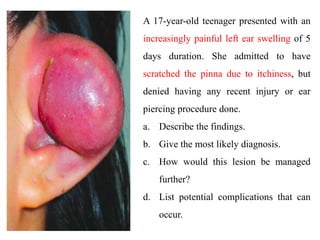
A 17-year-old teenager presented with an
increasingly painful left ear swelling of 5
days duration. She admitted to have
scratched the pinna due to itchiness, but
denied having any recent injury or ear
piercing procedure done.
a. Describe the findings.
b. Give the most likely diagnosis.
c. How would this lesion be managed
further?
d. List potential complications that can
occur.
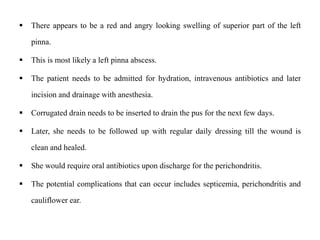
 There appears to be a red and angry looking swelling of superior part of the left
pinna.
 This is most likely a left pinna abscess.
 The patient needs to be admitted for hydration, intravenous antibiotics and later
incision and drainage with anesthesia.
 Corrugated drain needs to be inserted to drain the pus for the next few days.
 Later, she needs to be followed up with regular daily dressing till the wound is
clean and healed.
 She would require oral antibiotics upon discharge for the perichondritis.
 The potential complications that can occur includes septicemia, perichondritis and
cauliflower ear.
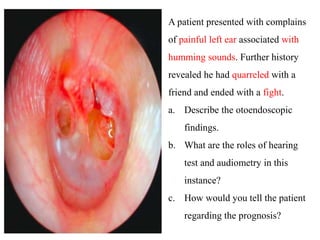
A patient presented with complains
of painful left ear associated with
humming sounds. Further history
revealed he had quarreled with a
friend and ended with a fight.
a. Describe the otoendoscopic
findings.
b. What are the roles of hearing
test and audiometry in this
instance?
c. How would you tell the patient
regarding the prognosis?
 This otoendoscopic examination reveals two central perforations of left TM, one at
anterior quadrant and the other at posterior quadrant with ragged perforation edges
and there is blood clot noted at the superior edge of the posterior perforation.
 The remaining TM appears hyperemic.
 Hearing test and audiometry are vital to assess the extent of the hearing loss mainly
for medical legal documentation as well as comparison during follow-up.
 The chances of traumatic TM to recover spontaneously are high as long as there is
no superimposed infection.
 However, the hearing and balance will have to be assessed as well as the inner ear
function can be compromised in trauma.
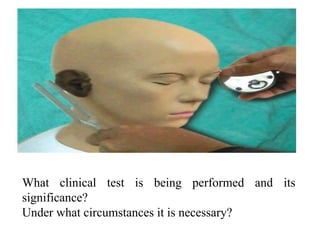
What clinical test is being performed and its
significance?
Under what circumstances it is necessary?
 The clinical test that is being performed is masking Rinne
tuning fork test.
 The significance of this test is to mask the non-tested ear with
Barany’s noise box to decrease the crossover effect from the
normal non-tested ear.
 This test is necessary in severe unilateral SNHL (the right ear
in this instance).
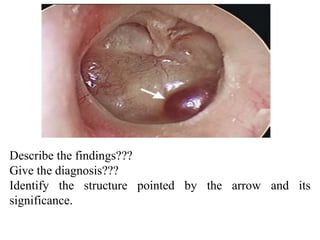
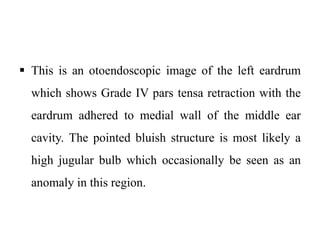
Describe the findings???
Give the diagnosis???
Identify the structure pointed by the arrow and its
significance.
 This is an otoendoscopic image of the left eardrum
which shows Grade IV pars tensa retraction with the
eardrum adhered to medial wall of the middle ear
cavity. The pointed bluish structure is most likely a
high jugular bulb which occasionally be seen as an
anomaly in this region.
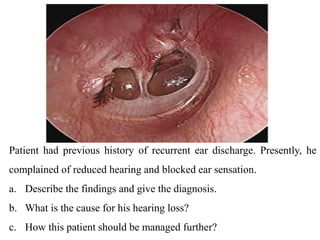
Patient had previous history of recurrent ear discharge. Presently, he
complained of reduced hearing and blocked ear sensation.
a. Describe the findings and give the diagnosis.
b. What is the cause for his hearing loss?
c. How this patient should be managed further?
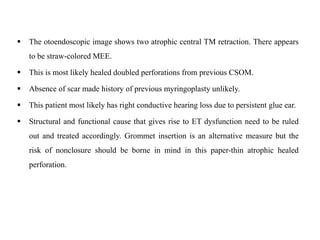
 The otoendoscopic image shows two atrophic central TM retraction. There appears
to be straw-colored MEE.
 This is most likely healed doubled perforations from previous CSOM.
 Absence of scar made history of previous myringoplasty unlikely.
 This patient most likely has right conductive hearing loss due to persistent glue ear.
 Structural and functional cause that gives rise to ET dysfunction need to be ruled
out and treated accordingly. Grommet insertion is an alternative measure but the
risk of nonclosure should be borne in mind in this paper-thin atrophic healed
perforation.
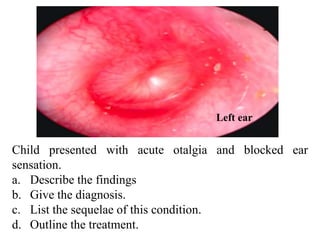
Child presented with acute otalgia and blocked ear
sensation.
a. Describe the findings
b. Give the diagnosis.
c. List the sequelae of this condition.
d. Outline the treatment.
Left ear
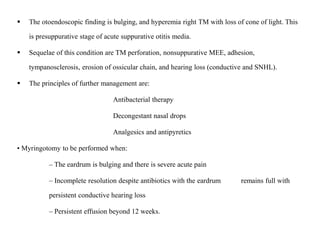
 The otoendoscopic finding is bulging, and hyperemia right TM with loss of cone of light. This
is presuppurative stage of acute suppurative otitis media.
 Sequelae of this condition are TM perforation, nonsuppurative MEE, adhesion,
tympanosclerosis, erosion of ossicular chain, and hearing loss (conductive and SNHL).
 The principles of further management are:
Antibacterial therapy
Decongestant nasal drops
Analgesics and antipyretics
• Myringotomy to be performed when:
– The eardrum is bulging and there is severe acute pain
– Incomplete resolution despite antibiotics with the eardrum remains full with
persistent conductive hearing loss
– Persistent effusion beyond 12 weeks.
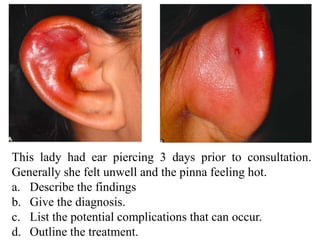
This lady had ear piercing 3 days prior to consultation.
Generally she felt unwell and the pinna feeling hot.
a. Describe the findings
b. Give the diagnosis.
c. List the potential complications that can occur.
d. Outline the treatment.
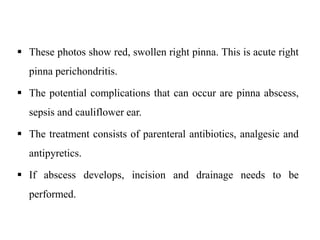
 These photos show red, swollen right pinna. This is acute right
pinna perichondritis.
 The potential complications that can occur are pinna abscess,
sepsis and cauliflower ear.
 The treatment consists of parenteral antibiotics, analgesic and
antipyretics.
 If abscess develops, incision and drainage needs to be
performed.
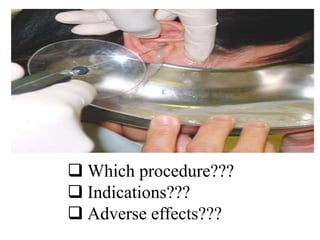
 Which procedure???
 Indications???
 Adverse effects???
 The procedure that is being performed is ear syringing.
 The indications of ear syringing are impacted earwax
and removal of non-organic foreign body in the ear.
 The potential complications include TM perforation,
dislocation of ossicular chain, conductive hearing loss,
SNHL, acute dizziness, and facial nerve palsy
Image based ear MCQ.pptx

Image based ear MCQ.pptx

  • 1.
  • 2.
    What does thispicture show? 1.
  • 3.
     This isan endoscopic view of a normal ear canal and left tympanic membrane (TM) (left because the handle of malleus is always directed posteriorly).  The ear canal has the characteristic anterior prominence and is free from earwax. This is due to the outward bound epithelial migration that starts from the umbo that radiates out right through the ear canal.  Thus, a normal ear is self-cleansing and there is no need to use cotton bud.  The TM is pearly translucent in appearance with the handle of malleus positioned approximately 45° to the horizon and the posterior malleolar ligament visible.  The cone of light is at the anterior inferior quadrant (around 8 o’clock in the left ear and 4 o’clock in the right ear) as this is the segment of TM that is 90° to the ear canal and thus reflects the light of the otoscope or endoscope.  This position of the cone of light is distorted if the TM is abnormal or retracted.
  • 4.
    a. What doesthis otoendoscopic examination show? b. Why does this occur? c. What are the possible causes?
  • 5.
     The normaltranslucent color of the TM is not present; instead it looks yellowish due to the accumulation of fluid in the middle ear space.  The TM is retracted (handle of malleus is more acute than usual 45°) and the Prussak’s space is retracted (a potential space just above the lateral process of the malleus).  This is consistent with middle ear effusion (MEE) or serous otitis media.  The middle ear space is an air-filled cavity that extends posteriorly to the mastoid antrum via the aditus and is connected to the nasopharynx via the Eustachian tube (ET). The ET functions to equalize pressure in the middle ear space and the atmospheric pressure outside.  Malfunctions occur most commonly due to mechanical obstruction, which causes a gradual negative pressure development in the middle ear that is eventually filled with fluid.  The causes of MEE include ET dysfunction (abnormal ET or muscular movements of ET, e.g. cleft palate, craniofacial abnormalities, mechanical obstruction, e.g. adenoids, tumors [e.g. nasopharyngeal carcinoma (CA), very common cancer in Southeast Asia], allergic rhinitis, and rhinosinusitis, etc.
  • 6.
    a. What procedurewas taken as demonstrated in this picture? b. What are the indications? c. What are the considerations when performing the procedure and its potential complications?
  • 7.
    • This patienthas undergone myringotomy and grommet (M&G) insertion. • This procedure is indicated for persistent serous otitis media despite conservative management, recurrent acute otitis media, marked ET dysfunction and sometimes for intratympanic gentamicin application in Meniere’s disease. • This allows the fluid in the middle ear space to be drained, and ventilation regained. As the grommet stays in place for at least a few months, this hopefully will allow the middle ear mucosa to heal and the ET recovers its function and patency before it extrudes. • The myringotomy is performed at the anteroinferior quadrant as this is the safest area. Posteroinferior quadrant should be avoided at all cost as the ossicles (long process and lentiform process of incus, stapes), and in some cases dehiscent facial nerve can be injured at this quadrant. Manipulation of the ossicles at this area can also dislocate the stapes footplate and result in a dead ear (total loss of hearing and balance). • Severe bleeding can occur in a high jugular bulb, where the jugular bulb occupies the hypotympanum or the lower limit of the middle ear space. A grommet is essentially a tube, thus all complications related to tube applies; it can get blocked, dislodged, and allow fluid from external ear to enter the middle ear space predisposing to frequent middle ear infections. • This is commonly seen in children, who swim with their grommets in situ.
  • 8.
    A middle-aged ladypresented with reduced hearing affecting the right ear associated with the past history of recurrent ear discharge since childhood. Otoendoscopic examination and tuning fork test was performed. a. Describe the findings. b. What would be the expected tuning fork test result? c. How this patient would be managed further?
  • 9.
     The imageshows a subtotal central perforation in quiescent stage with the handle and neck of malleus left bare. The long process of incus was absent and the lenticular process of stapes seen surrounded by mucosal adhesions.  Rinne’s test is expected to be negative and Weber’s test lateralized to ipsilateral side indicating conductive hearing loss. As there was ossicular discontinuity on the top of the large perforation, free field voice test and audiometry would reveal severe conductive hearing loss.  The options are hearing aid, surgery, or to leave it alone. Surgery needs to be done at several stages including myringoplasty and ossicular prosthesis insertion.  The risk of incomplete closure, secondary acquired cholesteatoma, and prosthesis- related complications need to be considered. Care of the ear from contaminants and treatment of intercurrent infections are important along the way.
  • 10.
    This is animage of the right ear. a. What does it show? b. What is the management?
  • 11.
    • This isan abnormal and malformed external ear which is called microtia (micro=small). • It is a congenital lesion due to malformation of the first and second branchial arches, which are responsible for external ear formation. It is sometimes associated with absent ear canal, which is called canal atresia as in this case, or a narrow ear canal, e.g. canal stenosis. There is also an accessory skin tag or vestigial auricle. • The management of this condition depends on whether the other ear is normal. If the other ear is normal externally and hearing wise, the patient can be advised to wait until he or she is old enough to decide, if they want surgery for cosmetic reason. This is because one functioning ear is enough for the patient to have a normal hearing, speech and education. • If the other ear is also abnormal, then the child must have a bone conduction hearing aid or even a bone anchored hearing aid fitted as soon as possible to assist hearing. A computed tomography CT scan is performed at the age of four to rule out any external ear cholesteatoma which will require surgery. • The middle ear and mastoid were analyzed for degree of pneumatization and integrity of the ossicular chain, and the normality of inner ear structures determined. • A canal reconstruction might be carried out in certain cases with canal atresia. Reconstruction of the pinna can be performed later. • Nowadays, there is even bone anchored ear prosthesis that matches the skin color.
  • 12.
    a. What isthe abnormality seen? b. What are the possible complications and the subsequent management?
  • 13.
     There appearsto be a pit or sinus just in front of the helix, which is characteristic of a preauricular sinus.  This is also a congenital malformation related to incomplete closure of the branchial arches.  Although most commonly found in front of the helix, it can also occur anywhere in the auricle.  They are usually asymptomatic. Sometimes, it can become infected and exude purulent discharge.  This can also result in an abscess formation with a tender, fluctuant swelling which can be accompanied by fever. The management depends on the presentation.  In asymptomatic patients, it can be left alone. In infected cases, antibiotics may be required. Abscess needs drainage and antibiotics, and subsequently requires an excision to completely remove the sinus and its underlying tract in the soft tissue.  Inadequate excision of the tract can cause recurrent infection. In rare cases, preauricular sinus is associated with ossicular abnormalities known as Wildervanck syndrome.
  • 14.
    a. What isthe diagnosis? b. Explain the underlying pathology and the subsequent management.
  • 15.
    • The pictureshows a keloid of the pinna. It can occur in anyone, although more commonly in darker skin people. • It usually occurs after an injury or any trauma. The fundamental underlying pathology is an exaggerated healing response which causes fibrosis out of the boundaries of the actual injury. These swellings are firm and nontender. • Small lesions can be managed by multiple frequent injections of steroids into the swellings while the larger ones will require surgical excision, pressure bandage and subsequent steroid injections (as justified).
  • 16.
    a. What doesthis picture show? b. How would this patient be managed further?
  • 17.
    • There appearsto be a swelling at the external ear canal in the bony segment (the medial aspect of the external ear). • This is most likely to be an exostosis. It is due to the bony outgrowth believed to be caused by swimming in cold water. This can be confirmed by palpating the swelling which will be bony hard in consistency. • The differential diagnosis includes tumors of the skin appendages, e.g. seboma, etc. • In asymptomatic patients, it can be left alone. Surgical management will be required in patients with obstructive symptoms, or in whom where there is a difficulty to clean the ears with resulting earwax cumulation and impaction. • The exostosis can be drilled off but there may be a risk of facial nerve palsy.
  • 18.
    A male teenagerpresented with a painful left ear for 2 days duration followed by itchiness and inability to close the eye on the same side. a. Describe the findings as shown. b. What is the diagnosis? c. Outline further management of this patient.
  • 19.
    • Examination revealedleft Bell’s sign and the pinna appeared erythematous with multiple blisters containing clear fluid. • Ramsay Hunt syndrome or herpes zoster oticus, which is varicellazoster virus infection involving the geniculate ganglion of facial nerve in the temporal bone. • Laboratory test, e.g. total white count and erythrocyte sedimentation rate can differentiate infective and inflammatory nature of the lesions. • Neurological studies has little role and not usually ordered in typical presentation. Pain relief medications are given either orally or by applying local anesthetic. • Eye protection is necessary to prevent corneal keratitis; however, this teenager showed positive Bell’s sign, which had made the cornea completely concealed. Corticosteroid in tapering doses and acyclovir are the main mode of treatment. • The latter has been shown to reduce pain and promote resolution of symptoms if given within 48 hours of symptoms onset.
  • 20.
    Patient presented withthe history of reduced hearing. a. What is the diagnosis? b. What are the other common clinical features? c. How would this child be managed further?
  • 21.
     The otoscopicview reveals wax almost totally occluding the ear canal.  Usually, the complaint of hearing loss in patients with earwax occurs after swimming or digging the ears. Swimming or entry of water into the ears causes the wax to expand and totally occlude the external ear.  This can be uncomfortable with a sense of ear obstruction, which a child will complain of pain and not obstruction.  In some patients, they have dizziness and cases of persistent coughs secondary to wax have also been reported. This is due to the vagus nerve (Arnold’s nerve) irritation as the nerve supply the innervation to both (tympanic membrane) and the larynx.  In a child with impacted wax, removal either by syringing or direct vision (under microscope) can be difficult due to the lack of cooperation as the procedure can be painful.  It is better to instill wax softener, e.g. cerumol for few days to soften and dissolve the wax before the procedure is undertaken.  Syringing should not be performed if the TM is suspected to be perforated.
  • 22.
    What does thisexamination of a child’s ear show? How is this condition managed?
  • 23.
     There isa yellow round object at the opening of the ear canal most likely a foreign body. Foreign body of the ear can be divided into organic and non-organic. Organic foreign body can lead to infection and need to be removed quickly.  Insects, if alive can be extremely painful and need to be killed with the use of any liquid.  Non-organic foreign body can be asymptomatic and left unnoticed for some time.  The management of ear foreign body is by removal.  A round object would require a probe or a curved hook to be inserted behind it, while the flat foreign bodies can be removed with the forceps.  Syringing can be used although if not used in the right method can cause the foreign body to be pushed further inside.  Some cases of tightly impacted foreign body may require removal under general anesthesia. Injuries to the TM or ossicles have been reported in overzealous or unskillful attempt at the removal of impacted foreign bodies.
  • 24.
    This patient presentedwith an itchy painful ear. What is the diagnosis, etiology and the subsequent treatment?
  • 25.
    • This isa typical otoscopic view of otomycosis or fungal infection of the ear. • The black spores seen in the picture indicate Aspergillus niger, while the white plague is often candidiasis. • Together they form a ‘wet newspaper’ appearance. Otomycosis is predominantly seen in humid tropical countries like Malaysia. • Frequent, recurrent otomycosis should be investigated for the possibility of diabetes mellitus. • The presentation can vary from itchiness and pain to a sensation of blockage. • Management involves a thorough cleaning of the ear, typically under the microscope with a meticulous attention to the inferior recess area. • Antifungal ear drops, ointment, or powder can then be used topically for at least 6 weeks
  • 26.
     This patientpresented with recurrent ear discharge.  What is the diagnosis, immediate and long-term management?
  • 27.
     This otoscopicpicture reveals a central perforation (around 30%) with purulent discharge noted around 9 o’clock and the inferior recess area.  Thus, this indicates an active stage of chronic suppurative otitis media (CSOM). The term tubotympanic (TT) indicates that the perforation is safe that it does not have cholesteatoma and the possible complications that can arise from it. However, TT is often not used and other term that can be used to describe this condition includes CSOM (safe), CSOM mucosal disease or just CSOM without cholesteatoma.  In the presence of active discharge, a thorough ear toilet is performed followed by topical antibiotic drops or even oral antibiotic if justified. The patient will be advised to keep his ear dry and subsequently, once it remains dry for a period of at least 2–3 months, myringoplasty can be safely performed.  Preoperative audiogram is taken for record keeping. If the ear continues to discharge despite antibiotics (after culture and sensitivity), then cortical mastoidectomy needs to be considered. This is to clear the infected mastoid air cells which would have served as a reservoir for the persistent infection.  (Note: Small perforation can close by itself overtime provided the ear is dry and devoid of infection thus not always need a repair).
  • 28.
    This patient presentedwith prolonged ear discharge. Otoscopic findings were as shown. a. What is the diagnosis? b. How is the presentation different from chronic suppurative otitis media (tubotympanic)? c. How would this condition be managed further?
  • 29.
     There isan attic (area above the anterior and posterior malleolar ligament or pars flaccida and scutum) pocket with white flaky debris characteristic of cholesteatoma. The pars tensa appears normal.  The discharge in these patients tends to be persistent, scanty, and foul-smelling as compared to intermittent, copious, mucopurulent, odorless discharge of CSOM (TT). Thus, the diagnosis is CSOM [atticoantral (AA)].  Atticoantral indicates that the perforation is unsafe; that it does have cholesteatoma and the possible complications that can arise from it. However, AA is often not used and other terms that can be used to describe this condition include CSOM (unsafe), CSOM epithelial disease or just CSOM with cholesteatoma.  The management of this condition is essential to prevent the possible complications if it is allowed to expand; namely brain abscess, labyrinthitis, facial palsy, subperiosteal abscess and sigmoid sinus thrombosis. In a small cavity and a medically unfit patient, regular cleaning will be adequate if all the boundaries of the sac or cavity can be visualized and easily assessed with the help of a microscope.  If this is not possible, mastoid exploration and exteriorization of cholesteatoma should be carried out.  This can be divided into an atticotomy, modified radical mastoidectomy (MRM) or combined approach mastoidectomy depending on the severity and intraoperative findings.
  • 30.
    a. What doesthis otoscopy picture show? b. What are the possible causes? c. How is this condition managed?
  • 31.
    • This isa left (the handle of malleus always points backward giving a clue to if the ear is right or left) otoendoscopic view that reveals a dark fluid collection in the middle ear space, probably blood. • The posterior malleolar ligament is also prominent with retraction of the attic (Prussak’s space) observed indicating the possibility of a negative middle ear pressure. • There appears to be a healed perforation at around 7 o’clock (anteroinferior aspect) suggesting this patient might have had a grommet inserted before. • This finding is typically seen in hemotympanum. In this condition, there is a collection of blood in the middle ear space usually resulting from trauma. • In some cases, it occurs secondary to severe barotrauma when sudden changes of pressure occur while flying or scuba diving in the presence of a nonfunctioning ET. • This causes an acute marked negative middle ear pressure with collection of fluid or even blood in severe cases. Similar appearance can also be found in cholesterol granuloma with MEE. • Hemotympanum is usually self-resolving and no surgical intervention is necessary. Decongestants may be prescribed and patient is advised to perform Valsalva maneuver if possible. • Antibiotic is not necessary. In a patient, without history of trauma, middle ear fluid obtained upon myringotomy can be sent for pathological examination if cholesterol granuloma is suspected and, thereafter, the patient treated accordingly.
  • 32.
    a. What doesthis picture reveal and what operation has been performed? b. What are the potential complications related to the surgery? c. What are the alternative procedures that can be carried out and in what condition?
  • 33.
    • This picturereveals a post MRM cavity where mastoid, attic and the external ear were operated and joined together to form a single chamber. • It is usually performed to exteriorize the cholesteatoma to render the ‘unsafe’ ear into ‘safe ear’. The middle ear cavity is usually closed off by laying the TM over the medial aspect of middle ear space since the scutum has been removed. • This is important as an open middle ear cavity with its respiratory mucosa (goblets cells and other mucous secreting glands) will cause a discharging mastoid cavity. In • MRM, the facial ridge is lowered sufficiently to prevent ‘sump’ effect in the mastoid bowl. • Complications of this surgery include injury to the dura [with or without cerebrospinal fluid (CSF) leak], labyrinth, facial nerve and sigmoid sinus. • There can also be a profound hearing loss that is believed due to the drills used during the surgery. • Other procedures include atticotomy and combined approach tympanoplasty. In atticotomy, disease that is limited to the attic is removed by removing the scutum and exteriorizing the attic pocket. This can be reconstructed with a cartilage grafting the same sitting if the surgeon is confident that all the cholesteatoma has been removed or perform later in the second sitting. Combined approach tympanoplasty or canal wall up procedure is usually performed in children, with well-pneumatized mastoid and in patients, who complaint and understand that this is a two-stage procedure. • This procedure prevents a mastoid cavity and its complications (discharging ear, regular ear toileting for life, vertigo and imbalance in cold winds) and retains a normal external ear canal. It can be technically more challenging as a posterior tympanotomy (boundary: facial nerve, chorda tympani and buttress) is performed together with the elevation of a tympanomeatal flap to remove the disease. • As recurrence rate is high, a second look is vital.
  • 34.
    A 25-year-old gentlemanpresented with hearing loss as the only symptom. What is the diagnosis and its subsequent management?
  • 35.
     The rightotoscopic view reveals an intact (tympanic membrane) with a bulging mass behind it between 9 o’clock and 12 o’clock position.  The mass appears to be white in color and the presence of blood vessels running over the mass continuous with the ear canal confirms the presence of an intact TM.  This appears to be a congenital cholesteatoma, which refers to the persistence of embryonic epithelial cell crest in the middle ear cleft. Congenital cholesteatoma can also occur in petrous apex, cerebellopontine (CP) angle and mastoid.  Since the TM is intact, they do not present with the typical scanty, purulent, persistent foul-smelling discharge that is the characteristic of CSOM (AA).  Thus, their main presenting symptom is usually hearing loss or facial nerve palsy depending on the size and location of the cholesteatoma.  Management consists of a pure tone audiogram (PTA) to assess and document the extent of hearing loss and a high resolution computed tomographic (HRCT) scan that will be able to assess the location, extent and other anatomical configurations that are important in planning the gold standard of treatment: surgical Excision.
  • 36.
    Patient presents withfullness of ear and mild hearing loss: a. What does the otoendoscopy reveal? b. Why is the hearing loss minimal? c. What can we do further?
  • 37.
    • This otoendoscopyview of the left ear reveals an adhesive otitis media. • It usually occurs as a consequence of chronic ET dysfunction that leads to chronic persistent negative middle ear pressure. Eventually, the TM will be sucked in and draped or even adherent to the medial aspect of the middle ear. The following structures can be identified: • Handle of malleus • Lateral process of malleus • Umbo • Promontory • Round window niche • Long process of incus • Head of stapes • Stapedius tendon. • The hearing loss is minimal as the TM is draped and adherent to the stapes forming a natural type III tympanoplasty (natural myringostapediopexy). The presence of an intact TM prevents a discharging ear. • Management of this condition needs to address two main factors. The ET and the nasopharynx should be examined to rule out any pathology and managed accordingly. As for the sensation of fullness, M&G can be attempted if there is enough room to insert one. • With regards to the hearing loss, if it is significant and impairing the quality of life of the patient, a hearing aid would probably be the best solution. Surgical exploration and attempts to reventilate the middle ear by elevating the TM is often unsuccessful with the reformation of adhesions.
  • 38.
    What is thepathology seen??? What would be the next course of action in this patient with hearing loss?
  • 39.
    • The otoendoscopyreveals an opaque TM with an anteroinferior area atrophic (thinner) segment (estimated 20%), which indicates a healed perforation. • The location of the atrophic segment suggests possibility of a previous grommet insertion site or probably a central perforation complicating CSOM. The opaque TM indicates thickening and scarring, and thus suggests frequent or longstanding middle ear infection previously. • Although the TM is intact, the atrophic segment would not be able to vibrate as good as a normal TM and the energy transmitted to the ossicles would be reduced. • Audiogram will show the severity of hearing loss. The management would be to advise the use of hearing aid if the hearing loss is significant. • There is no role of surgery in this condition.
  • 40.
    a. What doesthis picture show? b. What would have contributed to this appearance?
  • 41.
    • This isan endoscopic view of the left ear, where there appears to be a white structure beneath the TM that appears to be thicker than an abnormal TM. • The attic region appears to be retracted and could possibly have undergone surgery. • Based on the appearance, there are two possibilities. The white structure could be the cartilage that was used (or even two pieces of cartilage) that is usually used to reconstruct the attic after an atticotomy, or the other possibility is that of incus interposition in an ossiculoplasty or tympanoplasty.
  • 42.
    This is theimage of an ear canal. a. What does this picture show? b. How would this condition be managed further?
  • 43.
     The endoscopicview reveals a red, fleshy mass with surrounding mucopus in the external ear canal. This appears to be an aural polyp.  It can occur due to infection, cholesteatoma, malignant otitis externa, or even malignancy.  In this patient, ear swab was taken for culture and sensitivity,and thereafter, a thorough aural toilet and examination under microscope was performed. It is important to probe all aroundthe polyp to see where the stalk or where the polyp is coming from.  If it is arising from middle ear, the probe will be able to go all around the polyp. A trial of antibiotic can be given and subsequently polypectomy carried out using a snare.  If it is arising from the posterosuperior aspect, then there is a strong possibility of cholesteatoma and a mastoid exploration after CT scan would be required.  Biopsy of the polyp is taken to rule out any malignancy.
  • 44.
    Middle-aged female whocomplains of an ear blockage. What do you see??? Probable underlying pathology???  This appears to be an endoscopic view of the right TM.  The pars flaccida (attic) is retracted.  There is an evidence of previous M&G insertion with the presence of a healed perforation (TM thinner than normal) at around 4 o’clock. The yellowish discoloration over the healed perforation can be due to adhesion to the promontory or the presence of serous otitis media (glue ear).  This is typically seen in longstanding ET obstruction commonly from childhood itself.  These patient usually present with sensation of ear fullness and blockage, inability to equalize the ears, and in some cases hearing loss.
  • 45.
    This child isundergoing a hearing assessment. What is the name of the test and its indications?  Brainstem evoked response audiometry (BERA).  It is an objective audiological testing, wherein sound stimulus generates electrical responses in the cochlea (inner ear) and in the brainstem.  This response travels along the auditory pathway, resulting in waveforms, identifiable to the site of origin by the amplitude and latency.  The advantages of BERA include noninvasive, reliability on repetitive testing, and not affected by sedatives or drugs.  Thus, it is most useful in newborn and neonates.  In adult, it is mostly ordered for acoustic neuroma, to differentiate cochlear and retrocochlear lesion, and in malingering patients
  • 46.
    A 45-year-old ladycomplained of right sided hearing loss, which has become worse since her last pregnancy. Examination revealed a normal tympanic membrane and the tuning fork tests showed a moderately severe conductive hearing loss. She underwent surgery and reconstructive procedure was performed. a. What is the diagnosis? b. Describe the findings as shown in Figures (A) and (B)? c. What procedure would probably have been performed?
  • 47.
     Conductive hearingloss in the presence of normal TM suggests a middle ear pathology.  These may range from tympanosclerosis, ossicular discontinuity, adhesion, or even ossicular fusion.  This patient is very likely to have otosclerosis, a condition whereby there is a new bone formation at or about the stapes footplate thus impeding the transmission of sound to the oval window.  The lesion is more commonly found in females and hormonal changes during pregnancy would have accelerated the disease process.  Figure A shows a complete stapes structure, i.e. the footplate, anterior and posterior crus, and its head.  Figure B shows a whitish material encircling and anchored at the lower part of the long process of incus.  These figures gave a clue to stapedectomy with tympanoplasty performed.  Ossicular reconstruction can be done with various commercialized materials, e.g. titanium piston, or synthetic material such as plastipore (likely in this case since it is white in color). This would restore the sound transmission to the round window enabling closure of air-bone gap.
  • 48.
    A 29-year-old ladywas involved in a road traffic accident and sustained intracranial injury. She was referred to the ENT team few days later for the complaint of reduced hearing affecting the left side. a. What is the clinical sign demonstrated in Figure (A) b. Otoscopic evaluation in Figure (B)? c. What other signs should be looked for? d. How would this patient be managed further?
  • 49.
    • Figure Ashowed mastoid and postauricular skin bruise, the typical Battle’s sign while Figure B showed a bluish spherical rim in the middle ear (an indicator of resolving hemotympanum) and purplish bruise along and around the handle of malleus with no obvious clue of ear canal injury. • These signs are highly suggestive of skull base fractures involving the squamous temporal bone (usually transverse fracture if TM is intact). In contrast, the presence of these findings in infant and young children would be suspicious of nonaccidental injury or child abuse. • Cranial nerves examination in particular, the facial and auditory nerves, to document paralysis and hearing loss, respectively. • Presence of conductive hearing loss without immediate facial palsy, sensorineural hearing loss (SNHL), or vestibular symptoms are in favor of longitudinal fractures rather than transverse fractures of the temporal bone. • In this patient, there is no facial palsy or nystagmus noted and the hearing loss is mild and conductive in nature, thus a conservative management is chosen.
  • 50.
    What is yourdiagnosis??? Subsequent management???
  • 51.
    This is theaudiogram of a patient who presented with bilateral tinnitus. What is the diagnosis??? Further management???
  • 52.
     This isa PTA of a patient performed in October 2001.  It reveals a dip at 4 kHz of upto 60–70 decibel (dB) with normal hearing threshold in all other frequencies.  This is typically seen in noise induced hearing loss.  The dip at 4 kHz is believed to be due to the fact that the promontory (corresponds to 4 kHz) is the most sensitive part of the cochlea, therefore, vulnerable to noise insults.  It initially presents as a temporary threshold shift (in early stage) that recovers to normal hearing threshold.  Permanent damage leads to a similar audiogram as above.  This is usually due to the exposure of noise above 90 dB, 8 hours a day, 5 days a week. If this patient is working in a noisy environment, it is vital that he is referred to occupational health authorities and provided with appropriate ear protection while working.
  • 53.
    A 69-year-old ladypresented with pulsatile tinnitus involving the left ear associated with mild decrease in hearing. a. Describe the otoscopic findings. b. What does the imaging study show? c. Give the possible diagnoses. d. Outline the treatment. L R
  • 54.
     Otoscopic examinationreveals a reddish mass in the inferior part of the left middle ear behind the intact TM.  This appears to be arising from the floor of the middle ear, extending to the umbo.  This MRI shows a hyperintense or hypervascular mass at the left middle ear space. It seems to be localized in this area without any extension into mastoid air cells.  The possible diagnosis includes glomus tympanicum, glomus jugulare and possibly high jugular bulb.  The main treatment is excision of the lesion.
  • 55.
    This child hadsurgery done for profound hearing loss. Related intraoperative images were as shown. a. What surgery was performed? b. List its indications. c. What are the necessary preoperative evaluations needed to be done? d. How would this child be monitored postoperatively?
  • 56.
    • This childhas had right cochlear implant performed. • The indications of cochlear implants include severe to profound bilateral SNHL (unaided threshold >90 dB) with little or no benefit from 3 months to 4 months trial of hearing aid. • This may be performed for congenital hearing loss in children ideally before the age of four or in postlingual deafness in adults or older children. • Children with congenital hearing loss detected after the age of four may not have good results. • The necessary preoperative evaluations include trial of hearing aid for 3–6 months, no medical contraindication to undergo surgery, good family support, preoperative HRCT to assess the anatomy of the inner ear, otoscopic examination to rule out any middle ear infection and assessment by audiologist and speech therapist. • The child needs to be followed up with the experienced audiologist and speech therapist for cochlear implant rehabilitation. • This is probably the most crucial part of the program.
  • 57.
    A 17-year-old teenagerpresented with an increasingly painful left ear swelling of 5 days duration. She admitted to have scratched the pinna due to itchiness, but denied having any recent injury or ear piercing procedure done. a. Describe the findings. b. Give the most likely diagnosis. c. How would this lesion be managed further? d. List potential complications that can occur.
  • 58.
     There appearsto be a red and angry looking swelling of superior part of the left pinna.  This is most likely a left pinna abscess.  The patient needs to be admitted for hydration, intravenous antibiotics and later incision and drainage with anesthesia.  Corrugated drain needs to be inserted to drain the pus for the next few days.  Later, she needs to be followed up with regular daily dressing till the wound is clean and healed.  She would require oral antibiotics upon discharge for the perichondritis.  The potential complications that can occur includes septicemia, perichondritis and cauliflower ear.
  • 59.
    A patient presentedwith complains of painful left ear associated with humming sounds. Further history revealed he had quarreled with a friend and ended with a fight. a. Describe the otoendoscopic findings. b. What are the roles of hearing test and audiometry in this instance? c. How would you tell the patient regarding the prognosis?
  • 60.
     This otoendoscopicexamination reveals two central perforations of left TM, one at anterior quadrant and the other at posterior quadrant with ragged perforation edges and there is blood clot noted at the superior edge of the posterior perforation.  The remaining TM appears hyperemic.  Hearing test and audiometry are vital to assess the extent of the hearing loss mainly for medical legal documentation as well as comparison during follow-up.  The chances of traumatic TM to recover spontaneously are high as long as there is no superimposed infection.  However, the hearing and balance will have to be assessed as well as the inner ear function can be compromised in trauma.
  • 61.
    What clinical testis being performed and its significance? Under what circumstances it is necessary?
  • 62.
     The clinicaltest that is being performed is masking Rinne tuning fork test.  The significance of this test is to mask the non-tested ear with Barany’s noise box to decrease the crossover effect from the normal non-tested ear.  This test is necessary in severe unilateral SNHL (the right ear in this instance).
  • 63.
    Describe the findings??? Givethe diagnosis??? Identify the structure pointed by the arrow and its significance.
  • 64.
     This isan otoendoscopic image of the left eardrum which shows Grade IV pars tensa retraction with the eardrum adhered to medial wall of the middle ear cavity. The pointed bluish structure is most likely a high jugular bulb which occasionally be seen as an anomaly in this region.
  • 65.
    Patient had previoushistory of recurrent ear discharge. Presently, he complained of reduced hearing and blocked ear sensation. a. Describe the findings and give the diagnosis. b. What is the cause for his hearing loss? c. How this patient should be managed further?
  • 66.
     The otoendoscopicimage shows two atrophic central TM retraction. There appears to be straw-colored MEE.  This is most likely healed doubled perforations from previous CSOM.  Absence of scar made history of previous myringoplasty unlikely.  This patient most likely has right conductive hearing loss due to persistent glue ear.  Structural and functional cause that gives rise to ET dysfunction need to be ruled out and treated accordingly. Grommet insertion is an alternative measure but the risk of nonclosure should be borne in mind in this paper-thin atrophic healed perforation.
  • 67.
    Child presented withacute otalgia and blocked ear sensation. a. Describe the findings b. Give the diagnosis. c. List the sequelae of this condition. d. Outline the treatment. Left ear
  • 68.
     The otoendoscopicfinding is bulging, and hyperemia right TM with loss of cone of light. This is presuppurative stage of acute suppurative otitis media.  Sequelae of this condition are TM perforation, nonsuppurative MEE, adhesion, tympanosclerosis, erosion of ossicular chain, and hearing loss (conductive and SNHL).  The principles of further management are: Antibacterial therapy Decongestant nasal drops Analgesics and antipyretics • Myringotomy to be performed when: – The eardrum is bulging and there is severe acute pain – Incomplete resolution despite antibiotics with the eardrum remains full with persistent conductive hearing loss – Persistent effusion beyond 12 weeks.
  • 69.
    This lady hadear piercing 3 days prior to consultation. Generally she felt unwell and the pinna feeling hot. a. Describe the findings b. Give the diagnosis. c. List the potential complications that can occur. d. Outline the treatment.
  • 70.
     These photosshow red, swollen right pinna. This is acute right pinna perichondritis.  The potential complications that can occur are pinna abscess, sepsis and cauliflower ear.  The treatment consists of parenteral antibiotics, analgesic and antipyretics.  If abscess develops, incision and drainage needs to be performed.
  • 71.
     Which procedure??? Indications???  Adverse effects???
  • 72.
     The procedurethat is being performed is ear syringing.  The indications of ear syringing are impacted earwax and removal of non-organic foreign body in the ear.  The potential complications include TM perforation, dislocation of ossicular chain, conductive hearing loss, SNHL, acute dizziness, and facial nerve palsy