

TYPES OF DENTAL
RESTORATION
SHRADDHA JOSHI
Ph.D. Shalakya
ITRA, Jamnagar
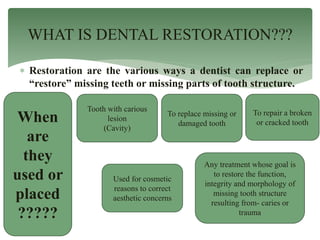
 Restoration are the various ways a dentist can replace or
“restore” missing teeth or missing parts of tooth structure.
WHAT IS DENTAL RESTORATION???
When
are
they
used or
placed
?????
Tooth with carious
lesion
(Cavity)
Used for cosmetic
reasons to correct
aesthetic concerns
To replace missing or
damaged tooth
To repair a broken
or cracked tooth
Any treatment whose goal is
to restore the function,
integrity and morphology of
missing tooth structure
resulting from- caries or
trauma
RESTORATIONS SEEN ON
RADIOGRAPH
Metallic and Non-metallic
Metallic- Amalgam, gold, stainless steel, chrome, post and core and porcelain-fused-to-metal
(PFM) restoration.
Non-metallic- Composite resin, porcelain crowns, bridges and acrylic restorations.
All dental images should be evaluated while patient is still present.
Number of dental materials look very similar on x-ray; therefore, a clinical exam of the
patient is needed to gain information necessary to verify what is being seen on the x-ray.
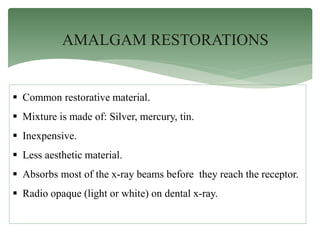
AMALGAM RESTORATIONS
 Common restorative material.
 Mixture is made of: Silver, mercury, tin.
 Inexpensive.
 Less aesthetic material.
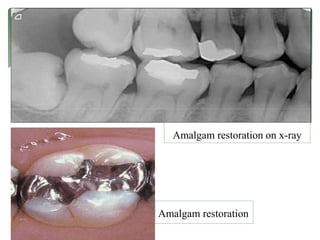
 Absorbs most of the x-ray beams before they reach the receptor.
 Radio opaque (light or white) on dental x-ray.
Amalgam restoration on x-ray
Amalgam restoration
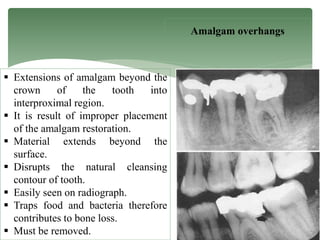
Amalgam overhangs
 Extensions of amalgam beyond the
crown of the tooth into
interproximal region.
 It is result of improper placement
of the amalgam restoration.
 Material extends beyond the
surface.
 Disrupts the natural cleansing
contour of tooth.
 Easily seen on radiograph.
 Traps food and bacteria therefore
contributes to bone loss.
 Must be removed.
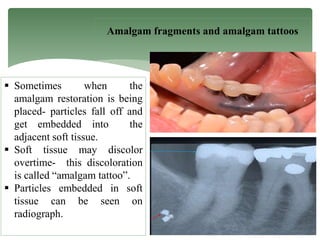
Amalgam fragments and amalgam tattoos
 Sometimes when the
amalgam restoration is being
placed- particles fall off and
get embedded into the
adjacent soft tissue.
 Soft tissue may discolor
overtime- this discoloration
is called “amalgam tattoo”.
 Particles embedded in soft
tissue can be seen on
radiograph.
GOLD RESTORATIONS
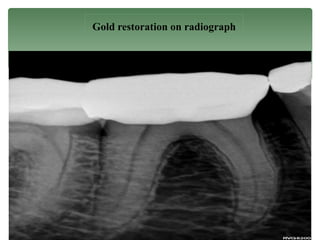
 Not easily distinguished from other metallic restorations on dental x-ray.
 Radiopaque with smooth contours and regular borders seen on radiograph.
 Large radiopaque restoration with smooth borders are seen on radiograph- is
most likely made of gold.
 Smooth contours and regular border.
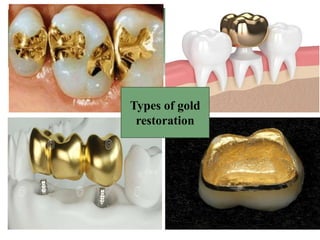
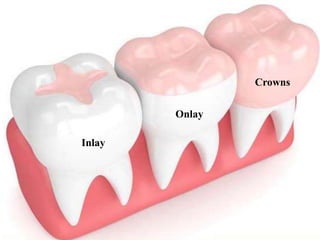
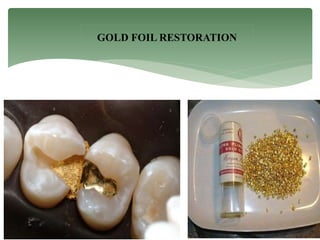
 Gold restorations may include: crowns, bridges, gold foil, gold inlays and
onlays.
Types of gold
restoration
Inlay
Onlay
Crowns
Gold restoration on radiograph
GOLD FOIL RESTORATION
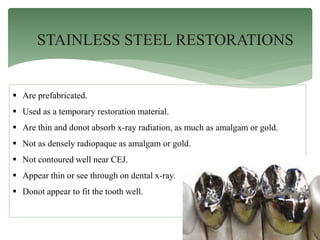
STAINLESS STEEL RESTORATIONS
 Are prefabricated.
 Used as a temporary restoration material.
 Are thin and donot absorb x-ray radiation, as much as amalgam or gold.
 Not as densely radiopaque as amalgam or gold.
 Not contoured well near CEJ.
 Appear thin or see through on dental x-ray.
 Donot appear to fit the tooth well.
Stainless steel restoration on radiograph
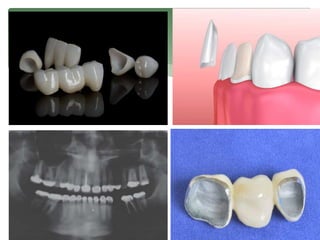
PORCELAIN RESTORATIONS
 Appear radiopaque ; vary in radiographic appearance depending upon whether
restoration is all porcelain or PFM style restoration.
 All porcelain crowns and bridges: slightly radiopaque with thin radiopaque line
outlining the prepared tooth; the thin line is the dental cement or adhesive
material; Porcelain is a specific type of ceramic.
 When someone refers to a ceramic crown- the material is almost definitely
porcelain.
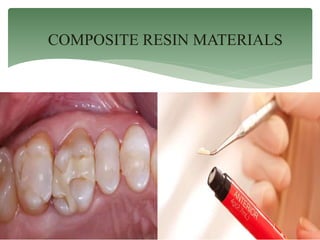
COMPOSITE RESIN MATERIALS
 Appearance of composite resin material varies on radiograph
depending upon the materials used (which company manufactured
the resin).
 Some manufacturers add radiopaque particles to distinguish the
composite resin from a carious lesion.
SOME OTHER MATERIALS
BASE MATERIALS:
 Includes zinc phosphate cement and zinc eugenol paste.
 Used as cavity liners to protect the pulp. (placed in the floor of the
prep)
 Afterwards- restorative material is placed over (on top of) based
material.
 Appears radiopaque.
POST AND CORE
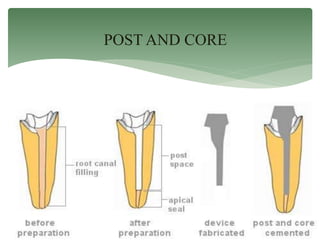
 When large part of the tooth’s crown is lost.
 Due to- progression of dental decay or tooth trauma.
 Required when inadequate amount of sound tooth tissue left to
retain a conventional crown.
 Tooth must have had root canal treatment.
 Purpose of the core: Improve crown retention.
 Purpose of the post: retain the core.
Cont….
WHAT IS
BRIDGE
CROWN
VENEER
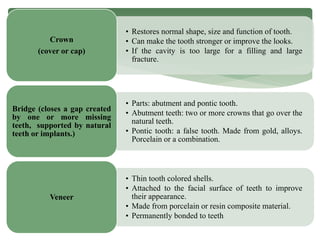
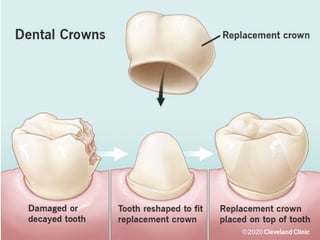
• Restores normal shape, size and function of tooth.
• Can make the tooth stronger or improve the looks.
• If the cavity is too large for a filling and large
fracture.
Crown
(cover or cap)
• Parts: abutment and pontic tooth.
• Abutment teeth: two or more crowns that go over the
natural teeth.
• Pontic tooth: a false tooth. Made from gold, alloys.
Porcelain or a combination.
Bridge (closes a gap created
by one or more missing
teeth, supported by natural
teeth or implants.)
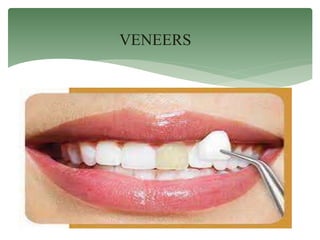
• Thin tooth colored shells.
• Attached to the facial surface of teeth to improve
their appearance.
• Made from porcelain or resin composite material.
• Permanently bonded to teeth
Veneer
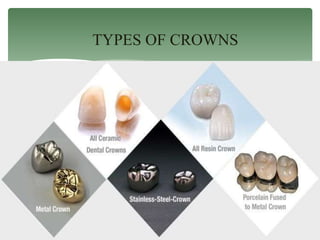
TYPES OF CROWNS
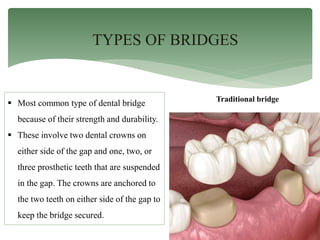
TYPES OF BRIDGES
Traditional bridge
 Most common type of dental bridge
because of their strength and durability.
 These involve two dental crowns on
either side of the gap and one, two, or
three prosthetic teeth that are suspended
in the gap. The crowns are anchored to
the two teeth on either side of the gap to
keep the bridge secured.
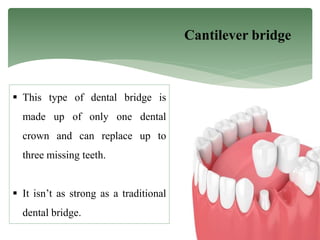
Cantilever bridge
 This type of dental bridge is
made up of only one dental
crown and can replace up to
three missing teeth.
 It isn’t as strong as a traditional
dental bridge.
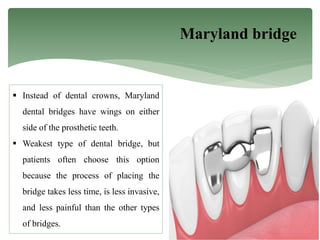
Maryland bridge
 Instead of dental crowns, Maryland
dental bridges have wings on either
side of the prosthetic teeth.
 Weakest type of dental bridge, but
patients often choose this option
because the process of placing the
bridge takes less time, is less invasive,
and less painful than the other types
of bridges.
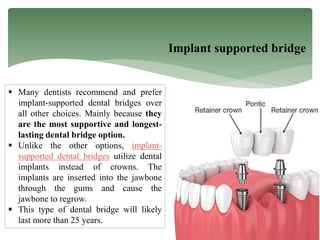
Implant supported bridge
 Many dentists recommend and prefer
implant-supported dental bridges over
all other choices. Mainly because they
are the most supportive and longest-
lasting dental bridge option.
 Unlike the other options, implant-
supported dental bridges utilize dental
implants instead of crowns. The
implants are inserted into the jawbone
through the gums and cause the
jawbone to regrow.
 This type of dental bridge will likely
last more than 25 years.
VENEERS
dental restorations.pptx

dental restorations.pptx

  • 1.
    TYPES OF DENTAL RESTORATION SHRADDHAJOSHI Ph.D. Shalakya ITRA, Jamnagar
  • 2.
     Restoration arethe various ways a dentist can replace or “restore” missing teeth or missing parts of tooth structure. WHAT IS DENTAL RESTORATION??? When are they used or placed ????? Tooth with carious lesion (Cavity) Used for cosmetic reasons to correct aesthetic concerns To replace missing or damaged tooth To repair a broken or cracked tooth Any treatment whose goal is to restore the function, integrity and morphology of missing tooth structure resulting from- caries or trauma
  • 3.
    RESTORATIONS SEEN ON RADIOGRAPH Metallicand Non-metallic Metallic- Amalgam, gold, stainless steel, chrome, post and core and porcelain-fused-to-metal (PFM) restoration. Non-metallic- Composite resin, porcelain crowns, bridges and acrylic restorations. All dental images should be evaluated while patient is still present. Number of dental materials look very similar on x-ray; therefore, a clinical exam of the patient is needed to gain information necessary to verify what is being seen on the x-ray.
  • 4.
    AMALGAM RESTORATIONS  Commonrestorative material.  Mixture is made of: Silver, mercury, tin.  Inexpensive.  Less aesthetic material.  Absorbs most of the x-ray beams before they reach the receptor.  Radio opaque (light or white) on dental x-ray.
  • 5.
    Amalgam restoration onx-ray Amalgam restoration
  • 6.
    Amalgam overhangs  Extensionsof amalgam beyond the crown of the tooth into interproximal region.  It is result of improper placement of the amalgam restoration.  Material extends beyond the surface.  Disrupts the natural cleansing contour of tooth.  Easily seen on radiograph.  Traps food and bacteria therefore contributes to bone loss.  Must be removed.
  • 7.
    Amalgam fragments andamalgam tattoos  Sometimes when the amalgam restoration is being placed- particles fall off and get embedded into the adjacent soft tissue.  Soft tissue may discolor overtime- this discoloration is called “amalgam tattoo”.  Particles embedded in soft tissue can be seen on radiograph.
  • 8.
    GOLD RESTORATIONS  Noteasily distinguished from other metallic restorations on dental x-ray.  Radiopaque with smooth contours and regular borders seen on radiograph.  Large radiopaque restoration with smooth borders are seen on radiograph- is most likely made of gold.  Smooth contours and regular border.  Gold restorations may include: crowns, bridges, gold foil, gold inlays and onlays.
  • 9.
  • 10.
  • 11.
  • 12.
  • 13.
    STAINLESS STEEL RESTORATIONS Are prefabricated.  Used as a temporary restoration material.  Are thin and donot absorb x-ray radiation, as much as amalgam or gold.  Not as densely radiopaque as amalgam or gold.  Not contoured well near CEJ.  Appear thin or see through on dental x-ray.  Donot appear to fit the tooth well.
  • 14.
  • 15.
    PORCELAIN RESTORATIONS  Appearradiopaque ; vary in radiographic appearance depending upon whether restoration is all porcelain or PFM style restoration.  All porcelain crowns and bridges: slightly radiopaque with thin radiopaque line outlining the prepared tooth; the thin line is the dental cement or adhesive material; Porcelain is a specific type of ceramic.  When someone refers to a ceramic crown- the material is almost definitely porcelain.
  • 17.
  • 18.
     Appearance ofcomposite resin material varies on radiograph depending upon the materials used (which company manufactured the resin).  Some manufacturers add radiopaque particles to distinguish the composite resin from a carious lesion.
  • 19.
    SOME OTHER MATERIALS BASEMATERIALS:  Includes zinc phosphate cement and zinc eugenol paste.  Used as cavity liners to protect the pulp. (placed in the floor of the prep)  Afterwards- restorative material is placed over (on top of) based material.  Appears radiopaque.
  • 20.
  • 21.
     When largepart of the tooth’s crown is lost.  Due to- progression of dental decay or tooth trauma.  Required when inadequate amount of sound tooth tissue left to retain a conventional crown.  Tooth must have had root canal treatment.  Purpose of the core: Improve crown retention.  Purpose of the post: retain the core. Cont….
  • 22.
  • 23.
    • Restores normalshape, size and function of tooth. • Can make the tooth stronger or improve the looks. • If the cavity is too large for a filling and large fracture. Crown (cover or cap) • Parts: abutment and pontic tooth. • Abutment teeth: two or more crowns that go over the natural teeth. • Pontic tooth: a false tooth. Made from gold, alloys. Porcelain or a combination. Bridge (closes a gap created by one or more missing teeth, supported by natural teeth or implants.) • Thin tooth colored shells. • Attached to the facial surface of teeth to improve their appearance. • Made from porcelain or resin composite material. • Permanently bonded to teeth Veneer
  • 24.
  • 26.
    TYPES OF BRIDGES Traditionalbridge  Most common type of dental bridge because of their strength and durability.  These involve two dental crowns on either side of the gap and one, two, or three prosthetic teeth that are suspended in the gap. The crowns are anchored to the two teeth on either side of the gap to keep the bridge secured.
  • 27.
    Cantilever bridge  Thistype of dental bridge is made up of only one dental crown and can replace up to three missing teeth.  It isn’t as strong as a traditional dental bridge.
  • 28.
    Maryland bridge  Insteadof dental crowns, Maryland dental bridges have wings on either side of the prosthetic teeth.  Weakest type of dental bridge, but patients often choose this option because the process of placing the bridge takes less time, is less invasive, and less painful than the other types of bridges.
  • 29.
    Implant supported bridge Many dentists recommend and prefer implant-supported dental bridges over all other choices. Mainly because they are the most supportive and longest- lasting dental bridge option.  Unlike the other options, implant- supported dental bridges utilize dental implants instead of crowns. The implants are inserted into the jawbone through the gums and cause the jawbone to regrow.  This type of dental bridge will likely last more than 25 years.
  • 30.