International Journal of Engineering and Technical Research (IJETR)
ISSN: 2321-0869, Volume-02, Issue-02, February 2014
89 www.erpublication.org

Abstract— High density poly ethylene (HDPE) has been leading
material for gas and water pipelines due to its many
advantageous properties over metals such as lower weight,
higher chemical and corrosion resistance. The paper has
investigated the resistance welding process of a high density
polyethylene which has been experimented under three
operating parameters, namely current, pressure and time. The
present research is dedicated exclusively to finite element
simulation of resistance welding of HDPE pipes. Joining of the
two HDPE pipes carried out by resistance welding process. The
software used for the FE analysis is ANSYS. In the FEA main
aim is to make a finite element model and simulation. At first
thermal analysis is carried out according to the parameters
current and time by considering variation of material properties
occurring at different levels of temperature and then structural
analysis done for the values of pressure. The study is carried out
how the temperature is distributing along the axial direction and
with respective to the time is found out and then different
structural deformation i.e. strain, material loss and weld bead
height is found out.
Index Terms— HDPE, Resistance Welding, Finite Element
Analysis
I. INTRODUCTION
Resistance welding is a fusion welding process that
requires the application of both heat and pressure to achieve a
sound joint. The simplest form of the process is spot welding
where the pressure is provided by clamping two or more
overlapping sheets between two electrodes. A current is then
passed between the electrodes, sufficient heat being generated
at the interface by resistance to the flow of the current that
melting occurs, a weld nugget is formed and an autogenously
fusion weld is made between the plates. The heat generated
depends upon the current, the time the current is passed and
the resistance at the interface. The resistance is a function of
the resistivity and surface condition of the parent material, the
size, shape and material of the electrodes and the pressure
applied by the electrodes.
HDPE is a common plastic that can be heat welded in the
field using specialized equipment. Fish farmers may find this
material useful when used for building hauling tanks, fish
tanks, or other farming related uses. As a plastic, HDPE
Manuscript received Feb. 13, 2014.
material is lighter than metal, non-corrosive, long lasting, and
is a poor conductor of electrical current. High density
polyethylene (HDPE) is a hard plastic that is used in many
applications due to its‘ resistance to degradation and fatigue.
Some of the commercial products made from this material
include drainage culverts, pipes, and whitewater kayaks.
There are specialty companies that can custom make just
about any product needed, however the average person can
quickly learn how to properly prepare and weld this material.
Welding of polyethylene materials gives new
possibilities of applications due to the fact that both materials
have significantly different physical, chemical and
mechanical properties. These thermoplastic materials have
good elevated temperature resistance, strength and wear
which helps to use it for many fields of electronic, aerospace,
nuclear and automotive industries. Friction welding is a solid
state welding technology with good quality and reliability. In
friction welding process, the temperature field, the stress field
and the strain field are the three important factors, which
directly affect the quality of welded joint. Resistance welding
is considered to be the most significant development in metal
joining in a decade and is a ―green‖ technology due to its
energy efficiency, environment friendliness, and versatility.
A. Finite Element Analysis
a) FEA model and mesh
FEA model of RSW process is shown in Fig 3 and 4, which is
axisymmetric about y axis since only half portion of the
complete model is analysed. The x axis is the contact surface
of the two sheets called as faying surface. The model is
meshed using three elements; PLANE223, CONTA172 AND
TARGE169. The element PLANE223 with
structuralthermoelectric capabilities has eight nodes with up
to four degrees of freedom per node. It has UX, UY, TEMP
and VOLT degrees of freedom. The other elements are
contact elements consisting of contact pair of CONTA172
and TARGE169. Contact occurs when the element surface
penetrates one of the target segment elements (TARGE169)
on a specified target surface. Any translational or rotational
displacement, forces, moments, temperature, voltage and
magnetic potential can be imposed on the target segment
element. [6] [7]
b) Material models and welding conditions
Temperature varying properties are considered for copper
electrode and mild steel sheets. The properties assigned are
Finite Element Simulation of Resistance Welding of
High Density Polyethylene Pipe
Sachin Kumar, Yash Kumar, Amandeep Singh
Finite Element Simulation of Resistance Welding of High Density Polyethylene Pipe
90 www.erpublication.org
thermal conductivity, resistivity, Young‘s modulus,
coefficient of thermal expansion, yield stress, specific heat
and contact resistivity. These temperature dependent
properties are assigned in the range of 21ºC to 1204ºC [4] . In
modelling RSW process with the complicated thermoelectric
behavior, several physical phenomena must be considered. It
is of great importance to define the parameters correctly to
obtain correct results. Since electric current has great
influence on the quality of RSW process, the input current in
this simulation is 50 Hz sine wave AC current of 10 kA,
applied for 200 ms. The current is imposed as an electric load
on the top surface of upper electrode. To simulate the cooling
process of the welding, the hold time is taken as 60 ms.
II. METHODS
A. SELECTION OF MATERIAL
For simulation of the Resistance Welding (RW)
experiments, pure HDPE are used for specimen are in the size
40mm internal diameter ,60mm external diameter and length
of 60mm. Stainless steel mesh of 150 microns having 40mm
internal diameter and 60mm external diameter is used.
Terminals of resistance welding machine are connected to this
mesh during welding process.
B. SELECTION OF PROCESS PARAMETERS
The Factors Varied for the current experiment are Current,
Time and Pressure. The Levels for Parameters, Current and
Time are determined by subjecting mesh to different current
and analysing the temperature of the mesh at different time
intervals.
C. DESIGN OF EXPERIMENTS
The design technique helps us study many factors (variables)
simultaneously and most economically. By studying the
effects of individual factors on the results, the best factor
combination can be determined. Full factorial design is used
to carry out experiments, in which responses are measured at
all combinations of the factor levels.
D. FINITE ELEMENT SIMULATION
The finite element simulation of the Resistance welding
process is done as explained below. ANSYS which is a widely
used software used for Finite Element simulation is used here.
To get good simulation results, first we have to consider the
basic material properties, here HDPE. Then modelling of
experiment can be done accordingly. The welding process is a
non-linear transient state. The thermal physical properties of
the material changes rapidly with the change of temperature.
The controlling equation of heat conduction is:
ρc = (λ ) + (λ ) + ) +Q ........................ (1)
In the equation, ρ, c and λ are the density of the material, the
specific thermal capacity of the material and the heat
conductance of material respectively as functions of
temperature and Q is the intensity of inner heat source.
III. OBSERVATIONS
A. Material Properties
Finite element simulation of resistance welding is a nonlinear
analysis. The material properties of hdpe material are
changing with temperature.The properties at different
temperature used in this study are shown in Table 1.
Table1. Properties of HDPE at different temperatures
S.
no
Temper
ature
(k)
Thermal
conducti
vity
(W/mK)
Specif
ic
heat
(J/Kg
K)
Densi
ty
(Kg/
m3
)
Young
’s
modul
us
MPa
Therm
al
expans
ion(10
e-5)/K
1 300 .46 1500 956 1000 9.5
2 320 .44 1600 946 850 9.5
3 340 .42 1700 934 600 9.5
4 360 .40 1800 922 380 14.2
5 380 .38 1900 904 200 14.2
6 400 .36 2000 842 100 18.0
B. Process Parameters
The Levels for Parameters, Current and Time are determined
by subjecting mesh to different current and analysing the
temperature of the mesh at different time intervals.
Parameters used in each level are as shown in Table 2.
Table 2. Process parameters with their values at 3 levels
Pressure
(Kg/cm2
)
Current
(A)
Time(s)
Leve1
1
4 20 5
Level
2
6 25 10
Level
3
8 30 15
C. Design of Experiments
The design technique helps us study many factors (variables)
simultaneously and most economically. By studying the
effects of individual factors on the results, the best factor
combination can be determined. Full factorial design is used
to carry out experiments, in which responses are measured at
all combinations of the factor levels which are as shown in
Table 3.
Table 3. Process parameters in different levels as per
simulation run order
S.no Current(A) Pressure(kg/cm2
) Time(s)
1 20 4 5
2 20 4 10
3 20 4 15
4 20 6 5
5 20 6 10
6 20 6 15
7 20 8 5
8 20 8 10
9 20 8 15
International Journal of Engineering and Technical Research (IJETR)
ISSN: 2321-0869, Volume-02, Issue-02, February 2014
91 www.erpublication.org
10 25 4 5
11 25 4 10
12 25 4 15
13 25 6 5
14 25 6 10
15 25 6 15
16 25 8 5
17 25 8 10
18 25 8 15
19 30 4 5
20 30 4 10
21 30 4 15
22 30 6 5
23 30 6 10
24 30 6 15
25 30 8 5
26 30 8 10
27 30 8 15
Once the factors are assigned to the columns, individual
experiments are easily described. The individual experiments
are represented by the rows, which can be described in plain
language.
D. Finite Element Simulation
The finite element simulation of the Resistance
welding process is done as explained below. ANSYS which is
a widely used software used for Finite Element Simulation is
used here.
E. Creating the model:
Model of HDPE specimen and stainless steel mesh is created
by using the modelling software of CATIA.The solid 70
(Brick 8 node 70) elements is adopted for the model.
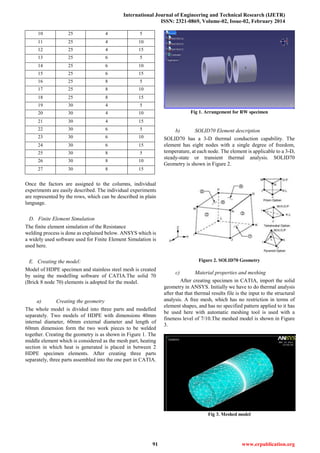
a) Creating the geometry
The whole model is divided into three parts and modelled
separately. Two models of HDPE with dimensions 40mm
internal diameter, 60mm external diameter and length of
60mm dimension form the two work pieces to be welded
together. Creating the geometry is as shown in Figure 1. The
middle element which is considered as the mesh part, heating
section in which heat is generated is placed in between 2
HDPE specimen elements. After creating three parts
separately, three parts assembled into the one part in CATIA.
Fig 1. Arrangement for RW specimen
b) SOLID70 Element description
SOLID70 has a 3-D thermal conduction capability. The
element has eight nodes with a single degree of freedom,
temperature, at each node. The element is applicable to a 3-D,
steady-state or transient thermal analysis. SOLID70
Geometry is shown in Figure 2.
Figure 2. SOLID70 Geometry
c) Material properties and meshing
After creating specimen in CATIA, import the solid
geometry in ANSYS. Initially we have to do thermal analysis
after that that thermal results file is the input to the structural
analysis. A free mesh, which has no restriction in terms of
element shapes, and has no specified pattern applied to it has
be used here with automatic meshing tool is used with a
fineness level of 7/10.The meshed model is shown in Figure
3.
Fig 3. Meshed model
Finite Element Simulation of Resistance Welding of High Density Polyethylene Pipe
92 www.erpublication.org
d) Thermal analysis
Stainless steel mesh of 150microns used with dimensions
40mm internal diameter ,60mm external diameter and
thickness 0.3mm. In this mesh has 120 threads which are the
carriers of electricity and thus heat generated will depend only
on this 120 threads. Welding machine used (TORNADO 201)
will supply constant output voltage of 63 V as per the manual
and has an efficiency of 85%.So total power produced by
mesh in the specified volume can be calculated as:
P = (V x I x 0.85 x 120) / (0.3e-3)................(2)
(2) (2)
As the experiment based on transient analysis, time is another
important parameter, which can be directly fed into the
programme as time sub step. The heat generated can be given
applied to the defined interval and finally results obtained.
Table 4 shows the heat generated for 3 levels of current used.
Table 4. Heat generated according to the current input
Current(A) Heat generation (J)
20 428400000
25 535500000
30 642600000
e) Structural analysis
Visualising the deformation occurred and obtaining stress,
strain and displacement values in , Z axis can be obtained by
structural analysis. Applying pressure on the areas in ANSYS
and deformation comes in the shape after applying the
pressure as shown in figure 4 & 5.
Fig 4. Pressure applied as visualised
Fig 5. Shows deformed shape after apply the pressure
f) FEM Simulated Results
Design of experiment gives the list of experiments which has
to be performed so as to obtain the results with the help of
finte element modelling. The results simulated by using finite
element modelling as shown in Table 5.
Table 5. FEM simulated results
S.no
Current(A)
Pressure
(Kg/cm2)
Time(S)
Temp(K)
Strain
Z-axis
Beadheight(mm)
Metalloss
(10-4m)
Beadwidth
mm
Heateffected
width(mm)
1 2
0
4 5 369 .0117 .51 2.12 6.6 8.8
2 2
0
4 1
0
404 .0158 .94 2.95 7.9 12.8
3 2
0
4 1
5
432 .0201 1.2 3.72 9.4 14
4 2
0
6 5 369 .0100 .73 2.75 7.3 8.8
5 2
0
6 1
0
404 .0178 1.1 3.52 8.6 12.8
6 2
0
6 1
5
432 .0280 1.43 4.23 10.2 14
7 2
0
8 5 369 .0130 .90 3.45 8.1 8.8
8 2
0
8 1
0
404 .0168 1.5 4.12 9.3 12.8
9 2
0
8 1
5
432 .024 1.74 4.98 11.1 14
1
0
2
5
4 5 387 .0138 .83 3.12 8.9 9.6
1
1
2
5
4 1
0
431 .0237 1.32 4.1 10.1 13.8
1
2
2
5
4 1
5
468 .0342 1.49 4.82 12.2 14.6
1
3
2
5
6 5 387 .0129 1.22 3.82 9.5 9.6
1
4
2
5
6 1
0
431 .0279 1.54 4.6 10.3 13.8
1
5
2
5
6 1
5
468 .0352 1.63 5.32 12.1 14.6
1
6
2
5
8 5 387 .0132 1.45 4.32 9.9 9.6
1
7
2
5
8 1
0
431 .0221 1.73 5.2 10.3 13.8
1
8
2
5
8 1
5
468 .033 1.97 6.01 12.9 14.6
1
9
3
0
4 5 405 .0129 1.27 3.81 10.2 11.4
2
0
3
0
4 1
0
459 .0308 1.53 4.68 11.2 14.8
2
1
3
0
4 1
5
505 .0325 1.82 5.43 13.4 16
2
2
3
0
6 5 405 .0222 1.49 4.34 10.8 11.4
2
3
3
0
6 1
0
459 .0336 1.72 5.29 11.2 14.8
2
4
3
0
6 1
5
505 .0453 2.3 5.9 12.6 16
2
5
3
0
8 5 405 .016 1.92 4.98 11.5 11.4
2
6
3
0
8 1
0
459 .040 2.21 5.97 12.4 14.8
2
7
3
0
8 1
5
505 .047 3.02 6.45 14.8 16
IV. RESULT AND DISCUSSION
The objective of the project is to obtain the finite element
model of the resistance welding specimens and do the
simulation. Simulation done considering ideal conditions.
Actual values may differ according to the process conditions.
The temperature profile created by the software after
simulation and the structural deformation occurred is
visualised and simulated values are discussed.
For three levels of current values (20A, 25A, 30A) and for
three levels of time (5s, 10s, 15s) the maximum temperature
obtained is tabulated and plotted as shown in Figure 6. The
temperatures reached corresponding each experiment
number. Maximum temperature obtained at the parameters
30A and 15s.
International Journal of Engineering and Technical Research (IJETR)
ISSN: 2321-0869, Volume-02, Issue-02, February 2014
93 www.erpublication.org
Fig. 6 Surface plot of Temperature v/s Current and Time
A. Variation of displacement
For each experiment, maximum material loss occurred along
Z axis, the direction through which pressure is acted while
conducting the experiment is noted and plotted.
 Material loss values obtained are tabulated and
plotted keeping current constant and other two
parameters, Pressure and Time varied is as shown in
Figure 7.
 Material loss (Z axis) values keeping current value
constant as 20A are plotted taking the variables as
Pressure on X axis, Time on Y axis as in Figure 7(a)
 Material loss (Z axis) values keeping current value
constant as 25A are plotted taking the variables as
Pressure on X axis, Time on Y axis as in Figure 7(b).
 Material loss (Z axis) values keeping current value
constant as 30A are plotted taking the variables as
Pressure on X axis, Time on Y axis as in Figure 7(c).
Fig. 7(a) Constant Current 20A
Fig. 7(b) Constant Current 25A
Fig. 7(c) Constant Current 30A
B. Surface plot of material loss vs current, Time
 Material loss values obtained are tabulated and
plotted keeping Pressure constant and other two
parameters, Current and Time varied is as
shown in Figure 8.
 Material loss (Z axis) values keeping pressure
value constant as 4 bar are plotted taking the
variables as Current on X axis, Time on Y axis
as in Figure 8(a).
 Material loss (Z axis) values keeping pressure
value constant as 6 bar are plotted taking the
variables as Current on X axis, Time on Y axis
as in Figure 8(b).
 Material loss (Z axis) values keeping pressure value
constant as 8 bar are plotted taking the variables as
Current on X axis, Time on Y axis as in Figure 8(c
Finite Element Simulation of Resistance Welding of High Density Polyethylene Pipe
94 www.erpublication.org
Fig. 8(a) Constant Pressure 4 kg/cm2
Fig. 8(b) Constant Pressure 6 kg/cm2
Fig. 8(c) Constant Pressure 8 kg/cm2
C. OPTIMISATION OF PROCESS PARAMETERS
The optimal combination of the process parameters can be
done by finding the signal-to-noise ratio (S/N) for each
performance variable. Usually there are three categories of
performance characteristics in the analysis of the S/N ratio:
the lower-the –better, the higher-the-better, and the
nominal-the-better
a) SIGNAL TO NOISE RATIO
Regardless of the category of the performance characteristics,
a larger S/N ratio corresponds to better performance
characteristics. Therefore the optimal level of the process
parameters is the level with the highest S/N ratio. The signal
to noise ratio is being find out by calculating the loss function
(Lij). The loss function Lij of the higher the better
performance characteristics can be expressed as:
(S/N) for MRR= -10log (Lij)
Where Lij= 1/ (Yij)²
The loss function Lij of the lower the better performance
characteristics can be expressed as:
(S/N) for TWR AND SR= -10log (Lij)
Where Lij= (Yij) ²
Where lij is the loss function of the ith performance
characteristics in the jth experiment.
b) ANOVA FOR CURRENT, PRESSURE AND
TIME
From the results of ANOVA, it can be found current is the
most affecting metal loss, then after time is affecting and
pressure is least affecting as shown in Table 6. For minimize
for metal optimum level C1,P1,T1.
Table 6.1 S/N Response table for metal loss
Level Current (c) Pressure(p) Time(t)
1 -10.73 -11.44 -10.97
2 -13.09 -12.70 -12.87
3 -14.24 -13.92 -14.22
Delta 3.51 2.47 3.24
Rank 1 3 2
Table 6.2 Response table for mean
Level Current Pressure Time
1 3.538 3.861 3.634
2 4.590 4.419 4.492
3 5.206 5.053 5.207
Delta 1.668 1.192 1.572
Rank 1 3 2
c) ANOVA FOR BEAD HEIGHT
From the results of ANOVA, it can be found current is the
most affecting bead height, then after time is affecting and
pressure is least affecting as shown in Table 7. For minimize
for bead height optimum level C1, P1, T1.
Table 6.3 Analysis of variance (Current, Pressure, Time)
Sour
ce
df Seq
SS
Adj
SS
Adj
MS
F P Contributi
on
(%)
Curre
nt
2 57.57
5
57.5
75
28.7
88
144.
81
0.
0
42
Press
ure
2 27.56
1
27.5
61
13.7
81
69.3
2
0.
0
20
Time 2 47.80
3
47.8
03
23.9
01
120.
23
0.
0
34
Error 20 3.976 3.97
6
.199 2.9
Total 26 136.9
15
International Journal of Engineering and Technical Research (IJETR)
ISSN: 2321-0869, Volume-02, Issue-02, February 2014
95 www.erpublication.org
Table 7.1 Signal to Noise Ratios for bead height
Level Current Pressure Time
1 -0.4240 -1.1584 -0.5605
2 -3.0951 -2.9257 -3.3364
3 -5.3927 -4.8277 -5.0149
Delta 4.9687 3.6693 4.4544
Rank 1 3 2
Table 7.2 Response table for mean
Level Current Pressure Time
1 1.117 1.212 1.147
2 1.464 1..462 1.510
3 1.920 1.827 1.844
Delta .803 .614 .698
Rank 1 3 2
Table 7.3 Analysis of Variance for bead height
Sourc
e
df Seq
SS
Adj
SS
Adj
MS
F P Contribution
%
curre
nt
2 11
1.3
03
111.3
03
55.6
52
67.7
5
0.0 39
press
ure
2 60.
61
4
60.61
4
30.3
07
36.9
0
0.0 21
Time 2 91.
09
4
91.09
4
45.5
47
55.4
5
0.0 32
Error 20 16.
42
8
16.42
8
.821 5.87
Total 26 27
9.4
38
d) ANOVA FOR BEAD WIDTH
From the results of ANOVA, it can be found current is the
most affecting bead height, then after time is affecting and
pressure is least affecting as shown in Table 8. For minimize
for bead width optimum level C1,P1,T1
Table8.1 Signal to Noise Ratio for bead width
Level Current Pressure Time
1 -18.71 -19.81 -19.15
2 -20.52 -20.14 -20.05
3 -21.54 -20.81 -21.57
Delta 2.83 1.00 2.42
Rank 1 3 2
Table 8.2 Response table for mean
Level Current Pressure Time
1 8.722 9.989 9.200
2 10.689 10.289 10.144
3 12.011 11.144 12.078
Delta 3.289 1.156 2.878
Rank 1 3 2
Table 8.3 Analysis of variance for bead width
sourc
e
df Seq
SS
Adj
SS
Adj
MS
F P Contribution%
curre
nt
2 36.9
55
36.9
55
18.4
78
14
8.0
8
0.0 52
press
ure
2 4.68
8
4.68
8
2.34
4
18.
78
0.0 6.5
time 2 26.8
57
26.8
57
13.4
28
10
7.6
2
0.0 37
Error 20 2.49
6
2.49
6
0.12
5
3.5
Total 26 70.9
96
Hence, S/N ratio for responses such as current, time, bead
height and bead width has been obtained as shown in Table 9.
TABLE 9. S/N RATIO FOR RESPONSES
Stdo
rder
Runo
rder
Curr
ent
Press
ure
Time
Bead
height
Bead
width
SNRA1 SNRA2
12 1 25 4 15 1.49 12.2 -3.4637 -21.727
23 2 30 6 10 1.72 11.2 -4.7105 -20.984
8 3 20 8 10 1.5 9.3 -3.5218 -19.3697
17 4 25 8 10 1.73 10.3 -4.76092 -20.2567
1 5 20 4 5 0.51 6.6 5.8486 -16.3909
22 6 30 6 5 1.49 10.8 -3.46373 -20.6685
20 7 30 4 10 1.53 11.2 -3.69383 -20.9844
4 8 20 6 5 0.73 7.3 2.73354 -17.2665
26 9 30 8 10 2.21 12.4 -6.88785 -21.8684
7 10 20 8 5 0.9 8.1 0.91515 -18.1697
21 11 30 4 15 1.82 13.4 -5.20143 -22.5421
2 12 20 4 10 0.94 7.9 0.53744 -17.9525
11 13 25 4 10 1.32 10.1 -2.41148 -20.0864
14 14 25 6 10 1.54 10.3 -3.75041 -20.2567
5 15 20 6 10 1.1 8.6 -0.82785 -18.69
19 16 30 4 5 1.27 10.2 -2.07607 -20.172
24 17 30 6 15 2.3 12.6 -7.23456 -22.0074
27 18 30 8 15 3.02 14.8 -9.60014 -23.4052
10 19 25 4 5 0.83 8.9 1.61844 -18.9878
6 20 20 6 15 1.43 10.2 -3.10672 -20.172
15 21 25 6 15 1.63 12.1 -4.24375 -21.6557
9 22 20 8 15 1.74 11.1 -4.81098 -20.9065
18 23 25 8 15 1.97 12.9 -5.88932 -22.2118
16 24 25 8 5 1.45 9.9 -3.22736 -19.9127
25 25 30 8 5 1.92 11.5 -5.66602 -21.214
3 26 20 4 15 1.2 9.4 -1.58362 -19.4626
13 27 25 6 5 1.22 9.5 -1.7272 -19.5545
V. CONCLUSION
The Finite Element Simulation of resistance welding of
HDPE considering the effect of three parameters such as
current, pressure and welding time was done successfully.
The following conclusions have been drawn from the results.
 As the value of current and time increases, heat
penetration increases through the material. In each case,
maximum temperature is noted at the centre area of mesh
designed.
Finite Element Simulation of Resistance Welding of High Density Polyethylene Pipe
96 www.erpublication.org
 As heat input increased, increase in temperature and
accordingly increase in heat affected width are noted.
 Correspondingly structural analysis has been carried out
and simulated values of displacement and strain has been
found out.
 Temperature profile for each level of process parameters
has been visualized, structural variations and different
values obtained is analysed considering the number of
experiments done.
 From the surface plots it is clear that the displacement and
temperature is maximum for the higher value of the input
parameters.
 From ANOVA,it can be found current is the most affecting
in metal loss, bead height and bead width, and then after
time is affecting and pressure is least affecting.
REFERENCE
[1]Meng Hou, Mingbo Yang, Andrew Beehag, Yiu-Wing Mai and Lin
Ye (1999) Resistance welding of carbon fibre reinforced thermoplastic
composite using alternative heating element. Composite Structures 47,
667-72.
[2]higang Hou, Ill-Soo Kim, Yuanxun Wang, Chunzhi Li, Chuanyao
Chen Finite element analysis for the mechanical features of resistance
spot welding process Journal of Materials Processing Technology
185 (2007) 160–165
[3]anrong Kong, Radovan Kovacevic 3D finite element modelling of the
thermally induced residual stress in the hybrid laser/arc welding of lap
joint. Journal of Materials Processing Technology 210 (2010)
941–950
[4]Stavrov and H.E.N. Bersee (2005) Resistance welding of thermoplastic
composites-an overview. Composites: Part A 36 , 39–54 K.
Leskovics, M.Kollar, P. Barczy (2006)
[5]vijay Soundararajan, Srdja Zekovic, Radovan Kovacevic
Thermo-mechanical model with adaptive boundary conditions for
friction stir welding of Al 6061 International Journal for Machine
Tools and manufacture 45 (2005) 1577- 1587.
[6].K. Zhu, and Y.J. Chao Effects of temperature-dependent material
properties on welding simulation, Computers and Structures, vol 80,
2002,pp 967–976.
[7]L.E. Lindgren, ‗Numerical modelling of welding‘, Comput. Methods
Appl.Mech. Engrg., vol 195, 2006, pp 6710–6736.
[8]C.M. Chen, R. Kovacevic Finite element modelling of friction stir
welding- thermal and thermo mechanical analysis International
Journal for Machine and Manufacture 43 (2003) 1319 – 1326.
[9]C. Ageorges and L. Ye (2001) Welding of composite/thermoplastic
composite joints. Composites: Part A 32, 1603-1602.
[10]M. Dube, P. Hubert, A. Yousefpour and J. Denault (2009) Fatigue
failure characterisation of resistance-welded thermoplastic composites
skin/stringer joints. International Journal of Fatigue 31, 719–725.
[11]P.J. Bates, S. Tan, G. Zak and M. McLeod (2009) Shear strength and
meltdown behaviour of reinforced polypropylene assemblies made by
resistance welding. Composites: Part A 40, 28–35
[12]Christophe Ageorges, Lin Ye, Yiu-Wing Mai and Meng Hou (1998)
Characteristics of resistance welding of lap-shear coupons. Part I. Heat
transfer. PII:s1359-835X(98)
[13]Rnjbar Nodeh, S. Seajzadeh, A.H. Kokabi Simulation of Welding
residual stresses in resistance spot welding, FE modeling and X-ray
verification. Journal of material processing technology 205 (2008)
60-69

Ijetr021242

  • 1.
    International Journal ofEngineering and Technical Research (IJETR) ISSN: 2321-0869, Volume-02, Issue-02, February 2014 89 www.erpublication.org  Abstract— High density poly ethylene (HDPE) has been leading material for gas and water pipelines due to its many advantageous properties over metals such as lower weight, higher chemical and corrosion resistance. The paper has investigated the resistance welding process of a high density polyethylene which has been experimented under three operating parameters, namely current, pressure and time. The present research is dedicated exclusively to finite element simulation of resistance welding of HDPE pipes. Joining of the two HDPE pipes carried out by resistance welding process. The software used for the FE analysis is ANSYS. In the FEA main aim is to make a finite element model and simulation. At first thermal analysis is carried out according to the parameters current and time by considering variation of material properties occurring at different levels of temperature and then structural analysis done for the values of pressure. The study is carried out how the temperature is distributing along the axial direction and with respective to the time is found out and then different structural deformation i.e. strain, material loss and weld bead height is found out. Index Terms— HDPE, Resistance Welding, Finite Element Analysis I. INTRODUCTION Resistance welding is a fusion welding process that requires the application of both heat and pressure to achieve a sound joint. The simplest form of the process is spot welding where the pressure is provided by clamping two or more overlapping sheets between two electrodes. A current is then passed between the electrodes, sufficient heat being generated at the interface by resistance to the flow of the current that melting occurs, a weld nugget is formed and an autogenously fusion weld is made between the plates. The heat generated depends upon the current, the time the current is passed and the resistance at the interface. The resistance is a function of the resistivity and surface condition of the parent material, the size, shape and material of the electrodes and the pressure applied by the electrodes. HDPE is a common plastic that can be heat welded in the field using specialized equipment. Fish farmers may find this material useful when used for building hauling tanks, fish tanks, or other farming related uses. As a plastic, HDPE Manuscript received Feb. 13, 2014. material is lighter than metal, non-corrosive, long lasting, and is a poor conductor of electrical current. High density polyethylene (HDPE) is a hard plastic that is used in many applications due to its‘ resistance to degradation and fatigue. Some of the commercial products made from this material include drainage culverts, pipes, and whitewater kayaks. There are specialty companies that can custom make just about any product needed, however the average person can quickly learn how to properly prepare and weld this material. Welding of polyethylene materials gives new possibilities of applications due to the fact that both materials have significantly different physical, chemical and mechanical properties. These thermoplastic materials have good elevated temperature resistance, strength and wear which helps to use it for many fields of electronic, aerospace, nuclear and automotive industries. Friction welding is a solid state welding technology with good quality and reliability. In friction welding process, the temperature field, the stress field and the strain field are the three important factors, which directly affect the quality of welded joint. Resistance welding is considered to be the most significant development in metal joining in a decade and is a ―green‖ technology due to its energy efficiency, environment friendliness, and versatility. A. Finite Element Analysis a) FEA model and mesh FEA model of RSW process is shown in Fig 3 and 4, which is axisymmetric about y axis since only half portion of the complete model is analysed. The x axis is the contact surface of the two sheets called as faying surface. The model is meshed using three elements; PLANE223, CONTA172 AND TARGE169. The element PLANE223 with structuralthermoelectric capabilities has eight nodes with up to four degrees of freedom per node. It has UX, UY, TEMP and VOLT degrees of freedom. The other elements are contact elements consisting of contact pair of CONTA172 and TARGE169. Contact occurs when the element surface penetrates one of the target segment elements (TARGE169) on a specified target surface. Any translational or rotational displacement, forces, moments, temperature, voltage and magnetic potential can be imposed on the target segment element. [6] [7] b) Material models and welding conditions Temperature varying properties are considered for copper electrode and mild steel sheets. The properties assigned are Finite Element Simulation of Resistance Welding of High Density Polyethylene Pipe Sachin Kumar, Yash Kumar, Amandeep Singh
  • 2.
    Finite Element Simulationof Resistance Welding of High Density Polyethylene Pipe 90 www.erpublication.org thermal conductivity, resistivity, Young‘s modulus, coefficient of thermal expansion, yield stress, specific heat and contact resistivity. These temperature dependent properties are assigned in the range of 21ºC to 1204ºC [4] . In modelling RSW process with the complicated thermoelectric behavior, several physical phenomena must be considered. It is of great importance to define the parameters correctly to obtain correct results. Since electric current has great influence on the quality of RSW process, the input current in this simulation is 50 Hz sine wave AC current of 10 kA, applied for 200 ms. The current is imposed as an electric load on the top surface of upper electrode. To simulate the cooling process of the welding, the hold time is taken as 60 ms. II. METHODS A. SELECTION OF MATERIAL For simulation of the Resistance Welding (RW) experiments, pure HDPE are used for specimen are in the size 40mm internal diameter ,60mm external diameter and length of 60mm. Stainless steel mesh of 150 microns having 40mm internal diameter and 60mm external diameter is used. Terminals of resistance welding machine are connected to this mesh during welding process. B. SELECTION OF PROCESS PARAMETERS The Factors Varied for the current experiment are Current, Time and Pressure. The Levels for Parameters, Current and Time are determined by subjecting mesh to different current and analysing the temperature of the mesh at different time intervals. C. DESIGN OF EXPERIMENTS The design technique helps us study many factors (variables) simultaneously and most economically. By studying the effects of individual factors on the results, the best factor combination can be determined. Full factorial design is used to carry out experiments, in which responses are measured at all combinations of the factor levels. D. FINITE ELEMENT SIMULATION The finite element simulation of the Resistance welding process is done as explained below. ANSYS which is a widely used software used for Finite Element simulation is used here. To get good simulation results, first we have to consider the basic material properties, here HDPE. Then modelling of experiment can be done accordingly. The welding process is a non-linear transient state. The thermal physical properties of the material changes rapidly with the change of temperature. The controlling equation of heat conduction is: ρc = (λ ) + (λ ) + ) +Q ........................ (1) In the equation, ρ, c and λ are the density of the material, the specific thermal capacity of the material and the heat conductance of material respectively as functions of temperature and Q is the intensity of inner heat source. III. OBSERVATIONS A. Material Properties Finite element simulation of resistance welding is a nonlinear analysis. The material properties of hdpe material are changing with temperature.The properties at different temperature used in this study are shown in Table 1. Table1. Properties of HDPE at different temperatures S. no Temper ature (k) Thermal conducti vity (W/mK) Specif ic heat (J/Kg K) Densi ty (Kg/ m3 ) Young ’s modul us MPa Therm al expans ion(10 e-5)/K 1 300 .46 1500 956 1000 9.5 2 320 .44 1600 946 850 9.5 3 340 .42 1700 934 600 9.5 4 360 .40 1800 922 380 14.2 5 380 .38 1900 904 200 14.2 6 400 .36 2000 842 100 18.0 B. Process Parameters The Levels for Parameters, Current and Time are determined by subjecting mesh to different current and analysing the temperature of the mesh at different time intervals. Parameters used in each level are as shown in Table 2. Table 2. Process parameters with their values at 3 levels Pressure (Kg/cm2 ) Current (A) Time(s) Leve1 1 4 20 5 Level 2 6 25 10 Level 3 8 30 15 C. Design of Experiments The design technique helps us study many factors (variables) simultaneously and most economically. By studying the effects of individual factors on the results, the best factor combination can be determined. Full factorial design is used to carry out experiments, in which responses are measured at all combinations of the factor levels which are as shown in Table 3. Table 3. Process parameters in different levels as per simulation run order S.no Current(A) Pressure(kg/cm2 ) Time(s) 1 20 4 5 2 20 4 10 3 20 4 15 4 20 6 5 5 20 6 10 6 20 6 15 7 20 8 5 8 20 8 10 9 20 8 15
  • 3.
    International Journal ofEngineering and Technical Research (IJETR) ISSN: 2321-0869, Volume-02, Issue-02, February 2014 91 www.erpublication.org 10 25 4 5 11 25 4 10 12 25 4 15 13 25 6 5 14 25 6 10 15 25 6 15 16 25 8 5 17 25 8 10 18 25 8 15 19 30 4 5 20 30 4 10 21 30 4 15 22 30 6 5 23 30 6 10 24 30 6 15 25 30 8 5 26 30 8 10 27 30 8 15 Once the factors are assigned to the columns, individual experiments are easily described. The individual experiments are represented by the rows, which can be described in plain language. D. Finite Element Simulation The finite element simulation of the Resistance welding process is done as explained below. ANSYS which is a widely used software used for Finite Element Simulation is used here. E. Creating the model: Model of HDPE specimen and stainless steel mesh is created by using the modelling software of CATIA.The solid 70 (Brick 8 node 70) elements is adopted for the model. a) Creating the geometry The whole model is divided into three parts and modelled separately. Two models of HDPE with dimensions 40mm internal diameter, 60mm external diameter and length of 60mm dimension form the two work pieces to be welded together. Creating the geometry is as shown in Figure 1. The middle element which is considered as the mesh part, heating section in which heat is generated is placed in between 2 HDPE specimen elements. After creating three parts separately, three parts assembled into the one part in CATIA. Fig 1. Arrangement for RW specimen b) SOLID70 Element description SOLID70 has a 3-D thermal conduction capability. The element has eight nodes with a single degree of freedom, temperature, at each node. The element is applicable to a 3-D, steady-state or transient thermal analysis. SOLID70 Geometry is shown in Figure 2. Figure 2. SOLID70 Geometry c) Material properties and meshing After creating specimen in CATIA, import the solid geometry in ANSYS. Initially we have to do thermal analysis after that that thermal results file is the input to the structural analysis. A free mesh, which has no restriction in terms of element shapes, and has no specified pattern applied to it has be used here with automatic meshing tool is used with a fineness level of 7/10.The meshed model is shown in Figure 3. Fig 3. Meshed model
  • 4.
    Finite Element Simulationof Resistance Welding of High Density Polyethylene Pipe 92 www.erpublication.org d) Thermal analysis Stainless steel mesh of 150microns used with dimensions 40mm internal diameter ,60mm external diameter and thickness 0.3mm. In this mesh has 120 threads which are the carriers of electricity and thus heat generated will depend only on this 120 threads. Welding machine used (TORNADO 201) will supply constant output voltage of 63 V as per the manual and has an efficiency of 85%.So total power produced by mesh in the specified volume can be calculated as: P = (V x I x 0.85 x 120) / (0.3e-3)................(2) (2) (2) As the experiment based on transient analysis, time is another important parameter, which can be directly fed into the programme as time sub step. The heat generated can be given applied to the defined interval and finally results obtained. Table 4 shows the heat generated for 3 levels of current used. Table 4. Heat generated according to the current input Current(A) Heat generation (J) 20 428400000 25 535500000 30 642600000 e) Structural analysis Visualising the deformation occurred and obtaining stress, strain and displacement values in , Z axis can be obtained by structural analysis. Applying pressure on the areas in ANSYS and deformation comes in the shape after applying the pressure as shown in figure 4 & 5. Fig 4. Pressure applied as visualised Fig 5. Shows deformed shape after apply the pressure f) FEM Simulated Results Design of experiment gives the list of experiments which has to be performed so as to obtain the results with the help of finte element modelling. The results simulated by using finite element modelling as shown in Table 5. Table 5. FEM simulated results S.no Current(A) Pressure (Kg/cm2) Time(S) Temp(K) Strain Z-axis Beadheight(mm) Metalloss (10-4m) Beadwidth mm Heateffected width(mm) 1 2 0 4 5 369 .0117 .51 2.12 6.6 8.8 2 2 0 4 1 0 404 .0158 .94 2.95 7.9 12.8 3 2 0 4 1 5 432 .0201 1.2 3.72 9.4 14 4 2 0 6 5 369 .0100 .73 2.75 7.3 8.8 5 2 0 6 1 0 404 .0178 1.1 3.52 8.6 12.8 6 2 0 6 1 5 432 .0280 1.43 4.23 10.2 14 7 2 0 8 5 369 .0130 .90 3.45 8.1 8.8 8 2 0 8 1 0 404 .0168 1.5 4.12 9.3 12.8 9 2 0 8 1 5 432 .024 1.74 4.98 11.1 14 1 0 2 5 4 5 387 .0138 .83 3.12 8.9 9.6 1 1 2 5 4 1 0 431 .0237 1.32 4.1 10.1 13.8 1 2 2 5 4 1 5 468 .0342 1.49 4.82 12.2 14.6 1 3 2 5 6 5 387 .0129 1.22 3.82 9.5 9.6 1 4 2 5 6 1 0 431 .0279 1.54 4.6 10.3 13.8 1 5 2 5 6 1 5 468 .0352 1.63 5.32 12.1 14.6 1 6 2 5 8 5 387 .0132 1.45 4.32 9.9 9.6 1 7 2 5 8 1 0 431 .0221 1.73 5.2 10.3 13.8 1 8 2 5 8 1 5 468 .033 1.97 6.01 12.9 14.6 1 9 3 0 4 5 405 .0129 1.27 3.81 10.2 11.4 2 0 3 0 4 1 0 459 .0308 1.53 4.68 11.2 14.8 2 1 3 0 4 1 5 505 .0325 1.82 5.43 13.4 16 2 2 3 0 6 5 405 .0222 1.49 4.34 10.8 11.4 2 3 3 0 6 1 0 459 .0336 1.72 5.29 11.2 14.8 2 4 3 0 6 1 5 505 .0453 2.3 5.9 12.6 16 2 5 3 0 8 5 405 .016 1.92 4.98 11.5 11.4 2 6 3 0 8 1 0 459 .040 2.21 5.97 12.4 14.8 2 7 3 0 8 1 5 505 .047 3.02 6.45 14.8 16 IV. RESULT AND DISCUSSION The objective of the project is to obtain the finite element model of the resistance welding specimens and do the simulation. Simulation done considering ideal conditions. Actual values may differ according to the process conditions. The temperature profile created by the software after simulation and the structural deformation occurred is visualised and simulated values are discussed. For three levels of current values (20A, 25A, 30A) and for three levels of time (5s, 10s, 15s) the maximum temperature obtained is tabulated and plotted as shown in Figure 6. The temperatures reached corresponding each experiment number. Maximum temperature obtained at the parameters 30A and 15s.
  • 5.
    International Journal ofEngineering and Technical Research (IJETR) ISSN: 2321-0869, Volume-02, Issue-02, February 2014 93 www.erpublication.org Fig. 6 Surface plot of Temperature v/s Current and Time A. Variation of displacement For each experiment, maximum material loss occurred along Z axis, the direction through which pressure is acted while conducting the experiment is noted and plotted.  Material loss values obtained are tabulated and plotted keeping current constant and other two parameters, Pressure and Time varied is as shown in Figure 7.  Material loss (Z axis) values keeping current value constant as 20A are plotted taking the variables as Pressure on X axis, Time on Y axis as in Figure 7(a)  Material loss (Z axis) values keeping current value constant as 25A are plotted taking the variables as Pressure on X axis, Time on Y axis as in Figure 7(b).  Material loss (Z axis) values keeping current value constant as 30A are plotted taking the variables as Pressure on X axis, Time on Y axis as in Figure 7(c). Fig. 7(a) Constant Current 20A Fig. 7(b) Constant Current 25A Fig. 7(c) Constant Current 30A B. Surface plot of material loss vs current, Time  Material loss values obtained are tabulated and plotted keeping Pressure constant and other two parameters, Current and Time varied is as shown in Figure 8.  Material loss (Z axis) values keeping pressure value constant as 4 bar are plotted taking the variables as Current on X axis, Time on Y axis as in Figure 8(a).  Material loss (Z axis) values keeping pressure value constant as 6 bar are plotted taking the variables as Current on X axis, Time on Y axis as in Figure 8(b).  Material loss (Z axis) values keeping pressure value constant as 8 bar are plotted taking the variables as Current on X axis, Time on Y axis as in Figure 8(c
  • 6.
    Finite Element Simulationof Resistance Welding of High Density Polyethylene Pipe 94 www.erpublication.org Fig. 8(a) Constant Pressure 4 kg/cm2 Fig. 8(b) Constant Pressure 6 kg/cm2 Fig. 8(c) Constant Pressure 8 kg/cm2 C. OPTIMISATION OF PROCESS PARAMETERS The optimal combination of the process parameters can be done by finding the signal-to-noise ratio (S/N) for each performance variable. Usually there are three categories of performance characteristics in the analysis of the S/N ratio: the lower-the –better, the higher-the-better, and the nominal-the-better a) SIGNAL TO NOISE RATIO Regardless of the category of the performance characteristics, a larger S/N ratio corresponds to better performance characteristics. Therefore the optimal level of the process parameters is the level with the highest S/N ratio. The signal to noise ratio is being find out by calculating the loss function (Lij). The loss function Lij of the higher the better performance characteristics can be expressed as: (S/N) for MRR= -10log (Lij) Where Lij= 1/ (Yij)² The loss function Lij of the lower the better performance characteristics can be expressed as: (S/N) for TWR AND SR= -10log (Lij) Where Lij= (Yij) ² Where lij is the loss function of the ith performance characteristics in the jth experiment. b) ANOVA FOR CURRENT, PRESSURE AND TIME From the results of ANOVA, it can be found current is the most affecting metal loss, then after time is affecting and pressure is least affecting as shown in Table 6. For minimize for metal optimum level C1,P1,T1. Table 6.1 S/N Response table for metal loss Level Current (c) Pressure(p) Time(t) 1 -10.73 -11.44 -10.97 2 -13.09 -12.70 -12.87 3 -14.24 -13.92 -14.22 Delta 3.51 2.47 3.24 Rank 1 3 2 Table 6.2 Response table for mean Level Current Pressure Time 1 3.538 3.861 3.634 2 4.590 4.419 4.492 3 5.206 5.053 5.207 Delta 1.668 1.192 1.572 Rank 1 3 2 c) ANOVA FOR BEAD HEIGHT From the results of ANOVA, it can be found current is the most affecting bead height, then after time is affecting and pressure is least affecting as shown in Table 7. For minimize for bead height optimum level C1, P1, T1. Table 6.3 Analysis of variance (Current, Pressure, Time) Sour ce df Seq SS Adj SS Adj MS F P Contributi on (%) Curre nt 2 57.57 5 57.5 75 28.7 88 144. 81 0. 0 42 Press ure 2 27.56 1 27.5 61 13.7 81 69.3 2 0. 0 20 Time 2 47.80 3 47.8 03 23.9 01 120. 23 0. 0 34 Error 20 3.976 3.97 6 .199 2.9 Total 26 136.9 15
  • 7.
    International Journal ofEngineering and Technical Research (IJETR) ISSN: 2321-0869, Volume-02, Issue-02, February 2014 95 www.erpublication.org Table 7.1 Signal to Noise Ratios for bead height Level Current Pressure Time 1 -0.4240 -1.1584 -0.5605 2 -3.0951 -2.9257 -3.3364 3 -5.3927 -4.8277 -5.0149 Delta 4.9687 3.6693 4.4544 Rank 1 3 2 Table 7.2 Response table for mean Level Current Pressure Time 1 1.117 1.212 1.147 2 1.464 1..462 1.510 3 1.920 1.827 1.844 Delta .803 .614 .698 Rank 1 3 2 Table 7.3 Analysis of Variance for bead height Sourc e df Seq SS Adj SS Adj MS F P Contribution % curre nt 2 11 1.3 03 111.3 03 55.6 52 67.7 5 0.0 39 press ure 2 60. 61 4 60.61 4 30.3 07 36.9 0 0.0 21 Time 2 91. 09 4 91.09 4 45.5 47 55.4 5 0.0 32 Error 20 16. 42 8 16.42 8 .821 5.87 Total 26 27 9.4 38 d) ANOVA FOR BEAD WIDTH From the results of ANOVA, it can be found current is the most affecting bead height, then after time is affecting and pressure is least affecting as shown in Table 8. For minimize for bead width optimum level C1,P1,T1 Table8.1 Signal to Noise Ratio for bead width Level Current Pressure Time 1 -18.71 -19.81 -19.15 2 -20.52 -20.14 -20.05 3 -21.54 -20.81 -21.57 Delta 2.83 1.00 2.42 Rank 1 3 2 Table 8.2 Response table for mean Level Current Pressure Time 1 8.722 9.989 9.200 2 10.689 10.289 10.144 3 12.011 11.144 12.078 Delta 3.289 1.156 2.878 Rank 1 3 2 Table 8.3 Analysis of variance for bead width sourc e df Seq SS Adj SS Adj MS F P Contribution% curre nt 2 36.9 55 36.9 55 18.4 78 14 8.0 8 0.0 52 press ure 2 4.68 8 4.68 8 2.34 4 18. 78 0.0 6.5 time 2 26.8 57 26.8 57 13.4 28 10 7.6 2 0.0 37 Error 20 2.49 6 2.49 6 0.12 5 3.5 Total 26 70.9 96 Hence, S/N ratio for responses such as current, time, bead height and bead width has been obtained as shown in Table 9. TABLE 9. S/N RATIO FOR RESPONSES Stdo rder Runo rder Curr ent Press ure Time Bead height Bead width SNRA1 SNRA2 12 1 25 4 15 1.49 12.2 -3.4637 -21.727 23 2 30 6 10 1.72 11.2 -4.7105 -20.984 8 3 20 8 10 1.5 9.3 -3.5218 -19.3697 17 4 25 8 10 1.73 10.3 -4.76092 -20.2567 1 5 20 4 5 0.51 6.6 5.8486 -16.3909 22 6 30 6 5 1.49 10.8 -3.46373 -20.6685 20 7 30 4 10 1.53 11.2 -3.69383 -20.9844 4 8 20 6 5 0.73 7.3 2.73354 -17.2665 26 9 30 8 10 2.21 12.4 -6.88785 -21.8684 7 10 20 8 5 0.9 8.1 0.91515 -18.1697 21 11 30 4 15 1.82 13.4 -5.20143 -22.5421 2 12 20 4 10 0.94 7.9 0.53744 -17.9525 11 13 25 4 10 1.32 10.1 -2.41148 -20.0864 14 14 25 6 10 1.54 10.3 -3.75041 -20.2567 5 15 20 6 10 1.1 8.6 -0.82785 -18.69 19 16 30 4 5 1.27 10.2 -2.07607 -20.172 24 17 30 6 15 2.3 12.6 -7.23456 -22.0074 27 18 30 8 15 3.02 14.8 -9.60014 -23.4052 10 19 25 4 5 0.83 8.9 1.61844 -18.9878 6 20 20 6 15 1.43 10.2 -3.10672 -20.172 15 21 25 6 15 1.63 12.1 -4.24375 -21.6557 9 22 20 8 15 1.74 11.1 -4.81098 -20.9065 18 23 25 8 15 1.97 12.9 -5.88932 -22.2118 16 24 25 8 5 1.45 9.9 -3.22736 -19.9127 25 25 30 8 5 1.92 11.5 -5.66602 -21.214 3 26 20 4 15 1.2 9.4 -1.58362 -19.4626 13 27 25 6 5 1.22 9.5 -1.7272 -19.5545 V. CONCLUSION The Finite Element Simulation of resistance welding of HDPE considering the effect of three parameters such as current, pressure and welding time was done successfully. The following conclusions have been drawn from the results.  As the value of current and time increases, heat penetration increases through the material. In each case, maximum temperature is noted at the centre area of mesh designed.
  • 8.
    Finite Element Simulationof Resistance Welding of High Density Polyethylene Pipe 96 www.erpublication.org  As heat input increased, increase in temperature and accordingly increase in heat affected width are noted.  Correspondingly structural analysis has been carried out and simulated values of displacement and strain has been found out.  Temperature profile for each level of process parameters has been visualized, structural variations and different values obtained is analysed considering the number of experiments done.  From the surface plots it is clear that the displacement and temperature is maximum for the higher value of the input parameters.  From ANOVA,it can be found current is the most affecting in metal loss, bead height and bead width, and then after time is affecting and pressure is least affecting. REFERENCE [1]Meng Hou, Mingbo Yang, Andrew Beehag, Yiu-Wing Mai and Lin Ye (1999) Resistance welding of carbon fibre reinforced thermoplastic composite using alternative heating element. Composite Structures 47, 667-72. [2]higang Hou, Ill-Soo Kim, Yuanxun Wang, Chunzhi Li, Chuanyao Chen Finite element analysis for the mechanical features of resistance spot welding process Journal of Materials Processing Technology 185 (2007) 160–165 [3]anrong Kong, Radovan Kovacevic 3D finite element modelling of the thermally induced residual stress in the hybrid laser/arc welding of lap joint. Journal of Materials Processing Technology 210 (2010) 941–950 [4]Stavrov and H.E.N. Bersee (2005) Resistance welding of thermoplastic composites-an overview. Composites: Part A 36 , 39–54 K. Leskovics, M.Kollar, P. Barczy (2006) [5]vijay Soundararajan, Srdja Zekovic, Radovan Kovacevic Thermo-mechanical model with adaptive boundary conditions for friction stir welding of Al 6061 International Journal for Machine Tools and manufacture 45 (2005) 1577- 1587. [6].K. Zhu, and Y.J. Chao Effects of temperature-dependent material properties on welding simulation, Computers and Structures, vol 80, 2002,pp 967–976. [7]L.E. Lindgren, ‗Numerical modelling of welding‘, Comput. Methods Appl.Mech. Engrg., vol 195, 2006, pp 6710–6736. [8]C.M. Chen, R. Kovacevic Finite element modelling of friction stir welding- thermal and thermo mechanical analysis International Journal for Machine and Manufacture 43 (2003) 1319 – 1326. [9]C. Ageorges and L. Ye (2001) Welding of composite/thermoplastic composite joints. Composites: Part A 32, 1603-1602. [10]M. Dube, P. Hubert, A. Yousefpour and J. Denault (2009) Fatigue failure characterisation of resistance-welded thermoplastic composites skin/stringer joints. International Journal of Fatigue 31, 719–725. [11]P.J. Bates, S. Tan, G. Zak and M. McLeod (2009) Shear strength and meltdown behaviour of reinforced polypropylene assemblies made by resistance welding. Composites: Part A 40, 28–35 [12]Christophe Ageorges, Lin Ye, Yiu-Wing Mai and Meng Hou (1998) Characteristics of resistance welding of lap-shear coupons. Part I. Heat transfer. PII:s1359-835X(98) [13]Rnjbar Nodeh, S. Seajzadeh, A.H. Kokabi Simulation of Welding residual stresses in resistance spot welding, FE modeling and X-ray verification. Journal of material processing technology 205 (2008) 60-69