![International Journal of Engineering Research and Development
e-ISSN: 2278-067X, p-ISSN: 2278-800X, www.ijerd.com
Volume 7, Issue 5 (June 2013), PP. 31-34
31
Experimental Investigations of EDM Parameters
S.B.Chikalthankar 1
, V.M Nandedkar 2
, S.V Borde 3
1&3
Department of Mechanical Engineering, Government college of Engineering , Aurangabad (India)
2
Department of Production Engineering, SGGSI&T , Nanded (India)
Abstract: - Electric Discharge Machining is capable of machining geometrically complex or hard
material components, super alloys, ceramics, carbides, heat resistant steels etc. being widely used in
die and mold making industries, aerospace, aeronautics and nuclear industries.. The objective of this
paper is to study the influence of operating parameters like current, voltage, pulse-on time and pulse-
off time for responses such as Material Removal Rate (MRR) and Surface Roughness (Ra) on the
EDM of WPS DIN 1.2379/AISI D2 tool steel using the copper electrode material. The effectiveness of
EDM process with WPS DIN 1.2379/AISI D2 is evaluated in terms of the Material removal rate and
Surface roughness produced. Design of experiment is conducted with L9 orthogonal array and Multi-
objective optimization is carried out with the help of Response surface methodology to optimize both
the responses at the same time and it was found that current is the more influential parameter affecting
the material removal rate and surface roughness.
Keywords:- Electrical discharge machining, Material Removal Rate, Surface roughness, Response
Surface Methodology, Design of Experiments.
I. INTRODUCTION
Electrical discharge machining sometimes colloquially also referred as spark machining, spark eroding,
burning, die sinking or wire erosion is a manufacturing process whereby a desired shape is obtained using
electrical discharges (sparks). Material is removed from the workpiece by means of a series of repeated
recurring electric discharges between tool electrode and workpiece separated by a dielectric fluid and subject to
an electric voltage. Electrical discharge machining (EDM) is a manufacturing method which could be used to
machine hard materials in complex shapes with high precision. EDM is commonly used in aerospace industries,
die and injection mold manufacturing across the world. The research in EDM machining is generally focused on
maximum material removal rate with good surface finish and less tool wear. It has been classified in four groups
mainly workpiece related, different electrode material used, effective EDM methods, and optimization of EDM
parameters. High carbon high chromium steel offers good dimensional accuracy, wear resistance and
machinability. In this paper an attempt has been made to study the various effects of discharge current, pulse-on
time, pulse-off time and gap voltage on responses like MRR and SR with the help of WPS DIN 1.2379/AISI D2
tool steel as workpiece material and copper as a tool electrode . Taguchi method of design of experiment is
conducted with L9 orthogonal array and multi- objective optimization is carried out with the help of Response
surface methodology to optimize both the MRR and SR at the same time.
The objectives of this paper are stated as follows:
a) To evaluate the performance of process parameters like IP, Ton, Toff, Vg with the help of copper electrode on
high carbon high chromium (WPS DIN 1.2379/AISI D2) with respect to various response parameters like the
material removal rate (MRR) and surface roughness (Ra) .
b) Taguchi method of design of experiment is conducted with L9 orthogonal array and Multi-objective
optimization is carried out with the help of Response Surface Methodology (RSM) to optimize both MRR and
SR at the same time.
II. LITERATURE SURVEY
A. Soveja et al [1] has defined the experimental study of the surface laser Texturing of TA6V alloy.
The influence of the operating factors of the laser Texturing process has been studied using two experimental
approaches: Taguchi methodology and RSM .Empirical models have been developed . They allowed us to
determine a correlation between process operating factors and performance indicators, such as surface
roughness and MRR. Results analysis shows that the laser pulse energy and frequency are the most important
operating factors. Mathematical models, that have been developed, can be used for the selection of operating
factors, proper values in order to obtain the desired value of the objective functions.](https://image.slidesharecdn.com/e0705031034-130613052504-phpapp02/85/International-Journal-of-Engineering-Research-and-Development-IJERD-1-320.jpg)
![International Journal of Engineering Research and Development
e-ISSN: 2278-067X, p-ISSN: 2278-800X, www.ijerd.com
Volume 7, Issue 5 (June 2013), PP. 31-34
31
Experimental Investigations of EDM Parameters
S.B.Chikalthankar 1
, V.M Nandedkar 2
, S.V Borde 3
1&3
Department of Mechanical Engineering, Government college of Engineering , Aurangabad (India)
2
Department of Production Engineering, SGGSI&T , Nanded (India)
Abstract: - Electric Discharge Machining is capable of machining geometrically complex or hard
material components, super alloys, ceramics, carbides, heat resistant steels etc. being widely used in
die and mold making industries, aerospace, aeronautics and nuclear industries.. The objective of this
paper is to study the influence of operating parameters like current, voltage, pulse-on time and pulse-
off time for responses such as Material Removal Rate (MRR) and Surface Roughness (Ra) on the
EDM of WPS DIN 1.2379/AISI D2 tool steel using the copper electrode material. The effectiveness of
EDM process with WPS DIN 1.2379/AISI D2 is evaluated in terms of the Material removal rate and
Surface roughness produced. Design of experiment is conducted with L9 orthogonal array and Multi-
objective optimization is carried out with the help of Response surface methodology to optimize both
the responses at the same time and it was found that current is the more influential parameter affecting
the material removal rate and surface roughness.
Keywords:- Electrical discharge machining, Material Removal Rate, Surface roughness, Response
Surface Methodology, Design of Experiments.
I. INTRODUCTION
Electrical discharge machining sometimes colloquially also referred as spark machining, spark eroding,
burning, die sinking or wire erosion is a manufacturing process whereby a desired shape is obtained using
electrical discharges (sparks). Material is removed from the workpiece by means of a series of repeated
recurring electric discharges between tool electrode and workpiece separated by a dielectric fluid and subject to
an electric voltage. Electrical discharge machining (EDM) is a manufacturing method which could be used to
machine hard materials in complex shapes with high precision. EDM is commonly used in aerospace industries,
die and injection mold manufacturing across the world. The research in EDM machining is generally focused on
maximum material removal rate with good surface finish and less tool wear. It has been classified in four groups
mainly workpiece related, different electrode material used, effective EDM methods, and optimization of EDM
parameters. High carbon high chromium steel offers good dimensional accuracy, wear resistance and
machinability. In this paper an attempt has been made to study the various effects of discharge current, pulse-on
time, pulse-off time and gap voltage on responses like MRR and SR with the help of WPS DIN 1.2379/AISI D2
tool steel as workpiece material and copper as a tool electrode . Taguchi method of design of experiment is
conducted with L9 orthogonal array and multi- objective optimization is carried out with the help of Response
surface methodology to optimize both the MRR and SR at the same time.
The objectives of this paper are stated as follows:
a) To evaluate the performance of process parameters like IP, Ton, Toff, Vg with the help of copper electrode on
high carbon high chromium (WPS DIN 1.2379/AISI D2) with respect to various response parameters like the
material removal rate (MRR) and surface roughness (Ra) .
b) Taguchi method of design of experiment is conducted with L9 orthogonal array and Multi-objective
optimization is carried out with the help of Response Surface Methodology (RSM) to optimize both MRR and
SR at the same time.
II. LITERATURE SURVEY
A. Soveja et al [1] has defined the experimental study of the surface laser Texturing of TA6V alloy.
The influence of the operating factors of the laser Texturing process has been studied using two experimental
approaches: Taguchi methodology and RSM .Empirical models have been developed . They allowed us to
determine a correlation between process operating factors and performance indicators, such as surface
roughness and MRR. Results analysis shows that the laser pulse energy and frequency are the most important
operating factors. Mathematical models, that have been developed, can be used for the selection of operating
factors, proper values in order to obtain the desired value of the objective functions.](https://image.slidesharecdn.com/e0705031034-130613052504-phpapp02/75/International-Journal-of-Engineering-Research-and-Development-IJERD-1-2048.jpg)
![Experimental Investigations Of Edm Parameters
32
Puertas and Luis [2] have defined the optimization of machining parameter for the EDM of Boron carbide of
conductive ceramic materials. It is these conditions that determine such important characteristics as surface
roughness, electrode wear, and MRR. In this article, a review of state of the art of the die sinking EDM
processes for conductive ceramic materials, as well as a description of the equipment used for carrying out the
experiments, are presented. Also, a series of mathematical models will be devised using design of experiments
techniques combined with multiple linear regression, which will allow us, while only performing a small
number of experiments, to select the optimal machining conditions for the finishing stage of the EDM process.
Sameh S. Habib [3] have defined the experimental study of machining parameters like MRR, TWR,
gap size and SR and relevant experimental data were obtained through experimentation by using RSM. They are
using Al/SiC composite material and shown the correlations between the cutting rates, the surface finish and the
physical material parameters was obtained in achieving controlled EDM of the workpiece and finding the MRR
increases with an increase of pulse-on time, peak current and gap voltage and MRR decrease with increasing of
SiC%.
K. Palanikumar [4] have defined experimental study of surface roughness through (RSM) hacking
machining glass fiber reinforced plastics composites.Four factors five level central composites, rotatable design
matrix is employed to carry out the experimental investigation. ANOVA is used to check the validity of the
model. Also, on an analysis of the influences of the entire individual input machining parameters on the
response has been carried out.
III. EXPERIMENTAL DETAILS
The material used in these experiments was WPS DIN 1.2379 tool steel material having size 10x40x40
mm with square shaped copper tool with 10x10x30 mm dimensions were used. Separate workpiece is used for
each experiment using copper as an electrode tool and commercial grade EDM oil (specific gravity=0. 763,
freezing point=94o
C) is used as a dielectric fluid. Square shaped copper electrode with EDM Oil is used to flush
away the eroded materials from the sparking zone. In this machining time and duty cycle is kept constant is 30
mins and 0.75. For four factors are tackled with a total number of 9 experiments for copper electrode were
performed. Electrical discharge machine (EDM) was used to machine on the workpiece for conducting the
experiments. This machine model E46PM (die-sinking type) as shown in Fig.1.
Fig 1 E46PM EDM machine
Fig .2 Workpiece after machining
Category STEEL
Class Cold work high carbon high
chromium tool steel
Table I. WPS tool steel category
Table II. Mechanical properties of WPS tool Steel
Properties
Density 7.70 x 10³
kg/m3
Thermal conductivity 40.9-55.2 x10⁻³
cal/cmso
c
Elastic Modulus 173-193Gpa](https://image.slidesharecdn.com/e0705031034-130613052504-phpapp02/85/International-Journal-of-Engineering-Research-and-Development-IJERD-2-320.jpg)
![Experimental Investigations Of Edm Parameters
34
Ton 1 2.0068 1.6956 1.69562 23.62 0.008
Toff 1 0.1350 0.2009 0.20090 2.80 0.170
Vg 1 0.2059 0.2059 0.20581 2.87 0.166
Error 4 0.2871 0.2871 0.07178
Total 8 13.1421
Table III-D Analysis of Variance for Ra for Copper electrode
OPTIMIZATION PLOT
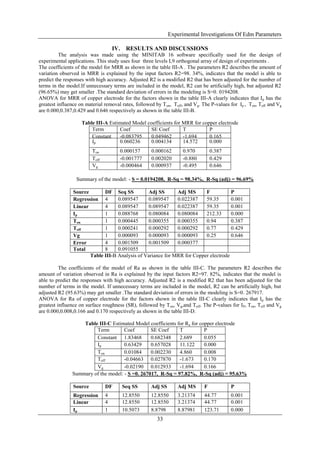
a) Table III-E shows the Optimal values of IP, Ton, Toff and Vg are 6 A, 50µs,12 µs and 40 V respectively.
b) The optimization plots show us that IP is the most influential parameter , as the IP increases MRR and SR also
increases, which is followed by Ton,Toff and Vg for MRR and Ton,Vg and Toff for SR respectively
Cur
High
Low0.73032
D
Optimal
d = 0.86394
Maximum
MRR(g/mi
y = 0.2456
d = 0.61737
Minimum
Ra (µm)
y = 4.3614
0.73032
Desirability
Composite
20.0
40.0
4.0
12.0
50.0
150.0
2.0
6.0
Ton Toff VgIp
[6.0] [50.0] [12.0] [40.0]
Table III-E Optimization plot for Copper electrode
IV. CONCLUSIONS
Basically this investigation is successful in achieving the objective with the acceptable outcome. This
experiment evaluates the machining of WPS DIN 1.2379/ AISI D2 tool steel with a Copper as Electrode. The
Taguchi method Design of experiment (DOE) is very useful in the analyzing the optimum condition of
parameters, and the significance of individual parameter to Material removal Rate and Surface Roughness.
In the case of the of material removal rate, it was seen that current factor was the most influential, followed by
and pulse-on time, pulse-off time and gap voltage. In order to obtain high material removal rate in the case of
WPS 1.2379 DIN/AISI D2, within the work interval considered in this study, one should use, high values for
current and gap voltage is to be used.
Finally, in the case of Surface Roughness , it was observed that the most influential factor was current,
followed by a pulse-on time, gap voltage and pulse-off time. Therefore, in order to be able to obtain low values
of surface roughness, low values of pulse-on time, current and gap voltage is to be used.
ACKNOWLEDGMENT
The author is very grateful to Dr. S. B. Chikalthankar , Faculty of Government College of Engineering,
Aurangabad for the support rendered. The authors are indebted to Om Sai Engineering (P) Ltd. for supplying
the material and machinery for experimentation.
REFERENCES
[1]. A Soveja, E, Cicala, "Optimization of TA6V alloy surface laser Texturing using an experimental
design approach,” Optics and laser engineering , Vol.46 (9), 2008, pp. 671-678.
[2]. I Puertas, Luis, Analysis of the influence of EDM parameters of surface quality, MRR and EW of WC-
CO”, Journal of Material processing technology Vol.153-154,2004, pp.1026-1032.
[3]. Sameh S. Habib,"Study of the parameters in EDM through Response surface Methodology approach”,
Applied Mathematical Modelling, Vol 33 (12), 2009, pp. 4397-4407.
[4]. K. Palanikumar, "Modelling and analysis of surface roughness in machining glass reinforced plastics
using response surface methodology,”Materials and Design 28 (2007),pp 2611-2618.](https://image.slidesharecdn.com/e0705031034-130613052504-phpapp02/85/International-Journal-of-Engineering-Research-and-Development-IJERD-4-320.jpg)

This paper investigates the impact of electric discharge machining (EDM) parameters on material removal rate (MRR) and surface roughness (Ra) using WPS DIN 1.2379/AISI D2 tool steel with a copper electrode. The study employs Taguchi method and response surface methodology for optimization, identifying current as the most influential factor on both MRR and Ra. Results indicate that higher current and gap voltage are necessary for improved MRR, while lower pulse-on time and current are preferred for reducing surface roughness.


