Download to read offline
![International Journal of Mechanical Engineering and Technology (IJMET), ISSN 0976 – 6340(Print),
ISSN 0976 – 6359(Online), Volume 5, Issue 5, May (2014), pp. 13-27 © IAEME
13
ANALYSIS OF RESIDUAL STRESSES AND DISTORTIONS IN
TIG-WELDED STAINLESS STEEL PIPE
`
Prabhat Kumar Sinha, Rakesh kumar maurya*, Rajneeshpandey, Vijay Kumar Yadav
Department of Mechanical Engineering. Shepherd School of Engineering and Technology,
Sam Higginbottom Institute of Agriculture, Technology and Sciences,
(Formerly Allahabad Agriculture Institute) Allahabad 211007 (INDIA)
ABSTRACT
In this article, the weld joint suffers various types of weld-induced residual stress fields (hoop
and axial) and deformation patterns (axial shrinkage, radial shrinkage). In this paper Three-
dimensional finite element modeling of residual stresses in a tig-welded stainless steel pipe is
presented with an emphasis on modeling procedures for the global residual stress characteristics. To
precisely capture the distortions and residual stresses, computational methodology based on three-
dimensional finite element model for the simulation of gas tungsten elctrode gas inert gas welding in
thin-walled pipe is presented. Butt-weld geometry with single "V" for a 300mm outer diameter
cylinder of 3 mm thick is used. The complex phenomenon of arc welding is numerically solved by
sequentially coupled transient, non-linear thermo-mechanical analysis. The accuracy of both the
thermal and structural models is validated through experiments for temperature distribution, residual
stresses and distortion. The simulated result shows close correlation with the experimental
measurements
Keywords: FEM; welding simulations; Distortions; Residual Stresses; Tungaston-Electrode Inert
Gas Welding.
INTRODUCTION
The distribution of residual stresses in a tig welded pipe is complex. Weld shrinkage in the
circumferential direction induces both shearing and bending that result in stress components in the
circumferential direction (hoop stress) and in the axial direction (meridian stress). Process and
geometric related factors that influence residual stresses include welding heat input, pipe diameter,
wall thickness and joint design [1-5].Brust, et al. [2], reported high tensile stresses in both axial and
hoop directions on the pipe inner surface using the axisymmetric, inherent shrinkage model.
INTERNATIONAL JOURNAL OF MECHANICAL ENGINEERING
AND TECHNOLOGY (IJMET)
ISSN 0976 – 6340 (Print)
ISSN 0976 – 6359 (Online)
Volume 5, Issue 5, May (2014), pp. 13-27
© IAEME: www.iaeme.com/ijmet.asp
Journal Impact Factor (2014): 7.5377 (Calculated by GISI)
www.jifactor.com
IJMET
© I A E M E](https://image.slidesharecdn.com/30120140505002-140523074853-phpapp02/85/30120140505002-1-320.jpg)
![International Journal of Mechanical Engineering and Technology (IJMET), ISSN 0976 – 6340(Print),
ISSN 0976 – 6359(Online), Volume 5, Issue 5, May (2014), pp. 13-27 © IAEME
13
ANALYSIS OF RESIDUAL STRESSES AND DISTORTIONS IN
TIG-WELDED STAINLESS STEEL PIPE
`
Prabhat Kumar Sinha, Rakesh kumar maurya*, Rajneeshpandey, Vijay Kumar Yadav
Department of Mechanical Engineering. Shepherd School of Engineering and Technology,
Sam Higginbottom Institute of Agriculture, Technology and Sciences,
(Formerly Allahabad Agriculture Institute) Allahabad 211007 (INDIA)
ABSTRACT
In this article, the weld joint suffers various types of weld-induced residual stress fields (hoop
and axial) and deformation patterns (axial shrinkage, radial shrinkage). In this paper Three-
dimensional finite element modeling of residual stresses in a tig-welded stainless steel pipe is
presented with an emphasis on modeling procedures for the global residual stress characteristics. To
precisely capture the distortions and residual stresses, computational methodology based on three-
dimensional finite element model for the simulation of gas tungsten elctrode gas inert gas welding in
thin-walled pipe is presented. Butt-weld geometry with single "V" for a 300mm outer diameter
cylinder of 3 mm thick is used. The complex phenomenon of arc welding is numerically solved by
sequentially coupled transient, non-linear thermo-mechanical analysis. The accuracy of both the
thermal and structural models is validated through experiments for temperature distribution, residual
stresses and distortion. The simulated result shows close correlation with the experimental
measurements
Keywords: FEM; welding simulations; Distortions; Residual Stresses; Tungaston-Electrode Inert
Gas Welding.
INTRODUCTION
The distribution of residual stresses in a tig welded pipe is complex. Weld shrinkage in the
circumferential direction induces both shearing and bending that result in stress components in the
circumferential direction (hoop stress) and in the axial direction (meridian stress). Process and
geometric related factors that influence residual stresses include welding heat input, pipe diameter,
wall thickness and joint design [1-5].Brust, et al. [2], reported high tensile stresses in both axial and
hoop directions on the pipe inner surface using the axisymmetric, inherent shrinkage model.
INTERNATIONAL JOURNAL OF MECHANICAL ENGINEERING
AND TECHNOLOGY (IJMET)
ISSN 0976 – 6340 (Print)
ISSN 0976 – 6359 (Online)
Volume 5, Issue 5, May (2014), pp. 13-27
© IAEME: www.iaeme.com/ijmet.asp
Journal Impact Factor (2014): 7.5377 (Calculated by GISI)
www.jifactor.com
IJMET
© I A E M E](https://image.slidesharecdn.com/30120140505002-140523074853-phpapp02/75/30120140505002-1-2048.jpg)
![International Journal of Mechanical Engineering and Technology (IJMET), ISSN 0976 – 6340(Print),
ISSN 0976 – 6359(Online), Volume 5, Issue 5, May (2014), pp. 13-27 © IAEME
14
However, discrepancies in stress magnitude were found between the predicted results and the
experimentally measured data, particularly in the axial component in the outer surface. Numerical
modelling using the finite element method (FEM) has been used by many researchers to predict weld
residual stresses in complex welded structures. To date, most of the finite element analysis[22] for
pipe Tig welds use the inherent shrinkage modelling technique that assumes an axisymmetric
condition. This is due to the fact that the three-dimensional, nonlinear FEM analysis of Tig welds
with a moving heat source is computational intensive and sometimes cost prohibitive. The inherent
shrinkage model is incapable of predicting the transient residual stress distributions near the weld
start and stop locations. The complex nature of the welding process due to multi field (thermal,
mechanical, metallurgy etc.) interactions and intricate geometries in real world applications has made
the prediction of weld-induced imperfections, a truly difficult and computationally intensive task.
However, with the availability of 64 digit computers and refined FE tools, welding engineers around
the world are more biased towards the computer simulations of complex welding phenomenon
instead of the conventional trial and error approach on the shop floor. A significant simulation and
experimental work focusing on circumferential welding is available in the literature [6-13]. As the
computer simulation of welding processes is highly computationally intensive and large computer
storage and CPU time are required, most of the previous research reduces computational power
requirements by simplifying with assumptions such as rotational symmetry and lateral symmetry in
numerical simulations [7-10]. These assumptions reduces the computational demand at the cost of
the accuracy of the results because the model was over simplified by limiting the solution domain to
only a section of the whole do-main with forced symmetry assumptions which did not prevails.
Further, these simplified assumptions are not capable of capturing the considerable effects of weld
start/stop and weld tack modeling. In this regard an experimental work by Jonsson and Josefson [16]
and some three-dimensional finite element (FE) studies [12, 13, 15, 24]; reported deviations from
rotational symmetry, especially at the beginning and end of the welding cycle for circumferential
joint in welding of pipes with lateral symmetry. Later, by using a full three-dimensional model for
multi-pass welding of pipes, Fricke et al. [16] concluded that residual stresses[21] are by no means
axis-symmetric. In the present analysis, the temperature fields and consequently the weld-induced
residual stress fields and distortion patterns are investigated by numerical simulations based on FEM
modeling. Tomodel the physics behind the gas tungsten arc welding (GTAW) process, a sequentially
coupled,
Legends : BM = Base Metal WM = Weld MetalSH = Strain Hardening
Fig. 1: Thermo-mechanical properties of low stainless steel as a function of temperature used in the
present study](https://image.slidesharecdn.com/30120140505002-140523074853-phpapp02/85/30120140505002-2-320.jpg)
![International Journal of Mechanical Engineering and Technology (IJMET), ISSN 0976 – 6340(Print),
ISSN 0976 – 6359(Online), Volume 5, Issue 5, May (2014), pp. 13-27 © IAEME
15
Full 3D model is employed. Transient, non-linear thermal solution based on heat conduction,
convective and radiative boundary conditions is solved in the first part to obtain the nodal
temperature history. The temperature fields are further utilized as thermal loads in subsequent
elastoplastic structural analysis to obtain the transient and residual stressfields and distortions.
II. FE ANALYSIS
2.1 FE model
For the tig welding of two pipe with "V" groove [23], a full 3D FE model along with finite
element statistics developed in ANSYS® is shown in Fig. 2. The element type in thermal analysis is
SOLID70 (linear 8-node brick element with one degree of freedom, i.e., temperature at each node)
and in structural analysis is SOLID45 (linear 8-node brick element with three degrees of freedom at
each node: translations in the nodal x, y, and z directions.). Further details about the selected
elements may be found in [17]. High temperature and flux gradients are anticipated in and around the
fusion zone (FZ) and heat affected zone (HAZ); therefore, a relatively fine mesh is used within a
distance of 10 mm on both sides of the weld line (WL). Away from the HAZ the element size
increases with an increase in the distance from WL. In the weld direction, the element size is kept
constant equal to 1.96 mm. Within the anticipated HAZ dimension of 10 mm on each side of the WL
in transverse direction, the element size of 1 mm is used. The element size away from the weld
region increases with the increase in distance. In the thickness direction there are total three
elements, 1 mm each to facilitate for “V” groove modeling. Two tack welds on the start, i.e., 0º and
middle, i.e., 180º of the weld are modeled, each of which is comprised of 4 elements (7.85 mm) in
circumferential direction and 4 and 2 elements (4mm and 2 mm, respectively) in two layers in the
thickness direction. The used mesh is based on a mesh sensitivity analysis performed for successive
mesh refinements.
Fig. 2: (a) 3D FE mesh based on sensitivity analysis. (b) “V” groove, tack weld and root opening in
FE model
A number of thermal analyses based on the number of elements as indicated in Fig. 3 are
conducted to see the corresponding effects of maximum temperature attained during the analysis.
This maximum temperature attained is then considered as the basis for mesh refinement. As shown
in Fig. 3, it is clear that no further increase in maximum temperature is achieved if the number of
elements is increased beyond 54720. The mesh with number of elements indicated by the arrow in
Fig. 3 is then considered for the analysis in order to get the mesh independent results. Tack lengths
positions in the FE models are in accordance with the physical weld sample. Theoretically, two
cylinders should be regarded as separate parts in the model setup, because they are independent until
the moving heat source (welding torch) passes over and joins these together. Both the cylinders are](https://image.slidesharecdn.com/30120140505002-140523074853-phpapp02/85/30120140505002-3-320.jpg)
![International Journal of Mechanical Engineering and Technology (IJMET), ISSN 0976 – 6340(Print),
ISSN 0976 – 6359(Online), Volume 5, Issue 5, May (2014), pp. 13-27 © IAEME
16
modeled as a single model in FE modeling as the cylinders are tack welded to each other and
mechanically restrained prior to welding.
Fig. 3: Mesh sensitivity analysis based on maximum temperature attained.
2.2 Thermal analysis technique
A high non-uniform temperature field is generated during the welding process resulting in
residual stresses in the welds. The transient temperature distribution is a function of total heat applied
and heat distribution patterns within the domain and is highly sensitive to weld induced residual
stresses. A detailed and accurate thermal analysis with appropriate boundary conditions such as heat
transfer by conduction, heat losses due to convection and radiation and heat input from the welding
torch along with the effects of filler metal deposition, is of paramount importance for the
determination of realistic temperature profiles. The governing equation for transient heat transfer
analysis during welding process is given by Eq. (1).
࣋ࢉ ࣔࢀ ࢚ࣔ ࢞, ࢟, ࢠ, ࢚ = સ. ࢞, ࢟, ࢠ, ࢚ + (࢞, ࢟, ࢠ, ࢚)…...(1)
where ρ is the density (kg m −3) of the material, c is the specific heat capacity (J kg −1 K −1), T is
the current temperature, q is the vector of heat flux, Q is the rate of internal heat generation (W m
−3), tis the time (s), ∇is the spatial gradient operator and x, y, zare the coordinates in the reference
plane. The non-liner isotropic Fourier heat flux constitutive equation given by Eq. (2) is employed.
q =−k∇T ..…(2)
Where k (W m −1 K −1) is the temperature dependent thermal conductivity. The most widely
acceptable double ellipsoidal heat source model, presented by Goldak et al. [18] as shown in Fig. 4,
is used to present the heat generated by the welding torch for the heat input distribution to the welds.
The very small variations due to curvature of the cylinders are not taken into account. The model
gives the Gaussian distribution for circumferential welding and has excellent features of power and
density distribution control in the weld pool and HAZ. The spatial heat distribution in a moving
frame of reference can be calculated with the governing equations Eq. (3) and Eq. (4) [18].](https://image.slidesharecdn.com/30120140505002-140523074853-phpapp02/85/30120140505002-4-320.jpg)
![International Journal of Mechanical Engineering and Technology (IJMET), ISSN 0976 – 6340(Print),
ISSN 0976 – 6359(Online), Volume 5, Issue 5, May (2014), pp. 13-27 © IAEME
17
Where, Q =VI and ff+ fr= 2 af is the length of the front ellipsoidal (m) ar is the length of rear
ellipsoidal (m)b is the width of heat source (m) cis the depth of heat source (m) ff is the fraction of
heat in front ellipsoidal fr is the fraction of heat in rear ellipsoidal Q is the total heat input (watts) V
is the welding voltage (volts) .
III. EXPERIMENTAL VERIFICATION
The appropriate way to ensure the reliability of the numerical simulations and to extend the
utilization of the research work for shop floor applications is by conducting full-scale experiments
with proper instrumentation for data measurement. For arc welding experiments, automatic welding
setup with minimum human intervention and skill is considered as mandatory for the proper
validation of numerical results due to the variations associated with the skill of the operators and
rotary synchronization problems. Similarly, the careful data acquisition during the experiments is of
critical importance and demands a proper data measurement and analysis system. In the present
research, to ensure the reliability of the FE models, GTAW experiments on two thin-walled pipe
with similar geometric and welding process parameters from the finite element models are
conducted. Low stainless steel equivalent to AH36 with chemical composition as shown in Table 1
having slight variations in chemical composition from the material model used in the simulation is
utilized. Similar approximations were made in the past by [22] with comparable measured and
predicted results. In addition to the FE parameters, argon with 99.999% purity was used as shielding
gas with flow rate of 15 liters/min. Commercially available high-tech, fully automatic SAF GTAW
welding equipment along with rotary positioners and welding fixtures was used to reflect the desired
structural boundary conditions. Single pass welding equipment along with rotary positioners and
welding fixtures was used to reflect the desired structural boundary conditions. Single pass butt-weld
geometry is used with single "V" groove having included angle of 90o and 2 mm root opening as
shown in Fig. 4. The welding specimen consists of two 150 mm outer diameter and 3 mm wall
thickness cylinders. Two tack welds starting from 0° (weld start position) equally spaced at 180°,
each with length of ~ 8 mm were placed. These tack welds were also used to create a root opening
prior to welding by insertion of additional spacers of 2 mm at some appropriate locations during tack
welding.
Table 1: Chemical composition of low stainless steel. % Chemical Composition
Composition % Chemical Composition
C 0.150 pb 0.05
Cr 11.50 Si 0.50
Mn 1.00 S 0.007
S 0.030 P 0.040
The spacers were removed after the tack welds were cooled to room temperature. To
minimize the initial stress effects prior to welding due to tack welds, the areas in and around the tack
welds were treated with post weld heating to 573K (300°C). Conventional gas torch heating with
both infrared and touch probe thermocouples measurement was utilized. However, the stress data
after the tack welds and after the post weld heating was not recorded and the effects are ignored.
Further, as these cylinders were linearly seam welded after roll forming of sheet metals, the effects of
the linear seam weld was also not considered in this work. The furnace stress relieving prior to
circumferential tack welds is a reasonable justification for not considering these effects. The nodal
temperature distributions from the thermal analysis are used as a basic input for the sequel structural
analysis. Therefore, experimental data correlation for the FZ and HAZ dimensions or alternatively](https://image.slidesharecdn.com/30120140505002-140523074853-phpapp02/85/30120140505002-5-320.jpg)
![International Journal of Mechanical Engineering and Technology (IJMET), ISSN 0976 – 6340(Print),
ISSN 0976 – 6359(Online), Volume 5, Issue 5, May (2014), pp. 13-27 © IAEME
18
some nodal temperature verification for accurate pre-dictions of subsequent stress fields and
distortion patterns is a prerequisite. The latter technique by using the thermocouples and data
acquisition system with computer interface is adopted for the thermal model validation in the present
study. Thermocouples at four different locations were placed and temperature recorded through the
data logger after every 10 seconds of time interval for comparison with FE results. A quantitative
comparison of measured and predicted transient temperatures at thermocouple locations is presented
in Fig. 5. The thermocouples TC1, TC2 and TC3 show close agreement with the FE data. Whereas,
thermocouple TC4 shows comparatively higher variation of predicted and measured temperatures.
Overall, the results are within the maximum variation of 8% and are reasonably accept-able.
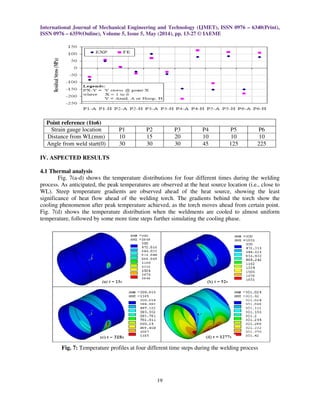
Residual stresses are measured at some specified points for comparison through the predicted results
for structural model validation.
Fig. 4: Butt-weld joint geometry (not to scale).
A center hole drilling strain gauge method is used to measure the residual hoop and axial
stresses at specified locations, i.e., points P1 to P3 on cylinder outer surface and P4 to P6 on cylinder
inner surface. Refer to the gauge location from P1 to P6 in Fig. 6. The details of the hole drilling
residual strain measurement method can be found in [20]. A quantitative comparison of residual
stresses from experiments with predicted data, showing good agreement, can be found in Fig. 6.
From the qualitative comparison of nodal temperatures and residual stresses from Fig. 5 and Fig. 6, it
is evident that predicted results agreed well with the experimental data; thus the developed models
have been experimentally validated.
Thermocouplelocation TC1 TC2 TC3 TC4
DistancefromW L(mm) 10 15 10 20
Distancefromweldstart(0) 30 30 90 90](https://image.slidesharecdn.com/30120140505002-140523074853-phpapp02/85/30120140505002-6-320.jpg)
![International Journal of Mechanical Engineering and Technology (IJMET), ISSN 0976 – 6340(Print),
ISSN 0976 – 6359(Online), Volume 5, Issue 5, May (2014), pp. 13-27 © IAEME
21
4.2 Residual stress analysis
4.2.1 Axial residual stress fields
For circumferentially welded cylinders, stress normal to the direction of the weld bead is the
axial stress. Compressive and tensile axial stress fields are observed in and near the weld region on
the outer and inner surfaces of the cylinders, respectively. This is attributed to different temperature
profiles on the inner and outer surfaces of the cylinders. Varying shrinkage patterns through the wall
thickness on the inner and outer surfaces due to different temperature gradients; results in tensile and
compressive residual stress fields on inner and outer surfaces, respectively, near the weld line (WL).
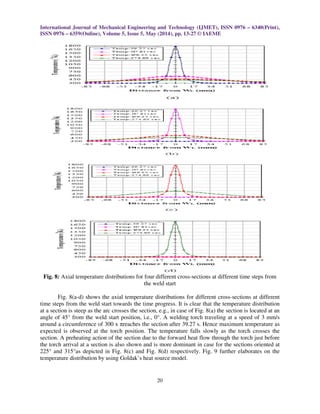
Fig. 10 shows axial stress distributions on the cylinder’s outer surface at different cross sections from
the weld start position. The convention used is that Axial-50 represents the axial stress at 50° from
the weld start position and so on.
Fig.10. Residual axial stresses (MPa) on outer surface at different cross sections from the
weld start position Fig. 11. Residual axial stresses (MPa) on inner surface at different cross sections
from the weld start position. The compressive residual axial stresses near the WL diminish to zero
after 17 mm on both sides of the WL. Beyond this, a stress reversal from compressive to tensile is
observed. These low magnitude tensile stresses again approach a zero value almost 68 mm away
from the WL. After 68 mm from the WL a constant axial stress value near to zero is obvious from
Fig. 10. The high tensile stresses near the WL approach to zero and then reverse to lower
compressive residual stresses at 17 mm, again increasing to almost constant value of zero at 68 mm
on both sides of WL observed for cylinder inner surfaces at different cross sections from weld start
position as shown in Fig. 11.The general residual axial stress profile shows close analogy with the
previous research [7, 10, 12, 14, 15]. The variation in magnitude (higher or lower residual stresses)
in the present research work is attributed to the different material properties, i.e., mechanical
properties like yield strength for base and weld filler metals along with other parameters such as
weld geometry and heat source parameters. Some observations of the significance pertaining to axial
stress fields from Fig. 10 and Fig. 11 are as follows: • Due to symmetry across the WL, the stresses
are also symmetric. In and around the FZ, the high magnitude stress fields, i.e., compressive and
tensile for outer and inner surfaces, respectively, are observed. • Axial stresses are weakly dependent
on the circumferential location. Fig. 10 and Fig. 11 clearly reveal that axial residual stresses on outer](https://image.slidesharecdn.com/30120140505002-140523074853-phpapp02/85/30120140505002-9-320.jpg)
![International Journal of Mechanical Engineering and Technology (IJMET), ISSN 0976 – 6340(Print),
ISSN 0976 – 6359(Online), Volume 5, Issue 5, May (2014), pp. 13-27 © IAEME
22
and inner surfaces at four different cross stresses sections (50°, 90°, 150° and 250°) are almost of the
same magnitude and trend. This is in absolute agreement with the previous research [7]. Except the
weld start and its vicinity, the axial stress around the circumferential direction almost has a
homogeneous distribution. • At the outer surface of cylinders near the WL, there is a prominent
bulge indicating stress variations beneath the weld crown (refer Fig. 10).
4.2 Hoop residual stress fields
Stresses parallel to the direction of the weld bead are known as hoop stresses. The residual
hoop stresses are developed due to the radial expansion and contraction during the heating and
cooling sequence of welding process. Residual hoop stress distributions for outer and inner surfaces
of cylinders along the axial directions in different cross sections from the weld start position are
shown in Fig. 12 and Fig. 13, respectively. On the inner and outer surfaces, in and around the
vicinity of the WL, large tensile and compressive hoop stresses, respectively, are developed. Similar
trends for stress reduction and stress reversal are observed for hoop residual stresses as for axial
residual stresses. The trend for the hoop stress also agreed well with the previous research [7, 10, 12,
14, 15]. The quantitative variation is again attributed to different welding parameters, heat source
parameters and material properties in the present and referred research work, respectively. Some
important aspects are as follows: • Hoop residual stresses are also symmetric due to symmetry across
the WL. • Near the FZ high tensile stresses (130 MPa on outer and 313 MPa on inner surface) are
predicted. Away from the HAZ region (about 17 mm from WL), both on outer and inner surfaces a
compressive residual stress of 200 MPa is observed. • Hoop stresses are dependent on the
circumferential location from weld start to weld end. From Fig. 12 and Fig. 13 it is obvious that hoop
residual stresses on outer and inner surfaces at three different cross sections (50°, 90°, and 250°) vary
in magnitude, with almost similar trend. This is also in close agreement with the previous research
[7].
Fig.13: Residual hoop stresses (MPa) on inner surface at different cross sections from the weld
start position
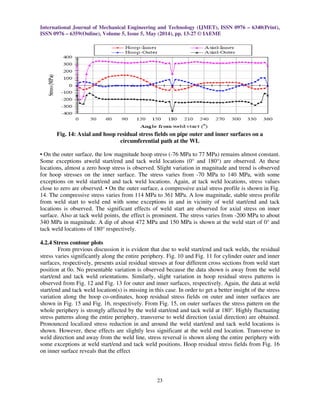
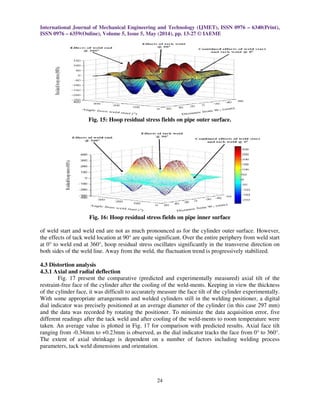
4.2.3 Axial and hoop residual stress fields along the circumference
Comparison of axial and hoop residual stress distribution for outer and inner surfaces, on a
circumferential path at the WLis shown in Fig. 14. Again, the stress profiles are generally in
agreement with the previous research. Some important observations are:](https://image.slidesharecdn.com/30120140505002-140523074853-phpapp02/85/30120140505002-10-320.jpg)
![International Journal of Mechanical Engineering and Technology (IJMET), ISSN 0976 – 6340(Print),
ISSN 0976 – 6359(Online), Volume 5, Issue 5, May (2014), pp. 13-27 © IAEME
26
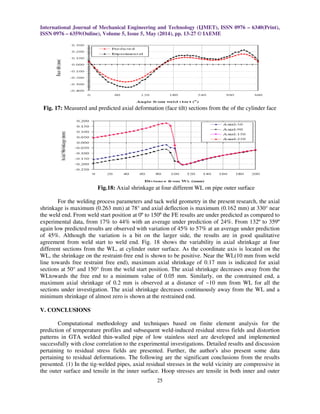
surfaces. (2).Hoop residual stresses are sensitive to the angular location from the weld start position.
(3) Pipe wall thickness has a significant effect on the residual stress distributions in the tig-welded
pipes. Thicker pipe tends to result in lower axial residual stresses, but higher hoop residual stresses.
(4) Maximum axial and radial deflection is observed near the weld line. The axial shrinkage
decreases continuously away from the WL and a minimum shrinkage of almost zero shown at the
restrained end. However, on the restraint free end some deflection (face tilt) is observed
REFERENCES
[1] Rybicki, E. F., Schmueser, D. W., Stone-sifer, R. W., Groom, J. J., Mishler, H. W. 1978. A
finite-element model for residual stresses and deflections in tig-butt welded pipes. Journal of
Pressure Vessel Technology, Vol. 100, pp. 256-262.
[2] Brust, F. W., Stonesifer, R. B. 1981. Effect of weldingarameters on residual stresses in BWR
piping systems. EPRI NP-1743, Project 1174-1, Final Report.
[3] Karlsson, C. T. 1989. Finite element analysis of temperatures and stresses in a single-pass
butt-welded pipe-influence of mesh density and material modeling. Engineering
Computations, Vol. 6, pp. 133-141.
[4] Fujita, Y., Nomoto, 1., Hasegawa, H. 1980. Deformations and residual stresses in butt welded
pipes and shells. Nav. Archit. a.OceanEngng. (Soc. of Nay. Archit. of Jap.) 18, pp. 164-174,
and IIW-Doc. X-963-80.
[5] Josefson, B. L. 1983. Stress redistribution [12] Y. Dong, J. Hong, C. Tsai and P. Dong. Finite
Element modeling of residual stresses in austenitic stainless steel pipe tig welds, Welding
Journal, Weld Research Supplement,442 (1997) 449-444.
[6] A. Yaghia, T. H. Hydea, A. A. Becker, W. Suna and J. A. Williams, Residual stress
simulation in thin and thick-walled stainless steel pipe welds including pipe diameter effects,
International Journal of Pres-sure Vessels and Piping,83 (11-12) (2006) 864-874.
[7] D. Deng and H. Murakawa, Numerical simulation of temperature field and residual stress in
multi-pass welds in stainless steel pipe and comparison with experimental measurements,
Computational Material Science,37 (3) (2006) 269-277.
[8] B. Brickstad and B. L. Josefson, A parametric study of residual stresses in multi-pass butt-
welded stainless steel pipes, International Journal of Pres-sure Vessels and Piping, 75 (1)
(1998) 11-25.
[9] E. F. Rybicki, D. W. Schmueser, R. W. Stonesifer, J. J. Groom and H. W. Mishaler, A Finite
Element model for residual stresses and deflections in tig-butt welded pipes, ASME Journal
of Pressure Ves-sel Technology,100 (1978) 256-262.
[10] E. F. Rybicki, P. A. McGuire, E. Merrick and J. Wert, The effect of Pipe thickness on
residual stresses due to tig welds. ASME Journal of Pres-sure Vessel Technology, 104 (1982)
204-209.
[11] E. F. Rybicki and R. B. Stonesifer, Computation ofresidual stresses due to multi-pass welds
in piping system. ASME Journal of Pressure Vessel Technology, 101 (1979) 49-54.
[12] Y. Dong, J. Hong, C. Tsai and P. Dong. Finite Element modeling of residual stresses in
austenitic stainless steel pipe tig welds, Welding Journal, Weld Research Supplement, 442
(1997) 449-444.
[13] R. I. Karlsson and B. L. Josefson, Three- dimensional Finite Element analysis of temperature
and stresses in single-pass butt-welded pipe. ASME Journal of Pressure Vessel
Technology,112 (1990) 76-84.
[14] M. Jonsson and B. L. Josefson, Experimentally determined transient and residual stresses in
the butt-welded pipes, Journal of Strain Analysis,23 (1) (1988) 25-31.](https://image.slidesharecdn.com/30120140505002-140523074853-phpapp02/85/30120140505002-14-320.jpg)
![International Journal of Mechanical Engineering and Technology (IJMET), ISSN 0976 – 6340(Print),
ISSN 0976 – 6359(Online), Volume 5, Issue 5, May (2014), pp. 13-27 © IAEME
27
[15] L. Karlsson, M. Jonsson, L. E. Lindgren, M. Näss-tröm and L. Troive, Residual stresses and
deformations in a welded thin-walled pipe, Proc. ASME Pressure Vessel and Piping Conf.
(Hawaii, July 1989)PVP-173 (1989) 7-11.
[16] S. Fricke, E. Keim and J. Schmidt, Numerical weld modeling-a method for calculating weld-
induced residual stresses, Nuclear Engineering and Design, 206 (2-3) (2001) 139-150.
[17] ANSYS-10.0 user manual.
[18] J. Goldak, A. Chakravarti and M. Bibby, A new Finite Element model for welding heat
source. Metallurgical Transactions B. 15B (1984) 299-305.
[19] L. F. Anderson, Residual stresses and deformations in steel structures, PhD. Thesis,
Technical University of Denmark, (2000).
[20] Vishay Group, Measurement of residual stresses by the hole drilling strain gage method,
Technical Note No.TN-503.
(///%/%/%/%/www.vishay.com/brands/measurements_group/guide/tn/tn503/503index.htm).
[21] P.J. Bouchard, D. George, J.R. Santisteban, G. Bruno, M. Dutta, L. Edwards,
E. Kingston, D.J. Smith, Measurement of the residual stresses in a stainless steel pipe tig
weld containing long and short repairs, International Journal of Pressure Vessels and Piping,
82,(4), ( 2005), 299–310.
[22] W.C. Jiang, B.Y. Wang, J.M. Gong, S.T. Tu, Finite element analysis of the effect of welding
heat input and layer number on residual stress in repair welds for a stainless steel clad plate,
Materials & Design, 32(5), (2011), 2851–2857.
[23] Chin-Hyung Lee, Jeong-HoonBaek, Kyong-Ho Chang, Bending capacity of tig-welded
circular steel tubes, Journal of Constructional Steel Research, 75 (2012), 142–151.
[24] Chin-Hyung Lee, Kyong-Ho Chang, Jeong-Ung Park, Three-dimensional finite element
analysis of residual stresses in dissimilar steel pipe welds, Nuclear Engineering and Design
256, (2013), 160–168.
[25] P. Govinda Rao, Dr. C L V R S V Prasad, Dr. D.Sreeramulu, Dr. V. Chitti Babu and
M.Vykunta Rao, “Determination of Residual Stresses of Welded Joints Prepared under the
Influence of Mechanical Vibrations by Hole Drilling Method and Compared by Finite
Element Analysis”, International Journal of Mechanical Engineering & Technology (IJMET),
Volume 4, Issue 2, 2013, pp. 542 - 553, ISSN Print: 0976 – 6340, ISSN Online: 0976 – 6359.
[26] Mr. Harshal K. Chavan, Mr. Gunwant D. Shelake, Dr. M. S. Kadam, “Finite Element Model
to Predict Residual Stresses in MIG Welding”, International Journal of Mechanical
Engineering & Technology (IJMET), Volume 3, Issue 3, 2012, pp. 350 - 361, ISSN Print:
0976 – 6340, ISSN Online: 0976 – 6359.
[27] Gunwant D.Shelake, Harshal K. Chavan, Prof. R. R. Deshmukh and Dr. S. D. Deshmukh,
“Modeling and Analysis of Surface Grinding for Residual Stresses in Workpiece”,
International Journal of Mechanical Engineering & Technology (IJMET), Volume 3, Issue 3,
2012, pp. 344 - 349, ISSN Print: 0976 – 6340, ISSN Online: 0976 – 6359.
[28] L.Suresh Kumar, Dr.S.M.Verma and Dr.V.V.Satyanarayana,, “Impact of Voltage on
Austentic Stainless Steel for the Process of TIG and MIG Welding”, International Journal of
Mechanical Engineering & Technology (IJMET), Volume 1, Issue 1, 2010, pp. 60 - 75,
ISSN Print: 0976 – 6340, ISSN Online: 0976 – 6359.
[29] Prabhat Kumar Sinha, Chandan Prasad, Mohdkaleem and Raisul Islam, “Analysis and
Simulation of Chip Formation & Thermal Effects on Tool Life using FEM”, International
Journal of Mechanical Engineering & Technology (IJMET), Volume 4, Issue 2, 2013,
pp. 53 - 78, ISSN Print: 0976 – 6340, ISSN Online: 0976 – 6359.](https://image.slidesharecdn.com/30120140505002-140523074853-phpapp02/85/30120140505002-15-320.jpg)

This document summarizes a study that used finite element modeling to analyze residual stresses and distortions in tungsten inert gas (TIG)-welded stainless steel pipe. A three-dimensional finite element model was created to simulate the TIG welding process using sequentially coupled thermal and structural analyses. Temperature distributions, residual stresses, and distortions were computed and validated through experimental measurements. The simulations showed close correlation with experiments and captured non-axisymmetric effects, which simplified axisymmetric models cannot. The model aims to precisely predict welding distortions and stresses in thin-walled pipe joints.


