International Journal of Networks (IJN)
Vol. 1, Issue. 1, April – 2015 ISSN (Online): 2454-1060
1
Abstract—In mobile ad-hoc network, the performance depends
on the adaptability of the underlying routing protocol to current
network condition. The existing fuzzy based cross layer routing
protocol in which the parameters such as number of hops and
mobile speed for estimating link stability in the network has the
drawback of leading to overhead and dependency. In turn
leading to delay and inefficiency in data transmission. In order to
overcome these drawbacks, in this paper we propose fuzzy based
optimal path selection by considering the path stability, the
residual energy of the nodes and bandwidth as parameters at the
source node. The path stability is estimated based on available
battery power, distance and link quality. The residual energy is
estimated for the node at both the situations, when the node
receives and transmits the data packets. Following the path
selection, fuzzy based transmission rate adjustment of source is
calculated by considering end to end delay and packet loss ratio
as parameters at destination node. Also we propose a method to
draw a table, which includes energy efficiency in all combination
of transmission power and rate, is updated by each node.
Index Terms—Ad-Hoc On Demand Distance Vector Routing
protocol (AODV), Fuzzy inference system, Cross-Layer design.
I. INTRODUCTION
I.1. MOBILE AD-HOC NETWORK (MANET)
With the extensive growth of wireless handheld devices
and plummeting costs [1] has emerged as a major area of
research for both academics and the industrial sector. A
Mobile network is a set of mobile telecommunications, Mobile
Ad-hoc Network (MANET) of wireless mobile nodes which
are infrastructure-less network consisting of numbers of mobile
hosts’ communication with one another through multiple hop
wireless links. MANETs are self-organizing, self-configuring
and dynamic topology network making them convenient for
combat, medical and other emergency situations.
I.2. ROUTING PROTOCOL
The MANETS’s routing protocol finds routes between
nodes and then allows data packets to be forwarded through
other network nodes towards the final destination [2].
The routing protocol for MANET could be broadly
classified into two major categories based on the method of
keeping the information about routes in the network.
They are:
 Proactive Routing Protocol
 Reactive Routing Protocol
I.3. AD-HOC ON DEMAND DISTANCE VECTOR ROUTING
PROTOCOL (AODV)
Ad-hoc On-demand Distance Vector (AODV) [2] routing
protocol is one of the MANET routing protocols which comes
classified under reactive protocol. It provides efficient route
establishment between nodes in a wireless network
communication between mobile nodes with minimal control
overhead and minimal route acquisition latency. The two main
operations taking place in AODV protocol are Route
discovery and Route maintenance.
I.4. FUZZY INFERENCE SYSTEM
Fuzzy Inference System [3] is a system that uses fuzzy
logic to map a set of inputs to a set of outputs.
Fuzzy Logic was initiated to represent /manipulate data
possessing non-statistical uncertainties. Fuzzy logic is a multi-
valued logic which deals with reasoning that are approximate
rather than fixed and exact. Fuzzy logic variables may have
truth value that ranges on degree between 0 and 1. It has been
extended to handle the concept of partial truth and hence the
truth value ranges from completely true to completely false.
Fuzzy logic provides inference morphology and enables
approximate human reasoning capabilities to be applied to be
applied to knowledge based system.
The fuzzy logic provides mathematical strength to capture
the uncertainties associated with human cognitive process such
as thinking and reasoning
I.5. CROSS LAYER DESIGN
In Ad-Hoc network, each and every node communicates
with each other through the OSI layer. But the defect of this
reference protocol architecture is that adjacent layers only can
communicate with each other and every layer has its own
Cross- Layer based efficient data transmission in MANET
using Fuzzy Logic
1
Narayanan.S, 2
Rani Thottungal, 3
R.Aarthi, 4
M.Nija Priya, 5
M.Anu
1
Department of Information Technology,Valliammai Engineering College, Chennai, India.
2
Department Of EEE Kumaraguru College of EngIneering, Coimbatore, India
3,4,5
UG Scholar, Valliammai Engineering College, Chennai, India
International Journal of Networks (IJN)
Vol. 1, Issue. 1, April – 2015 ISSN (Online): 2454-1060
2
information which cannot be accessed by other layers. Cross-
layer design [4] is the protocol design which is mainly used to
remove the dependency between layers .Cross layer is the
interface that is used for sharing information between layers. It
is mainly used to enhance the performance of a system. In this
paper, we have used shared database design of the cross layer.
II. RELATED WORK
Siddesh Gundagatti Karibasappa et al. [5] proposed neuro
fuzzy based routing protocol. They have utilized the soft
computing techniques such as Neural Nets, Fuzzy Logic and
genetic Algorithms to derive accurate routing information from
mobile Ad-Hoc networks to achieve this efficient protocol. To
solve the objective function and establish a route within the
shortest possible time the combination of these powerful
techniques are used. This protocol has used feed forward
artificial neural network to achieve best performance in
routing.
M.Niazi Torshiz et al. [6] proposed to incorporate the fuzzy
concept with AODV routing algorithm and have considered
power consumption. This fuzzy logic based routing algorithm
monitors the routes and tries to select the optimal route based
on minimum bandwidth and hop count of each route. It also
has tried to balance the traffic load inside the network so as to
increase the battery lifetime of the nodes and hence the overall
useful life of the ad hoc network. In this paper, the fuzzy input
variables are chosen to be minimum bandwidth, battery life
and hop-count.
Zuo Jing et al. [7] proposed a multi constrained QoS
routing protocol based on fuzzy logic. The protocol is service
aware and developed based on DSR. It has considered the QoS
requirements asked by different kinds of services and takes
different network state parameters as the constraint conditions.
They proposed new route informing mechanism to support
route update; and have adjusted the speed of packet in terms of
the output of fuzzy system; also they have optimized routing
algorithm for real time traffic to assure that data are always
transmitted through the route with the lowest delay. In this
proposal, the fuzzy system consists of three subsystems.
Therefore multiple metrics have been considered as fuzzy
inputs. The fuzzy inputs used are number of hops, bandwidth,
mobile speed and buffer occupancy rate.
Golnoosh Ghalavani et al. [8] proposed a reliable routing
protocol for MANET based on fuzzy logic. The proposed
work is known as RRAF and it finds reliable path for the
transmission of data. In their work, during route discovery,
node with maximum trust value and maximum energy
capacity is selected as a router based on a parameter called
“Reliability Value”. Battery power and trust value of
individual nodes are used to find the reliable path. This
approach forms a reliable route for transmission thus
increasing network lifetime and decreasing number of packet
loss during transmission. This paper has considered trust value
of each node and energy capacity (Battery capacity) as fuzzy
parameters.
Cherine Fathy et al. [9] proposed a fuzzy based adaptive
cross layer routing protocol that enables each mobile node to
switch between reactive routing mode and proactive routing
mode depending on the current node status. Fuzzy-based
routing mode selector whose inputs are the number of link
breaks, the interface queue length and the type of application
for each node. The advantage of this protocol is improved
packet delivery ratio, route-discovery latency and average
discovery path length.
Masaki Bandai et al. [10] proposed a Medium Access
Control (MAC) protocol with transmission power and rate
control in multi-rate Ad-Hoc networks. This protocol realizes
high energy efficient data transmission. In the protocol, each
node prepares a table that includes energy efficiency in all
combinations of transmission power and rate. Exchanging of
control frames, looking up the transmission power and rate
table and relay transmission sequences are used arbitrarily. The
relay sequence is adopted instead of direct transmission when
relay transmission by intermediate node between sender and
receiver is more effective in terms of power consumption. The
advantage of this approach is that it can realize high energy
efficient data transmission via computer simulations.
III. FUZZY BASED CROSS LAYER ROUTINGAND TRANSMISSION
RATE DETERMINATION
In this paper, we propose cross layer based routing in
MANET using fuzzy logic. In this technique, two fuzzy
systems are used for efficient transmission. The fuzzy logic
system 1 (FLS1) is responsible for best path selection and the
fuzzy logic system 2 (FLS2) is responsible for transmission
rate determination. In FLS1, through the route discovery
mechanism the input parameters such as the path stability and
bandwidth are obtained at the source. These inputs are
fuzzified and the optimal path for data transmission is
identified. In FLS2, the end to end delay and packet loss ratio
are obtained as the input values at the destination.These inputs
are fuzzified and the state of the transmission rate is estimated.
Thus, this prevents the path fromcongestion.
International Journal of Networks (IJN)
Vol. 1, Issue. 1, April – 2015 ISSN (Online): 2454-1060
3
III.1. ESTIMATION OF METRICS
III.1.1. ESTIMATION OF BANDWIDTH
Any node that wants to transmit data should be aware of its
local bandwidth and its neighboring nodes information within
the inference range.The node pays attention to the channel and
estimates local bandwidth (BWL) as the bandwidth is shared
among neighboring nodes. The ratio of idle and busy time
period for a predefined interval affects the local bandwidth
[11]:
BWl = C*(Ti/Ttp) (1)
Where C= Channel capacity and Ti= Idle time period in the
predefined time period Ttp.
The minimum bandwidth (BWmn) of all the nodes within the
interference range is calculated as the result of prior collection
of neighboring node information. Thus, the difference between
BWmn and BWl gives the residual bandwidth (BWr) of the
node:
BWr = BWl - BWmn (2)
III.1.2. ESTIMATION OF PATH STABILITY
The path stability is estimated based on available battery
power, distance and link quality. These values are obtained
from the PHY and MAC layer dynamically [12]:
Path Stability (PS) = (3)
Where,
Available Battery Power (Bij) is defined as the ratio of power
received at the node (Brx) to the power transmitted (Btx) by the
neighbor node.
Link Quality (Lij) is defined in terms of the expected
transmission time (ET).
The expected transmission time (ET) is defined as the
expected time to successfully transmit a data packet at the
MAC layer for a single link. ET can be obtained by adding all
the ET values of the individual links in the route:
ET = EX * (z/ BW) (4)
Where z = average size of a packet, BW = current link
bandwidth and EX =Expected transmission count metrics.
The expected transmission time (EX) is the measure of the
path and link quality. EX metric for a single is defined as
following equation:
EX = (5)
Where,
Ptx = probability of successful packet delivery in forward
direction.
Prx = probability of successful acknowledgement packet
reception.
Distance between the two nodes is calculated using the
following free space propagation model:
The proposed technique involves selection Brx =
( )
(6)
Where α = transmitter gain, β = receiver gain, µ = systemloss
and w = wavelength
III.1.3. ESTIMATION OF RESIDUAL ENERGY
The energy consumption (Econ) of a node after time (t) is
calculated by using the following equation:
Econ (t)= Ntx + C1 * Nrx + C2 (7)
Where,
Econ (t) = Energy consumed by a node after time (t).
Ntx = Number of packets transmitted by the node after time (t).
Nrx = Number of packets received by the node after time (t).
C1 and C2 = Constant factors having the value between 0 and 1.
The residual energy (Eres) [13] of a node at time (t) is
calculated by using the following equation:
Eres = E - Econ (t) (8)
Where E = initial energy of a node.
III.1.4. ESTIMATION OF END TO END DELAY
The end to end delay consists of all possible delay such as
buffering caused during routing discovery latency, queuing at
the interface queue, retransmission delay at the MAC,
propagation and transmission time.
Thus, the end to end delay is defined as the time taken for
transmission of the data from source to destination [14] which
is given by the following equation:
Dee = (Trx – Ttx) (9)
Where Trx = reception time and Ttx = transmission time.
III.1.3. ESTIMATION OF PACKET LOSS RATIO
The packet loss ratio can be defined as the number of data
packets that are not effectively transmitted to the destination
which is expressed in terms of dropped packets.
III.2. PROPOSED TECHNIQUE
The proposed techniques involve the selection of optimal
routes and rate adjustment using the fuzzy logic system.
This is described in the following two phases of fuzzy logic
system:
International Journal of Networks (IJN)
Vol. 1, Issue. 1, April – 2015 ISSN (Online): 2454-1060
4
 Fuzzy Logic System 1 (FLS1): Optimal Path
Selection.
 Fuzzy Logic System 2 (FLS2): Optimal Rate
determination.
The fuzzy logic is chosen due to the following two reasons:
a) There is no clear boundary between normal and
abnormal events.
b) The fuzzy rules should level the normality and
abnormality separation.
The mechanism of the proposed technique is described in the
following section sequentially.
III.2.1. ALGORITHM FOR OPTIMAL PATH SELECTION
The steps involved in the selection of the optimal path are
as following:
1) When source (S) wants to transmit a data packet to
destination (D) , it verifies its route cache for path
availability:
If path exists
Then
Go to step10
Else
Go to step 2
End if
2) S broadcasts route request (RREQ) packet towards the
D through intermediate nodes (Ni).
3) Ni upon receiving the RREQ updates the route cache
(shown in Table 1) about the source, destination,
previous hop node, battery power, link quality and
available bandwidth.
4) Ni then either re-broadcasts the RREQ to its
neighbors or sends the route reply (RREP) if the node
is D. This process is repeated till RREQ reaches D.
5) When D receives RREQ, for the every received
RREQ the RREP packet is unicast in the reverse path
towards the source.
6) Every Ni that receives RREP updates its cache for the
next hop of the RREP and then unicasts this RREP in
the reverse-path using the earlier stored previous hop
node information.
7) Step 6 is being repeated until RREP reaches S.
8) S then computes bandwidth, path stability and
residual energy (Estimates in section III.1.1, III.1.2
and III.1.3) based on collected information from
RREP.
9) The values calculated in step8 by S are considered as
the inputs to the fuzzy logic system. Based on the
result, S selects an optimal path that has high
bandwidth, path stability and residual energy. This
optimal path is used for data transmission.
10) The path that is available in the route cache is
considered for data transmission.
III.2.1.1. FUZZY LOGIC SYSTEM 1 (FLS1)
The Fuzzy logic System 1 involves the selection of the
optimal path. The optimal path is selected by considering the
three inputs such as bandwidth, path stability and residual
energy. The three inputs are fuzzified to obtain the appropriate
optimal path.
Fuzzification:
It involves the fuzzification of the input variables- BWr, PS and
Eres. Crisp inputs are taken from these variables and these
inputs are given a degree to appropriate fuzzy sets. The
combination of BWr , PS and Eres are the crisp inputs. We
consider the three possibilities- high, mediumand low for BWr,
PS and Eres.
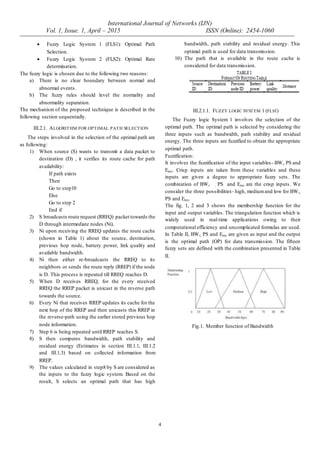
The fig. 1, 2 and 3 shows the membership function for the
input and output variables. The triangulation function which is
widely used in real-time applications owing to their
computational efficiency and uncomplicated formulas are used.
In Table II, BWr, PS and Eres are given as input and the output
is the optimal path (OP) for data transmission. The fifteen
fuzzy sets are defined with the combination presented in Table
II.
Fig.1. Member function of Bandwidth
International Journal of Networks (IJN)
Vol. 1, Issue. 1, April – 2015 ISSN (Online): 2454-1060
5
Fig.2. Member function for Path Stability
Fig.3. Member function for Residual Energy
TABLE II
Fuzzy Rules (for FLS1)
S.No Bandwidth Path Stability Residual
Energy
Output
1 Low Low Low Very Low
2 Low Medium Low Low
3 Low High Low Low
4 Low High High High
5 Low Medium Medium Medium
6 Low High Medium Medium
7 Medium Low Low Low
8 Medium Medium Medium Medium
9 Medium High Medium Medium
10 Medium High High High
11 High Low Low Low
12 High Medium Medium Medium
13 High High Medium High
14 High Medium High High
15 High High High Very High
The Table II demonstrates the designed fuzzy inference
system.
It illustrates the function of the inference engine and method by
which the outputs of each rule are combined to generate the
fuzzy decision.
For example, let us consider Rule 15.
If BWr is high, PS is high and Eres is high,
Then
The path is highly optimal for data transmission
End if.
Defuzzification:
It is the technique by which a crisp values are extracted
from a fuzzy set as a representation value is referred to as
defuzzification.
The centroid of area is taken into consideration for
defuzzification during fuzzy decision making process. The
following equation describes the defuzzifier method:
F_Cost = [∑ λ (zi)] (10)
Where,
F_Cost = specify the degree of decision making.
zi = fuzzy rules and variables.
λ (zi) = membership function.
As per the defuzzification method, the output of the fuzzy cost
function is modified to crisp value.
Thus, the optimal path chosen is used for data transmission
from source to destination.
III.2.1.2. FUZZY LOGIC SYSTEM 2 (FLS2)
Source proceeds with the transmission of data to
destination through the selected optimal path (Described in
section III.2.1.1). At the receiver side at this moment, the
destination node computes the parameter such as end-to-end
delay (Dee) and packet loss ratio (PLR) (explained in section
III.1.4 and III.1.5). It applies the inputs to FLS2 in order to
estimate the state of transmission rate.
Fuzzification:
This involves fuzzification of input variables such as Dee and
PLR. Crisp inputs are taken from these variables and these
inputs are given a degree to appropriate fuzzy sets. The crisp
inputs are combination of Dee and PLR. We consider three
possibilities - high, medium, and low for Dee and PLR.
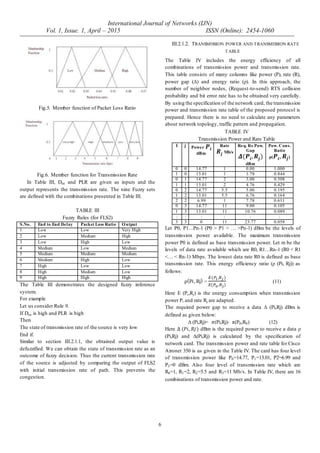
The Figs. 4, 5, and 6 shows the membership function for
the input and output variables. This utilizes the triangulation
functions as they are widely used in real-time applications
owing to their computational efficiency and uncomplicated
formulas.
Fig.4. Member function of End to End delay
International Journal of Networks (IJN)
Vol. 1, Issue. 1, April – 2015 ISSN (Online): 2454-1060
6
Fig.5. Member function of Packet Loss Ratio
Fig.6. Member function for Transmission Rate
In Table III, Dee and PLR are given as inputs and the
output represents the transmission rate. The nine Fuzzy sets
are defined with the combinations presented in Table III.
TABLE III
Fuzzy Rules (for FLS2)
S.No. End to End Delay Packet Loss Ratio Output
1 Low Low Very High
2 Low Medium High
3 Low High Low
4 Medium Low Medium
5 Medium Medium Medium
6 Medium High Low
7 High Low Low
8 High Medium Low
9 High High High
The Table III demonstrates the designed fuzzy inference
system.
For example
Let us consider Rule 9.
If Dee is high and PLR is high
Then
The state of transmission rate of the source is very low
End if.
Similar to section III.2.1.1, the obtained output value is
defuzzified. We can obtain the state of transmission rate as an
outcome of fuzzy decision. Thus the current transmission rate
of the source is adjusted by comparing the output of FLS2
with initial transmission rate of path. This prevents the
congestion.
III.2.1.2. TRANSMISSION POWER AND TRANSMISSION RATE
TABLE
The Table IV includes the energy efficiency of all
combinations of transmission power and transmission rate.
This table consists of many columns like power (P), rate (R),
power gap (∆) and energy ratio (ρ). In this approach, the
number of neighbor nodes, (Request-to-send) RTS collision
probability and bit error rate has to be obtained very carefully.
By using the specification of the network card, the transmission
power and transmission rate table of the proposed protocol is
prepared. Hence there is no need to calculate any parameters
about network topology, traffic pattern and propagation.
TABLE IV
Transmission Power and Rate Table
I j Power
dBm
Rate
Mb/s
Req. Rx Pow.
Gap
dBm
Pow. Cons.
Ratio
ρ( )
0 0 14.77 1 0.00 1.000
1 0 13.01 1 1.78 0.844
0 1 14.77 2 3.00 0.508
1 1 13.01 2 4.76 0.429
0 2 14.77 5.5 5.00 0.195
1 2 13.01 5.5 6.76 0.164
2 2 6.99 1 7.78 0.611
0 3 14.77 11 9.00 0.105
1 3 13.01 11 10.76 0.089
: : : : : :
3 3 0 11 23.77 0.058
Let P0, P1…Pn-1 (P0 > P1 > … >Pn-1) dBm be the levels of
transmission power available. The maximum transmission
power P0 is defined as base transmission power. Let m be the
levels of data rate available which are R0, R1…Rn-1 (R0 < R1
<… < Rn-1) Mbps. The lowest data rate R0 is defined as base
transmission rate. This energy efficiency ratio (ρ (Pi, Rj)) as
follows:
= (11)
Here E (Pi,Rj) is the energy consumption when transmission
power Pi and rate Rj are adapted.
The required power gap to receive a data ∆ (Pi,Rj) dBm is
defined as given below:
∆ (Pi,Rj)= (Pi,Rj)- π(P0,R0) (12)
Here dBm is the required power to receive a data ρ
(Pi,Rj) and ∆(Pi,Rj) is calculated by the specification of
network card. The transmission power and rate table for Cisco
Aironet 350 is as given in the Table IV. The card has four level
of transmission power like P0=14.77, P1=13.01, P2=6.99 and
P3=0 dBm. Also four level of transmission rate which are
R0=1, R1=2, R2=5.5 and R3=11 Mb/s. In Table IV, there are 16
combinations of transmission power and rate.
International Journal of Networks (IJN)
Vol. 1, Issue. 1, April – 2015 ISSN (Online): 2454-1060
7
Example: If P0=14.77 dBm and R3=11 Mb/s are selected, then
the energy consumption is 0.105 times as that of the base
transmission power and rate. The required power at a receiver
is 9.00 dBm larger than that of base transmission power and
rate. The node will calculate the received power when the node
receives a control frame such as RTS.
Let p dBm be the received power of the RTS.
The power gap is given by p-π (P0, R0), hence the combination
satisfying ∆ (Pi,Rj) < p-π(P0,R0) is selected fromthe table.
IV. SIMULATION RESULTS
The Network Simulator (NS2) [15], is used to simulate the
proposed architecture. In the simulation, 150 mobile nodes
move in a 1000 * 1000 meter square region for 50 seconds of
simulation time. All the nodes are of the transmission range of
250 meters. The simulated traffic is constant bit rate (CBR).
The simulation setting and parameters are summarized in
the following Table V:
TABLE V
Simulation Parameters
Number of nodes 150
Area Size 1000x1000
MAC IEEE 802.11
Transmission Range 250 meters
Simulation Time 50 seconds
Traffic source CBR
Packet Size 512
Sources 2,4,6,8 and 10
Rate 100,200,300,400and 500 kb
Initial Energy 9.1 Joules
Transmission Power 0.660 Watts
Receiving Power 0.395 Watts
IV.1. PERFORMANCE METRICS
The proposed routing technique is compared with the EE-
MAC technique [16].The performance is evaluated mainly
according the following metrics.
 Packet Delivery Ratio: The ration between the
numbers of packets received to the number of
packets sent.
 Packet Drop: The average number of packets
dropped during transmission.
 Residual Energy: The amount of energy that
remains in the participant node.
IV.2. RESULTS
A. Based on Rate:
In our first experiment, we vary the transmission rate as
100, 200, 300, 400 and 500 kbs.
Fig.7. Rate vs. Delivery Ratio
Fig.8. Rate vs. Packet Drop
Fig.9. Rate vs. Residual Energy
Fig.7. shows the delivery ratio of this protocol and EEMAC
techniques fordifferent rate scenario.We can conclude that the
delivery ratio of our proposed approach has 27% of higher than
EEMAC approach.
Fig.8. shows the packet drop of the protocol and EEMAC
techniques fordifferent rate scenario.We can conclude that the
drop of our proposed approach has 11% of less than EEMAC
approach.
Fig.9. shows the residual energy of this protocol and
EEMAC techniques for different rate scenario. We can
conclude that the drop of our proposed approach has 2% higher
than EEMAC approach.
B. Based on Flow:
In our second experiment, we vary the number of flows as
2,4,6,8 and 10.
International Journal of Networks (IJN)
Vol. 1, Issue. 1, April – 2015 ISSN (Online): 2454-1060
8
Fig.10. Flows vs. Delivery Ratio
Fig.11. Flows vs. Packet drop
Fig.12. Flows vs. Residual Energy
Fig.10. shows the delivery ratio of this protocol and
EEMAC technique for different rate scenario. We can conclude
that the delivery ratio of our proposed approach has 15% of
higher than EEMA C approach.
Fig.11. shows the packet drop of this protocol and EEMAC
techniques fordifferent rate scenario.We can conclude that the
drop of our proposed approach has 11% of less than EEMAC
approach.
Fig.12 shows the residual energy of this protocol and
EEMAC techniques for different rate scenario. We can
conclude that the residual energy of ourproposed approach has
14% higher than EEMAC approach.
V. CONCLUSION
In this paper, we have proposed a fuzzy based cross layer
routing in MANET in which the system comprises of two
fuzzy system namely fuzzy logic system 1 (FLS1) and fuzzy
logic system2 (FLS2).
By simulation results,this path selected by this approach is
more stable and more energy efficient. Also through this way
the network’s and node’s lifetime will be prolonged.
References
[1] Vahid Ayatollahi Tafti and Abolfazl Gandomi,
“Performance of QoS Parameters in MANET Application
Traffics in Large Scale Scenarios”, World Academy of
Science, Engineering and Technology, 2010.
[2] Al-Sakib Khan Pathan and Choong Seon Hong, “Routing
in Mobile Ad Hoc Network”, Guide to Wireless Ad Hoc
Network, 2009 edition.
[3] Serge Guillaume, “Designing Fuzzy Inference Systems
from Data: An Interpretability Oriented-Review, IEEE
Transaction on Fuzzy Systems, Vol. 9, NO. 3, June 2001.
[4] Vineet Srivastava ans Mehul Motani, “Cross-Layer Design:
A Survey and the Road Ahead”, IEEE Communication
Magazine, December 2005.
[5] A. Siddesh Gundagatti Karibasappa and B.K.N.
Muralidhara, “Neuro Fuzzy Based Routing Protocol for
Mobile Ad-Hoc Networks”, IEEE 6th
International
Conference on Industrial and Information Systems, (IICSI
2011), 2011.
[6] M. Niazi Torshiz, H. Amintoosi and A. Movaghar, “A
Fuzzy Energy-based Extension to AODV Routing”, IEEE
International Symposium on Telecommunications, 2008.
[7] Zuo Jing, Chi Xuefen, Lin Guan and Li Hongxia, “Service-
aware Multi-constrained Routing Protocol with QoS
Guarantee Based on Fuzzy Logic”, IEEE 22nd
International conference on Advanced Information
Networking and Applications- Workshops , 2008.
[8] Golnoosh Ghalavand, Arash Dana, Azadeh Ghalavand and
Mahnaz Rezahosieni, “Reliable routing algorithm based on
Fuzzy logic for Golnoosh Mobile Adhoc Network”, IEEE
3rd International Conference on Advanced Computer
Theory and Engineering (ICACTE), 2010.
[9] Cherine Fathy, M.T. El-Haddi and M.A.El-Nasr,
“Fuzzy-based Adaptive Cross Layer Routing Protocol for
Delay Sensitive Application in MANET”, IEEE
International Conference on Communications (ICC),
2012.
[10] Masaki Bandai, Satoshi Maeda, and Takashi Watanabe,
“Energy Efficient MAC Protocol with Power and Rate
Control in Multi-rate ad hoc networks”, IEEE, 2008.
[11] Mohammed Saghir, Tat-Chee Wan, Rahmat Budiarto,
“QoS Multicast Routing Based on Bandwidth Estimation in
Mobile Ad-Hoc Networks”, Proceedings of the Int. Conf.
On Computer and Communication Engineering
(ICCCE),Vol. I, 9-11, 2006.
[12] G N V Prasad, V. Siva Parvathi, Dr.K.Nageswara Rao,
“Link stability based multicast routing scheme inMANET”,
International Journal of Advanced Engineering Sciences
and Technologies (IJAEST), Vol No. 8, pp 169 – 176, Issue
No. 2, 2011.
International Journal of Networks (IJN)
Vol. 1, Issue. 1, April – 2015 ISSN (Online): 2454-1060
9
[13] Partha Sarathi Banerjee, J. Paulchoudhury and S. R.
Bhadra Chaudhuri, “Fuzzy Membership Function in a
Trust Based AODVfor MANET”, I. J. Computer Network
and Information Security, 2013.
[14] Dimitrios Liarokapis and Ali Shahrabi, “Fuzzy-based
Probabilistic Broadcasting in Mobile Ad Hoc Networks”,
IEEE International Conference on Wireless Days (WD),
IFIP, pp-1-6, 2011.
[15] Network Simulator: http //www.isi.edu/nsnam/ns

Iisrt aarthi ravindran (networks)

  • 1.
    International Journal ofNetworks (IJN) Vol. 1, Issue. 1, April – 2015 ISSN (Online): 2454-1060 1 Abstract—In mobile ad-hoc network, the performance depends on the adaptability of the underlying routing protocol to current network condition. The existing fuzzy based cross layer routing protocol in which the parameters such as number of hops and mobile speed for estimating link stability in the network has the drawback of leading to overhead and dependency. In turn leading to delay and inefficiency in data transmission. In order to overcome these drawbacks, in this paper we propose fuzzy based optimal path selection by considering the path stability, the residual energy of the nodes and bandwidth as parameters at the source node. The path stability is estimated based on available battery power, distance and link quality. The residual energy is estimated for the node at both the situations, when the node receives and transmits the data packets. Following the path selection, fuzzy based transmission rate adjustment of source is calculated by considering end to end delay and packet loss ratio as parameters at destination node. Also we propose a method to draw a table, which includes energy efficiency in all combination of transmission power and rate, is updated by each node. Index Terms—Ad-Hoc On Demand Distance Vector Routing protocol (AODV), Fuzzy inference system, Cross-Layer design. I. INTRODUCTION I.1. MOBILE AD-HOC NETWORK (MANET) With the extensive growth of wireless handheld devices and plummeting costs [1] has emerged as a major area of research for both academics and the industrial sector. A Mobile network is a set of mobile telecommunications, Mobile Ad-hoc Network (MANET) of wireless mobile nodes which are infrastructure-less network consisting of numbers of mobile hosts’ communication with one another through multiple hop wireless links. MANETs are self-organizing, self-configuring and dynamic topology network making them convenient for combat, medical and other emergency situations. I.2. ROUTING PROTOCOL The MANETS’s routing protocol finds routes between nodes and then allows data packets to be forwarded through other network nodes towards the final destination [2]. The routing protocol for MANET could be broadly classified into two major categories based on the method of keeping the information about routes in the network. They are:  Proactive Routing Protocol  Reactive Routing Protocol I.3. AD-HOC ON DEMAND DISTANCE VECTOR ROUTING PROTOCOL (AODV) Ad-hoc On-demand Distance Vector (AODV) [2] routing protocol is one of the MANET routing protocols which comes classified under reactive protocol. It provides efficient route establishment between nodes in a wireless network communication between mobile nodes with minimal control overhead and minimal route acquisition latency. The two main operations taking place in AODV protocol are Route discovery and Route maintenance. I.4. FUZZY INFERENCE SYSTEM Fuzzy Inference System [3] is a system that uses fuzzy logic to map a set of inputs to a set of outputs. Fuzzy Logic was initiated to represent /manipulate data possessing non-statistical uncertainties. Fuzzy logic is a multi- valued logic which deals with reasoning that are approximate rather than fixed and exact. Fuzzy logic variables may have truth value that ranges on degree between 0 and 1. It has been extended to handle the concept of partial truth and hence the truth value ranges from completely true to completely false. Fuzzy logic provides inference morphology and enables approximate human reasoning capabilities to be applied to be applied to knowledge based system. The fuzzy logic provides mathematical strength to capture the uncertainties associated with human cognitive process such as thinking and reasoning I.5. CROSS LAYER DESIGN In Ad-Hoc network, each and every node communicates with each other through the OSI layer. But the defect of this reference protocol architecture is that adjacent layers only can communicate with each other and every layer has its own Cross- Layer based efficient data transmission in MANET using Fuzzy Logic 1 Narayanan.S, 2 Rani Thottungal, 3 R.Aarthi, 4 M.Nija Priya, 5 M.Anu 1 Department of Information Technology,Valliammai Engineering College, Chennai, India. 2 Department Of EEE Kumaraguru College of EngIneering, Coimbatore, India 3,4,5 UG Scholar, Valliammai Engineering College, Chennai, India
  • 2.
    International Journal ofNetworks (IJN) Vol. 1, Issue. 1, April – 2015 ISSN (Online): 2454-1060 2 information which cannot be accessed by other layers. Cross- layer design [4] is the protocol design which is mainly used to remove the dependency between layers .Cross layer is the interface that is used for sharing information between layers. It is mainly used to enhance the performance of a system. In this paper, we have used shared database design of the cross layer. II. RELATED WORK Siddesh Gundagatti Karibasappa et al. [5] proposed neuro fuzzy based routing protocol. They have utilized the soft computing techniques such as Neural Nets, Fuzzy Logic and genetic Algorithms to derive accurate routing information from mobile Ad-Hoc networks to achieve this efficient protocol. To solve the objective function and establish a route within the shortest possible time the combination of these powerful techniques are used. This protocol has used feed forward artificial neural network to achieve best performance in routing. M.Niazi Torshiz et al. [6] proposed to incorporate the fuzzy concept with AODV routing algorithm and have considered power consumption. This fuzzy logic based routing algorithm monitors the routes and tries to select the optimal route based on minimum bandwidth and hop count of each route. It also has tried to balance the traffic load inside the network so as to increase the battery lifetime of the nodes and hence the overall useful life of the ad hoc network. In this paper, the fuzzy input variables are chosen to be minimum bandwidth, battery life and hop-count. Zuo Jing et al. [7] proposed a multi constrained QoS routing protocol based on fuzzy logic. The protocol is service aware and developed based on DSR. It has considered the QoS requirements asked by different kinds of services and takes different network state parameters as the constraint conditions. They proposed new route informing mechanism to support route update; and have adjusted the speed of packet in terms of the output of fuzzy system; also they have optimized routing algorithm for real time traffic to assure that data are always transmitted through the route with the lowest delay. In this proposal, the fuzzy system consists of three subsystems. Therefore multiple metrics have been considered as fuzzy inputs. The fuzzy inputs used are number of hops, bandwidth, mobile speed and buffer occupancy rate. Golnoosh Ghalavani et al. [8] proposed a reliable routing protocol for MANET based on fuzzy logic. The proposed work is known as RRAF and it finds reliable path for the transmission of data. In their work, during route discovery, node with maximum trust value and maximum energy capacity is selected as a router based on a parameter called “Reliability Value”. Battery power and trust value of individual nodes are used to find the reliable path. This approach forms a reliable route for transmission thus increasing network lifetime and decreasing number of packet loss during transmission. This paper has considered trust value of each node and energy capacity (Battery capacity) as fuzzy parameters. Cherine Fathy et al. [9] proposed a fuzzy based adaptive cross layer routing protocol that enables each mobile node to switch between reactive routing mode and proactive routing mode depending on the current node status. Fuzzy-based routing mode selector whose inputs are the number of link breaks, the interface queue length and the type of application for each node. The advantage of this protocol is improved packet delivery ratio, route-discovery latency and average discovery path length. Masaki Bandai et al. [10] proposed a Medium Access Control (MAC) protocol with transmission power and rate control in multi-rate Ad-Hoc networks. This protocol realizes high energy efficient data transmission. In the protocol, each node prepares a table that includes energy efficiency in all combinations of transmission power and rate. Exchanging of control frames, looking up the transmission power and rate table and relay transmission sequences are used arbitrarily. The relay sequence is adopted instead of direct transmission when relay transmission by intermediate node between sender and receiver is more effective in terms of power consumption. The advantage of this approach is that it can realize high energy efficient data transmission via computer simulations. III. FUZZY BASED CROSS LAYER ROUTINGAND TRANSMISSION RATE DETERMINATION In this paper, we propose cross layer based routing in MANET using fuzzy logic. In this technique, two fuzzy systems are used for efficient transmission. The fuzzy logic system 1 (FLS1) is responsible for best path selection and the fuzzy logic system 2 (FLS2) is responsible for transmission rate determination. In FLS1, through the route discovery mechanism the input parameters such as the path stability and bandwidth are obtained at the source. These inputs are fuzzified and the optimal path for data transmission is identified. In FLS2, the end to end delay and packet loss ratio are obtained as the input values at the destination.These inputs are fuzzified and the state of the transmission rate is estimated. Thus, this prevents the path fromcongestion.
  • 3.
    International Journal ofNetworks (IJN) Vol. 1, Issue. 1, April – 2015 ISSN (Online): 2454-1060 3 III.1. ESTIMATION OF METRICS III.1.1. ESTIMATION OF BANDWIDTH Any node that wants to transmit data should be aware of its local bandwidth and its neighboring nodes information within the inference range.The node pays attention to the channel and estimates local bandwidth (BWL) as the bandwidth is shared among neighboring nodes. The ratio of idle and busy time period for a predefined interval affects the local bandwidth [11]: BWl = C*(Ti/Ttp) (1) Where C= Channel capacity and Ti= Idle time period in the predefined time period Ttp. The minimum bandwidth (BWmn) of all the nodes within the interference range is calculated as the result of prior collection of neighboring node information. Thus, the difference between BWmn and BWl gives the residual bandwidth (BWr) of the node: BWr = BWl - BWmn (2) III.1.2. ESTIMATION OF PATH STABILITY The path stability is estimated based on available battery power, distance and link quality. These values are obtained from the PHY and MAC layer dynamically [12]: Path Stability (PS) = (3) Where, Available Battery Power (Bij) is defined as the ratio of power received at the node (Brx) to the power transmitted (Btx) by the neighbor node. Link Quality (Lij) is defined in terms of the expected transmission time (ET). The expected transmission time (ET) is defined as the expected time to successfully transmit a data packet at the MAC layer for a single link. ET can be obtained by adding all the ET values of the individual links in the route: ET = EX * (z/ BW) (4) Where z = average size of a packet, BW = current link bandwidth and EX =Expected transmission count metrics. The expected transmission time (EX) is the measure of the path and link quality. EX metric for a single is defined as following equation: EX = (5) Where, Ptx = probability of successful packet delivery in forward direction. Prx = probability of successful acknowledgement packet reception. Distance between the two nodes is calculated using the following free space propagation model: The proposed technique involves selection Brx = ( ) (6) Where α = transmitter gain, β = receiver gain, µ = systemloss and w = wavelength III.1.3. ESTIMATION OF RESIDUAL ENERGY The energy consumption (Econ) of a node after time (t) is calculated by using the following equation: Econ (t)= Ntx + C1 * Nrx + C2 (7) Where, Econ (t) = Energy consumed by a node after time (t). Ntx = Number of packets transmitted by the node after time (t). Nrx = Number of packets received by the node after time (t). C1 and C2 = Constant factors having the value between 0 and 1. The residual energy (Eres) [13] of a node at time (t) is calculated by using the following equation: Eres = E - Econ (t) (8) Where E = initial energy of a node. III.1.4. ESTIMATION OF END TO END DELAY The end to end delay consists of all possible delay such as buffering caused during routing discovery latency, queuing at the interface queue, retransmission delay at the MAC, propagation and transmission time. Thus, the end to end delay is defined as the time taken for transmission of the data from source to destination [14] which is given by the following equation: Dee = (Trx – Ttx) (9) Where Trx = reception time and Ttx = transmission time. III.1.3. ESTIMATION OF PACKET LOSS RATIO The packet loss ratio can be defined as the number of data packets that are not effectively transmitted to the destination which is expressed in terms of dropped packets. III.2. PROPOSED TECHNIQUE The proposed techniques involve the selection of optimal routes and rate adjustment using the fuzzy logic system. This is described in the following two phases of fuzzy logic system:
  • 4.
    International Journal ofNetworks (IJN) Vol. 1, Issue. 1, April – 2015 ISSN (Online): 2454-1060 4  Fuzzy Logic System 1 (FLS1): Optimal Path Selection.  Fuzzy Logic System 2 (FLS2): Optimal Rate determination. The fuzzy logic is chosen due to the following two reasons: a) There is no clear boundary between normal and abnormal events. b) The fuzzy rules should level the normality and abnormality separation. The mechanism of the proposed technique is described in the following section sequentially. III.2.1. ALGORITHM FOR OPTIMAL PATH SELECTION The steps involved in the selection of the optimal path are as following: 1) When source (S) wants to transmit a data packet to destination (D) , it verifies its route cache for path availability: If path exists Then Go to step10 Else Go to step 2 End if 2) S broadcasts route request (RREQ) packet towards the D through intermediate nodes (Ni). 3) Ni upon receiving the RREQ updates the route cache (shown in Table 1) about the source, destination, previous hop node, battery power, link quality and available bandwidth. 4) Ni then either re-broadcasts the RREQ to its neighbors or sends the route reply (RREP) if the node is D. This process is repeated till RREQ reaches D. 5) When D receives RREQ, for the every received RREQ the RREP packet is unicast in the reverse path towards the source. 6) Every Ni that receives RREP updates its cache for the next hop of the RREP and then unicasts this RREP in the reverse-path using the earlier stored previous hop node information. 7) Step 6 is being repeated until RREP reaches S. 8) S then computes bandwidth, path stability and residual energy (Estimates in section III.1.1, III.1.2 and III.1.3) based on collected information from RREP. 9) The values calculated in step8 by S are considered as the inputs to the fuzzy logic system. Based on the result, S selects an optimal path that has high bandwidth, path stability and residual energy. This optimal path is used for data transmission. 10) The path that is available in the route cache is considered for data transmission. III.2.1.1. FUZZY LOGIC SYSTEM 1 (FLS1) The Fuzzy logic System 1 involves the selection of the optimal path. The optimal path is selected by considering the three inputs such as bandwidth, path stability and residual energy. The three inputs are fuzzified to obtain the appropriate optimal path. Fuzzification: It involves the fuzzification of the input variables- BWr, PS and Eres. Crisp inputs are taken from these variables and these inputs are given a degree to appropriate fuzzy sets. The combination of BWr , PS and Eres are the crisp inputs. We consider the three possibilities- high, mediumand low for BWr, PS and Eres. The fig. 1, 2 and 3 shows the membership function for the input and output variables. The triangulation function which is widely used in real-time applications owing to their computational efficiency and uncomplicated formulas are used. In Table II, BWr, PS and Eres are given as input and the output is the optimal path (OP) for data transmission. The fifteen fuzzy sets are defined with the combination presented in Table II. Fig.1. Member function of Bandwidth
  • 5.
    International Journal ofNetworks (IJN) Vol. 1, Issue. 1, April – 2015 ISSN (Online): 2454-1060 5 Fig.2. Member function for Path Stability Fig.3. Member function for Residual Energy TABLE II Fuzzy Rules (for FLS1) S.No Bandwidth Path Stability Residual Energy Output 1 Low Low Low Very Low 2 Low Medium Low Low 3 Low High Low Low 4 Low High High High 5 Low Medium Medium Medium 6 Low High Medium Medium 7 Medium Low Low Low 8 Medium Medium Medium Medium 9 Medium High Medium Medium 10 Medium High High High 11 High Low Low Low 12 High Medium Medium Medium 13 High High Medium High 14 High Medium High High 15 High High High Very High The Table II demonstrates the designed fuzzy inference system. It illustrates the function of the inference engine and method by which the outputs of each rule are combined to generate the fuzzy decision. For example, let us consider Rule 15. If BWr is high, PS is high and Eres is high, Then The path is highly optimal for data transmission End if. Defuzzification: It is the technique by which a crisp values are extracted from a fuzzy set as a representation value is referred to as defuzzification. The centroid of area is taken into consideration for defuzzification during fuzzy decision making process. The following equation describes the defuzzifier method: F_Cost = [∑ λ (zi)] (10) Where, F_Cost = specify the degree of decision making. zi = fuzzy rules and variables. λ (zi) = membership function. As per the defuzzification method, the output of the fuzzy cost function is modified to crisp value. Thus, the optimal path chosen is used for data transmission from source to destination. III.2.1.2. FUZZY LOGIC SYSTEM 2 (FLS2) Source proceeds with the transmission of data to destination through the selected optimal path (Described in section III.2.1.1). At the receiver side at this moment, the destination node computes the parameter such as end-to-end delay (Dee) and packet loss ratio (PLR) (explained in section III.1.4 and III.1.5). It applies the inputs to FLS2 in order to estimate the state of transmission rate. Fuzzification: This involves fuzzification of input variables such as Dee and PLR. Crisp inputs are taken from these variables and these inputs are given a degree to appropriate fuzzy sets. The crisp inputs are combination of Dee and PLR. We consider three possibilities - high, medium, and low for Dee and PLR. The Figs. 4, 5, and 6 shows the membership function for the input and output variables. This utilizes the triangulation functions as they are widely used in real-time applications owing to their computational efficiency and uncomplicated formulas. Fig.4. Member function of End to End delay
  • 6.
    International Journal ofNetworks (IJN) Vol. 1, Issue. 1, April – 2015 ISSN (Online): 2454-1060 6 Fig.5. Member function of Packet Loss Ratio Fig.6. Member function for Transmission Rate In Table III, Dee and PLR are given as inputs and the output represents the transmission rate. The nine Fuzzy sets are defined with the combinations presented in Table III. TABLE III Fuzzy Rules (for FLS2) S.No. End to End Delay Packet Loss Ratio Output 1 Low Low Very High 2 Low Medium High 3 Low High Low 4 Medium Low Medium 5 Medium Medium Medium 6 Medium High Low 7 High Low Low 8 High Medium Low 9 High High High The Table III demonstrates the designed fuzzy inference system. For example Let us consider Rule 9. If Dee is high and PLR is high Then The state of transmission rate of the source is very low End if. Similar to section III.2.1.1, the obtained output value is defuzzified. We can obtain the state of transmission rate as an outcome of fuzzy decision. Thus the current transmission rate of the source is adjusted by comparing the output of FLS2 with initial transmission rate of path. This prevents the congestion. III.2.1.2. TRANSMISSION POWER AND TRANSMISSION RATE TABLE The Table IV includes the energy efficiency of all combinations of transmission power and transmission rate. This table consists of many columns like power (P), rate (R), power gap (∆) and energy ratio (ρ). In this approach, the number of neighbor nodes, (Request-to-send) RTS collision probability and bit error rate has to be obtained very carefully. By using the specification of the network card, the transmission power and transmission rate table of the proposed protocol is prepared. Hence there is no need to calculate any parameters about network topology, traffic pattern and propagation. TABLE IV Transmission Power and Rate Table I j Power dBm Rate Mb/s Req. Rx Pow. Gap dBm Pow. Cons. Ratio ρ( ) 0 0 14.77 1 0.00 1.000 1 0 13.01 1 1.78 0.844 0 1 14.77 2 3.00 0.508 1 1 13.01 2 4.76 0.429 0 2 14.77 5.5 5.00 0.195 1 2 13.01 5.5 6.76 0.164 2 2 6.99 1 7.78 0.611 0 3 14.77 11 9.00 0.105 1 3 13.01 11 10.76 0.089 : : : : : : 3 3 0 11 23.77 0.058 Let P0, P1…Pn-1 (P0 > P1 > … >Pn-1) dBm be the levels of transmission power available. The maximum transmission power P0 is defined as base transmission power. Let m be the levels of data rate available which are R0, R1…Rn-1 (R0 < R1 <… < Rn-1) Mbps. The lowest data rate R0 is defined as base transmission rate. This energy efficiency ratio (ρ (Pi, Rj)) as follows: = (11) Here E (Pi,Rj) is the energy consumption when transmission power Pi and rate Rj are adapted. The required power gap to receive a data ∆ (Pi,Rj) dBm is defined as given below: ∆ (Pi,Rj)= (Pi,Rj)- π(P0,R0) (12) Here dBm is the required power to receive a data ρ (Pi,Rj) and ∆(Pi,Rj) is calculated by the specification of network card. The transmission power and rate table for Cisco Aironet 350 is as given in the Table IV. The card has four level of transmission power like P0=14.77, P1=13.01, P2=6.99 and P3=0 dBm. Also four level of transmission rate which are R0=1, R1=2, R2=5.5 and R3=11 Mb/s. In Table IV, there are 16 combinations of transmission power and rate.
  • 7.
    International Journal ofNetworks (IJN) Vol. 1, Issue. 1, April – 2015 ISSN (Online): 2454-1060 7 Example: If P0=14.77 dBm and R3=11 Mb/s are selected, then the energy consumption is 0.105 times as that of the base transmission power and rate. The required power at a receiver is 9.00 dBm larger than that of base transmission power and rate. The node will calculate the received power when the node receives a control frame such as RTS. Let p dBm be the received power of the RTS. The power gap is given by p-π (P0, R0), hence the combination satisfying ∆ (Pi,Rj) < p-π(P0,R0) is selected fromthe table. IV. SIMULATION RESULTS The Network Simulator (NS2) [15], is used to simulate the proposed architecture. In the simulation, 150 mobile nodes move in a 1000 * 1000 meter square region for 50 seconds of simulation time. All the nodes are of the transmission range of 250 meters. The simulated traffic is constant bit rate (CBR). The simulation setting and parameters are summarized in the following Table V: TABLE V Simulation Parameters Number of nodes 150 Area Size 1000x1000 MAC IEEE 802.11 Transmission Range 250 meters Simulation Time 50 seconds Traffic source CBR Packet Size 512 Sources 2,4,6,8 and 10 Rate 100,200,300,400and 500 kb Initial Energy 9.1 Joules Transmission Power 0.660 Watts Receiving Power 0.395 Watts IV.1. PERFORMANCE METRICS The proposed routing technique is compared with the EE- MAC technique [16].The performance is evaluated mainly according the following metrics.  Packet Delivery Ratio: The ration between the numbers of packets received to the number of packets sent.  Packet Drop: The average number of packets dropped during transmission.  Residual Energy: The amount of energy that remains in the participant node. IV.2. RESULTS A. Based on Rate: In our first experiment, we vary the transmission rate as 100, 200, 300, 400 and 500 kbs. Fig.7. Rate vs. Delivery Ratio Fig.8. Rate vs. Packet Drop Fig.9. Rate vs. Residual Energy Fig.7. shows the delivery ratio of this protocol and EEMAC techniques fordifferent rate scenario.We can conclude that the delivery ratio of our proposed approach has 27% of higher than EEMAC approach. Fig.8. shows the packet drop of the protocol and EEMAC techniques fordifferent rate scenario.We can conclude that the drop of our proposed approach has 11% of less than EEMAC approach. Fig.9. shows the residual energy of this protocol and EEMAC techniques for different rate scenario. We can conclude that the drop of our proposed approach has 2% higher than EEMAC approach. B. Based on Flow: In our second experiment, we vary the number of flows as 2,4,6,8 and 10.
  • 8.
    International Journal ofNetworks (IJN) Vol. 1, Issue. 1, April – 2015 ISSN (Online): 2454-1060 8 Fig.10. Flows vs. Delivery Ratio Fig.11. Flows vs. Packet drop Fig.12. Flows vs. Residual Energy Fig.10. shows the delivery ratio of this protocol and EEMAC technique for different rate scenario. We can conclude that the delivery ratio of our proposed approach has 15% of higher than EEMA C approach. Fig.11. shows the packet drop of this protocol and EEMAC techniques fordifferent rate scenario.We can conclude that the drop of our proposed approach has 11% of less than EEMAC approach. Fig.12 shows the residual energy of this protocol and EEMAC techniques for different rate scenario. We can conclude that the residual energy of ourproposed approach has 14% higher than EEMAC approach. V. CONCLUSION In this paper, we have proposed a fuzzy based cross layer routing in MANET in which the system comprises of two fuzzy system namely fuzzy logic system 1 (FLS1) and fuzzy logic system2 (FLS2). By simulation results,this path selected by this approach is more stable and more energy efficient. Also through this way the network’s and node’s lifetime will be prolonged. References [1] Vahid Ayatollahi Tafti and Abolfazl Gandomi, “Performance of QoS Parameters in MANET Application Traffics in Large Scale Scenarios”, World Academy of Science, Engineering and Technology, 2010. [2] Al-Sakib Khan Pathan and Choong Seon Hong, “Routing in Mobile Ad Hoc Network”, Guide to Wireless Ad Hoc Network, 2009 edition. [3] Serge Guillaume, “Designing Fuzzy Inference Systems from Data: An Interpretability Oriented-Review, IEEE Transaction on Fuzzy Systems, Vol. 9, NO. 3, June 2001. [4] Vineet Srivastava ans Mehul Motani, “Cross-Layer Design: A Survey and the Road Ahead”, IEEE Communication Magazine, December 2005. [5] A. Siddesh Gundagatti Karibasappa and B.K.N. Muralidhara, “Neuro Fuzzy Based Routing Protocol for Mobile Ad-Hoc Networks”, IEEE 6th International Conference on Industrial and Information Systems, (IICSI 2011), 2011. [6] M. Niazi Torshiz, H. Amintoosi and A. Movaghar, “A Fuzzy Energy-based Extension to AODV Routing”, IEEE International Symposium on Telecommunications, 2008. [7] Zuo Jing, Chi Xuefen, Lin Guan and Li Hongxia, “Service- aware Multi-constrained Routing Protocol with QoS Guarantee Based on Fuzzy Logic”, IEEE 22nd International conference on Advanced Information Networking and Applications- Workshops , 2008. [8] Golnoosh Ghalavand, Arash Dana, Azadeh Ghalavand and Mahnaz Rezahosieni, “Reliable routing algorithm based on Fuzzy logic for Golnoosh Mobile Adhoc Network”, IEEE 3rd International Conference on Advanced Computer Theory and Engineering (ICACTE), 2010. [9] Cherine Fathy, M.T. El-Haddi and M.A.El-Nasr, “Fuzzy-based Adaptive Cross Layer Routing Protocol for Delay Sensitive Application in MANET”, IEEE International Conference on Communications (ICC), 2012. [10] Masaki Bandai, Satoshi Maeda, and Takashi Watanabe, “Energy Efficient MAC Protocol with Power and Rate Control in Multi-rate ad hoc networks”, IEEE, 2008. [11] Mohammed Saghir, Tat-Chee Wan, Rahmat Budiarto, “QoS Multicast Routing Based on Bandwidth Estimation in Mobile Ad-Hoc Networks”, Proceedings of the Int. Conf. On Computer and Communication Engineering (ICCCE),Vol. I, 9-11, 2006. [12] G N V Prasad, V. Siva Parvathi, Dr.K.Nageswara Rao, “Link stability based multicast routing scheme inMANET”, International Journal of Advanced Engineering Sciences and Technologies (IJAEST), Vol No. 8, pp 169 – 176, Issue No. 2, 2011.
  • 9.
    International Journal ofNetworks (IJN) Vol. 1, Issue. 1, April – 2015 ISSN (Online): 2454-1060 9 [13] Partha Sarathi Banerjee, J. Paulchoudhury and S. R. Bhadra Chaudhuri, “Fuzzy Membership Function in a Trust Based AODVfor MANET”, I. J. Computer Network and Information Security, 2013. [14] Dimitrios Liarokapis and Ali Shahrabi, “Fuzzy-based Probabilistic Broadcasting in Mobile Ad Hoc Networks”, IEEE International Conference on Wireless Days (WD), IFIP, pp-1-6, 2011. [15] Network Simulator: http //www.isi.edu/nsnam/ns