This document describes a system for tracking mobile phones even when they are switched off. The system uses a real-time clock (RTC) powered by a backup battery to activate the phone's GPS and GSM modules periodically when the phone is off. The GPS determines the phone's location, which is sent via GSM as a text message to a backup phone number provided by the user. This allows the user to track a lost or stolen phone that has been turned off, improving on existing tracking apps that require the phone to be on. The system could help users locate their phones without relying on authorities once the phone is off.
![International Journal of Electrical, Computing Engineering and Communication
(IJECC)
Vol. 1, Issue. 3, June – 2015 ISSN (Online): 2394-8310
44
RESOLUTE MOBILE ACQUIRER1
S.Srikiran Rao, 2
S. Bharath, 3
R.Chandrajith
1,2,3
UG Students, Department of Electronics Communication Engineering
Easwari Engineering College, Chennai, INDIA
Abstract: Cell phones are used to schedule
appointments, fax, e-mail, call for assistance,
report emergencies and keep in contact with
loved ones and friends. It can also be used during
crisis so as to alert the people close to us. If your
lost phone happens to be a smartphone, there are
multiple Apps that have been developed to get it
back. Both iOS and Android have this feature of
locating Mobile phones. Some of the Apps
designed to serve this purpose are Device
Manager (Android), Find my iPhone (iOS). But
all these Apps require the mobile phones to be
switched ON. These Apps fails to function when
the Phone is switched OFF. Our paper primarily
focuses on tracking a mobile phone even when it
is switched OFF using the GSM and GPS.
Keywords: GPS, GSM, SMS, Real Time Clock
(RTC).
I INTRODUCTION:
Mobile Phones have become a vital tool for
survival in today’s fast paced world. Increase
of business needs has resulted in a tremendous
leap in the industry of technology to produce
new models of communication such as Tab,
Android, iOS and Windows Mobile and many
more in order to customize the efficiency of
business tracks. They are also an essential part
of our personal lives. We have become so
dependent on this gadget that we find it hard to
survive without it. In case the mobile phone is
lost or misplaced or stolen, we have to go and
complain to authorities concerned. The
developers do not provide an in-built feature to
track the device once it is lost/Switched-off.
This is an area which needs improvisation; and
we have tried a solution which will be
appealing and helpful to the mobile users.
II.CONSTRUCTION:
In this module we use some of the components
which are already present in a conventional
mobile phone. In addition to that we mount
few components to the rear end of the mobile
and also we use a processor to do the required
computations. Some of the components which
will be used are:
III GLOBAL SYSTEM FOR MOBILE
(GSM):
It is a standard, established by the European
Telecommunications Standards Institute for
describing the protocols for second generation
(2G) digital [3]cellular networks used by
mobile phones. It was the default standard
followed in over 219 countries [3] with a
market share of more than 90%.
The network is structured into a number of
discrete sections :
Base station subsystem
Network and switching subsystem
GPRS core network
Operations support system
These GSM networks operate over different
range of frequencies with 2G operating in the
900 MHz or 1800MHz bands and 3G is being
operated in 2100MHz frequency band.
Irrespective of the selected frequency, it is
divided into timeslots for individual phones.
IV.REAL TIME CLOCK:
A real time clock is basically just like a watch-
it runs on a battery and keeps time for any
individual even when there is a power outage.
Using an RTC, we can also keep track of long
timeliness[1]. RTC has certain benefits:
Low Power consumption.
Reduces RAM usage.
V GLOBAL POSITIONING SYSTEM
(GPS):
It is a Space based Satellite navigation system
created by the US Government which provides
location and time information in all
circumstances on earth where there is no
proper line of sight to more than four GPS
satellites.[4] It is widely used in military, civil
and commercial domains. This system is based
on time. The satellites have stable atomic
clocks synchronized to each other and to those
on the earth. Any deviation from the true time
is corrected on a regular basis. Similarly, their
positions are governed precisely.[4] GPS](https://image.slidesharecdn.com/iisrtzzsrikiranrao-150705080307-lva1-app6891/85/Iisrt-zz-srikiran-rao-1-320.jpg)
![International Journal of Electrical, Computing Engineering and Communication
(IJECC)
Vol. 1, Issue. 3, June – 2015 ISSN (Online): 2394-8310
44
RESOLUTE MOBILE ACQUIRER1
S.Srikiran Rao, 2
S. Bharath, 3
R.Chandrajith
1,2,3
UG Students, Department of Electronics Communication Engineering
Easwari Engineering College, Chennai, INDIA
Abstract: Cell phones are used to schedule
appointments, fax, e-mail, call for assistance,
report emergencies and keep in contact with
loved ones and friends. It can also be used during
crisis so as to alert the people close to us. If your
lost phone happens to be a smartphone, there are
multiple Apps that have been developed to get it
back. Both iOS and Android have this feature of
locating Mobile phones. Some of the Apps
designed to serve this purpose are Device
Manager (Android), Find my iPhone (iOS). But
all these Apps require the mobile phones to be
switched ON. These Apps fails to function when
the Phone is switched OFF. Our paper primarily
focuses on tracking a mobile phone even when it
is switched OFF using the GSM and GPS.
Keywords: GPS, GSM, SMS, Real Time Clock
(RTC).
I INTRODUCTION:
Mobile Phones have become a vital tool for
survival in today’s fast paced world. Increase
of business needs has resulted in a tremendous
leap in the industry of technology to produce
new models of communication such as Tab,
Android, iOS and Windows Mobile and many
more in order to customize the efficiency of
business tracks. They are also an essential part
of our personal lives. We have become so
dependent on this gadget that we find it hard to
survive without it. In case the mobile phone is
lost or misplaced or stolen, we have to go and
complain to authorities concerned. The
developers do not provide an in-built feature to
track the device once it is lost/Switched-off.
This is an area which needs improvisation; and
we have tried a solution which will be
appealing and helpful to the mobile users.
II.CONSTRUCTION:
In this module we use some of the components
which are already present in a conventional
mobile phone. In addition to that we mount
few components to the rear end of the mobile
and also we use a processor to do the required
computations. Some of the components which
will be used are:
III GLOBAL SYSTEM FOR MOBILE
(GSM):
It is a standard, established by the European
Telecommunications Standards Institute for
describing the protocols for second generation
(2G) digital [3]cellular networks used by
mobile phones. It was the default standard
followed in over 219 countries [3] with a
market share of more than 90%.
The network is structured into a number of
discrete sections :
Base station subsystem
Network and switching subsystem
GPRS core network
Operations support system
These GSM networks operate over different
range of frequencies with 2G operating in the
900 MHz or 1800MHz bands and 3G is being
operated in 2100MHz frequency band.
Irrespective of the selected frequency, it is
divided into timeslots for individual phones.
IV.REAL TIME CLOCK:
A real time clock is basically just like a watch-
it runs on a battery and keeps time for any
individual even when there is a power outage.
Using an RTC, we can also keep track of long
timeliness[1]. RTC has certain benefits:
Low Power consumption.
Reduces RAM usage.
V GLOBAL POSITIONING SYSTEM
(GPS):
It is a Space based Satellite navigation system
created by the US Government which provides
location and time information in all
circumstances on earth where there is no
proper line of sight to more than four GPS
satellites.[4] It is widely used in military, civil
and commercial domains. This system is based
on time. The satellites have stable atomic
clocks synchronized to each other and to those
on the earth. Any deviation from the true time
is corrected on a regular basis. Similarly, their
positions are governed precisely.[4] GPS](https://image.slidesharecdn.com/iisrtzzsrikiranrao-150705080307-lva1-app6891/75/Iisrt-zz-srikiran-rao-1-2048.jpg)
![International Journal of Electrical, Computing Engineering and Communication
(IJECC)
Vol. 1, Issue. 3, June – 2015 ISSN (Online): 2394-8310
45
receivers have clocks as well - however, they
are not sync with current time, and fluctuating.
The satellites continuously transmit their
current time and position. A GPS receiver
monitors multiple satellites and computes the
exact position and time based on certain
algorithm
We mount the RTC and its power source in the
back of the phone and that power sources is
used to activate the respective parts (GPS,
GSM and PROCESSOR) of our phone. In
addition to these,the user has to provide a back
up mobile number, to which the location of the
lost mobile will be sent as a SMS.
Fig 1. Block diagram of resolute mobile
acquirer.
VI WORKING:
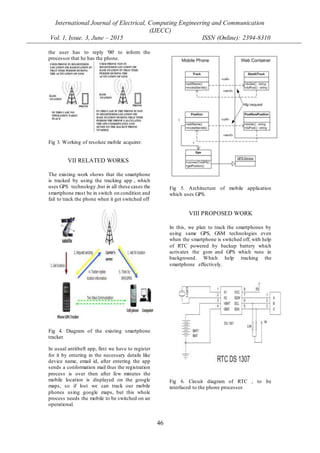
Here, an external power sources, super
capacitor, is used to power the RTC and act as
an external power supply to the mobile phone.
This power source is used to activate the
required parts of mobile phone[5]. A super
capacitor can be recharged and soldered.
Fig 2.Working process of resolute mobile
acquirer .
Once the mobile phone is switched off the real
time clock starts ticking. After an hour, the
processor activates the global positioning
system module in the mobile phone. Now the
processor checks for the location and sends it
to the alternate mobile phone number which
would have been provided by the user through
a SMS. Now, the user is expected to reply[5].
The processor is programmed in such a way
that if '1' is received it has to realise that the
mobile phone has been stolen, and if it receives
'0' it assumes that the mobile phone is in safe.
If the user sends '1', the processor recognizes it
and keeps transmitting the location to the user,
so that the user can find his/her phone. This
process is repeated for every one hour till the
user gets back his phone and[5] the user is
expected to reply 1 till he gets back his phone.
Once the mobile phone is back with the user,
MOBILE
SWITCHED OFF
IN
ABNORMAL
LOCATION
IN
CORRECT
LOCATION
RTC STARTS IN
BACKGROUND
DO
NOTHING
SMS THE
LOCATION
ACTIVATE
GPS AFTER 1hr
CHECKS FOR
LOCATION](https://image.slidesharecdn.com/iisrtzzsrikiranrao-150705080307-lva1-app6891/85/Iisrt-zz-srikiran-rao-2-320.jpg)
![International Journal of Electrical, Computing Engineering and Communication
(IJECC)
Vol. 1, Issue. 3, June – 2015 ISSN (Online): 2394-8310
48
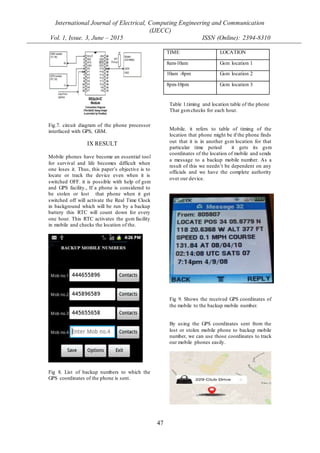
Fig 10. The location of the stolen mobile
phone found using GPS coordinates.
X DISCUSSION
The amount of smartphone theft had increased
in recent days and there had been many phone
tracking facility and apps in stores but these
apps fail to work when they switch off the
phone, in this we plan to track our smartphone
even when it get switched off by the thief in
background without his knowledge which
helps us in tracking our smartphone
efficiently
IX REFERENCE:
1.http://en.wikipedia.org/wiki/Real-time
clock[1].
2.https://learn.adafruit.com/ds1307-real-time-
clock-breakout-board-kit/what-is-an-rtc[2].
3.http://en.wikipedia.org/wiki/GSM[3].
4. http://www.gps.gov/[4]
5.https://www.google.co.in/webhp?sourceid=c
hrome-instant&ion=1&espv=2&ie=UTF-
8#q=intel%20phone%20processor[5].](https://image.slidesharecdn.com/iisrtzzsrikiranrao-150705080307-lva1-app6891/85/Iisrt-zz-srikiran-rao-5-320.jpg)


