International Journal of Mechanical Civil and Control Engineering
Vol. 1, Issue. 3, June 2015 ISSN (Online): 2394-8868
12
S.Karthik Subramanian sks.august17@gmail.com 9500186161
K.Kaushik kau.9477@gmail.com 8939462100
S.S.Parthipan Raj parthipanss@gmail.com 8056770054
P.Naveen naveenprabakaran95@gmail.com 7299539239
ABSTRACT
This project aims to harvest underground vegetables such
as potatoes, onions and carrots in an efficient manner.
This harvester was fabricated to facilitate effective
harvesting and to reduce manual efforts of harvesting
underground vegetables by farmers in the field. This
objective was accomplished by a setup consists of a set
of jaws, a conveyor setup and a collection box. These
were connected by a set of gears actuated by chain
drives. The project was done after conducting studies on
various approaches towards vegetable harvesting. Crop
parameters and field parameters were considered. The
distances between placements of successive crops were
considered. The experiment was done to get an insight of
both qualitative and quantitative aspects of the field as
well as the various reactions to impacts during
harvesting. A few areas regarding scope for future
improvements were discussed and suggestions were
made.
Keywords: Harvester, Onions, Shared-lifting, Sprocket
I. INTRODUCTION
Harvesters
Vegetable harvesters have been used to
harvest underground vegetables in farms. There are
various designs of tools and equipment used for
harvesting the crops and threshing it separately.
Sickles, hand tools and reapers for grain crops and
diggers for tuber crops and rhizomes, operated with
different power sources are used. Combine
harvesters, both tractor mounted and self-propelled,
are being very widely used for different grain
crops. Vegetable harvesters are generally
categorized based on the method of lifting
vegetables. They are of two types - top-lifting and
shared-lifting. Top-lifting harvesters consist of
pointed jaws that grab the vegetables out of the
ground. Shared-lifting harvester consists of blunt
jaws that grab soil along with the vegetables.
Fig.1 Shared-lifting vegetable harvester
A common shared-lifting type of
vegetable harvester is shown in Figure 1.1. In this
type of harvester an enlarged jaw which is twice
the size of the vegetable is used to grab the
vegetables completely from the ground along with
the soil. The collective produce is transferred to a
container where the soil is removed my various
methods including pores, vibration or by manual
selection.
The top-lifting type of vegetable harvester
consists ofpointed jaws that are exactly designed to
hold the vegetables and pick them from under the
ground.The vegetables are then placed into baskets
for collection[10]
.
The top-lifting harvesters also cut the
external top portion of specific vegetables like
carrot, onion etc. This is accomplished by when the
belt of the harvester carries the vegetables; there is
a cutter that is attached to the end of the belt which
cuts the top of the vegetables.
II. LITERATURE REVIEW
For years environmental changes have affected the
harvesting process.Vegetables have been harvested
from various concepts and methods.Carrots,
Design and Fabrication of Underground Vegetable
Harvester
1
S.Karthik Subramanian, 2
K Kaushik, 3
S.S.Parthiban Raj, 4
P.Naveen
Department of Mechanical Engineering,
Easwari Engineering College, Chennai, INDIA
International Journal of Mechanical Civil and Control Engineering
Vol. 1, Issue. 3, June 2015 ISSN (Online): 2394-8868
13
Radishes, Onions, Potatoes have been developed by
mechanical harvesting methods for the last three
decades.
A site-specific sugarbeet yield monitoring system
was then developed and tested.Two weight-
sensing systems (155 mm idler wheels attached to
load cells and the replacement of two existing
idlers on each side of the harvester outlet conveyor
with slide bars) were developed,tested and
evaluated on a laboratory test conveyor.Laboratory
tests to predict accumulated weight showed a 3%
error for the slide bar systemand a low percent
error for the idler wheel system[9]
.
A field study was conducted to evaluate three real-
time weighing systems to measure sugarbeet yield.
There was no statistical difference between two of
the sensors,but there was for the otherone and the
systemprovided unacceptable results. One of the
systems provided reasonable accuracy and allowed
for use of the on-board storage hopper[3]
.
The yield measurement equipment, consisting ofa
weighing frame, load cells, speed sensors and data-
acquisition apparatus,was developed and tested
both under laboratory and field conditions. The
field observations confirmed the high accuracy
attainable with the systemapplied in which the
weighing accuracy ranged from 2.5% (too low) to
4.8%, (too high) with an average weighing
accuracy of 1.36% [7]
.
Abd-Rabou concluded that there is a decrease in
total damaged roots by decreasing forward speed.It
is clear that, increasing forward speed from 0.55 to
1.08 m/s tends to increase the total damaged roots
from 4.91 to 5.6%. The highest value of the total
damaged roots of 5.6% was obtained at forward of
1.08 m/s therefore the lowest value of the total
damaged 4.91%was obtained at forward speed of
0.55 m/s [1]
.
III. DESIGN & ANALYSIS
The CAD model of the product was
designed to determine the external dimensions of
the harvester. The harvester consists of a
rectangular frame with links provided inside it to
place components. The jaws are closely assisted by
a roller setup which takes the vegetables from the
jaws to the collecting box. On the way to the box
the impurities present with the vegetables are
withered out. The jaws are powered by a motor
setup. The rollers are moved by actuation from the
motion of wheels.
Determination of Basic Dimensions
The basic external dimensions were
decided based upon the study of vegetable
harvesters. The wheelbase of the vehicle was
decided as 1500 mm and the track width was
decided to be 640 mm. It was decided to include
links inside the frame of 3-4 in number to
strengthen the frame. The height of the support was
decided to be 420 mm. The angle for the jaw was
decided to be around 35-45 degrees. Suitable motor
and gears were decided based on requirement.
Parts
After the determination of basic dimensions of the
harvester, the part design of the various parts of the
harvesterwas done. The part designs of various
parts are described below in detail.
Frame
The design of the frame of the harvester is
shown below. It has an overall length of 1720 mm
and an overall width of 640mm. It is supported by a
pushing frame which has a height of 420 mm and a
width of 627 mm. The frame is rigidly supported
by three support links of width 640 mm. The frame
consists of two vertical supports of 350 mmeach to
place the conveyor roller bearing. The frame design
is shown below.
Fig.2: Design of Frame
Sprocket (Jaw)
The sprocket was designed based on the
dimensions of the vegetables that were being
harvested. The sprocket was decided to be at an
inclined angle of 45 and consisting of two parts.
The first part is shorter with a length of 60 mmand
is meant to be attached to the sprocket bearing. The
second part is longer with a length of 100 mm and
meant to dig into the ground and harvest
vegetables. The width of each jaw is 75 mm. The
design of the shaft is shown below.
International Journal of Mechanical Civil and Control Engineering
Vol. 1, Issue. 3, June 2015 ISSN (Online): 2394-8868
14
Fig.3: Design of Jaw
Assembled setup of Jaw
The assembled setup of jaw is shown
below. A single set of jaw assembly consists of
three sprockets which are attached at an angle of
120 degrees apart from each other. These jaws are
bolted in the jaw bearing and fixed on the bearing
disc. This jaw is then mounted on the jaw shaft.
Fig.4: Design of Assembled Setup of Jaw
Assembled View of Harvester
The assembly of harvester is represented
below. This contains all the parts including the
fixtures used. The various views of the harvester
are shown below.
Fig.5: Isometric View of Harvester
Analysis
The various components of the harvester
were analysed based on stress and moment
reactions.
Static Structural Analysis of Frame
The frame design of the harvester was
analysed using static structural analysis. The rear
end of the frame was fixed using fixed support. The
front end of the frame was given a load of 700N.
Based on the overall result of this analysis, we can
conclude that the frame design is safe.
Fig.6: Static Analysis of Frame
Modal Analysis
Modal analysis is done on a component to
determine its frequency under no load condition
during a transient period of working. The
frequencies of the frame analysed is depicted below
in the modal graph. The frequency obtained is
27.625 x 10⁻³
Hz.
Fig.7: Modal Analysis Graph of Frame
Torsional Analysis
International Journal of Mechanical Civil and Control Engineering
Vol. 1, Issue. 3, June 2015 ISSN (Online): 2394-8868
15
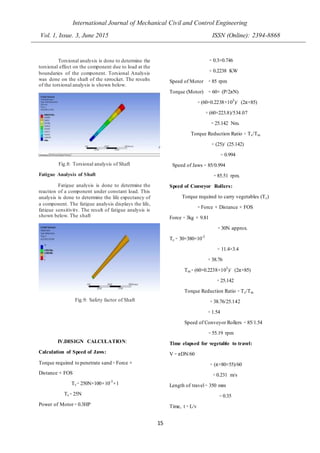
Torsional analysis is done to determine the
torsional effect on the component due to load at the
boundaries of the component. Torsional Analysis
was done on the shaft of the sprocket. The results
of the torsional analysis is shown below.
Fig.8: Torsional analysis of Shaft
Fatigue Analysis of Shaft
Fatigue analysis is done to determine the
reaction of a component under constant load. This
analysis is done to determine the life expectancy of
a component. The fatigue analysis displays the life,
fatigue sensitivity. The result of fatigue analysis is
shown below. The shaft
Fig.9: Safety factor of Shaft
IV.DESIGN CALCULATION:
Calculation of Speed of Jaws:
Torque required to penetrate sand ꞊ Force ×
Distance × FOS
Ts ꞊ 250N×100×10-3
×1
Ts ꞊ 25N
Power of Motor ꞊ 0.3HP
꞊ 0.3×0.746
꞊ 0.2238 KW
Speed of Motor ꞊ 85 rpm
Torque (Motor) ꞊ 60× (P/2πN)
꞊ (60×0.2238×103
)/ (2π×85)
꞊ (60×223.8)/534.07
꞊ 25.142 Nm.
Torque Reduction Ratio ꞊ Ts/Tm
꞊ (25)/ (25.142)
꞊ 0.994
Speed of Jaws ꞊ 85/0.994
꞊ 85.51 rpm.
Speed of Conveyor Rollers:
Torque required to carry vegetables (Tc)
꞊ Force × Distance × FOS
Force ꞊ 3kg × 9.81
꞊ 30N approx.
Tc ꞊ 30×380×10-3
꞊ 11.4×3.4
꞊ 38.76
Tm ꞊ (60×0.2238×103
)/ (2π×85)
꞊ 25.142
Torque Reduction Ratio ꞊ Tc/Tm
꞊ 38.76/25.142
꞊ 1.54
Speed of Conveyor Rollers ꞊ 85/1.54
꞊ 55.19 rpm
Time elapsed for vegetable to travel:
V ꞊ πDN/60
꞊ (π×80×55)/60
꞊ 0.231 m/s
Length of travel ꞊ 350 mm
꞊ 0.35
Time, t ꞊ L/v
International Journal of Mechanical Civil and Control Engineering
Vol. 1, Issue. 3, June 2015 ISSN (Online): 2394-8868
16
꞊ 0.35/0.231
꞊ 1.5 sec
V. FABRICATION
The fabrication of the underground
vegetable harvester begins with the fabrication of
the base frame of the harvester. The frame is made
of L-shaped rods with an overall length of 1720
mm and an overall width of 640 mm. The various
links are joined together using welded and bolted
joints.
Fabrication of Rollers
The fabrication of frame is followed by the
fabrication of the rollers required for the conveyor
setup. Two rollers are required for the actuation of
conveyor. The processes that are involved in this
are:
 Turning
 Chamfering
 Facing
 Drilling
 Grinding
 Boring
After the fabrication of rollers the bearing that
go with the rollers were fabricated. The fabrication
of bearing was made according to the inner
diameter of the rollers. The ends of the bearing are
machined to a lower diameter to facilitate the
actuation by pulleys. The bearing is fitted inside the
pulley.
Fig.10: Fabrication of Rollers
Fabrication of Jaws
The fabrication of one set of jaws was
carried out as follows. The jaw was fabricated from
square shaped rods. The square shaped rods were
taken and one side of the rods were removed. After
this process the rods were reduced to a dimension
of 160 mm. After this they are marked as two parts
with lengths 60 and 100 mm respectively.
Fig.11: Fabrication and Assembly of Jaws
These two parts were heated at the
junction using gas cutting equipment and the inter-
junction was gas-cut at 45 degrees and then bent to
35 degrees. The ends of the jaw was chamfered and
then machined using grinding equipment.
Three jaws constitute one set of jaws on a
shaft. A rod of diameter 55 mm and length 105 mm
is machined using lathe equipment. On this three
jaws were place at an angle of 120 degrees from
each other. The jaws were fixed to the base by
means of bolted joints.Two sets of jaws were
attached to the shaft present at the frontal region of
the harvester. The jaws are shown in Fig 4.2.
Assembling the Harvester
The assembly of the harvester was
completed as follows. The frame is mounted on the
wheels and made rigid. One roller-bearing
assembly is place at the higher link in the centre of
the frame while the other link is connected at the
front portion of the frame. The conveyor belt is
fixed between the rollers and clamped together.
The collection box is fixed behind the conveyor.
International Journal of Mechanical Civil and Control Engineering
Vol. 1, Issue. 3, June 2015 ISSN (Online): 2394-8868
17
Fig.12: Assembly of the Harvester
The jaws and the shaft are placed at the
front portion of the frame. The motor is placed
below the conveyor on the frame and it is
connected with the rollers and the jaw shaft through
a set of gears connected by chain.
VI. RESULTS AND DISCUSSION
Results
When the motor setup is started, the gear
setup starts to rotate along with it. This gear setup
actuates the rotation of the jaw shaft and the
rotation of the rollers. This motor is setup to run at
a controlled speed as per soil requirements. From
the jaw shaft another set of gears transfer the
motion to the roller setup. The jaws dig into the
ground due to the rotation of the shaft. The
assembled setup of jaw carries the harvest and
throw it on to the conveyor. The conveyor is
equipped with strips to hold the harvest. The
harvest is carried by the conveyor and is deposited
in the collection box. Under the collection box a
vibrator setup is present. It vibrates the collection
box and removes soil from the harvest. Thus the
harvester effectively harvests the vegetables from
under the ground. There is initial force required to
dig into the soil and there is an initial time delay.
After this the harvester harvests the vegetables
from the ground.
Scope for Future and Improvements
The future improvements that are possible
in the harvester are:
Firstly, the width of the jaw can be
enlarged to accommodate a larger crop yield. This
can be done by increasing the number of jaws that
are placed on the shaft. Larger frontal regions tend
to have larger torques and hence power
requirements are higher. This also increases the
overall weight of the machine.
Secondly, the mechanism of harvesting
could be modified as per individual vegetable type.
This mechanism involves either using front and
rear movement of the jaws or alternating angle for
harvesting. This requires the incorporation of a RC
circuit to actuate the jaws. Also, the jaws needs to
be designed for variable sizes.
Thirdly, the length of the harvester could
be reduced and the conveyor setup could be
optimized. This could reduce the overall weight of
the harvester and help increase the efficiency of the
harvester.
Finally, the power required to operate the
harvester could be actuated by the motion of gears
which are connected to the wheels of the harvester.
REFERENCES
[1] Abd-Rabou, A.F. (2004). Manufacturing a
small machine to suit harvesting sugar beet under
Egyptian conditions. PhD Thesis Agric. Mech.
Dept. Fac. of Agric. Kafr El–Sheikh. Tanta Univ.
[2] El–Sherief, R.R.A. (1996). A study on
harvesting mechanization of sugar beet. PhD
Thesis Agric. Mech. Dept. Fac. of Agric. Kafr El–
Sheikh. Tanta Univ.
[3] Hall, T. L., Backer, L. F. and Hofman, V. L.
2003. Sugar Beet Yield Monitoring for Site specific
Farming Part II-Field Testing. Springer Science
and Business Media B.V., 4 (4):433 – 444.
[4] Mady, M. A. (2001). Mechanization of some
operations for sugar beet
Production. Misr. J. Agric. Eng., 18 (2): 339 – 355.
[5] Ozarslan, C; D. Erdogan and Y. Zeren (1990).
Mechanization
Possibilities on carrot harvesting, I. Cong. Mee.
And Energy in Engr.
Proc. of cont. held in Adana, Turky, 374-282.
International Journal of Mechanical Civil and Control Engineering
Vol. 1, Issue. 3, June 2015 ISSN (Online): 2394-8868
18
[6] PSG Design Data Book for Engineers, PSG
College of Technology, Coimbatore. ISBN 978-81-
927355-0-4
[7] Van Canneyt, T. and Verschoore, R. 2000.Yield
Measurements on a Potato Harvester. (00-PA-020)
Agri. Eng., Warwick 2000.
[8] Walter, J. D. and Backer, L. F. 2003. Sugar
Beet Yield Monitoring for Site-specific Farm-ing
Part I. Laboratory Tests and Preliminary Field
Tests.
Springer Science and Business Media B. V.,4(4):
421 – 431.
[9] Walter, J. D., Backer, L. F., Hofman, V. L. and
Scherer, T. F. 1996. Sugar Beet Yield Monitoring
for Site Specific Farming. ASAE Paper No. 96-
1022, ASAE, St. Joseph, MI.
[10] Wikipedia-“Carrot Harvesters-Simon-
Welcome” 2012 en.wikipedia.org.

Iisrt karthik subramanian

  • 1.
    International Journal ofMechanical Civil and Control Engineering Vol. 1, Issue. 3, June 2015 ISSN (Online): 2394-8868 12 S.Karthik Subramanian sks.august17@gmail.com 9500186161 K.Kaushik kau.9477@gmail.com 8939462100 S.S.Parthipan Raj parthipanss@gmail.com 8056770054 P.Naveen naveenprabakaran95@gmail.com 7299539239 ABSTRACT This project aims to harvest underground vegetables such as potatoes, onions and carrots in an efficient manner. This harvester was fabricated to facilitate effective harvesting and to reduce manual efforts of harvesting underground vegetables by farmers in the field. This objective was accomplished by a setup consists of a set of jaws, a conveyor setup and a collection box. These were connected by a set of gears actuated by chain drives. The project was done after conducting studies on various approaches towards vegetable harvesting. Crop parameters and field parameters were considered. The distances between placements of successive crops were considered. The experiment was done to get an insight of both qualitative and quantitative aspects of the field as well as the various reactions to impacts during harvesting. A few areas regarding scope for future improvements were discussed and suggestions were made. Keywords: Harvester, Onions, Shared-lifting, Sprocket I. INTRODUCTION Harvesters Vegetable harvesters have been used to harvest underground vegetables in farms. There are various designs of tools and equipment used for harvesting the crops and threshing it separately. Sickles, hand tools and reapers for grain crops and diggers for tuber crops and rhizomes, operated with different power sources are used. Combine harvesters, both tractor mounted and self-propelled, are being very widely used for different grain crops. Vegetable harvesters are generally categorized based on the method of lifting vegetables. They are of two types - top-lifting and shared-lifting. Top-lifting harvesters consist of pointed jaws that grab the vegetables out of the ground. Shared-lifting harvester consists of blunt jaws that grab soil along with the vegetables. Fig.1 Shared-lifting vegetable harvester A common shared-lifting type of vegetable harvester is shown in Figure 1.1. In this type of harvester an enlarged jaw which is twice the size of the vegetable is used to grab the vegetables completely from the ground along with the soil. The collective produce is transferred to a container where the soil is removed my various methods including pores, vibration or by manual selection. The top-lifting type of vegetable harvester consists ofpointed jaws that are exactly designed to hold the vegetables and pick them from under the ground.The vegetables are then placed into baskets for collection[10] . The top-lifting harvesters also cut the external top portion of specific vegetables like carrot, onion etc. This is accomplished by when the belt of the harvester carries the vegetables; there is a cutter that is attached to the end of the belt which cuts the top of the vegetables. II. LITERATURE REVIEW For years environmental changes have affected the harvesting process.Vegetables have been harvested from various concepts and methods.Carrots, Design and Fabrication of Underground Vegetable Harvester 1 S.Karthik Subramanian, 2 K Kaushik, 3 S.S.Parthiban Raj, 4 P.Naveen Department of Mechanical Engineering, Easwari Engineering College, Chennai, INDIA
  • 2.
    International Journal ofMechanical Civil and Control Engineering Vol. 1, Issue. 3, June 2015 ISSN (Online): 2394-8868 13 Radishes, Onions, Potatoes have been developed by mechanical harvesting methods for the last three decades. A site-specific sugarbeet yield monitoring system was then developed and tested.Two weight- sensing systems (155 mm idler wheels attached to load cells and the replacement of two existing idlers on each side of the harvester outlet conveyor with slide bars) were developed,tested and evaluated on a laboratory test conveyor.Laboratory tests to predict accumulated weight showed a 3% error for the slide bar systemand a low percent error for the idler wheel system[9] . A field study was conducted to evaluate three real- time weighing systems to measure sugarbeet yield. There was no statistical difference between two of the sensors,but there was for the otherone and the systemprovided unacceptable results. One of the systems provided reasonable accuracy and allowed for use of the on-board storage hopper[3] . The yield measurement equipment, consisting ofa weighing frame, load cells, speed sensors and data- acquisition apparatus,was developed and tested both under laboratory and field conditions. The field observations confirmed the high accuracy attainable with the systemapplied in which the weighing accuracy ranged from 2.5% (too low) to 4.8%, (too high) with an average weighing accuracy of 1.36% [7] . Abd-Rabou concluded that there is a decrease in total damaged roots by decreasing forward speed.It is clear that, increasing forward speed from 0.55 to 1.08 m/s tends to increase the total damaged roots from 4.91 to 5.6%. The highest value of the total damaged roots of 5.6% was obtained at forward of 1.08 m/s therefore the lowest value of the total damaged 4.91%was obtained at forward speed of 0.55 m/s [1] . III. DESIGN & ANALYSIS The CAD model of the product was designed to determine the external dimensions of the harvester. The harvester consists of a rectangular frame with links provided inside it to place components. The jaws are closely assisted by a roller setup which takes the vegetables from the jaws to the collecting box. On the way to the box the impurities present with the vegetables are withered out. The jaws are powered by a motor setup. The rollers are moved by actuation from the motion of wheels. Determination of Basic Dimensions The basic external dimensions were decided based upon the study of vegetable harvesters. The wheelbase of the vehicle was decided as 1500 mm and the track width was decided to be 640 mm. It was decided to include links inside the frame of 3-4 in number to strengthen the frame. The height of the support was decided to be 420 mm. The angle for the jaw was decided to be around 35-45 degrees. Suitable motor and gears were decided based on requirement. Parts After the determination of basic dimensions of the harvester, the part design of the various parts of the harvesterwas done. The part designs of various parts are described below in detail. Frame The design of the frame of the harvester is shown below. It has an overall length of 1720 mm and an overall width of 640mm. It is supported by a pushing frame which has a height of 420 mm and a width of 627 mm. The frame is rigidly supported by three support links of width 640 mm. The frame consists of two vertical supports of 350 mmeach to place the conveyor roller bearing. The frame design is shown below. Fig.2: Design of Frame Sprocket (Jaw) The sprocket was designed based on the dimensions of the vegetables that were being harvested. The sprocket was decided to be at an inclined angle of 45 and consisting of two parts. The first part is shorter with a length of 60 mmand is meant to be attached to the sprocket bearing. The second part is longer with a length of 100 mm and meant to dig into the ground and harvest vegetables. The width of each jaw is 75 mm. The design of the shaft is shown below.
  • 3.
    International Journal ofMechanical Civil and Control Engineering Vol. 1, Issue. 3, June 2015 ISSN (Online): 2394-8868 14 Fig.3: Design of Jaw Assembled setup of Jaw The assembled setup of jaw is shown below. A single set of jaw assembly consists of three sprockets which are attached at an angle of 120 degrees apart from each other. These jaws are bolted in the jaw bearing and fixed on the bearing disc. This jaw is then mounted on the jaw shaft. Fig.4: Design of Assembled Setup of Jaw Assembled View of Harvester The assembly of harvester is represented below. This contains all the parts including the fixtures used. The various views of the harvester are shown below. Fig.5: Isometric View of Harvester Analysis The various components of the harvester were analysed based on stress and moment reactions. Static Structural Analysis of Frame The frame design of the harvester was analysed using static structural analysis. The rear end of the frame was fixed using fixed support. The front end of the frame was given a load of 700N. Based on the overall result of this analysis, we can conclude that the frame design is safe. Fig.6: Static Analysis of Frame Modal Analysis Modal analysis is done on a component to determine its frequency under no load condition during a transient period of working. The frequencies of the frame analysed is depicted below in the modal graph. The frequency obtained is 27.625 x 10⁻³ Hz. Fig.7: Modal Analysis Graph of Frame Torsional Analysis
  • 4.
    International Journal ofMechanical Civil and Control Engineering Vol. 1, Issue. 3, June 2015 ISSN (Online): 2394-8868 15 Torsional analysis is done to determine the torsional effect on the component due to load at the boundaries of the component. Torsional Analysis was done on the shaft of the sprocket. The results of the torsional analysis is shown below. Fig.8: Torsional analysis of Shaft Fatigue Analysis of Shaft Fatigue analysis is done to determine the reaction of a component under constant load. This analysis is done to determine the life expectancy of a component. The fatigue analysis displays the life, fatigue sensitivity. The result of fatigue analysis is shown below. The shaft Fig.9: Safety factor of Shaft IV.DESIGN CALCULATION: Calculation of Speed of Jaws: Torque required to penetrate sand ꞊ Force × Distance × FOS Ts ꞊ 250N×100×10-3 ×1 Ts ꞊ 25N Power of Motor ꞊ 0.3HP ꞊ 0.3×0.746 ꞊ 0.2238 KW Speed of Motor ꞊ 85 rpm Torque (Motor) ꞊ 60× (P/2πN) ꞊ (60×0.2238×103 )/ (2π×85) ꞊ (60×223.8)/534.07 ꞊ 25.142 Nm. Torque Reduction Ratio ꞊ Ts/Tm ꞊ (25)/ (25.142) ꞊ 0.994 Speed of Jaws ꞊ 85/0.994 ꞊ 85.51 rpm. Speed of Conveyor Rollers: Torque required to carry vegetables (Tc) ꞊ Force × Distance × FOS Force ꞊ 3kg × 9.81 ꞊ 30N approx. Tc ꞊ 30×380×10-3 ꞊ 11.4×3.4 ꞊ 38.76 Tm ꞊ (60×0.2238×103 )/ (2π×85) ꞊ 25.142 Torque Reduction Ratio ꞊ Tc/Tm ꞊ 38.76/25.142 ꞊ 1.54 Speed of Conveyor Rollers ꞊ 85/1.54 ꞊ 55.19 rpm Time elapsed for vegetable to travel: V ꞊ πDN/60 ꞊ (π×80×55)/60 ꞊ 0.231 m/s Length of travel ꞊ 350 mm ꞊ 0.35 Time, t ꞊ L/v
  • 5.
    International Journal ofMechanical Civil and Control Engineering Vol. 1, Issue. 3, June 2015 ISSN (Online): 2394-8868 16 ꞊ 0.35/0.231 ꞊ 1.5 sec V. FABRICATION The fabrication of the underground vegetable harvester begins with the fabrication of the base frame of the harvester. The frame is made of L-shaped rods with an overall length of 1720 mm and an overall width of 640 mm. The various links are joined together using welded and bolted joints. Fabrication of Rollers The fabrication of frame is followed by the fabrication of the rollers required for the conveyor setup. Two rollers are required for the actuation of conveyor. The processes that are involved in this are:  Turning  Chamfering  Facing  Drilling  Grinding  Boring After the fabrication of rollers the bearing that go with the rollers were fabricated. The fabrication of bearing was made according to the inner diameter of the rollers. The ends of the bearing are machined to a lower diameter to facilitate the actuation by pulleys. The bearing is fitted inside the pulley. Fig.10: Fabrication of Rollers Fabrication of Jaws The fabrication of one set of jaws was carried out as follows. The jaw was fabricated from square shaped rods. The square shaped rods were taken and one side of the rods were removed. After this process the rods were reduced to a dimension of 160 mm. After this they are marked as two parts with lengths 60 and 100 mm respectively. Fig.11: Fabrication and Assembly of Jaws These two parts were heated at the junction using gas cutting equipment and the inter- junction was gas-cut at 45 degrees and then bent to 35 degrees. The ends of the jaw was chamfered and then machined using grinding equipment. Three jaws constitute one set of jaws on a shaft. A rod of diameter 55 mm and length 105 mm is machined using lathe equipment. On this three jaws were place at an angle of 120 degrees from each other. The jaws were fixed to the base by means of bolted joints.Two sets of jaws were attached to the shaft present at the frontal region of the harvester. The jaws are shown in Fig 4.2. Assembling the Harvester The assembly of the harvester was completed as follows. The frame is mounted on the wheels and made rigid. One roller-bearing assembly is place at the higher link in the centre of the frame while the other link is connected at the front portion of the frame. The conveyor belt is fixed between the rollers and clamped together. The collection box is fixed behind the conveyor.
  • 6.
    International Journal ofMechanical Civil and Control Engineering Vol. 1, Issue. 3, June 2015 ISSN (Online): 2394-8868 17 Fig.12: Assembly of the Harvester The jaws and the shaft are placed at the front portion of the frame. The motor is placed below the conveyor on the frame and it is connected with the rollers and the jaw shaft through a set of gears connected by chain. VI. RESULTS AND DISCUSSION Results When the motor setup is started, the gear setup starts to rotate along with it. This gear setup actuates the rotation of the jaw shaft and the rotation of the rollers. This motor is setup to run at a controlled speed as per soil requirements. From the jaw shaft another set of gears transfer the motion to the roller setup. The jaws dig into the ground due to the rotation of the shaft. The assembled setup of jaw carries the harvest and throw it on to the conveyor. The conveyor is equipped with strips to hold the harvest. The harvest is carried by the conveyor and is deposited in the collection box. Under the collection box a vibrator setup is present. It vibrates the collection box and removes soil from the harvest. Thus the harvester effectively harvests the vegetables from under the ground. There is initial force required to dig into the soil and there is an initial time delay. After this the harvester harvests the vegetables from the ground. Scope for Future and Improvements The future improvements that are possible in the harvester are: Firstly, the width of the jaw can be enlarged to accommodate a larger crop yield. This can be done by increasing the number of jaws that are placed on the shaft. Larger frontal regions tend to have larger torques and hence power requirements are higher. This also increases the overall weight of the machine. Secondly, the mechanism of harvesting could be modified as per individual vegetable type. This mechanism involves either using front and rear movement of the jaws or alternating angle for harvesting. This requires the incorporation of a RC circuit to actuate the jaws. Also, the jaws needs to be designed for variable sizes. Thirdly, the length of the harvester could be reduced and the conveyor setup could be optimized. This could reduce the overall weight of the harvester and help increase the efficiency of the harvester. Finally, the power required to operate the harvester could be actuated by the motion of gears which are connected to the wheels of the harvester. REFERENCES [1] Abd-Rabou, A.F. (2004). Manufacturing a small machine to suit harvesting sugar beet under Egyptian conditions. PhD Thesis Agric. Mech. Dept. Fac. of Agric. Kafr El–Sheikh. Tanta Univ. [2] El–Sherief, R.R.A. (1996). A study on harvesting mechanization of sugar beet. PhD Thesis Agric. Mech. Dept. Fac. of Agric. Kafr El– Sheikh. Tanta Univ. [3] Hall, T. L., Backer, L. F. and Hofman, V. L. 2003. Sugar Beet Yield Monitoring for Site specific Farming Part II-Field Testing. Springer Science and Business Media B.V., 4 (4):433 – 444. [4] Mady, M. A. (2001). Mechanization of some operations for sugar beet Production. Misr. J. Agric. Eng., 18 (2): 339 – 355. [5] Ozarslan, C; D. Erdogan and Y. Zeren (1990). Mechanization Possibilities on carrot harvesting, I. Cong. Mee. And Energy in Engr. Proc. of cont. held in Adana, Turky, 374-282.
  • 7.
    International Journal ofMechanical Civil and Control Engineering Vol. 1, Issue. 3, June 2015 ISSN (Online): 2394-8868 18 [6] PSG Design Data Book for Engineers, PSG College of Technology, Coimbatore. ISBN 978-81- 927355-0-4 [7] Van Canneyt, T. and Verschoore, R. 2000.Yield Measurements on a Potato Harvester. (00-PA-020) Agri. Eng., Warwick 2000. [8] Walter, J. D. and Backer, L. F. 2003. Sugar Beet Yield Monitoring for Site-specific Farm-ing Part I. Laboratory Tests and Preliminary Field Tests. Springer Science and Business Media B. V.,4(4): 421 – 431. [9] Walter, J. D., Backer, L. F., Hofman, V. L. and Scherer, T. F. 1996. Sugar Beet Yield Monitoring for Site Specific Farming. ASAE Paper No. 96- 1022, ASAE, St. Joseph, MI. [10] Wikipedia-“Carrot Harvesters-Simon- Welcome” 2012 en.wikipedia.org.