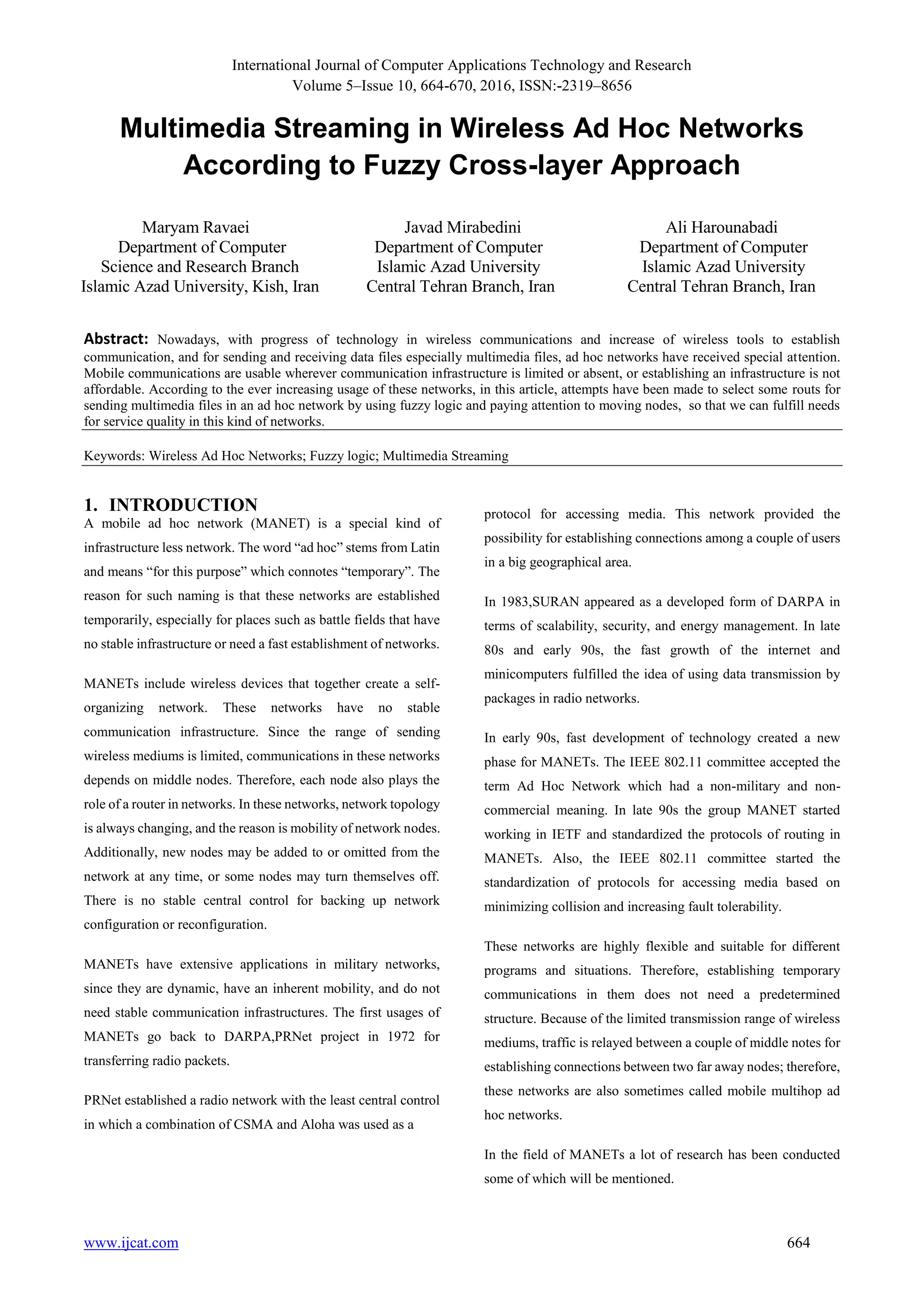
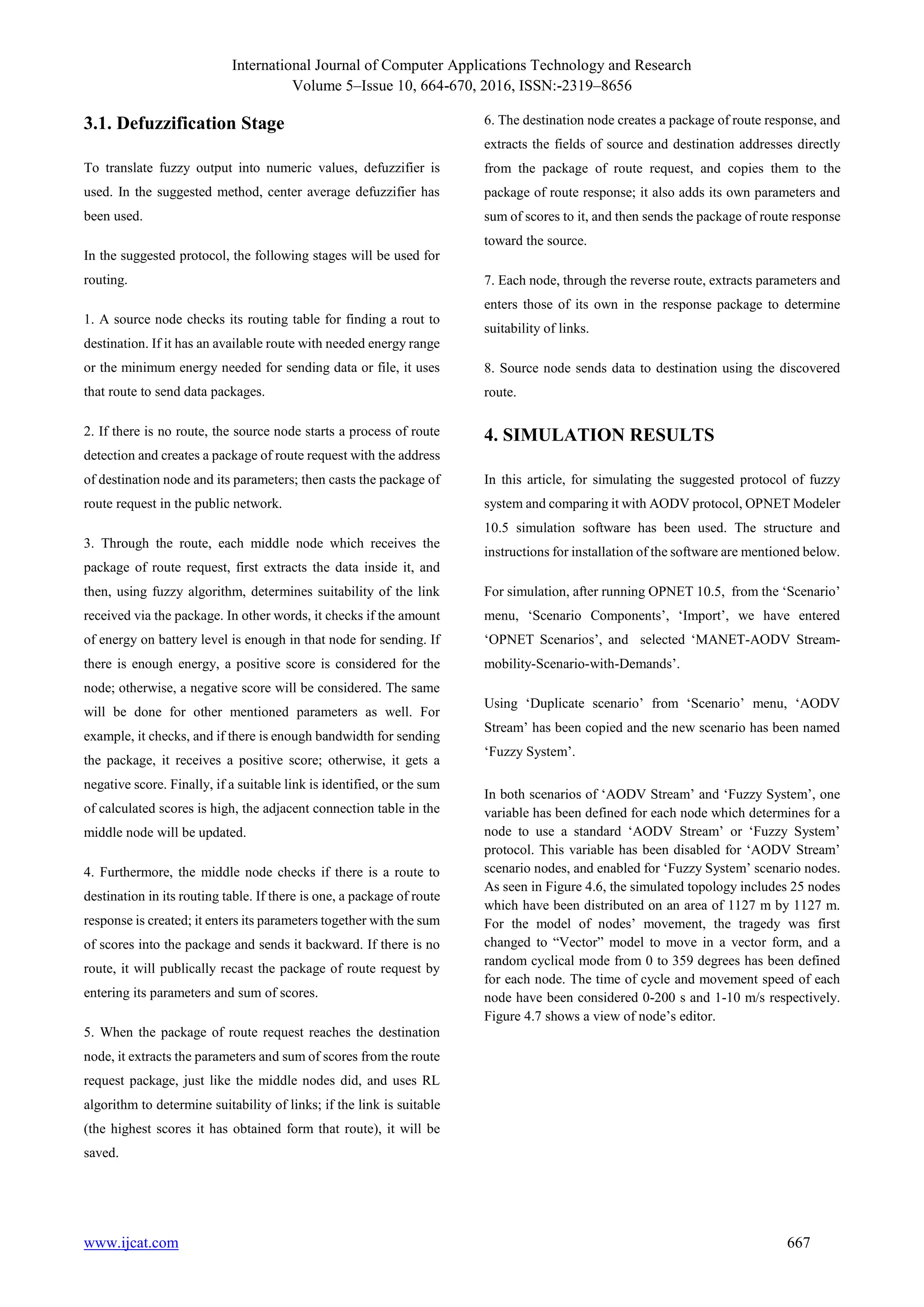
International Journal of Computer Applications Technology and Research
Volume 5–Issue 10, 664-670, 2016, ISSN:-2319–8656
www.ijcat.com 664
Multimedia Streaming in Wireless Ad Hoc Networks
According to Fuzzy Cross-layer Approach
Maryam Ravaei
Department of Computer
Science and Research Branch
Islamic Azad University, Kish, Iran
Javad Mirabedini
Department of Computer
Islamic Azad University
Central Tehran Branch, Iran
Ali Harounabadi
Department of Computer
Islamic Azad University
Central Tehran Branch, Iran
Abstract: Nowadays, with progress of technology in wireless communications and increase of wireless tools to establish
communication, and for sending and receiving data files especially multimedia files, ad hoc networks have received special attention.
Mobile communications are usable wherever communication infrastructure is limited or absent, or establishing an infrastructure is not
affordable. According to the ever increasing usage of these networks, in this article, attempts have been made to select some routs for
sending multimedia files in an ad hoc network by using fuzzy logic and paying attention to moving nodes, so that we can fulfill needs
for service quality in this kind of networks.
Keywords: Wireless Ad Hoc Networks; Fuzzy logic; Multimedia Streaming
1. INTRODUCTION
A mobile ad hoc network (MANET) is a special kind of
infrastructure less network. The word “ad hoc” stems from Latin
and means “for this purpose” which connotes “temporary”. The
reason for such naming is that these networks are established
temporarily, especially for places such as battle fields that have
no stable infrastructure or need a fast establishment of networks.
MANETs include wireless devices that together create a self-
organizing network. These networks have no stable
communication infrastructure. Since the range of sending
wireless mediums is limited, communications in these networks
depends on middle nodes. Therefore, each node also plays the
role of a router in networks. In these networks, network topology
is always changing, and the reason is mobility of network nodes.
Additionally, new nodes may be added to or omitted from the
network at any time, or some nodes may turn themselves off.
There is no stable central control for backing up network
configuration or reconfiguration.
MANETs have extensive applications in military networks,
since they are dynamic, have an inherent mobility, and do not
need stable communication infrastructures. The first usages of
MANETs go back to DARPA,PRNet project in 1972 for
transferring radio packets.
PRNet established a radio network with the least central control
in which a combination of CSMA and Aloha was used as a
protocol for accessing media. This network provided the
possibility for establishing connections among a couple of users
in a big geographical area.
In 1983,SURAN appeared as a developed form of DARPA in
terms of scalability, security, and energy management. In late
80s and early 90s, the fast growth of the internet and
minicomputers fulfilled the idea of using data transmission by
packages in radio networks.
In early 90s, fast development of technology created a new
phase for MANETs. The IEEE 802.11 committee accepted the
term Ad Hoc Network which had a non-military and non-
commercial meaning. In late 90s the group MANET started
working in IETF and standardized the protocols of routing in
MANETs. Also, the IEEE 802.11 committee started the
standardization of protocols for accessing media based on
minimizing collision and increasing fault tolerability.
These networks are highly flexible and suitable for different
programs and situations. Therefore, establishing temporary
communications in them does not need a predetermined
structure. Because of the limited transmission range of wireless
mediums, traffic is relayed between a couple of middle notes for
establishing connections between two far away nodes; therefore,
these networks are also sometimes called mobile multihop ad
hoc networks.
In the field of MANETs a lot of research has been conducted
some of which will be mentioned.
International Journal of Computer Applications Technology and Research
Volume 5–Issue 10, 664-670, 2016, ISSN:-2319–8656
www.ijcat.com 665
You et al. proposed an exploration routing protocol based on hop
counts. In their study, an exploration function has been used to
assist routing. Vu et al. [2] suggested an on-demand protocol
considering the mobility in nodes and capability of detecting
local faults.
Sivakumar et al. [3] proposed a protocol based on machine
learning with an optimal energy consumption approach via load
balancing in critical nodes. Xia et al. [4] introduced a flexible
trust-based on-demand routing protocol for selecting the shortest
and safest route for transmission of data packages in MANETs.
Mousaoui et al. [5] suggested a new mechanism for creating
stable routes between pairs of network nodes on the OLSR
routing protocol. Kumar et al. [6] proposed a model for
managing energy and controlling energy consumption by
decreasing the time of data transmission in MANETs.
Sridhar et al. [7] introduced an energy-based protocol on the
known protocol AODV which, based on send/receive rates of
nodes and data size, calculates the energy level of nodes before
selecting a node for routing, and decides if it is enough for
transmission . Sumathia et al. [8] implemented Adaptive
HELLO messaging scheme on the dynamic on-demand protocol
which uses connectivity information and local links for
observing conditions of links between nodes in order to decrease
energy consumption.
Mousaoui et al. [9] suggested a mechanism for creating highly
stable, fault-tollerant paths among all mobile nodes in
MANETs; in their suggested method, a stability function was
used in OLSR protocol to calculate the mobility degree of a node
compared with its neighbors to select routes with the least
amount of mobility. Kanakaris et. al [10] investigated efficiency
of protocols in MANETs named AODV, DSDV, and DSR, by
considering the factor of mobility in nodes on different network
scales.
Xia et al. [11] proposed an on-demand trust-based uni-cast
routing protocol for choosing the shortest routs according to
needs for security in data packets transmission for routing of
MANETs. Jain et al. [12] introduced different proposals for
energy level accuracy in order to decrease energy loss and to
increase data transmission and networks’ life time.
Tabatabei et al. [13] proposed a new reward-based protocol in
order to increase throughput and provide service quality for
MANETs. Palma et al. [14] suggested a new protocol for
MANETs that selects routes according to the situation of links
in order to increase network efficiency.
In this article, we have presented a routing protocol for multi-
media streaming in MANETs according to a fuzzy cross-layer
approach. In the second part, the operation of this protocol will
be explained; in the third, simulation results will be presented;
and in the fourth, conclusion will be derived.
2. BACKGROUND
2.1 Scheduling Method
In the suggested protocol, fuzzy logic will be used for routing
multi-media files, which will be briefly explained.
Each type III fuzzy system includes four main parts: fuzzy rule
base, fuzzy inference engine, fuzzifier, and defuzzifier (Figure
2.2). Each part will be reviewed below.
Fuzzy rule base is a collection of fuzzy if-then rules. It is
considered the heart of fuzzy systems, since other components
of fuzzy systems are used for establishing these rules in an
effective and efficient totality. As mentioned before, the fuzzy
rule base includes if-then rules shown below:
If X1 is A1,X2 is A2, … and Xn is An, then y is B.
In this rule, As and B are fuzzy sets; and Xs and y are linguist
variables of input and output in a fuzzy system.
A fuzzifier can be considered as a mapping from a real-valued
point to another point in a fuzzy set of inference engine.
In the suggested protocol of fuzzy system input, four parameters
have been considered: hop count, movement speed of nodes,
available bandwidth, and energy at battery level of nodes.
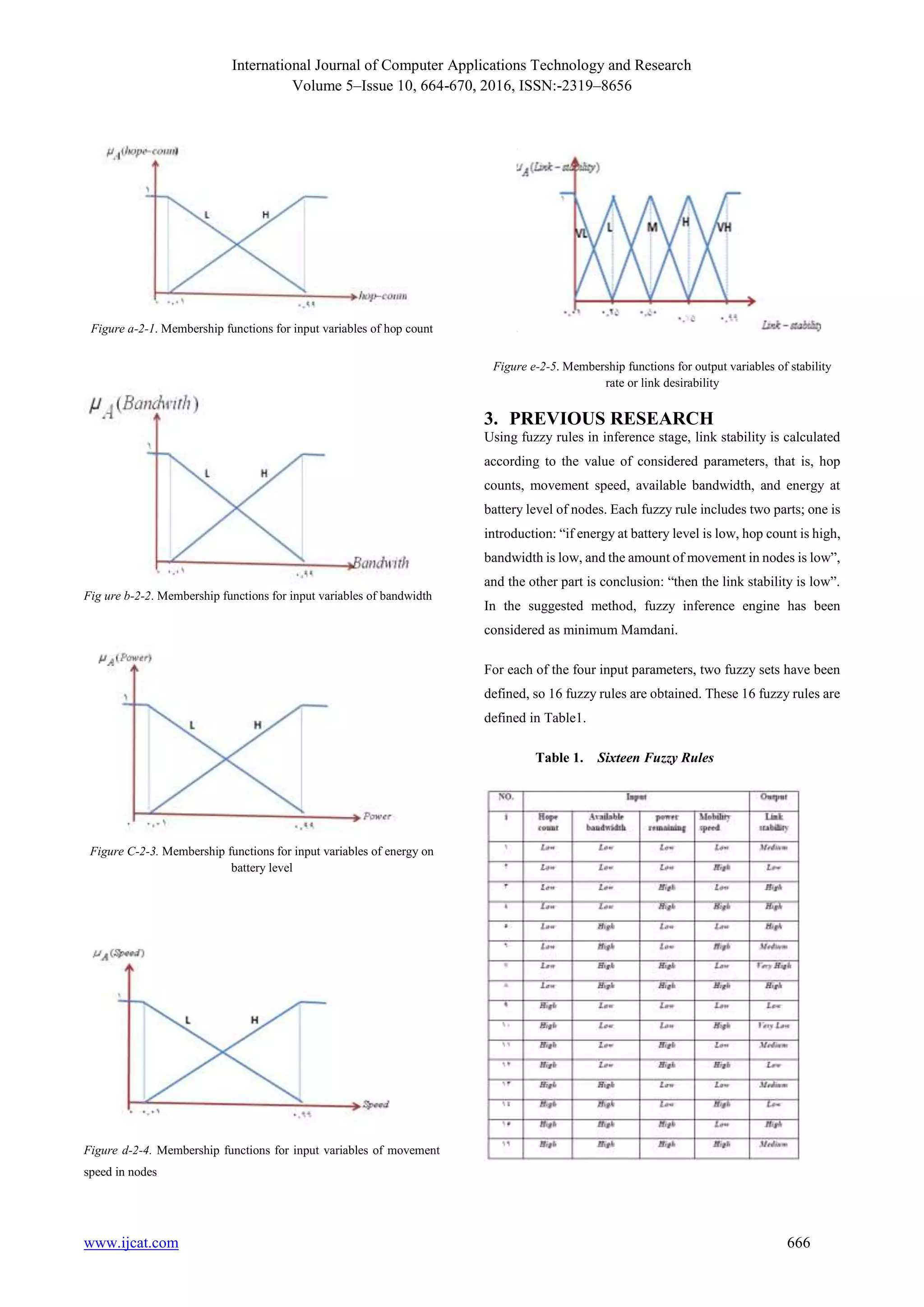
For each input variable, two fuzzy sets having trapezoidal
membership functions will be defined (H stands for high level,
and l for low level), shown in Figures a1-2, b2-2, d3-2, and e4-
2. Trapezoidal membership functions are used because they are
accurate. For output or stability rate of link, four fuzzy sets with
triangular membership functions (H for high level, VH for very
high level, M for moderate, L for low level, and VL for very low
level) have been used which are shown in Figure 6-5.
International Journal of Computer Applications Technology and Research
Volume 5–Issue 10, 664-670, 2016, ISSN:-2319–8656
www.ijcat.com 666
Figure a-2-1. Membership functions for input variables of hop count
Fig ure b-2-2. Membership functions for input variables of bandwidth
Figure C-2-3. Membership functions for input variables of energy on
battery level
Figure d-2-4. Membership functions for input variables of movement
speed in nodes
Figure e-2-5. Membership functions for output variables of stability
rate or link desirability
3. PREVIOUS RESEARCH
Using fuzzy rules in inference stage, link stability is calculated
according to the value of considered parameters, that is, hop
counts, movement speed, available bandwidth, and energy at
battery level of nodes. Each fuzzy rule includes two parts; one is
introduction: “if energy at battery level is low, hop count is high,
bandwidth is low, and the amount of movement in nodes is low”,
and the other part is conclusion: “then the link stability is low”.
In the suggested method, fuzzy inference engine has been
considered as minimum Mamdani.
For each of the four input parameters, two fuzzy sets have been
defined, so 16 fuzzy rules are obtained. These 16 fuzzy rules are
defined in Table1.
Table 1. Sixteen Fuzzy Rules
International Journal of Computer Applications Technology and Research
Volume 5–Issue 10, 664-670, 2016, ISSN:-2319–8656
www.ijcat.com 667
3.1. Defuzzification Stage
To translate fuzzy output into numeric values, defuzzifier is
used. In the suggested method, center average defuzzifier has
been used.
In the suggested protocol, the following stages will be used for
routing.
1. A source node checks its routing table for finding a rout to
destination. If it has an available route with needed energy range
or the minimum energy needed for sending data or file, it uses
that route to send data packages.
2. If there is no route, the source node starts a process of route
detection and creates a package of route request with the address
of destination node and its parameters; then casts the package of
route request in the public network.
3. Through the route, each middle node which receives the
package of route request, first extracts the data inside it, and
then, using fuzzy algorithm, determines suitability of the link
received via the package. In other words, it checks if the amount
of energy on battery level is enough in that node for sending. If
there is enough energy, a positive score is considered for the
node; otherwise, a negative score will be considered. The same
will be done for other mentioned parameters as well. For
example, it checks, and if there is enough bandwidth for sending
the package, it receives a positive score; otherwise, it gets a
negative score. Finally, if a suitable link is identified, or the sum
of calculated scores is high, the adjacent connection table in the
middle node will be updated.
4. Furthermore, the middle node checks if there is a route to
destination in its routing table. If there is one, a package of route
response is created; it enters its parameters together with the sum
of scores into the package and sends it backward. If there is no
route, it will publically recast the package of route request by
entering its parameters and sum of scores.
5. When the package of route request reaches the destination
node, it extracts the parameters and sum of scores from the route
request package, just like the middle nodes did, and uses RL
algorithm to determine suitability of links; if the link is suitable
(the highest scores it has obtained form that route), it will be
saved.
6. The destination node creates a package of route response, and
extracts the fields of source and destination addresses directly
from the package of route request, and copies them to the
package of route response; it also adds its own parameters and
sum of scores to it, and then sends the package of route response
toward the source.
7. Each node, through the reverse route, extracts parameters and
enters those of its own in the response package to determine
suitability of links.
8. Source node sends data to destination using the discovered
route.
4. SIMULATION RESULTS
In this article, for simulating the suggested protocol of fuzzy
system and comparing it with AODV protocol, OPNET Modeler
10.5 simulation software has been used. The structure and
instructions for installation of the software are mentioned below.
For simulation, after running OPNET 10.5, from the ‘Scenario’
menu, ‘Scenario Components’, ‘Import’, we have entered
‘OPNET Scenarios’, and selected ‘MANET-AODV Stream-
mobility-Scenario-with-Demands’.
Using ‘Duplicate scenario’ from ‘Scenario’ menu, ‘AODV
Stream’ has been copied and the new scenario has been named
‘Fuzzy System’.
In both scenarios of ‘AODV Stream’ and ‘Fuzzy System’, one
variable has been defined for each node which determines for a
node to use a standard ‘AODV Stream’ or ‘Fuzzy System’
protocol. This variable has been disabled for ‘AODV Stream’
scenario nodes, and enabled for ‘Fuzzy System’ scenario nodes.
As seen in Figure 4.6, the simulated topology includes 25 nodes
which have been distributed on an area of 1127 m by 1127 m.
For the model of nodes’ movement, the tragedy was first
changed to “Vector” model to move in a vector form, and a
random cyclical mode from 0 to 359 degrees has been defined
for each node. The time of cycle and movement speed of each
node have been considered 0-200 s and 1-10 m/s respectively.
Figure 4.7 shows a view of node’s editor.
International Journal of Computer Applications Technology and Research
Volume 5–Issue 10, 664-670, 2016, ISSN:-2319–8656
www.ijcat.com 668
Figure 4.1. A view of network topology for the simulated mode
Figure 4.2. A view of node’s editor for the simulated model
The transmission rage of each node is 250 m; bandwidth has
been randomly considered 1-10 Mbps; and the simulation time
is 600 s.
To make changes in the process model, ‘Open’ is selected from
‘File’ menu and then ‘Process model’ is selected for the type of
files. By opening ‘AODV Stream –rte’ file form ‘manet’ folder,
a diagram of mode with two modes of ‘init’ and ‘wait’ are
observed which had already been available. A mode named
‘TURN’ has been added which is responsible for circulation of
nodes in an expressed form. This process model is shown in
Figure 4.3.
Figure 4.3. A view of processing model of simulated model
To see the code, the ‘Edit Function Block’ button is used. The
main changes in codes for obtaining the suggested protocol
includes calculating amounts of available bandwidth, energy
level, node speed, hop count, radio frequency, antenna pattern
field, signal productivity, and the level of radio sensitivity, and
sending them to evaluation functions of reinforcement learning
before updating the table in the functions:
‘aodv_rte_rreq_pkt_arrival_handle’ and
‘aodv_rte_rrep_pkt_arrival_handle’ which are respectively the
function of carrying package of route request and the function of
carrying the package of route response.
The Fuzzy System software package includes two folders named
‘manet’ and ‘op-model’; To run the simulated model, the
contents of ‘manet’ folder must be copied in ‘manet’ folder in:
‘C:Program FilesOPNETAmodelsstdmanet10.5’
and then the contents of ‘op_model’ must be copied in:
‘C:Document and Settingsuserop_models’
After running ‘Opnet’, we should select ‘Edit’ menu, enter
‘preferences’, and copy the address below to the existing paths:
‘C:Document and
Settingsuserop_modelsReinforciment_AODV Stream’
Now, we can run ‘Fuzzy System’ project from ‘Fuzzy System’
folder by going to ‘File’ menu and choosing ‘Open’.
After simulation, diagram of results are observable in different
forms using the ‘View Result’ button.
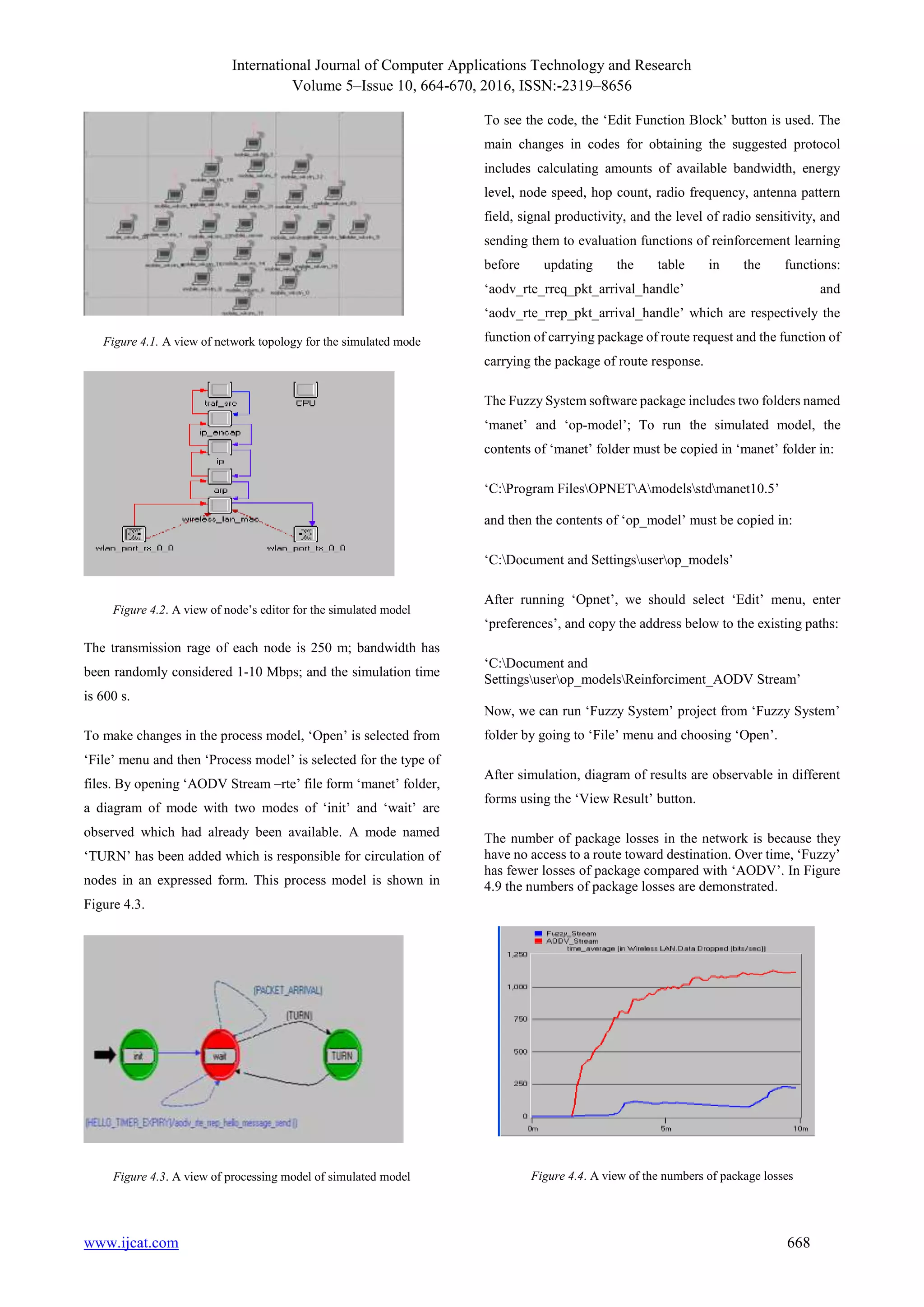
The number of package losses in the network is because they
have no access to a route toward destination. Over time, ‘Fuzzy’
has fewer losses of package compared with ‘AODV’. In Figure
4.9 the numbers of package losses are demonstrated.
Figure 4.4. A view of the numbers of package losses
International Journal of Computer Applications Technology and Research
Volume 5–Issue 10, 664-670, 2016, ISSN:-2319–8656
www.ijcat.com 669
Mean time is calculated from the start of transmission of
package from the source node until the time the package is
delivered to a destination. A remarkable reduction in delay
parameter in wireless ad hoc network is received for ‘Fuzzy’
compared with ‘AODV’. By creating more stable routes, in
other words, a couple of routes are created which are likely to
take packages to destination, and there is no need for
rediscovering the route. In Figure 4.10, the total delay in the
network is shown.
Figure 4.5. A view of total delay in the network
Compared with the total packages transferred by source nodes,
the number of packages successfully delivered to destination is
more in ‘Fuzzy’ than in ‘AODV’. In Figure 4.11 transmission or
delivery rate of packages are shown.
Figure 4.6. Transmission or delivery rate
5. DISCUSSION
In the suggested protocol of fuzzy system input, four parameters
have been considered: hop count, movement speed of nodes,
available bandwidth, and energy at battery level of nodes.
. Each fuzzy rule includes two parts; one is introduction: “if
energy at battery level is low, hop count is high, bandwidth is
low, and the amount of movement in nodes is low”, and the other
part is conclusion: “then the link stability is low”. In the
suggested method, fuzzy inference engine has been considered
as minimum Mamdani. Mean time is calculated from the start of
transmission of package from the source node until the time the
package is delivered to a destination. A remarkable reduction in
delay parameter in wireless ad hoc network is received for
‘Fuzzy’ compared with ‘AODV’. This suggested protocol
considers two important criteria for accessing more stable
routes, and tries to create optimal routes to destination and
increase their availability by creating routes with high available
bandwidth and higher remained energy levels. In other words, it
creates more stable routes for later more effective usages.
6. CONCLUSIONS
In this article, wireless ad hoc networks and their features were
first introduced, and then their problems were reviewed. Types
of routing protocols in wireless ad hoc peer-to-peer networks
have been discussed. A new routing protocol named ‘Fuzzy’ has
been presented for wireless ad hoc peer networks, whose
efficiency was investigated in two faulty and non-faulty states.
It increases efficiency of AODV protocol using cuckoo learning
method with a high calculative speed.
This suggested protocol considers two important criteria for
accessing more stable routes, and tries to create optimal routes
to destination and increase their availability by creating routes
with high available bandwidth and higher remained energy
levels. In other words, it creates more stable routes for later more
effective usages.
7. REFERENCES
[1] L. You, J. Li, C. Wei, C. Dai, J. Xu, L. Hu, “A hop count
based heuristic routing protocol for mobile delay tolerant
networks”, Hindawi Publishing Corporation, Scientific World
Journal, 2014.
[2] Vu TK, Kwon S, “Mobility-Assisted on-Demand Routing
Algorithm for MANETs in the Presence of Location Errors”,
International Journal of Computer Applications Technology and Research
Volume 5–Issue 10, 664-670, 2016, ISSN:-2319–8656
www.ijcat.com 670
Hindawi Publishing Corporation, Scientific World Journal,
2014.
[3] B. Sivakumar, N. Bhalaji, D. Sivakumar, “A survey on
investigating the need for intelligent power-aware load balanced
routing protocols for handling critical links in MANETs”,
Hindawi Publishing Corporation, Scientific World Journal,
2014.
[4] H. Xia, Z. Jia, X. Li, L. Ju, EHM. Sha, “Trust prediction and
trustbased source routing in mobile ad hoc networks”, Ad Hoc
Networks, 2013.
[5] A. Moussaoui, F. Semchedine, A. Boukerram, “A link-state
QoS routing protocol based on link stability for Mobile Ad hoc
Networks”, Journal of Network and Computer Applications,
2014.
[6] K. Kumar, VP. Singh, “Power consumption based simulation
model for mobile ad-hoc network”, Wireless Personal
Communications, 2014.
[7] S. Sridhar, R. Baskaran, P.Chandrasekar “Energy supported
AODV (EN-AODV) for QOS routing in MANET”, Social and
Behavioal Science, 2013.
[8] A.Moussaoui, F.Semchedine, A.Boukerram “A link-state
QoS routing protocol based on link stability for Mobile Ad hoc
Networks”, Journal of Network and Computer Applications,
2015.
[9] V. Kanakaris, D. Ndzi, D. Azzi, “Ad-hoc Networks Energy
Consumption: A review of the Ad-Hoc Routing Protocols”,
Journal of Engineering Science and Technology Review, 2010.
[10] H. Xia, Z. Jia, X. Li, L. Ju, EHM. Sha, “Trust prediction
and trust-based source routing in mobile ad hoc networks”, Ad
Hoc Networks, 2013.
[11] Y. Kumar Jain, R. Kumar Verma, “Energy Level Accuracy
and Life Time Increased in Mobile Ad-Hoc Networks Using
OLSR”, International Journal of Advanced Research in
Computer Science and Software Engineering, 2012.
[12] Sh. Tabatabaei, M. Teshnehlab, S.J.Mirabedini, “A New
Routing Protocol to Increase Throughput in Mobile Ad Hoc
Networks”, Wireless Personal Communications, 2015.
[13] D.Palma, M.Curado, “Onto scalable Ad-hoc networks:
Deferred Routing”, Computer Communications, 2012.

Multimedia Streaming in Wireless Ad Hoc Networks According to Fuzzy Cross-layer Approach

  • 1.
    International Journal ofComputer Applications Technology and Research Volume 5–Issue 10, 664-670, 2016, ISSN:-2319–8656 www.ijcat.com 664 Multimedia Streaming in Wireless Ad Hoc Networks According to Fuzzy Cross-layer Approach Maryam Ravaei Department of Computer Science and Research Branch Islamic Azad University, Kish, Iran Javad Mirabedini Department of Computer Islamic Azad University Central Tehran Branch, Iran Ali Harounabadi Department of Computer Islamic Azad University Central Tehran Branch, Iran Abstract: Nowadays, with progress of technology in wireless communications and increase of wireless tools to establish communication, and for sending and receiving data files especially multimedia files, ad hoc networks have received special attention. Mobile communications are usable wherever communication infrastructure is limited or absent, or establishing an infrastructure is not affordable. According to the ever increasing usage of these networks, in this article, attempts have been made to select some routs for sending multimedia files in an ad hoc network by using fuzzy logic and paying attention to moving nodes, so that we can fulfill needs for service quality in this kind of networks. Keywords: Wireless Ad Hoc Networks; Fuzzy logic; Multimedia Streaming 1. INTRODUCTION A mobile ad hoc network (MANET) is a special kind of infrastructure less network. The word “ad hoc” stems from Latin and means “for this purpose” which connotes “temporary”. The reason for such naming is that these networks are established temporarily, especially for places such as battle fields that have no stable infrastructure or need a fast establishment of networks. MANETs include wireless devices that together create a self- organizing network. These networks have no stable communication infrastructure. Since the range of sending wireless mediums is limited, communications in these networks depends on middle nodes. Therefore, each node also plays the role of a router in networks. In these networks, network topology is always changing, and the reason is mobility of network nodes. Additionally, new nodes may be added to or omitted from the network at any time, or some nodes may turn themselves off. There is no stable central control for backing up network configuration or reconfiguration. MANETs have extensive applications in military networks, since they are dynamic, have an inherent mobility, and do not need stable communication infrastructures. The first usages of MANETs go back to DARPA,PRNet project in 1972 for transferring radio packets. PRNet established a radio network with the least central control in which a combination of CSMA and Aloha was used as a protocol for accessing media. This network provided the possibility for establishing connections among a couple of users in a big geographical area. In 1983,SURAN appeared as a developed form of DARPA in terms of scalability, security, and energy management. In late 80s and early 90s, the fast growth of the internet and minicomputers fulfilled the idea of using data transmission by packages in radio networks. In early 90s, fast development of technology created a new phase for MANETs. The IEEE 802.11 committee accepted the term Ad Hoc Network which had a non-military and non- commercial meaning. In late 90s the group MANET started working in IETF and standardized the protocols of routing in MANETs. Also, the IEEE 802.11 committee started the standardization of protocols for accessing media based on minimizing collision and increasing fault tolerability. These networks are highly flexible and suitable for different programs and situations. Therefore, establishing temporary communications in them does not need a predetermined structure. Because of the limited transmission range of wireless mediums, traffic is relayed between a couple of middle notes for establishing connections between two far away nodes; therefore, these networks are also sometimes called mobile multihop ad hoc networks. In the field of MANETs a lot of research has been conducted some of which will be mentioned.
  • 2.
    International Journal ofComputer Applications Technology and Research Volume 5–Issue 10, 664-670, 2016, ISSN:-2319–8656 www.ijcat.com 665 You et al. proposed an exploration routing protocol based on hop counts. In their study, an exploration function has been used to assist routing. Vu et al. [2] suggested an on-demand protocol considering the mobility in nodes and capability of detecting local faults. Sivakumar et al. [3] proposed a protocol based on machine learning with an optimal energy consumption approach via load balancing in critical nodes. Xia et al. [4] introduced a flexible trust-based on-demand routing protocol for selecting the shortest and safest route for transmission of data packages in MANETs. Mousaoui et al. [5] suggested a new mechanism for creating stable routes between pairs of network nodes on the OLSR routing protocol. Kumar et al. [6] proposed a model for managing energy and controlling energy consumption by decreasing the time of data transmission in MANETs. Sridhar et al. [7] introduced an energy-based protocol on the known protocol AODV which, based on send/receive rates of nodes and data size, calculates the energy level of nodes before selecting a node for routing, and decides if it is enough for transmission . Sumathia et al. [8] implemented Adaptive HELLO messaging scheme on the dynamic on-demand protocol which uses connectivity information and local links for observing conditions of links between nodes in order to decrease energy consumption. Mousaoui et al. [9] suggested a mechanism for creating highly stable, fault-tollerant paths among all mobile nodes in MANETs; in their suggested method, a stability function was used in OLSR protocol to calculate the mobility degree of a node compared with its neighbors to select routes with the least amount of mobility. Kanakaris et. al [10] investigated efficiency of protocols in MANETs named AODV, DSDV, and DSR, by considering the factor of mobility in nodes on different network scales. Xia et al. [11] proposed an on-demand trust-based uni-cast routing protocol for choosing the shortest routs according to needs for security in data packets transmission for routing of MANETs. Jain et al. [12] introduced different proposals for energy level accuracy in order to decrease energy loss and to increase data transmission and networks’ life time. Tabatabei et al. [13] proposed a new reward-based protocol in order to increase throughput and provide service quality for MANETs. Palma et al. [14] suggested a new protocol for MANETs that selects routes according to the situation of links in order to increase network efficiency. In this article, we have presented a routing protocol for multi- media streaming in MANETs according to a fuzzy cross-layer approach. In the second part, the operation of this protocol will be explained; in the third, simulation results will be presented; and in the fourth, conclusion will be derived. 2. BACKGROUND 2.1 Scheduling Method In the suggested protocol, fuzzy logic will be used for routing multi-media files, which will be briefly explained. Each type III fuzzy system includes four main parts: fuzzy rule base, fuzzy inference engine, fuzzifier, and defuzzifier (Figure 2.2). Each part will be reviewed below. Fuzzy rule base is a collection of fuzzy if-then rules. It is considered the heart of fuzzy systems, since other components of fuzzy systems are used for establishing these rules in an effective and efficient totality. As mentioned before, the fuzzy rule base includes if-then rules shown below: If X1 is A1,X2 is A2, … and Xn is An, then y is B. In this rule, As and B are fuzzy sets; and Xs and y are linguist variables of input and output in a fuzzy system. A fuzzifier can be considered as a mapping from a real-valued point to another point in a fuzzy set of inference engine. In the suggested protocol of fuzzy system input, four parameters have been considered: hop count, movement speed of nodes, available bandwidth, and energy at battery level of nodes. For each input variable, two fuzzy sets having trapezoidal membership functions will be defined (H stands for high level, and l for low level), shown in Figures a1-2, b2-2, d3-2, and e4- 2. Trapezoidal membership functions are used because they are accurate. For output or stability rate of link, four fuzzy sets with triangular membership functions (H for high level, VH for very high level, M for moderate, L for low level, and VL for very low level) have been used which are shown in Figure 6-5.
  • 3.
    International Journal ofComputer Applications Technology and Research Volume 5–Issue 10, 664-670, 2016, ISSN:-2319–8656 www.ijcat.com 666 Figure a-2-1. Membership functions for input variables of hop count Fig ure b-2-2. Membership functions for input variables of bandwidth Figure C-2-3. Membership functions for input variables of energy on battery level Figure d-2-4. Membership functions for input variables of movement speed in nodes Figure e-2-5. Membership functions for output variables of stability rate or link desirability 3. PREVIOUS RESEARCH Using fuzzy rules in inference stage, link stability is calculated according to the value of considered parameters, that is, hop counts, movement speed, available bandwidth, and energy at battery level of nodes. Each fuzzy rule includes two parts; one is introduction: “if energy at battery level is low, hop count is high, bandwidth is low, and the amount of movement in nodes is low”, and the other part is conclusion: “then the link stability is low”. In the suggested method, fuzzy inference engine has been considered as minimum Mamdani. For each of the four input parameters, two fuzzy sets have been defined, so 16 fuzzy rules are obtained. These 16 fuzzy rules are defined in Table1. Table 1. Sixteen Fuzzy Rules
  • 4.
    International Journal ofComputer Applications Technology and Research Volume 5–Issue 10, 664-670, 2016, ISSN:-2319–8656 www.ijcat.com 667 3.1. Defuzzification Stage To translate fuzzy output into numeric values, defuzzifier is used. In the suggested method, center average defuzzifier has been used. In the suggested protocol, the following stages will be used for routing. 1. A source node checks its routing table for finding a rout to destination. If it has an available route with needed energy range or the minimum energy needed for sending data or file, it uses that route to send data packages. 2. If there is no route, the source node starts a process of route detection and creates a package of route request with the address of destination node and its parameters; then casts the package of route request in the public network. 3. Through the route, each middle node which receives the package of route request, first extracts the data inside it, and then, using fuzzy algorithm, determines suitability of the link received via the package. In other words, it checks if the amount of energy on battery level is enough in that node for sending. If there is enough energy, a positive score is considered for the node; otherwise, a negative score will be considered. The same will be done for other mentioned parameters as well. For example, it checks, and if there is enough bandwidth for sending the package, it receives a positive score; otherwise, it gets a negative score. Finally, if a suitable link is identified, or the sum of calculated scores is high, the adjacent connection table in the middle node will be updated. 4. Furthermore, the middle node checks if there is a route to destination in its routing table. If there is one, a package of route response is created; it enters its parameters together with the sum of scores into the package and sends it backward. If there is no route, it will publically recast the package of route request by entering its parameters and sum of scores. 5. When the package of route request reaches the destination node, it extracts the parameters and sum of scores from the route request package, just like the middle nodes did, and uses RL algorithm to determine suitability of links; if the link is suitable (the highest scores it has obtained form that route), it will be saved. 6. The destination node creates a package of route response, and extracts the fields of source and destination addresses directly from the package of route request, and copies them to the package of route response; it also adds its own parameters and sum of scores to it, and then sends the package of route response toward the source. 7. Each node, through the reverse route, extracts parameters and enters those of its own in the response package to determine suitability of links. 8. Source node sends data to destination using the discovered route. 4. SIMULATION RESULTS In this article, for simulating the suggested protocol of fuzzy system and comparing it with AODV protocol, OPNET Modeler 10.5 simulation software has been used. The structure and instructions for installation of the software are mentioned below. For simulation, after running OPNET 10.5, from the ‘Scenario’ menu, ‘Scenario Components’, ‘Import’, we have entered ‘OPNET Scenarios’, and selected ‘MANET-AODV Stream- mobility-Scenario-with-Demands’. Using ‘Duplicate scenario’ from ‘Scenario’ menu, ‘AODV Stream’ has been copied and the new scenario has been named ‘Fuzzy System’. In both scenarios of ‘AODV Stream’ and ‘Fuzzy System’, one variable has been defined for each node which determines for a node to use a standard ‘AODV Stream’ or ‘Fuzzy System’ protocol. This variable has been disabled for ‘AODV Stream’ scenario nodes, and enabled for ‘Fuzzy System’ scenario nodes. As seen in Figure 4.6, the simulated topology includes 25 nodes which have been distributed on an area of 1127 m by 1127 m. For the model of nodes’ movement, the tragedy was first changed to “Vector” model to move in a vector form, and a random cyclical mode from 0 to 359 degrees has been defined for each node. The time of cycle and movement speed of each node have been considered 0-200 s and 1-10 m/s respectively. Figure 4.7 shows a view of node’s editor.
  • 5.
    International Journal ofComputer Applications Technology and Research Volume 5–Issue 10, 664-670, 2016, ISSN:-2319–8656 www.ijcat.com 668 Figure 4.1. A view of network topology for the simulated mode Figure 4.2. A view of node’s editor for the simulated model The transmission rage of each node is 250 m; bandwidth has been randomly considered 1-10 Mbps; and the simulation time is 600 s. To make changes in the process model, ‘Open’ is selected from ‘File’ menu and then ‘Process model’ is selected for the type of files. By opening ‘AODV Stream –rte’ file form ‘manet’ folder, a diagram of mode with two modes of ‘init’ and ‘wait’ are observed which had already been available. A mode named ‘TURN’ has been added which is responsible for circulation of nodes in an expressed form. This process model is shown in Figure 4.3. Figure 4.3. A view of processing model of simulated model To see the code, the ‘Edit Function Block’ button is used. The main changes in codes for obtaining the suggested protocol includes calculating amounts of available bandwidth, energy level, node speed, hop count, radio frequency, antenna pattern field, signal productivity, and the level of radio sensitivity, and sending them to evaluation functions of reinforcement learning before updating the table in the functions: ‘aodv_rte_rreq_pkt_arrival_handle’ and ‘aodv_rte_rrep_pkt_arrival_handle’ which are respectively the function of carrying package of route request and the function of carrying the package of route response. The Fuzzy System software package includes two folders named ‘manet’ and ‘op-model’; To run the simulated model, the contents of ‘manet’ folder must be copied in ‘manet’ folder in: ‘C:Program FilesOPNETAmodelsstdmanet10.5’ and then the contents of ‘op_model’ must be copied in: ‘C:Document and Settingsuserop_models’ After running ‘Opnet’, we should select ‘Edit’ menu, enter ‘preferences’, and copy the address below to the existing paths: ‘C:Document and Settingsuserop_modelsReinforciment_AODV Stream’ Now, we can run ‘Fuzzy System’ project from ‘Fuzzy System’ folder by going to ‘File’ menu and choosing ‘Open’. After simulation, diagram of results are observable in different forms using the ‘View Result’ button. The number of package losses in the network is because they have no access to a route toward destination. Over time, ‘Fuzzy’ has fewer losses of package compared with ‘AODV’. In Figure 4.9 the numbers of package losses are demonstrated. Figure 4.4. A view of the numbers of package losses
  • 6.
    International Journal ofComputer Applications Technology and Research Volume 5–Issue 10, 664-670, 2016, ISSN:-2319–8656 www.ijcat.com 669 Mean time is calculated from the start of transmission of package from the source node until the time the package is delivered to a destination. A remarkable reduction in delay parameter in wireless ad hoc network is received for ‘Fuzzy’ compared with ‘AODV’. By creating more stable routes, in other words, a couple of routes are created which are likely to take packages to destination, and there is no need for rediscovering the route. In Figure 4.10, the total delay in the network is shown. Figure 4.5. A view of total delay in the network Compared with the total packages transferred by source nodes, the number of packages successfully delivered to destination is more in ‘Fuzzy’ than in ‘AODV’. In Figure 4.11 transmission or delivery rate of packages are shown. Figure 4.6. Transmission or delivery rate 5. DISCUSSION In the suggested protocol of fuzzy system input, four parameters have been considered: hop count, movement speed of nodes, available bandwidth, and energy at battery level of nodes. . Each fuzzy rule includes two parts; one is introduction: “if energy at battery level is low, hop count is high, bandwidth is low, and the amount of movement in nodes is low”, and the other part is conclusion: “then the link stability is low”. In the suggested method, fuzzy inference engine has been considered as minimum Mamdani. Mean time is calculated from the start of transmission of package from the source node until the time the package is delivered to a destination. A remarkable reduction in delay parameter in wireless ad hoc network is received for ‘Fuzzy’ compared with ‘AODV’. This suggested protocol considers two important criteria for accessing more stable routes, and tries to create optimal routes to destination and increase their availability by creating routes with high available bandwidth and higher remained energy levels. In other words, it creates more stable routes for later more effective usages. 6. CONCLUSIONS In this article, wireless ad hoc networks and their features were first introduced, and then their problems were reviewed. Types of routing protocols in wireless ad hoc peer-to-peer networks have been discussed. A new routing protocol named ‘Fuzzy’ has been presented for wireless ad hoc peer networks, whose efficiency was investigated in two faulty and non-faulty states. It increases efficiency of AODV protocol using cuckoo learning method with a high calculative speed. This suggested protocol considers two important criteria for accessing more stable routes, and tries to create optimal routes to destination and increase their availability by creating routes with high available bandwidth and higher remained energy levels. In other words, it creates more stable routes for later more effective usages. 7. REFERENCES [1] L. You, J. Li, C. Wei, C. Dai, J. Xu, L. Hu, “A hop count based heuristic routing protocol for mobile delay tolerant networks”, Hindawi Publishing Corporation, Scientific World Journal, 2014. [2] Vu TK, Kwon S, “Mobility-Assisted on-Demand Routing Algorithm for MANETs in the Presence of Location Errors”,
  • 7.
    International Journal ofComputer Applications Technology and Research Volume 5–Issue 10, 664-670, 2016, ISSN:-2319–8656 www.ijcat.com 670 Hindawi Publishing Corporation, Scientific World Journal, 2014. [3] B. Sivakumar, N. Bhalaji, D. Sivakumar, “A survey on investigating the need for intelligent power-aware load balanced routing protocols for handling critical links in MANETs”, Hindawi Publishing Corporation, Scientific World Journal, 2014. [4] H. Xia, Z. Jia, X. Li, L. Ju, EHM. Sha, “Trust prediction and trustbased source routing in mobile ad hoc networks”, Ad Hoc Networks, 2013. [5] A. Moussaoui, F. Semchedine, A. Boukerram, “A link-state QoS routing protocol based on link stability for Mobile Ad hoc Networks”, Journal of Network and Computer Applications, 2014. [6] K. Kumar, VP. Singh, “Power consumption based simulation model for mobile ad-hoc network”, Wireless Personal Communications, 2014. [7] S. Sridhar, R. Baskaran, P.Chandrasekar “Energy supported AODV (EN-AODV) for QOS routing in MANET”, Social and Behavioal Science, 2013. [8] A.Moussaoui, F.Semchedine, A.Boukerram “A link-state QoS routing protocol based on link stability for Mobile Ad hoc Networks”, Journal of Network and Computer Applications, 2015. [9] V. Kanakaris, D. Ndzi, D. Azzi, “Ad-hoc Networks Energy Consumption: A review of the Ad-Hoc Routing Protocols”, Journal of Engineering Science and Technology Review, 2010. [10] H. Xia, Z. Jia, X. Li, L. Ju, EHM. Sha, “Trust prediction and trust-based source routing in mobile ad hoc networks”, Ad Hoc Networks, 2013. [11] Y. Kumar Jain, R. Kumar Verma, “Energy Level Accuracy and Life Time Increased in Mobile Ad-Hoc Networks Using OLSR”, International Journal of Advanced Research in Computer Science and Software Engineering, 2012. [12] Sh. Tabatabaei, M. Teshnehlab, S.J.Mirabedini, “A New Routing Protocol to Increase Throughput in Mobile Ad Hoc Networks”, Wireless Personal Communications, 2015. [13] D.Palma, M.Curado, “Onto scalable Ad-hoc networks: Deferred Routing”, Computer Communications, 2012.