International Journal of Mechanical, Civil, Automobile and Structural Engineering (IJMCAS)
Vol. 1, Issue. 1, April – 2015 ISSN (Online): 2395-6755
13
Abstract— In this study, an experimental investigation on the
impact resistance of fibre reinforced concrete (FRC) plates is
done by us using a simple drop weight test. The testing procedure
was recommended by ACI committee 544. For this purpose
concrete plates were prepared at the size of 50cm x 50cm x 5cm.
Two different fibres were used in this investigation such as
polypropylene, hooked end steel fibre with the volume fraction of
0.2% and 0.4% for Polypropylene and 0.5% and 1.0% for Steel
Fibre. The results indicated the addition of polypropylene and
steel fibre into the concrete can enhance the impact strength of
the concrete plates. Further, the steel fibres were efficient in
arresting the cracks and polypropylene fibres in arresting the
micro cracks. The specimen with 0.9% steel + 0.1%
polypropylene hybrid concrete developed excellent impact
energy which was so many times higher than the plain concrete.
Keywords— Impact energy, Drop weight Test, Number of blows
I. INTRODUCTION
Brittleness of normal and high strength concrete increases
with the increasing strength and it is considered as
disadvantage, since it severely affects the performance of
concrete especially under impact loads. In order to overcome
this problem several research have been carried out to enhance
the properties of normal and high strength concrete such as
durability, ductility, flexural strength, fracture toughness,
thermal and shock strength, resistance under dynamic, fatigue
and impact load by inclusion of various type of fibres in
concrete mixture [1-6]. The impact resistance of concrete can
be determined by various test methods such as the explosive
test, dropweight test and projectile impact test; suggested by
different guidelines [7-10]. Alavi Nia et al. [11] developed a
numerical simulation by examining the effect of different
volume fractions of hooked end steel and polypropylene fibre
on the impact strength. There are many studies about the
influence of hybrid fibres on the fresh and hardened properties
of normal concrete [12-15]
II. EXPERIMENTAL WORK
The main objective of our experimental work is to find out the
impact resistance of the steel, polypropylene and hybrid fibre
reinforced plates.
2.1 Materials
2.1.1 Cement, fine aggregate and coarse aggregate
The Ordinary Portland Cement of 53 grade was used for all
the mixes and the specific gravity of the cement was 3.15.
Siliceous river sand passed through 4.75 mm IS sieve was
used as the fine aggregate with specific gravity of 2.61.The
hard broken stone passing through 20 mm IS sieve and retain
on 12.5 mm IS sieve was used as the coarse aggregate with
the specify gravity of the 2.70.
2.1.2. Fibre
The hybrid fibres used in this study are shown in figure 1.
(a) Hooked end steel fibres of length 30mm and
diameter 0.5mm with Aspect ratio of 60 (b)
Fibrillated multidimensional Poly propylene fibres of
length 10-12mm.The specific gravity and tensile
strength of steel fibres(SF) are 7.9 and 1100 Mpa and
polypropylene fibres (PF) are 0.91 and 550 Mpa
respectively.
Fig 1. Steel and Polypropylene fibre
2.1.2 Water and Mixing
Impact Resistance of Hybrid Fibre-reinforced concrete
Plates
1
G.Murali, 2
Prithvi Elango
1,2
Department of Civil Engineering, Panimalar Engineering College, Chennai, INDIA
International Journal of Mechanical, Civil, Automobile and Structural Engineering (IJMCAS)
Vol. 1, Issue. 1, April – 2015 ISSN (Online): 2395-6755
14
In accordance with the Indian standard code 10262–2009,
M25 grade of concrete mix was adopted. Polypropylene fibres
(PF) and hooked end steel fibres (SF) were added to the
mixture in various proportions as shown in table1. Water
cement ratio of 0.42 was adopted for all the mixes. A total of
42 plates were prepared with 6 plates in each mix id in order
to obtain accuracy.
TABLE I
MIX DETAILS
Mix Id Description Volume Fraction of fibre
(%)
PC Conventional 0% fibre
PF1 Poly propylene fibre
reinforced 0.2% PP fibre
PF2 Poly propylene fibre
reinforced 0.4% PP fibre
SF1 Steel fibre reinforced 0.5% steel fibre
SF2 Steel fibre reinforced 1.0% steel fibre
PSF1 Hybrid fibre reinforced 0.4% steel fibre+ 0.1% PP
fibre
PSF2 Hybrid fibre reinforced 0.9% steel fibre+ 0.1% PP
fibre
2.1.3 Moulding of specimen
The concrete was casted into 500 x 500 x 50 mm plates for
simple drop weight test. The tests were conducted after the
curing period of 28 days.
III. IMPACT TEST
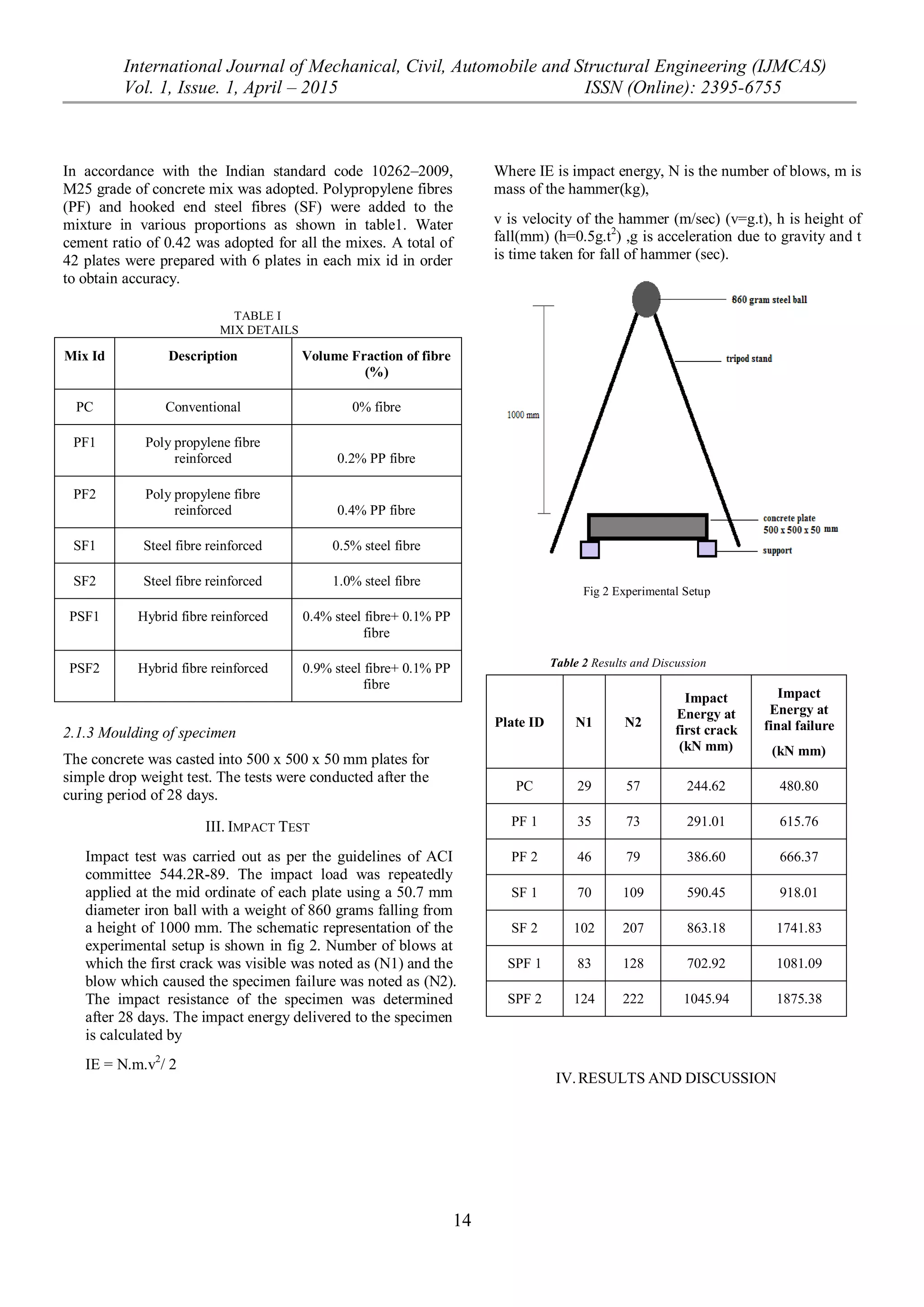
Impact test was carried out as per the guidelines of ACI
committee 544.2R-89. The impact load was repeatedly
applied at the mid ordinate of each plate using a 50.7 mm
diameter iron ball with a weight of 860 grams falling from
a height of 1000 mm. The schematic representation of the
experimental setup is shown in fig 2. Number of blows at
which the first crack was visible was noted as (N1) and the
blow which caused the specimen failure was noted as (N2).
The impact resistance of the specimen was determined
after 28 days. The impact energy delivered to the specimen
is calculated by
IE = N.m.v2
/ 2
Where IE is impact energy, N is the number of blows, m is
mass of the hammer(kg),
v is velocity of the hammer (m/sec) (v=g.t), h is height of
fall(mm) (h=0.5g.t2
) ,g is acceleration due to gravity and t
is time taken for fall of hammer (sec).
Fig 2 Experimental Setup
Table 2 Results and Discussion
Plate ID N1 N2
Impact
Energy at
first crack
(kN mm)
Impact
Energy at
final failure
(kN mm)
PC 29 57 244.62 480.80
PF 1 35 73 291.01 615.76
PF 2 46 79 386.60 666.37
SF 1 70 109 590.45 918.01
SF 2 102 207 863.18 1741.83
SPF 1 83 128 702.92 1081.09
SPF 2 124 222 1045.94 1875.38
IV.RESULTS AND DISCUSSION
International Journal of Mechanical, Civil, Automobile and Structural Engineering (IJMCAS)
Vol. 1, Issue. 1, April – 2015 ISSN (Online): 2395-6755
15
It can be seen from the figure 3, the mixes PF1, PF2, SF1 and
SF2 showed an increase in no of blows to first crack by 1.19,
1.58, 2.41 and 3.52 times compared to PC. Whereas the
hybrid fibre reinforced plates SPF1 and SPF2 showed an
increase of 2.87 and 4.28 times strength comparing to the
plain concrete plates. Similarly the mix PF1, PF2, SF1, SF2,
SPF1, SPF2 showed increase in number of cracks to failure by
1.28, 1.38, 1.90, 3.62, 2.24 and 3.90 times strength
respectively.
Comparing to the PC, the impact energy at first crack was
increasing 18.96%, 58.04%, 141.37%, 252.87%, 187.35%,
327.56% for PF1, PF2,SF1, SF2 SPF1and SPF2 respectively.
The hybrid fibre reinforced plates showed high performance,
thus required higher energy to break.
The increase in impact failure energy at failure was observed
by 28.07%, 38.59%, 90.93%, and 262.87% for PF1, PF2, SF1,
and SF2 respectively. Further it showed 124. 85%, 290.05%
increment in the SPF1, SPF2 respectively. From the results it
is evident that the addition of fibres increase the impact
resistance.The Impact failure energy values of concrete,
increased in the cases, PF, SF and SPF when compared to PC
and this increase in energy is slightly greater in case of SPF
when compared to SF and PF. Furthermore, it can be
concluded that the addition of steel fibre to concrete
significantly increases its impact resistance.
Fig 3. Impact energy versus mix id
V. CRACK PATTERN
The crack pattern for different proportions of fibre added is
shown in fig 4. The plate in which 0% fibres were added
brittle mode of failure was observed and it was broken into
two pieces. Adding the fibre to concrete lead to encounter
the ductile mode of failure and bridging the number of cracks
which displays the beneficial effects of adding fibre to
concrete.
Fig 4. Crack pattern of fibre reinforced plates of different proportions.
VI.CONCLUSIONS
The performance of fibre concrete plate under impact loads
was very positive especially in hybrid fibre reinforced
concrete including polypropylene and steel fibre. But hybrid
fibre was the more effective than polypropylene and steel
fibre. Under impact loading, a ductile failure was observed in
non fibrous concrete. The failure pattern of plate shows that
incorporation of polypropylene, steel and hybrid fibre as an
arrestor of crack propagation considerably improves the
ability of concrete to absorb kinetic energy.
REFERENCES
[1] Nataraja, M. C., Dhang, N. and Gupta, A., ―Statistical Variations in
Impact Resistance of Steel Fibre-Reinforced Concrete Subjected to Drop
Weight Test,‖ Cement and Concrete Research, Vol. 29, No. 7, pp. 989_ 995
(1999).
[2] Nataraja, M. C., Nagaraj, T. S. and Basavaraja, S. B., ―Reproportioning of
Steel Fibre Reinforced Concrete Mixes and their Impact Resistance,‖ Cement
and Concrete Research, Vol. 35, pp. 2350_2359 (2005).
[3] Lu, X. and Hsu, C., ―Behavior of High Strength Concrete with and
without Steel Fibre Reinforcement in Triaxial Compression,‖ Cement and
Concrete Research, Vol. 36, pp. 1679_1685 (2006).
[4] Taner Yildirim, S., Cevdet, E. and Fehim Findik, E., ―Properties of Hybrid
Fibre Reinforced Concrete under
Repeated Impact Loads,‖ Russian Journal of Nondestructive Testing, Vol. 46,
No. 7, pp. 538_546 (2010).
[5] Mohammadi, Y., Carkon-Azad, R., Singh, S. P. and Kaushik, S. K.,
―Impact Resistance of Steel Fibrous
Concrete Containing Fibres of Mixed Aspect Ratio,‖ Construction and
Building Materials, Vol. 23, pp. 183_189 (2009).
[6] Chen X. Y., Ding, Y. N. and Azevedo, C., ―Combined Effect of Steel
Fibres and Steel Rebars on Impact Resistance of High Performance
Concrete,‖ J Cent South Univ Technol, Vol. 18, pp. 1677_1684 (2011).
[7] Song, P.,Wu, J., Hwang, S. and Sheu, B., ―Assessment of Statistical
Variations in Impact Resistance of High- Strength Steel Fibre-Reinforced
Concrete,‖ Cement and Concrete Research, Vol. 35, No. 2, pp. 393_399
(2005).
[8] Atef, B., Ashraf, F. and Andrew, K., ―Statistical Variations in Impact
Resistance of Polypropylene Fibre-Reinforced Concrete,‖ International
Journal of Impact Engineering, Vol. 32, pp. 1907_1920 (2006).
International Journal of Mechanical, Civil, Automobile and Structural Engineering (IJMCAS)
Vol. 1, Issue. 1, April – 2015 ISSN (Online): 2395-6755
16
[9] G. Murali, A. S. Santhi and G. Mohan Ganesh, ―Effect of Crimped and
Hooked End Steel Fibres on the Impact Resistance of Concrete‖ Journal of
Applied Science and Engineering, Vol. 17, No. 3, pp. 259_266 (2014)
[10] G. Murali, A. S. Santhi and G. Mohan Ganesh, ―Empirical Relationship
between the Impact Energy and Compressive Strength for Fibre Reinforced
Concrete‖ Journal of Scientific & Industrial Research ,Vol. 73, July 2014, pp.
469-473
[11] Alavi Nia, A., Hedayatian, M., Nili, M. and Afrough Sabet, V., ―An
Experimental and Numerical Study on How Steel and Polypropylene Fibres
Affect the Impact Resistance in Fibre-Reinforced Concrete,‖ International
Journal of Impact Engineering, Vol. 46, pp. 62_73 (2012).
[12] Ahmed SFU, Maalej M, Paramasivam P. Flexural responses of hybrid
steel polyethylene fibre reinforced cement composites containing high volume
fly ash. Constr Build Mater 2007;21(5):1088–97.
[13] Banthia N, Gupta R. Hybrid fibre reinforced concrete (HyFRC): fibre
synergy in high strength matrices. Mater Struct 2004;37(10):707–16.
[14] Banthia N, Nandakumar N. Crack growth resistance of hybrid fibre
reinforced cement composites. Cem. Concr. Compos. 2003;25(1):3–9.
[15] Lawler JS, Wilhelm T, Zampini D, Shah SP. Fracture process of hybrid
fibre reinforced mortar. Mater Struct 2003;35(3):197–208

Iisrt prithvi elango (civil)

  • 1.
    International Journal ofMechanical, Civil, Automobile and Structural Engineering (IJMCAS) Vol. 1, Issue. 1, April – 2015 ISSN (Online): 2395-6755 13 Abstract— In this study, an experimental investigation on the impact resistance of fibre reinforced concrete (FRC) plates is done by us using a simple drop weight test. The testing procedure was recommended by ACI committee 544. For this purpose concrete plates were prepared at the size of 50cm x 50cm x 5cm. Two different fibres were used in this investigation such as polypropylene, hooked end steel fibre with the volume fraction of 0.2% and 0.4% for Polypropylene and 0.5% and 1.0% for Steel Fibre. The results indicated the addition of polypropylene and steel fibre into the concrete can enhance the impact strength of the concrete plates. Further, the steel fibres were efficient in arresting the cracks and polypropylene fibres in arresting the micro cracks. The specimen with 0.9% steel + 0.1% polypropylene hybrid concrete developed excellent impact energy which was so many times higher than the plain concrete. Keywords— Impact energy, Drop weight Test, Number of blows I. INTRODUCTION Brittleness of normal and high strength concrete increases with the increasing strength and it is considered as disadvantage, since it severely affects the performance of concrete especially under impact loads. In order to overcome this problem several research have been carried out to enhance the properties of normal and high strength concrete such as durability, ductility, flexural strength, fracture toughness, thermal and shock strength, resistance under dynamic, fatigue and impact load by inclusion of various type of fibres in concrete mixture [1-6]. The impact resistance of concrete can be determined by various test methods such as the explosive test, dropweight test and projectile impact test; suggested by different guidelines [7-10]. Alavi Nia et al. [11] developed a numerical simulation by examining the effect of different volume fractions of hooked end steel and polypropylene fibre on the impact strength. There are many studies about the influence of hybrid fibres on the fresh and hardened properties of normal concrete [12-15] II. EXPERIMENTAL WORK The main objective of our experimental work is to find out the impact resistance of the steel, polypropylene and hybrid fibre reinforced plates. 2.1 Materials 2.1.1 Cement, fine aggregate and coarse aggregate The Ordinary Portland Cement of 53 grade was used for all the mixes and the specific gravity of the cement was 3.15. Siliceous river sand passed through 4.75 mm IS sieve was used as the fine aggregate with specific gravity of 2.61.The hard broken stone passing through 20 mm IS sieve and retain on 12.5 mm IS sieve was used as the coarse aggregate with the specify gravity of the 2.70. 2.1.2. Fibre The hybrid fibres used in this study are shown in figure 1. (a) Hooked end steel fibres of length 30mm and diameter 0.5mm with Aspect ratio of 60 (b) Fibrillated multidimensional Poly propylene fibres of length 10-12mm.The specific gravity and tensile strength of steel fibres(SF) are 7.9 and 1100 Mpa and polypropylene fibres (PF) are 0.91 and 550 Mpa respectively. Fig 1. Steel and Polypropylene fibre 2.1.2 Water and Mixing Impact Resistance of Hybrid Fibre-reinforced concrete Plates 1 G.Murali, 2 Prithvi Elango 1,2 Department of Civil Engineering, Panimalar Engineering College, Chennai, INDIA
  • 2.
    International Journal ofMechanical, Civil, Automobile and Structural Engineering (IJMCAS) Vol. 1, Issue. 1, April – 2015 ISSN (Online): 2395-6755 14 In accordance with the Indian standard code 10262–2009, M25 grade of concrete mix was adopted. Polypropylene fibres (PF) and hooked end steel fibres (SF) were added to the mixture in various proportions as shown in table1. Water cement ratio of 0.42 was adopted for all the mixes. A total of 42 plates were prepared with 6 plates in each mix id in order to obtain accuracy. TABLE I MIX DETAILS Mix Id Description Volume Fraction of fibre (%) PC Conventional 0% fibre PF1 Poly propylene fibre reinforced 0.2% PP fibre PF2 Poly propylene fibre reinforced 0.4% PP fibre SF1 Steel fibre reinforced 0.5% steel fibre SF2 Steel fibre reinforced 1.0% steel fibre PSF1 Hybrid fibre reinforced 0.4% steel fibre+ 0.1% PP fibre PSF2 Hybrid fibre reinforced 0.9% steel fibre+ 0.1% PP fibre 2.1.3 Moulding of specimen The concrete was casted into 500 x 500 x 50 mm plates for simple drop weight test. The tests were conducted after the curing period of 28 days. III. IMPACT TEST Impact test was carried out as per the guidelines of ACI committee 544.2R-89. The impact load was repeatedly applied at the mid ordinate of each plate using a 50.7 mm diameter iron ball with a weight of 860 grams falling from a height of 1000 mm. The schematic representation of the experimental setup is shown in fig 2. Number of blows at which the first crack was visible was noted as (N1) and the blow which caused the specimen failure was noted as (N2). The impact resistance of the specimen was determined after 28 days. The impact energy delivered to the specimen is calculated by IE = N.m.v2 / 2 Where IE is impact energy, N is the number of blows, m is mass of the hammer(kg), v is velocity of the hammer (m/sec) (v=g.t), h is height of fall(mm) (h=0.5g.t2 ) ,g is acceleration due to gravity and t is time taken for fall of hammer (sec). Fig 2 Experimental Setup Table 2 Results and Discussion Plate ID N1 N2 Impact Energy at first crack (kN mm) Impact Energy at final failure (kN mm) PC 29 57 244.62 480.80 PF 1 35 73 291.01 615.76 PF 2 46 79 386.60 666.37 SF 1 70 109 590.45 918.01 SF 2 102 207 863.18 1741.83 SPF 1 83 128 702.92 1081.09 SPF 2 124 222 1045.94 1875.38 IV.RESULTS AND DISCUSSION
  • 3.
    International Journal ofMechanical, Civil, Automobile and Structural Engineering (IJMCAS) Vol. 1, Issue. 1, April – 2015 ISSN (Online): 2395-6755 15 It can be seen from the figure 3, the mixes PF1, PF2, SF1 and SF2 showed an increase in no of blows to first crack by 1.19, 1.58, 2.41 and 3.52 times compared to PC. Whereas the hybrid fibre reinforced plates SPF1 and SPF2 showed an increase of 2.87 and 4.28 times strength comparing to the plain concrete plates. Similarly the mix PF1, PF2, SF1, SF2, SPF1, SPF2 showed increase in number of cracks to failure by 1.28, 1.38, 1.90, 3.62, 2.24 and 3.90 times strength respectively. Comparing to the PC, the impact energy at first crack was increasing 18.96%, 58.04%, 141.37%, 252.87%, 187.35%, 327.56% for PF1, PF2,SF1, SF2 SPF1and SPF2 respectively. The hybrid fibre reinforced plates showed high performance, thus required higher energy to break. The increase in impact failure energy at failure was observed by 28.07%, 38.59%, 90.93%, and 262.87% for PF1, PF2, SF1, and SF2 respectively. Further it showed 124. 85%, 290.05% increment in the SPF1, SPF2 respectively. From the results it is evident that the addition of fibres increase the impact resistance.The Impact failure energy values of concrete, increased in the cases, PF, SF and SPF when compared to PC and this increase in energy is slightly greater in case of SPF when compared to SF and PF. Furthermore, it can be concluded that the addition of steel fibre to concrete significantly increases its impact resistance. Fig 3. Impact energy versus mix id V. CRACK PATTERN The crack pattern for different proportions of fibre added is shown in fig 4. The plate in which 0% fibres were added brittle mode of failure was observed and it was broken into two pieces. Adding the fibre to concrete lead to encounter the ductile mode of failure and bridging the number of cracks which displays the beneficial effects of adding fibre to concrete. Fig 4. Crack pattern of fibre reinforced plates of different proportions. VI.CONCLUSIONS The performance of fibre concrete plate under impact loads was very positive especially in hybrid fibre reinforced concrete including polypropylene and steel fibre. But hybrid fibre was the more effective than polypropylene and steel fibre. Under impact loading, a ductile failure was observed in non fibrous concrete. The failure pattern of plate shows that incorporation of polypropylene, steel and hybrid fibre as an arrestor of crack propagation considerably improves the ability of concrete to absorb kinetic energy. REFERENCES [1] Nataraja, M. C., Dhang, N. and Gupta, A., ―Statistical Variations in Impact Resistance of Steel Fibre-Reinforced Concrete Subjected to Drop Weight Test,‖ Cement and Concrete Research, Vol. 29, No. 7, pp. 989_ 995 (1999). [2] Nataraja, M. C., Nagaraj, T. S. and Basavaraja, S. B., ―Reproportioning of Steel Fibre Reinforced Concrete Mixes and their Impact Resistance,‖ Cement and Concrete Research, Vol. 35, pp. 2350_2359 (2005). [3] Lu, X. and Hsu, C., ―Behavior of High Strength Concrete with and without Steel Fibre Reinforcement in Triaxial Compression,‖ Cement and Concrete Research, Vol. 36, pp. 1679_1685 (2006). [4] Taner Yildirim, S., Cevdet, E. and Fehim Findik, E., ―Properties of Hybrid Fibre Reinforced Concrete under Repeated Impact Loads,‖ Russian Journal of Nondestructive Testing, Vol. 46, No. 7, pp. 538_546 (2010). [5] Mohammadi, Y., Carkon-Azad, R., Singh, S. P. and Kaushik, S. K., ―Impact Resistance of Steel Fibrous Concrete Containing Fibres of Mixed Aspect Ratio,‖ Construction and Building Materials, Vol. 23, pp. 183_189 (2009). [6] Chen X. Y., Ding, Y. N. and Azevedo, C., ―Combined Effect of Steel Fibres and Steel Rebars on Impact Resistance of High Performance Concrete,‖ J Cent South Univ Technol, Vol. 18, pp. 1677_1684 (2011). [7] Song, P.,Wu, J., Hwang, S. and Sheu, B., ―Assessment of Statistical Variations in Impact Resistance of High- Strength Steel Fibre-Reinforced Concrete,‖ Cement and Concrete Research, Vol. 35, No. 2, pp. 393_399 (2005). [8] Atef, B., Ashraf, F. and Andrew, K., ―Statistical Variations in Impact Resistance of Polypropylene Fibre-Reinforced Concrete,‖ International Journal of Impact Engineering, Vol. 32, pp. 1907_1920 (2006).
  • 4.
    International Journal ofMechanical, Civil, Automobile and Structural Engineering (IJMCAS) Vol. 1, Issue. 1, April – 2015 ISSN (Online): 2395-6755 16 [9] G. Murali, A. S. Santhi and G. Mohan Ganesh, ―Effect of Crimped and Hooked End Steel Fibres on the Impact Resistance of Concrete‖ Journal of Applied Science and Engineering, Vol. 17, No. 3, pp. 259_266 (2014) [10] G. Murali, A. S. Santhi and G. Mohan Ganesh, ―Empirical Relationship between the Impact Energy and Compressive Strength for Fibre Reinforced Concrete‖ Journal of Scientific & Industrial Research ,Vol. 73, July 2014, pp. 469-473 [11] Alavi Nia, A., Hedayatian, M., Nili, M. and Afrough Sabet, V., ―An Experimental and Numerical Study on How Steel and Polypropylene Fibres Affect the Impact Resistance in Fibre-Reinforced Concrete,‖ International Journal of Impact Engineering, Vol. 46, pp. 62_73 (2012). [12] Ahmed SFU, Maalej M, Paramasivam P. Flexural responses of hybrid steel polyethylene fibre reinforced cement composites containing high volume fly ash. Constr Build Mater 2007;21(5):1088–97. [13] Banthia N, Gupta R. Hybrid fibre reinforced concrete (HyFRC): fibre synergy in high strength matrices. Mater Struct 2004;37(10):707–16. [14] Banthia N, Nandakumar N. Crack growth resistance of hybrid fibre reinforced cement composites. Cem. Concr. Compos. 2003;25(1):3–9. [15] Lawler JS, Wilhelm T, Zampini D, Shah SP. Fracture process of hybrid fibre reinforced mortar. Mater Struct 2003;35(3):197–208