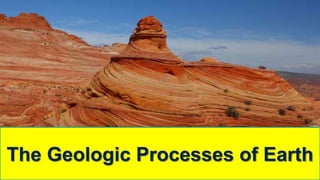
The Geologic Processes of Earth
A. I can distinguish the types of
weathering;
B. I can discuss the factors
affecting
C. I can describe how rocks
undergo
weathering;
D. I can perform an outdoor activity
“Treasure Rock Activity”; and
E. I can manifest appreciation
on
the product of weathering
through visual literacy.
EXOGENIC PROCESSES
1.Weathering
a.Physical Weathering
b.Chemical Weathering
EXOGENIC PROCESSES
2. Erosion
3. Mass Wasting
a. Fall
b. Slide
c. Avalanches
d. Flow
4. Sedimentation
♥ It is the disintegration of rocks,
soil, and minerals together with
other materials through contact
with Earth’s subsystems.
• is the breakdown of rocks by
mechanical forces concentrated
along rock fractures.
PROCESSES AND AGENTS OF
PHYSICAL WEATHERING
These are actions or things that break down
Earth materials
1. Frost wedging
2. Thermal expansion and contraction
3. Mechanical exfoliation
4. Plant growth
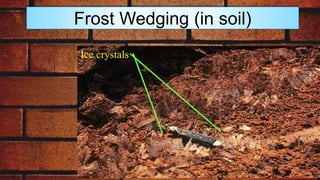
1. Frost Wedging
cracking of rock mass by the
expansion of water as it freezes in
crevasses and cracks
Expansion and contraction of rocks
eventually breaking them apart.
Frost Wedging (in soil)
Ice crystals
2. Thermal expansion and contraction
(Temperature)
–repeated heating and cooling of
materials cause rigid
substances to crack and
separate.
3. Mechanical Exfoliation
–Due to unloading, the sudden release
from pressure causes the formation of
fractures on rocks.
–Outer rocks generate onion-like layers
called sheet.
Dome Exfoliation
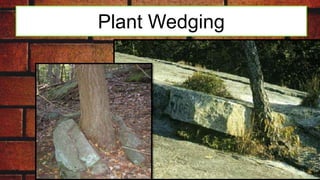
4. Plant Growth
• As plants such as trees send out root
systems, the fine roots find their way
into cracks in the rocks. As the roots
increase in size, they force the rock
sections apart, increasing the
separation and weathering.
Plant Wedging
• Is the process by which rocks
break down by chemical
reactions.
• Oxidation and hydrolysis and
carbonation are chemical
processes that contributed these
1. Oxidation – Oxygen combines with
minerals to form oxides.
(iron + oxygen = Rust)
Oxidation weakens the bedrock making it
softer.
Pyrite Oxidation
Pyrite
Limonite
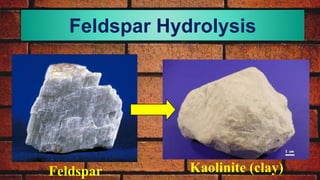
2. HYDROLYSIS
• minerals absorb water and
chemically change the
composition of the material
• these are generally not as
hard as the original material.
Feldspar Hydrolysis
Kaolinite (clay)Feldspar
Eg. granite contains mica.
Mica has a weak chemical composition and
absorb water.
Turns into clay
CARBONATION-When pollutants like Carbon
Dioxide, Nitrogen & Sulfuric Oxides mix
with rain water creating acid rain, which can
dissolve limestone and harm the living
environment.
“I Know it is…”
I know it is physical weathering because
.
I know it is chemical weathering because
.
I know it is weathering because .
Treasure Rock Activity
1. Go out of the classroom and look for rocks that
undergo weathering.
2. Identify the factors which contributed to the
weathering of the rock. Each member of the group
should have 1 specific type of rock to look for
during the activity.
Note: the students should take a photo of the
identified rock which will be presented inside the
classroom.
Treasure Rock Activity
3. Do the activity as fast as you can.
4. The group who finished the tasks in a short period
of
time will be given corresponding points.
Note: Only complete members who can gain points.
Answer the following questions: ( 5 points
each)
1.Physical weathering is an entirely different
process compared to chemical weathering.
How can these two processes work together
to speed up the weathering process?
2.Differentiate a desert and a rainforest in terms
of rate of chemical weathering.
STANDARDS 5 4 3 2 1
Content
Accuracy
All Concepts
are
informative,
clearly and
accurately
presented in
the
presentation
.
Most
concepts
are
informative,
clearly and
accurately
presented in
the
presentation
.
Some
concepts
are
informative,
clearly and
accurately
presented in
the
presentation
.
Concepts
are
informative,
and but not
accurately
presented in
the
presentation
.
Concepts
are lack
formation,
and not
accurately
presented in
the
presentation
.
Organizati
on
Concepts
are neatly
and nearly
organized
Most
concepts
are neatly
and nearly
organized
Some
concepts
are neatly
and nearly
organized
No concepts
are neatly
and nearly
organized
No concepts
are neatly
and nearly
organized
-Design a model that would
stimulate rapid and slow erosion.
-Bring the needed materials for
your model next meeting.
ASSIGNMENT: (By group)
A. I can differentiate erosion from
mass wasting;
B. I can classify mass wasting
according to its rate of
movement;
C. I can design a model that would
stimulate rapid and slow erosion;
and
D. I can internalize the factors in
preventing erosion.
Mass Wasting
• This refers to the movement of
large masses of materials
down slope or a steep-sided
hill or mountain due to the pull
of gravity.
MASS WASTING
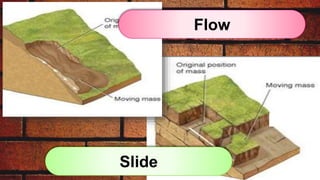
a. Fall
b. Slide
c. Avalanche
d. Flow
Avalanche
Fall
Flow
Slide
a. Falls
• Occur when materials
located in a steep slope
move downward without
contact with the ground until
they reach the foot of the
slope.
b. Slides
• Move the
materials as
one following a
near straight
line down the
slope.
Slumps
• Is a slow movement of soil
along a curved surface.
• In time, the area would look
curved because of the
depression formed by the
c. Avalanches
• Are the most rapid
moving type of mass
wasting where loose
materials move
incoherently or in
chaotic fashion.
d. Flows
• Are the movement of
materials when they
become saturated with
water thus moving like a
liquid.
EROSION
• It is the process by which
earth’s surface is worn away
by wind, water, or ice.
• Moves rock debris or soil from
one place to another
• Erosion by
different agents:
winds carry smaller
particles through
saltation and
bigger particles by
“I Know it is…”
• I know it is fall because .
• I know it is slide plowing because
.
• I know it is avalanche because
.
Erosion model
• With the same group, the student will
design a model that would stimulate rapid
(all soil washed away in 20 seconds) and
slow erosion (soil is transported in 1 min).
• 20 minutes is given to finish the task.
• 3-5 minutes to present
Content
Standard
Excellent Good Fair Poor
Content
Knowledge
Group members had a stronghold on
the content and context was
thoroughly addressed. No mistakes
were made with regard to content
knowledge. (10 points)
Both members had a solid
understanding of the content.
Content missing minor elements or
contained minor errors.
(8 points)
Group members had a
superficial understanding of the
content. Several mistakes were
made during the presentation.
(6 points)
Group members had little
or no knowledge of the
content addressed in the
presentation. (5 points)
Teamwork/
Participation
The group worked very well with
each other and the presentation was
shared equally among the group
members. (10 points)
The group worked well with each
other and communicated well. One
member participated slightly more
than the other. (8 points)
Group communicated relatively
well with a few lapses in the
presentation. One group
member dominated the
presentation. (6 points)
Group did not work well
together. There were
obvious
miscommunications and
lapses in the presentation.
(5 points)
Organization Presentation was very well organized
and very easy to follow. Transitions
between group members were well
planned and executed cleanly. (10
points)
Presentation was fairly organized
and pretty easy to follow. Transitions
might have been slightly
discontinuous; but did not greatly
take away from the presentation. (8
points)
Presentation was not clearly
organized. Transitions between
members were jumpy or
awkward. (6 points)
Presentation lacked
organization. Poor
transitions between group
members individual parts.
Presentation lacked order
and very difficult to
follow. (5 points)
Erosion
Model
The model was effective and water
poured through it was clear after it
ran through. The model is put
together well.
(20 points)
The model was effective and water
runs through clear, but was not
neatly or sturdily constructed. (18
points)
The model somewhat resisted
erosion, but water that runs
through it was slightly
discolored. (16 points)
The model was ineffective.
Soil washed away when
water was poured through
it.
(15 points)
Quiz
ASSIGNMENT
Read in advance effects of convection
current to the crust using photos
curated from http://bit.ly/28MuHCw
and http://bit.ly/28RySgM or just visit
your account in Edmodo.

Ii. b. exogenic processes

  • 7.
  • 8.
    A. I candistinguish the types of weathering; B. I can discuss the factors affecting
  • 9.
    C. I candescribe how rocks undergo weathering; D. I can perform an outdoor activity “Treasure Rock Activity”; and
  • 10.
    E. I canmanifest appreciation on the product of weathering through visual literacy.
  • 12.
  • 13.
    EXOGENIC PROCESSES 2. Erosion 3.Mass Wasting a. Fall b. Slide c. Avalanches d. Flow 4. Sedimentation
  • 14.
    ♥ It isthe disintegration of rocks, soil, and minerals together with other materials through contact with Earth’s subsystems.
  • 16.
    • is thebreakdown of rocks by mechanical forces concentrated along rock fractures.
  • 17.
    PROCESSES AND AGENTSOF PHYSICAL WEATHERING
  • 18.
    These are actionsor things that break down Earth materials 1. Frost wedging 2. Thermal expansion and contraction 3. Mechanical exfoliation 4. Plant growth
  • 19.
    1. Frost Wedging crackingof rock mass by the expansion of water as it freezes in crevasses and cracks Expansion and contraction of rocks eventually breaking them apart.
  • 21.
    Frost Wedging (insoil) Ice crystals
  • 22.
    2. Thermal expansionand contraction (Temperature) –repeated heating and cooling of materials cause rigid substances to crack and separate.
  • 23.
    3. Mechanical Exfoliation –Dueto unloading, the sudden release from pressure causes the formation of fractures on rocks. –Outer rocks generate onion-like layers called sheet.
  • 24.
  • 25.
    4. Plant Growth •As plants such as trees send out root systems, the fine roots find their way into cracks in the rocks. As the roots increase in size, they force the rock sections apart, increasing the separation and weathering.
  • 26.
  • 28.
    • Is theprocess by which rocks break down by chemical reactions. • Oxidation and hydrolysis and carbonation are chemical processes that contributed these
  • 30.
    1. Oxidation –Oxygen combines with minerals to form oxides. (iron + oxygen = Rust) Oxidation weakens the bedrock making it softer.
  • 31.
  • 32.
    2. HYDROLYSIS • mineralsabsorb water and chemically change the composition of the material • these are generally not as hard as the original material.
  • 33.
  • 34.
    Eg. granite containsmica. Mica has a weak chemical composition and absorb water. Turns into clay
  • 35.
    CARBONATION-When pollutants likeCarbon Dioxide, Nitrogen & Sulfuric Oxides mix with rain water creating acid rain, which can dissolve limestone and harm the living environment.
  • 36.
    “I Know itis…” I know it is physical weathering because . I know it is chemical weathering because . I know it is weathering because .
  • 37.
    Treasure Rock Activity 1.Go out of the classroom and look for rocks that undergo weathering. 2. Identify the factors which contributed to the weathering of the rock. Each member of the group should have 1 specific type of rock to look for during the activity. Note: the students should take a photo of the identified rock which will be presented inside the classroom.
  • 38.
    Treasure Rock Activity 3.Do the activity as fast as you can. 4. The group who finished the tasks in a short period of time will be given corresponding points. Note: Only complete members who can gain points.
  • 39.
    Answer the followingquestions: ( 5 points each) 1.Physical weathering is an entirely different process compared to chemical weathering. How can these two processes work together to speed up the weathering process? 2.Differentiate a desert and a rainforest in terms of rate of chemical weathering.
  • 40.
    STANDARDS 5 43 2 1 Content Accuracy All Concepts are informative, clearly and accurately presented in the presentation . Most concepts are informative, clearly and accurately presented in the presentation . Some concepts are informative, clearly and accurately presented in the presentation . Concepts are informative, and but not accurately presented in the presentation . Concepts are lack formation, and not accurately presented in the presentation . Organizati on Concepts are neatly and nearly organized Most concepts are neatly and nearly organized Some concepts are neatly and nearly organized No concepts are neatly and nearly organized No concepts are neatly and nearly organized
  • 41.
    -Design a modelthat would stimulate rapid and slow erosion. -Bring the needed materials for your model next meeting. ASSIGNMENT: (By group)
  • 44.
    A. I candifferentiate erosion from mass wasting; B. I can classify mass wasting according to its rate of movement;
  • 45.
    C. I candesign a model that would stimulate rapid and slow erosion; and D. I can internalize the factors in preventing erosion.
  • 46.
    Mass Wasting • Thisrefers to the movement of large masses of materials down slope or a steep-sided hill or mountain due to the pull of gravity.
  • 47.
    MASS WASTING a. Fall b.Slide c. Avalanche d. Flow
  • 48.
  • 49.
  • 50.
    a. Falls • Occurwhen materials located in a steep slope move downward without contact with the ground until they reach the foot of the slope.
  • 52.
    b. Slides • Movethe materials as one following a near straight line down the slope.
  • 53.
    Slumps • Is aslow movement of soil along a curved surface. • In time, the area would look curved because of the depression formed by the
  • 55.
    c. Avalanches • Arethe most rapid moving type of mass wasting where loose materials move incoherently or in chaotic fashion.
  • 56.
    d. Flows • Arethe movement of materials when they become saturated with water thus moving like a liquid.
  • 58.
  • 59.
    • It isthe process by which earth’s surface is worn away by wind, water, or ice. • Moves rock debris or soil from one place to another
  • 60.
    • Erosion by differentagents: winds carry smaller particles through saltation and bigger particles by
  • 61.
    “I Know itis…” • I know it is fall because . • I know it is slide plowing because . • I know it is avalanche because .
  • 62.
    Erosion model • Withthe same group, the student will design a model that would stimulate rapid (all soil washed away in 20 seconds) and slow erosion (soil is transported in 1 min). • 20 minutes is given to finish the task. • 3-5 minutes to present
  • 63.
    Content Standard Excellent Good FairPoor Content Knowledge Group members had a stronghold on the content and context was thoroughly addressed. No mistakes were made with regard to content knowledge. (10 points) Both members had a solid understanding of the content. Content missing minor elements or contained minor errors. (8 points) Group members had a superficial understanding of the content. Several mistakes were made during the presentation. (6 points) Group members had little or no knowledge of the content addressed in the presentation. (5 points) Teamwork/ Participation The group worked very well with each other and the presentation was shared equally among the group members. (10 points) The group worked well with each other and communicated well. One member participated slightly more than the other. (8 points) Group communicated relatively well with a few lapses in the presentation. One group member dominated the presentation. (6 points) Group did not work well together. There were obvious miscommunications and lapses in the presentation. (5 points) Organization Presentation was very well organized and very easy to follow. Transitions between group members were well planned and executed cleanly. (10 points) Presentation was fairly organized and pretty easy to follow. Transitions might have been slightly discontinuous; but did not greatly take away from the presentation. (8 points) Presentation was not clearly organized. Transitions between members were jumpy or awkward. (6 points) Presentation lacked organization. Poor transitions between group members individual parts. Presentation lacked order and very difficult to follow. (5 points) Erosion Model The model was effective and water poured through it was clear after it ran through. The model is put together well. (20 points) The model was effective and water runs through clear, but was not neatly or sturdily constructed. (18 points) The model somewhat resisted erosion, but water that runs through it was slightly discolored. (16 points) The model was ineffective. Soil washed away when water was poured through it. (15 points)
  • 64.
  • 65.
    ASSIGNMENT Read in advanceeffects of convection current to the crust using photos curated from http://bit.ly/28MuHCw and http://bit.ly/28RySgM or just visit your account in Edmodo.

Editor's Notes

  • #62 Saltation where the sediments particles bounces along the ground due to wind or water currents.