IMMUNOHISTOCHEMISTRY
IN HISTOLOGICAL
DIAGNOSIS
Dr. Sapana Bhandari
JR II Pathology
Dr. V.M.G.M.C. Solapur
INDEX
• DEFINITION
• PRINCIPLE
• TECHNIQUE
• CLASSIFICATION OF MARKERS
• APPLICATION IN NEOPLASTIC
CONDITIONS.
• APPLICATION IN INFECTIOUS DIS.
Immunohistochemistry
• Def- The method for in situ detection of
antigens in tissues by Ag-Ab recognition,
by using specificity provided by Ab with its
Ag at a light microscopic level.
• The site of antibody binding is identified by
tagging the antibody with a visible label as
antibody molecules cannot be seen by light
or electron microscope ie. Enzymes –
Horseradish peroxidase
Dr.Sonal Agrawal
PRINCIPLE
• The basic critical principle of IHC is sharp
localization of target components in the cell &
tissue, based on satisfactory signal to noise ratio.
• Amplifying the signal while reducing nonspecific
background staining (noise) is the major strategy.
Dr.Sonal AgrawalDr.Sonal Agrawal
SAMPLES FOR IHCSAMPLES FOR IHC
Immunohistochemistry can be performed onImmunohistochemistry can be performed on
Formalin fixed paraffin embedded sectionsFormalin fixed paraffin embedded sections
Frozen sectionsFrozen sections
SmearsSmears
ImprintsImprints
CytospinsCytospins
PREPARATION
• Fixation, dehydration, embedding
• FIXATION-
• 1. Freezing- Rapidly frozen tissue
* Adv- Superior preservation of antigens
Optimal reaction
* Disadv- Not routinely available
Morphology is not so good.
FIXATION
Other fixatives
Crosslinking fix. Microwave Coagulant fix.
irradiation fix.
10% formalin
Act- covalent crossli-
nking between macro-
molecules
Adv- Mcly used, inex-
pensive ,Morphology
is preserved.
Ethanol
Act- Precipitation
of protein
Adv-primary structure
is unmodified.
Disadv- LMW Ag lost
during fixation,
dislocation artifacts
Principle of cross linking fixatives &
Antigen Retrieval
Deleterious
effects of
formaldehyde
countered by
Antigen
retrieval in
attempts to
retrieve/unmask
target Ag.
Dr.Sonal AgrawalDr.Sonal Agrawal
METHODOLOGYMETHODOLOGY
1.1. Signal detectionSignal detection
2.2. Signal amplificationSignal amplification
3.3. Reducing the noise : Blocking ofReducing the noise : Blocking of
background stainbackground stain
a)a) Nonspecific antibody bindingNonspecific antibody binding
Dr.Sonal AgrawalDr.Sonal Agrawal
1. SIGNAL DETECTION METHODS1. SIGNAL DETECTION METHODS
Labeled methodLabeled method
Direct conjugate labeled methodDirect conjugate labeled method
Indirect conjugate labeled method (sandwich method)Indirect conjugate labeled method (sandwich method)
Avidin Biotin Method (Direct & Indirect)Avidin Biotin Method (Direct & Indirect)
Polyvalent methodPolyvalent method
Protein A MethodProtein A Method
Enzyme Labeled Antigen MethodEnzyme Labeled Antigen Method
Polymeric Labeling Two Step MethodPolymeric Labeling Two Step Method
Unlabeled methodUnlabeled method
Enzyme Bridge TechniqueEnzyme Bridge Technique
Paroxidase Antiperoxidase Technique (PAP)Paroxidase Antiperoxidase Technique (PAP)
Avidin Biotin Conjugate Procedure (ABC)Avidin Biotin Conjugate Procedure (ABC)
Biotin Streptavidin SystemsBiotin Streptavidin Systems
Alkaline Phosphatase Anti Alkaline Phosphtase method (APAAP)Alkaline Phosphatase Anti Alkaline Phosphtase method (APAAP)
Dr.Sonal AgrawalDr.Sonal Agrawal
Direct Conjugate Labeled Antibody MethodDirect Conjugate Labeled Antibody Method
One step methodOne step method
Labeled primary antibody reactsLabeled primary antibody reacts
directly with tissue antigensdirectly with tissue antigens
AdvAdv – short & quick– short & quick
DisadvDisadv ––
Less sensitiveLess sensitive
Require large number ofRequire large number of
conjugated primary antibodiesconjugated primary antibodies
Dr.Sonal AgrawalDr.Sonal Agrawal
Indirect or Sandwich ProcedureIndirect or Sandwich Procedure
Secondary antibody is raisedSecondary antibody is raised
to gamma globulin of theto gamma globulin of the
species producing primaryspecies producing primary
antibodyantibody
Secondary Ab is conjugatedSecondary Ab is conjugated
Adv –Adv –
Increased versatilityIncreased versatility
primary Ab can be used at aprimary Ab can be used at a
higher working dilutionhigher working dilution
Dr.Sonal AgrawalDr.Sonal Agrawal
Peroxidase Antiperoxidase MethodPeroxidase Antiperoxidase Method
Further development of indirect techniqueFurther development of indirect technique
It involves third layer of PAP complexIt involves third layer of PAP complex
This complex is made up of 2 Ab molecules & 3This complex is made up of 2 Ab molecules & 3
horseradish peroxidase moleculeshorseradish peroxidase molecules
Adv –Adv –
The sensitivity is about 100 to 1000 times higher sinceThe sensitivity is about 100 to 1000 times higher since
peroxidase molecule is not chemically conjugated to antiperoxidase molecule is not chemically conjugated to anti
IgG but immunologically bound & loses none of itsIgG but immunologically bound & loses none of its
enzymatic activityenzymatic activity
Allows use of much higher dilution of primary antibodiesAllows use of much higher dilution of primary antibodies
Disadv –Disadv –
Antibody incorporated into PAP reagent should be ofAntibody incorporated into PAP reagent should be of
same species as the primary antibodysame species as the primary antibody
Dr.Sonal AgrawalDr.Sonal Agrawal
Peroxidase Antiperoxidase MethodPeroxidase Antiperoxidase Method
Dr.Sonal AgrawalDr.Sonal Agrawal
Biotin Avidin ProcedureBiotin Avidin Procedure
This procedure exploits the high affinity binding betweenThis procedure exploits the high affinity binding between
biotin & avidinbiotin & avidin
Direct i.e. primary Ab is conjugated with biotinDirect i.e. primary Ab is conjugated with biotin
Indirect i.e. secondary Ab is conjugated with biotinIndirect i.e. secondary Ab is conjugated with biotin
Adv –Adv – RapidRapid
DisadvDisadv ––
 Different batches of biotin & different batches of avidinDifferent batches of biotin & different batches of avidin
have differing affinity for each otherhave differing affinity for each other
 Some tissues contain significant amount of endogenousSome tissues contain significant amount of endogenous
biotinbiotin
Dr.Sonal AgrawalDr.Sonal Agrawal
Biotin Avidin ProcedureBiotin Avidin Procedure
Dr.Sonal AgrawalDr.Sonal Agrawal
Avidin Biotin Conjugate MethodAvidin Biotin Conjugate Method
Standard methodStandard method
One of the widely used techniqueOne of the widely used technique
It involves three layersIt involves three layers
First layer of primary AbFirst layer of primary Ab
Second of biotinylated secondary AbSecond of biotinylated secondary Ab
Third is complex of avidin biotinThird is complex of avidin biotin
peroxidaseperoxidase
Lastly DAB/other substrate isLastly DAB/other substrate is
added to develop colored productsadded to develop colored products
Dr.Sonal AgrawalDr.Sonal Agrawal
Indirect Biotin Avidin Method
Avidin Biotin Conjugate Method
Dr.Sonal AgrawalDr.Sonal Agrawal
Double Staining MethodDouble Staining Method
Technique to visualizeTechnique to visualize
more than one antigenmore than one antigen
- sequentially- sequentially
-simultaneously-simultaneously
Enzyme labeled antigenEnzyme labeled antigen
method is usedmethod is used
Two antigens are stainedTwo antigens are stained
simultaneously withinsimultaneously within
same section using twosame section using two
labeled antigenslabeled antigens
Dr.Sonal AgrawalDr.Sonal Agrawal
Enhanced Polymer One Step Staging MethodEnhanced Polymer One Step Staging Method
Novel technology reported byNovel technology reported by
Pluzek et alPluzek et al
A large number of primaryA large number of primary
antibody molecules &antibody molecules &
peroxidase enzymes areperoxidase enzymes are
attatched to dextran polymerattatched to dextran polymer
Adv: more rapidAdv: more rapid
more sensitivemore sensitive
less time is requiredless time is required
Dr.Sonal AgrawalDr.Sonal Agrawal
DAKO EnVision polymeric method
Mirror Image Complementary
Antibody labeling method (MICA)
Dr.Sonal AgrawalDr.Sonal Agrawal
Enzyme Bridge Method labeled Antigen Method
Protein A –PAP Method APAAP Method
Dr.Sonal AgrawalDr.Sonal Agrawal
2. Amplification Methods2. Amplification Methods
CARD (Catalyzed Reporter Deposition technique)CARD (Catalyzed Reporter Deposition technique)
TSA (Tyramine Signal Amplification)TSA (Tyramine Signal Amplification)
Dr.Sonal AgrawalDr.Sonal Agrawal
3a. Blocking of nonspecific antibody3a. Blocking of nonspecific antibody
bindingbinding
 Mainly a problem with polyclonal antibody as multipleMainly a problem with polyclonal antibody as multiple
unwanted antibodies may exist in antiserumunwanted antibodies may exist in antiserum
• Use greater optimal working dilutions of antibodyUse greater optimal working dilutions of antibody
• Preincubate the tissue section with normal serum from the samePreincubate the tissue section with normal serum from the same
species of animal in order to occupy unwanted binding sitesspecies of animal in order to occupy unwanted binding sites
 Antibodies are highly charged molecule & may bindAntibodies are highly charged molecule & may bind
nonspecifically to tissue components bearing reciprocalnonspecifically to tissue components bearing reciprocal
chargecharge
• Preincubate with normal serumPreincubate with normal serum
Dr.Sonal AgrawalDr.Sonal Agrawal
3b. Blocking of endogenous enzymes3b. Blocking of endogenous enzymes
Enzymes like peroxidase are preserved in both paraffinEnzymes like peroxidase are preserved in both paraffin
& frozen sections& frozen sections
Peroxidase is present normally inPeroxidase is present normally in
erythrocytes,neutrophils ,eosinophils & hepatocyteserythrocytes,neutrophils ,eosinophils & hepatocytes
Peroxidase blocking step should be performedPeroxidase blocking step should be performed
-Incubation in methanol/ H2O2-Incubation in methanol/ H2O2
-Use alternative methods ( immunogold / glucose oxidase-Use alternative methods ( immunogold / glucose oxidase ))
Dr.Sonal AgrawalDr.Sonal Agrawal
Fixation for immunocytochemistry andFixation for immunocytochemistry and
cryostat tissue:cryostat tissue:
1 FNAC slides and cytospin sections should be1 FNAC slides and cytospin sections should be
fixed in ether alcoholfixed in ether alcohol
2 Cryostat sections should be fixed in cold2 Cryostat sections should be fixed in cold
acetoneacetone
Dr.Sonal AgrawalDr.Sonal Agrawal
IHC REACTION ASSESSMENTIHC REACTION ASSESSMENT
1.1. Qualitative:Qualitative:
a. Pa. Presence or absence of reactionresence or absence of reaction
b. Types of reaction patternb. Types of reaction pattern
Nuclear, cytoplasmic & membranousNuclear, cytoplasmic & membranous
Dr.Sonal AgrawalDr.Sonal Agrawal
2. Quantitative (Immunoscores):2. Quantitative (Immunoscores):
Predominantly used in ER PR receptorsPredominantly used in ER PR receptors
Based on intensity of staining & percentage of positiveBased on intensity of staining & percentage of positive
cellscells
Scoring systems: H score, Quick score, Allred scoreScoring systems: H score, Quick score, Allred score
Recently importance of scoring is undermined (weakRecently importance of scoring is undermined (weak
ER stain & staining in 1to 10% cells are enough to startER stain & staining in 1to 10% cells are enough to start
treatment)treatment)
IHC REACTION ASSESSMENTIHC REACTION ASSESSMENT
Dr.Sonal AgrawalDr.Sonal Agrawal
REPORTINGREPORTING
1.1. Patient demographics & specimen identification dataPatient demographics & specimen identification data
2.2. Reference to diagnostic problem (that is differential diagnosis)Reference to diagnostic problem (that is differential diagnosis)
3.3. Nature of specimen analyzed (Frozen, FNAC/paraffin section)Nature of specimen analyzed (Frozen, FNAC/paraffin section)
4.4. Statement of all stains used with details of all primary antibodiesStatement of all stains used with details of all primary antibodies
(designate specificity & clone where appropriate)(designate specificity & clone where appropriate)
5.5. Findings both positive & negative, for all stains; sufficient detailsFindings both positive & negative, for all stains; sufficient details
of patterns & controls to justify the interpretationof patterns & controls to justify the interpretation
6.6. The immunohistochemistry should not stand alone but should beThe immunohistochemistry should not stand alone but should be
integrated into the final surgical pathology reportintegrated into the final surgical pathology report
Immunohistochemical markers
Common Panels of IHC stains
Epithelial
LMW-k
(CAM5.2),
AE1-AE3 CK cocktail,
CK7, CK20, CEA,
EMA
Mesenchymal
Vimentin
S100
Endothelial
CD34,CD31,
Factor VIII
ulex europaeus
Muscle
Desmin,
Myoglobin
Actin
Melanocytic
HMB45
S100
Melan-A,
MART-1
Neuroendocrine
NSE,
chromogranin,
Synaptophysin
Fibrohistio-
cytic
CD68,
lysozyme,
HAM 56,
CD1a(Lang-
erhans).
Lymphoid
Bcell-LCA/CD45,
CD20
T cell-LCA,CD3
Hodgkins- Ki1, CD15
L26,BLA36, CD30
Neuronal
NF,GFAP,
S100
Leu7
Other markers-
Ewings, PNET- MIC-2(o-13/CD99)
Hormone receptors-ER/PR/AR
Germ cell-AFP,HCG, PLAP
Cell Proliferation-Ki67, PCNA
Oncogenes/tumor supressor-Her 2neu,
p53,RAS,bcl-2,Rb.WT1
Metastatic potential-Laminin, collagen, cathepsin D
Tissue specific epithelial markers
Breast-GCDFP-15
Prostate-PAP,PSA
Liver- AFP, Hep Par1
Thyroid-TG, Calcitonin
Mesothelium-Keratin
Ovary- CA 125
Vimentin
Intermediate fil.
Mesenchymal tissue
Endothelial cells,
Fibroblast,
vascular
smooth muscle
Mesenchymal
tumors
Renal cell
carcinoma
Mesenchymal markers
Muscle Specific Markers
Desmin
Intermediate
filament
Smooth muscle-
cytoplasmic dense
bodies
Striated muscle-
sarcomeric Z disc
Myoblast,
myofibroblast-variable
fetal mesothelial cells
Endometrial stromal
cells
Leiomyoma
Rhabdomyoma,
Rhabdomyosarcoma
Desmoplastic small
round cell tumor
Endometrial stromal
sarcoma
PNET
Actin
2 imp Isomers-
• Muscle specific
• Smooth muscle
actin
Myoepithelial
cells
Vascular
smooth
muscle
Pericytes
Myofibroblasts
RMS, LMS,
Fibromatosis,
myoepithelioma
Angiomyolipoma
Adenoid cystic
carcinoma
Inflammatory
myofibroblastic
tumor
Myogenin Skeletal muscle
(expressed only in
early
differentiation).
RMS(sensitive
& specific),
regenerative
skeletal muscle
Muscle markers
Actin in myoepithelial cells Myoglobin in MMMT
Melanocytic Markers
S100
Intracellular Ca
binding protein,
Soluble in 100%
amm.sulphate sol.
Localised in cytopl
asm & nucleus
Glial cell
Schwann cell
Melanocytes
Chondrocytes
Adipocytes
Myoepithelial
cell
Histiocyte
Melanoma,MPN
ST-variable,
Clear cell
sarcoma,
Schwannoma,
Malignant glioma
Rare-
Leiomyosarcoma,
synovial
sarcoma,
chondosarcoma
S100- Both nuclear & cytoplasmic staining
Chondrosarcoma Malignant melanoma
HMB-45
immature
melanosomes
Melanocytes
Melanoma, Spitz nevi,
cellular nevi, pigmented
nerve sheath tumors,
angiomyolipoma,
tuberous sclerosis
complex components,
clear cell tumor of lung,
lymphangiomyomatosis.
Melan A/
MART 1
Sensitive & specific
-Melanoma
Sentinel lymph nodes
Adrenal cortical tumors
Sex cord stromal tumors
HMB 45 staining
Isolated melanoma cells in
sentinel lymph node- HMB 45
Neuroendocrine Markers
Neuron specific
Enolase (NSE)
Gamma gamma
isoenzyme
Glycolytic enzyme
2PGL PEP
Neurons
Neuroendocrinal
cells
Neuroectodermal
&
Neuroendocrinal
tumors,
Melanoma
Synaptophysin
Presynaptic
vesicles
Neuroendocrinal
tumors
Leu 7/CD57
T cell Ag
Indicative of NK
cell activity
Myelin of
CNS/PNS,
Neuroendocrine
cells
MPNST,
Carcinoids,
Pheochromocytoma,
Small cell Ca of
lung
Chromogranin
Loc.-secretory
granules of
neuroendocrinal cells
Neuroendocrinal tumors
Chromo. A-Gastric & appendiceal
carcinoid
Chrom. B-Rectal carcinoid,
prolactinoma
To diff b/w adrenal cortical Ca &
pheochromocytoma
Carcinoid tumour stomach Paraganglioma
Endothelial Markers
CD34
Hematopoietic
stem cell Ag
Endothelial cells,
mesenchymal cells
Angiosarcoma,
Kaposi Sarcoma
DFSP, Spindle cell
lipoma, Solitary
fibrous tumor.
CD31
PECAM-1
Endothelial cells,
Megakaryocytes,
Platelets, other
hematopoietic
elements
Angiosarcoma,
Hemangioma,
Hemangioendothel
ioma.
VWF
Factor VIII
related Ag
Endothelial cells
Megakaryocytes
Vascular
tumors
Factor VIII related Antigen
epithelioid vascular tumor. Kaposi sarcoma
Ulex
Europaeus I
agglutinin
Lectin produced by
a gorse plant
Vascular
neoplasm.
Thrombo-
modulin
Endothelial
cells,
mesothelial
cells,
osteoblasts,
monocytes
Sensitive in
poorly
differentiated
vascular
malignancies.
Ulex Europaeus I agglutinin
Vascular invasion of breast ca
Neuronal Markers
Neurofilament
Protein
Neuronal cells
Small round cell tumors
Neuroblastoma
Medulloblastoma
retinoblastoma
Peripheral
neuroepithelioma
Merkel cell tumors
Carcinoid
Parathyroid tumors
GFAP
Intermediate fil.
Astrocytes
Ependymal
cells
CNS tumors
Schwannoma
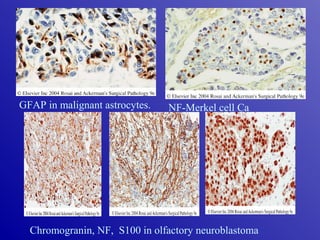
GFAP in malignant astrocytes. NF-Merkel cell Ca
Chromogranin, NF, S100 in olfactory neuroblastoma
CD99-
•Transmembrane Protein
•Encoded by MIC- 2 gene
•Expressed in all hematopoietic cells except
neutrophils, plasma cells, cortical thymocytes.
•Important to diagnose small round cell tumors-
100% expressed in Ewings sarcoma/PNET
100% not expressed in neuroblastoma.
•Other tumors - synovial sarcoma, vascular tumors.
CD99 -membrane reactivity in
Ewings/PNET
Collagen
type IV
Predominant
component of
basement membrane
Complete BM
around endothelial
cells, smooth
muscle cells,
Schwann cells,
glands
To diff. In
situ/invasive
carcinomas,
To diff. B/W
MPNST & MFH.
Malignant soft tissue round cell tumors
• Small cell carcinoma
• Polyphenotypic small cell tumor
• Lymphoma
• Melanoma
• Rhabdomyosarcoma
• Ewing’s sarcoma / PNET
• Desmoplastic small round cell tumor
• Round cell liposarcoma.
• Small cell osteosarcoma.
Diagnosis of malignant soft tissue round cell tumors
Sarcomas with spindle appearance
• Synovial sarcoma
• Sarcomatoid carcinoma
• Fibrosarcoma, Fibromatosis
• Angiosarcoma
• MPNST, Cellular Schwannoma
• MFH
• Leiomyosarcoma, Spindle cell RMS
• Melanoma
• Clear cell sarcoma
Diagnosis of sarcomas with spindle appearance
Malignant soft tissue epithelioid tumors
• Alveolar soft part sarcoma
• Angiosarcoma
• Leiomyosarcoma, GIST
• MFH
• Melanoma
• Synovial Sarcoma
• Malignant Mesothelioma
• Malignant Rhabdoid Tumor
Diagnosis of malignant soft tissue epithelioid tumors
Malignant soft tissue pleomorphic tumors
• MFH
• Pleomorphic liposarcoma
• Pleomorphic RMS
• Pleomorphic MPNST
• Pleomorphic Leiomyosarcoma.
Diagnosis of Malignant soft tissue pleomorphic tumors
Epithelial Markers
Cytokeratin
EMA
Epithelial
membrane
antigen
Glycoprotein
Apical surface
of most
glandular
epithelial cells.
Adeno Ca of breast,
lung, bile ducts,
pancreas, endocervix,
thyroid, salivary glands
Skin & adneaxal tumors
Synovial sarcoma,
epithelioid sarcoma,
plasmacytoma.
AFP
Major oncofetal
Protein
Fetal Gut, Liver,
Yolk Sac
HCC, Yolk
Sac Tumor,
Non
seminomatous
germ cell
Tumors
HCG
PLAP
Choriocarcinoma,
Syncytiotrophob-
last cells in
seminomas,
embryonal/yolk
sac tumors.
Most germ cell
tumors-
Seminomas.
Infantile germ
cells
Germ cell Tumours
• Seminoma: CAM 5.2 - ve, PLAP +ve, OCT4 +ve,
EMA-ve
• Embryonal carcinoma: CAM 5.2 +ve, PLAP +ve, OCT
4 +ve, EMA -ve, AFP +/-ve
• Yolk sac carcinoma: CAM 5.2 +ve, PLAP +ve, EMA
-ve, AFP +ve, OCT 4 -ve
• Choriocarcinoma: CAM 5.2 +ve, PLAP+/-, EMA +/-,
HCG +ve, OCT 4 -ve
HCG +ve in seminoma
with trophoblastic giant
cells.
PLAP +ve in tumor cells of
intratubular germ cell
neoplasia.
HCG
CEA- +ve in colorectal Ca, Ductal Ca breast,
Lung Ca, HCC- pericanalicular
Hep Par1 Granular cytoplasm staining
Most HCC
Villin- Actin binding protein in brush border of
intestine
+ve in colorectal carcinoma, HCC
(canalicular), Lung Ca.
CDX2- Encodes transcription factor for
intestinal epithelium.
+ve in colorectal Ca, Duodenal Ca, Bladder adenoca,
ovarian mucinous tumors, colloid Ca of lung.
Canalicular formation in
HCC -demo. By CEA,
which are diff. From
sinusoids of normal liver.
Luminal staining in glandular
structures of adenosquamous
carcinoma.
CEA
TTF-1 Thyroid follicular
& parafollicular C
cells,
Type II
pneumocytes, Clara
cells
Thyroid Ca
Primary Lung Ca
-ve in pulmonary
metastasis
/mesothelioma.
Thyroglobulin Thyroid
follicular cells
Thyroid
carcinoma.
Thyroglobulin staining in
poorly diff. Carcinoma of
thyroid.
PSA Formed exclusively by
prostatic epithelial cells.
Prostatic tumors,
BHP,
Salivary, breast,
bladder adenoca.
Intensityœ diff.
PSMA
Highly specific BHP, Prostatic
tumorsIntensity œ1/ diff.
GCDFP-15
Breast cystic fluid,
cells with apocrine
features
Breast Ca,
Pagets disease of
skin,
vulva.Salivary
gland Ca,
Prostate Ca.
Fibroadenoma with
apocrine metaplasia
Mets-AdenoCa Mesothelioma
B72.3Ab +nt -ve
Ber EP4 Diffuse +ve Focal +ve/- ve
WT 1 -ve +ve
(nuclear (sensitive & specific)
staining) Also +ve in ovarian serous Ca
Calretinin -ve +ve.
(N- neurons, renal convoluted tubules,
steroid producing cells)
Calretinin in mesothelioma-
nuclear & cytoplasmic
reactivity.
Reactive mesothelial cells
CK5/6
Mesothelioma
CK7
CK20
Transitional cell carcinoma - Bladder
Paget’s disease
CK7
CEA
GCDFP
Pediatric Neoplasms
1.NBL NSE, SYN, CMG, NF, CD56/57
2.RMS Myogenin, Myo-D, Desmin, Muscle
specific actin, WT
3.Ewings/PNET Vimentin, SYN, CD99, FLI-1,NSE
4.Desmoplatic Cytokeratin, EMA, Vimentin,
small RCT Desmin, WT, CD99, NSE
5.Malignant Vimentin, MSA, synaptophysin
Rhabdoid T. S100, CD99, NSE, Keratin
6.Wilms Tumor Blastemal-vimentin, Desmin
Epithelial- cytokeratin
Mesenchymal- variable acc. To
differentiation pattern
Desmoplastic small round cell tumour
Keratin Desmin NSE
Diagnosis of head & neck
endocrine tumors.
CK
Chromogranin
Synaptophysin
S 100
Paraganglioma
TTF1
TGB
CGN
Calcitonin
PTH
TTF +
TGB +
CGN +
calcitonin +
PTH -ve
Mixed follicular
C cell tumor
Thyroid follicular
cell tumor
TTF +
TGB+
CGN -ve
PTH -ve
Calc -ve
Medullary Ca
TTF+
CGN +
Calc +
TGB -ve
PTH -ve
TTF +
CGN +
Calc +/-
Metast. NE lung Ca
CGN+, PTH+
Parathyroid
Ca
-ve
+ve
Medullary carcinoma of thyroid.
Calcitonin CGN CEA
Applications in carcinoma of
breast
I. Hormone Receptors
• ER/PR-nuclear staining , normal breast acini
• varies with menstrual cycle
• Total score= % positive nuclei with intensity of
nuclear staining
• Any nuclear staining = positive, good prognosis
ER +ve invasive breast ca
ER/PR semiquantitation
Her-2/ neu
• Member of tyrosine kinase receptor family
• over-expression-- poor outcome
• current use- predictor of response to doxorubicin
chemotherapy,
• to determine which pts would response to trastuzumab
(herceptin) therapy
• FISH-advantage-
detects gene amplification
• CISH replacing FISH
II. E-cadherin
• Calcium dependent trans-membrane protein
• loss mets & poor survival
• crisp, intense cell memb staining
• lobular lesions-in situ / invasive lack it
completely,decreased /focal memb staining
may be seen in high grade ductal ca
III. To differentiate b/w in
situ & invasive ductal Ca
SMA
AE 1/AE3
IV. To detect metastasis
sentinel lymph node.
CD 117-
Encoded by proto-oncogene C-KIT
Transmembrane tyrosine kinase family.
Expressed normally in mast cells, melanocytes, germ
cells, interstitial cells of Cajal
Expressed in Systemic mastocytosis, small cell lung
cancer, germ cell tumors & sensitive marker for GIST.
Epithelioid GIST - CD117 is -ve
Other markers for GIST- CD34, CD99, smooth muscle
actin.
Immunoreactivity for CD117
in GIST
CD117- in
seminoma
Ki- 67/ MIB 1- Proliferation Marker
Recognised nuclear protein involved in proliferating
cells.
Expression ass. With p53 exp. Tumor grade, pt.
Prognosis.
Normal cervix HSIL
Hyperplastic polyp
Proliferating cells-MIB1+ve
Cells restricted to basal part
only.
Tubular adenoma
Proliferating epithelium
also at luminal surface.
B cell markers
CD19- Earlier marker of lineage- not useful.
CD 20- +nt in cell throughout differentiation
+ve in all mature B cell neoplasm(except
Plasma cells). RS cells in 25% cases
CD21- Follicular dendritic cells & some B
lymphocytes
+ve in Follicular lymphoma, Angio-
immunoblastic T cell lymphoma (Dendr-
itic cells).
Follicular Lymphoma
CD20 in neoplastic
cells
CD 3 in non neoplastic
T cells
CD21 in dendritic
follicular cells
CD 23- +ve in B cell CLL/SLL
-ve in Mantle cell lymphoma
CD 79a- + ve Precursor Bcell LL &
in Mature B cell LL
Ig Light chain-
Lambda in plasmacytoma
B cell markers
T cells
CD2, CD3- +ve in T cell lymphoma
CD5- Present on most thymocytes & immature
peripheral T cells.
+ve in B- CLL /SLL, Mantle
cell lymphoma.
-ve in Follicular & marginal cell
lymphoma.
+ve in Thymic carcinoma.
Other markers
CD43- +ve in Most T cell malignancies,
group of small lymphocyte B cell
CLL/SLL, Mantle cell lymphoma
-ve in Follicular lymphoma
CD45- Pan cell marker Found on all
leucocytes.
RA RB RC RO
B lymph. +nt widespread Myeloid &
T cells.
LCA - AB mixture to CD 45- +ve in all
lymphomas except ALCL, HL.
Large T cell lymphoma
CD43 +ve Lysozyme +ve of
reactive histiocytes
ALK +ve in ALCL
(Anaplastic lymphoma kinase gene)
Cyclin D1- Cell cycle regulatory nuclear protein
+ve in mantle cell lymphoma, hairy cell
leukemia, plasma cytoma.
-ve in B-CLL/SLL.
Bcl-2- Antiapoptotic gene-
normally in follicular mantle B
lymphocytes, occ.germinal cemtres.
+ve in follicular lymphoma
Other markers
ALK +ve in anaplastic large
cell lymphoma
CD30 in Anaplastic large
cell lymphoma
Bcl 6- Nucleus of lymphocyte in germinal centre
+ve in most B cell lymphoma
-ve in follicular lymphoma progression.
CD 10 Markers of germinal centre origin
(CALLA) Precursor B cell lymphoma,
Burkitts lymphoma., Follicular lymphoma.
Tdt- DNA polymerase
Early B & T lymphoblast
Sensitive & specific for lymphoblastic
lymphoma.
Other markers
CD19 +ve
CD20 +ve
Mantle cell
Lymphoma
Follicular cell
lymphoma
B-CLL/SLL
CD5+ve
Cyclin D1 +ve
CD23 -ve
CD5- ve
Bcl2 +ve
Bcl6 +ve
CD5 +ve
Cyclin D1 -ve
CD23 + ve
Non- Hodgkins Lymphoma
CD15- Lewis X Ag
Stains membranous paranuclear dot like,
golgi localization.
Specific marker of RS cells of classical HL
-ve in most NHL.
CD30 ALCL,
Classical HL
(TNF receptor family)
Other markers
LCA -ve
CD15+ve
CD30 +ve
CD 20
Classical HL
CD15 -ve/+ve
CD30-ve
CD 43/CD 2/CD 3
Keratin/ S100 ALCL
Embryonal Ca
Pancreatic Ca
Malignant Melanoma
CD15 -ve
CD30 +ve
+ve
+ve -ve
+ve-ve
+ve
-ve
Keratin
Carcinoma/ Sarcoma
+ve
-ve
CD30 in HL
EBV/ LMP1 Ag
in HL
Application in Infectious diseases
• Viral infection-HBV, HCV, HHV8, HSV,
Adenovirus, CMV,HPV,Rabies, Parvovirus B19
• Bacterial infection-H pylori, Rickettsia,
Bartonella, Leptospira.
• Fungi & parasite-aspergillus, Pneumocystis
carinii, toxoplasma, cryptosporidium.
HbSAg localized in variable
quantity in cytoplasm & cell
membrane of hepatocytes.
Positive cytoplasmic granules
in every periportal hepatocytes.
H-pylori in
superficial mucus
in chr gastritis
Advantages-
• Can be done on paraffin embedded tissue
• Allows microbiologic & morphologic
correlation
• Provides diagnosis when fresh tissue not
available.
• Sensitive & specific.
Facts About IHC
• Diagnosis should be based on clinical
history, radiological finding, H & E
morphology with confirmation by IHC
testing.
• Use of a panel of IHC stains rather than
over-reliance on a single Ab is an important
principle.
• Detection of infectious agents/
identification of physiologic substances in
aberrant locations directly determine
diagnosis.
Facts About IHC
• Negative immunoreaction in IHC never
rules out a diagnosis.
• Key is- to utilise IHC as cost effective tool
in patient care.
p-53

Ihc no dread

  • 1.
    IMMUNOHISTOCHEMISTRY IN HISTOLOGICAL DIAGNOSIS Dr. SapanaBhandari JR II Pathology Dr. V.M.G.M.C. Solapur
  • 2.
    INDEX • DEFINITION • PRINCIPLE •TECHNIQUE • CLASSIFICATION OF MARKERS • APPLICATION IN NEOPLASTIC CONDITIONS. • APPLICATION IN INFECTIOUS DIS.
  • 3.
    Immunohistochemistry • Def- Themethod for in situ detection of antigens in tissues by Ag-Ab recognition, by using specificity provided by Ab with its Ag at a light microscopic level. • The site of antibody binding is identified by tagging the antibody with a visible label as antibody molecules cannot be seen by light or electron microscope ie. Enzymes – Horseradish peroxidase
  • 4.
    Dr.Sonal Agrawal PRINCIPLE • Thebasic critical principle of IHC is sharp localization of target components in the cell & tissue, based on satisfactory signal to noise ratio. • Amplifying the signal while reducing nonspecific background staining (noise) is the major strategy.
  • 5.
    Dr.Sonal AgrawalDr.Sonal Agrawal SAMPLESFOR IHCSAMPLES FOR IHC Immunohistochemistry can be performed onImmunohistochemistry can be performed on Formalin fixed paraffin embedded sectionsFormalin fixed paraffin embedded sections Frozen sectionsFrozen sections SmearsSmears ImprintsImprints CytospinsCytospins
  • 6.
    PREPARATION • Fixation, dehydration,embedding • FIXATION- • 1. Freezing- Rapidly frozen tissue * Adv- Superior preservation of antigens Optimal reaction * Disadv- Not routinely available Morphology is not so good.
  • 7.
    FIXATION Other fixatives Crosslinking fix.Microwave Coagulant fix. irradiation fix. 10% formalin Act- covalent crossli- nking between macro- molecules Adv- Mcly used, inex- pensive ,Morphology is preserved. Ethanol Act- Precipitation of protein Adv-primary structure is unmodified. Disadv- LMW Ag lost during fixation, dislocation artifacts
  • 8.
    Principle of crosslinking fixatives & Antigen Retrieval Deleterious effects of formaldehyde countered by Antigen retrieval in attempts to retrieve/unmask target Ag.
  • 9.
    Dr.Sonal AgrawalDr.Sonal Agrawal METHODOLOGYMETHODOLOGY 1.1.Signal detectionSignal detection 2.2. Signal amplificationSignal amplification 3.3. Reducing the noise : Blocking ofReducing the noise : Blocking of background stainbackground stain a)a) Nonspecific antibody bindingNonspecific antibody binding
  • 10.
    Dr.Sonal AgrawalDr.Sonal Agrawal 1.SIGNAL DETECTION METHODS1. SIGNAL DETECTION METHODS Labeled methodLabeled method Direct conjugate labeled methodDirect conjugate labeled method Indirect conjugate labeled method (sandwich method)Indirect conjugate labeled method (sandwich method) Avidin Biotin Method (Direct & Indirect)Avidin Biotin Method (Direct & Indirect) Polyvalent methodPolyvalent method Protein A MethodProtein A Method Enzyme Labeled Antigen MethodEnzyme Labeled Antigen Method Polymeric Labeling Two Step MethodPolymeric Labeling Two Step Method Unlabeled methodUnlabeled method Enzyme Bridge TechniqueEnzyme Bridge Technique Paroxidase Antiperoxidase Technique (PAP)Paroxidase Antiperoxidase Technique (PAP) Avidin Biotin Conjugate Procedure (ABC)Avidin Biotin Conjugate Procedure (ABC) Biotin Streptavidin SystemsBiotin Streptavidin Systems Alkaline Phosphatase Anti Alkaline Phosphtase method (APAAP)Alkaline Phosphatase Anti Alkaline Phosphtase method (APAAP)
  • 11.
    Dr.Sonal AgrawalDr.Sonal Agrawal DirectConjugate Labeled Antibody MethodDirect Conjugate Labeled Antibody Method One step methodOne step method Labeled primary antibody reactsLabeled primary antibody reacts directly with tissue antigensdirectly with tissue antigens AdvAdv – short & quick– short & quick DisadvDisadv –– Less sensitiveLess sensitive Require large number ofRequire large number of conjugated primary antibodiesconjugated primary antibodies
  • 12.
    Dr.Sonal AgrawalDr.Sonal Agrawal Indirector Sandwich ProcedureIndirect or Sandwich Procedure Secondary antibody is raisedSecondary antibody is raised to gamma globulin of theto gamma globulin of the species producing primaryspecies producing primary antibodyantibody Secondary Ab is conjugatedSecondary Ab is conjugated Adv –Adv – Increased versatilityIncreased versatility primary Ab can be used at aprimary Ab can be used at a higher working dilutionhigher working dilution
  • 13.
    Dr.Sonal AgrawalDr.Sonal Agrawal PeroxidaseAntiperoxidase MethodPeroxidase Antiperoxidase Method Further development of indirect techniqueFurther development of indirect technique It involves third layer of PAP complexIt involves third layer of PAP complex This complex is made up of 2 Ab molecules & 3This complex is made up of 2 Ab molecules & 3 horseradish peroxidase moleculeshorseradish peroxidase molecules Adv –Adv – The sensitivity is about 100 to 1000 times higher sinceThe sensitivity is about 100 to 1000 times higher since peroxidase molecule is not chemically conjugated to antiperoxidase molecule is not chemically conjugated to anti IgG but immunologically bound & loses none of itsIgG but immunologically bound & loses none of its enzymatic activityenzymatic activity Allows use of much higher dilution of primary antibodiesAllows use of much higher dilution of primary antibodies Disadv –Disadv – Antibody incorporated into PAP reagent should be ofAntibody incorporated into PAP reagent should be of same species as the primary antibodysame species as the primary antibody
  • 14.
    Dr.Sonal AgrawalDr.Sonal Agrawal PeroxidaseAntiperoxidase MethodPeroxidase Antiperoxidase Method
  • 15.
    Dr.Sonal AgrawalDr.Sonal Agrawal BiotinAvidin ProcedureBiotin Avidin Procedure This procedure exploits the high affinity binding betweenThis procedure exploits the high affinity binding between biotin & avidinbiotin & avidin Direct i.e. primary Ab is conjugated with biotinDirect i.e. primary Ab is conjugated with biotin Indirect i.e. secondary Ab is conjugated with biotinIndirect i.e. secondary Ab is conjugated with biotin Adv –Adv – RapidRapid DisadvDisadv ––  Different batches of biotin & different batches of avidinDifferent batches of biotin & different batches of avidin have differing affinity for each otherhave differing affinity for each other  Some tissues contain significant amount of endogenousSome tissues contain significant amount of endogenous biotinbiotin
  • 16.
    Dr.Sonal AgrawalDr.Sonal Agrawal BiotinAvidin ProcedureBiotin Avidin Procedure
  • 17.
    Dr.Sonal AgrawalDr.Sonal Agrawal AvidinBiotin Conjugate MethodAvidin Biotin Conjugate Method Standard methodStandard method One of the widely used techniqueOne of the widely used technique It involves three layersIt involves three layers First layer of primary AbFirst layer of primary Ab Second of biotinylated secondary AbSecond of biotinylated secondary Ab Third is complex of avidin biotinThird is complex of avidin biotin peroxidaseperoxidase Lastly DAB/other substrate isLastly DAB/other substrate is added to develop colored productsadded to develop colored products
  • 18.
    Dr.Sonal AgrawalDr.Sonal Agrawal IndirectBiotin Avidin Method Avidin Biotin Conjugate Method
  • 19.
    Dr.Sonal AgrawalDr.Sonal Agrawal DoubleStaining MethodDouble Staining Method Technique to visualizeTechnique to visualize more than one antigenmore than one antigen - sequentially- sequentially -simultaneously-simultaneously Enzyme labeled antigenEnzyme labeled antigen method is usedmethod is used Two antigens are stainedTwo antigens are stained simultaneously withinsimultaneously within same section using twosame section using two labeled antigenslabeled antigens
  • 20.
    Dr.Sonal AgrawalDr.Sonal Agrawal EnhancedPolymer One Step Staging MethodEnhanced Polymer One Step Staging Method Novel technology reported byNovel technology reported by Pluzek et alPluzek et al A large number of primaryA large number of primary antibody molecules &antibody molecules & peroxidase enzymes areperoxidase enzymes are attatched to dextran polymerattatched to dextran polymer Adv: more rapidAdv: more rapid more sensitivemore sensitive less time is requiredless time is required
  • 21.
    Dr.Sonal AgrawalDr.Sonal Agrawal DAKOEnVision polymeric method Mirror Image Complementary Antibody labeling method (MICA)
  • 22.
    Dr.Sonal AgrawalDr.Sonal Agrawal EnzymeBridge Method labeled Antigen Method Protein A –PAP Method APAAP Method
  • 23.
    Dr.Sonal AgrawalDr.Sonal Agrawal 2.Amplification Methods2. Amplification Methods CARD (Catalyzed Reporter Deposition technique)CARD (Catalyzed Reporter Deposition technique) TSA (Tyramine Signal Amplification)TSA (Tyramine Signal Amplification)
  • 24.
    Dr.Sonal AgrawalDr.Sonal Agrawal 3a.Blocking of nonspecific antibody3a. Blocking of nonspecific antibody bindingbinding  Mainly a problem with polyclonal antibody as multipleMainly a problem with polyclonal antibody as multiple unwanted antibodies may exist in antiserumunwanted antibodies may exist in antiserum • Use greater optimal working dilutions of antibodyUse greater optimal working dilutions of antibody • Preincubate the tissue section with normal serum from the samePreincubate the tissue section with normal serum from the same species of animal in order to occupy unwanted binding sitesspecies of animal in order to occupy unwanted binding sites  Antibodies are highly charged molecule & may bindAntibodies are highly charged molecule & may bind nonspecifically to tissue components bearing reciprocalnonspecifically to tissue components bearing reciprocal chargecharge • Preincubate with normal serumPreincubate with normal serum
  • 25.
    Dr.Sonal AgrawalDr.Sonal Agrawal 3b.Blocking of endogenous enzymes3b. Blocking of endogenous enzymes Enzymes like peroxidase are preserved in both paraffinEnzymes like peroxidase are preserved in both paraffin & frozen sections& frozen sections Peroxidase is present normally inPeroxidase is present normally in erythrocytes,neutrophils ,eosinophils & hepatocyteserythrocytes,neutrophils ,eosinophils & hepatocytes Peroxidase blocking step should be performedPeroxidase blocking step should be performed -Incubation in methanol/ H2O2-Incubation in methanol/ H2O2 -Use alternative methods ( immunogold / glucose oxidase-Use alternative methods ( immunogold / glucose oxidase ))
  • 26.
    Dr.Sonal AgrawalDr.Sonal Agrawal Fixationfor immunocytochemistry andFixation for immunocytochemistry and cryostat tissue:cryostat tissue: 1 FNAC slides and cytospin sections should be1 FNAC slides and cytospin sections should be fixed in ether alcoholfixed in ether alcohol 2 Cryostat sections should be fixed in cold2 Cryostat sections should be fixed in cold acetoneacetone
  • 27.
    Dr.Sonal AgrawalDr.Sonal Agrawal IHCREACTION ASSESSMENTIHC REACTION ASSESSMENT 1.1. Qualitative:Qualitative: a. Pa. Presence or absence of reactionresence or absence of reaction b. Types of reaction patternb. Types of reaction pattern Nuclear, cytoplasmic & membranousNuclear, cytoplasmic & membranous
  • 28.
    Dr.Sonal AgrawalDr.Sonal Agrawal 2.Quantitative (Immunoscores):2. Quantitative (Immunoscores): Predominantly used in ER PR receptorsPredominantly used in ER PR receptors Based on intensity of staining & percentage of positiveBased on intensity of staining & percentage of positive cellscells Scoring systems: H score, Quick score, Allred scoreScoring systems: H score, Quick score, Allred score Recently importance of scoring is undermined (weakRecently importance of scoring is undermined (weak ER stain & staining in 1to 10% cells are enough to startER stain & staining in 1to 10% cells are enough to start treatment)treatment) IHC REACTION ASSESSMENTIHC REACTION ASSESSMENT
  • 29.
    Dr.Sonal AgrawalDr.Sonal Agrawal REPORTINGREPORTING 1.1.Patient demographics & specimen identification dataPatient demographics & specimen identification data 2.2. Reference to diagnostic problem (that is differential diagnosis)Reference to diagnostic problem (that is differential diagnosis) 3.3. Nature of specimen analyzed (Frozen, FNAC/paraffin section)Nature of specimen analyzed (Frozen, FNAC/paraffin section) 4.4. Statement of all stains used with details of all primary antibodiesStatement of all stains used with details of all primary antibodies (designate specificity & clone where appropriate)(designate specificity & clone where appropriate) 5.5. Findings both positive & negative, for all stains; sufficient detailsFindings both positive & negative, for all stains; sufficient details of patterns & controls to justify the interpretationof patterns & controls to justify the interpretation 6.6. The immunohistochemistry should not stand alone but should beThe immunohistochemistry should not stand alone but should be integrated into the final surgical pathology reportintegrated into the final surgical pathology report
  • 30.
  • 31.
    Common Panels ofIHC stains Epithelial LMW-k (CAM5.2), AE1-AE3 CK cocktail, CK7, CK20, CEA, EMA Mesenchymal Vimentin S100 Endothelial CD34,CD31, Factor VIII ulex europaeus Muscle Desmin, Myoglobin Actin Melanocytic HMB45 S100 Melan-A, MART-1 Neuroendocrine NSE, chromogranin, Synaptophysin Fibrohistio- cytic CD68, lysozyme, HAM 56, CD1a(Lang- erhans). Lymphoid Bcell-LCA/CD45, CD20 T cell-LCA,CD3 Hodgkins- Ki1, CD15 L26,BLA36, CD30 Neuronal NF,GFAP, S100 Leu7
  • 32.
    Other markers- Ewings, PNET-MIC-2(o-13/CD99) Hormone receptors-ER/PR/AR Germ cell-AFP,HCG, PLAP Cell Proliferation-Ki67, PCNA Oncogenes/tumor supressor-Her 2neu, p53,RAS,bcl-2,Rb.WT1 Metastatic potential-Laminin, collagen, cathepsin D Tissue specific epithelial markers Breast-GCDFP-15 Prostate-PAP,PSA Liver- AFP, Hep Par1 Thyroid-TG, Calcitonin Mesothelium-Keratin Ovary- CA 125
  • 33.
    Vimentin Intermediate fil. Mesenchymal tissue Endothelialcells, Fibroblast, vascular smooth muscle Mesenchymal tumors Renal cell carcinoma Mesenchymal markers
  • 34.
  • 35.
    Desmin Intermediate filament Smooth muscle- cytoplasmic dense bodies Striatedmuscle- sarcomeric Z disc Myoblast, myofibroblast-variable fetal mesothelial cells Endometrial stromal cells Leiomyoma Rhabdomyoma, Rhabdomyosarcoma Desmoplastic small round cell tumor Endometrial stromal sarcoma PNET
  • 36.
    Actin 2 imp Isomers- •Muscle specific • Smooth muscle actin Myoepithelial cells Vascular smooth muscle Pericytes Myofibroblasts RMS, LMS, Fibromatosis, myoepithelioma Angiomyolipoma Adenoid cystic carcinoma Inflammatory myofibroblastic tumor Myogenin Skeletal muscle (expressed only in early differentiation). RMS(sensitive & specific), regenerative skeletal muscle
  • 37.
    Muscle markers Actin inmyoepithelial cells Myoglobin in MMMT
  • 38.
  • 39.
    S100 Intracellular Ca binding protein, Solublein 100% amm.sulphate sol. Localised in cytopl asm & nucleus Glial cell Schwann cell Melanocytes Chondrocytes Adipocytes Myoepithelial cell Histiocyte Melanoma,MPN ST-variable, Clear cell sarcoma, Schwannoma, Malignant glioma Rare- Leiomyosarcoma, synovial sarcoma, chondosarcoma
  • 40.
    S100- Both nuclear& cytoplasmic staining Chondrosarcoma Malignant melanoma
  • 41.
    HMB-45 immature melanosomes Melanocytes Melanoma, Spitz nevi, cellularnevi, pigmented nerve sheath tumors, angiomyolipoma, tuberous sclerosis complex components, clear cell tumor of lung, lymphangiomyomatosis. Melan A/ MART 1 Sensitive & specific -Melanoma Sentinel lymph nodes Adrenal cortical tumors Sex cord stromal tumors
  • 42.
    HMB 45 staining Isolatedmelanoma cells in sentinel lymph node- HMB 45
  • 43.
  • 44.
    Neuron specific Enolase (NSE) Gammagamma isoenzyme Glycolytic enzyme 2PGL PEP Neurons Neuroendocrinal cells Neuroectodermal & Neuroendocrinal tumors, Melanoma Synaptophysin Presynaptic vesicles Neuroendocrinal tumors Leu 7/CD57 T cell Ag Indicative of NK cell activity Myelin of CNS/PNS, Neuroendocrine cells MPNST, Carcinoids, Pheochromocytoma, Small cell Ca of lung
  • 45.
    Chromogranin Loc.-secretory granules of neuroendocrinal cells Neuroendocrinaltumors Chromo. A-Gastric & appendiceal carcinoid Chrom. B-Rectal carcinoid, prolactinoma To diff b/w adrenal cortical Ca & pheochromocytoma Carcinoid tumour stomach Paraganglioma
  • 46.
  • 47.
    CD34 Hematopoietic stem cell Ag Endothelialcells, mesenchymal cells Angiosarcoma, Kaposi Sarcoma DFSP, Spindle cell lipoma, Solitary fibrous tumor. CD31 PECAM-1 Endothelial cells, Megakaryocytes, Platelets, other hematopoietic elements Angiosarcoma, Hemangioma, Hemangioendothel ioma. VWF Factor VIII related Ag Endothelial cells Megakaryocytes Vascular tumors
  • 48.
    Factor VIII relatedAntigen epithelioid vascular tumor. Kaposi sarcoma
  • 49.
    Ulex Europaeus I agglutinin Lectin producedby a gorse plant Vascular neoplasm. Thrombo- modulin Endothelial cells, mesothelial cells, osteoblasts, monocytes Sensitive in poorly differentiated vascular malignancies.
  • 50.
    Ulex Europaeus Iagglutinin Vascular invasion of breast ca
  • 51.
  • 52.
    Neurofilament Protein Neuronal cells Small roundcell tumors Neuroblastoma Medulloblastoma retinoblastoma Peripheral neuroepithelioma Merkel cell tumors Carcinoid Parathyroid tumors GFAP Intermediate fil. Astrocytes Ependymal cells CNS tumors Schwannoma
  • 53.
    GFAP in malignantastrocytes. NF-Merkel cell Ca Chromogranin, NF, S100 in olfactory neuroblastoma
  • 54.
    CD99- •Transmembrane Protein •Encoded byMIC- 2 gene •Expressed in all hematopoietic cells except neutrophils, plasma cells, cortical thymocytes. •Important to diagnose small round cell tumors- 100% expressed in Ewings sarcoma/PNET 100% not expressed in neuroblastoma. •Other tumors - synovial sarcoma, vascular tumors.
  • 55.
  • 56.
    Collagen type IV Predominant component of basementmembrane Complete BM around endothelial cells, smooth muscle cells, Schwann cells, glands To diff. In situ/invasive carcinomas, To diff. B/W MPNST & MFH.
  • 57.
    Malignant soft tissueround cell tumors • Small cell carcinoma • Polyphenotypic small cell tumor • Lymphoma • Melanoma • Rhabdomyosarcoma • Ewing’s sarcoma / PNET • Desmoplastic small round cell tumor • Round cell liposarcoma. • Small cell osteosarcoma.
  • 58.
    Diagnosis of malignantsoft tissue round cell tumors
  • 59.
    Sarcomas with spindleappearance • Synovial sarcoma • Sarcomatoid carcinoma • Fibrosarcoma, Fibromatosis • Angiosarcoma • MPNST, Cellular Schwannoma • MFH • Leiomyosarcoma, Spindle cell RMS • Melanoma • Clear cell sarcoma
  • 60.
    Diagnosis of sarcomaswith spindle appearance
  • 61.
    Malignant soft tissueepithelioid tumors • Alveolar soft part sarcoma • Angiosarcoma • Leiomyosarcoma, GIST • MFH • Melanoma • Synovial Sarcoma • Malignant Mesothelioma • Malignant Rhabdoid Tumor
  • 62.
    Diagnosis of malignantsoft tissue epithelioid tumors
  • 63.
    Malignant soft tissuepleomorphic tumors • MFH • Pleomorphic liposarcoma • Pleomorphic RMS • Pleomorphic MPNST • Pleomorphic Leiomyosarcoma.
  • 64.
    Diagnosis of Malignantsoft tissue pleomorphic tumors
  • 65.
  • 66.
  • 68.
    EMA Epithelial membrane antigen Glycoprotein Apical surface of most glandular epithelialcells. Adeno Ca of breast, lung, bile ducts, pancreas, endocervix, thyroid, salivary glands Skin & adneaxal tumors Synovial sarcoma, epithelioid sarcoma, plasmacytoma.
  • 69.
    AFP Major oncofetal Protein Fetal Gut,Liver, Yolk Sac HCC, Yolk Sac Tumor, Non seminomatous germ cell Tumors HCG PLAP Choriocarcinoma, Syncytiotrophob- last cells in seminomas, embryonal/yolk sac tumors. Most germ cell tumors- Seminomas. Infantile germ cells
  • 70.
    Germ cell Tumours •Seminoma: CAM 5.2 - ve, PLAP +ve, OCT4 +ve, EMA-ve • Embryonal carcinoma: CAM 5.2 +ve, PLAP +ve, OCT 4 +ve, EMA -ve, AFP +/-ve • Yolk sac carcinoma: CAM 5.2 +ve, PLAP +ve, EMA -ve, AFP +ve, OCT 4 -ve • Choriocarcinoma: CAM 5.2 +ve, PLAP+/-, EMA +/-, HCG +ve, OCT 4 -ve
  • 71.
    HCG +ve inseminoma with trophoblastic giant cells. PLAP +ve in tumor cells of intratubular germ cell neoplasia. HCG
  • 72.
    CEA- +ve incolorectal Ca, Ductal Ca breast, Lung Ca, HCC- pericanalicular Hep Par1 Granular cytoplasm staining Most HCC Villin- Actin binding protein in brush border of intestine +ve in colorectal carcinoma, HCC (canalicular), Lung Ca. CDX2- Encodes transcription factor for intestinal epithelium. +ve in colorectal Ca, Duodenal Ca, Bladder adenoca, ovarian mucinous tumors, colloid Ca of lung.
  • 73.
    Canalicular formation in HCC-demo. By CEA, which are diff. From sinusoids of normal liver. Luminal staining in glandular structures of adenosquamous carcinoma. CEA
  • 74.
    TTF-1 Thyroid follicular &parafollicular C cells, Type II pneumocytes, Clara cells Thyroid Ca Primary Lung Ca -ve in pulmonary metastasis /mesothelioma. Thyroglobulin Thyroid follicular cells Thyroid carcinoma. Thyroglobulin staining in poorly diff. Carcinoma of thyroid.
  • 75.
    PSA Formed exclusivelyby prostatic epithelial cells. Prostatic tumors, BHP, Salivary, breast, bladder adenoca. Intensityœ diff. PSMA Highly specific BHP, Prostatic tumorsIntensity œ1/ diff.
  • 76.
    GCDFP-15 Breast cystic fluid, cellswith apocrine features Breast Ca, Pagets disease of skin, vulva.Salivary gland Ca, Prostate Ca. Fibroadenoma with apocrine metaplasia
  • 77.
    Mets-AdenoCa Mesothelioma B72.3Ab +nt-ve Ber EP4 Diffuse +ve Focal +ve/- ve WT 1 -ve +ve (nuclear (sensitive & specific) staining) Also +ve in ovarian serous Ca Calretinin -ve +ve. (N- neurons, renal convoluted tubules, steroid producing cells)
  • 78.
    Calretinin in mesothelioma- nuclear& cytoplasmic reactivity. Reactive mesothelial cells CK5/6 Mesothelioma
  • 80.
  • 81.
  • 82.
  • 83.
    1.NBL NSE, SYN,CMG, NF, CD56/57 2.RMS Myogenin, Myo-D, Desmin, Muscle specific actin, WT 3.Ewings/PNET Vimentin, SYN, CD99, FLI-1,NSE 4.Desmoplatic Cytokeratin, EMA, Vimentin, small RCT Desmin, WT, CD99, NSE 5.Malignant Vimentin, MSA, synaptophysin Rhabdoid T. S100, CD99, NSE, Keratin 6.Wilms Tumor Blastemal-vimentin, Desmin Epithelial- cytokeratin Mesenchymal- variable acc. To differentiation pattern
  • 84.
    Desmoplastic small roundcell tumour Keratin Desmin NSE
  • 85.
    Diagnosis of head& neck endocrine tumors.
  • 86.
    CK Chromogranin Synaptophysin S 100 Paraganglioma TTF1 TGB CGN Calcitonin PTH TTF + TGB+ CGN + calcitonin + PTH -ve Mixed follicular C cell tumor Thyroid follicular cell tumor TTF + TGB+ CGN -ve PTH -ve Calc -ve Medullary Ca TTF+ CGN + Calc + TGB -ve PTH -ve TTF + CGN + Calc +/- Metast. NE lung Ca CGN+, PTH+ Parathyroid Ca -ve +ve
  • 87.
    Medullary carcinoma ofthyroid. Calcitonin CGN CEA
  • 88.
  • 89.
    I. Hormone Receptors •ER/PR-nuclear staining , normal breast acini • varies with menstrual cycle • Total score= % positive nuclei with intensity of nuclear staining • Any nuclear staining = positive, good prognosis ER +ve invasive breast ca
  • 90.
  • 91.
  • 92.
    Her-2/ neu • Memberof tyrosine kinase receptor family • over-expression-- poor outcome • current use- predictor of response to doxorubicin chemotherapy, • to determine which pts would response to trastuzumab (herceptin) therapy • FISH-advantage- detects gene amplification • CISH replacing FISH
  • 93.
    II. E-cadherin • Calciumdependent trans-membrane protein • loss mets & poor survival • crisp, intense cell memb staining • lobular lesions-in situ / invasive lack it completely,decreased /focal memb staining may be seen in high grade ductal ca
  • 94.
    III. To differentiateb/w in situ & invasive ductal Ca SMA AE 1/AE3 IV. To detect metastasis sentinel lymph node.
  • 95.
    CD 117- Encoded byproto-oncogene C-KIT Transmembrane tyrosine kinase family. Expressed normally in mast cells, melanocytes, germ cells, interstitial cells of Cajal Expressed in Systemic mastocytosis, small cell lung cancer, germ cell tumors & sensitive marker for GIST. Epithelioid GIST - CD117 is -ve Other markers for GIST- CD34, CD99, smooth muscle actin.
  • 96.
    Immunoreactivity for CD117 inGIST CD117- in seminoma
  • 97.
    Ki- 67/ MIB1- Proliferation Marker Recognised nuclear protein involved in proliferating cells. Expression ass. With p53 exp. Tumor grade, pt. Prognosis. Normal cervix HSIL
  • 98.
    Hyperplastic polyp Proliferating cells-MIB1+ve Cellsrestricted to basal part only. Tubular adenoma Proliferating epithelium also at luminal surface.
  • 99.
    B cell markers CD19-Earlier marker of lineage- not useful. CD 20- +nt in cell throughout differentiation +ve in all mature B cell neoplasm(except Plasma cells). RS cells in 25% cases CD21- Follicular dendritic cells & some B lymphocytes +ve in Follicular lymphoma, Angio- immunoblastic T cell lymphoma (Dendr- itic cells).
  • 100.
    Follicular Lymphoma CD20 inneoplastic cells CD 3 in non neoplastic T cells CD21 in dendritic follicular cells
  • 101.
    CD 23- +vein B cell CLL/SLL -ve in Mantle cell lymphoma CD 79a- + ve Precursor Bcell LL & in Mature B cell LL Ig Light chain- Lambda in plasmacytoma B cell markers
  • 102.
    T cells CD2, CD3-+ve in T cell lymphoma CD5- Present on most thymocytes & immature peripheral T cells. +ve in B- CLL /SLL, Mantle cell lymphoma. -ve in Follicular & marginal cell lymphoma. +ve in Thymic carcinoma.
  • 103.
    Other markers CD43- +vein Most T cell malignancies, group of small lymphocyte B cell CLL/SLL, Mantle cell lymphoma -ve in Follicular lymphoma CD45- Pan cell marker Found on all leucocytes. RA RB RC RO B lymph. +nt widespread Myeloid & T cells. LCA - AB mixture to CD 45- +ve in all lymphomas except ALCL, HL.
  • 104.
    Large T celllymphoma CD43 +ve Lysozyme +ve of reactive histiocytes
  • 105.
    ALK +ve inALCL (Anaplastic lymphoma kinase gene) Cyclin D1- Cell cycle regulatory nuclear protein +ve in mantle cell lymphoma, hairy cell leukemia, plasma cytoma. -ve in B-CLL/SLL. Bcl-2- Antiapoptotic gene- normally in follicular mantle B lymphocytes, occ.germinal cemtres. +ve in follicular lymphoma Other markers
  • 106.
    ALK +ve inanaplastic large cell lymphoma CD30 in Anaplastic large cell lymphoma
  • 107.
    Bcl 6- Nucleusof lymphocyte in germinal centre +ve in most B cell lymphoma -ve in follicular lymphoma progression. CD 10 Markers of germinal centre origin (CALLA) Precursor B cell lymphoma, Burkitts lymphoma., Follicular lymphoma. Tdt- DNA polymerase Early B & T lymphoblast Sensitive & specific for lymphoblastic lymphoma. Other markers
  • 108.
    CD19 +ve CD20 +ve Mantlecell Lymphoma Follicular cell lymphoma B-CLL/SLL CD5+ve Cyclin D1 +ve CD23 -ve CD5- ve Bcl2 +ve Bcl6 +ve CD5 +ve Cyclin D1 -ve CD23 + ve Non- Hodgkins Lymphoma
  • 109.
    CD15- Lewis XAg Stains membranous paranuclear dot like, golgi localization. Specific marker of RS cells of classical HL -ve in most NHL. CD30 ALCL, Classical HL (TNF receptor family) Other markers
  • 110.
    LCA -ve CD15+ve CD30 +ve CD20 Classical HL CD15 -ve/+ve CD30-ve CD 43/CD 2/CD 3 Keratin/ S100 ALCL Embryonal Ca Pancreatic Ca Malignant Melanoma CD15 -ve CD30 +ve +ve +ve -ve +ve-ve +ve -ve Keratin Carcinoma/ Sarcoma +ve -ve
  • 111.
    CD30 in HL EBV/LMP1 Ag in HL
  • 112.
    Application in Infectiousdiseases • Viral infection-HBV, HCV, HHV8, HSV, Adenovirus, CMV,HPV,Rabies, Parvovirus B19 • Bacterial infection-H pylori, Rickettsia, Bartonella, Leptospira. • Fungi & parasite-aspergillus, Pneumocystis carinii, toxoplasma, cryptosporidium.
  • 113.
    HbSAg localized invariable quantity in cytoplasm & cell membrane of hepatocytes. Positive cytoplasmic granules in every periportal hepatocytes.
  • 114.
  • 115.
    Advantages- • Can bedone on paraffin embedded tissue • Allows microbiologic & morphologic correlation • Provides diagnosis when fresh tissue not available. • Sensitive & specific.
  • 116.
    Facts About IHC •Diagnosis should be based on clinical history, radiological finding, H & E morphology with confirmation by IHC testing. • Use of a panel of IHC stains rather than over-reliance on a single Ab is an important principle. • Detection of infectious agents/ identification of physiologic substances in aberrant locations directly determine diagnosis.
  • 117.
    Facts About IHC •Negative immunoreaction in IHC never rules out a diagnosis. • Key is- to utilise IHC as cost effective tool in patient care.
  • 119.