Social and Emotional Needs of the Gifted Kent State University Adapted by Bob Hudson, MA, M Ed
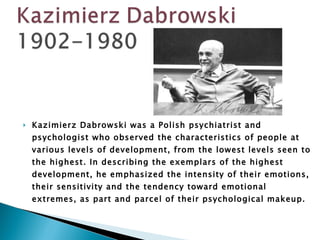
Kazimierz Dabrowski was a Polish psychiatrist and psychologist who observed the characteristics of people at various levels of development, from the lowest levels seen to the highest. In describing the exemplars of the highest development, he emphasized the intensity of their emotions, their sensitivity and the tendency toward emotional extremes, as part and parcel of their psychological makeup.
Development emphasizes several major features: Personality is not a given universal trait, it must be created and shaped by the individual to reflect his or her own unique character (personality shaping). Personality develops as a result of the action of  developmental potential  (DP). Developmental potential includes overexcitability,  the third (autonomous) factor and special abilities and talents. Dabrowski hypothesized that DP is genetically determined and that not everyone will display sufficient DP to lead to advanced development and to create a unique personality.
Dabrowski called developmental potential the “tragic gift” because it amplifies both the highest and lowest experiences of everyday life.  Developmental potential creates strong emotional situations that often lead to strong anxieties and depressions – psychoneurosis - that precipitate disintegration. Strong DP creates opportunities for growth that the individual must seize and take advantage of - development is not guaranteed.
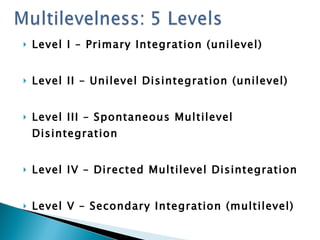
Dabrowski used a multilevel approach to describe the continuum of developmental differences he observed in the population.  The initial level – primary integration – is characterized by the strong influence of socialization and, to some degree, of instinct. Three levels describe various degrees of disintegration – levels characterized by extreme anxiety depression and crises. The fifth level describes a secondary integration characterized by the development of autonomy and a unique personality.
Advanced development requires the disintegration of the initial integration - a process Dabrowski called  positive disintegration . The development of a higher order of individual values and emotional reactions are an essential component of advanced development. In contrast to most psychological theories,  emotion  plays a critical role in Dabrowski. Emotional reactions  guide the individual in creating his or her individual personality identity or ideal; an autonomous standard that acts as the goal of individual development.
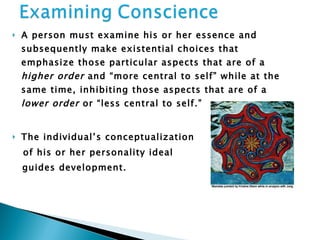
A person must examine his or her essence and subsequently make existential choices that emphasize those particular aspects that are of a  higher order  and “more central to self” while at the same time, inhibiting those aspects that are of a  lower order  or “less central to self.” The individual’s conceptualization  of his or her personality ideal  guides development.
Developmental Potential Multilevelness
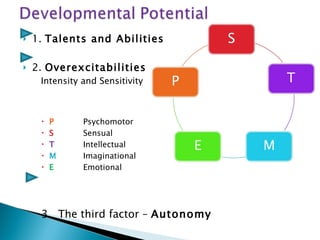
1.  Talents and Abilities 2.  Overexcitabilities Intensity and Sensitivity  P Psychomotor S Sensual T Intellectual M Imaginational E Emotional 3.  The third factor –  Autonomy
psychomotor (P)   –  movement, restlessness, drivenness, and augmented capacity for being active and energetic sensual (S)   –  enhanced refinement and aliveness of sensual experience intellectual (T)   – avidity for knowledge, discovery, questioning, love of ideas, theoretical analysis, search for truth
imaginational (M)  -  vividness of imagery, richness of association, facility for dreams, fantasies and inventions, endowing toys and other objects with personality (animism), liking for the unusual emotional (E)  -  great depth and intensity of emotional life expressed in a wide range of feelings, compassion, responsibility, self-examination
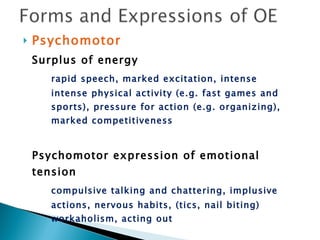
Psychomotor Surplus of energy rapid speech, marked excitation, intense  intense physical activity (e.g. fast games and sports), pressure for action (e.g. organizing), marked competitiveness Psychomotor expression of emotional tension compulsive talking and chattering, implusive  actions, nervous habits, (tics, nail biting) workaholism, acting out
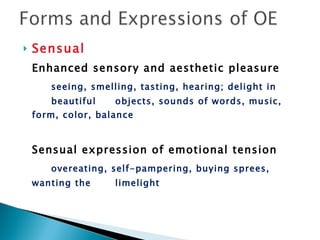
Sensual Enhanced sensory and aesthetic pleasure seeing, smelling, tasting, hearing; delight in beautiful  objects, sounds of words, music, form, color, balance Sensual expression of emotional tension overeating, self-pampering, buying sprees, wanting the  limelight
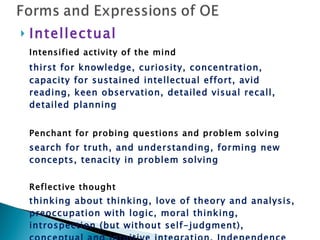
Intellectual Intensified activity of the mind thirst for knowledge, curiosity, concentration, capacity for sustained intellectual effort, avid reading, keen observation, detailed visual recall, detailed planning Penchant for probing questions and problem solving search for truth, and understanding, forming new concepts, tenacity in problem solving Reflective thought thinking about thinking, love of theory and analysis, preoccupation with logic, moral thinking, introspection (but without self-judgment), conceptual and intuitive integration, Independence of thought (can be critical)
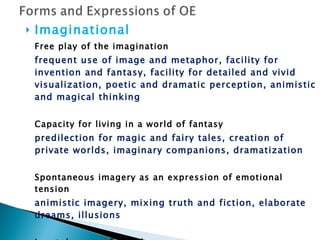
Imaginational Free play of the imagination frequent use of image and metaphor, facility for invention and fantasy, facility for detailed and vivid visualization, poetic and dramatic perception, animistic and magical thinking Capacity for living in a world of fantasy predilection for magic and fairy tales, creation of private worlds, imaginary companions, dramatization Spontaneous imagery as an expression of emotional tension animistic imagery, mixing truth and fiction, elaborate dreams, illusions Low tolerance of boredom need for novelty
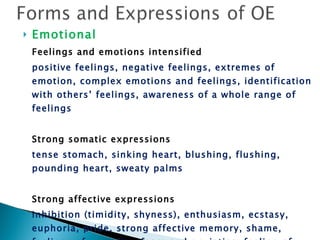
Emotional Feelings and emotions intensified positive feelings, negative feelings, extremes of emotion, complex emotions and feelings, identification with others’ feelings, awareness of a whole range of feelings Strong somatic expressions tense stomach, sinking heart, blushing, flushing, pounding heart, sweaty palms Strong affective expressions inhibition (timidity, shyness), enthusiasm, ecstasy, euphoria, pride, strong affective memory, shame, feelings of unreality, fears and anxieties, feeling of guilt, concern with death, depressive and suicidal moods
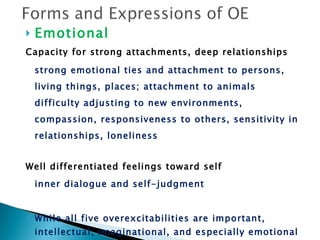
Emotional Capacity for strong attachments, deep relationships strong emotional ties and attachment to persons, living things, places; attachment to animals difficulty adjusting to new environments, compassion, responsiveness to others, sensitivity in relationships, loneliness Well differentiated feelings toward self inner dialogue and self-judgment While all five overexcitabilities are important, intellectual, imaginational, and especially emotional are considered the most important.
Level I – Primary Integration (unilevel) Level II – Unilevel Disintegration (unilevel) Level III – Spontaneous Multilevel Disintegration Level IV – Directed Multilevel Disintegration Level V – Secondary Integration (multilevel)
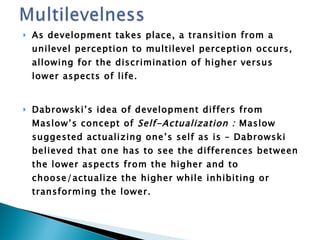
As development takes place, a transition from a unilevel perception to multilevel perception occurs, allowing for the discrimination of higher versus lower aspects of life. Dabrowski’s idea of development differs from Maslow’s concept of  Self-Actualization :  Maslow suggested actualizing one’s self as is – Dabrowski believed that one has to see the differences between the lower aspects from the higher and to choose/actualize the higher while inhibiting or transforming the lower.
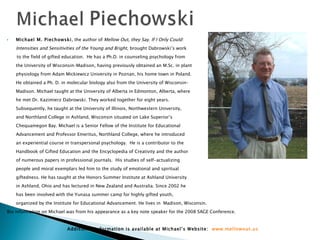
Michael M. Piechowski , the author of  Mellow Out, they Say. If I Only Could:  Intensities and Sensitivities of the Young and Bright,  brought Dabrowski’s work  to the field of gifted education.  He has a Ph.D. in counseling psychology from the University of Wisconsin–Madison, having previously obtained an M.Sc. in plant  physiology from Adam Mickiewicz University in Poznan, his home town in Poland.  He obtained a Ph. D. in molecular biology also from the University of Wisconsin– Madison. Michael taught at the University of Alberta in Edmonton, Alberta, where he met Dr. Kazimierz Dabrowski. They worked together for eight years.  Subsequently, he taught at the University of Illinois, Northwestern University,  and Northland College in Ashland, Wisconsin situated on Lake Superior’s  Chequamegon Bay. Michael is a Senior Fellow of the Institute for Educational  Advancement and Professor Emeritus, Northland College, where he introduced  an experiential course in transpersonal psychology.  He is a contributor to the  Handbook of Gifted Education and the Encyclopedia of Creativity and the author  of numerous papers in professional journals.  His studies of self-actualizing  people and moral exemplars led him to the study of emotional and spiritual  giftedness. He has taught at the Honors Summer Institute at Ashland University  in Ashland, Ohio and has lectured in New Zealand and Australia. Since 2002 he  has been involved with the Yunasa summer camp for highly gifted youth,  organized by the Institute for Educational Advancement. He lives in  Madison, Wisconsin. Bio information on Michael was from his appearance as a key note speaker for the 2008 SAGE Conference. Additional information is available at Michael’s Website:  www.mellowout.us

Overexcitabilitiesgifted

  • 1.
    Social and EmotionalNeeds of the Gifted Kent State University Adapted by Bob Hudson, MA, M Ed
  • 2.
    Kazimierz Dabrowski wasa Polish psychiatrist and psychologist who observed the characteristics of people at various levels of development, from the lowest levels seen to the highest. In describing the exemplars of the highest development, he emphasized the intensity of their emotions, their sensitivity and the tendency toward emotional extremes, as part and parcel of their psychological makeup.
  • 3.
    Development emphasizes severalmajor features: Personality is not a given universal trait, it must be created and shaped by the individual to reflect his or her own unique character (personality shaping). Personality develops as a result of the action of developmental potential (DP). Developmental potential includes overexcitability, the third (autonomous) factor and special abilities and talents. Dabrowski hypothesized that DP is genetically determined and that not everyone will display sufficient DP to lead to advanced development and to create a unique personality.
  • 4.
    Dabrowski called developmentalpotential the “tragic gift” because it amplifies both the highest and lowest experiences of everyday life. Developmental potential creates strong emotional situations that often lead to strong anxieties and depressions – psychoneurosis - that precipitate disintegration. Strong DP creates opportunities for growth that the individual must seize and take advantage of - development is not guaranteed.
  • 5.
    Dabrowski used amultilevel approach to describe the continuum of developmental differences he observed in the population. The initial level – primary integration – is characterized by the strong influence of socialization and, to some degree, of instinct. Three levels describe various degrees of disintegration – levels characterized by extreme anxiety depression and crises. The fifth level describes a secondary integration characterized by the development of autonomy and a unique personality.
  • 6.
    Advanced development requiresthe disintegration of the initial integration - a process Dabrowski called positive disintegration . The development of a higher order of individual values and emotional reactions are an essential component of advanced development. In contrast to most psychological theories, emotion plays a critical role in Dabrowski. Emotional reactions guide the individual in creating his or her individual personality identity or ideal; an autonomous standard that acts as the goal of individual development.
  • 7.
    A person mustexamine his or her essence and subsequently make existential choices that emphasize those particular aspects that are of a higher order and “more central to self” while at the same time, inhibiting those aspects that are of a lower order or “less central to self.” The individual’s conceptualization of his or her personality ideal guides development.
  • 8.
  • 9.
    1. Talentsand Abilities 2. Overexcitabilities Intensity and Sensitivity P Psychomotor S Sensual T Intellectual M Imaginational E Emotional 3. The third factor – Autonomy
  • 10.
    psychomotor (P) – movement, restlessness, drivenness, and augmented capacity for being active and energetic sensual (S) – enhanced refinement and aliveness of sensual experience intellectual (T) – avidity for knowledge, discovery, questioning, love of ideas, theoretical analysis, search for truth
  • 11.
    imaginational (M) - vividness of imagery, richness of association, facility for dreams, fantasies and inventions, endowing toys and other objects with personality (animism), liking for the unusual emotional (E) - great depth and intensity of emotional life expressed in a wide range of feelings, compassion, responsibility, self-examination
  • 12.
    Psychomotor Surplus ofenergy rapid speech, marked excitation, intense intense physical activity (e.g. fast games and sports), pressure for action (e.g. organizing), marked competitiveness Psychomotor expression of emotional tension compulsive talking and chattering, implusive actions, nervous habits, (tics, nail biting) workaholism, acting out
  • 13.
    Sensual Enhanced sensoryand aesthetic pleasure seeing, smelling, tasting, hearing; delight in beautiful objects, sounds of words, music, form, color, balance Sensual expression of emotional tension overeating, self-pampering, buying sprees, wanting the limelight
  • 14.
    Intellectual Intensified activityof the mind thirst for knowledge, curiosity, concentration, capacity for sustained intellectual effort, avid reading, keen observation, detailed visual recall, detailed planning Penchant for probing questions and problem solving search for truth, and understanding, forming new concepts, tenacity in problem solving Reflective thought thinking about thinking, love of theory and analysis, preoccupation with logic, moral thinking, introspection (but without self-judgment), conceptual and intuitive integration, Independence of thought (can be critical)
  • 15.
    Imaginational Free playof the imagination frequent use of image and metaphor, facility for invention and fantasy, facility for detailed and vivid visualization, poetic and dramatic perception, animistic and magical thinking Capacity for living in a world of fantasy predilection for magic and fairy tales, creation of private worlds, imaginary companions, dramatization Spontaneous imagery as an expression of emotional tension animistic imagery, mixing truth and fiction, elaborate dreams, illusions Low tolerance of boredom need for novelty
  • 16.
    Emotional Feelings andemotions intensified positive feelings, negative feelings, extremes of emotion, complex emotions and feelings, identification with others’ feelings, awareness of a whole range of feelings Strong somatic expressions tense stomach, sinking heart, blushing, flushing, pounding heart, sweaty palms Strong affective expressions inhibition (timidity, shyness), enthusiasm, ecstasy, euphoria, pride, strong affective memory, shame, feelings of unreality, fears and anxieties, feeling of guilt, concern with death, depressive and suicidal moods
  • 17.
    Emotional Capacity forstrong attachments, deep relationships strong emotional ties and attachment to persons, living things, places; attachment to animals difficulty adjusting to new environments, compassion, responsiveness to others, sensitivity in relationships, loneliness Well differentiated feelings toward self inner dialogue and self-judgment While all five overexcitabilities are important, intellectual, imaginational, and especially emotional are considered the most important.
  • 18.
    Level I –Primary Integration (unilevel) Level II – Unilevel Disintegration (unilevel) Level III – Spontaneous Multilevel Disintegration Level IV – Directed Multilevel Disintegration Level V – Secondary Integration (multilevel)
  • 19.
    As development takesplace, a transition from a unilevel perception to multilevel perception occurs, allowing for the discrimination of higher versus lower aspects of life. Dabrowski’s idea of development differs from Maslow’s concept of Self-Actualization : Maslow suggested actualizing one’s self as is – Dabrowski believed that one has to see the differences between the lower aspects from the higher and to choose/actualize the higher while inhibiting or transforming the lower.
  • 20.
    Michael M. Piechowski, the author of Mellow Out, they Say. If I Only Could: Intensities and Sensitivities of the Young and Bright, brought Dabrowski’s work to the field of gifted education. He has a Ph.D. in counseling psychology from the University of Wisconsin–Madison, having previously obtained an M.Sc. in plant physiology from Adam Mickiewicz University in Poznan, his home town in Poland. He obtained a Ph. D. in molecular biology also from the University of Wisconsin– Madison. Michael taught at the University of Alberta in Edmonton, Alberta, where he met Dr. Kazimierz Dabrowski. They worked together for eight years. Subsequently, he taught at the University of Illinois, Northwestern University, and Northland College in Ashland, Wisconsin situated on Lake Superior’s Chequamegon Bay. Michael is a Senior Fellow of the Institute for Educational Advancement and Professor Emeritus, Northland College, where he introduced an experiential course in transpersonal psychology. He is a contributor to the Handbook of Gifted Education and the Encyclopedia of Creativity and the author of numerous papers in professional journals. His studies of self-actualizing people and moral exemplars led him to the study of emotional and spiritual giftedness. He has taught at the Honors Summer Institute at Ashland University in Ashland, Ohio and has lectured in New Zealand and Australia. Since 2002 he has been involved with the Yunasa summer camp for highly gifted youth, organized by the Institute for Educational Advancement. He lives in Madison, Wisconsin. Bio information on Michael was from his appearance as a key note speaker for the 2008 SAGE Conference. Additional information is available at Michael’s Website: www.mellowout.us