THE GIFTED & TALENTED Prepared by Union 98 GT Teachers Leda Ball - MDI HS Sarah Winne - Conners Emerson Kate StDenis - Mount Desert Tracey McCarthy - Pemetic & Tremont
PART 1: Defining  ‘ gifted ’ PART 2: Characteristics PART 3: Identification PART 4: Services
True or False? All children are “gifted” in some way. A high I.Q. (above 130) is required for giftedness. There is a strong biological basis for giftedness.  Giftedness, when it occurs, is generally global.
1. All Children Are Gifted in Some Way:  False State of Maine Definition of Gifted and Talented Children (based on the federal definition) Children with exceptional ability, aptitude, skill, or creativity in one or more academic areas  or in the literary, performing, and/or visual arts Granted all children are special, unique, and wonderful… but not all are gifted. - Renzulli & Reis, 1991

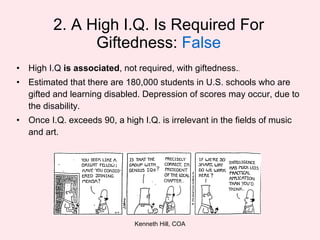
2. A High I.Q. Is Required For Giftedness:  False High I.Q  is associated , not required, with giftedness. . Estimated that there are 180,000 students in U.S. schools who are gifted and learning disabled. Depression of scores may occur, due to the disability. Once I.Q. exceeds 90, a high I.Q. is irrelevant in the fields of music and art.
3. There is a biological basis for giftedness:  TRUE &   FALSE Gifted Children tend to have: Larger heads/brains Faster reflexes Greater bilateral representation of language Common non-right handedness Greater immune system disorders. Born to older mothers (30.8 years) Be first born or only children Nature and Nurture must work together.
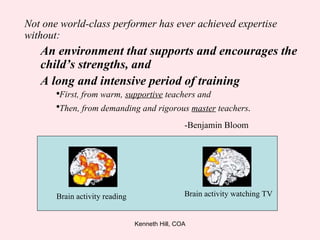
Not one world-class performer has ever achieved expertise without: An environment that supports and encourages the child’s strengths, and A long and intensive period of training First, from warm,  supportive  teachers and  Then, from demanding and rigorous  master  teachers . -Benjamin Bloom Brain activity reading Brain activity watching TV
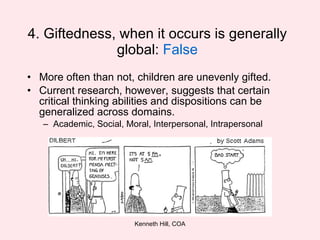
4. Giftedness, when it occurs is generally global:  False More often than not, children are unevenly gifted. Current research, however, suggests that certain critical thinking abilities and dispositions can be generalized across domains.  Academic, Social, Moral, Interpersonal, Intrapersonal
Gifted Characteristics & Needs Cognitive and Affective
Gifted Students have an ability to differentiate patterns at an early age. Needs:   To be exposed to abstractions and relationships, and to be given opportunities for drawing and testing generalizations Problems:   Omitting detail, questioning generalizations of others
Great minds don’t necessarily know the right answer more often… they are simply better at identifying and eliminating incorrect answers. Non-gifted often get stuck “checking” false beliefs.
Gifted Students have a high level of language development and verbal ability. Needs:   To share ideas verbally in depth and to encounter uses for difficult vocabulary Problems:   Dominating discussions with information or questions - possibly being perceived as a show-off
A 4th grader’s comment after correctly solving a math problem involving ratios and a salsa recipe: The recipe sounds very tasty.  I’d like to make it at home sometime, but maybe you want to dilute the jalapeno peppers.
Gifted Students learn faster. Needs:  Instruction available at rates appropriate to individual pace of learning Problems:  Frustration with inactivity or perceived absence of progress
He just gets it. - reported numerous times by teachers and parents
Gifted Students have unusually varied interests and curiosity. Needs:   To be exposed to varied content and to be allowed to pursue individual ideas Problems:   Difficulty conforming to group task; taking on too much; persistency in asking questions
Gifted students have high retentiveness, often knowing extraordinary quantities of information.   Needs:  To master foundation skills early on and then be exposed to new and challenging information Problems:  Restlessness and impatience with ‘waiting for the group’; overextending self.
Said by an 8th grader who was carrying around a stack of 6 classics: I’m not particularly interested in these, but they’ll be really good reference for next year.
Gifted Students are goal directed with long attention spans. Needs:   To pursue activities beyond allotted time spans and to set priorities for oneself Problems: Hyper-focusing so as not to complete assignments; being perceived as stubborn or uncooperative
The truth is that prodigies usually push their parents and teachers!
Gifted Students have heightened self-awareness and ability to be independent. Needs:   To work alone and to learn to assert needs non-defensively Problems: Isolating self, being considered aloof; difficulty sharing self
Gifted Students have an idealism and sense of justice, which appears at an early age. Needs: To find values to which he or she can be committed Problems: Attempting unrealistic reforms and goals with resulting intense frustration
Gifted people have higher moral reasoning but not necessarily moral action.  Hill, 1995 Highly intelligent children are superior to average children in their resistance to temptation.  Hartshorne and May
I heard on the radio last week that a law has been changed about what torture is, and that’s not right.  Do you think the president would accept a letter from an eleven year old? - A 5th grader
Gifted Students have unusual sensitivity to the expectations and feelings of others. Needs:   To learn to clarify the feelings and expectations of others Problems: Unusual vulnerability to the criticism of others, and a high level of need for success and recognition
Over 60% of gifted people are introverted compared with 30% of the general population. What is normal for the gifted is most often labeled  as neurosis in the general population. Azpeitia and Rocamora
I could feel the cold water wrap around me like a cape.   - 7 year old
Gifted Students have high expectations of themselves and others. Needs:   To learn to set realistic goals and to accept setbacks Problems:   Procrastination; perfectionism; high levels of discouragement or frustration
I’m not any good at math.  I always make my 3’s backwards.  a 1st grader  (with a perfect nonverbal OLSAT)
Gifted Students have a heightened ability to see unusual relationships.   Needs:   To be allowed to organize information in unique ways Problems:   Frustration with others’ lack of ability to appreciate original organizations or insights; frustration with ambiguity
She knows every book in the classroom library, even if she hasn’t read it.  She can recommend any of the books or give summaries of them. - 5th grade teacher about a GT student
Gifted Students have flexible and imaginative thought processes.   Needs: To be allowed to solve problems in diverse ways Problems: Being seen as disruptive and disrespectful to authority and tradition
There is evidence of a link between extreme creativity and mental illness, especially within the subpopulation of writers, poets, and visual artists.   - Andreasen 1988; Jamison, 1989; 1993; Richards, 1989   There also seems to be an increased rate of suicide in eminent creative people .
From the pen of a 7th grader: In Einstein’s realm of work, imagination was important, because how could one formulate ideas as broad-minded and well, imaginative, as Einstein's with no imagination?
Gifted Students have a keen sense of humor (which may be gentle or hostile). Needs: To learn how behaviors affect the feelings of others Problems: Distracting task-at-hand; using humor for critical attack upon others, resulting in damaged interpersonal relationships
This student is intellectually mischievous. - A 5th grade teacher
UNION 98 GIFTED & TALENTED  PROGRAM K-12 IDENTIFICATION CRITERIA
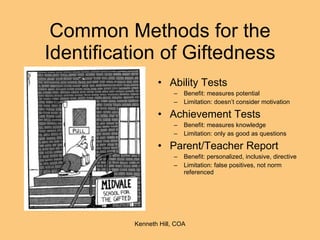
Common Methods for the Identification of Giftedness Ability Tests Benefit: measures potential Limitation: doesn’t consider motivation Achievement Tests Benefit: measures knowledge Limitation: only as good as questions Parent/Teacher Report Benefit: personalized, inclusive, directive Limitation: false positives, not norm referenced
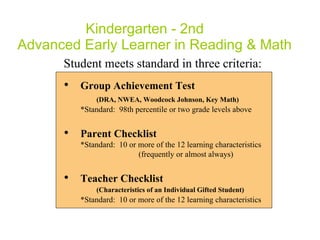
Kindergarten - 2nd  Advanced Early Learner in Reading & Math Student meets standard in three criteria: Group Achievement Test  (DRA,  NWEA, Woodcock Johnson, Key Math ) *Standard:  98th percentile or two grade levels above Parent Checklist  *Standard:  10 or more of the 12 learning characteristics    (frequently or almost always) Teacher Checklist  (Characteristics of an Individual Gifted Student) *Standard:  10 or more of the 12 learning characteristics
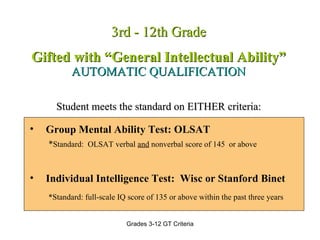
3rd - 12th Grade Gifted with “General Intellectual Ability” AUTOMATIC QUALIFICATION Student meets the standard on EITHER criteria: Group Mental Ability Test: OLSAT * Standard:  OLSAT verbal  and  nonverbal score of 145  or above Individual Intelligence Test:  Wisc or Stanford Binet   *Standard: full-scale IQ score of 135 or above within the past three years
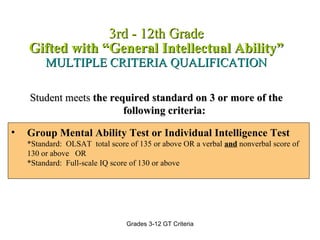
3rd - 12th Grade Gifted with “General Intellectual Ability” MULTIPLE CRITERIA QUALIFICATION Student meets  the required standard on 3 or more of the following criteria: Group Mental Ability Test or Individual Intelligence Test  *Standard:  OLSAT  total score of 135 or above OR a verbal  and   nonverbal score of 130 or above OR *Standard:  Full-scale IQ score of 130 or above
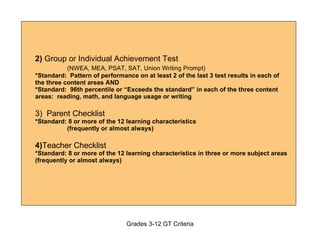
2)  Group or Individual Achievement Test  (NWEA, MEA, PSAT, SAT, Union Writing Prompt) *Standard:  Pattern of performance on at least 2 of the last 3 test results in each of the three content areas AND *Standard:  96th percentile or “Exceeds the standard” in each of the three content areas:  reading, math, and language usage or writing 3)  Parent Checklist *Standard: 8 or more of the 12 learning characteristics    (frequently or almost always) 4) Teacher Checklist  *Standard: 8 or more of the 12 learning characteristics in three or more subject areas (frequently or almost always)
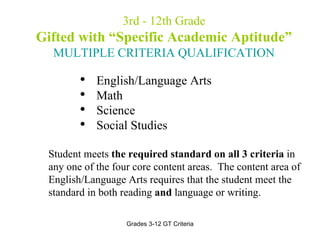
3rd - 12th Grade Gifted with “Specific Academic Aptitude” MULTIPLE CRITERIA QUALIFICATION English/Language Arts  Math  Science Social Studies Student meets  the required standard on all 3 criteria  in any one of the four core content areas.  The content area of English/Language Arts requires that the student meet the standard in both reading  and  language or writing.
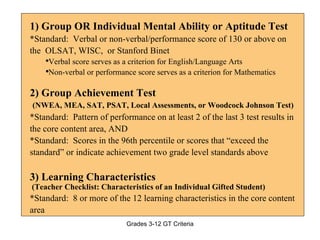
1) Group OR Individual Mental Ability or Aptitude Test *Standard:  Verbal or non-verbal/performance score of 130 or above on the  OLSAT, WISC,  or Stanford Binet Verbal score serves as a criterion for English/Language Arts Non-verbal or performance score serves as a criterion for Mathematics 2) Group Achievement Test (NWEA, MEA, SAT, PSAT, Local Assessments, or Woodcock Johnson Test) *Standard:  Pattern of performance on at least 2 of the last 3 test results in the core content area, AND *Standard:  Scores in the 96th percentile or scores that “exceed the standard” or indicate achievement two grade level standards above 3) Learning Characteristics  (Teacher Checklist: Characteristics of an Individual Gifted Student) *Standard:  8 or more of the 12 learning characteristics in the core content area
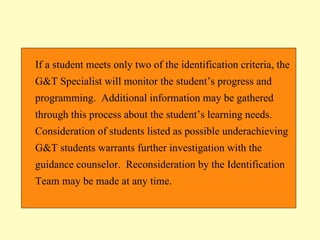
If a student meets only two of the identification criteria, the G&T Specialist will monitor the student’s progress and programming.  Additional information may be gathered through this process about the student’s learning needs.  Consideration of students listed as possible underachieving G&T students warrants further investigation with the guidance counselor.  Reconsideration by the Identification Team may be made at any time.
UNION 98  GIFTED AND TALENTED   PROGRAM OF SERVICES
G&T Services  Consultation Curriculum and instructional differentiation Compacting Cluster grouping or small group instruction Individualized and independent learning Mentoring, internships & apprenticeships   Distance Learning Advanced classes  Specialized classes  Pull-out programming Mixed-age grouping  Acceleration
Curriculum and Instructional Differentiation Pretest out of skills and content they have already mastered Adjust their pace to allow for greater depth of learning Engage with material at the appropriate level of complexity Flexible grouping Independent work in area of interest
COMPACTING Pretest around factual knowledge and basic skills accelerating students through mastery of necessary knowledge and skills Focus on those processes that represent a higher level of cognitive engagement
Consultation Work with the classroom teacher to offer a coordinated, comprehensive, and integrated structure of services Assess student abilities Monitor the needs of high ability students Modify activities to challenge gifted students
Individual Learning Plan Work with the classroom teacher to develop, implement, monitor, revise and evaluate a program to meet the unique learning needs of the individual gifted student
Cluster Grouping or Small Group Instruction Placing all the G&T students in a particular grade in one classroom  Teacher who is ready to differentiate the curriculum for their gifted students
Mixed Age Groupings and   Specialized Classes  Interest  Ability Specialized Classes Project GT Summit
Individualized and Independent Learning Opportunities that allow gifted students to develop their talents in an area of interest Develops independent learning skills
Mentoring, Internships and Apprenticeships Opportunities to work with knowledgeable people in the student’s area of interest Develop the knowledge and skills specific to that area
Advanced Classes  Honors Level Classes Advanced Placement Classes College Classes Distance Learning
Acceleration Advanced Material Content Acceleration Grade Acceleration Dual Enrollment  Early Graduation
Pullout Programming Allows the student to work at their level Acceleration and Compression of Content  Focus on higher order thinking skills  Analyzing, Synthesizing, and Evaluating Opportunities for students to develop advanced products Focus on Problem Solving Skills
Union 98 G&T Program Description http://blue1.emerson.u98.k12.me.us/gtprogram/

Gt presentation

  • 1.
    THE GIFTED &TALENTED Prepared by Union 98 GT Teachers Leda Ball - MDI HS Sarah Winne - Conners Emerson Kate StDenis - Mount Desert Tracey McCarthy - Pemetic & Tremont
  • 2.
    PART 1: Defining ‘ gifted ’ PART 2: Characteristics PART 3: Identification PART 4: Services
  • 3.
    True or False?All children are “gifted” in some way. A high I.Q. (above 130) is required for giftedness. There is a strong biological basis for giftedness. Giftedness, when it occurs, is generally global.
  • 4.
    1. All ChildrenAre Gifted in Some Way: False State of Maine Definition of Gifted and Talented Children (based on the federal definition) Children with exceptional ability, aptitude, skill, or creativity in one or more academic areas or in the literary, performing, and/or visual arts Granted all children are special, unique, and wonderful… but not all are gifted. - Renzulli & Reis, 1991
  • 5.
    2. A HighI.Q. Is Required For Giftedness: False High I.Q is associated , not required, with giftedness. . Estimated that there are 180,000 students in U.S. schools who are gifted and learning disabled. Depression of scores may occur, due to the disability. Once I.Q. exceeds 90, a high I.Q. is irrelevant in the fields of music and art.
  • 6.
    3. There isa biological basis for giftedness: TRUE & FALSE Gifted Children tend to have: Larger heads/brains Faster reflexes Greater bilateral representation of language Common non-right handedness Greater immune system disorders. Born to older mothers (30.8 years) Be first born or only children Nature and Nurture must work together.
  • 7.
    Not one world-classperformer has ever achieved expertise without: An environment that supports and encourages the child’s strengths, and A long and intensive period of training First, from warm, supportive teachers and Then, from demanding and rigorous master teachers . -Benjamin Bloom Brain activity reading Brain activity watching TV
  • 8.
    4. Giftedness, whenit occurs is generally global: False More often than not, children are unevenly gifted. Current research, however, suggests that certain critical thinking abilities and dispositions can be generalized across domains. Academic, Social, Moral, Interpersonal, Intrapersonal
  • 9.
    Gifted Characteristics &Needs Cognitive and Affective
  • 10.
    Gifted Students havean ability to differentiate patterns at an early age. Needs: To be exposed to abstractions and relationships, and to be given opportunities for drawing and testing generalizations Problems: Omitting detail, questioning generalizations of others
  • 11.
    Great minds don’tnecessarily know the right answer more often… they are simply better at identifying and eliminating incorrect answers. Non-gifted often get stuck “checking” false beliefs.
  • 12.
    Gifted Students havea high level of language development and verbal ability. Needs: To share ideas verbally in depth and to encounter uses for difficult vocabulary Problems: Dominating discussions with information or questions - possibly being perceived as a show-off
  • 13.
    A 4th grader’scomment after correctly solving a math problem involving ratios and a salsa recipe: The recipe sounds very tasty. I’d like to make it at home sometime, but maybe you want to dilute the jalapeno peppers.
  • 14.
    Gifted Students learnfaster. Needs: Instruction available at rates appropriate to individual pace of learning Problems: Frustration with inactivity or perceived absence of progress
  • 15.
    He just getsit. - reported numerous times by teachers and parents
  • 16.
    Gifted Students haveunusually varied interests and curiosity. Needs: To be exposed to varied content and to be allowed to pursue individual ideas Problems: Difficulty conforming to group task; taking on too much; persistency in asking questions
  • 17.
    Gifted students havehigh retentiveness, often knowing extraordinary quantities of information. Needs: To master foundation skills early on and then be exposed to new and challenging information Problems: Restlessness and impatience with ‘waiting for the group’; overextending self.
  • 18.
    Said by an8th grader who was carrying around a stack of 6 classics: I’m not particularly interested in these, but they’ll be really good reference for next year.
  • 19.
    Gifted Students aregoal directed with long attention spans. Needs: To pursue activities beyond allotted time spans and to set priorities for oneself Problems: Hyper-focusing so as not to complete assignments; being perceived as stubborn or uncooperative
  • 20.
    The truth isthat prodigies usually push their parents and teachers!
  • 21.
    Gifted Students haveheightened self-awareness and ability to be independent. Needs: To work alone and to learn to assert needs non-defensively Problems: Isolating self, being considered aloof; difficulty sharing self
  • 22.
    Gifted Students havean idealism and sense of justice, which appears at an early age. Needs: To find values to which he or she can be committed Problems: Attempting unrealistic reforms and goals with resulting intense frustration
  • 23.
    Gifted people havehigher moral reasoning but not necessarily moral action. Hill, 1995 Highly intelligent children are superior to average children in their resistance to temptation. Hartshorne and May
  • 24.
    I heard onthe radio last week that a law has been changed about what torture is, and that’s not right. Do you think the president would accept a letter from an eleven year old? - A 5th grader
  • 25.
    Gifted Students haveunusual sensitivity to the expectations and feelings of others. Needs: To learn to clarify the feelings and expectations of others Problems: Unusual vulnerability to the criticism of others, and a high level of need for success and recognition
  • 26.
    Over 60% ofgifted people are introverted compared with 30% of the general population. What is normal for the gifted is most often labeled as neurosis in the general population. Azpeitia and Rocamora
  • 27.
    I could feelthe cold water wrap around me like a cape. - 7 year old
  • 28.
    Gifted Students havehigh expectations of themselves and others. Needs: To learn to set realistic goals and to accept setbacks Problems: Procrastination; perfectionism; high levels of discouragement or frustration
  • 29.
    I’m not anygood at math. I always make my 3’s backwards. a 1st grader (with a perfect nonverbal OLSAT)
  • 30.
    Gifted Students havea heightened ability to see unusual relationships. Needs: To be allowed to organize information in unique ways Problems: Frustration with others’ lack of ability to appreciate original organizations or insights; frustration with ambiguity
  • 31.
    She knows everybook in the classroom library, even if she hasn’t read it. She can recommend any of the books or give summaries of them. - 5th grade teacher about a GT student
  • 32.
    Gifted Students haveflexible and imaginative thought processes. Needs: To be allowed to solve problems in diverse ways Problems: Being seen as disruptive and disrespectful to authority and tradition
  • 33.
    There is evidenceof a link between extreme creativity and mental illness, especially within the subpopulation of writers, poets, and visual artists. - Andreasen 1988; Jamison, 1989; 1993; Richards, 1989 There also seems to be an increased rate of suicide in eminent creative people .
  • 34.
    From the penof a 7th grader: In Einstein’s realm of work, imagination was important, because how could one formulate ideas as broad-minded and well, imaginative, as Einstein's with no imagination?
  • 35.
    Gifted Students havea keen sense of humor (which may be gentle or hostile). Needs: To learn how behaviors affect the feelings of others Problems: Distracting task-at-hand; using humor for critical attack upon others, resulting in damaged interpersonal relationships
  • 36.
    This student isintellectually mischievous. - A 5th grade teacher
  • 37.
    UNION 98 GIFTED& TALENTED PROGRAM K-12 IDENTIFICATION CRITERIA
  • 38.
    Common Methods forthe Identification of Giftedness Ability Tests Benefit: measures potential Limitation: doesn’t consider motivation Achievement Tests Benefit: measures knowledge Limitation: only as good as questions Parent/Teacher Report Benefit: personalized, inclusive, directive Limitation: false positives, not norm referenced
  • 39.
    Kindergarten - 2nd Advanced Early Learner in Reading & Math Student meets standard in three criteria: Group Achievement Test (DRA, NWEA, Woodcock Johnson, Key Math ) *Standard: 98th percentile or two grade levels above Parent Checklist *Standard: 10 or more of the 12 learning characteristics (frequently or almost always) Teacher Checklist (Characteristics of an Individual Gifted Student) *Standard: 10 or more of the 12 learning characteristics
  • 40.
    3rd - 12thGrade Gifted with “General Intellectual Ability” AUTOMATIC QUALIFICATION Student meets the standard on EITHER criteria: Group Mental Ability Test: OLSAT * Standard: OLSAT verbal and nonverbal score of 145 or above Individual Intelligence Test: Wisc or Stanford Binet *Standard: full-scale IQ score of 135 or above within the past three years
  • 41.
    3rd - 12thGrade Gifted with “General Intellectual Ability” MULTIPLE CRITERIA QUALIFICATION Student meets the required standard on 3 or more of the following criteria: Group Mental Ability Test or Individual Intelligence Test *Standard: OLSAT total score of 135 or above OR a verbal and nonverbal score of 130 or above OR *Standard: Full-scale IQ score of 130 or above
  • 42.
    2) Groupor Individual Achievement Test (NWEA, MEA, PSAT, SAT, Union Writing Prompt) *Standard: Pattern of performance on at least 2 of the last 3 test results in each of the three content areas AND *Standard: 96th percentile or “Exceeds the standard” in each of the three content areas: reading, math, and language usage or writing 3) Parent Checklist *Standard: 8 or more of the 12 learning characteristics (frequently or almost always) 4) Teacher Checklist *Standard: 8 or more of the 12 learning characteristics in three or more subject areas (frequently or almost always)
  • 43.
    3rd - 12thGrade Gifted with “Specific Academic Aptitude” MULTIPLE CRITERIA QUALIFICATION English/Language Arts Math Science Social Studies Student meets the required standard on all 3 criteria in any one of the four core content areas. The content area of English/Language Arts requires that the student meet the standard in both reading and language or writing.
  • 44.
    1) Group ORIndividual Mental Ability or Aptitude Test *Standard: Verbal or non-verbal/performance score of 130 or above on the OLSAT, WISC, or Stanford Binet Verbal score serves as a criterion for English/Language Arts Non-verbal or performance score serves as a criterion for Mathematics 2) Group Achievement Test (NWEA, MEA, SAT, PSAT, Local Assessments, or Woodcock Johnson Test) *Standard: Pattern of performance on at least 2 of the last 3 test results in the core content area, AND *Standard: Scores in the 96th percentile or scores that “exceed the standard” or indicate achievement two grade level standards above 3) Learning Characteristics (Teacher Checklist: Characteristics of an Individual Gifted Student) *Standard: 8 or more of the 12 learning characteristics in the core content area
  • 45.
    If a studentmeets only two of the identification criteria, the G&T Specialist will monitor the student’s progress and programming. Additional information may be gathered through this process about the student’s learning needs. Consideration of students listed as possible underachieving G&T students warrants further investigation with the guidance counselor. Reconsideration by the Identification Team may be made at any time.
  • 46.
    UNION 98 GIFTED AND TALENTED PROGRAM OF SERVICES
  • 47.
    G&T Services Consultation Curriculum and instructional differentiation Compacting Cluster grouping or small group instruction Individualized and independent learning Mentoring, internships & apprenticeships Distance Learning Advanced classes Specialized classes Pull-out programming Mixed-age grouping Acceleration
  • 48.
    Curriculum and InstructionalDifferentiation Pretest out of skills and content they have already mastered Adjust their pace to allow for greater depth of learning Engage with material at the appropriate level of complexity Flexible grouping Independent work in area of interest
  • 49.
    COMPACTING Pretest aroundfactual knowledge and basic skills accelerating students through mastery of necessary knowledge and skills Focus on those processes that represent a higher level of cognitive engagement
  • 50.
    Consultation Work withthe classroom teacher to offer a coordinated, comprehensive, and integrated structure of services Assess student abilities Monitor the needs of high ability students Modify activities to challenge gifted students
  • 51.
    Individual Learning PlanWork with the classroom teacher to develop, implement, monitor, revise and evaluate a program to meet the unique learning needs of the individual gifted student
  • 52.
    Cluster Grouping orSmall Group Instruction Placing all the G&T students in a particular grade in one classroom Teacher who is ready to differentiate the curriculum for their gifted students
  • 53.
    Mixed Age Groupingsand Specialized Classes Interest Ability Specialized Classes Project GT Summit
  • 54.
    Individualized and IndependentLearning Opportunities that allow gifted students to develop their talents in an area of interest Develops independent learning skills
  • 55.
    Mentoring, Internships andApprenticeships Opportunities to work with knowledgeable people in the student’s area of interest Develop the knowledge and skills specific to that area
  • 56.
    Advanced Classes Honors Level Classes Advanced Placement Classes College Classes Distance Learning
  • 57.
    Acceleration Advanced MaterialContent Acceleration Grade Acceleration Dual Enrollment Early Graduation
  • 58.
    Pullout Programming Allowsthe student to work at their level Acceleration and Compression of Content Focus on higher order thinking skills Analyzing, Synthesizing, and Evaluating Opportunities for students to develop advanced products Focus on Problem Solving Skills
  • 59.
    Union 98 G&TProgram Description http://blue1.emerson.u98.k12.me.us/gtprogram/