GE2201 DESIGN THINKING
UNIT II – IDEA GENERATION AND REFINEMENT
Mr. S. Muthu Natarajan M.E., (Ph.D.),
Assistant Professor/Mechanical
Kamaraj College of Engineering and Technology (Autonomous)
Madurai District
Mobile: +91-9566470389
Basic design directions - Themes of thinking -
Inspiration and references - Brainstorming - Value -
Inclusion – Sketching - Presenting ideas - Thinking in
images - Thinking in signs - Appropriation -
Personification - Visual metaphors - Modification -
Thinking in words – Words and language - Thinking in
shapes - Thinking in proportions - Thinking in colour -
Outside the Box.
Syllabus
 Once a design brief has been defined and researched, the idea
generation or ideate stage sees concepts created that may solve the
design problem.
 This is the part of the design process where creativity is unleashed.
Ideation seeks to generate concepts that will be worked up and
resolved in subsequent process stages, and therefore concerns ideas
rather than the vocabulary of the design.
 Creativity conveys a sense of pure inventiveness and knowing no
bounds, yet graphic design requires applied creativity directed
towards a specific end. This is informed or controlled by the
requirements of the design brief and the qualitative and quantitative
information produced during the research stage.
Idea Generation
 Despite channelling the creative effort in this way, the scope for
inventiveness and novelty is not diminished.
 Design ideas can be generated using various methods and reference
points that allow creativity to flourish and produce results in a
consistent way as part of an economic activity. This chapter will
introduce some of the methods and techniques that designers use to
generate design ideas.
Basic design directions
 Starting from a given point (often the design of existing or
competing products, brands or organisations), designers can think in
specific ‘directions’ in order to generate new ideas from existing
designs.
Idea Generation (Contd…)
Divergence
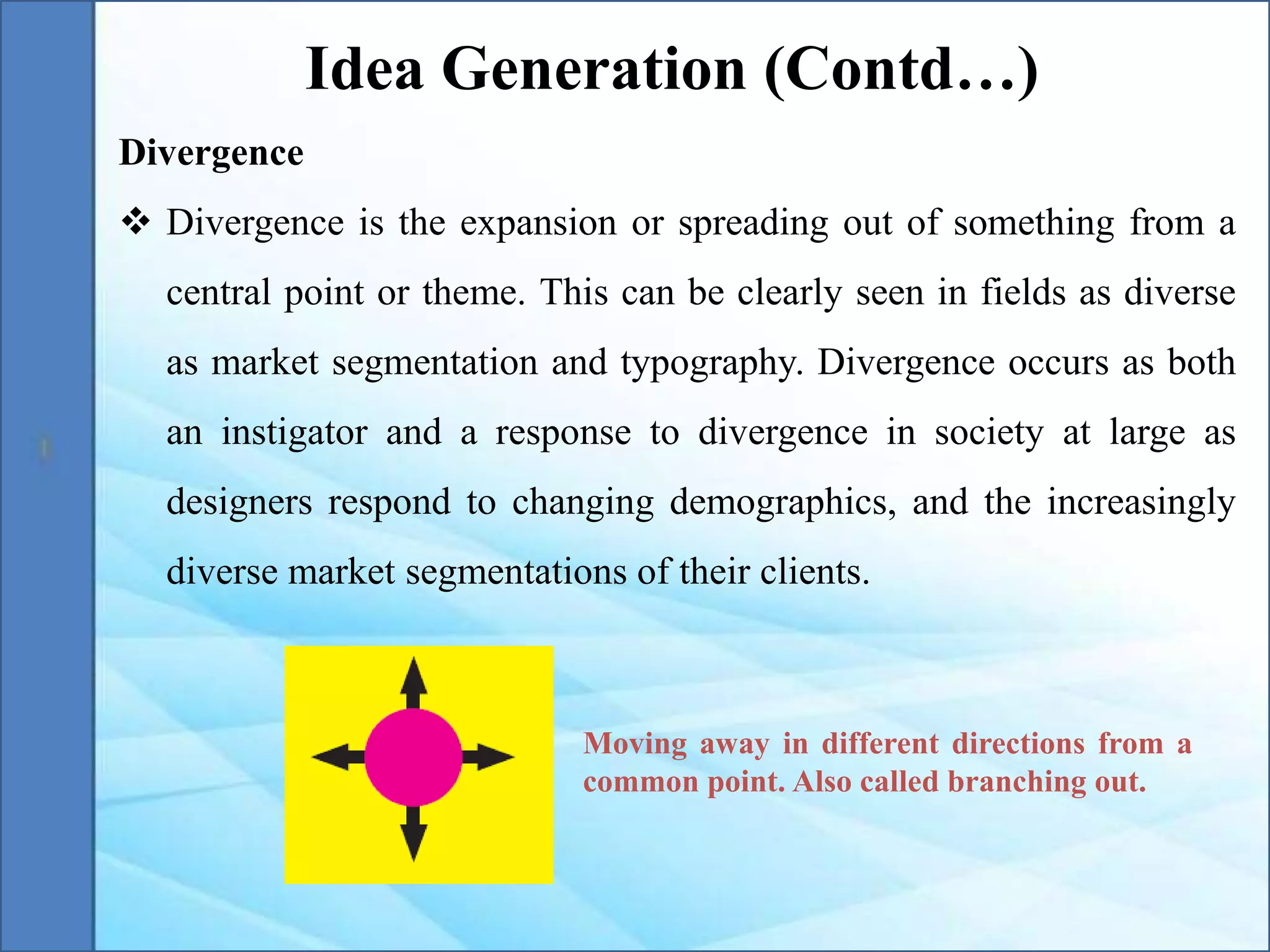
 Divergence is the expansion or spreading out of something from a
central point or theme. This can be clearly seen in fields as diverse
as market segmentation and typography. Divergence occurs as both
an instigator and a response to divergence in society at large as
designers respond to changing demographics, and the increasingly
diverse market segmentations of their clients.
Idea Generation (Contd…)
Moving away in different directions from a
common point. Also called branching out.
Convergence
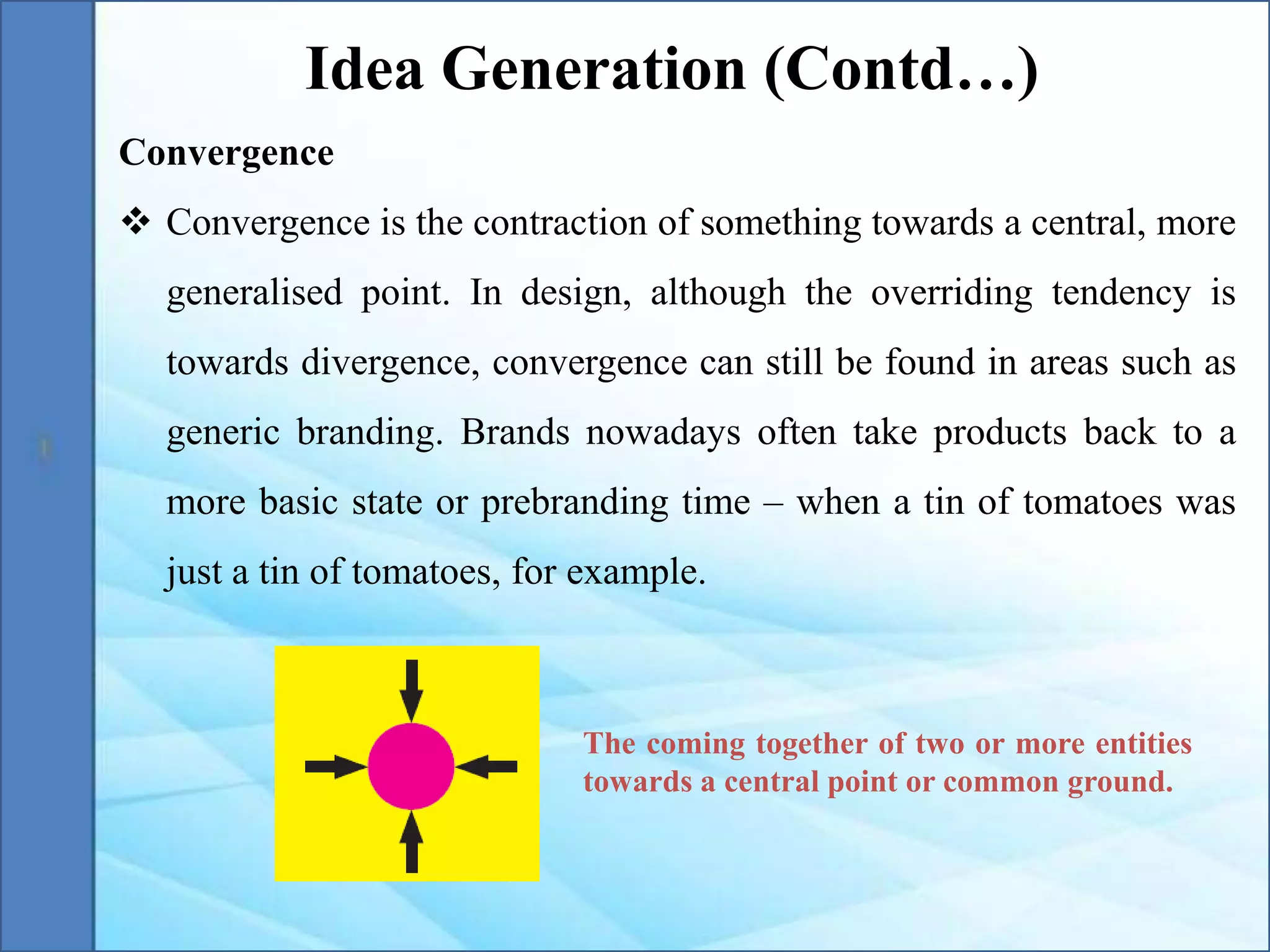
 Convergence is the contraction of something towards a central, more
generalised point. In design, although the overriding tendency is
towards divergence, convergence can still be found in areas such as
generic branding. Brands nowadays often take products back to a
more basic state or prebranding time – when a tin of tomatoes was
just a tin of tomatoes, for example.
Idea Generation (Contd…)
The coming together of two or more entities
towards a central point or common ground.
Transformation
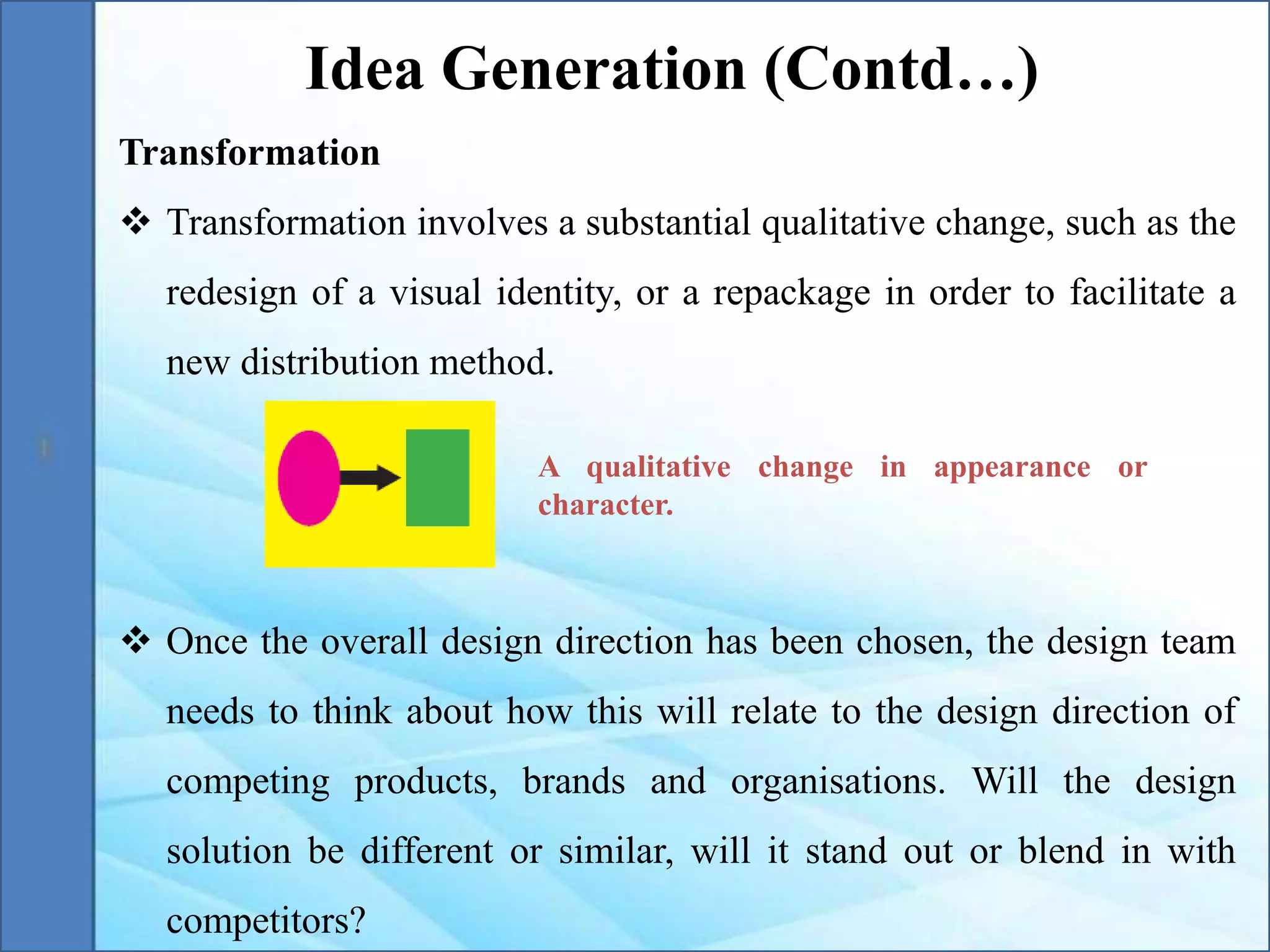
 Transformation involves a substantial qualitative change, such as the
redesign of a visual identity, or a repackage in order to facilitate a
new distribution method.
 Once the overall design direction has been chosen, the design team
needs to think about how this will relate to the design direction of
competing products, brands and organisations. Will the design
solution be different or similar, will it stand out or blend in with
competitors?
Idea Generation (Contd…)
A qualitative change in appearance or
character.
Point of difference or unique selling point (USP)
It is the combination of values and attributes that differentiates a
company or product from all other similar companies or products. As
such, it is a form of divergence as it involves moving away from the
designs used by similar companies or brands.
Clustering
Clustering can be found in any town. For example, the presence of
many restaurants in one area draws people to that area to eat, although
they may not know which restaurant they’ll be eating at until they get
there. Designs can be created to blend in (converge) with the visual
image presented by others in the peer group or can be created to stand
out (diverge) from them.
Idea Generation (Contd…)
Keep It Short and Simple
The idea is to pare back a design to its essential elements, something
that requires a clear understanding of the message that has to be
communicated and the audience it is to be directed towards.
Focus
Select only the key message elements as the focus for the design. A
company may have many products or projects but the design should
focus on the most important ones. Information about other aspects of
the company can be provided via other communications such as printed
materials, brochures or the web page.
Themes of Thinking
Top down and bottom up
An analytical approach appropriated from information technology
development, this looks at a design problem from the system
perspective and then ‘drills’ down to add detail in specific areas (top
down), or focuses on the basic elements first and works upwards to link
these together as part of a system (bottom up).
Python philosophy
Derived from ideas presented by Tim Peters in The Zen of Python,
these tenets include: beautiful is better than ugly; simple is better than
complex; sparse is better than dense; readability counts; practicality
beats purity; and refuse the temptation to guess.
Themes of Thinking (Contd…)
White space
Some believe that white space allows key design elements to breathe
and be easily seen. It also helps the viewer to focus attention on them,
giving them greater impact.
Text minimization
This tenet suggests that text should be kept to a minimum, with
sentences pared back to short, sharp phrases that have a meaningful
impact.
Graphic impact
Graphics should create a visual impact that grabs the attention and
reinforces text communication. However, graphics that go overboard
and are too large, complicated or numerous are distracting.
Themes of Thinking (Contd…)
Scale
Designers need to think about scale, an easily forgotten aspect when
designing on screen. Design proofing needs to include an actual scale
proof for small- or large-scale items such as stamps or posters to ensure
that text and graphics are of sufficient scale to be comfortably read.
User-centred design (UCD)
User-centred design (UCD) places the needs, desires and limitations of
the user at the centre of every stage of the design process and requires
designers to foresee how they are likely to use the resulting product.
Themes of Thinking (Contd…)
Ergonomics
Ergonomics is the practice of designing in accordance with physical
human needs, to optimise performance and minimise discomfort.
Ergonomics focuses on safety, efficiency, productivity and health in
work settings to ensure that products, services and environments are
compatible with the human form.
TIMTOWTDI (pronounced Tim Toady)
This means simply that ‘there is more than one way to do it’ and
follows the belief that a problem may have several different, but
equally valid, solutions.
Themes of Thinking (Contd…)
Inspiration
Inspiration is essential in any creative activity and design is no
exception. Inspiration is a key to the generation of exciting design ideas
and design professionals draw inspiration from innumerable sources.
Creative people draw inspiration from both obvious and unexpected
sources, such as magazines, music, literature and the urban
environment. The work of other people in the field, past and
contemporary, provides creative stimulation, which is one of the
reasons why this series of design books contains so many examples of
work by contemporary designers.
Inspiration and References
Many designers and design studios formalise the inspiration process to
a certain extent though the use of an ideas book. An ideas book is a
collection of cuttings, photos, sketches, colour swatches, typographic
examples, scribbled ideas, words and found objects that are
accumulated to inspire. An ideas book may be a general collection that
is continuously added to or it may be made as part of the preparation
for a specific project. Designers often create characters that are a
mental image of the typical target audience for a design, exemplifying
their characteristics, lifestyle, aspirations and consumption habits.
Inspiration and References (Contd…)
Resolve
To decide, bring to a conclusion or end. A design idea is resolved when
it is worked up into a final form.
Resonate
To be received or understood, to come across well. A design resonates
when the viewer understands and appreciates the various aspects of the
message communicated.
Inspiration and References (Contd…)
References
Reference points to inspire design come in many forms due to the
wealth of cultural information that surrounds us. The latest trends and
styles are easily observable on the street, in films, on TV, in magazines
and in the shops.
Designers also seek inspiration from other creative disciplines such as
painting, sculpture, music, architecture, photography and cinema.
Designers browse art galleries, museums, libraries, bookshops and junk
shops, as well as graffiti covered streets and supermarkets as they seek
inspiration for design.
Inspiration and References (Contd…)
Brainstorming is a creative group approach to developing ideas and
originating solutions during the ideate stage.
Brainstorming seeks to generate many different ideas that are
subsequently pared back to a few possibilities for potential
development. The brainstorming process starts by defining the problem
to be addressed, selecting group participants that will address it, and
forming questions with which to stimulate the creative process.
During the brainstorming session, participants have free rein to make
suggestions in a non-critical environment. This encourages the
presentation of unusual and potentially useful ideas.
Brain Storming
Resources such as flip charts or a whiteboard may be used to facilitate
the process and to record the ideas that are generated. Following the
session, ideas are grouped by type and their suitability assessed in order
for a shortlist of the best ideas to be formed.
Brain Storming Rules
 Do not criticize
 Keep the process manager-free
 Avoid resolve
 Work to a target
 Clock watch
 Let go
 Be inclusive
Brain Storming (Contd…)
Additional brainstorming methods
Brainstorming is the unfettered generation of ideas, but it needs to be
employed in a structured way in order to maximise its value and to
ensure that useful ideas will be generated. The following steps steer the
brainstorming process towards producing ideas that can be developed
further.
Visualisation
Quick visual aids can be produced to aid brainstorming and focus
attention, although this should not slow the proceedings down or
amount to resolve. Visualisation aims to provide feedback with which
to stimulate further creativity and build upon suggested ideas and
themes.
Brain Storming (Contd…)
Groups and voting
The brainstorming participants can be split into smaller groups, each of
which is tasked with finding solutions to particular concerns or
challenges. For example, one group may address aesthetics while
another looks at cost reduction. Groups can vote on which ideas
generated by the other groups are to be taken forward.
Scribble, say, slap
Use of sticky notes allows participants to quickly write down their
ideas, shout them out, and put them up rather than having to wait for
their turn under standard brainstorming. This method also helps people
to relax, lowers their inhibitions and allows more timid group members
to express their ideas.
Brain Storming (Contd…)
Assessment criteria
Finally, to assess the ideas generated requires the need for criteria
against which they can be assessed. Criteria can include cost, resources
required, necessary resources available, time factors and fitness for
purpose. A scoring system can be used for each criterion such as a scale
rating (one to five, for example) or a simple yes/no about whether it has
been met. This assessment allows the ideas to be ordered and prioritised
for follow up and potential resolve.
Brain Storming (Contd…)
Value is a term often used in design. A designer ‘adds value’ to a brand
through the creation of a visual identity
Value Equation
William Neal and Stefan Bathe developed the Value Equation to
measure value perception. This states that total brand value (or utility)
is a function of a product’s tangible, deliverable features, its brand
equity, and its price. Within the price Value Equation, any of these three
factors may be the most important value differentiator under market
conditions; where prices are similar, brand equity may govern
purchasing behaviour.
Value
Designers add value through creating significance, prestige or other
qualities sought by the target audience. The building of prestige
through a sense of exclusivity for a premium brand adds value, while
emphasising economy adds value to a budget brand. Clothing, perfume
and all consumer goods and services are subject to these factors and
possibilities. Designers create value by focusing on characteristics of
significance: those relevant and meaningful to the target audience; and
prestige: high standards and honour achieved through success,
influence or wealth.
Value (Contd…)
Throughout the design process it is important to remember who the
target audience is and to consider how design ideas might resonate with
this audience. Design must be focused on who it is communicating to
and not just the tastes of the designers who create it.
In order to judge how a target group will respond to a design, it is
desirable to solicit the opinions of members of that group where
possible and include them in the ideate process.
A designer wants to create work that inspires and engages, but
ultimately it has to give the viewer a feeling of inclusivity; design is
about establishing emotional connections rather than the positioning of
type and images.
Inclusion
Inclusion means soliciting the ideas, opinions and views of the target
group. Including people from the target group in the design process –
perhaps as a focus group – makes them part of the process and gives
the group an element of ownership of the ideas generated. This
contribution helps ensure an idea resonates with the group, aiding
acceptance, and reducing the possibility of arrogance errors by the
design team, who may think they know what is best for the target
group.
Inclusion (Contd…)
Most designers sketch in order to quickly put ideas down on paper. As
sketching can convey a visual idea for a design or design element very
rapidly, it can be used in many parts of the design process, and indeed,
throughout it.
Sketching can form part of the definition stage as the brief may be a
sketch by the client. It can be used in the research stage as part of the
process of creating character profiles. In this instance, a designer may
sketch a representation of who the target audience is. This can be
broadened into a sketch book that details various aspects of the life of
the target audience. A detailed sketch can form the basis of a prototype.
Sketching
Sketching is perhaps most often associated with the ideation stage,
during which a designer rapidly outlines possible design solutions and
creates a visual representation of ideas as they are generated. By its
nature, sketching implies the rapid outlining of a visual idea and so it
should be undertaken in whatever way is quickest and most efficient for
the designer. The availability of drawing tablets means that some
designers prefer to ‘sketch’ directly into their computers rather than
using traditional materials such as pencil and paper. Sketching digitally
in this way means ideas can easily be archived and circulated by email,
and they occupy less space than hard copies. However, a designer
should use the method that they find quicker and easier.
Sketching (Contd…)
Sketching (Contd…)
Digital sketching
A Wacom Tablet, a digital interface that
allows a designer to sketch ideas straight
into their computer where they can be
easily stored and emailed.
la
Personification is a figurative language that attributes human
characteristics, emotion and behavior to animals, object or an idea.
Personification
la
Personification is an abstract quality that is used to represent the
highlighted characteristics of a company or brand. Designers create
graphic devices that personify these qualities so that consumers or
customers can form an emotional identification. Many company or
brand logos function in this way. For personification to be
successful and credible, the graphic device – and the attributes it
represents – needs to successfully resonate with the target audience
and be compatible with the characteristics of the product or
organisation. If not, it will appear incongruous.
Personification (Contd…)
la
Personification (Contd…)
la
Personification (Contd…)
la
A visual metaphor refers to something it typically does not denote in
order to imply a similarity to something else.
Visual Metaphor
la
This new meaning implied by a visual metaphor is often created by
the context in which the visual device is present. As such, for a
visual metaphor to work (for the viewer to perceive a specific
meaning, in other words) requires the presence of shared knowledge
or culture. The existence of a common pool of shared knowledge
allows the designer to place subjective clues or references within the
overall design and this can form the basis of the metaphor.
Visual Metaphor (Contd…)

Idea Generation.pptx

  • 1.
    GE2201 DESIGN THINKING UNITII – IDEA GENERATION AND REFINEMENT Mr. S. Muthu Natarajan M.E., (Ph.D.), Assistant Professor/Mechanical Kamaraj College of Engineering and Technology (Autonomous) Madurai District Mobile: +91-9566470389
  • 2.
    Basic design directions- Themes of thinking - Inspiration and references - Brainstorming - Value - Inclusion – Sketching - Presenting ideas - Thinking in images - Thinking in signs - Appropriation - Personification - Visual metaphors - Modification - Thinking in words – Words and language - Thinking in shapes - Thinking in proportions - Thinking in colour - Outside the Box. Syllabus
  • 3.
     Once adesign brief has been defined and researched, the idea generation or ideate stage sees concepts created that may solve the design problem.  This is the part of the design process where creativity is unleashed. Ideation seeks to generate concepts that will be worked up and resolved in subsequent process stages, and therefore concerns ideas rather than the vocabulary of the design.  Creativity conveys a sense of pure inventiveness and knowing no bounds, yet graphic design requires applied creativity directed towards a specific end. This is informed or controlled by the requirements of the design brief and the qualitative and quantitative information produced during the research stage. Idea Generation
  • 4.
     Despite channellingthe creative effort in this way, the scope for inventiveness and novelty is not diminished.  Design ideas can be generated using various methods and reference points that allow creativity to flourish and produce results in a consistent way as part of an economic activity. This chapter will introduce some of the methods and techniques that designers use to generate design ideas. Basic design directions  Starting from a given point (often the design of existing or competing products, brands or organisations), designers can think in specific ‘directions’ in order to generate new ideas from existing designs. Idea Generation (Contd…)
  • 5.
    Divergence  Divergence isthe expansion or spreading out of something from a central point or theme. This can be clearly seen in fields as diverse as market segmentation and typography. Divergence occurs as both an instigator and a response to divergence in society at large as designers respond to changing demographics, and the increasingly diverse market segmentations of their clients. Idea Generation (Contd…) Moving away in different directions from a common point. Also called branching out.
  • 6.
    Convergence  Convergence isthe contraction of something towards a central, more generalised point. In design, although the overriding tendency is towards divergence, convergence can still be found in areas such as generic branding. Brands nowadays often take products back to a more basic state or prebranding time – when a tin of tomatoes was just a tin of tomatoes, for example. Idea Generation (Contd…) The coming together of two or more entities towards a central point or common ground.
  • 7.
    Transformation  Transformation involvesa substantial qualitative change, such as the redesign of a visual identity, or a repackage in order to facilitate a new distribution method.  Once the overall design direction has been chosen, the design team needs to think about how this will relate to the design direction of competing products, brands and organisations. Will the design solution be different or similar, will it stand out or blend in with competitors? Idea Generation (Contd…) A qualitative change in appearance or character.
  • 8.
    Point of differenceor unique selling point (USP) It is the combination of values and attributes that differentiates a company or product from all other similar companies or products. As such, it is a form of divergence as it involves moving away from the designs used by similar companies or brands. Clustering Clustering can be found in any town. For example, the presence of many restaurants in one area draws people to that area to eat, although they may not know which restaurant they’ll be eating at until they get there. Designs can be created to blend in (converge) with the visual image presented by others in the peer group or can be created to stand out (diverge) from them. Idea Generation (Contd…)
  • 9.
    Keep It Shortand Simple The idea is to pare back a design to its essential elements, something that requires a clear understanding of the message that has to be communicated and the audience it is to be directed towards. Focus Select only the key message elements as the focus for the design. A company may have many products or projects but the design should focus on the most important ones. Information about other aspects of the company can be provided via other communications such as printed materials, brochures or the web page. Themes of Thinking
  • 10.
    Top down andbottom up An analytical approach appropriated from information technology development, this looks at a design problem from the system perspective and then ‘drills’ down to add detail in specific areas (top down), or focuses on the basic elements first and works upwards to link these together as part of a system (bottom up). Python philosophy Derived from ideas presented by Tim Peters in The Zen of Python, these tenets include: beautiful is better than ugly; simple is better than complex; sparse is better than dense; readability counts; practicality beats purity; and refuse the temptation to guess. Themes of Thinking (Contd…)
  • 11.
    White space Some believethat white space allows key design elements to breathe and be easily seen. It also helps the viewer to focus attention on them, giving them greater impact. Text minimization This tenet suggests that text should be kept to a minimum, with sentences pared back to short, sharp phrases that have a meaningful impact. Graphic impact Graphics should create a visual impact that grabs the attention and reinforces text communication. However, graphics that go overboard and are too large, complicated or numerous are distracting. Themes of Thinking (Contd…)
  • 12.
    Scale Designers need tothink about scale, an easily forgotten aspect when designing on screen. Design proofing needs to include an actual scale proof for small- or large-scale items such as stamps or posters to ensure that text and graphics are of sufficient scale to be comfortably read. User-centred design (UCD) User-centred design (UCD) places the needs, desires and limitations of the user at the centre of every stage of the design process and requires designers to foresee how they are likely to use the resulting product. Themes of Thinking (Contd…)
  • 13.
    Ergonomics Ergonomics is thepractice of designing in accordance with physical human needs, to optimise performance and minimise discomfort. Ergonomics focuses on safety, efficiency, productivity and health in work settings to ensure that products, services and environments are compatible with the human form. TIMTOWTDI (pronounced Tim Toady) This means simply that ‘there is more than one way to do it’ and follows the belief that a problem may have several different, but equally valid, solutions. Themes of Thinking (Contd…)
  • 14.
    Inspiration Inspiration is essentialin any creative activity and design is no exception. Inspiration is a key to the generation of exciting design ideas and design professionals draw inspiration from innumerable sources. Creative people draw inspiration from both obvious and unexpected sources, such as magazines, music, literature and the urban environment. The work of other people in the field, past and contemporary, provides creative stimulation, which is one of the reasons why this series of design books contains so many examples of work by contemporary designers. Inspiration and References
  • 15.
    Many designers anddesign studios formalise the inspiration process to a certain extent though the use of an ideas book. An ideas book is a collection of cuttings, photos, sketches, colour swatches, typographic examples, scribbled ideas, words and found objects that are accumulated to inspire. An ideas book may be a general collection that is continuously added to or it may be made as part of the preparation for a specific project. Designers often create characters that are a mental image of the typical target audience for a design, exemplifying their characteristics, lifestyle, aspirations and consumption habits. Inspiration and References (Contd…)
  • 16.
    Resolve To decide, bringto a conclusion or end. A design idea is resolved when it is worked up into a final form. Resonate To be received or understood, to come across well. A design resonates when the viewer understands and appreciates the various aspects of the message communicated. Inspiration and References (Contd…)
  • 17.
    References Reference points toinspire design come in many forms due to the wealth of cultural information that surrounds us. The latest trends and styles are easily observable on the street, in films, on TV, in magazines and in the shops. Designers also seek inspiration from other creative disciplines such as painting, sculpture, music, architecture, photography and cinema. Designers browse art galleries, museums, libraries, bookshops and junk shops, as well as graffiti covered streets and supermarkets as they seek inspiration for design. Inspiration and References (Contd…)
  • 18.
    Brainstorming is acreative group approach to developing ideas and originating solutions during the ideate stage. Brainstorming seeks to generate many different ideas that are subsequently pared back to a few possibilities for potential development. The brainstorming process starts by defining the problem to be addressed, selecting group participants that will address it, and forming questions with which to stimulate the creative process. During the brainstorming session, participants have free rein to make suggestions in a non-critical environment. This encourages the presentation of unusual and potentially useful ideas. Brain Storming
  • 19.
    Resources such asflip charts or a whiteboard may be used to facilitate the process and to record the ideas that are generated. Following the session, ideas are grouped by type and their suitability assessed in order for a shortlist of the best ideas to be formed. Brain Storming Rules  Do not criticize  Keep the process manager-free  Avoid resolve  Work to a target  Clock watch  Let go  Be inclusive Brain Storming (Contd…)
  • 20.
    Additional brainstorming methods Brainstormingis the unfettered generation of ideas, but it needs to be employed in a structured way in order to maximise its value and to ensure that useful ideas will be generated. The following steps steer the brainstorming process towards producing ideas that can be developed further. Visualisation Quick visual aids can be produced to aid brainstorming and focus attention, although this should not slow the proceedings down or amount to resolve. Visualisation aims to provide feedback with which to stimulate further creativity and build upon suggested ideas and themes. Brain Storming (Contd…)
  • 21.
    Groups and voting Thebrainstorming participants can be split into smaller groups, each of which is tasked with finding solutions to particular concerns or challenges. For example, one group may address aesthetics while another looks at cost reduction. Groups can vote on which ideas generated by the other groups are to be taken forward. Scribble, say, slap Use of sticky notes allows participants to quickly write down their ideas, shout them out, and put them up rather than having to wait for their turn under standard brainstorming. This method also helps people to relax, lowers their inhibitions and allows more timid group members to express their ideas. Brain Storming (Contd…)
  • 22.
    Assessment criteria Finally, toassess the ideas generated requires the need for criteria against which they can be assessed. Criteria can include cost, resources required, necessary resources available, time factors and fitness for purpose. A scoring system can be used for each criterion such as a scale rating (one to five, for example) or a simple yes/no about whether it has been met. This assessment allows the ideas to be ordered and prioritised for follow up and potential resolve. Brain Storming (Contd…)
  • 23.
    Value is aterm often used in design. A designer ‘adds value’ to a brand through the creation of a visual identity Value Equation William Neal and Stefan Bathe developed the Value Equation to measure value perception. This states that total brand value (or utility) is a function of a product’s tangible, deliverable features, its brand equity, and its price. Within the price Value Equation, any of these three factors may be the most important value differentiator under market conditions; where prices are similar, brand equity may govern purchasing behaviour. Value
  • 24.
    Designers add valuethrough creating significance, prestige or other qualities sought by the target audience. The building of prestige through a sense of exclusivity for a premium brand adds value, while emphasising economy adds value to a budget brand. Clothing, perfume and all consumer goods and services are subject to these factors and possibilities. Designers create value by focusing on characteristics of significance: those relevant and meaningful to the target audience; and prestige: high standards and honour achieved through success, influence or wealth. Value (Contd…)
  • 25.
    Throughout the designprocess it is important to remember who the target audience is and to consider how design ideas might resonate with this audience. Design must be focused on who it is communicating to and not just the tastes of the designers who create it. In order to judge how a target group will respond to a design, it is desirable to solicit the opinions of members of that group where possible and include them in the ideate process. A designer wants to create work that inspires and engages, but ultimately it has to give the viewer a feeling of inclusivity; design is about establishing emotional connections rather than the positioning of type and images. Inclusion
  • 26.
    Inclusion means solicitingthe ideas, opinions and views of the target group. Including people from the target group in the design process – perhaps as a focus group – makes them part of the process and gives the group an element of ownership of the ideas generated. This contribution helps ensure an idea resonates with the group, aiding acceptance, and reducing the possibility of arrogance errors by the design team, who may think they know what is best for the target group. Inclusion (Contd…)
  • 27.
    Most designers sketchin order to quickly put ideas down on paper. As sketching can convey a visual idea for a design or design element very rapidly, it can be used in many parts of the design process, and indeed, throughout it. Sketching can form part of the definition stage as the brief may be a sketch by the client. It can be used in the research stage as part of the process of creating character profiles. In this instance, a designer may sketch a representation of who the target audience is. This can be broadened into a sketch book that details various aspects of the life of the target audience. A detailed sketch can form the basis of a prototype. Sketching
  • 28.
    Sketching is perhapsmost often associated with the ideation stage, during which a designer rapidly outlines possible design solutions and creates a visual representation of ideas as they are generated. By its nature, sketching implies the rapid outlining of a visual idea and so it should be undertaken in whatever way is quickest and most efficient for the designer. The availability of drawing tablets means that some designers prefer to ‘sketch’ directly into their computers rather than using traditional materials such as pencil and paper. Sketching digitally in this way means ideas can easily be archived and circulated by email, and they occupy less space than hard copies. However, a designer should use the method that they find quicker and easier. Sketching (Contd…)
  • 29.
    Sketching (Contd…) Digital sketching AWacom Tablet, a digital interface that allows a designer to sketch ideas straight into their computer where they can be easily stored and emailed.
  • 30.
    la Personification is afigurative language that attributes human characteristics, emotion and behavior to animals, object or an idea. Personification
  • 31.
    la Personification is anabstract quality that is used to represent the highlighted characteristics of a company or brand. Designers create graphic devices that personify these qualities so that consumers or customers can form an emotional identification. Many company or brand logos function in this way. For personification to be successful and credible, the graphic device – and the attributes it represents – needs to successfully resonate with the target audience and be compatible with the characteristics of the product or organisation. If not, it will appear incongruous. Personification (Contd…)
  • 32.
  • 33.
  • 34.
    la A visual metaphorrefers to something it typically does not denote in order to imply a similarity to something else. Visual Metaphor
  • 35.
    la This new meaningimplied by a visual metaphor is often created by the context in which the visual device is present. As such, for a visual metaphor to work (for the viewer to perceive a specific meaning, in other words) requires the presence of shared knowledge or culture. The existence of a common pool of shared knowledge allows the designer to place subjective clues or references within the overall design and this can form the basis of the metaphor. Visual Metaphor (Contd…)