Contents 
 Fins 
 How fish swim 
 Forces acting on swimming fish 
 Types of swimming and their modes 
 How fish generates lift 
 Forces resisting movement
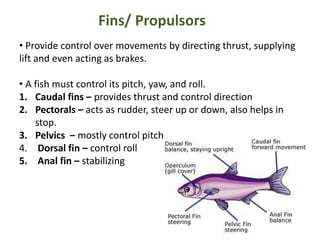
Fins/ Propulsors 
• Provide control over movements by directing thrust, supplying 
lift and even acting as brakes. 
• A fish must control its pitch, yaw, and roll. 
1. Caudal fins – provides thrust and control direction 
2. Pectorals – acts as rudder, steer up or down, also helps in 
stop. 
3. Pelvics – mostly control pitch 
4. Dorsal fin – control roll 
5. Anal fin – stabilizing
How fish swim 
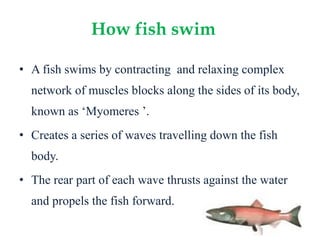
• A fish swims by contracting and relaxing complex 
network of muscles blocks along the sides of its body, 
known as ‘Myomeres ’. 
• Creates a series of waves travelling down the fish 
body. 
• The rear part of each wave thrusts against the water 
and propels the fish forward.
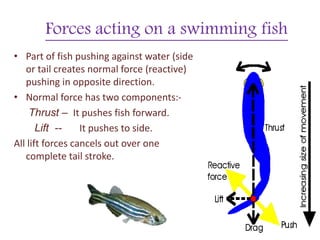
Forces acting on a swimming fish 
• Part of fish pushing against water (side 
or tail creates normal force (reactive) 
pushing in opposite direction. 
• Normal force has two components:- 
Thrust – It pushes fish forward. 
Lift -- It pushes to side. 
All lift forces cancels out over one 
complete tail stroke.
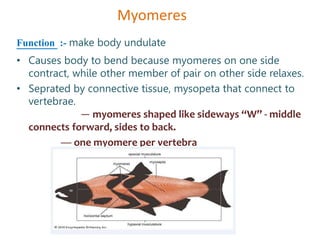
Myomeres 
Function :- make body undulate 
• Causes body to bend because myomeres on one side 
contract, while other member of pair on other side relaxes. 
• Seprated by connective tissue, mysopeta that connect to 
vertebrae. 
— myomeres shaped like sideways “W” - middle 
connects forward, sides to back. 
— one myomere per vertebra
Types of swimming 
A. Body and Caudal Fin swimming (BCF). 
1. undulation 
2. oscillation 
B. Median and Paired Fin swimming (MPF). 
1. undulation 
2. oscillation 
3. rowing/sculling 
Undulation :- wavelength pass down length of body. 
Oscillation :- structure (fins) pivots on a base.
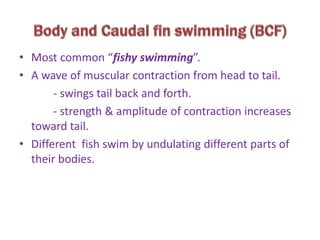
• Most common “fishy swimming”. 
• A wave of muscular contraction from head to tail. 
- swings tail back and forth. 
- strength & amplitude of contraction increases 
toward tail. 
• Different fish swim by undulating different parts of 
their bodies.
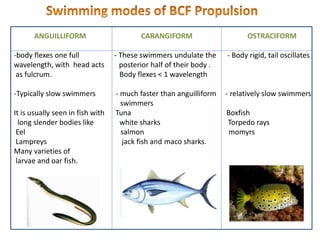
ANGUILLIFORM CARANGIFORM OSTRACIFORM 
-body flexes one full - These swimmers undulate the - Body rigid, tail oscillates 
wavelength, with head acts posterior half of their body . 
as fulcrum. Body flexes < 1 wavelength 
-Typically slow swimmers - much faster than anguilliform - relatively slow swimmers 
swimmers 
It is usually seen in fish with Tuna Boxfish 
long slender bodies like white sharks Torpedo rays 
Eel salmon momyrs 
Lampreys jack fish and maco sharks. 
Many varieties of 
larvae and oar fish.
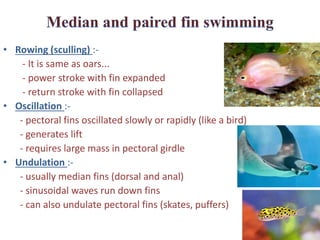
• Rowing (sculling) :- 
- It is same as oars... 
- power stroke with fin expanded 
- return stroke with fin collapsed 
• Oscillation :- 
- pectoral fins oscillated slowly or rapidly (like a bird) 
- generates lift 
- requires large mass in pectoral girdle 
• Undulation :- 
- usually median fins (dorsal and anal) 
- sinusoidal waves run down fins 
- can also undulate pectoral fins (skates, puffers)
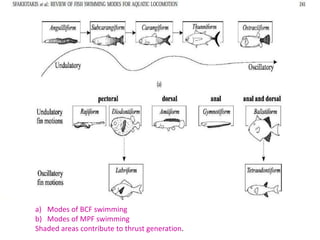
• Rajiform :- Thrust generation involves the passing of vertical undulations along the 
pectorals that are very large, triangular shaped, and flexible. The fins may also be 
flapped up and down. 
- likened to the flight of birds. Eg:- rays, skates and mantas 
• Diodontiform :- propulsion is achieved by passing undulations down broad pectoral 
fins. 
- Up to two full wavelengths may be visible across the fins. Eg:- puffer fish 
• Amiiform :- swimming is by undulations of a (usually long-based) dorsal fin, while 
the body axis is in many cases held straight when swimming. 
eg:- african fresh water eel 
• Gymnotiform :- since propulsion is obtained by undulations of a long-based anal 
fin. 
- dorsal fin is usually absent Eg:- knife fish 
• Balistiform :- both the anal and dorsal fins undulate to generate the propulsion 
forces. 
- their median fins are usually inclined relative to each other, while the body 
is usually flat and compressed laterally. 
eg:- trigger fish
a) Modes of BCF swimming 
b) Modes of MPF swimming 
Shaded areas contribute to thrust generation.
How fish generate lift 
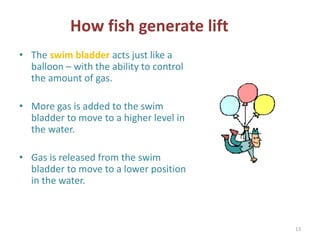
• The swim bladder acts just like a 
balloon – with the ability to control 
the amount of gas. 
• More gas is added to the swim 
bladder to move to a higher level in 
the water. 
• Gas is released from the swim 
bladder to move to a lower position 
in the water. 
13
Inflating the Swim Bladder 
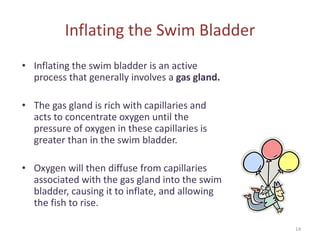
• Inflating the swim bladder is an active 
process that generally involves a gas gland. 
• The gas gland is rich with capillaries and 
acts to concentrate oxygen until the 
pressure of oxygen in these capillaries is 
greater than in the swim bladder. 
• Oxygen will then diffuse from capillaries 
associated with the gas gland into the swim 
bladder, causing it to inflate, and allowing 
the fish to rise. 
14
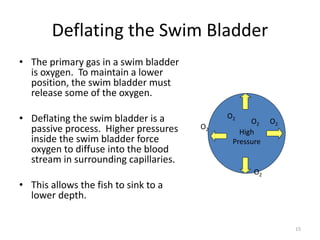
Deflating the Swim Bladder 
• The primary gas in a swim bladder 
is oxygen. To maintain a lower 
position, the swim bladder must 
release some of the oxygen. 
• Deflating the swim bladder is a 
passive process. Higher pressures 
inside the swim bladder force 
oxygen to diffuse into the blood 
stream in surrounding capillaries. 
• This allows the fish to sink to a 
lower depth. 
15 
O2 
O2 
O2 O2 
High 
Pressure 
O2
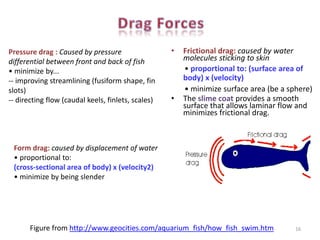
• Frictional drag: caused by water 
molecules sticking to skin 
• proportional to: (surface area of 
body) x (velocity) 
• minimize surface area (be a sphere) 
• The slime coat provides a smooth 
surface that allows laminar flow and 
minimizes frictional drag. 
Pressure drag : Caused by pressure 
differential between front and back of fish 
• minimize by... 
-- improving streamlining (fusiform shape, fin 
slots) 
-- directing flow (caudal keels, finlets, scales) 
Form drag: caused by displacement of water 
• proportional to: 
(cross-sectional area of body) x (velocity2) 
• minimize by being slender 
Figure from http://www.geocities.com/aquarium_fish/how_fish_swim.htm 16
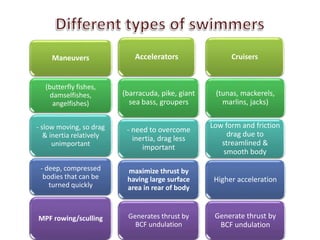
Maneuvers 
(butterfly fishes, 
damselfishes, 
angelfishes) 
- slow moving, so drag 
& inertia relatively 
unimportant 
- deep, compressed 
bodies that can be 
turned quickly 
MPF rowing/sculling 
Accelerators 
(barracuda, pike, giant 
sea bass, groupers 
- need to overcome 
inertia, drag less 
important 
maximize thrust by 
having large surface 
area in rear of body 
Generates thrust by 
BCF undulation 
Cruisers 
(tunas, mackerels, 
marlins, jacks) 
Low form and friction 
drag due to 
streamlined & 
smooth body 
Higher acceleration 
Generate thrust by 
BCF undulation
– http://www.amonline.net.au/FISHES/students/dissect/swimbladder. 
htm 
– http://lookd.com/fish/swimming.html 
– http://www.fisheriesmanagement.co.uk/index.htm 
– http://www.scienceandthesea.org/index.php?option=com_frontpag 
e&Itemid=1 
– http://lookd.com/fish/index.html 
– https://www.tpwd.state.tx.us/ 
– https://googleimages.com 
18
. 
AKASH KUMAR BHANDARI 
A3MB13 
11MEB325

Fish swim

  • 2.
    Contents  Fins  How fish swim  Forces acting on swimming fish  Types of swimming and their modes  How fish generates lift  Forces resisting movement
  • 3.
    Fins/ Propulsors •Provide control over movements by directing thrust, supplying lift and even acting as brakes. • A fish must control its pitch, yaw, and roll. 1. Caudal fins – provides thrust and control direction 2. Pectorals – acts as rudder, steer up or down, also helps in stop. 3. Pelvics – mostly control pitch 4. Dorsal fin – control roll 5. Anal fin – stabilizing
  • 4.
    How fish swim • A fish swims by contracting and relaxing complex network of muscles blocks along the sides of its body, known as ‘Myomeres ’. • Creates a series of waves travelling down the fish body. • The rear part of each wave thrusts against the water and propels the fish forward.
  • 5.
    Forces acting ona swimming fish • Part of fish pushing against water (side or tail creates normal force (reactive) pushing in opposite direction. • Normal force has two components:- Thrust – It pushes fish forward. Lift -- It pushes to side. All lift forces cancels out over one complete tail stroke.
  • 6.
    Myomeres Function :-make body undulate • Causes body to bend because myomeres on one side contract, while other member of pair on other side relaxes. • Seprated by connective tissue, mysopeta that connect to vertebrae. — myomeres shaped like sideways “W” - middle connects forward, sides to back. — one myomere per vertebra
  • 7.
    Types of swimming A. Body and Caudal Fin swimming (BCF). 1. undulation 2. oscillation B. Median and Paired Fin swimming (MPF). 1. undulation 2. oscillation 3. rowing/sculling Undulation :- wavelength pass down length of body. Oscillation :- structure (fins) pivots on a base.
  • 8.
    • Most common“fishy swimming”. • A wave of muscular contraction from head to tail. - swings tail back and forth. - strength & amplitude of contraction increases toward tail. • Different fish swim by undulating different parts of their bodies.
  • 9.
    ANGUILLIFORM CARANGIFORM OSTRACIFORM -body flexes one full - These swimmers undulate the - Body rigid, tail oscillates wavelength, with head acts posterior half of their body . as fulcrum. Body flexes < 1 wavelength -Typically slow swimmers - much faster than anguilliform - relatively slow swimmers swimmers It is usually seen in fish with Tuna Boxfish long slender bodies like white sharks Torpedo rays Eel salmon momyrs Lampreys jack fish and maco sharks. Many varieties of larvae and oar fish.
  • 10.
    • Rowing (sculling):- - It is same as oars... - power stroke with fin expanded - return stroke with fin collapsed • Oscillation :- - pectoral fins oscillated slowly or rapidly (like a bird) - generates lift - requires large mass in pectoral girdle • Undulation :- - usually median fins (dorsal and anal) - sinusoidal waves run down fins - can also undulate pectoral fins (skates, puffers)
  • 11.
    • Rajiform :-Thrust generation involves the passing of vertical undulations along the pectorals that are very large, triangular shaped, and flexible. The fins may also be flapped up and down. - likened to the flight of birds. Eg:- rays, skates and mantas • Diodontiform :- propulsion is achieved by passing undulations down broad pectoral fins. - Up to two full wavelengths may be visible across the fins. Eg:- puffer fish • Amiiform :- swimming is by undulations of a (usually long-based) dorsal fin, while the body axis is in many cases held straight when swimming. eg:- african fresh water eel • Gymnotiform :- since propulsion is obtained by undulations of a long-based anal fin. - dorsal fin is usually absent Eg:- knife fish • Balistiform :- both the anal and dorsal fins undulate to generate the propulsion forces. - their median fins are usually inclined relative to each other, while the body is usually flat and compressed laterally. eg:- trigger fish
  • 12.
    a) Modes ofBCF swimming b) Modes of MPF swimming Shaded areas contribute to thrust generation.
  • 13.
    How fish generatelift • The swim bladder acts just like a balloon – with the ability to control the amount of gas. • More gas is added to the swim bladder to move to a higher level in the water. • Gas is released from the swim bladder to move to a lower position in the water. 13
  • 14.
    Inflating the SwimBladder • Inflating the swim bladder is an active process that generally involves a gas gland. • The gas gland is rich with capillaries and acts to concentrate oxygen until the pressure of oxygen in these capillaries is greater than in the swim bladder. • Oxygen will then diffuse from capillaries associated with the gas gland into the swim bladder, causing it to inflate, and allowing the fish to rise. 14
  • 15.
    Deflating the SwimBladder • The primary gas in a swim bladder is oxygen. To maintain a lower position, the swim bladder must release some of the oxygen. • Deflating the swim bladder is a passive process. Higher pressures inside the swim bladder force oxygen to diffuse into the blood stream in surrounding capillaries. • This allows the fish to sink to a lower depth. 15 O2 O2 O2 O2 High Pressure O2
  • 16.
    • Frictional drag:caused by water molecules sticking to skin • proportional to: (surface area of body) x (velocity) • minimize surface area (be a sphere) • The slime coat provides a smooth surface that allows laminar flow and minimizes frictional drag. Pressure drag : Caused by pressure differential between front and back of fish • minimize by... -- improving streamlining (fusiform shape, fin slots) -- directing flow (caudal keels, finlets, scales) Form drag: caused by displacement of water • proportional to: (cross-sectional area of body) x (velocity2) • minimize by being slender Figure from http://www.geocities.com/aquarium_fish/how_fish_swim.htm 16
  • 17.
    Maneuvers (butterfly fishes, damselfishes, angelfishes) - slow moving, so drag & inertia relatively unimportant - deep, compressed bodies that can be turned quickly MPF rowing/sculling Accelerators (barracuda, pike, giant sea bass, groupers - need to overcome inertia, drag less important maximize thrust by having large surface area in rear of body Generates thrust by BCF undulation Cruisers (tunas, mackerels, marlins, jacks) Low form and friction drag due to streamlined & smooth body Higher acceleration Generate thrust by BCF undulation
  • 18.
    – http://www.amonline.net.au/FISHES/students/dissect/swimbladder. htm – http://lookd.com/fish/swimming.html – http://www.fisheriesmanagement.co.uk/index.htm – http://www.scienceandthesea.org/index.php?option=com_frontpag e&Itemid=1 – http://lookd.com/fish/index.html – https://www.tpwd.state.tx.us/ – https://googleimages.com 18
  • 19.
    . AKASH KUMARBHANDARI A3MB13 11MEB325