AIR BLADDER AND WEBERIAN
OSSICLES IN FISHES
Dr. Sandeep Kumar Raghuvanshi
Assistant Professor
PG Department of Zoology
Bareilly College, Bareilly (U.P.)
e-mail: sandeepraghuvanshi@rediffmail.com
INTRODUCTION
• Swim/Gas/Air bladder is an internal gas-filled organ contributing in maintenance of
buoyancy in most bony fish, at a water depth without wasting energy in swimming.
• Also functions as a resonating chamber, to produce/receive sound. The gas/tissue
interface at the swim bladder produces a strong reflection of sound, which is used in
SONAR equipment to find fish.
• Evolutionarily homologous to the lungs. Charls Darwin suggested in his book that the
lung in air-breathing vertebrates is derived from a primitive swim bladder.
• Cartilaginous fishes lack swim bladders. Some of them can control their depth only by
swimming; others store fats or oils with density less than that of seawater to produce a
neutral or near neutral buoyancy.
STRUCTURE AND FUNCTION
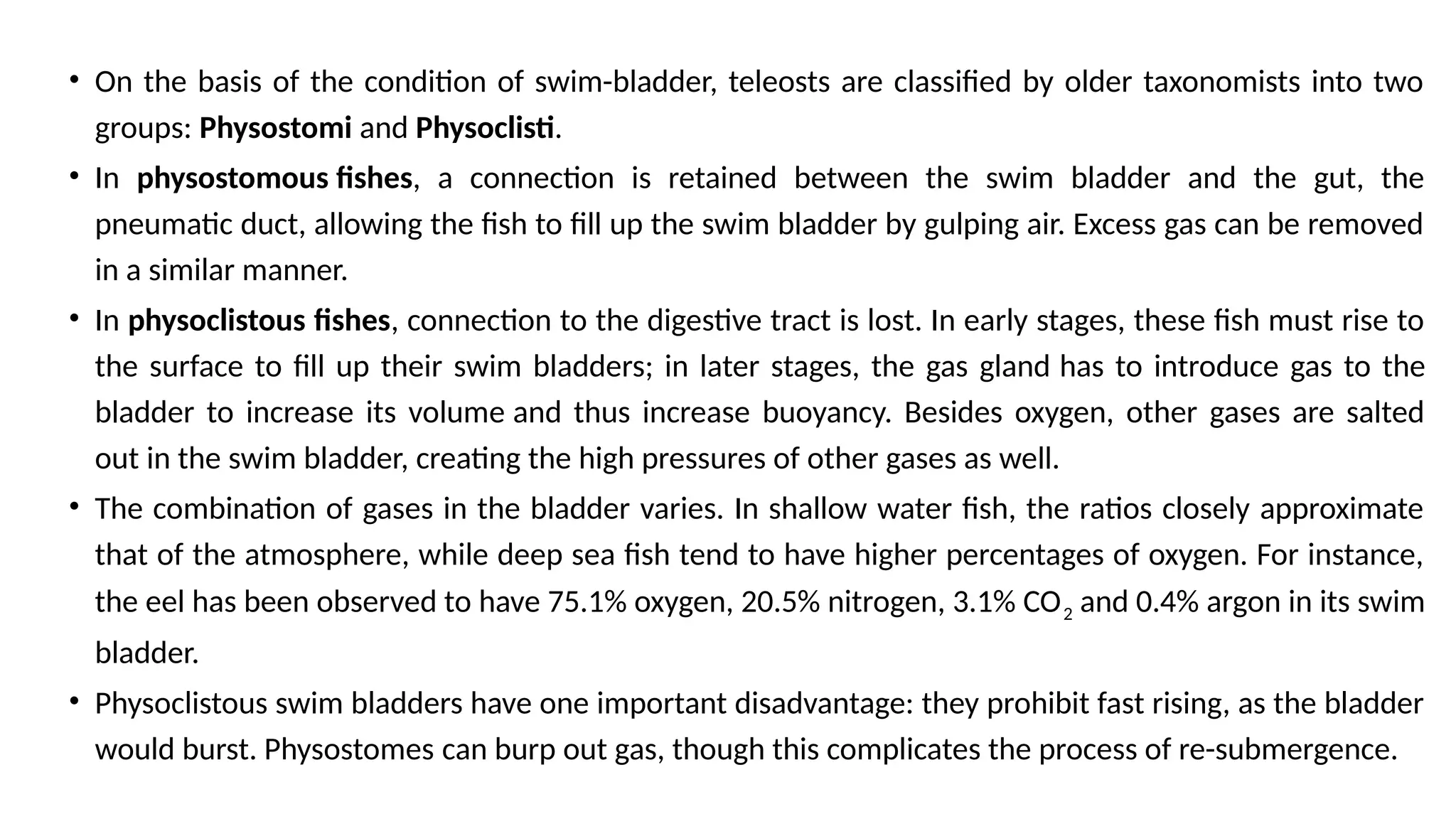
• The swim bladder normally has two gas-filled sacs in the
dorsal portion of the fish, although in a few primitive
species, there is only a single sac.
• It has flexible walls that contract or expand according to
the ambient pressure.
• The walls of the bladder contain few blood vessels lined
with guanine crystals, which make them impermeable to
gases.
• Due to the dorsal position, it gives the fish lateral stability.
• By adjusting the gas pressurizing organ using the gas
gland/oval window, the fish can obtain neutral buoyancy
and ascend/descend to a large range of depths.
• On the basis of the condition of swim-bladder, teleosts are classified by older taxonomists into two
groups: Physostomi and Physoclisti.
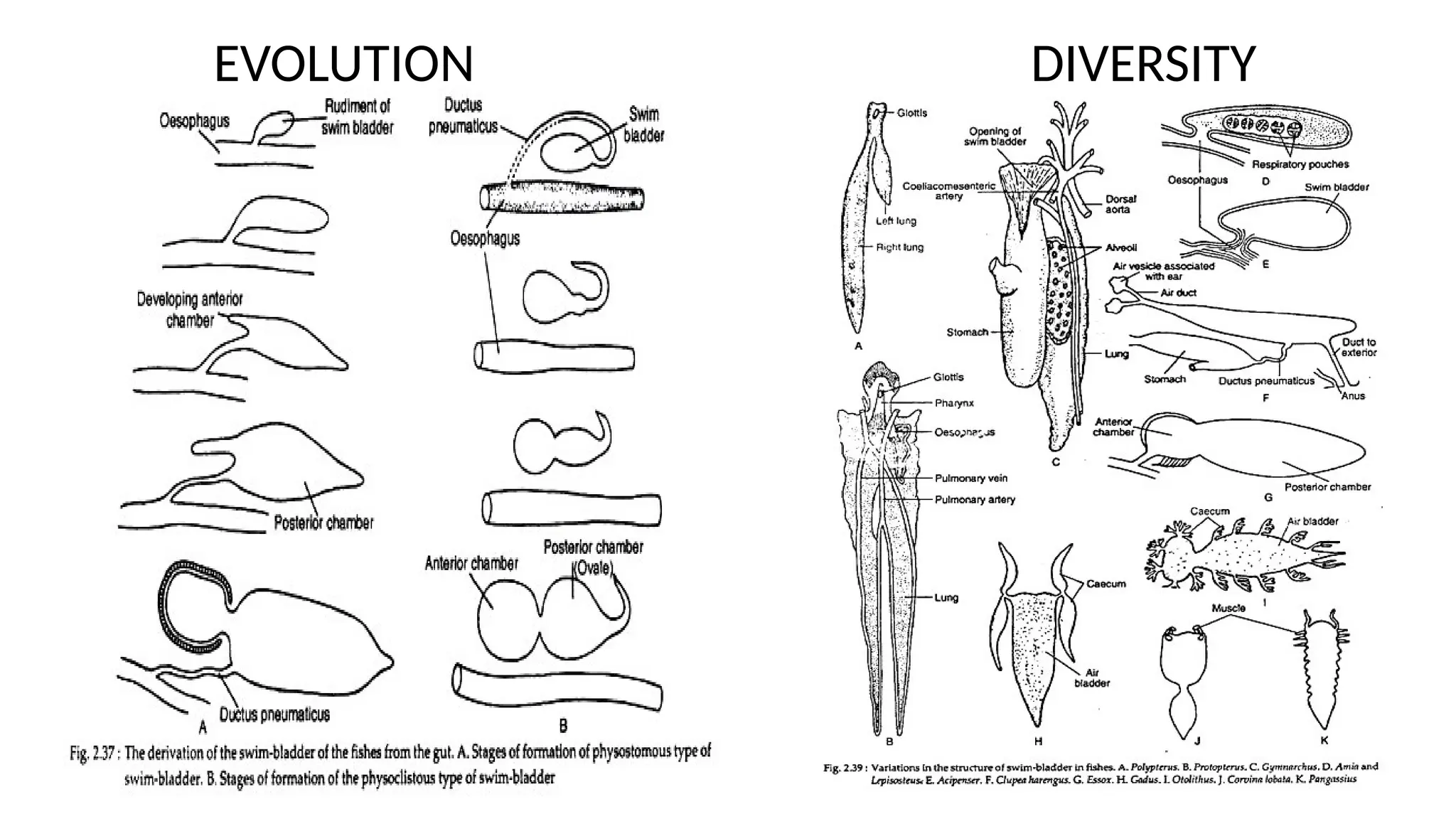
• In physostomous fishes, a connection is retained between the swim bladder and the gut, the
pneumatic duct, allowing the fish to fill up the swim bladder by gulping air. Excess gas can be removed
in a similar manner.
• In physoclistous fishes, connection to the digestive tract is lost. In early stages, these fish must rise to
the surface to fill up their swim bladders; in later stages, the gas gland has to introduce gas to the
bladder to increase its volume and thus increase buoyancy. Besides oxygen, other gases are salted
out in the swim bladder, creating the high pressures of other gases as well.
• The combination of gases in the bladder varies. In shallow water fish, the ratios closely approximate
that of the atmosphere, while deep sea fish tend to have higher percentages of oxygen. For instance,
the eel has been observed to have 75.1% oxygen, 20.5% nitrogen, 3.1% CO2 and 0.4% argon in its swim
bladder.
• Physoclistous swim bladders have one important disadvantage: they prohibit fast rising, as the bladder
would burst. Physostomes can burp out gas, though this complicates the process of re-submergence.
• The swim bladder in fresh water fishes is interconnected
with the inner ear of the fish.
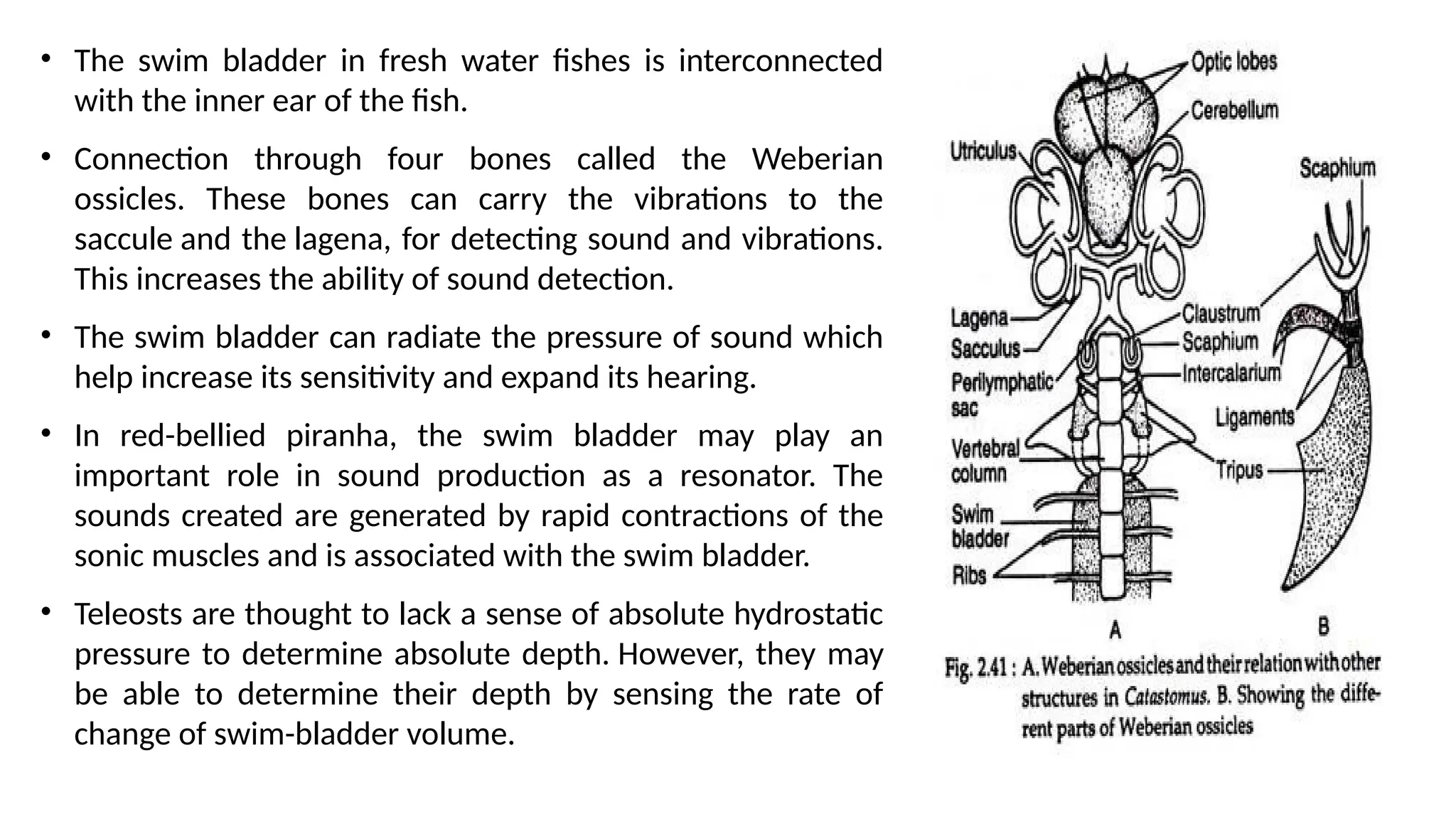
• Connection through four bones called the Weberian
ossicles. These bones can carry the vibrations to the
saccule and the lagena, for detecting sound and vibrations.
This increases the ability of sound detection.
• The swim bladder can radiate the pressure of sound which
help increase its sensitivity and expand its hearing.
• In red-bellied piranha, the swim bladder may play an
important role in sound production as a resonator. The
sounds created are generated by rapid contractions of the
sonic muscles and is associated with the swim bladder.
• Teleosts are thought to lack a sense of absolute hydrostatic
pressure to determine absolute depth. However, they may
be able to determine their depth by sensing the rate of
change of swim-bladder volume.
EVOLUTION OF AIR BLADDER
• Swim bladders are evolutionarily homologous to lungs. Previous study presumes that the first
lungs (simple sacs connected to the gut that allowed the organism to gulp air under oxygen-poor
conditions) evolved into the lungs of today's terrestrial vertebrates and some fish (e.g., lungfish)
and into the swim bladders of the ray-finned fish.
• In embryonic development, both lung and swim bladder originate as an outpocketing from the
gut; in the case of swim bladders, this connection to the gut continues to exist as the pneumatic
duct in the more "primitive" ray-finned fish, and is lost in some of the more derived teleost
orders. There are no animals which have both lungs and a swim bladder.
• The cartilaginous fish, split from the other fishes about 420 mya, lack both lungs and swim
bladders, suggesting that these structures evolved after that split. These fish also have stiff, wing-
like pectoral fins which provide the necessary lift in absence of swim bladders. Teleost fish with
swim bladders have neutral buoyancy, and have no need for this lift.
EVOLUTION DIVERSITY
RISK OF INJURY
• Many anthropogenic activities or even Seismic wave, resulting from
climate change or natural causes, can create high-intensity sound waves
that cause a certain amount of damage to fish having gas bladder.
• Physostomes can release air in order to decrease the tension in the gas
bladder that may cause internal injuries to other vital organs, while
physoclisti can't expel air fast enough, making it more difficult to avoid
any major injuries.
• Some of the commonly seen injuries included ruptured gas bladder and
renal Hemorrhage, which mostly affect the overall health of the fish.
WEBERIAN OSSICLE
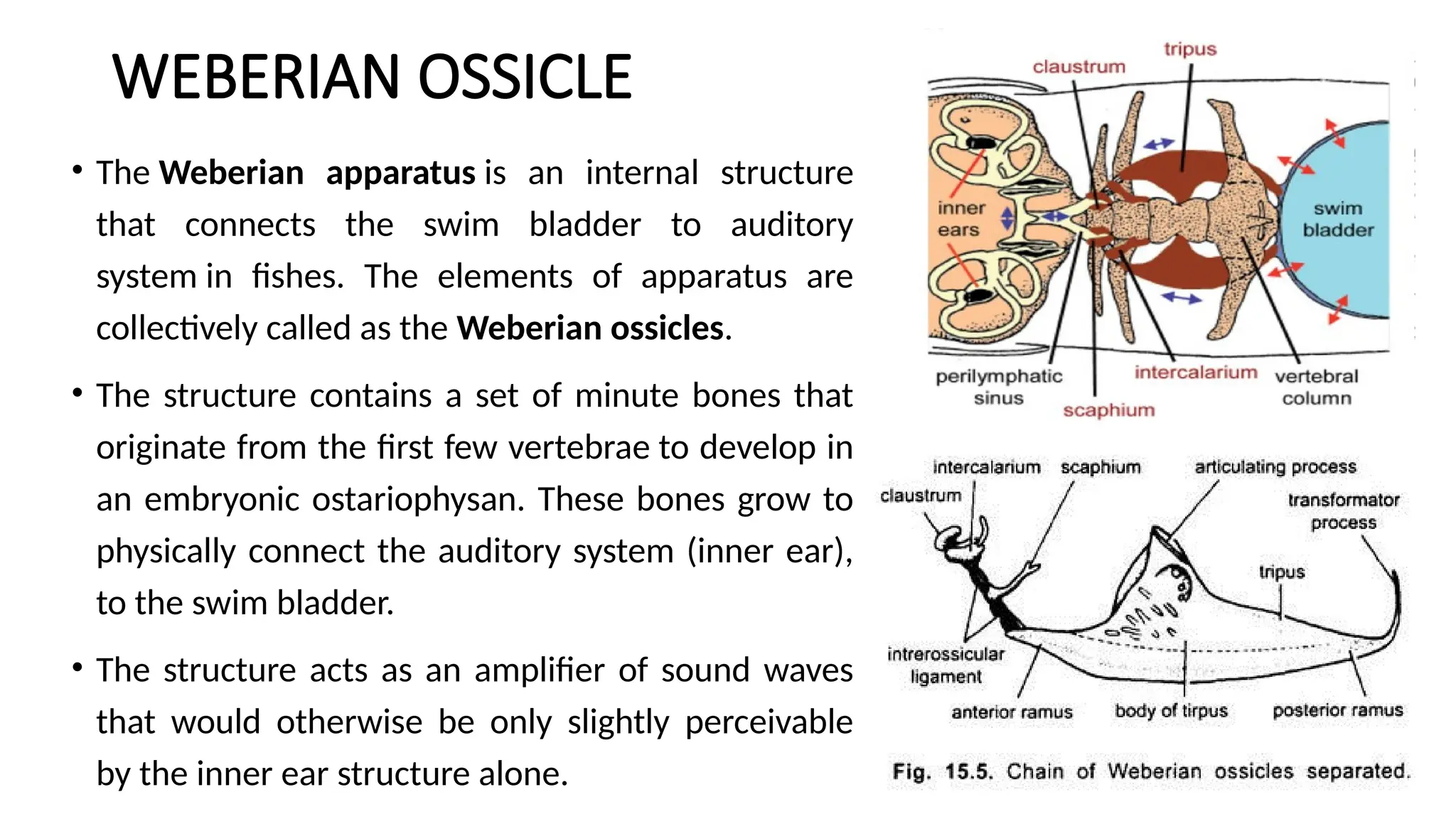
• The Weberian apparatus is an internal structure
that connects the swim bladder to auditory
system in fishes. The elements of apparatus are
collectively called as the Weberian ossicles.
• The structure contains a set of minute bones that
originate from the first few vertebrae to develop in
an embryonic ostariophysan. These bones grow to
physically connect the auditory system (inner ear),
to the swim bladder.
• The structure acts as an amplifier of sound waves
that would otherwise be only slightly perceivable
by the inner ear structure alone.
STRUCTURAL ANATOMY AND FUNCTIONS
• General structure of Weberian apparatus is
similar to a skeletal complex of bones and
ossicles that are physically connected to the
labyrinth auditory complex anteriorly and the
anterior most region of the swim bladder
posteriorly.
• The entire structure is derived from skeletal
elements of the first four vertebrae. Together,
the structure interacts anteriorly with the
lagenar otolith set within the skull and
posteriorly with the swim bladder via the
pleural rib.
FUNCTIONS
• Transmitting auditory signals straight from the gas bladder, through the
Weberian ossicles and then straight into the labyrinth structures of the
inner ear.
• Volume change of the gas bladder cause the Weberian ossicles to move
in such a manner that pressure changes are transmitted to the perilymph
and then to the sensory cells of the inferior portion of the labyrinth
which is the seat of sound reception.
• The structure essentially acts as an amplifier of sound waves that would
otherwise be only slightly perceivable by the inner ear structure alone.
• With the added function of the swim bladder as a resonating chamber,
signals are amplified to noticeable levels.
7. Air bladder and weberian ossicles of fishes.pptx

7. Air bladder and weberian ossicles of fishes.pptx

  • 1.
    AIR BLADDER ANDWEBERIAN OSSICLES IN FISHES Dr. Sandeep Kumar Raghuvanshi Assistant Professor PG Department of Zoology Bareilly College, Bareilly (U.P.) e-mail: sandeepraghuvanshi@rediffmail.com
  • 2.
    INTRODUCTION • Swim/Gas/Air bladderis an internal gas-filled organ contributing in maintenance of buoyancy in most bony fish, at a water depth without wasting energy in swimming. • Also functions as a resonating chamber, to produce/receive sound. The gas/tissue interface at the swim bladder produces a strong reflection of sound, which is used in SONAR equipment to find fish. • Evolutionarily homologous to the lungs. Charls Darwin suggested in his book that the lung in air-breathing vertebrates is derived from a primitive swim bladder. • Cartilaginous fishes lack swim bladders. Some of them can control their depth only by swimming; others store fats or oils with density less than that of seawater to produce a neutral or near neutral buoyancy.
  • 3.
    STRUCTURE AND FUNCTION •The swim bladder normally has two gas-filled sacs in the dorsal portion of the fish, although in a few primitive species, there is only a single sac. • It has flexible walls that contract or expand according to the ambient pressure. • The walls of the bladder contain few blood vessels lined with guanine crystals, which make them impermeable to gases. • Due to the dorsal position, it gives the fish lateral stability. • By adjusting the gas pressurizing organ using the gas gland/oval window, the fish can obtain neutral buoyancy and ascend/descend to a large range of depths.
  • 4.
    • On thebasis of the condition of swim-bladder, teleosts are classified by older taxonomists into two groups: Physostomi and Physoclisti. • In physostomous fishes, a connection is retained between the swim bladder and the gut, the pneumatic duct, allowing the fish to fill up the swim bladder by gulping air. Excess gas can be removed in a similar manner. • In physoclistous fishes, connection to the digestive tract is lost. In early stages, these fish must rise to the surface to fill up their swim bladders; in later stages, the gas gland has to introduce gas to the bladder to increase its volume and thus increase buoyancy. Besides oxygen, other gases are salted out in the swim bladder, creating the high pressures of other gases as well. • The combination of gases in the bladder varies. In shallow water fish, the ratios closely approximate that of the atmosphere, while deep sea fish tend to have higher percentages of oxygen. For instance, the eel has been observed to have 75.1% oxygen, 20.5% nitrogen, 3.1% CO2 and 0.4% argon in its swim bladder. • Physoclistous swim bladders have one important disadvantage: they prohibit fast rising, as the bladder would burst. Physostomes can burp out gas, though this complicates the process of re-submergence.
  • 5.
    • The swimbladder in fresh water fishes is interconnected with the inner ear of the fish. • Connection through four bones called the Weberian ossicles. These bones can carry the vibrations to the saccule and the lagena, for detecting sound and vibrations. This increases the ability of sound detection. • The swim bladder can radiate the pressure of sound which help increase its sensitivity and expand its hearing. • In red-bellied piranha, the swim bladder may play an important role in sound production as a resonator. The sounds created are generated by rapid contractions of the sonic muscles and is associated with the swim bladder. • Teleosts are thought to lack a sense of absolute hydrostatic pressure to determine absolute depth. However, they may be able to determine their depth by sensing the rate of change of swim-bladder volume.
  • 6.
    EVOLUTION OF AIRBLADDER • Swim bladders are evolutionarily homologous to lungs. Previous study presumes that the first lungs (simple sacs connected to the gut that allowed the organism to gulp air under oxygen-poor conditions) evolved into the lungs of today's terrestrial vertebrates and some fish (e.g., lungfish) and into the swim bladders of the ray-finned fish. • In embryonic development, both lung and swim bladder originate as an outpocketing from the gut; in the case of swim bladders, this connection to the gut continues to exist as the pneumatic duct in the more "primitive" ray-finned fish, and is lost in some of the more derived teleost orders. There are no animals which have both lungs and a swim bladder. • The cartilaginous fish, split from the other fishes about 420 mya, lack both lungs and swim bladders, suggesting that these structures evolved after that split. These fish also have stiff, wing- like pectoral fins which provide the necessary lift in absence of swim bladders. Teleost fish with swim bladders have neutral buoyancy, and have no need for this lift.
  • 7.
  • 8.
    RISK OF INJURY •Many anthropogenic activities or even Seismic wave, resulting from climate change or natural causes, can create high-intensity sound waves that cause a certain amount of damage to fish having gas bladder. • Physostomes can release air in order to decrease the tension in the gas bladder that may cause internal injuries to other vital organs, while physoclisti can't expel air fast enough, making it more difficult to avoid any major injuries. • Some of the commonly seen injuries included ruptured gas bladder and renal Hemorrhage, which mostly affect the overall health of the fish.
  • 9.
    WEBERIAN OSSICLE • TheWeberian apparatus is an internal structure that connects the swim bladder to auditory system in fishes. The elements of apparatus are collectively called as the Weberian ossicles. • The structure contains a set of minute bones that originate from the first few vertebrae to develop in an embryonic ostariophysan. These bones grow to physically connect the auditory system (inner ear), to the swim bladder. • The structure acts as an amplifier of sound waves that would otherwise be only slightly perceivable by the inner ear structure alone.
  • 10.
    STRUCTURAL ANATOMY ANDFUNCTIONS • General structure of Weberian apparatus is similar to a skeletal complex of bones and ossicles that are physically connected to the labyrinth auditory complex anteriorly and the anterior most region of the swim bladder posteriorly. • The entire structure is derived from skeletal elements of the first four vertebrae. Together, the structure interacts anteriorly with the lagenar otolith set within the skull and posteriorly with the swim bladder via the pleural rib.
  • 11.
    FUNCTIONS • Transmitting auditorysignals straight from the gas bladder, through the Weberian ossicles and then straight into the labyrinth structures of the inner ear. • Volume change of the gas bladder cause the Weberian ossicles to move in such a manner that pressure changes are transmitted to the perilymph and then to the sensory cells of the inferior portion of the labyrinth which is the seat of sound reception. • The structure essentially acts as an amplifier of sound waves that would otherwise be only slightly perceivable by the inner ear structure alone. • With the added function of the swim bladder as a resonating chamber, signals are amplified to noticeable levels.