Presented By:
Shweta Tyagi
Bsc. Home Sc (H), 3rd Sem
Subject: ICT4D (GE)
Roll No. 69 (Sec C), IHE-DU
Submitted To:
Mrs. Savita Aggarwal
• Also known as Electronic governance
• application of information and communication
technology (ICT) for delivering government services
• exchange of information, communication transactions
• integration of various stand-alone systems & services
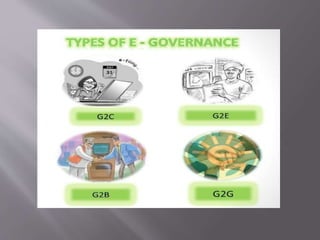
between government-to-customer (G2C), government-to-
business (G2B), government-to-government (G2G)
Introduction
OBJECTIVE
“ To provide a SMARRT Government”
• S The use of ICT brings simplicity in governance
• M It brings morality to governance
• A It makes the Government accountable
• R Due to increased communication speeds, the Government
becomes responsive
• R Increased access to information make a responsible
Government
• T Government becomes transparent
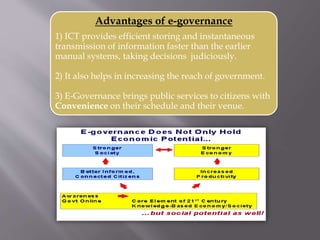
Advantages of e-governance
1) ICT provides efficient storing and instantaneous
transmission of information faster than the earlier
manual systems, taking decisions judiciously.
2) It also helps in increasing the reach of government.
3) E-Governance brings public services to citizens with
Convenience on their schedule and their venue.
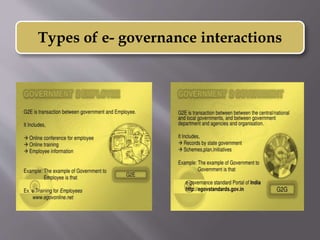
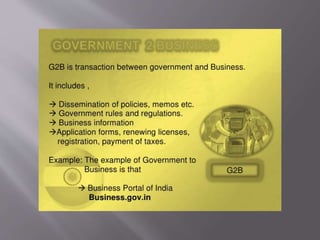
Types of e- governance interactions
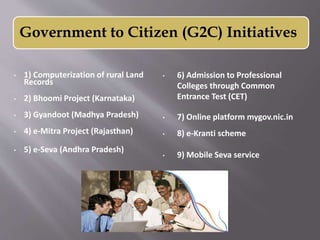
• 1) Computerization of rural Land
Records
• 2) Bhoomi Project (Karnataka)
• 3) Gyandoot (Madhya Pradesh)
• 4) e-Mitra Project (Rajasthan)
• 5) e-Seva (Andhra Pradesh)
• 6) Admission to Professional
Colleges through Common
Entrance Test (CET)
• 7) Online platform mygov.nic.in
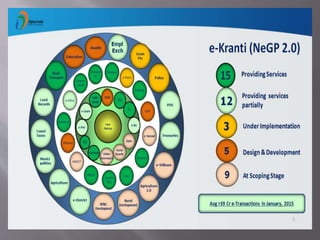
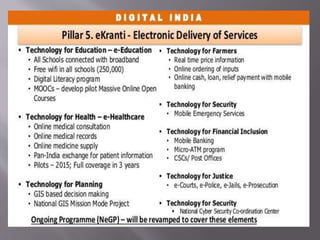
• 8) e-Kranti scheme
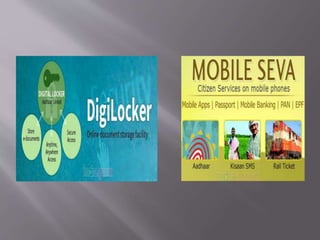
• 9) Mobile Seva service
Government to Citizen (G2C) Initiatives
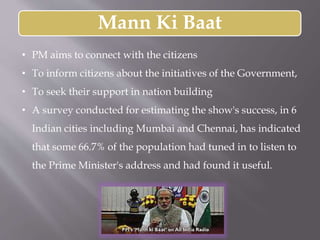
Mann Ki Baat
• PM aims to connect with the citizens
• To inform citizens about the initiatives of the Government,
• To seek their support in nation building
• A survey conducted for estimating the show's success, in 6
Indian cities including Mumbai and Chennai, has indicated
that some 66.7% of the population had tuned in to listen to
the Prime Minister's address and had found it useful.
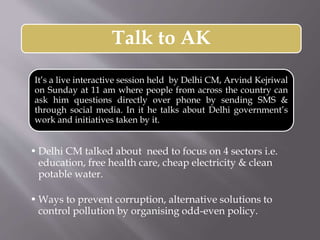
Talk to AK
It’s a live interactive session held by Delhi CM, Arvind Kejriwal
on Sunday at 11 am where people from across the country can
ask him questions directly over phone by sending SMS &
through social media. In it he talks about Delhi government’s
work and initiatives taken by it.
• Delhi CM talked about need to focus on 4 sectors i.e.
education, free health care, cheap electricity & clean
potable water.
• Ways to prevent corruption, alternative solutions to
control pollution by organising odd-even policy.
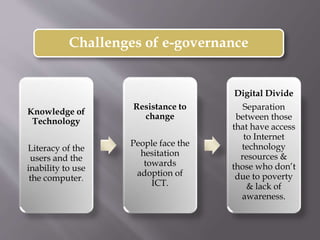
Challenges of e-governance
Knowledge of
Technology
Literacy of the
users and the
inability to use
the computer.
Resistance to
change
People face the
hesitation
towards
adoption of
ICT.
Digital Divide
Separation
between those
that have access
to Internet
technology
resources &
those who don’t
due to poverty
& lack of
awareness.
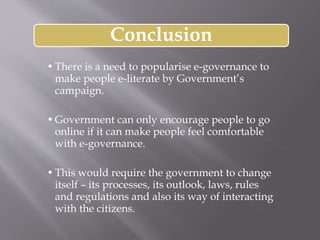
Conclusion
•There is a need to popularise e-governance to
make people e-literate by Government’s
campaign.
•Government can only encourage people to go
online if it can make people feel comfortable
with e-governance.
•This would require the government to change
itself – its processes, its outlook, laws, rules
and regulations and also its way of interacting
with the citizens.

Ict ppt on e governance

  • 1.
    Presented By: Shweta Tyagi Bsc.Home Sc (H), 3rd Sem Subject: ICT4D (GE) Roll No. 69 (Sec C), IHE-DU Submitted To: Mrs. Savita Aggarwal
  • 2.
    • Also knownas Electronic governance • application of information and communication technology (ICT) for delivering government services • exchange of information, communication transactions • integration of various stand-alone systems & services between government-to-customer (G2C), government-to- business (G2B), government-to-government (G2G) Introduction
  • 3.
    OBJECTIVE “ To providea SMARRT Government” • S The use of ICT brings simplicity in governance • M It brings morality to governance • A It makes the Government accountable • R Due to increased communication speeds, the Government becomes responsive • R Increased access to information make a responsible Government • T Government becomes transparent
  • 4.
    Advantages of e-governance 1)ICT provides efficient storing and instantaneous transmission of information faster than the earlier manual systems, taking decisions judiciously. 2) It also helps in increasing the reach of government. 3) E-Governance brings public services to citizens with Convenience on their schedule and their venue.
  • 6.
    Types of e-governance interactions
  • 8.
    • 1) Computerizationof rural Land Records • 2) Bhoomi Project (Karnataka) • 3) Gyandoot (Madhya Pradesh) • 4) e-Mitra Project (Rajasthan) • 5) e-Seva (Andhra Pradesh) • 6) Admission to Professional Colleges through Common Entrance Test (CET) • 7) Online platform mygov.nic.in • 8) e-Kranti scheme • 9) Mobile Seva service Government to Citizen (G2C) Initiatives
  • 13.
    Mann Ki Baat •PM aims to connect with the citizens • To inform citizens about the initiatives of the Government, • To seek their support in nation building • A survey conducted for estimating the show's success, in 6 Indian cities including Mumbai and Chennai, has indicated that some 66.7% of the population had tuned in to listen to the Prime Minister's address and had found it useful.
  • 15.
    Talk to AK It’sa live interactive session held by Delhi CM, Arvind Kejriwal on Sunday at 11 am where people from across the country can ask him questions directly over phone by sending SMS & through social media. In it he talks about Delhi government’s work and initiatives taken by it. • Delhi CM talked about need to focus on 4 sectors i.e. education, free health care, cheap electricity & clean potable water. • Ways to prevent corruption, alternative solutions to control pollution by organising odd-even policy.
  • 16.
    Challenges of e-governance Knowledgeof Technology Literacy of the users and the inability to use the computer. Resistance to change People face the hesitation towards adoption of ICT. Digital Divide Separation between those that have access to Internet technology resources & those who don’t due to poverty & lack of awareness.
  • 17.
    Conclusion •There is aneed to popularise e-governance to make people e-literate by Government’s campaign. •Government can only encourage people to go online if it can make people feel comfortable with e-governance. •This would require the government to change itself – its processes, its outlook, laws, rules and regulations and also its way of interacting with the citizens.