Presented By : 
Marjia Mizan 
Abul Kalam Azad 
Nowrin Jahan Jerin 
Abu Hanif Mia 
Md. Abu Nasir 
Md. Omar Faruk 
Md. Abdullah Al Muhaimenul Islam 
Md. Miraz Hosen 
Md. Tariqur Rahman 
Year: 2nd , Semester: 4th 
Batch No-7th 
Dept. of Public Administration 
University of Dhaka
MARJIA MIZAN 
ROLL NO-22 
CONCEPT AND OBJECTIVES OF E-GOVERNANCE
Governance 
• Act, process or power of governing 
• The state of being governed
What E-Governance is not 
• Changing govt. process 
• Computerization of govt. offices 
• Type documents using computers 
• Put govt. security and confidentiality at risk
E-Governance 
• Intangible status 
• Strategic issue that relates to redesigning the national 
administrative process 
• Refers to the use of information and communication technologies 
(ICT) by the govt. agencies
Examples 
• Notification of a meeting time 
• Accessing documents 
• Accessing needed data 
• Tracking progress 
• Disseminating policies and strategies
Objectives of E-Governance 
• To build an informed society 
• To increase govt. and citizen interaction 
• To encourage citizen participation 
• To bring transparency in the governing process 
• To make the govt. accountable 
• To reduce the cost of governance 
• To reduce the reaction time of the govt.
ABUL KALAM AZAD 
ROLL NO- 50 
Types and models of e-governance
Government- to-Citizen 
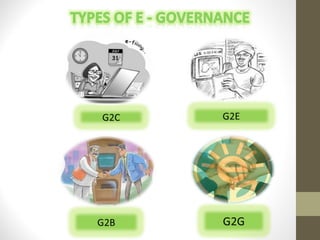
G2C is transaction between government and citizens. 
Examples of G2C are payment of utility bills. 
The primary goal of G2C e-Governance is to offer a variety of 
ICT services to citizens. 
Situation of G2C in the world: 
USA….. 
UK….. 
European Countries….. 
Asian Countries: Singapore; Taiwan; South Korea; BD
Government-to-Business 
• Involves interaction of the business establishments with 
the government. 
• The example of G2B is submission of tax assessment 
• The main Goal of G2B is to increase productivity 
• Key Points of Government to business 
1. Reduce the burden 
2. Key lines of business 
• Difference between G2B and B2G 
1. Government to business 
2. Business to government
Government-to-Employee 
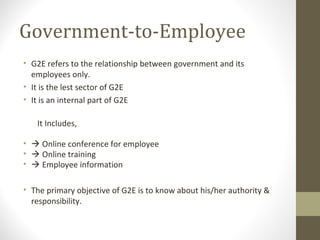
• G2E refers to the relationship between government and its 
employees only. 
• It is the lest sector of G2E 
• It is an internal part of G2E 
It Includes, 
•  Online conference for employee 
•  Online training 
•  Employee information 
• The primary objective of G2E is to know about his/her authority & 
responsibility.
Government-to-Government 
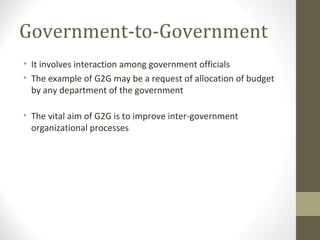
• It involves interaction among government officials 
• The example of G2G may be a request of allocation of budget 
by any department of the government 
• The vital aim of G2G is to improve inter-government 
organizational processes
NOWRIN JAHAN JERIN 
ROLL NO-24 
History of e-Governance In 
Bangladesh
E-Governance in 
Bangladesh 
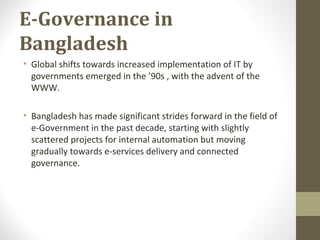
• Global shifts towards increased implementation of IT by 
governments emerged in the ’90s , with the advent of the 
WWW. 
• Bangladesh has made significant strides forward in the field of 
e-Government in the past decade, starting with slightly 
scattered projects for internal automation but moving 
gradually towards e-services delivery and connected 
governance.
History of e-Governance in 
Bangladesh
History of e-Governance in 
Bangladesh 
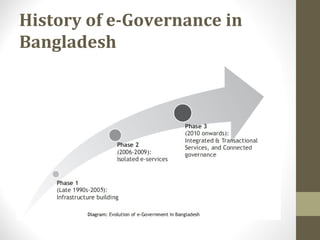
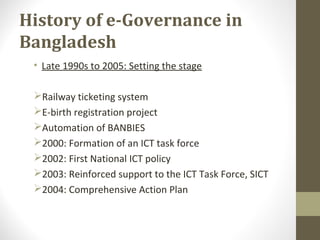
• Late 1990s to 2005: Setting the stage 
Railway ticketing system 
E-birth registration project 
Automation of BANBIES 
2000: Formation of an ICT task force 
2002: First National ICT policy 
2003: Reinforced support to the ICT Task Force, SICT 
2004: Comprehensive Action Plan
History of e-Governance in 
Bangladesh 
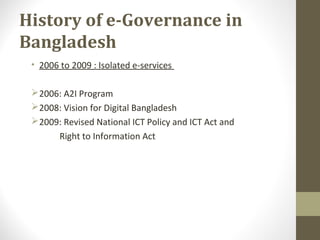
• 2006 to 2009 : Isolated e-services 
2006: A2I Program 
2008: Vision for Digital Bangladesh 
2009: Revised National ICT Policy and ICT Act and 
Right to Information Act
History of e-Governance in 
Bangladesh 
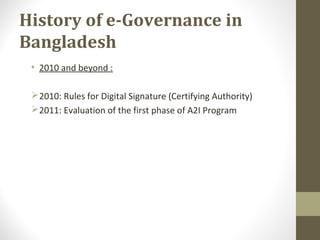
• 2010 and beyond : 
2010: Rules for Digital Signature (Certifying Authority) 
2011: Evaluation of the first phase of A2I Program
ABU HANIF MIA 
ROLL NO-71 
INFRASTRUCTURE AND CONNECTIVITY 
ISSUES
Present e-Governance scenario 
in Bangladesh 
1. INFRASTRUCTURE AND CONNECTIVITY ISSUE 
2. E-GOVERNANCE IN PUBLIC SECTOR 
3. E-GOVERNANCE IN PRIVATE SECTOR
INFRASTRUCTURE AND CONNECTIVITY 
ISSUE 
Telecommunication Network 
Data Connectivity 
Television Network 
Radio Network 
Post 
Tele Center And Cyber Café 
Power Sector
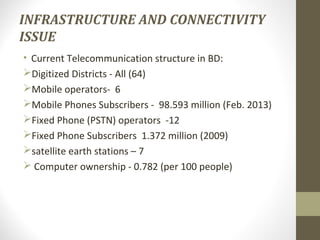
INFRASTRUCTURE AND CONNECTIVITY 
ISSUE 
• Current Telecommunication structure in BD: 
Digitized Districts - All (64) 
Mobile operators- 6 
Mobile Phones Subscribers - 98.593 million (Feb. 2013) 
Fixed Phone (PSTN) operators -12 
Fixed Phone Subscribers 1.372 million (2009) 
satellite earth stations – 7 
 Computer ownership - 0.782 (per 100 people)
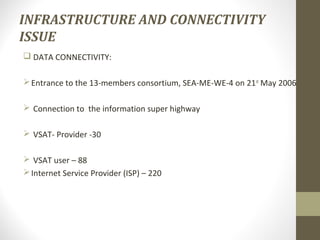
INFRASTRUCTURE AND CONNECTIVITY 
ISSUE 
 DATA CONNECTIVITY: 
Entrance to the 13-members consortium, SEA-ME-WE-4 on 21st May 2006 
 Connection to the information super highway 
 VSAT- Provider -30 
 VSAT user – 88 
Internet Service Provider (ISP) – 220
INFRASTRUCTURE AND CONNECTIVITY 
ISSUE 
 TELEVISION NETWORK: 
BTV broadcasts on health, education, women and children affairs, 
weather and agriculture 
Television broadcast stations – 27 
RADIO STATION: 
Radio broadcast stations - 38 (SW,FM, Internet) 
 BD Betar and Other Private FM Radio 
 POWER SECTOR: 
 Power production capacity- 10213 MW 
 Service provider- (BPDB, DESA, DESCO, REB) 
 21 state-owned power plants
MD. ABU NASIR 
ROLL NO-56 
E-GOVERNANCE IN PUBLIC SECTOR
E-GOVERNANCE IN PUBLIC SECTORS 
 EE--GGoovveerrnnaannccee iinn LLGG 
 OOnnlliinnee bbiirrtthh//ddeeaatthh cceerrttiiffiiccaattee 
 AAcccceessss ttoo iinnffoorrmmaattiioonn ooff llooccaall ppeeooppllee 
 EE--GGoovveerrnnaannccee iinn EElleeccttiioonn CCoommmmiissssiioonn 
 EElleeccttrroonniicc VVoottiinngg MMaacchhiinnee ((EEVVMM)) 
 NNaattiioonnaall IIDD CCaarrdd
E-GOVERNANCE IN PUBLIC SECTORS 
 EE--GGoovveerrnnaannccee iinn EEdduuccaattiioonn 
 OOnnlliinnee aaddmmiissssiioonn pprroocceedduurree 
 OOnnlliinnee rreessuulltt pprroocceedduurree 
 EE--GGoovveerrnnaannccee iinn CCoommmmuunniiccaattiioonn aanndd TTrraannssppoorrttaattiioonn 
 EE--TTiicckkeett 
EElleeccttrriicc bbiillll ppaayymmeenntt uussiinngg mmoobbiillee pphhoonnee
E-GOVERNANCE IN PUBLIC SECTORS 
 E-GGoovveerrnnaannccee iinn BBuussiinneessss 
 DDhhaakkaa && CChhiittttaaggoonngg SSttoocckk EExxcchhaannggee 
 NNBBRR 
 EE--GGoovveerrnnaannccee iinn MMOOSSIICCTT 
web-sites containing information about 
various ministries.
MD:OMAR FARUK 
ROLL-78 
E-governance in Private Sector
E-governance in Private Sector 
1. Banking Sector 
2. Bangladesh ICT Sector 
3. Media and Advertising 
1. Banking Sector : 
•Online Banking 
•Service Line: 
i. ATM Booth 
ii. Different types of cards 
iii. Point of Sales 
iv. Tele - Banking 
v. Mobile Banking 
vi. Home banking 
•Utility Bill Payment 
•Connectivity and software
E-governance in Private Sector 
2. Bangladesh ICT Sector 
 Local Market Scenarios 
 Software Trade 
 Human Resource Dynamics 
 IT Enabled Service 
 Prospective BPO Areas of Bangladesh:
E-governance in Private Sector 
Prospective BPO Areas: 
i.Data Entry 
ii.Data Processing 
iii.Call Centre 
iv.E- Accounting 
3. Media and Advertising
Md. Abdullah Al Muhaimenul Islam 
Roll No-228 
E-Governance and Globalization
E-Governance and Globalization 
• Globalization: 
Globalization is a process of international integration of 
economies, societies through cross country arising from 
interchange of world views, ideas, information, products, 
capital, finance, people and culture.
E-Governance and Globalization 
• Main focus: 
Free Trade, Competition in market,connectivity 
How e-governance is helping to achieve these goal. 
• Free trade: 
 Reduction of Trade barrier 
Online Trading 
 Producer has a variety of buyer to choose from 
Access to information.
E-Governance and Globalization 
• Competition in market: 
 Out sourcing 
 E-tender 
 Global market 
 Connectivity: 
 Proper implementation of government policy 
 Better opportunity of gathering feed back result 
 Use full tool in the formulation of better policy 
 Ensuring free access for every one in the government 
activity.
How e government is helping 
Globalization: 
• E-Government reducing red tapism, and other 
administrative difficulty. 
 Access to information about high authority 
 increasing trade 
 opening new market 
 increasing access to cheep resources 
Helping student in their study by easing the 
application and examination process 
Opening new opportunity for one labor to work 
abroad.
MD.MIRAZ HOSEN 
Roll No-61 
Challenges Of e-Governance
Major Challenges: 
• Poor ICT Infrastructure 
• IT Policy 
• Lack of Awareness of government officials 
• Non-acceptability of IT systems 
• Lack of Coordination 
• Low Level of IT literacy
Major Challenges: 
• Lack of IT Training 
• High-cost, Lower Liability of Internet Access 
• Lack of IT Funds 
• Poor Salary Structure 
• Wrong task and blocked post
Major Challenges: 
• Conflict with culture 
• Lack of Education 
• Lack of Attention in Complain Centre 
• Hassle in Getting Required Service 
• Lack of Information
MD.TARIQUR RAHMAN 
ROLL NO-85 
RECOMMENDATIONS FOR 
IMPLEMENTING E-GOVERNANCE IN 
BANGLADESH
Key Recommendations 
• ICT Infrastructure development 
• Strong Roadmap 
• Reduce Internet and local bandwidth cost 
• Financial solution 
• Strong IT Division
Key Recommendations 
• Proper IT training 
• Updated and Integrated websites 
• Automation of govt. services and 
application 
• Public Private Partnership (PPP) programs
Key Recommendations 
• Provide e-SMART CARD based Govt. 
services 
• Database of citizen 
• Long term planning for Govt. application 
security issue 
• Motivating Public by the Govt. 
• Disability-friendly software
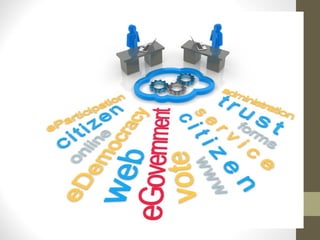
E governance : Bangladesh Perspective

E governance : Bangladesh Perspective

  • 2.
    Presented By : Marjia Mizan Abul Kalam Azad Nowrin Jahan Jerin Abu Hanif Mia Md. Abu Nasir Md. Omar Faruk Md. Abdullah Al Muhaimenul Islam Md. Miraz Hosen Md. Tariqur Rahman Year: 2nd , Semester: 4th Batch No-7th Dept. of Public Administration University of Dhaka
  • 3.
    MARJIA MIZAN ROLLNO-22 CONCEPT AND OBJECTIVES OF E-GOVERNANCE
  • 4.
    Governance • Act,process or power of governing • The state of being governed
  • 5.
    What E-Governance isnot • Changing govt. process • Computerization of govt. offices • Type documents using computers • Put govt. security and confidentiality at risk
  • 6.
    E-Governance • Intangiblestatus • Strategic issue that relates to redesigning the national administrative process • Refers to the use of information and communication technologies (ICT) by the govt. agencies
  • 7.
    Examples • Notificationof a meeting time • Accessing documents • Accessing needed data • Tracking progress • Disseminating policies and strategies
  • 8.
    Objectives of E-Governance • To build an informed society • To increase govt. and citizen interaction • To encourage citizen participation • To bring transparency in the governing process • To make the govt. accountable • To reduce the cost of governance • To reduce the reaction time of the govt.
  • 9.
    ABUL KALAM AZAD ROLL NO- 50 Types and models of e-governance
  • 11.
    Government- to-Citizen G2Cis transaction between government and citizens. Examples of G2C are payment of utility bills. The primary goal of G2C e-Governance is to offer a variety of ICT services to citizens. Situation of G2C in the world: USA….. UK….. European Countries….. Asian Countries: Singapore; Taiwan; South Korea; BD
  • 12.
    Government-to-Business • Involvesinteraction of the business establishments with the government. • The example of G2B is submission of tax assessment • The main Goal of G2B is to increase productivity • Key Points of Government to business 1. Reduce the burden 2. Key lines of business • Difference between G2B and B2G 1. Government to business 2. Business to government
  • 13.
    Government-to-Employee • G2Erefers to the relationship between government and its employees only. • It is the lest sector of G2E • It is an internal part of G2E It Includes, •  Online conference for employee •  Online training •  Employee information • The primary objective of G2E is to know about his/her authority & responsibility.
  • 14.
    Government-to-Government • Itinvolves interaction among government officials • The example of G2G may be a request of allocation of budget by any department of the government • The vital aim of G2G is to improve inter-government organizational processes
  • 15.
    NOWRIN JAHAN JERIN ROLL NO-24 History of e-Governance In Bangladesh
  • 16.
    E-Governance in Bangladesh • Global shifts towards increased implementation of IT by governments emerged in the ’90s , with the advent of the WWW. • Bangladesh has made significant strides forward in the field of e-Government in the past decade, starting with slightly scattered projects for internal automation but moving gradually towards e-services delivery and connected governance.
  • 17.
  • 18.
    History of e-Governancein Bangladesh • Late 1990s to 2005: Setting the stage Railway ticketing system E-birth registration project Automation of BANBIES 2000: Formation of an ICT task force 2002: First National ICT policy 2003: Reinforced support to the ICT Task Force, SICT 2004: Comprehensive Action Plan
  • 19.
    History of e-Governancein Bangladesh • 2006 to 2009 : Isolated e-services 2006: A2I Program 2008: Vision for Digital Bangladesh 2009: Revised National ICT Policy and ICT Act and Right to Information Act
  • 20.
    History of e-Governancein Bangladesh • 2010 and beyond : 2010: Rules for Digital Signature (Certifying Authority) 2011: Evaluation of the first phase of A2I Program
  • 21.
    ABU HANIF MIA ROLL NO-71 INFRASTRUCTURE AND CONNECTIVITY ISSUES
  • 22.
    Present e-Governance scenario in Bangladesh 1. INFRASTRUCTURE AND CONNECTIVITY ISSUE 2. E-GOVERNANCE IN PUBLIC SECTOR 3. E-GOVERNANCE IN PRIVATE SECTOR
  • 23.
    INFRASTRUCTURE AND CONNECTIVITY ISSUE Telecommunication Network Data Connectivity Television Network Radio Network Post Tele Center And Cyber Café Power Sector
  • 24.
    INFRASTRUCTURE AND CONNECTIVITY ISSUE • Current Telecommunication structure in BD: Digitized Districts - All (64) Mobile operators- 6 Mobile Phones Subscribers - 98.593 million (Feb. 2013) Fixed Phone (PSTN) operators -12 Fixed Phone Subscribers 1.372 million (2009) satellite earth stations – 7  Computer ownership - 0.782 (per 100 people)
  • 25.
    INFRASTRUCTURE AND CONNECTIVITY ISSUE  DATA CONNECTIVITY: Entrance to the 13-members consortium, SEA-ME-WE-4 on 21st May 2006  Connection to the information super highway  VSAT- Provider -30  VSAT user – 88 Internet Service Provider (ISP) – 220
  • 26.
    INFRASTRUCTURE AND CONNECTIVITY ISSUE  TELEVISION NETWORK: BTV broadcasts on health, education, women and children affairs, weather and agriculture Television broadcast stations – 27 RADIO STATION: Radio broadcast stations - 38 (SW,FM, Internet)  BD Betar and Other Private FM Radio  POWER SECTOR:  Power production capacity- 10213 MW  Service provider- (BPDB, DESA, DESCO, REB)  21 state-owned power plants
  • 27.
    MD. ABU NASIR ROLL NO-56 E-GOVERNANCE IN PUBLIC SECTOR
  • 28.
    E-GOVERNANCE IN PUBLICSECTORS  EE--GGoovveerrnnaannccee iinn LLGG  OOnnlliinnee bbiirrtthh//ddeeaatthh cceerrttiiffiiccaattee  AAcccceessss ttoo iinnffoorrmmaattiioonn ooff llooccaall ppeeooppllee  EE--GGoovveerrnnaannccee iinn EElleeccttiioonn CCoommmmiissssiioonn  EElleeccttrroonniicc VVoottiinngg MMaacchhiinnee ((EEVVMM))  NNaattiioonnaall IIDD CCaarrdd
  • 29.
    E-GOVERNANCE IN PUBLICSECTORS  EE--GGoovveerrnnaannccee iinn EEdduuccaattiioonn  OOnnlliinnee aaddmmiissssiioonn pprroocceedduurree  OOnnlliinnee rreessuulltt pprroocceedduurree  EE--GGoovveerrnnaannccee iinn CCoommmmuunniiccaattiioonn aanndd TTrraannssppoorrttaattiioonn  EE--TTiicckkeett EElleeccttrriicc bbiillll ppaayymmeenntt uussiinngg mmoobbiillee pphhoonnee
  • 30.
    E-GOVERNANCE IN PUBLICSECTORS  E-GGoovveerrnnaannccee iinn BBuussiinneessss  DDhhaakkaa && CChhiittttaaggoonngg SSttoocckk EExxcchhaannggee  NNBBRR  EE--GGoovveerrnnaannccee iinn MMOOSSIICCTT web-sites containing information about various ministries.
  • 31.
    MD:OMAR FARUK ROLL-78 E-governance in Private Sector
  • 32.
    E-governance in PrivateSector 1. Banking Sector 2. Bangladesh ICT Sector 3. Media and Advertising 1. Banking Sector : •Online Banking •Service Line: i. ATM Booth ii. Different types of cards iii. Point of Sales iv. Tele - Banking v. Mobile Banking vi. Home banking •Utility Bill Payment •Connectivity and software
  • 33.
    E-governance in PrivateSector 2. Bangladesh ICT Sector  Local Market Scenarios  Software Trade  Human Resource Dynamics  IT Enabled Service  Prospective BPO Areas of Bangladesh:
  • 34.
    E-governance in PrivateSector Prospective BPO Areas: i.Data Entry ii.Data Processing iii.Call Centre iv.E- Accounting 3. Media and Advertising
  • 35.
    Md. Abdullah AlMuhaimenul Islam Roll No-228 E-Governance and Globalization
  • 36.
    E-Governance and Globalization • Globalization: Globalization is a process of international integration of economies, societies through cross country arising from interchange of world views, ideas, information, products, capital, finance, people and culture.
  • 37.
    E-Governance and Globalization • Main focus: Free Trade, Competition in market,connectivity How e-governance is helping to achieve these goal. • Free trade:  Reduction of Trade barrier Online Trading  Producer has a variety of buyer to choose from Access to information.
  • 38.
    E-Governance and Globalization • Competition in market:  Out sourcing  E-tender  Global market  Connectivity:  Proper implementation of government policy  Better opportunity of gathering feed back result  Use full tool in the formulation of better policy  Ensuring free access for every one in the government activity.
  • 39.
    How e governmentis helping Globalization: • E-Government reducing red tapism, and other administrative difficulty.  Access to information about high authority  increasing trade  opening new market  increasing access to cheep resources Helping student in their study by easing the application and examination process Opening new opportunity for one labor to work abroad.
  • 40.
    MD.MIRAZ HOSEN RollNo-61 Challenges Of e-Governance
  • 41.
    Major Challenges: •Poor ICT Infrastructure • IT Policy • Lack of Awareness of government officials • Non-acceptability of IT systems • Lack of Coordination • Low Level of IT literacy
  • 42.
    Major Challenges: •Lack of IT Training • High-cost, Lower Liability of Internet Access • Lack of IT Funds • Poor Salary Structure • Wrong task and blocked post
  • 43.
    Major Challenges: •Conflict with culture • Lack of Education • Lack of Attention in Complain Centre • Hassle in Getting Required Service • Lack of Information
  • 44.
    MD.TARIQUR RAHMAN ROLLNO-85 RECOMMENDATIONS FOR IMPLEMENTING E-GOVERNANCE IN BANGLADESH
  • 45.
    Key Recommendations •ICT Infrastructure development • Strong Roadmap • Reduce Internet and local bandwidth cost • Financial solution • Strong IT Division
  • 46.
    Key Recommendations •Proper IT training • Updated and Integrated websites • Automation of govt. services and application • Public Private Partnership (PPP) programs
  • 47.
    Key Recommendations •Provide e-SMART CARD based Govt. services • Database of citizen • Long term planning for Govt. application security issue • Motivating Public by the Govt. • Disability-friendly software