eGovernance
Explained

Mukund Nadgowda
YASHADA
eGovernance
“Employing

Information
and
Communication
Technology
in Governance”
WH
3

Just possessing Information & Communication
Technology (ICT)Tools is not enough.
It may make your life more complex
unless you are clear about
Why, when, where & how to use these
powers to get what we want in the
simplified way.
Our Transformations

First Wave

-

Agriculture Revolution

Second Wave

-

Industrial Revolution

Third Wave
Information Revolution, which in turn triggered
the concept of eGovernance
SMART Governance Characteristics
A Governance body having characteristics like :






Simple
Moral
Accountable
Responsive
Transparent

SMART Governance with focus around citizens, and
prefixed with “e” (usage of ICT tools to achieve desired
objectives ) is e-Governance.
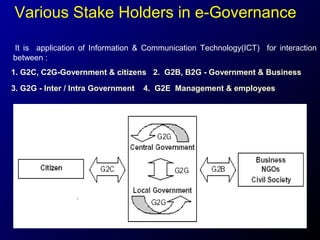
Various Stake Holders in e-Governance
It is application of Information & Communication Technology(ICT) for interaction
between :
1. G2C, C2G-Government & citizens 2. G2B, B2G - Government & Business
3. G2G - Inter / Intra Government

4. G2E Management & employees
e-Governance Mission
Partnership between various stake holders with objectives as follows :
e - Citizen

: To receive govt. services, access them on line
24x7x365 days , and participate in
governance process

e - Business

: To access Govt. services, for faster economic
development, and participation in value
addition to govt. services

e – Employees : For better communication / understanding,
Increased productivity, participation in
strategic planning
e – Government : To Increase productivity / efficiency, build
good relationships with others for good
governance.
Citizen Centric e-Governance
When the focus of Government services is to facilitate
citizens to have access to information :
-

-

In the format convenient to them
at the place of their choice
Transparency about the decision making processes
Simplification of procedures of information access
To minimize the total processing time for requested
actions

An example

Technology should facilitate citizen to make payments of utility
bills (electricity bill, telephone bill or water bill) at one place
or automate the payment through bank. It should further
facilitate the citizens to interact with the concerned agencies for
queries / clarifications / adjustments etc.
( Aim should be to provide Single window service 24 X 7 X 365 )
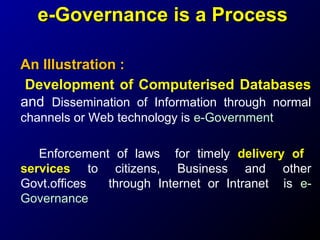
e-Governance is a Process
An Illustration :
Development of Computerised Databases
and Dissemination of Information through normal
channels or Web technology is e-Government
Enforcement of laws for timely delivery of
services to citizens, Business and other
Govt.offices
through Internet or Intranet is eGovernance
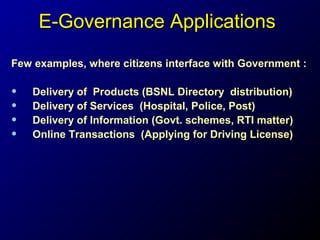
E-Governance Applications
Few examples, where citizens interface with Government :

•
•
•
•

Delivery of Products (BSNL Directory distribution)
Delivery of Services (Hospital, Police, Post)
Delivery of Information (Govt. schemes, RTI matter)
Online Transactions (Applying for Driving License)
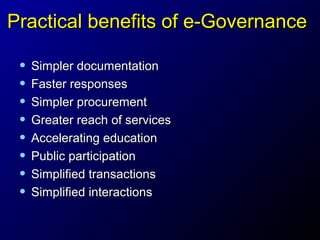
Practical benefits of e-Governance
• Simpler documentation
• Faster responses
• Simpler procurement
• Greater reach of services
• Accelerating education
• Public participation
• Simplified transactions
• Simplified interactions
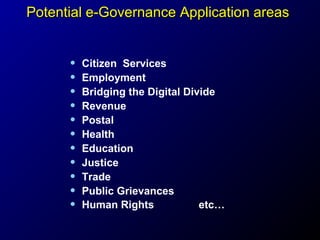
Potential e-Governance Application areas

•
•
•
•
•
•
•
•
•
•
•

Citizen Services
Employment
Bridging the Digital Divide
Revenue
Postal
Health
Education
Justice
Trade
Public Grievances
Human Rights
etc…
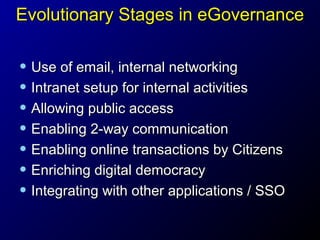
Evolutionary Stages in eGovernance

• Use of email, internal networking
• Intranet setup for internal activities
• Allowing public access
• Enabling 2-way communication
• Enabling online transactions by Citizens
• Enriching digital democracy
• Integrating with other applications / SSO
e-Governance : Challenges
The key challenges with
e-Governance are not the
TECHNOLOGY issues
but, they are the
ORGANIZATIONAL issues

Let us look into these challenges
e-Governance : Challenges

•

Realistic Needs Analysis

•

Redefining rules and procedures for
data collection, processing, storage,
dissemination, and decision making
e-Governance : Challenges
•

Information transparency / security
( Is it practical to have 100 % transparency ? )

•

Interdepartmental
collaboration
for
information sharing ( Horizontal & Vertical)
(How to change mind sets to employees to
come out of possessive nature ? )

•

Security and Legal Issues
( Who should be responsible for correctness of
the information having
multiple updation
/access rights?)
e-Governance : Challenges
Infrastructure
(Just acquiring computers is not enough.
People should be aware of their potential and
should acquire skill of using them optimally… )


Tendency to resist the change in
work culture
(Using a computer instead of type writer and
using email, instead of telephone can not be
treated as change in work culture. Some thing
more is required, What is that challenge?)
Challenges specific to Indian scenario

• Problem of priority (There are other important issues…)
• Infrastructure (lack or unavailability thereof)
• Diversity (Different languages and regions)
• Over powering (IT expert sector)
• Low quality of input (hence…)
• Low quality of output ( Garbage in / garbage out)
Words of Caution
Technology helps to reach the un-reached,
but it can make the things worse through
digital divide.
There is the fear of emergence of an elite
group who only may be the ultimate
beneficiaries of successful technology
application
Where do we stand ?
• In Countries such as USA, Singapore, Norway,
•
•

Sweden, online Govt. services are high.
In Britain, New Zealand, South Korea even the
general usage of internet is less when
compared.
Internet usage in India too growing and many
state governments are going online.
What is lacking ?
We have been doing computerization

NOT e-Governance!
We need to adopt a holistic approach!
What is e-government ?
It is the
transformation of government
to provide
Efficient
Convenient &
Transparent

Services
to
the Citizens & Businesses
through
Information & Communication Technologies
What is NOT e-Government ?
e-Government is not about ‘e’
but about government !
e-Government is not about computers
but about citizens !
e-Government is not about translating processes
but about transforming processes !
Minimum Agenda for
e-Governance
•

Intranet Infrastructure ( LAN, PC, Software Tools,
Portal /Vortal )

•

IT Empowerment of Officers/
Officials

•

IT enabled Services - intra and inter Departments (G2G,
G2B)

•

IT enabled delivery of services for masses - Public
Information & Facilitation (G2C)

•

IT Vision for the Sectoral Development
e-Governance Systems Development Steps

1.
2.
3.

4.

Have a clear vision and prepare action plan.
Choose projects that fit in action plan, if you
can’t, make them fit in.
Large e-Governance systems have to be divided
into manageable logical modules, each with a
goal that supports overall objective of eGovernance. ICT provides solution for plugging
such components to a great extent, even if the
modules are developed on different platforms.
There is need to contain cost by developing
portable / replicable modules, which can be
reused across different government.
e-Governance Systems Development Steps
5. The e-Governance architecture should be able
to support phased implementation. This is
possible by providing interlinked common
backbone
architecture,
and
customized
architecture at front end for deployment of different
e-Governance applications.
6. There is need to follow technology standards
for Databases, operating systems,Schema,
nomenclatures,
architecture,
communication
security etc.
Critical Success Factors

• People, Process, Technology
• Architecture & Standards
• Security
Implementation Models
Implementation
Points to Ponder
in Implementation of e-Gov
•

System Study Vs. System Development

•

Pilot Vs. Rollout

•

In-house Vs. Outsource

•

Make or Buy

•

Open Source Vs Proprietary software
Problems in implementation
• Budget constraints
• Too many disjointed efforts
• Lack of Infrastructure
• Digital Divide
• Shortage of Champions
• Local Language Interface
• No architecture and standards
• Too little benefits
eGov Applications

• Railway Reservation
• 7/12 / Land Records,
• E-Tendering
• Sevarth
• PlanPlus

etc…
The National e-Governance Plan
(NeGP)

http://mit.gov.in/content/national-e-governance-plan
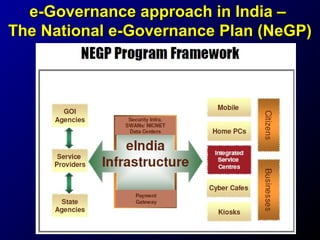
e-Governance approach in India –
The National e-Governance Plan (NeGP)
The Plan seeks to lay the foundation and provide the
impetus for long-term growth of e-Governance within
the country.
It seeks to create the right governance and institutional
mechanisms, set up the core infrastructure and policies
and implement a number of Mission Mode Projects at
the center, state and integrated service levels to create
a citizen-centric and business-centric environment for
governance.
e-Governance approach in India –
The National e-Governance Plan (NeGP)
VISION
The NeGP aims at improving delivery of Government
services to citizens and businesses with the following
vision:
“Make all Government services accessible to the
common man in his locality, through common service
delivery outlets and ensure efficiency, transparency &
reliability of such services at affordable costs to
realize the basic needs of the common man.”
e-Governance approach in India –
The National e-Governance Plan (NeGP)
NATIONAL E-GOVERNANCE STRATEGY
• Centralized Initiative, Decentralized Implementation
• Identify services to be targeted
• Prioritize Services (Mission)
• Identify measurable service goals (Outcomes)
• Identify, Appoint & Empower Mission Leaders
• Create mechanism for effective Private Sector participation
• Put in place a common Infrastructure, Policies, Standards and Framework.
• Service delivery through Common Service Centres
• Think Big, Start Small and Scale Fast
• All services supported by infrastructure to facilitate web-enabled access
• Connectivity: State Wide Area Networks (SWANs)/NICNET
• National Data Bank/ State Data Centres ( SDCs)
• Common Service Centres (CSCs) primary mode of delivery
e-Governance approach in India –
The National e-Governance Plan (NeGP)
Core Infrastructure
• National eGovernment Intranet (NICNET, ERNET etc.)
• State wide Intranets
• National eGovernment Data Center
• State Data Centers
• Security Infrastructure
• Resource Centre for E-Governance
• GIS National Spatial Data Infrastructure
• Language Resource Centre
e-Governance approach in India –
The National e-Governance Plan (NeGP)
e-Governance approach in India –
The National e-Governance Plan (NeGP)
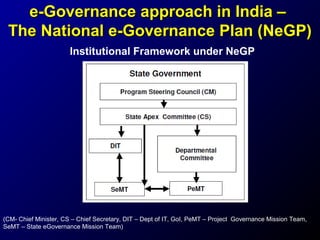
Institutional Framework under NeGP

(CM- Chief Minister, CS – Chief Secretary, DIT – Dept of IT, GoI, PeMT – Project Governance Mission Team,
SeMT – State eGovernance Mission Team)
Legal Framework for eGovernance
IT Act, 2000, was enacted to “… provide legal recognition for transactions
carried out by means of electronic data interchange and other means of
electronic communication, commonly referred to as “electronic commerce”,
which involve the use of alternatives to paper-based methods of
communication and storage of information, to facilitate electronic filing of
documents with the Government agencies and further to amend the Indian
Penal Code, the Indian Evidence Act, 1872, the Bankers’ Books Evidence
Act, 1891 and the Reserve Bank of India Act, 1934 and for matters
connected therewith or incidental thereto.”
The focus of the Act is on electronic commerce and electronic records. It
contains provisions on digital signatures and authentication of electronic
records, legal recognition of digital signatures and electronic records,
retention of electronic records, attribution, acknowledgement and dispatch of
electronic records, security of electronic records, regulation of Certifying
Authorities, Cyber Regulation Appellate Tribunal etc. To facilitate the
implementation of e-Governance projects at various levels across the
country, a more holistic legal framework is required.
Need for Statutory Backing for E-Governance
As seen earlier, the DIT has been tasked with creating the
common core and support infrastructure, like the National and
State Wide Area Networks, NDC and SDCs, Common Services
Centres and the Electronic Service Delivery Gateways.
It is also laying down Standards and Policy Guidelines in its role
as facilitator.
There are complexities involved in evolution/development and
adoption of the overall technology architecture, framework
standards, security policy, funding strategy, service delivery
mechanism, sharing of common infrastructure etc.
Need for Statutory Backing for E-Governance
Data Retention and Preservation policies are important,
as paper files are replaced by electronic methods.
Data Privacy issues are extremely important. Citizens
may take Government Departments to courts on
leakage of data and privacy issues.
NDA (Non-Disclosure Agreements) with all vendors and
their employees is an aspect that should be carefully
examined.
Amendments to IT Act now have section on “Sensitive
Personal information” (Rules u/s 43A).
Stronger laws
Stronger and more effective laws and rules
related to usage of ICT will have to be formulated,
and strongly implemented.
This presupposes the adoption and use of
security measures more particularly empowering
and training judiciary and law enforcement
manpower with the knowledge and use of cyber
forensics and digital evidencing.
To conclude…
E-governance is an evolutionary phenomenon, and requires a
change in the mindset of one and all – citizen, executives and the
government.
With the support of the Internet, the government processes defined
by specializations can be made efficient, effective, and citizenfriendly.
There are many challenging issues lying ahead. Security is the main
concern, both for the Government and for citizens.
Redefining rules and procedures, information transparency, legal
issues, infrastructure, skill and awareness, access to right
information, inter-departmental collaboration, tendency to resist the
change in work culture, are the main concerns for the government to
address.
eGovernance Explained - Mukund Nadgowda

eGovernance Explained - Mukund Nadgowda

  • 1.
  • 2.
  • 3.
    WH 3 Just possessing Information& Communication Technology (ICT)Tools is not enough. It may make your life more complex unless you are clear about Why, when, where & how to use these powers to get what we want in the simplified way.
  • 4.
    Our Transformations First Wave - AgricultureRevolution Second Wave - Industrial Revolution Third Wave Information Revolution, which in turn triggered the concept of eGovernance
  • 5.
    SMART Governance Characteristics AGovernance body having characteristics like :      Simple Moral Accountable Responsive Transparent SMART Governance with focus around citizens, and prefixed with “e” (usage of ICT tools to achieve desired objectives ) is e-Governance.
  • 6.
    Various Stake Holdersin e-Governance It is application of Information & Communication Technology(ICT) for interaction between : 1. G2C, C2G-Government & citizens 2. G2B, B2G - Government & Business 3. G2G - Inter / Intra Government 4. G2E Management & employees
  • 7.
    e-Governance Mission Partnership betweenvarious stake holders with objectives as follows : e - Citizen : To receive govt. services, access them on line 24x7x365 days , and participate in governance process e - Business : To access Govt. services, for faster economic development, and participation in value addition to govt. services e – Employees : For better communication / understanding, Increased productivity, participation in strategic planning e – Government : To Increase productivity / efficiency, build good relationships with others for good governance.
  • 8.
    Citizen Centric e-Governance Whenthe focus of Government services is to facilitate citizens to have access to information : - - In the format convenient to them at the place of their choice Transparency about the decision making processes Simplification of procedures of information access To minimize the total processing time for requested actions An example Technology should facilitate citizen to make payments of utility bills (electricity bill, telephone bill or water bill) at one place or automate the payment through bank. It should further facilitate the citizens to interact with the concerned agencies for queries / clarifications / adjustments etc. ( Aim should be to provide Single window service 24 X 7 X 365 )
  • 9.
    e-Governance is aProcess An Illustration : Development of Computerised Databases and Dissemination of Information through normal channels or Web technology is e-Government Enforcement of laws for timely delivery of services to citizens, Business and other Govt.offices through Internet or Intranet is eGovernance
  • 10.
    E-Governance Applications Few examples,where citizens interface with Government : • • • • Delivery of Products (BSNL Directory distribution) Delivery of Services (Hospital, Police, Post) Delivery of Information (Govt. schemes, RTI matter) Online Transactions (Applying for Driving License)
  • 11.
    Practical benefits ofe-Governance • Simpler documentation • Faster responses • Simpler procurement • Greater reach of services • Accelerating education • Public participation • Simplified transactions • Simplified interactions
  • 12.
    Potential e-Governance Applicationareas • • • • • • • • • • • Citizen Services Employment Bridging the Digital Divide Revenue Postal Health Education Justice Trade Public Grievances Human Rights etc…
  • 13.
    Evolutionary Stages ineGovernance • Use of email, internal networking • Intranet setup for internal activities • Allowing public access • Enabling 2-way communication • Enabling online transactions by Citizens • Enriching digital democracy • Integrating with other applications / SSO
  • 14.
    e-Governance : Challenges Thekey challenges with e-Governance are not the TECHNOLOGY issues but, they are the ORGANIZATIONAL issues Let us look into these challenges
  • 15.
    e-Governance : Challenges • RealisticNeeds Analysis • Redefining rules and procedures for data collection, processing, storage, dissemination, and decision making
  • 16.
    e-Governance : Challenges • Informationtransparency / security ( Is it practical to have 100 % transparency ? ) • Interdepartmental collaboration for information sharing ( Horizontal & Vertical) (How to change mind sets to employees to come out of possessive nature ? ) • Security and Legal Issues ( Who should be responsible for correctness of the information having multiple updation /access rights?)
  • 17.
    e-Governance : Challenges Infrastructure (Justacquiring computers is not enough. People should be aware of their potential and should acquire skill of using them optimally… )  Tendency to resist the change in work culture (Using a computer instead of type writer and using email, instead of telephone can not be treated as change in work culture. Some thing more is required, What is that challenge?)
  • 18.
    Challenges specific toIndian scenario • Problem of priority (There are other important issues…) • Infrastructure (lack or unavailability thereof) • Diversity (Different languages and regions) • Over powering (IT expert sector) • Low quality of input (hence…) • Low quality of output ( Garbage in / garbage out)
  • 19.
    Words of Caution Technologyhelps to reach the un-reached, but it can make the things worse through digital divide. There is the fear of emergence of an elite group who only may be the ultimate beneficiaries of successful technology application
  • 20.
    Where do westand ? • In Countries such as USA, Singapore, Norway, • • Sweden, online Govt. services are high. In Britain, New Zealand, South Korea even the general usage of internet is less when compared. Internet usage in India too growing and many state governments are going online.
  • 21.
    What is lacking? We have been doing computerization NOT e-Governance! We need to adopt a holistic approach!
  • 22.
    What is e-government? It is the transformation of government to provide Efficient Convenient & Transparent Services to the Citizens & Businesses through Information & Communication Technologies
  • 23.
    What is NOTe-Government ? e-Government is not about ‘e’ but about government ! e-Government is not about computers but about citizens ! e-Government is not about translating processes but about transforming processes !
  • 24.
    Minimum Agenda for e-Governance • IntranetInfrastructure ( LAN, PC, Software Tools, Portal /Vortal ) • IT Empowerment of Officers/ Officials • IT enabled Services - intra and inter Departments (G2G, G2B) • IT enabled delivery of services for masses - Public Information & Facilitation (G2C) • IT Vision for the Sectoral Development
  • 25.
    e-Governance Systems DevelopmentSteps 1. 2. 3. 4. Have a clear vision and prepare action plan. Choose projects that fit in action plan, if you can’t, make them fit in. Large e-Governance systems have to be divided into manageable logical modules, each with a goal that supports overall objective of eGovernance. ICT provides solution for plugging such components to a great extent, even if the modules are developed on different platforms. There is need to contain cost by developing portable / replicable modules, which can be reused across different government.
  • 26.
    e-Governance Systems DevelopmentSteps 5. The e-Governance architecture should be able to support phased implementation. This is possible by providing interlinked common backbone architecture, and customized architecture at front end for deployment of different e-Governance applications. 6. There is need to follow technology standards for Databases, operating systems,Schema, nomenclatures, architecture, communication security etc.
  • 27.
    Critical Success Factors •People, Process, Technology • Architecture & Standards • Security Implementation Models
  • 28.
  • 29.
    Points to Ponder inImplementation of e-Gov • System Study Vs. System Development • Pilot Vs. Rollout • In-house Vs. Outsource • Make or Buy • Open Source Vs Proprietary software
  • 30.
    Problems in implementation •Budget constraints • Too many disjointed efforts • Lack of Infrastructure • Digital Divide • Shortage of Champions • Local Language Interface • No architecture and standards • Too little benefits
  • 31.
    eGov Applications • RailwayReservation • 7/12 / Land Records, • E-Tendering • Sevarth • PlanPlus etc…
  • 32.
    The National e-GovernancePlan (NeGP) http://mit.gov.in/content/national-e-governance-plan
  • 33.
    e-Governance approach inIndia – The National e-Governance Plan (NeGP) The Plan seeks to lay the foundation and provide the impetus for long-term growth of e-Governance within the country. It seeks to create the right governance and institutional mechanisms, set up the core infrastructure and policies and implement a number of Mission Mode Projects at the center, state and integrated service levels to create a citizen-centric and business-centric environment for governance.
  • 34.
    e-Governance approach inIndia – The National e-Governance Plan (NeGP) VISION The NeGP aims at improving delivery of Government services to citizens and businesses with the following vision: “Make all Government services accessible to the common man in his locality, through common service delivery outlets and ensure efficiency, transparency & reliability of such services at affordable costs to realize the basic needs of the common man.”
  • 35.
    e-Governance approach inIndia – The National e-Governance Plan (NeGP) NATIONAL E-GOVERNANCE STRATEGY • Centralized Initiative, Decentralized Implementation • Identify services to be targeted • Prioritize Services (Mission) • Identify measurable service goals (Outcomes) • Identify, Appoint & Empower Mission Leaders • Create mechanism for effective Private Sector participation • Put in place a common Infrastructure, Policies, Standards and Framework. • Service delivery through Common Service Centres • Think Big, Start Small and Scale Fast • All services supported by infrastructure to facilitate web-enabled access • Connectivity: State Wide Area Networks (SWANs)/NICNET • National Data Bank/ State Data Centres ( SDCs) • Common Service Centres (CSCs) primary mode of delivery
  • 36.
    e-Governance approach inIndia – The National e-Governance Plan (NeGP) Core Infrastructure • National eGovernment Intranet (NICNET, ERNET etc.) • State wide Intranets • National eGovernment Data Center • State Data Centers • Security Infrastructure • Resource Centre for E-Governance • GIS National Spatial Data Infrastructure • Language Resource Centre
  • 37.
    e-Governance approach inIndia – The National e-Governance Plan (NeGP)
  • 38.
    e-Governance approach inIndia – The National e-Governance Plan (NeGP) Institutional Framework under NeGP (CM- Chief Minister, CS – Chief Secretary, DIT – Dept of IT, GoI, PeMT – Project Governance Mission Team, SeMT – State eGovernance Mission Team)
  • 39.
    Legal Framework foreGovernance IT Act, 2000, was enacted to “… provide legal recognition for transactions carried out by means of electronic data interchange and other means of electronic communication, commonly referred to as “electronic commerce”, which involve the use of alternatives to paper-based methods of communication and storage of information, to facilitate electronic filing of documents with the Government agencies and further to amend the Indian Penal Code, the Indian Evidence Act, 1872, the Bankers’ Books Evidence Act, 1891 and the Reserve Bank of India Act, 1934 and for matters connected therewith or incidental thereto.” The focus of the Act is on electronic commerce and electronic records. It contains provisions on digital signatures and authentication of electronic records, legal recognition of digital signatures and electronic records, retention of electronic records, attribution, acknowledgement and dispatch of electronic records, security of electronic records, regulation of Certifying Authorities, Cyber Regulation Appellate Tribunal etc. To facilitate the implementation of e-Governance projects at various levels across the country, a more holistic legal framework is required.
  • 40.
    Need for StatutoryBacking for E-Governance As seen earlier, the DIT has been tasked with creating the common core and support infrastructure, like the National and State Wide Area Networks, NDC and SDCs, Common Services Centres and the Electronic Service Delivery Gateways. It is also laying down Standards and Policy Guidelines in its role as facilitator. There are complexities involved in evolution/development and adoption of the overall technology architecture, framework standards, security policy, funding strategy, service delivery mechanism, sharing of common infrastructure etc.
  • 41.
    Need for StatutoryBacking for E-Governance Data Retention and Preservation policies are important, as paper files are replaced by electronic methods. Data Privacy issues are extremely important. Citizens may take Government Departments to courts on leakage of data and privacy issues. NDA (Non-Disclosure Agreements) with all vendors and their employees is an aspect that should be carefully examined. Amendments to IT Act now have section on “Sensitive Personal information” (Rules u/s 43A).
  • 42.
    Stronger laws Stronger andmore effective laws and rules related to usage of ICT will have to be formulated, and strongly implemented. This presupposes the adoption and use of security measures more particularly empowering and training judiciary and law enforcement manpower with the knowledge and use of cyber forensics and digital evidencing.
  • 43.
    To conclude… E-governance isan evolutionary phenomenon, and requires a change in the mindset of one and all – citizen, executives and the government. With the support of the Internet, the government processes defined by specializations can be made efficient, effective, and citizenfriendly. There are many challenging issues lying ahead. Security is the main concern, both for the Government and for citizens. Redefining rules and procedures, information transparency, legal issues, infrastructure, skill and awareness, access to right information, inter-departmental collaboration, tendency to resist the change in work culture, are the main concerns for the government to address.