e-Governance and
Digital India Initiative
Presented By:
Neha Bansal
M.Tech(ISSE)
Table of Contents
What is e-governance?
History of e-governance
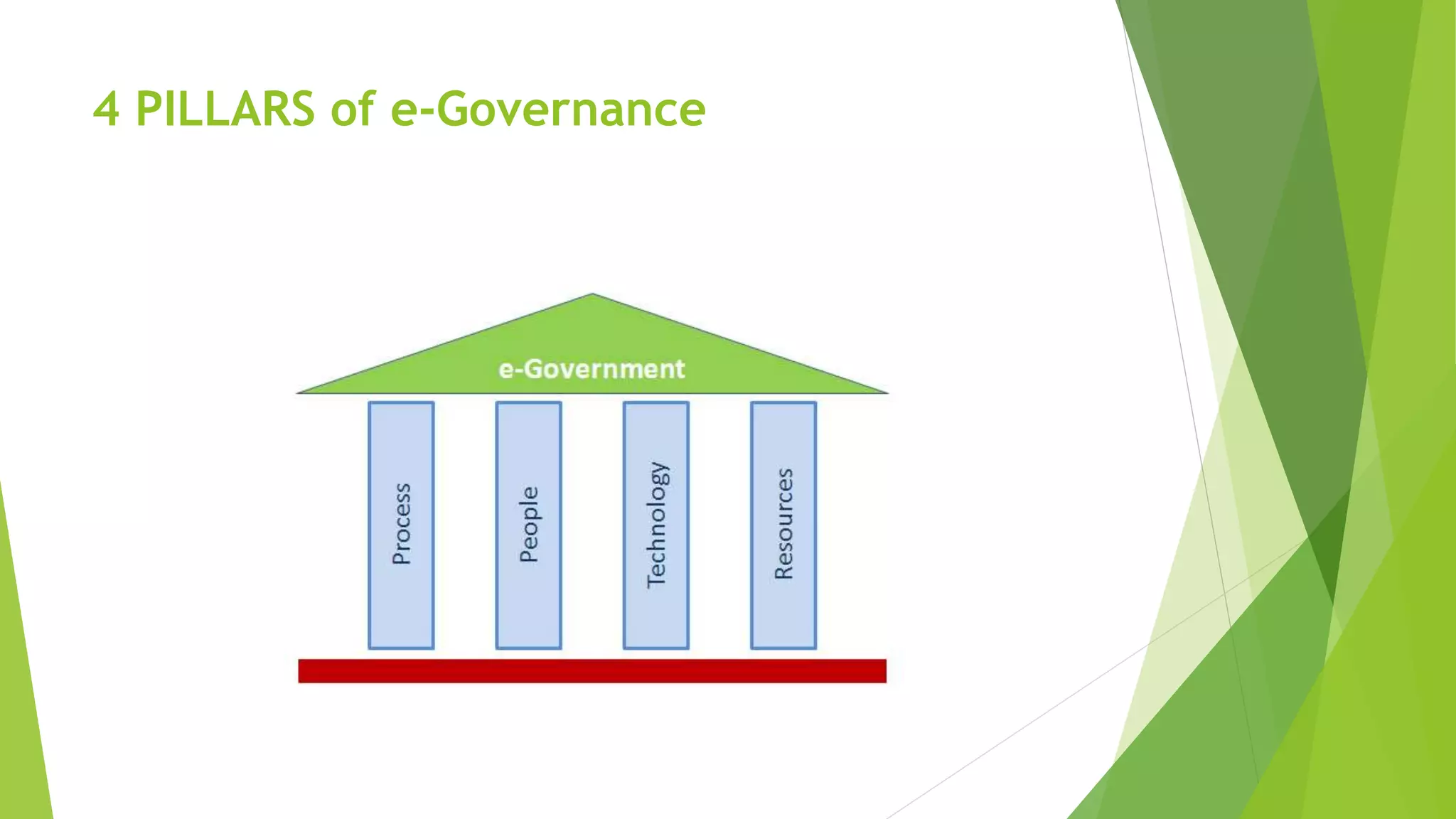
Pillars of e-governance
Phases of e-governance
Types of e-governance
Benefits,Limitations of e-governance
What is Digital India?
Vision and Pillars of Digital India
Conclusion
What is e-governance?
 The “e” in e-Governance stands for ‘electronic’.
 It acts as a mediator between government and citizens.
 It is the use of a range of modern information and technologies
to the processes of government functioning to bring about…
Smart
Moral
Accountable
Responsive
Transparent Governance.
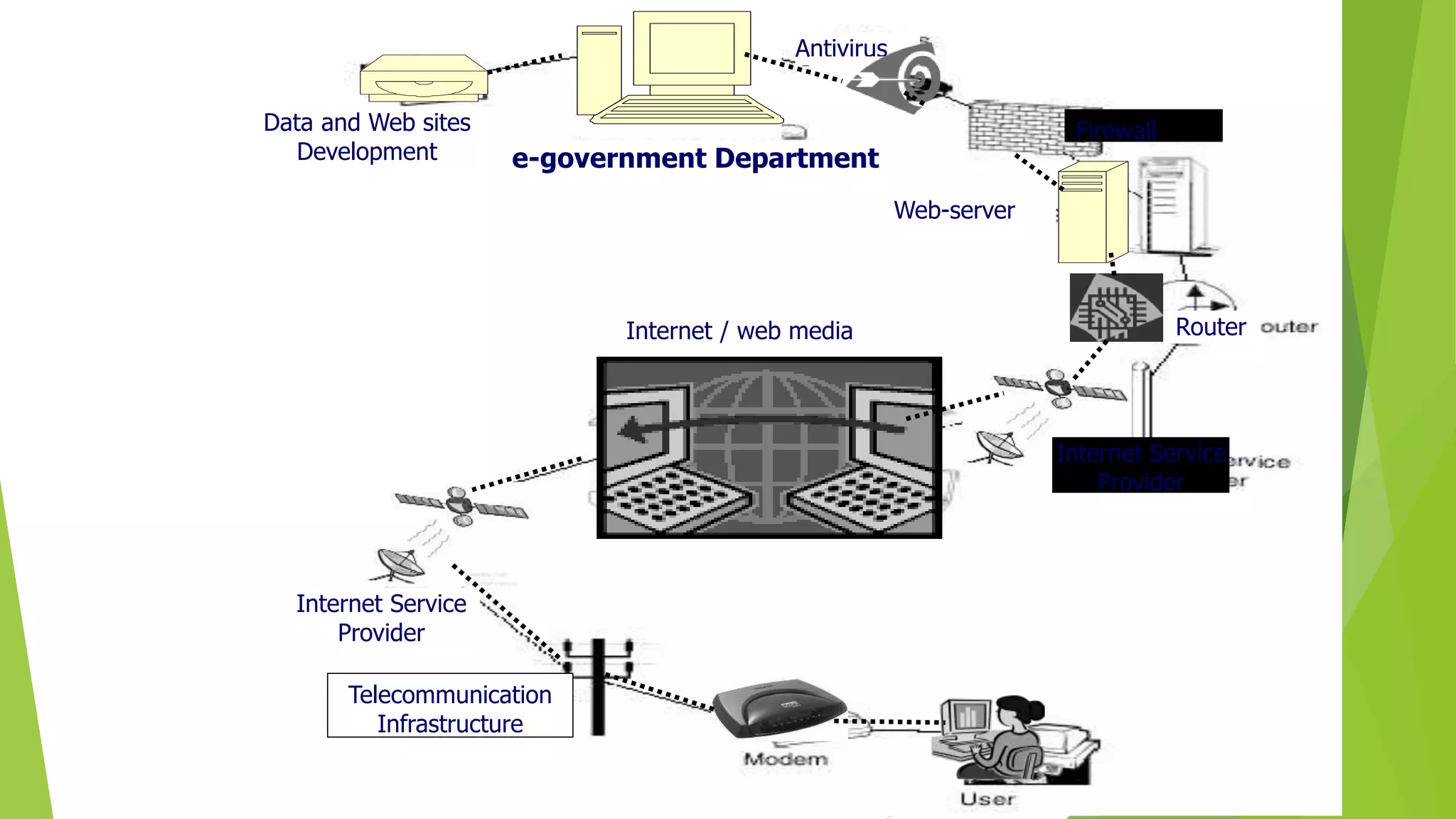
e-government Department
Data and Web sites
Development
Antivirus
Firewall
Web-server
Router
Internet
User
Internet Service
Provider
Telecommunication
Infrastructure
Internet Service
Provider
Internet / web media
History of e-governance in India
 It was provided by the launching of NICNET (the national
satellite based computer network) in 1987.
 This was followed by the launch of the District Information
System of the National Informatics Centre (DISNIC) programme
to computerize all district offices in the country.
 NICNET was extended via the State capitals to all district
headquarters by 1990.
 Top 5 countries which implemented e-governance are:
SWEDEN,DENMARK,NORWAY,UNITED STATES, NETHERLANDS
4 PILLARS of e-Governance
Phases of E-
Governance
 Phase I – Presence
 Making the intentions and objectives of
govt. known , development of govt.
websites.
 Phase II – Interaction
 It allow basic interaction with govt. ,
host engine for easy navigation and
provide the basic services like land
records , online jobs etc.
 Phase III – Transaction
 It provides complete online services for
public , businessmen and govt. agencies.
 Phase IV – Transformation
 Final phase to achieve vision of e-
governance.
 Provides a integrated platform for govt.
services transparent to public.
G2G
G2E
G2B
G2C
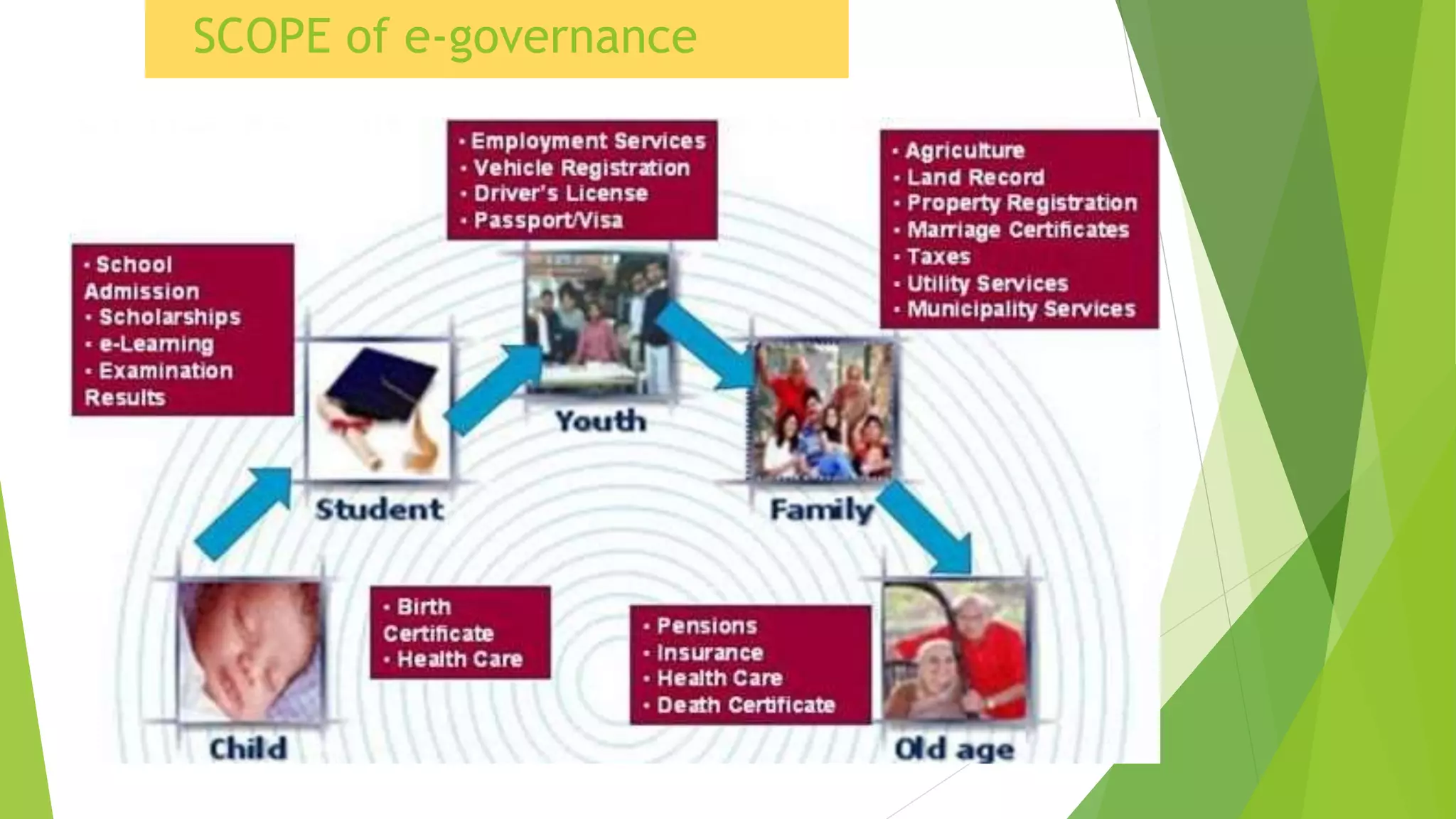
• G2C is transaction between government and citizens.
• It includes
Basic citizens services such as online registration of
birth/death/marriage certificates.
Health care, education services etc.
Filing of income taxes.
National Portal of India
India.gov.in
G2C
SCOPE of e-governance
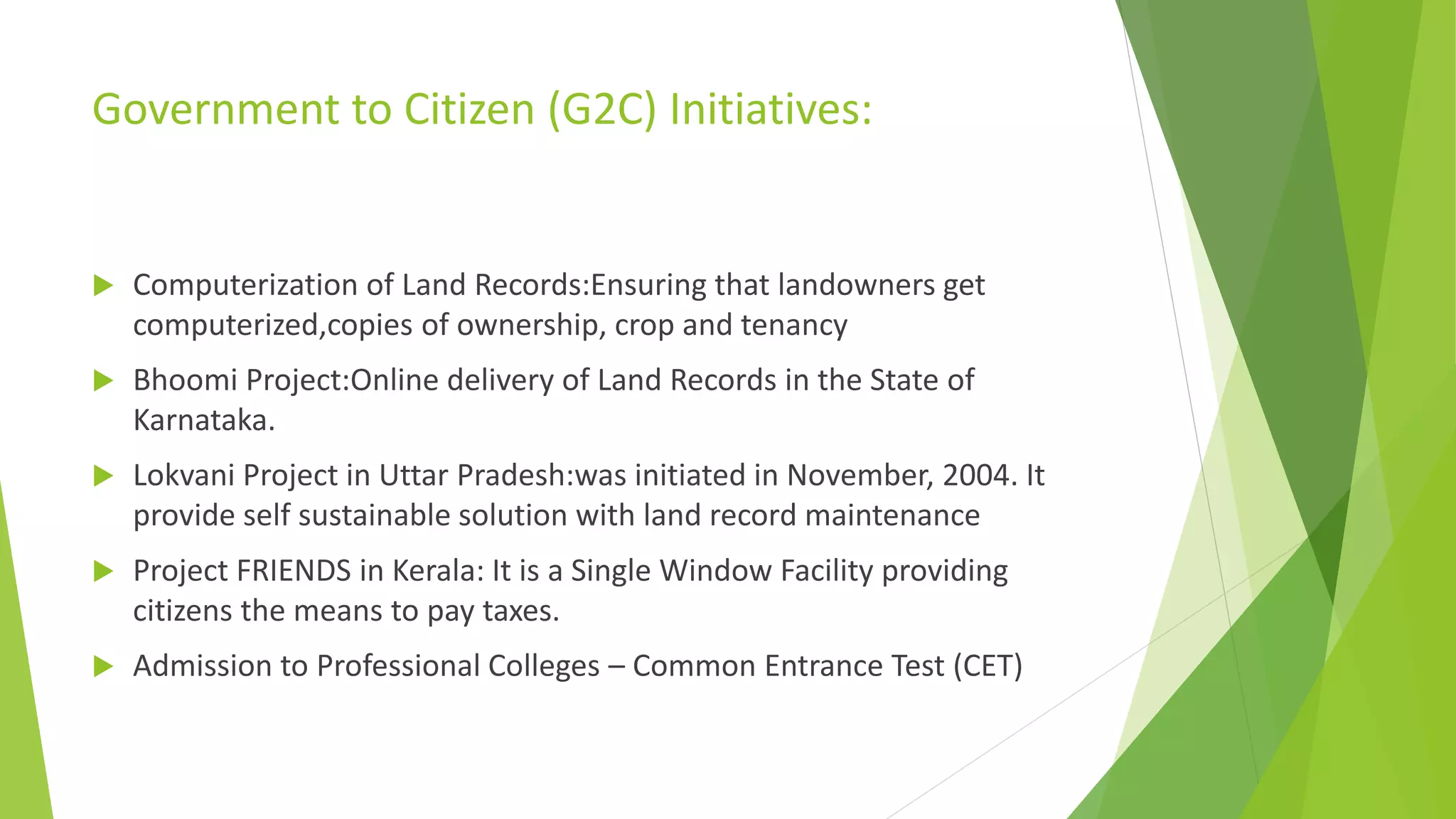
Government to Citizen (G2C) Initiatives:
 Computerization of Land Records:Ensuring that landowners get
computerized,copies of ownership, crop and tenancy
 Bhoomi Project:Online delivery of Land Records in the State of
Karnataka.
 Lokvani Project in Uttar Pradesh:was initiated in November, 2004. It
provide self sustainable solution with land record maintenance
 Project FRIENDS in Kerala: It is a Single Window Facility providing
citizens the means to pay taxes.
 Admission to Professional Colleges – Common Entrance Test (CET)
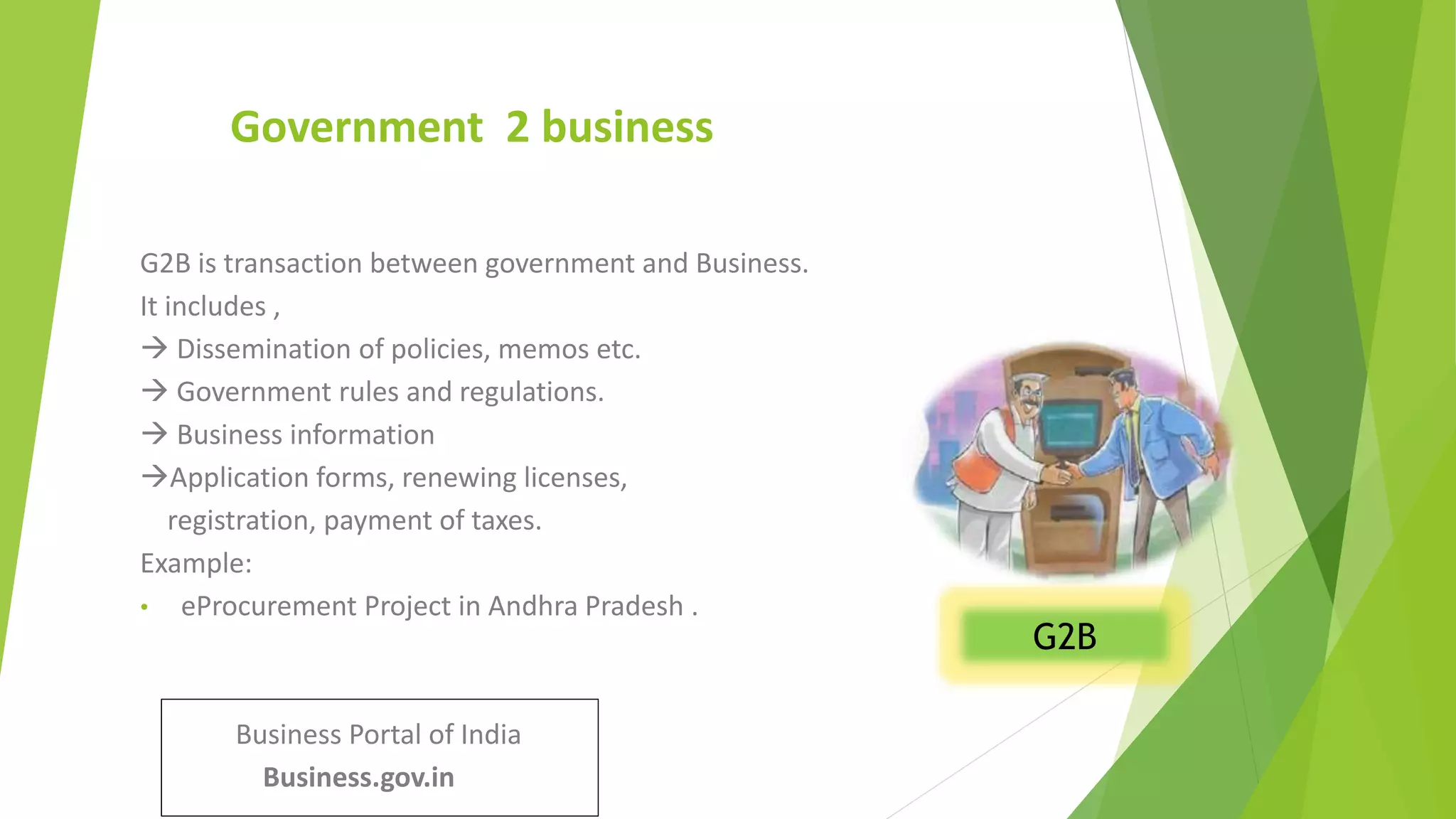
Government 2 business
G2B is transaction between government and Business.
It includes ,
 Dissemination of policies, memos etc.
 Government rules and regulations.
 Business information
Application forms, renewing licenses,
registration, payment of taxes.
Example:
• eProcurement Project in Andhra Pradesh .
Business Portal of India
Business.gov.in
G2B
G2E is transaction between government and Employee.
It Includes,
 Online conference for employee
 Online training
 Employee information
Ex. e-Training for Employees
www.egovonline.net
G2E
G2E is transaction between between the central/national and local
governments, and between government department and agencies and
organisation.
It Includes,
 Records by state government
 Schemes,plan,Initiatives
Example: Khajane Project in Karnataka
SmartGov (Andhra Pradesh)
e-governance standard Portal of India
http://egovstandards.gov.in
G2G
Integrated Mission Mode Projects
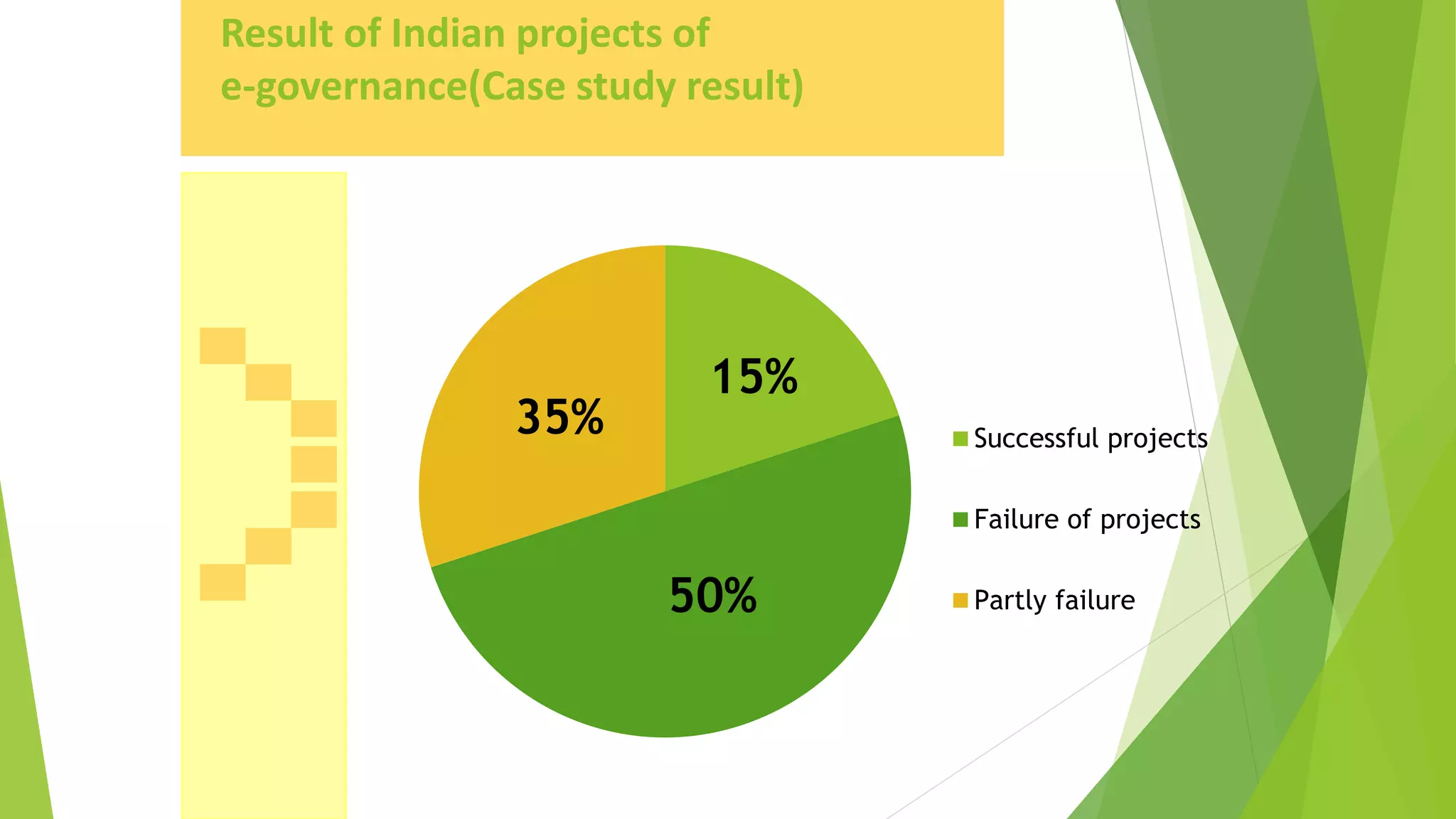
Result of Indian projects of
e-governance(Case study result)
15%
50%
35% Successful projects
Failure of projects
Partly failure
Benefits of e-Governance
 Better access to information and quality services for citizens.
 Simplicity, efficiency and accountability in the government.
 Expanded reach of governance
 Building strong and effective information chain.
 To bridge the gap between India and developed countries.
 Effective utilization of resources.
 Reduction in delays, Red tape and corruption.
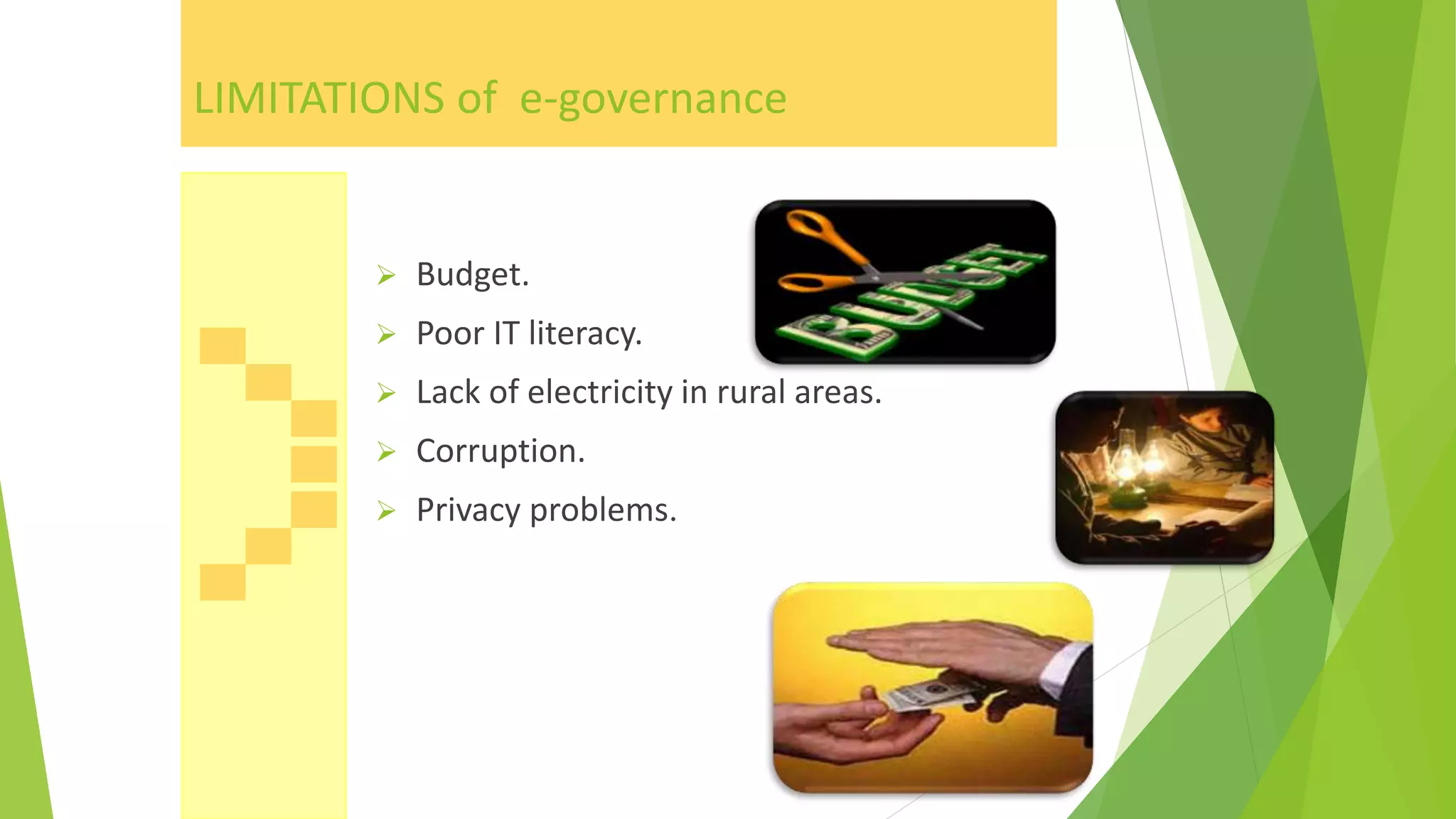
LIMITATIONS of e-governance
 Budget.
 Poor IT literacy.
 Lack of electricity in rural areas.
 Corruption.
 Privacy problems.
Clarity about objective
Provided services
Misconception about information transparency
Localization
Security threats & legal issue
Maximum use of infrastructure
Standardization
DIGITAL INDIA
 The Digital India program is a flagship program of the
Government of India with a vision to transform India into a
digitally empowered society and knowledge economy.
 Digital India is a Programme to prepare India for a knowledge
future.
 It was started by PM Narendra Modi on 1st july 2015.
 It aims at ensuring the government services are made available
to citizens electronically by reducing paperwork.
 It also includes plan to connect rural areas with high-speed
internet networks.
 It is coordinated by DeitY, implemented by the entire government
VISION
VISION 1. Infrastructure as Utility to Every Citizen
 High speed internet shall be made available in all villages.
 Digital identity- unique, lifelong, online and authenticable.
 Mobile phone and Bank account enabling participation in digital &
financial space.
 Easy access to common service centre within their locality.
 Shareable private space on a public cloud.
 Safe and secure cyber space.
VISION 2:Governance & Services on Demand
 Seamlessly integrated services across departments
 Availability of services in real time from online & mobile platforms
 All citizen entitlements to be portable and available on the cloud
 Digitally transformed services for improving ease of doing business
 Making financial transactions electronic & cashless
VISION 3:Digital Empowerment of Citizens
 Universal digital literacy
 Universally accessible digital resources
 Availability of digital resources / services in Indian languages
 Collaborative digital platforms for participative governance
 Citizens not required to physically submit Govt. documents / certificates
Nine Pillars of Digital India
1. Broadband
Highways
2. Universal
Access to Phones
3. Public Internet
Access
Programme
4. E-Governance –
Reforming
government through
Technology
5. eKranti –
Electronic delivery
of services
6. Information for
All
Electronics Manufacturing
7. Electronics
Manufacturing –
Target NET ZERO
Imports
8. IT for Jobs
9. Early Harvest
Programmes
Pillar 5. eKranti - Electronic Delivery of Services
There are 44 Mission Mode Projects under e-Kranti, which are at
various stages of implementation with the vision of “Transforming e-
Governance for Transforming Governance”.
Pillar 5. eKranti - Electronic Delivery of Services
 Technology for Education – e-
Education
 Technology for Health – e-
Healthcare
 Technology for Planning
 Technology for Security
 Technology for Farmers
 Technology for Security
 Technology for Financial
Inclusion
 Technology for Justice
Pillar 9. Early Harvest Programmes
 Biometric attendance
 Wi-Fi in All Universities
 Secure Email within Government
 School Books to be eBooks
 SMS based weather information, disaster alerts
 National Portal for Lost & Found children
 Public Wi-fi hotspots
IS INDIA DIGITALLY READY
 Yes,India is ready for it.
 Organizations like BSNL, Reliance Ltd. are coming forward to
spread digitalization among rural areas.
 The Internet Saathi initiative aims to cover 4,500 villages over the
next 18 months, starting with Gujarat, Rajasthan and Jharkhand.
Impact Of digital India
 India’s gross domestic product (GDP) at factor cost at constant (2011-
12) prices 2014-15 is Rs 106.4 trillion (US$ 1.596 trillion), as against Rs
99.21 trillion (US$ 1.488 trillion) in 2013-14, registering a growth rate
of 7.3 per cent.
 The Digital India project itself will create employment opportunities for
17 million people directly or indirectly which will help in fighting
against unemployment problems in India.
 Government has planned to give IT training to 100 million students in
smaller towns and villages as employment opportunity in IT sector is
very high in India.
 Digital India programme will help India boost its GDP by $550 billion to
$1 trillion by 2025.
Conclusion
 The Digital India program is just the beginning of a digital
revolution, once implemented properly it will open various new
opportunities for the citizens.
 The goal of e-governance is the ability to access & interact with
the world.
 Developing countries have many opportunities to better
themselves through e-governance.
Thank you
Any Question?

E governance and digital india initiative

  • 1.
    e-Governance and Digital IndiaInitiative Presented By: Neha Bansal M.Tech(ISSE)
  • 2.
    Table of Contents Whatis e-governance? History of e-governance Pillars of e-governance Phases of e-governance Types of e-governance Benefits,Limitations of e-governance What is Digital India? Vision and Pillars of Digital India Conclusion
  • 3.
    What is e-governance? The “e” in e-Governance stands for ‘electronic’.  It acts as a mediator between government and citizens.  It is the use of a range of modern information and technologies to the processes of government functioning to bring about… Smart Moral Accountable Responsive Transparent Governance.
  • 4.
    e-government Department Data andWeb sites Development Antivirus Firewall Web-server Router Internet User Internet Service Provider Telecommunication Infrastructure Internet Service Provider Internet / web media
  • 5.
    History of e-governancein India  It was provided by the launching of NICNET (the national satellite based computer network) in 1987.  This was followed by the launch of the District Information System of the National Informatics Centre (DISNIC) programme to computerize all district offices in the country.  NICNET was extended via the State capitals to all district headquarters by 1990.  Top 5 countries which implemented e-governance are: SWEDEN,DENMARK,NORWAY,UNITED STATES, NETHERLANDS
  • 6.
    4 PILLARS ofe-Governance
  • 7.
    Phases of E- Governance Phase I – Presence  Making the intentions and objectives of govt. known , development of govt. websites.  Phase II – Interaction  It allow basic interaction with govt. , host engine for easy navigation and provide the basic services like land records , online jobs etc.  Phase III – Transaction  It provides complete online services for public , businessmen and govt. agencies.  Phase IV – Transformation  Final phase to achieve vision of e- governance.  Provides a integrated platform for govt. services transparent to public.
  • 8.
  • 9.
    • G2C istransaction between government and citizens. • It includes Basic citizens services such as online registration of birth/death/marriage certificates. Health care, education services etc. Filing of income taxes. National Portal of India India.gov.in G2C
  • 10.
  • 11.
    Government to Citizen(G2C) Initiatives:  Computerization of Land Records:Ensuring that landowners get computerized,copies of ownership, crop and tenancy  Bhoomi Project:Online delivery of Land Records in the State of Karnataka.  Lokvani Project in Uttar Pradesh:was initiated in November, 2004. It provide self sustainable solution with land record maintenance  Project FRIENDS in Kerala: It is a Single Window Facility providing citizens the means to pay taxes.  Admission to Professional Colleges – Common Entrance Test (CET)
  • 12.
    Government 2 business G2Bis transaction between government and Business. It includes ,  Dissemination of policies, memos etc.  Government rules and regulations.  Business information Application forms, renewing licenses, registration, payment of taxes. Example: • eProcurement Project in Andhra Pradesh . Business Portal of India Business.gov.in G2B
  • 13.
    G2E is transactionbetween government and Employee. It Includes,  Online conference for employee  Online training  Employee information Ex. e-Training for Employees www.egovonline.net G2E
  • 14.
    G2E is transactionbetween between the central/national and local governments, and between government department and agencies and organisation. It Includes,  Records by state government  Schemes,plan,Initiatives Example: Khajane Project in Karnataka SmartGov (Andhra Pradesh) e-governance standard Portal of India http://egovstandards.gov.in G2G
  • 15.
  • 16.
    Result of Indianprojects of e-governance(Case study result) 15% 50% 35% Successful projects Failure of projects Partly failure
  • 17.
    Benefits of e-Governance Better access to information and quality services for citizens.  Simplicity, efficiency and accountability in the government.  Expanded reach of governance  Building strong and effective information chain.  To bridge the gap between India and developed countries.  Effective utilization of resources.  Reduction in delays, Red tape and corruption.
  • 18.
    LIMITATIONS of e-governance Budget.  Poor IT literacy.  Lack of electricity in rural areas.  Corruption.  Privacy problems.
  • 19.
    Clarity about objective Providedservices Misconception about information transparency Localization Security threats & legal issue Maximum use of infrastructure Standardization
  • 20.
    DIGITAL INDIA  TheDigital India program is a flagship program of the Government of India with a vision to transform India into a digitally empowered society and knowledge economy.  Digital India is a Programme to prepare India for a knowledge future.  It was started by PM Narendra Modi on 1st july 2015.  It aims at ensuring the government services are made available to citizens electronically by reducing paperwork.  It also includes plan to connect rural areas with high-speed internet networks.  It is coordinated by DeitY, implemented by the entire government
  • 21.
  • 22.
    VISION 1. Infrastructureas Utility to Every Citizen  High speed internet shall be made available in all villages.  Digital identity- unique, lifelong, online and authenticable.  Mobile phone and Bank account enabling participation in digital & financial space.  Easy access to common service centre within their locality.  Shareable private space on a public cloud.  Safe and secure cyber space.
  • 23.
    VISION 2:Governance &Services on Demand  Seamlessly integrated services across departments  Availability of services in real time from online & mobile platforms  All citizen entitlements to be portable and available on the cloud  Digitally transformed services for improving ease of doing business  Making financial transactions electronic & cashless
  • 24.
    VISION 3:Digital Empowermentof Citizens  Universal digital literacy  Universally accessible digital resources  Availability of digital resources / services in Indian languages  Collaborative digital platforms for participative governance  Citizens not required to physically submit Govt. documents / certificates
  • 25.
    Nine Pillars ofDigital India 1. Broadband Highways 2. Universal Access to Phones 3. Public Internet Access Programme 4. E-Governance – Reforming government through Technology 5. eKranti – Electronic delivery of services 6. Information for All Electronics Manufacturing 7. Electronics Manufacturing – Target NET ZERO Imports 8. IT for Jobs 9. Early Harvest Programmes
  • 26.
    Pillar 5. eKranti- Electronic Delivery of Services There are 44 Mission Mode Projects under e-Kranti, which are at various stages of implementation with the vision of “Transforming e- Governance for Transforming Governance”.
  • 27.
    Pillar 5. eKranti- Electronic Delivery of Services  Technology for Education – e- Education  Technology for Health – e- Healthcare  Technology for Planning  Technology for Security  Technology for Farmers  Technology for Security  Technology for Financial Inclusion  Technology for Justice
  • 28.
    Pillar 9. EarlyHarvest Programmes  Biometric attendance  Wi-Fi in All Universities  Secure Email within Government  School Books to be eBooks  SMS based weather information, disaster alerts  National Portal for Lost & Found children  Public Wi-fi hotspots
  • 29.
    IS INDIA DIGITALLYREADY  Yes,India is ready for it.  Organizations like BSNL, Reliance Ltd. are coming forward to spread digitalization among rural areas.  The Internet Saathi initiative aims to cover 4,500 villages over the next 18 months, starting with Gujarat, Rajasthan and Jharkhand.
  • 30.
    Impact Of digitalIndia  India’s gross domestic product (GDP) at factor cost at constant (2011- 12) prices 2014-15 is Rs 106.4 trillion (US$ 1.596 trillion), as against Rs 99.21 trillion (US$ 1.488 trillion) in 2013-14, registering a growth rate of 7.3 per cent.  The Digital India project itself will create employment opportunities for 17 million people directly or indirectly which will help in fighting against unemployment problems in India.  Government has planned to give IT training to 100 million students in smaller towns and villages as employment opportunity in IT sector is very high in India.  Digital India programme will help India boost its GDP by $550 billion to $1 trillion by 2025.
  • 31.
    Conclusion  The DigitalIndia program is just the beginning of a digital revolution, once implemented properly it will open various new opportunities for the citizens.  The goal of e-governance is the ability to access & interact with the world.  Developing countries have many opportunities to better themselves through e-governance.
  • 32.
  • 33.