PPT ON E-GOVERNANCE
GURU NANAK DEV UNIVERSITY, AMRITSAR
Guru Nanak College Sukhchainana Sahib Phagwara
Submitted to:-. Submitted by:-
Dr. Jasvinderjit Kaur Umangpreet Kaur
Class:- B.com FS 3rd
Roll no.:- 1814
What is Governance?
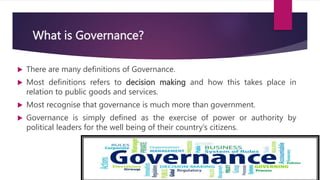
 There are many definitions of Governance.
 Most definitions refers to decision making and how this takes place in
relation to public goods and services.
 Most recognise that governance is much more than government.
 Governance is simply defined as the exercise of power or authority by
political leaders for the well being of their country’s citizens.
What is E-governance ?
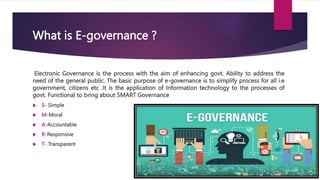
Electronic Governance is the process with the aim of enhancing govt. Ability to address the
need of the general public. The basic purpose of e-governance is to simplify process for all i.e
government, citizens etc .It is the application of Information technology to the processes of
govt. Functional to bring about SMART Governance
 S- Simple
 M-Moral
 A-Accountable
 R-Responsive
 T- Transparent
E- governance is originated in India during 1970s with a
focus on in- house government applications in the area
of defence, economic monitoring, planning and
development of ICT to manage data intensive functions
related to Eections,Census,Tax administration.
Origin
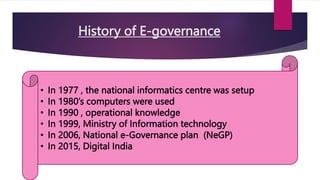
History of E-governance
• In 1977 , the national informatics centre was setup
• In 1980’s computers were used
• In 1990 , operational knowledge
• In 1999, Ministry of Information technology
• In 2006, National e-Governance plan (NeGP)
• In 2015, Digital India
Purpose of E-governance
 E-governance,expands to electronic governance ,is the integration of information and
communication technology (ICT) in all the processes, with the aim of enhancing govt.ability to
address the needs of the general public.
 The basic purpose of e-governance is to simplify processes for all i.e. government,citizens ,
businesses,etc.at national,state and local levels.
 To promote good governance. It connotes the implementation of information technology in
the government processes and functions so as to cause simple, moral, accountable and
transparent governance.
 To provide access to government services, dissemination of information, communication in a
quick and efficient manner.
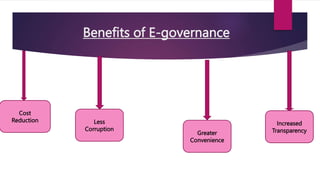
Benefits of E-governance
Cost
Reduction Less
Corruption
Greater
Convenience
Increased
Transparency
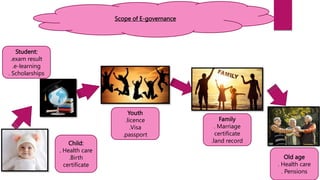
Scope of E-governance
Child:
. Health care
.Birth
certificate
Student:
.exam result
.e-learning
. Scholarships
Youth
.licence
.Visa
.passport
Family
. Marriage
certificate
.land record
Old age
. Health care
. Pensions
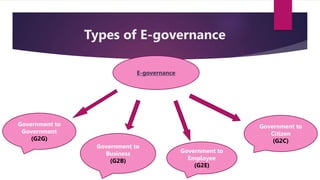
Types of E-governance
E-governance
Government to
Business
(G2B)
Government to
Employee
(G2E)
Government to
Citizen
(G2C)
Government to
Government
(G2G)
Conti..........
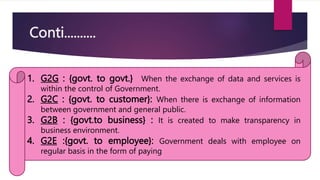
1. G2G : {govt. to govt.} When the exchange of data and services is
within the control of Government.
2. G2C : {govt. to customer}: When there is exchange of information
between government and general public.
3. G2B : {govt.to business} : It is created to make transparency in
business environment.
4. G2E :{govt. to employee}: Government deals with employee on
regular basis in the form of paying
e-Governance under IT act ,2000
 Sec 4 -: legal recognition of electronic records.
 Sec 5 -: legal recognition of electronic signature.
 Sec 6 -: Use of electronic records and electronic signature in
government and its agencies.
 Sec 6A -: Delivery of services by service provider.
 Sec 7 -: Retention of electronic records.
 Sec 7A -: Audit of documents,etc.maintained in electronic form
.
Conti.......
Sec 8 -: Publication of rule, regulations etc. In
electronic gazette.
Sec 9-: Sec 6,7and 8 not to confer rights to insist
document should be accepted in electronic form.
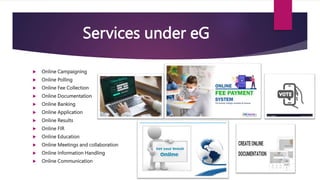
Services under eG
 Online Campaigning
 Online Polling
 Online Fee Collection
 Online Documentation
 Online Banking
 Online Application
 Online Results
 Online FIR
 Online Education
 Online Meetings and collaboration
 Online Information Handling
 Online Communication
Models of e-Governance
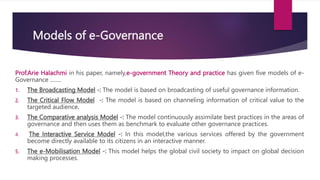
Prof.Arie Halachmi in his paper, namely,e-government Theory and practice has given five models of e-
Governance ........
1. The Broadcasting Model -: The model is based on broadcasting of useful governance information.
2. The Critical Flow Model -: The model is based on channeling information of critical value to the
targeted audience.
3. The Comparative analysis Model -: The model continuously assimilate best practices in the areas of
governance and then uses them as benchmark to evaluate other governance practices.
4. The Interactive Service Model -: In this model,the various services offered by the government
become directly available to its citizens in an interactive manner.
5. The e-Mobilisation Model -: This model helps the global civil society to impact on global decision
making processes.
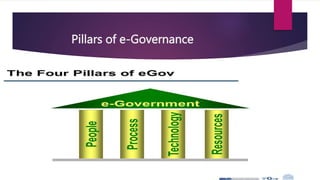
Pillars of e-Governance
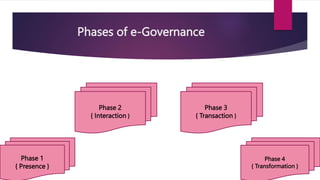
Phases of e-Governance
Phase 1
{ Presence }
Phase 2
{ Interaction }
Phase 3
{ Transaction }
Phase 4
{ Transformation }
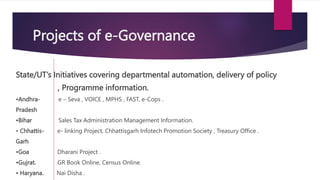
Projects of e-Governance
State/UT’s Initiatives covering departmental automation, delivery of policy
, Programme information.
•Andhra- e – Seva , VOICE , MPHS , FAST, e-Cops .
Pradesh
•Bihar Sales Tax Administration Management Information.
• Chhattis- e- linking Project, Chhattisgarh Infotech Promotion Society , Treasury Office .
Garh
•Goa Dharani Project .
•Gujrat. GR Book Online, Census Online.
• Haryana. Nai Disha .
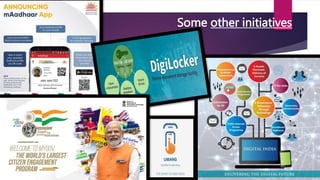
Some other initiatives
Case study : SUWIDHA
 State wide project implemented in Punjab.
 Objectives -:
•Provide transparency in government operations.
•Provide timely and efficient service delivery.
•Improve quality of government services.
• Provide friendly and efficient interface between govt.
and citizens.
Conti........
Other SUWIDHA features
On the spot photograph capture wherever required.
Application forms available.
Information on schemes and procedures.
Implemented in all 17 DC offices and 54 SDM
offices of Punjab.
Conti........
A citizen’s concerns
 Different branches for different services.
 Not familiar with the procedures.
 Unaware of the schemes being implemented.
 Not aware of source of information.
 Services are not delivered as scheduled.
 Has to visit many offices for a single service.
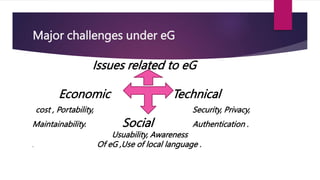
Major challenges under eG
Issues related to eG
Economic Technical
cost , Portability, Security, Privacy,
Maintainability. Social Authentication .
Usuability, Awareness
. Of eG ,Use of local language .
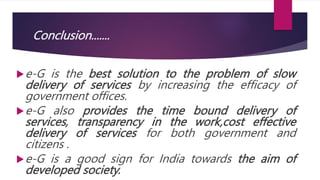
Conclusion.......
e-G is the best solution to the problem of slow
delivery of services by increasing the efficacy of
government offices.
e-G also provides the time bound delivery of
services, transparency in the work,cost effective
delivery of services for both government and
citizens .
e-G is a good sign for India towards the aim of
developed society.
E-governance .pptx

E-governance .pptx

  • 1.
    PPT ON E-GOVERNANCE GURUNANAK DEV UNIVERSITY, AMRITSAR Guru Nanak College Sukhchainana Sahib Phagwara Submitted to:-. Submitted by:- Dr. Jasvinderjit Kaur Umangpreet Kaur Class:- B.com FS 3rd Roll no.:- 1814
  • 2.
    What is Governance? There are many definitions of Governance.  Most definitions refers to decision making and how this takes place in relation to public goods and services.  Most recognise that governance is much more than government.  Governance is simply defined as the exercise of power or authority by political leaders for the well being of their country’s citizens.
  • 3.
    What is E-governance? Electronic Governance is the process with the aim of enhancing govt. Ability to address the need of the general public. The basic purpose of e-governance is to simplify process for all i.e government, citizens etc .It is the application of Information technology to the processes of govt. Functional to bring about SMART Governance  S- Simple  M-Moral  A-Accountable  R-Responsive  T- Transparent
  • 4.
    E- governance isoriginated in India during 1970s with a focus on in- house government applications in the area of defence, economic monitoring, planning and development of ICT to manage data intensive functions related to Eections,Census,Tax administration. Origin
  • 5.
    History of E-governance •In 1977 , the national informatics centre was setup • In 1980’s computers were used • In 1990 , operational knowledge • In 1999, Ministry of Information technology • In 2006, National e-Governance plan (NeGP) • In 2015, Digital India
  • 6.
    Purpose of E-governance E-governance,expands to electronic governance ,is the integration of information and communication technology (ICT) in all the processes, with the aim of enhancing govt.ability to address the needs of the general public.  The basic purpose of e-governance is to simplify processes for all i.e. government,citizens , businesses,etc.at national,state and local levels.  To promote good governance. It connotes the implementation of information technology in the government processes and functions so as to cause simple, moral, accountable and transparent governance.  To provide access to government services, dissemination of information, communication in a quick and efficient manner.
  • 7.
    Benefits of E-governance Cost ReductionLess Corruption Greater Convenience Increased Transparency
  • 8.
    Scope of E-governance Scopeof E-governance Child: . Health care .Birth certificate Student: .exam result .e-learning . Scholarships Youth .licence .Visa .passport Family . Marriage certificate .land record Old age . Health care . Pensions
  • 9.
    Types of E-governance E-governance Governmentto Business (G2B) Government to Employee (G2E) Government to Citizen (G2C) Government to Government (G2G)
  • 10.
    Conti.......... 1. G2G :{govt. to govt.} When the exchange of data and services is within the control of Government. 2. G2C : {govt. to customer}: When there is exchange of information between government and general public. 3. G2B : {govt.to business} : It is created to make transparency in business environment. 4. G2E :{govt. to employee}: Government deals with employee on regular basis in the form of paying
  • 11.
    e-Governance under ITact ,2000  Sec 4 -: legal recognition of electronic records.  Sec 5 -: legal recognition of electronic signature.  Sec 6 -: Use of electronic records and electronic signature in government and its agencies.  Sec 6A -: Delivery of services by service provider.  Sec 7 -: Retention of electronic records.  Sec 7A -: Audit of documents,etc.maintained in electronic form .
  • 12.
    Conti....... Sec 8 -:Publication of rule, regulations etc. In electronic gazette. Sec 9-: Sec 6,7and 8 not to confer rights to insist document should be accepted in electronic form.
  • 13.
    Services under eG Online Campaigning  Online Polling  Online Fee Collection  Online Documentation  Online Banking  Online Application  Online Results  Online FIR  Online Education  Online Meetings and collaboration  Online Information Handling  Online Communication
  • 14.
    Models of e-Governance Prof.ArieHalachmi in his paper, namely,e-government Theory and practice has given five models of e- Governance ........ 1. The Broadcasting Model -: The model is based on broadcasting of useful governance information. 2. The Critical Flow Model -: The model is based on channeling information of critical value to the targeted audience. 3. The Comparative analysis Model -: The model continuously assimilate best practices in the areas of governance and then uses them as benchmark to evaluate other governance practices. 4. The Interactive Service Model -: In this model,the various services offered by the government become directly available to its citizens in an interactive manner. 5. The e-Mobilisation Model -: This model helps the global civil society to impact on global decision making processes.
  • 15.
  • 16.
    Phases of e-Governance Phase1 { Presence } Phase 2 { Interaction } Phase 3 { Transaction } Phase 4 { Transformation }
  • 17.
    Projects of e-Governance State/UT’sInitiatives covering departmental automation, delivery of policy , Programme information. •Andhra- e – Seva , VOICE , MPHS , FAST, e-Cops . Pradesh •Bihar Sales Tax Administration Management Information. • Chhattis- e- linking Project, Chhattisgarh Infotech Promotion Society , Treasury Office . Garh •Goa Dharani Project . •Gujrat. GR Book Online, Census Online. • Haryana. Nai Disha .
  • 18.
  • 19.
    Case study :SUWIDHA  State wide project implemented in Punjab.  Objectives -: •Provide transparency in government operations. •Provide timely and efficient service delivery. •Improve quality of government services. • Provide friendly and efficient interface between govt. and citizens.
  • 20.
    Conti........ Other SUWIDHA features Onthe spot photograph capture wherever required. Application forms available. Information on schemes and procedures. Implemented in all 17 DC offices and 54 SDM offices of Punjab.
  • 21.
    Conti........ A citizen’s concerns Different branches for different services.  Not familiar with the procedures.  Unaware of the schemes being implemented.  Not aware of source of information.  Services are not delivered as scheduled.  Has to visit many offices for a single service.
  • 22.
    Major challenges undereG Issues related to eG Economic Technical cost , Portability, Security, Privacy, Maintainability. Social Authentication . Usuability, Awareness . Of eG ,Use of local language .
  • 23.
    Conclusion....... e-G is thebest solution to the problem of slow delivery of services by increasing the efficacy of government offices. e-G also provides the time bound delivery of services, transparency in the work,cost effective delivery of services for both government and citizens . e-G is a good sign for India towards the aim of developed society.