E-COMMERCE
ARCHITECTURE
PRESENTED BY,
DEEPIKA.K
CONTENT
• Introduction.
• Types Of E-commerce Architectures.
• Client Server Architectures.
• Two Tier Architectures.
• Three Tier Architectures.
• Conclusion.
INTRODUCTION
• Every day more and more business
transactions are conducted in the Internet
under the umbrella of Ecommerce. The main
feature that distinguishes E-Commerce from
traditional commerce is the ability to conduct
business with spatially distributed partners
and products, and achieves considerable
reduction in human effort and latency time.
TYPES OF E-COMMERCE
ARCHITECTURE
• CLIENT-SERVER ARCHITECTURE.
• TWO – TIER ARCHITECTURE.
• THREE – TIER ARCHITECTURE.
• N – TIER ARCHITECTURE.
CLIENT-SERVER ARCHITECTURE
• The client–server architecture is a
computing model that acts as a
distributed application which
partitions tasks or workloads
between the providers of a resource
or service, called servers, and service
requesters, called clients
SEARCH
CLIENT
SERVER DATA
CLIENT- SERVER ARCHITECTURE
TWO – TIER ARCHITECTURE
• In two-tier client-server
architecture the user interface
runs on the client and the
database is stored on the server.
The business application logic
can either run on the client or the
server.
THREE – TIER ARCHITECTURE
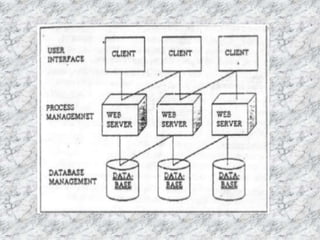
• The three-tier architecture emerged in the
1990s to overcome the limitations of the
two-tier architecture. In three-tier
architecture, the user interface and the
business application logic, also known as
business rules and data storage and
access, are developed and maintained as
independent modules.
Advantage of client server
architecture
• Centralization.
• Proper management.
• Back up and recovery possible.
• Updating is easy.
• Accessibility.
• Security.
ADVANTAGE OF THREE – TIER
ARCHITECTURE
•Improved scalability.
•Enhanced re-usage.
•Improved data integrity.
•Enhanced security.
ADVANTAGE OF TWO – TIER
ARCHITECTURE
• Easy to maintain.
• Modification is bit easy.
• Communication is faster.
CONCULSION
• The size and complexity of E-
Commerce systems make the
architecture level of design and
specification of the overall
system a significant issue.
e-commerce architecture

e-commerce architecture

  • 1.
  • 2.
    CONTENT • Introduction. • TypesOf E-commerce Architectures. • Client Server Architectures. • Two Tier Architectures. • Three Tier Architectures. • Conclusion.
  • 3.
    INTRODUCTION • Every daymore and more business transactions are conducted in the Internet under the umbrella of Ecommerce. The main feature that distinguishes E-Commerce from traditional commerce is the ability to conduct business with spatially distributed partners and products, and achieves considerable reduction in human effort and latency time.
  • 4.
    TYPES OF E-COMMERCE ARCHITECTURE •CLIENT-SERVER ARCHITECTURE. • TWO – TIER ARCHITECTURE. • THREE – TIER ARCHITECTURE. • N – TIER ARCHITECTURE.
  • 5.
    CLIENT-SERVER ARCHITECTURE • Theclient–server architecture is a computing model that acts as a distributed application which partitions tasks or workloads between the providers of a resource or service, called servers, and service requesters, called clients
  • 6.
  • 7.
    TWO – TIERARCHITECTURE • In two-tier client-server architecture the user interface runs on the client and the database is stored on the server. The business application logic can either run on the client or the server.
  • 9.
    THREE – TIERARCHITECTURE • The three-tier architecture emerged in the 1990s to overcome the limitations of the two-tier architecture. In three-tier architecture, the user interface and the business application logic, also known as business rules and data storage and access, are developed and maintained as independent modules.
  • 11.
    Advantage of clientserver architecture • Centralization. • Proper management. • Back up and recovery possible. • Updating is easy. • Accessibility. • Security.
  • 12.
    ADVANTAGE OF THREE– TIER ARCHITECTURE •Improved scalability. •Enhanced re-usage. •Improved data integrity. •Enhanced security.
  • 13.
    ADVANTAGE OF TWO– TIER ARCHITECTURE • Easy to maintain. • Modification is bit easy. • Communication is faster.
  • 14.
    CONCULSION • The sizeand complexity of E- Commerce systems make the architecture level of design and specification of the overall system a significant issue.