Presentation on Topic
e-governance
Group no:-- 9
Date- 19th May 2020
Techno Main, Salt Lake, Kolkata
Group Members
Student name University RollNo
 1. Ashish Kumar Sharma 13000217106
 2. Ankit Kashyap 13000217113
 3. Krishnesh Krishna 13000217086
 4.Manish Kumar Jha 13000217081
Table of content
 1 What is e-governance?
 2 History of e-governance
 3 Pillars of the e-governance
 4. phases of e-governance
 5. Sector of e-governance
 6.Benefits of e-governance
 7.Limitations of e-governance
 8. Challenges of e-governance
What is e-governance?
 The “e” in the word e-governance stands for ‘electronic’.
 It acts as a mediator between government and citizens.
 It is the use of the range of modern information and technologies to
processes of government functioning to bring about
 Smart
 Moral
 Responsible
 Transparent Governance
History of e-governance
 It can be traced back to year 1970 in india.
 Government established the Department of Electronics.
 National Informatics Centre(NIC).
 In 1987 NICNET(the national satellite based computer
network) was launched.
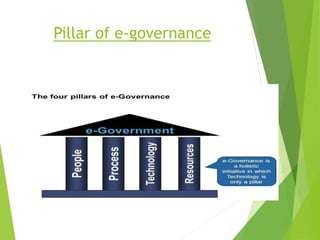
Pillar of e-governance
Phases of e-governance
 Gartner, an international consultancy firm, has
formulated four-phase e-governance model
 The design and purpose of each step would have to
serve the relevant needs of all G2C,G2B,G2E and G2G
sectors
 Phase l- Presence
 Phase ll- Interaction
 Phase lll- Transaction
 Phase lV- Transformation
Phases of E-governance
continue…..
Part I – Presence
Making the intentions and objectives of govt. known, development of government,
websites.
Part 2-Interaction
It allows basic interaction with govt, host engine for easy navigation and provide the
basic services like land record, online jobs etc
Part 3-Transaction
It provides complete online services for public, businessman and govt. agencies
Part 4- Transformation
•Final phase to achieve version of e-governance
•Provides a integrated platform for govt. services transparent to public
Different sector of e-governance
These are the different sectors of e—governance:-
1. G2C (Government to citizen)
2. G2B (Government to Business)
3. G2E (Government to employee)
4. G2G (Government to Government)
GOVERNMENT 2 CITIZEN
 G2C is transaction between government and citizens.
It includes:-
 citizens services such as online registration of birth/death/marriage
certificates.
 Health Care, education service etc.
 Filing of income taxes.
National Portal of India
India.gov.in
GOVERNMENT 2 BUSINESS
 G2B is a transaction between government and Business.
It includes:-
 Dissemination of policies, memos etc.
 Government rules and regulations.
 Business information
 Application forms, renewing licenses, registration, payment of taxes.
Example:-
eProcurement project in Andhra Pradesh
Business portal of India
Business.gov.in
GOVERNMENT 2 EMPLOYEE
G2E is a transaction between government and Employee.
It includes:-
 Online Conference for employee
 Online Training
 Employee information
Ex:- e-training for Employees
Government 2 Government
G2E is transaction between the central/national and local
governments, and between government department and agencies
and organization
It includes:-
 Record by state Government
 Schemes, plan, initiatives
Example: Khajane Project in Karnataka
SmartGov(Andhra Pradesh)
Benefit of e-governance
 Better access to information and quality service for
citizens.
 Simplicity, efficiency and accounting in the government.
 Expanded reach of governance
 Building strong and effective information chain.
 To bridge the gap between India and developed countries
 Effective utilization of resources.
 Reduction in delays, Red tape and corruption.
LIMITATIONS of e-governance
 Budget
 Poor IT literacy
 Lack of electricity in Rural areas
 Corruption
 Privacy problems
CHALLENGES FACED
Clarity about objective
Provided services
Misconnection about information transparency
Localization
Security Threats & legal issue
Maximum use of Infrastructure
Standardization
E governance presentation

E governance presentation

  • 1.
    Presentation on Topic e-governance Groupno:-- 9 Date- 19th May 2020 Techno Main, Salt Lake, Kolkata
  • 2.
    Group Members Student nameUniversity RollNo  1. Ashish Kumar Sharma 13000217106  2. Ankit Kashyap 13000217113  3. Krishnesh Krishna 13000217086  4.Manish Kumar Jha 13000217081
  • 3.
    Table of content 1 What is e-governance?  2 History of e-governance  3 Pillars of the e-governance  4. phases of e-governance  5. Sector of e-governance  6.Benefits of e-governance  7.Limitations of e-governance  8. Challenges of e-governance
  • 4.
    What is e-governance? The “e” in the word e-governance stands for ‘electronic’.  It acts as a mediator between government and citizens.  It is the use of the range of modern information and technologies to processes of government functioning to bring about  Smart  Moral  Responsible  Transparent Governance
  • 5.
    History of e-governance It can be traced back to year 1970 in india.  Government established the Department of Electronics.  National Informatics Centre(NIC).  In 1987 NICNET(the national satellite based computer network) was launched.
  • 6.
  • 7.
    Phases of e-governance Gartner, an international consultancy firm, has formulated four-phase e-governance model  The design and purpose of each step would have to serve the relevant needs of all G2C,G2B,G2E and G2G sectors  Phase l- Presence  Phase ll- Interaction  Phase lll- Transaction  Phase lV- Transformation
  • 8.
    Phases of E-governance continue….. PartI – Presence Making the intentions and objectives of govt. known, development of government, websites. Part 2-Interaction It allows basic interaction with govt, host engine for easy navigation and provide the basic services like land record, online jobs etc Part 3-Transaction It provides complete online services for public, businessman and govt. agencies Part 4- Transformation •Final phase to achieve version of e-governance •Provides a integrated platform for govt. services transparent to public
  • 9.
    Different sector ofe-governance These are the different sectors of e—governance:- 1. G2C (Government to citizen) 2. G2B (Government to Business) 3. G2E (Government to employee) 4. G2G (Government to Government)
  • 10.
    GOVERNMENT 2 CITIZEN G2C is transaction between government and citizens. It includes:-  citizens services such as online registration of birth/death/marriage certificates.  Health Care, education service etc.  Filing of income taxes. National Portal of India India.gov.in
  • 11.
    GOVERNMENT 2 BUSINESS G2B is a transaction between government and Business. It includes:-  Dissemination of policies, memos etc.  Government rules and regulations.  Business information  Application forms, renewing licenses, registration, payment of taxes. Example:- eProcurement project in Andhra Pradesh Business portal of India Business.gov.in
  • 12.
    GOVERNMENT 2 EMPLOYEE G2Eis a transaction between government and Employee. It includes:-  Online Conference for employee  Online Training  Employee information Ex:- e-training for Employees
  • 13.
    Government 2 Government G2Eis transaction between the central/national and local governments, and between government department and agencies and organization It includes:-  Record by state Government  Schemes, plan, initiatives Example: Khajane Project in Karnataka SmartGov(Andhra Pradesh)
  • 14.
    Benefit of e-governance Better access to information and quality service for citizens.  Simplicity, efficiency and accounting in the government.  Expanded reach of governance  Building strong and effective information chain.  To bridge the gap between India and developed countries  Effective utilization of resources.  Reduction in delays, Red tape and corruption.
  • 15.
    LIMITATIONS of e-governance Budget  Poor IT literacy  Lack of electricity in Rural areas  Corruption  Privacy problems
  • 16.
    CHALLENGES FACED Clarity aboutobjective Provided services Misconnection about information transparency Localization Security Threats & legal issue Maximum use of Infrastructure Standardization